 Schönfeld Heimat Buch (Original Scans)

 at escort
Proven signs of the settlement of our home country go back well over
700 years. For centuries, our ancestors from Schönefeld worked hard in
mining, crafts and agriculture. Times of hardship and times of war
alternated with periods of prosperity and great achievements,
especially in ore mining and ore exploitation. The eventful history
could not discourage generations before us and shaped the character of
our homeland. Only the inhumane expulsion should draw a temporary line
under the development of our hometown.
With joyful anticipation, we welcomed the planning and the preparatory
work of our revered Willi Bauer for a Schönfelder Heimatbuch. To have
continued and completed his work is the great merit of our Brandl
Beb. Both of us are very grateful.
The present book was created with sacrifices of leisure time as well
as financially and in addition to the duties that work and family
bring with it. Based on the information and evidence collected with
diligence and perseverance by Willi Bauer, a systematically built
folkloristic work emerged , Brandl Beb has analyzed sources and
verified historical statements in time-consuming work. Thus, a work
was designed that does not just want to be a souvenir of the
generation that has experienced the homeland. The book is also
intended to be a bridge for the next generation. It also wants to be
information and contribution to the settlement history of Cheb.
Document and call - both are the order of this home book. We, the
citizens of the once royal free mountain town of Schönfeld, are now
located in many places. Here we have integrated ourselves with head
and hand. But our heart and our loyalty are first and foremost our
common old hometown.
At home we are in our Schönfeld
"Schönfelder Heimat- und Geschichtsverein e.V."
Dr. Hans Sehling Kurt Filsner
at escort
Proven signs of the settlement of our home country go back well over
700 years. For centuries, our ancestors from Schönefeld worked hard in
mining, crafts and agriculture. Times of hardship and times of war
alternated with periods of prosperity and great achievements,
especially in ore mining and ore exploitation. The eventful history
could not discourage generations before us and shaped the character of
our homeland. Only the inhumane expulsion should draw a temporary line
under the development of our hometown.
With joyful anticipation, we welcomed the planning and the preparatory
work of our revered Willi Bauer for a Schönfelder Heimatbuch. To have
continued and completed his work is the great merit of our Brandl
Beb. Both of us are very grateful.
The present book was created with sacrifices of leisure time as well
as financially and in addition to the duties that work and family
bring with it. Based on the information and evidence collected with
diligence and perseverance by Willi Bauer, a systematically built
folkloristic work emerged , Brandl Beb has analyzed sources and
verified historical statements in time-consuming work. Thus, a work
was designed that does not just want to be a souvenir of the
generation that has experienced the homeland. The book is also
intended to be a bridge for the next generation. It also wants to be
information and contribution to the settlement history of Cheb.
Document and call - both are the order of this home book. We, the
citizens of the once royal free mountain town of Schönfeld, are now
located in many places. Here we have integrated ourselves with head
and hand. But our heart and our loyalty are first and foremost our
common old hometown.
At home we are in our Schönfeld
"Schönfelder Heimat- und Geschichtsverein e.V."
Dr. Hans Sehling Kurt Filsner
 Foreword by the author
Exactly 50 years ago Pastor Enzmann wrote a chronicle about our
Schönfeld, which appeared in 1934. It was a first documentary about
the history of our hometown, of which only a few copies exist.
Now, as it were for the anniversary, there is a book which
comprehensively reports on Schönfeld in words and pictures and also
includes the essentials from this chronicle.
This history book has a long history - its creation was laborious and
financing was uncertain for a long time; the latter put a strain on
the work and constantly contained the danger of discouragement and
abandonment. When Willi Bauer, who tackled this book project on his
own and to whom we are all indebted for his unselfish efforts in this
matter, was compelled to abandon his project for health reasons, I
followed Bauer's request and took over the further processing ,
d. H. the text version and overall design. As a member of the year
1929, who had to leave his homeland at the age of 16, I was aware that
among our countrymen - especially among the older age groups - there
were far more professionals for this task than me.
However, homeworking work will always be limited, limiting knowledge
and memory, and also financial in scope. This should be considered and
taken into account by any critical reader.
The topics of politics and party were deliberately excluded. Also, the
time after the expulsion was only addressed in very few exceptional
cases.
Looking back on my work, I would like to thank our compatriot Willi
Bauer, for whose recordings this informative Heimatwerk was created,
very much for his previous work. But it is also to be given thanks to
those men who have already done so
Foreword by the author
Exactly 50 years ago Pastor Enzmann wrote a chronicle about our
Schönfeld, which appeared in 1934. It was a first documentary about
the history of our hometown, of which only a few copies exist.
Now, as it were for the anniversary, there is a book which
comprehensively reports on Schönfeld in words and pictures and also
includes the essentials from this chronicle.
This history book has a long history - its creation was laborious and
financing was uncertain for a long time; the latter put a strain on
the work and constantly contained the danger of discouragement and
abandonment. When Willi Bauer, who tackled this book project on his
own and to whom we are all indebted for his unselfish efforts in this
matter, was compelled to abandon his project for health reasons, I
followed Bauer's request and took over the further processing ,
d. H. the text version and overall design. As a member of the year
1929, who had to leave his homeland at the age of 16, I was aware that
among our countrymen - especially among the older age groups - there
were far more professionals for this task than me.
However, homeworking work will always be limited, limiting knowledge
and memory, and also financial in scope. This should be considered and
taken into account by any critical reader.
The topics of politics and party were deliberately excluded. Also, the
time after the expulsion was only addressed in very few exceptional
cases.
Looking back on my work, I would like to thank our compatriot Willi
Bauer, for whose recordings this informative Heimatwerk was created,
very much for his previous work. But it is also to be given thanks to
those men who have already done so
Page 0011
 home letters. Subject-oriented, he wrote down the
results of his chrono- logical investigations, supplementing them with
his own memory, whereby his former town hall activities were a not
inconsiderable support for him.
That this work included a lively correspondence and many phone calls,
which required considerable financial expenditure even for the
peasants was only marginally noted. 13
home letters. Subject-oriented, he wrote down the
results of his chrono- logical investigations, supplementing them with
his own memory, whereby his former town hall activities were a not
inconsiderable support for him.
That this work included a lively correspondence and many phone calls,
which required considerable financial expenditure even for the
peasants was only marginally noted. 13
Page 0012
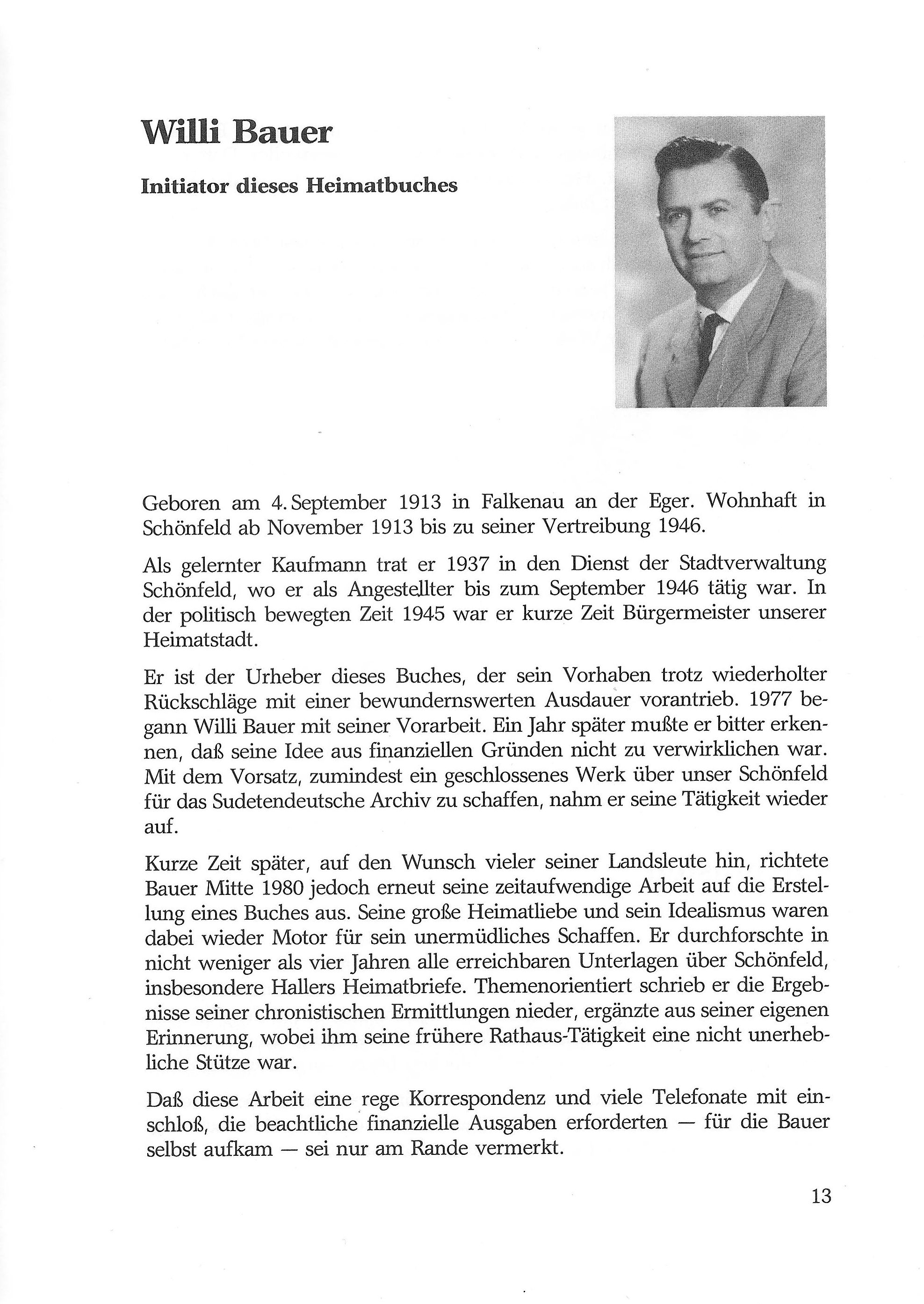
Page 0013
 At the end of 1981, he was forced to give up his health. By then he
had created nearly 600 typewritten pages with valuable data and
records. In addition, there were numerous photos, which he got sent by
compatriots.
With a heavy heart, he parted from his self-imposed task, for which he
was so persistent and unwaveringly active for years. Even if the final
version of his work has failed him, he still provided for a succession
and a seamless transition to the continuation and completion of his
project, even under severe health conditions.
chroniclers
The first pages of this book "Schönfeld" are to be dedicated to those
men who, in the past years and decades, laboriously and selflessly
arranged in painstaking time and effort to ensure that this work
presents this wealth of historical data.
Only unspeakable diligence and idealism, and above all a great love
for the homeland, could accomplish such work. An appreciation of their
achievement, and at the same time a thank you, should be this book.
14
At the end of 1981, he was forced to give up his health. By then he
had created nearly 600 typewritten pages with valuable data and
records. In addition, there were numerous photos, which he got sent by
compatriots.
With a heavy heart, he parted from his self-imposed task, for which he
was so persistent and unwaveringly active for years. Even if the final
version of his work has failed him, he still provided for a succession
and a seamless transition to the continuation and completion of his
project, even under severe health conditions.
chroniclers
The first pages of this book "Schönfeld" are to be dedicated to those
men who, in the past years and decades, laboriously and selflessly
arranged in painstaking time and effort to ensure that this work
presents this wealth of historical data.
Only unspeakable diligence and idealism, and above all a great love
for the homeland, could accomplish such work. An appreciation of their
achievement, and at the same time a thank you, should be this book.
14
Page 0014
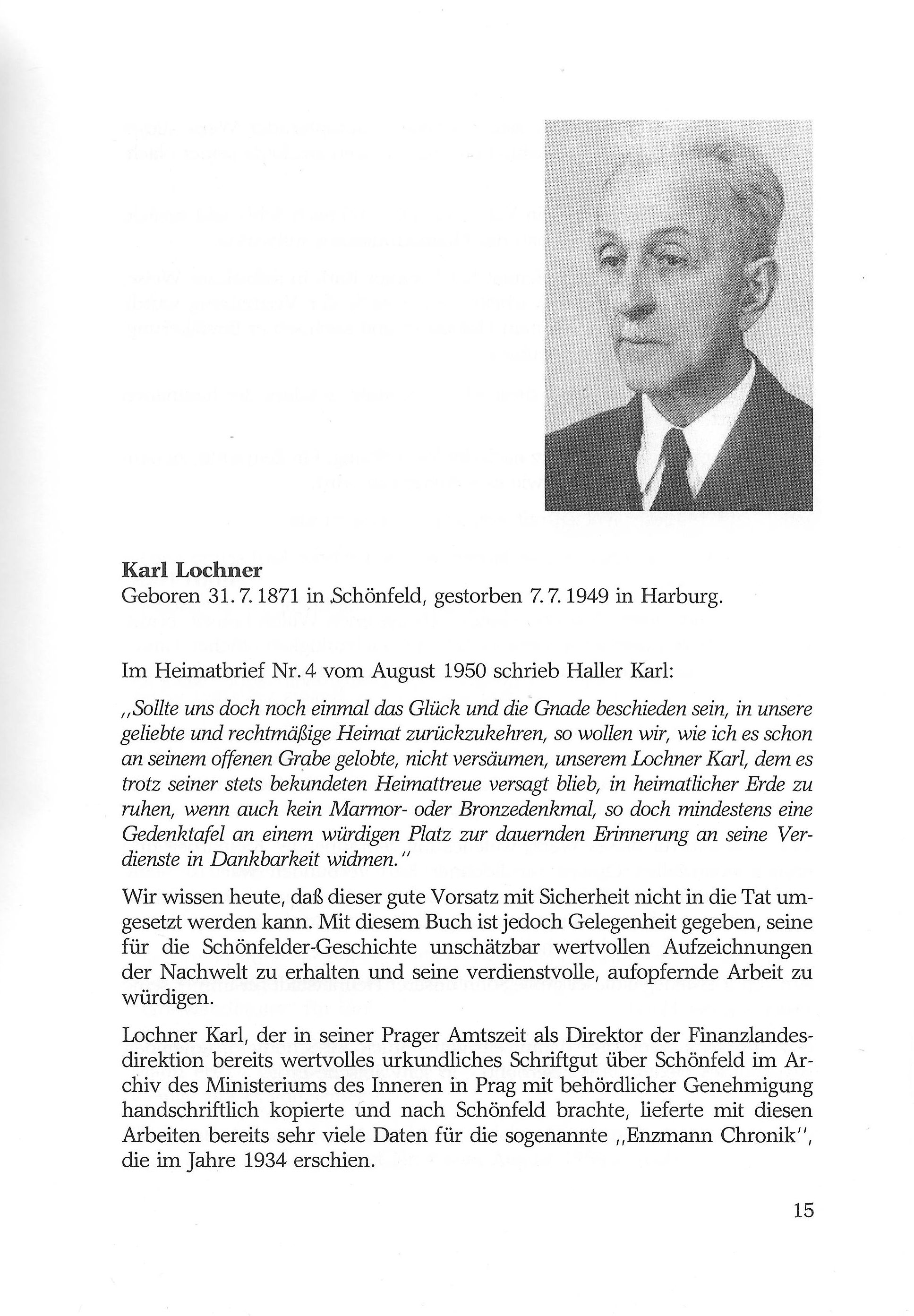 Karl Lochner
Born 31.7. 1871 in Schönfeld, died 7.7. 1949 in Harburg.
In the Heimatbrief No. 4 of August 1950 Haller Karl wrote:
"If we have the fortune and the grace to return to our beloved and
rightful homeland, we will not, as I have already vowed in his open
tomb, want to do, to our Lochner Karl, who, despite his ever-evidenced
homeland failed to rest in native soil, though not a marble or bronze
monument, but at least a plaque in a dignified place dedicated to the
constant remembrance of his merits in gratitude. "
We know today that this good intent can certainly not be put into
action. With this book, however, there is an opportunity to preserve
his valuable for Schönfelder history records of posterity and to honor
his meritorious, self-sacrificing work.
Lochner Karl, who in his Prague term of office as director of the
Financial Directorate already copied valuable written documents about
Schönfeld in the archives of the Ministry of the Interior in Prague
with official approval and brought them to Schönfeld, provided already
with this work a lot of data for the so-called "Enzmann Chronicle",
which appeared in 1934.
15
Karl Lochner
Born 31.7. 1871 in Schönfeld, died 7.7. 1949 in Harburg.
In the Heimatbrief No. 4 of August 1950 Haller Karl wrote:
"If we have the fortune and the grace to return to our beloved and
rightful homeland, we will not, as I have already vowed in his open
tomb, want to do, to our Lochner Karl, who, despite his ever-evidenced
homeland failed to rest in native soil, though not a marble or bronze
monument, but at least a plaque in a dignified place dedicated to the
constant remembrance of his merits in gratitude. "
We know today that this good intent can certainly not be put into
action. With this book, however, there is an opportunity to preserve
his valuable for Schönfelder history records of posterity and to honor
his meritorious, self-sacrificing work.
Lochner Karl, who in his Prague term of office as director of the
Financial Directorate already copied valuable written documents about
Schönfeld in the archives of the Ministry of the Interior in Prague
with official approval and brought them to Schönfeld, provided already
with this work a lot of data for the so-called "Enzmann Chronicle",
which appeared in 1934.
15
Page 0015
 Still retired, Lochner dedicated himself to this activity in a
sacrificial way. Over 2000 handwritten pages were available at the end
of his research.
In 1938 he returned to his father's house (No. 317) in Schönfeld,
where he immediately took an active part in the construction of the
Heimatmuseum.
But not only in the old home did Lochner Karl, in a selfless way, work
for a good home affair; even after the expulsion, his unique love for
his hometown and also for his people, this time in a different way,
became clear.
Not the past this time was his commitment, but the close-up present.
Think back, 1947, shortly after the expulsion. A time when none of us
knew how to proceed.
Everyone had enough to do with themselves during this time of need.
This year, at the age of 76, Lochner Karl was again "home" active.
Inspired by tireless diligence and an indomitable will, he determined
- despite some incomprehensible indifference of several country people
- the new addresses of the Schönfelder, which were scattered after the
expulsion from their homeland over the whole of Germany and beyond.
In September 1948 his address directory appeared, in which nearly 1000
addresses of former Schonfelder were listed. This directory was also
the first of our Schoenfelder Heimatbriefe, the most important link
for all of us abroad.
The effort for this work, which was associated with time-consuming
small work and large financial sacrifices for Lochner Karl, is today
hardly estimable by us. Who knows, or can imagine, that Lochner wrote
and sent 1,800 letters and 700 cards in this connection!
On July 7, 1949, this great son of our hometown forever put his pen
out of his hands.
Two days later, a good deal of Alt-Schönfeld sank with him, under the
sounds of the song, 's ist Feierobnd', into Swabian soil. 16
Still retired, Lochner dedicated himself to this activity in a
sacrificial way. Over 2000 handwritten pages were available at the end
of his research.
In 1938 he returned to his father's house (No. 317) in Schönfeld,
where he immediately took an active part in the construction of the
Heimatmuseum.
But not only in the old home did Lochner Karl, in a selfless way, work
for a good home affair; even after the expulsion, his unique love for
his hometown and also for his people, this time in a different way,
became clear.
Not the past this time was his commitment, but the close-up present.
Think back, 1947, shortly after the expulsion. A time when none of us
knew how to proceed.
Everyone had enough to do with themselves during this time of need.
This year, at the age of 76, Lochner Karl was again "home" active.
Inspired by tireless diligence and an indomitable will, he determined
- despite some incomprehensible indifference of several country people
- the new addresses of the Schönfelder, which were scattered after the
expulsion from their homeland over the whole of Germany and beyond.
In September 1948 his address directory appeared, in which nearly 1000
addresses of former Schonfelder were listed. This directory was also
the first of our Schoenfelder Heimatbriefe, the most important link
for all of us abroad.
The effort for this work, which was associated with time-consuming
small work and large financial sacrifices for Lochner Karl, is today
hardly estimable by us. Who knows, or can imagine, that Lochner wrote
and sent 1,800 letters and 700 cards in this connection!
On July 7, 1949, this great son of our hometown forever put his pen
out of his hands.
Two days later, a good deal of Alt-Schönfeld sank with him, under the
sounds of the song, 's ist Feierobnd', into Swabian soil. 16
Page 0016
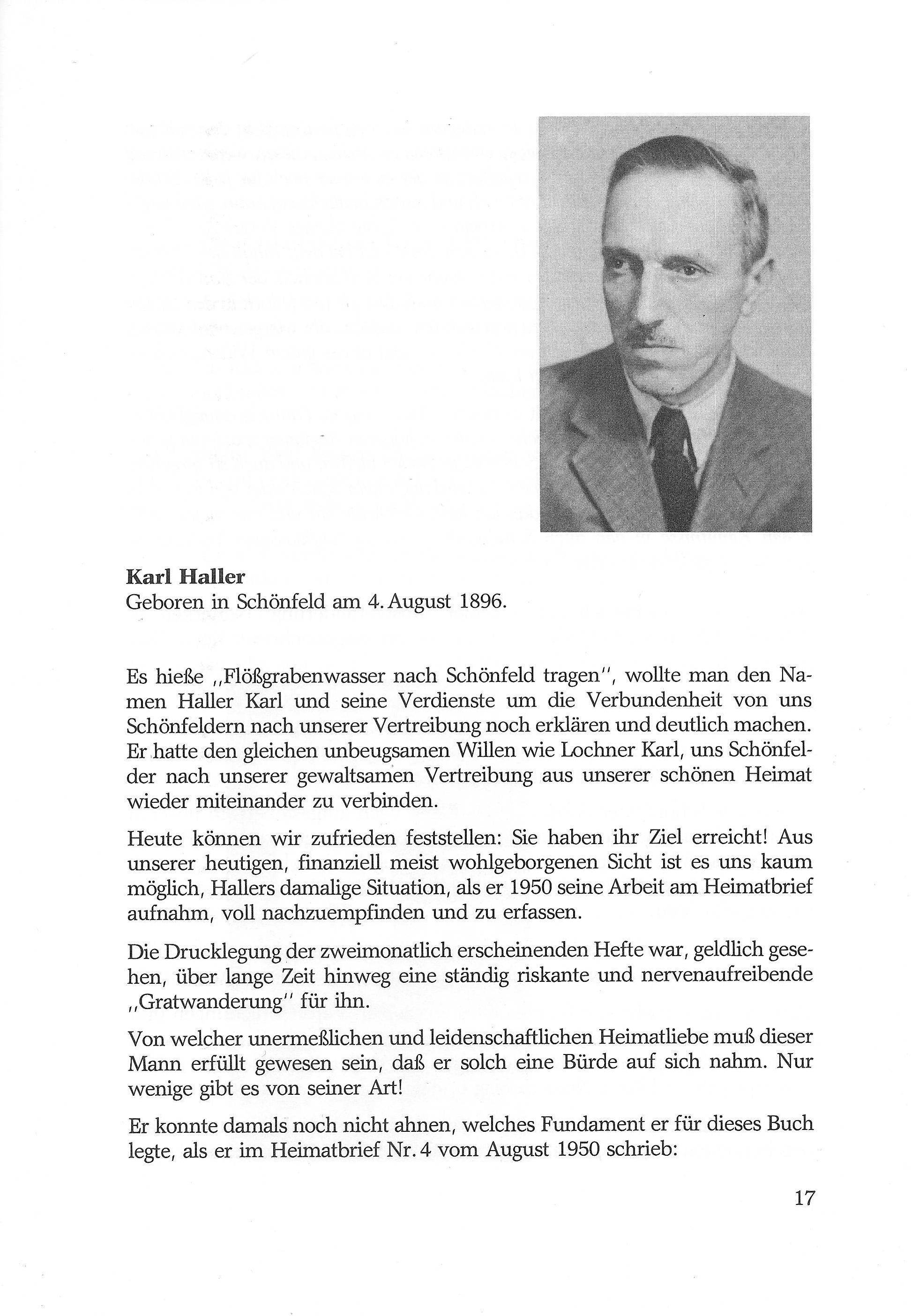 , financially most well-secured viewpoint, it is hardly
possible for us to fully comprehend and grasp Haller's situation when
he took up his homeland letter in 1950.
For a long time, printing the bi-monthly issues was a risky and
nerve-wracking "tightrope walk" for him in the long term
From what immense and passionate love of the homeland this man must
have been fulfilled, that he took upon himself such a burden. Only a
few exist of their kind!
At that time he still could not guess what foundation he laid for this
book when he wrote in his home letter no. 4 of August 1950:
17
, financially most well-secured viewpoint, it is hardly
possible for us to fully comprehend and grasp Haller's situation when
he took up his homeland letter in 1950.
For a long time, printing the bi-monthly issues was a risky and
nerve-wracking "tightrope walk" for him in the long term
From what immense and passionate love of the homeland this man must
have been fulfilled, that he took upon himself such a burden. Only a
few exist of their kind!
At that time he still could not guess what foundation he laid for this
book when he wrote in his home letter no. 4 of August 1950:
17
Page 0017
 hobby-horse, I will at least try to preserve it, even if with little
groats, in a way in which it is still possible for every beautiful
person in some May be useful and expedient. That it will not be
easiest for me to continue this work in the spirit of my predecessor,
will probably be understood by everyone, since the content of the
Heimatletter is now less about addresses, but more about substance
Much of myself must be conceived or formed. However, since we have all
had to get used to worse chunks in the last few years than we were
used to, I hope that one can get used to this change in price with
some indulgence and some good will. "
A few pages later, he remarks: "But my own imagination does not enable
me to walk like a writer in higher regions, but I must always stay on
Schönfelder Boden and speak as we have spoken at home. No Schönfelder
will ask me any more, since everyone knows that I am not a scholar and
that my meager knowledge of the old school desks of our five-grade
elementary school had to be crushed. "
As a writer, I would like to say only to his "cost change": In the ten
years of his work, he was an excellent cook! What he literary brought
to the table, "håout us ålln oårch gout gschmeckt"!
Outstanding from his many works, his "walk durch Schönfeld. "A cabinet
piece in which his enormous, almost incomprehensible memory took full
advantage.
He has us all Schonfeld in the row, in our approximately 450
houses. His comments on each person were unerring, and many a cheerful
and heartening event was woven into an original, one-of-a-kind
fellow-composer in a genuine Schönfelder version.
Unfortunately, due to its size, this report could not be included in
this book, and a short version would amount to destruction.
However, a lot of interesting information from his publications and
essays has flowed into this book as an informative enrichment. There
is hardly a chapter in which the work done by Haller Karl is not
reflected and finds its expression.
For ten years he has selflessly recorded valuable local history and
local events and saved them from being forgotten. 18
18
hobby-horse, I will at least try to preserve it, even if with little
groats, in a way in which it is still possible for every beautiful
person in some May be useful and expedient. That it will not be
easiest for me to continue this work in the spirit of my predecessor,
will probably be understood by everyone, since the content of the
Heimatletter is now less about addresses, but more about substance
Much of myself must be conceived or formed. However, since we have all
had to get used to worse chunks in the last few years than we were
used to, I hope that one can get used to this change in price with
some indulgence and some good will. "
A few pages later, he remarks: "But my own imagination does not enable
me to walk like a writer in higher regions, but I must always stay on
Schönfelder Boden and speak as we have spoken at home. No Schönfelder
will ask me any more, since everyone knows that I am not a scholar and
that my meager knowledge of the old school desks of our five-grade
elementary school had to be crushed. "
As a writer, I would like to say only to his "cost change": In the ten
years of his work, he was an excellent cook! What he literary brought
to the table, "håout us ålln oårch gout gschmeckt"!
Outstanding from his many works, his "walk durch Schönfeld. "A cabinet
piece in which his enormous, almost incomprehensible memory took full
advantage.
He has us all Schonfeld in the row, in our approximately 450
houses. His comments on each person were unerring, and many a cheerful
and heartening event was woven into an original, one-of-a-kind
fellow-composer in a genuine Schönfelder version.
Unfortunately, due to its size, this report could not be included in
this book, and a short version would amount to destruction.
However, a lot of interesting information from his publications and
essays has flowed into this book as an informative enrichment. There
is hardly a chapter in which the work done by Haller Karl is not
reflected and finds its expression.
For ten years he has selflessly recorded valuable local history and
local events and saved them from being forgotten. 18
18
Page 0018
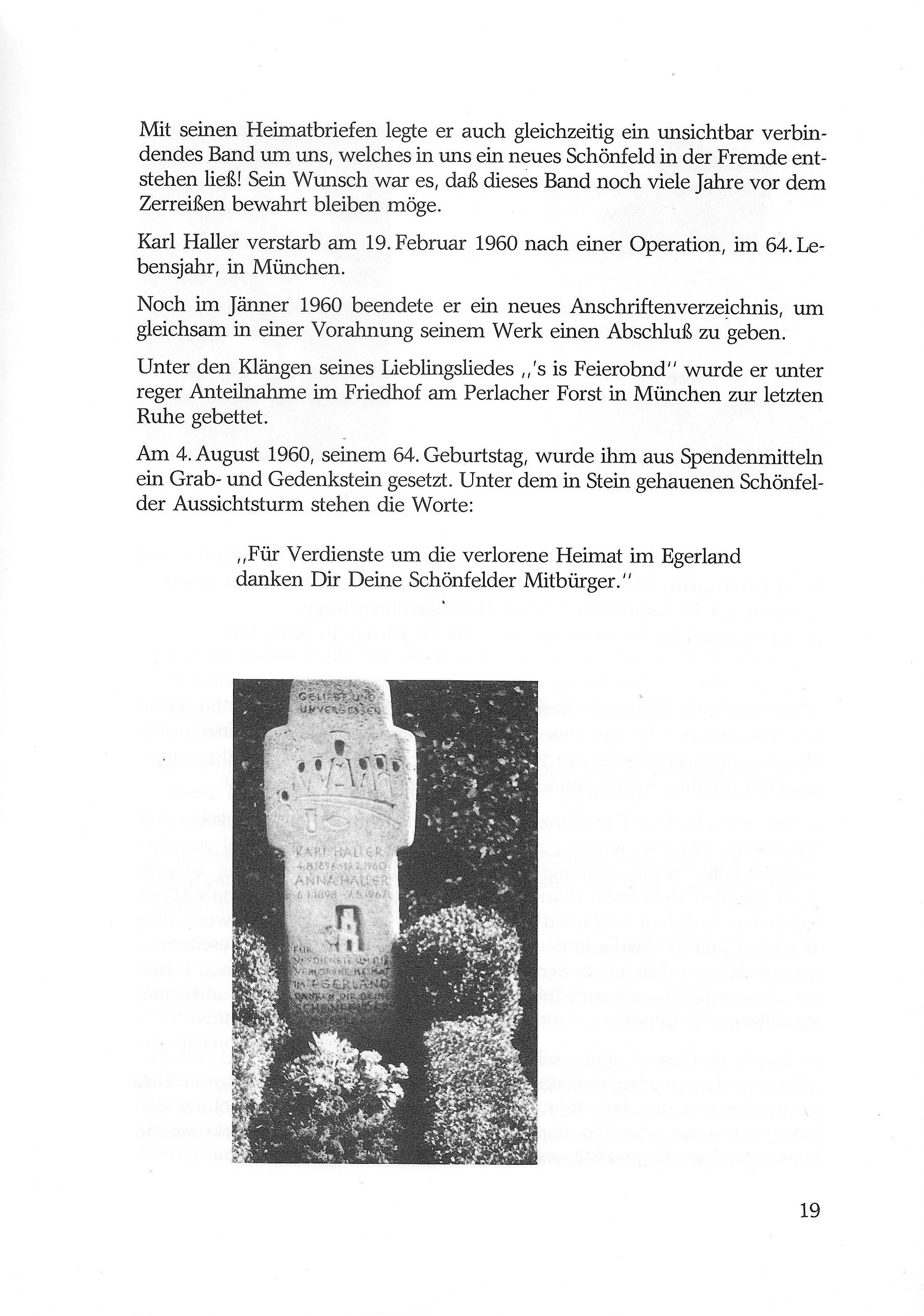 n the graveyard at the Perlacher Forst in Munich
On August 4, 1960, his 64th birthday, he was donated a grave and
memorial stone set. Below the stone carved Schönfelder lookout tower
are the words:
"For services to the lost homeland in the Egerland thank you, your
Schönfelder fellow citizens. "
19
n the graveyard at the Perlacher Forst in Munich
On August 4, 1960, his 64th birthday, he was donated a grave and
memorial stone set. Below the stone carved Schönfelder lookout tower
are the words:
"For services to the lost homeland in the Egerland thank you, your
Schönfelder fellow citizens. "
19
Page 0019
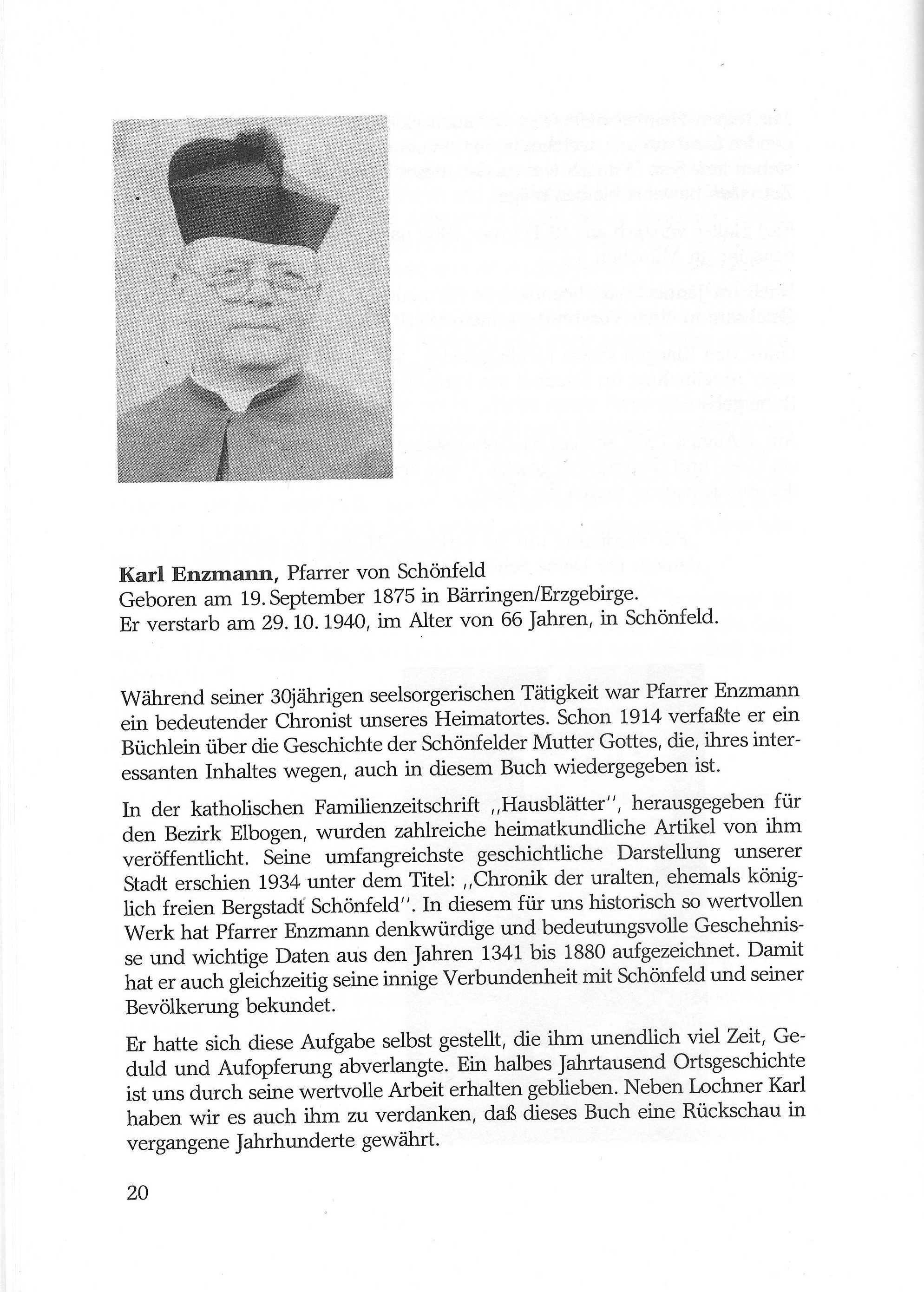 Karl Enzmann, pastor of Schönfeld Born on September 19, 1875 in
Bärringen / Erzgebirge. He died on 29. 10. 1940, at the age of 66,
in Schönfeld.
During his 30 years of pastoral activity Pastor Enzmann was an
important chronicler of our hometown. As early as 1914 he wrote a
booklet on the history of the Schoenfelder Mother of God, which, for
its interesting content, is also reproduced in this book.
In the Catholic family magazine "Hausblätter", published for the
district of Elbogen, numerous local history articles were published by
him.His most extensive historical representation of our city appeared
in 1934 under the title: "Chronicle of the ancient, formerly royal
free mountain town of Schönfeld". In this historically valuable work,
Pastor Enzmann recorded memorable and significant events and important
dates from the years 1341-1880. At the same time, he expressed his
deep attachment to Schönfeld and his people.
He had set himself this task, which required him infinite time,
patience and sacrifice. Half a millennium of local history has been
preserved through its valuable work. Besides Lochner Karl we owe it to
him that this book grants a retrospective into past centuries.
20
Karl Enzmann, pastor of Schönfeld Born on September 19, 1875 in
Bärringen / Erzgebirge. He died on 29. 10. 1940, at the age of 66,
in Schönfeld.
During his 30 years of pastoral activity Pastor Enzmann was an
important chronicler of our hometown. As early as 1914 he wrote a
booklet on the history of the Schoenfelder Mother of God, which, for
its interesting content, is also reproduced in this book.
In the Catholic family magazine "Hausblätter", published for the
district of Elbogen, numerous local history articles were published by
him.His most extensive historical representation of our city appeared
in 1934 under the title: "Chronicle of the ancient, formerly royal
free mountain town of Schönfeld". In this historically valuable work,
Pastor Enzmann recorded memorable and significant events and important
dates from the years 1341-1880. At the same time, he expressed his
deep attachment to Schönfeld and his people.
He had set himself this task, which required him infinite time,
patience and sacrifice. Half a millennium of local history has been
preserved through its valuable work. Besides Lochner Karl we owe it to
him that this book grants a retrospective into past centuries.
20
Page 0020
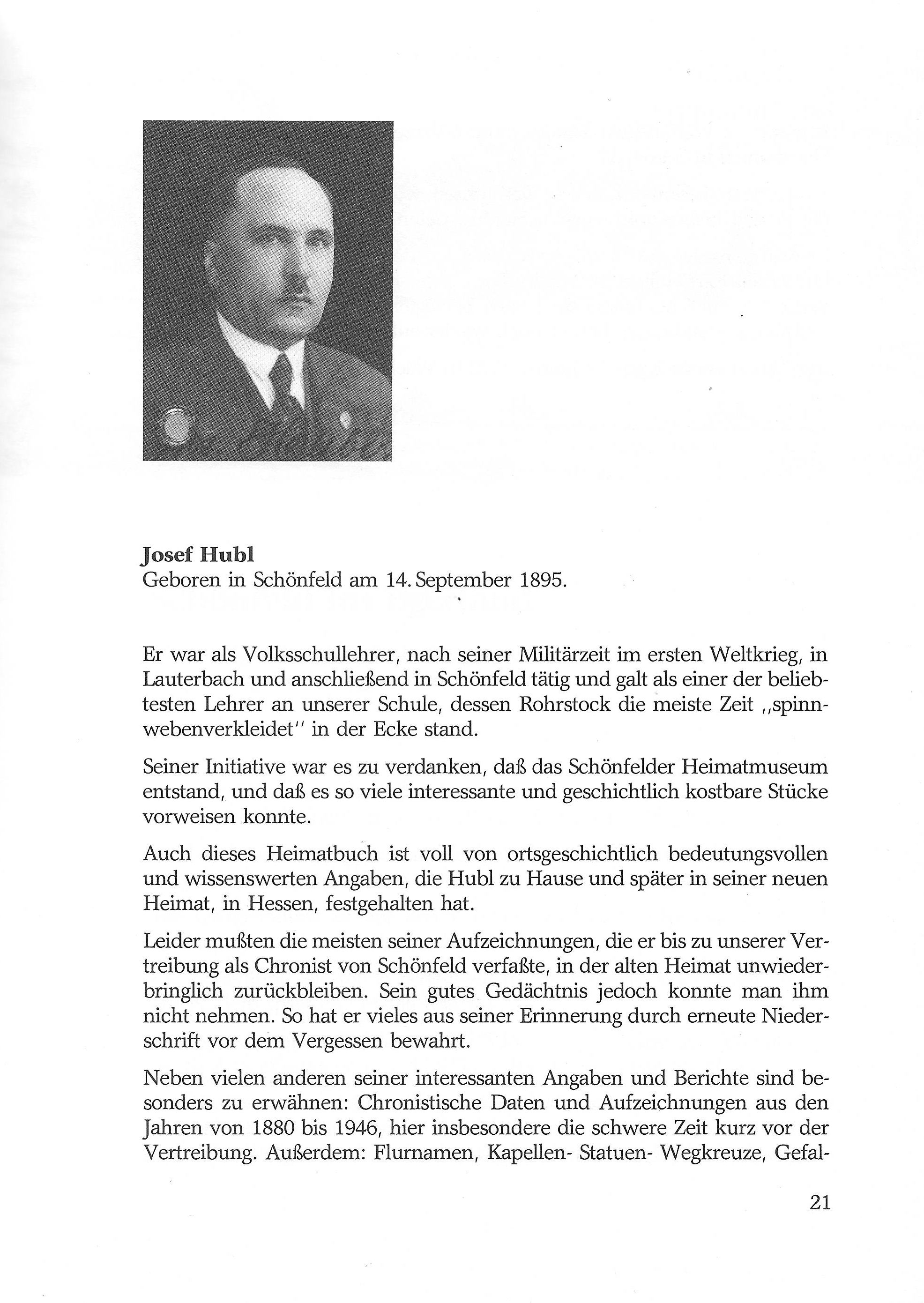 Josef Hubl
Born in Schönfeld on 14 September 1895.
He worked as an elementary school teacher, after his military service
in the First World War, in Lauterbach and then in Schönfeld and was
considered one of the most popular teachers at our school, whose cane
was "spangled in the corner most of the time.
It was thanks to his initiative that the Schönfelder Heimatmuseum
originated, and that it had so many interesting and historically
valuable pieces.
Also this book is full of locally significant and interesting
information that Hubl at home and later in his new home, held in
Hesse.
Unfortunately, most of his notes, which he wrote as a chronicler of
Schonfeld until our expulsion, had to remain irrevocably left behind
in his native country. His good memory, however, could not be taken
from him. Thus, he has saved much of his memory from forgetting by
rewriting it.
In addition to many other interesting facts and reports, special
mention should be made: Chronological dates and records from the years
1880 to 1946, especially the difficult time shortly before the
expulsion. In addition: field names, chapel- statues- way crosses,
fall-
21
Josef Hubl
Born in Schönfeld on 14 September 1895.
He worked as an elementary school teacher, after his military service
in the First World War, in Lauterbach and then in Schönfeld and was
considered one of the most popular teachers at our school, whose cane
was "spangled in the corner most of the time.
It was thanks to his initiative that the Schönfelder Heimatmuseum
originated, and that it had so many interesting and historically
valuable pieces.
Also this book is full of locally significant and interesting
information that Hubl at home and later in his new home, held in
Hesse.
Unfortunately, most of his notes, which he wrote as a chronicler of
Schonfeld until our expulsion, had to remain irrevocably left behind
in his native country. His good memory, however, could not be taken
from him. Thus, he has saved much of his memory from forgetting by
rewriting it.
In addition to many other interesting facts and reports, special
mention should be made: Chronological dates and records from the years
1880 to 1946, especially the difficult time shortly before the
expulsion. In addition: field names, chapel- statues- way crosses,
fall-
21
Page 0021
 022
en of the 2nd World War, house number directory and family and house
names in Schönfeld.
It would go too far in this context, if you wanted to enumerate all
his work, which can be found in the previously published home letters.
He was one of the very few Schönfelder who provided informative
support for Karl Haller's invaluable homework. We owe it to him that
especially the last turbulent years until our expulsion are revived so
clearly in this book.
Josef Hubl died on January 19, 1972 in Wächtersbach / Hesse.
22
022
en of the 2nd World War, house number directory and family and house
names in Schönfeld.
It would go too far in this context, if you wanted to enumerate all
his work, which can be found in the previously published home letters.
He was one of the very few Schönfelder who provided informative
support for Karl Haller's invaluable homework. We owe it to him that
especially the last turbulent years until our expulsion are revived so
clearly in this book.
Josef Hubl died on January 19, 1972 in Wächtersbach / Hesse.
22
Page 0022
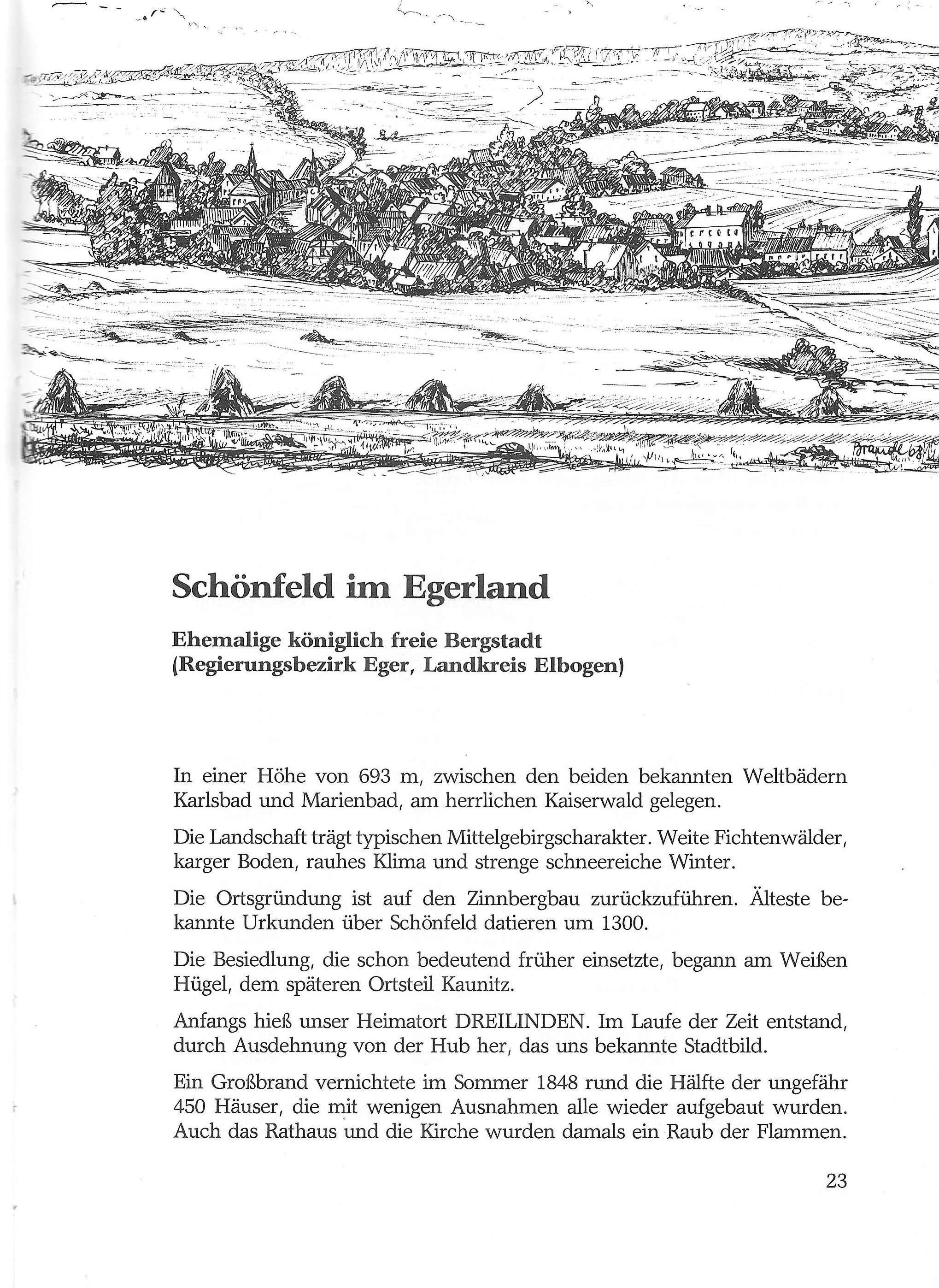 Schönfeld in the Egerland
Former royal free mining town
(Eger administrative district, Elbogen district)
Located at an altitude of 693 m, between the two famous spa towns of
Karlovy Vary and Mariánské Lázn?, in the magnificent
Kaiserwald forest.
The landscape has the typical character of a low mountain range: vast
spruce forests, barren soil, a harsh climate, and severe, snowy
winters.
The town's founding can be traced back to tin mining. The oldest known
documents about Schönfeld date back to around 1300.
Settlement, which began much earlier, began on the White Hill, later
the district of Kaunitz.
Our hometown was originally called Dreilinden. Over time, the
townscape we know today emerged through expansion from the Hub.
A major fire in the summer of 1848 destroyed about half of the
approximately 450 houses, all of which, with a few exceptions, were
rebuilt. The town hall and the church were also destroyed by the
flames.
023
Schönfeld in the Egerland
Former royal free mining town
(Eger administrative district, Elbogen district)
Located at an altitude of 693 m, between the two famous spa towns of
Karlovy Vary and Mariánské Lázn?, in the magnificent
Kaiserwald forest.
The landscape has the typical character of a low mountain range: vast
spruce forests, barren soil, a harsh climate, and severe, snowy
winters.
The town's founding can be traced back to tin mining. The oldest known
documents about Schönfeld date back to around 1300.
Settlement, which began much earlier, began on the White Hill, later
the district of Kaunitz.
Our hometown was originally called Dreilinden. Over time, the
townscape we know today emerged through expansion from the Hub.
A major fire in the summer of 1848 destroyed about half of the
approximately 450 houses, all of which, with a few exceptions, were
rebuilt. The town hall and the church were also destroyed by the
flames.
23
Schönfeld in the Egerland
Former royal free mining town
(Eger administrative district, Elbogen district)
Located at an altitude of 693 m, between the two famous spa towns of
Karlovy Vary and Mariánské Lázn?, in the magnificent
Kaiserwald forest.
The landscape has the typical character of a low mountain range: vast
spruce forests, barren soil, a harsh climate, and severe, snowy
winters.
The town's founding can be traced back to tin mining. The oldest known
documents about Schönfeld date back to around 1300.
Settlement, which began much earlier, began on the White Hill, later
the district of Kaunitz.
Our hometown was originally called Dreilinden. Over time, the
townscape we know today emerged through expansion from the Hub.
A major fire in the summer of 1848 destroyed about half of the
approximately 450 houses, all of which, with a few exceptions, were
rebuilt. The town hall and the church were also destroyed by the
flames.
023
Schönfeld in the Egerland
Former royal free mining town
(Eger administrative district, Elbogen district)
Located at an altitude of 693 m, between the two famous spa towns of
Karlovy Vary and Mariánské Lázn?, in the magnificent
Kaiserwald forest.
The landscape has the typical character of a low mountain range: vast
spruce forests, barren soil, a harsh climate, and severe, snowy
winters.
The town's founding can be traced back to tin mining. The oldest known
documents about Schönfeld date back to around 1300.
Settlement, which began much earlier, began on the White Hill, later
the district of Kaunitz.
Our hometown was originally called Dreilinden. Over time, the
townscape we know today emerged through expansion from the Hub.
A major fire in the summer of 1848 destroyed about half of the
approximately 450 houses, all of which, with a few exceptions, were
rebuilt. The town hall and the church were also destroyed by the
flames.
23
Page 0023
 024
Um die Jahrhundertwende hatte Schönfeld knapp über 3000
Einwohner. Bis 1946 sank diese Zahl auf etwa 1600.
Beständigste Erwerbsquellen, neben dem nicht immer in Betrieb
befindlichen Bergbau, waren Handwerk, Kleinlandwirtschaft und etwas
Klein- industrie.
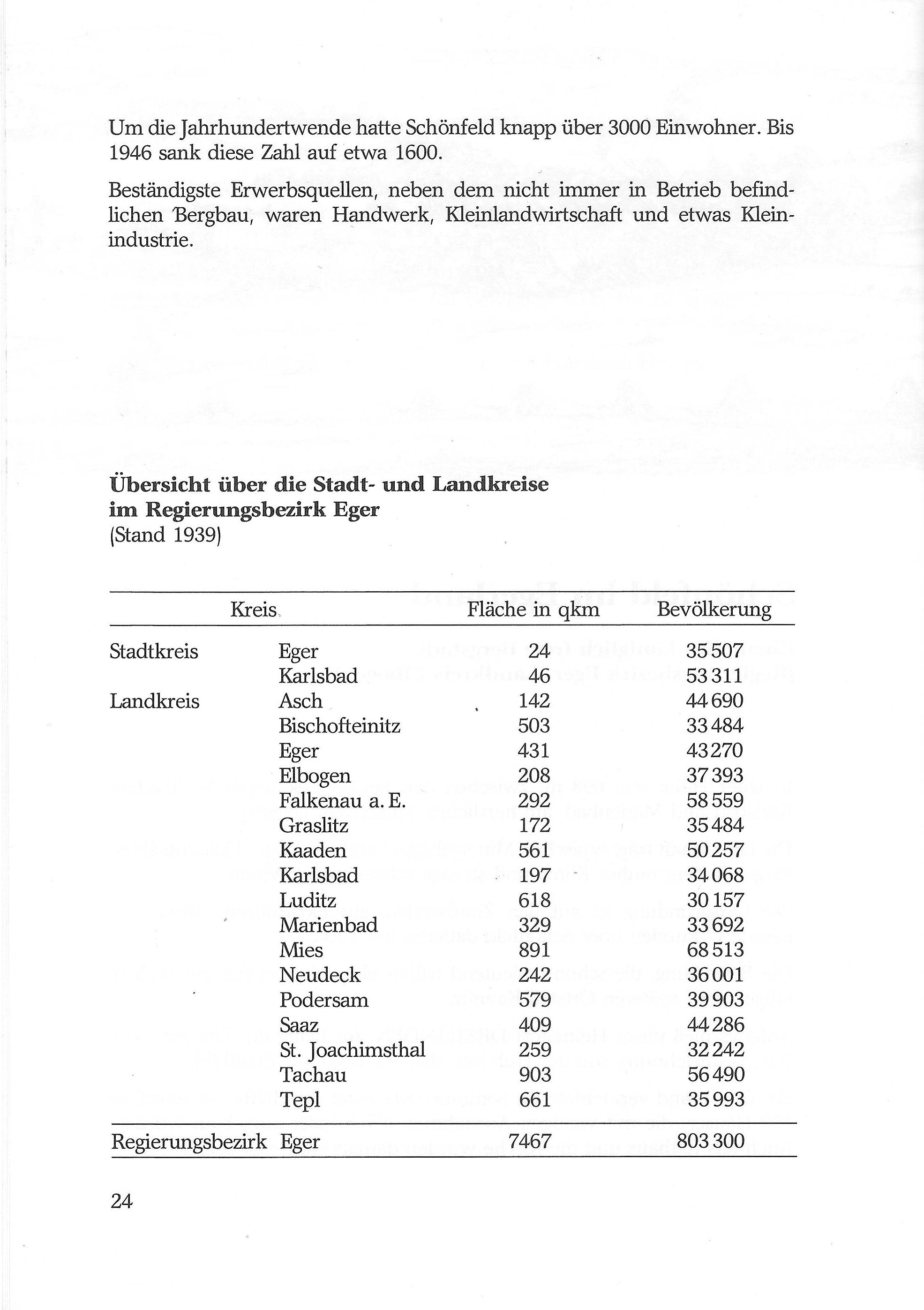
Übersicht über die Stdtß und Landkreise
im Regierungsbeyirk Eger
(Stand 1939)
Kreis Flache in qkm Bevölkerung
Stadtkreis Eger 24 35 507
Karlsbad 46 53 311
Landkreis Asch 142 44 609
Bischofteinitz 503 33 484
Eger 431 43 270
Elbogen 208 37 393
Falkenau a. E. 292 58 559
Graslitz 172 35 484
Kaaden 561 50 257
Karlsbad 197 34 068
Luditz 618 30 157
Marienbad 329 33 692
Mies 891 68 513
Neudeck 242 36 001
Podersam 579 39 903
Saaz 409 44 286
St. Joachimsthal 259 32 242
Tachau 903 56 490
Tepl 661 35 993
Regierungsbezirk Eger 7467 803 300
24
024
Um die Jahrhundertwende hatte Schönfeld knapp über 3000
Einwohner. Bis 1946 sank diese Zahl auf etwa 1600.
Beständigste Erwerbsquellen, neben dem nicht immer in Betrieb
befindlichen Bergbau, waren Handwerk, Kleinlandwirtschaft und etwas
Klein- industrie.
Übersicht über die Stdtß und Landkreise
im Regierungsbeyirk Eger
(Stand 1939)
Kreis Flache in qkm Bevölkerung
Stadtkreis Eger 24 35 507
Karlsbad 46 53 311
Landkreis Asch 142 44 609
Bischofteinitz 503 33 484
Eger 431 43 270
Elbogen 208 37 393
Falkenau a. E. 292 58 559
Graslitz 172 35 484
Kaaden 561 50 257
Karlsbad 197 34 068
Luditz 618 30 157
Marienbad 329 33 692
Mies 891 68 513
Neudeck 242 36 001
Podersam 579 39 903
Saaz 409 44 286
St. Joachimsthal 259 32 242
Tachau 903 56 490
Tepl 661 35 993
Regierungsbezirk Eger 7467 803 300
24
Page 0024
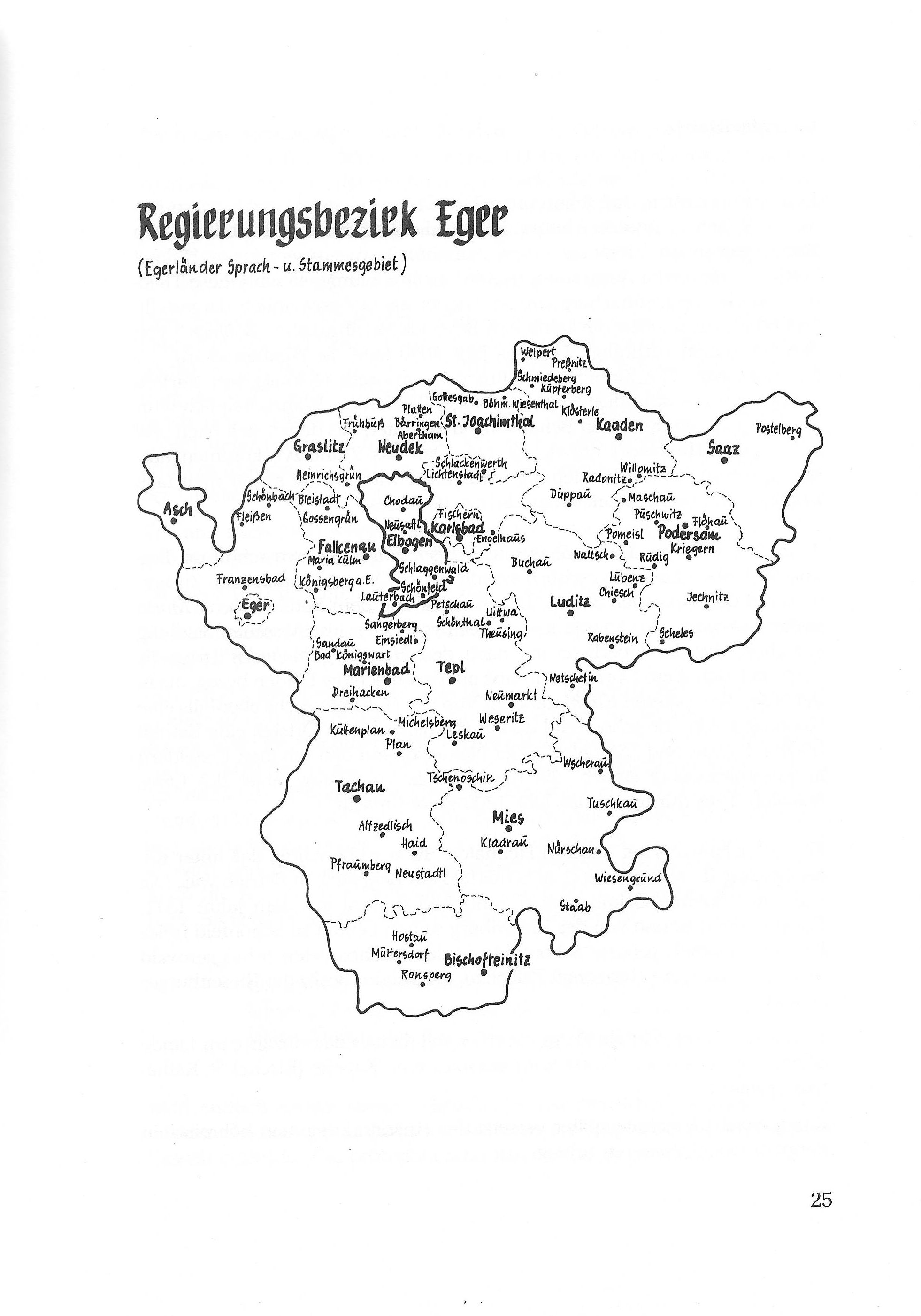 025
Eger Administrative District
(Egerland language and tribal area)
25
025
Eger Administrative District
(Egerland language and tribal area)
25
Page 0025
 026
Local History
It is assumed that as early as 800 BC—perhaps even
earlier—Celtic peoples in our homeland, Lenten, mined tin for the
production of bronze. Although this assumption—as far as our
immediate area is concerned—has never been confirmed by
excavations, this theory is repeatedly presented as likely by
historians. Around 60 BC, the Celtic Boii (from which "Bohemia" is
derived) were displaced by the Germanic tribes. The Eger Valley was
resettled around the year 1000. The tin ore deposits in our homeland
likely attracted skilled settlers. The first dwellings were probably
built around that time, from which our hometown gradually
developed. That the tin ore deposits were crucial to the emergence of
Schönfeld has been confirmed many times and requires no further proof.
Our village is said to have originated from the Hohen Stein and
Weißer Hügel, where tin ore was already mined in the Tag and
Stufenbau (day and stage mining). Together with the districts of
Staude, Butterscheibe, and the area of ??the upper market (later
Dreifaltigkeit), one could already speak of a closed settlement,
which, according to tradition, bore the name "Dreilinden." It is said
that this village name referred to three mighty linden trees that
stood near what would later become the Kirchl (church). A settlement
also grew up from the Hub, which soon formed a single unit with the
upper part of the village. This is how "Schönfeld" came about. The
name is said to be related to the beautiful ore fields that were being
developed in the village's catchment area at that time. This must have
been around the year 1200.
A first reference to our hometown: It is reported that a mine was in
operation in Schönfeld under King Ottokar II, i.e., around 1260. The
earliest known document about Schönfeld dates back to 1341. In it,
Borsso von der Riesenburg grants his people free inheritance rights to
Schönfeld. At that time, Schönfeld, along with the neighboring towns
of Schlaggenwald and Lauterbach, belonged to the Petschau domain,
which was owned by the Riesenburgs.
In 1355, Schönfeld received a mining court, which is said to have been
the only one in Bohemia. In 1404, a chapel (church) of St. Catherine
was first mentioned.
Almost two decades later, the Hussite War dealt a severe blow to
Bohemian mining.
26
026
Local History
It is assumed that as early as 800 BC—perhaps even
earlier—Celtic peoples in our homeland, Lenten, mined tin for the
production of bronze. Although this assumption—as far as our
immediate area is concerned—has never been confirmed by
excavations, this theory is repeatedly presented as likely by
historians. Around 60 BC, the Celtic Boii (from which "Bohemia" is
derived) were displaced by the Germanic tribes. The Eger Valley was
resettled around the year 1000. The tin ore deposits in our homeland
likely attracted skilled settlers. The first dwellings were probably
built around that time, from which our hometown gradually
developed. That the tin ore deposits were crucial to the emergence of
Schönfeld has been confirmed many times and requires no further proof.
Our village is said to have originated from the Hohen Stein and
Weißer Hügel, where tin ore was already mined in the Tag and
Stufenbau (day and stage mining). Together with the districts of
Staude, Butterscheibe, and the area of ??the upper market (later
Dreifaltigkeit), one could already speak of a closed settlement,
which, according to tradition, bore the name "Dreilinden." It is said
that this village name referred to three mighty linden trees that
stood near what would later become the Kirchl (church). A settlement
also grew up from the Hub, which soon formed a single unit with the
upper part of the village. This is how "Schönfeld" came about. The
name is said to be related to the beautiful ore fields that were being
developed in the village's catchment area at that time. This must have
been around the year 1200.
A first reference to our hometown: It is reported that a mine was in
operation in Schönfeld under King Ottokar II, i.e., around 1260. The
earliest known document about Schönfeld dates back to 1341. In it,
Borsso von der Riesenburg grants his people free inheritance rights to
Schönfeld. At that time, Schönfeld, along with the neighboring towns
of Schlaggenwald and Lauterbach, belonged to the Petschau domain,
which was owned by the Riesenburgs.
In 1355, Schönfeld received a mining court, which is said to have been
the only one in Bohemia. In 1404, a chapel (church) of St. Catherine
was first mentioned.
Almost two decades later, the Hussite War dealt a severe blow to
Bohemian mining.
26
Page 0026
 027
After the Riesenburgers, the Petschau domain, including the three
aforementioned mining towns, came into the possession of the Lords of
Plauen, burgraves of Meissen. In 1518, the property passed to the
Pflug von Rabenstein family, who had their seat at Petschau
Castle. Mining experienced a major boom, particularly under Johann
Pflug. Thus, in 1523, construction of the rafting ditch began. Around
this time, the Schönfeld Mining Court was expanded into a jury and
high court.
Johann Pflug was succeeded by his nephew Kaspar Pflug, under whom
Luther's teachings found their way into and spread in our region. Due
to the hereditary ownership of the mines, Pflug came into conflict
with the imperial government. He lost his property, which the state
seized. Schönfeld, like the neighboring towns of Schlaggenwald and
Lauterbach (the latter not until 1555?), was elevated to a royal free
mining town under Ferdinand I in 1547. In 1558, it was granted market
rights and its own salt mine. Two years later, the bell tower was
built.
Before and after 1600, our hometown was repeatedly ravaged by the
plague and smallpox, which claimed numerous lives.
In 1601, miners built the first town hall.
In 1614, Emperor Matthias declared Schönfeld a free mining town under
the Imperial and Royal Order. Four years later, the Thirty Years' War
began. Troops often plundered and burned through Schönfeld. They
destroyed and desecrated; it was a terrible time. Several times, the
residents abandoned the town, fleeing from the wild hordes into the
nearby forests. In 1621, General Mansfeld's troops plundered our
hometown. In 1632, Wallenstein's troops from Eger plundered
Schönfeld. A few years later, Polish troops repeatedly devastated the
town. By 1638, it is reported that 52 troop marches had taken
place. The Swedes also sacked our city. This happened in 1639. The old
nursery rhyme still says this:
The Swedes came, they all had their share.
they closed the windows, they had poured lead through the walls.
they had poured bullets through them, they had shot the eagle out.
This terrible religious war finally ended in 1648, while the Catholic
Counter-Reformation began with full force in our region. The
Protestant church was closed.
27
027
After the Riesenburgers, the Petschau domain, including the three
aforementioned mining towns, came into the possession of the Lords of
Plauen, burgraves of Meissen. In 1518, the property passed to the
Pflug von Rabenstein family, who had their seat at Petschau
Castle. Mining experienced a major boom, particularly under Johann
Pflug. Thus, in 1523, construction of the rafting ditch began. Around
this time, the Schönfeld Mining Court was expanded into a jury and
high court.
Johann Pflug was succeeded by his nephew Kaspar Pflug, under whom
Luther's teachings found their way into and spread in our region. Due
to the hereditary ownership of the mines, Pflug came into conflict
with the imperial government. He lost his property, which the state
seized. Schönfeld, like the neighboring towns of Schlaggenwald and
Lauterbach (the latter not until 1555?), was elevated to a royal free
mining town under Ferdinand I in 1547. In 1558, it was granted market
rights and its own salt mine. Two years later, the bell tower was
built.
Before and after 1600, our hometown was repeatedly ravaged by the
plague and smallpox, which claimed numerous lives.
In 1601, miners built the first town hall.
In 1614, Emperor Matthias declared Schönfeld a free mining town under
the Imperial and Royal Order. Four years later, the Thirty Years' War
began. Troops often plundered and burned through Schönfeld. They
destroyed and desecrated; it was a terrible time. Several times, the
residents abandoned the town, fleeing from the wild hordes into the
nearby forests. In 1621, General Mansfeld's troops plundered our
hometown. In 1632, Wallenstein's troops from Eger plundered
Schönfeld. A few years later, Polish troops repeatedly devastated the
town. By 1638, it is reported that 52 troop marches had taken
place. The Swedes also sacked our city. This happened in 1639. The old
nursery rhyme still says this:
The Swedes came, they all had their share.
they closed the windows, they had poured lead through the walls.
they had poured bullets through them, they had shot the eagle out.
This terrible religious war finally ended in 1648, while the Catholic
Counter-Reformation began with full force in our region. The
Protestant church was closed.
27
Page 0027
 028
After 1700, Schönfeld had 1,100 inhabitants. In 1723, it became a
church-recognized place of pilgrimage.
Around 1740, our homeland was affected by the War of the Austrian
Succession. This time, the population suffered under the French. Years
later, under Joseph II, a moderate reform policy began. In 1751, the
High Court was demolished, and torture was abolished. In 1771, house
numbers were introduced. Schönfeld then had over 300 houses. In the
same year, the mining industry was taken over by the state.
In 1848, Schönfeld experienced a devastating fire that destroyed
approximately 230 residential and outbuildings, including the town
hall and church. Construction of the state road began that same
year. The foundation stone for the new town hall was laid in 1852, and
the parish church was consecrated in 1859. In 1867, Schönfeld received
a post office. By the turn of the century, the population rose to
almost 3,300 due to the economic boom.
The new cemetery was consecrated in 1901.
A typhus epidemic broke out in 1905 due to contaminated drinking
water. Schönfeld subsequently received a water supply. Electrification
followed in 1916.
As elsewhere, the food situation became catastrophic in the last two
years of the World War, 1917/18.
After the war, the Czechoslovak Republic was proclaimed. Government
offices were occupied by Czechs.
In 1921, the first carnival parade took place in Schönfeld. High
unemployment began to rise, reaching its peak around 1932. To increase
tourism, Schönfeld residents built the observation tower in 1933/34.
In the following years, the political situation became increasingly
tense for the almost entirely German population. In October 1938, the
Sudetenland was annexed to the Greater German Reich. The liberators
were received with great enthusiasm.
Just one year later, the inferno of World War II began. In the winter
of 1940/41, Schönfeld was virtually suffocated by snow. In 1942, the
church bells were confiscated for wartime use. At the beginning of
1945, the first refugees from the East arrived in our hometown,
followed by more in May. German troops, attacked from both East and
West, were forced into our homeland. On May 7, American troops
occupied
28
028
After 1700, Schönfeld had 1,100 inhabitants. In 1723, it became a
church-recognized place of pilgrimage.
Around 1740, our homeland was affected by the War of the Austrian
Succession. This time, the population suffered under the French. Years
later, under Joseph II, a moderate reform policy began. In 1751, the
High Court was demolished, and torture was abolished. In 1771, house
numbers were introduced. Schönfeld then had over 300 houses. In the
same year, the mining industry was taken over by the state.
In 1848, Schönfeld experienced a devastating fire that destroyed
approximately 230 residential and outbuildings, including the town
hall and church. Construction of the state road began that same
year. The foundation stone for the new town hall was laid in 1852, and
the parish church was consecrated in 1859. In 1867, Schönfeld received
a post office. By the turn of the century, the population rose to
almost 3,300 due to the economic boom.
The new cemetery was consecrated in 1901.
A typhus epidemic broke out in 1905 due to contaminated drinking
water. Schönfeld subsequently received a water supply. Electrification
followed in 1916.
As elsewhere, the food situation became catastrophic in the last two
years of the World War, 1917/18.
After the war, the Czechoslovak Republic was proclaimed. Government
offices were occupied by Czechs.
In 1921, the first carnival parade took place in Schönfeld. High
unemployment began to rise, reaching its peak around 1932. To increase
tourism, Schönfeld residents built the observation tower in 1933/34.
In the following years, the political situation became increasingly
tense for the almost entirely German population. In October 1938, the
Sudetenland was annexed to the Greater German Reich. The liberators
were received with great enthusiasm.
Just one year later, the inferno of World War II began. In the winter
of 1940/41, Schönfeld was virtually suffocated by snow. In 1942, the
church bells were confiscated for wartime use. At the beginning of
1945, the first refugees from the East arrived in our hometown,
followed by more in May. German troops, attacked from both East and
West, were forced into our homeland. On May 7, American troops
occupied
28
Page 0028
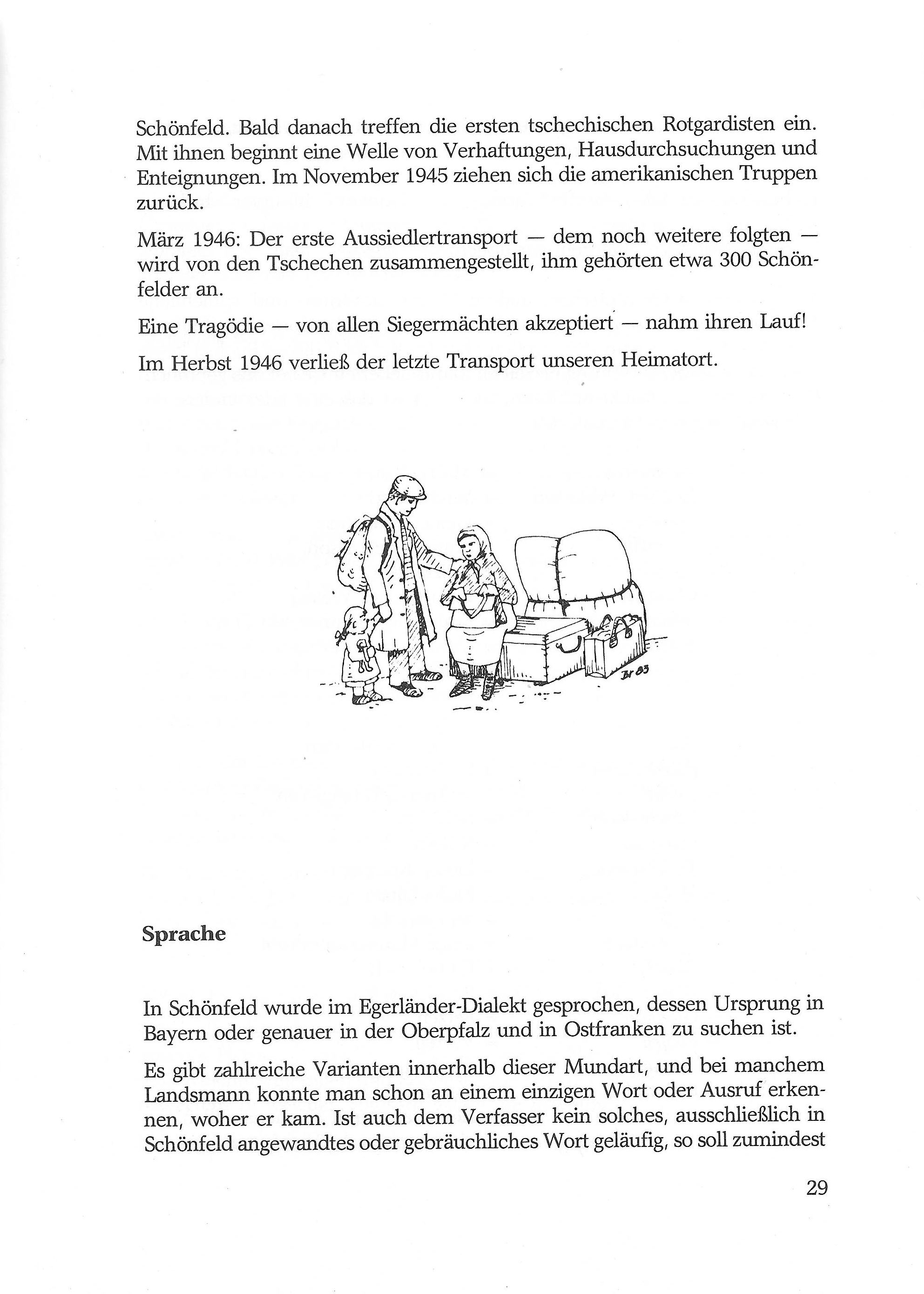 029
Schönfeld. Soon after, the first Czech Red Guards arrived. With them,
a wave of arrests, house searches, and expropriations began. In
November 1945, the American troops withdrew.
March 1946: The first transport of ethnic Germans—followed by
more—was assembled by the Czechs, including approximately 300
Schönfeld residents.
A tragedy—accepted by all victorious powers—took its course!
In the fall of 1946, the last transport left our hometown.
Language
In Schönfeld, the Egerländer dialect was spoken, which originated
in Bavaria, or more precisely, in Upper Palatinate and East Franconia.
There are numerous variations within this dialect, and with some
compatriots, one could tell where they came from just by a single word
or exclamation. If the author is not familiar with such a word that is
used or customary exclusively in Schönfeld, then at least
29
029
Schönfeld. Soon after, the first Czech Red Guards arrived. With them,
a wave of arrests, house searches, and expropriations began. In
November 1945, the American troops withdrew.
March 1946: The first transport of ethnic Germans—followed by
more—was assembled by the Czechs, including approximately 300
Schönfeld residents.
A tragedy—accepted by all victorious powers—took its course!
In the fall of 1946, the last transport left our hometown.
Language
In Schönfeld, the Egerländer dialect was spoken, which originated
in Bavaria, or more precisely, in Upper Palatinate and East Franconia.
There are numerous variations within this dialect, and with some
compatriots, one could tell where they came from just by a single word
or exclamation. If the author is not familiar with such a word that is
used or customary exclusively in Schönfeld, then at least
29
Page 0029
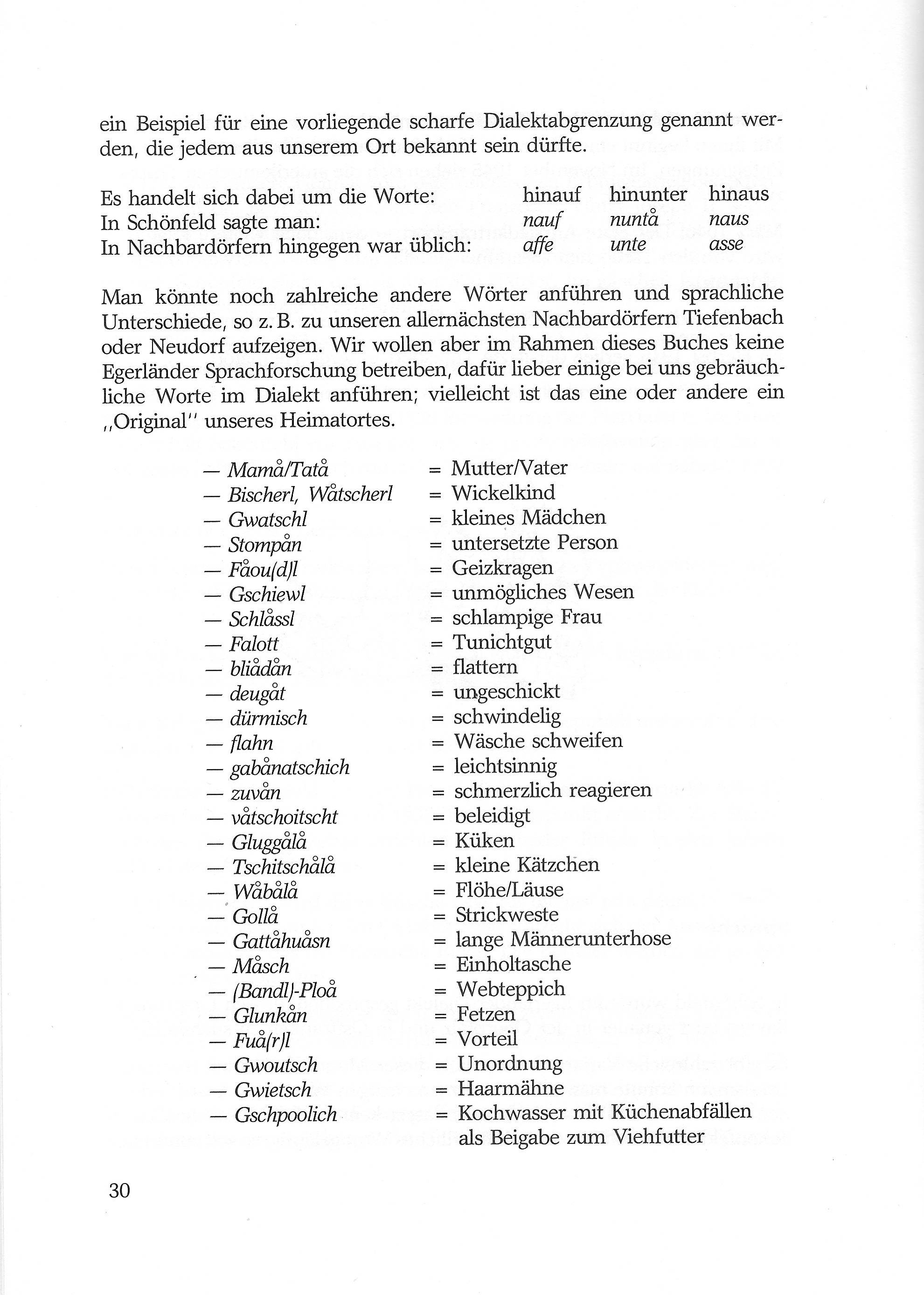 030
An example of a clear dialect distinction that should be familiar to
everyone in our village is:
These are the words: up down out In Schönfeld, they said: nauf
nunttå naus In neighboring villages, however, it was common: affe
unte asse
One could cite numerous other words and point out linguistic
differences, for example, with our very nearest neighboring villages
of Tiefenbach or Neudorf. However, we do not want to conduct
Egerländer linguistic research within the scope of this book;
instead, we would rather cite some of the dialect words commonly used
here; perhaps one or the other is an "original" of our hometown.
Mom/Dad
Little, little, little
Waiting
Stomp
Football
Squeal ...
---
Mother/Father
Baby in diapers
Little girl
Stocky person
Stingy-minded
Impossible being
Slovenly woman
Needless-minded
Flutter
Clumsy
Dizzy
Laundry wandering
Careless
Reacting painfully
Offended
Chicks
Little kittens
Fleas/lice
Cardigan
Long men's underwear
Bag for hauling
Woven carpet
Rags
Advantage
Mess
Mane of hair
Boiling water with kitchen scraps
As an addition to animal feed
30
030
An example of a clear dialect distinction that should be familiar to
everyone in our village is:
These are the words: up down out In Schönfeld, they said: nauf
nunttå naus In neighboring villages, however, it was common: affe
unte asse
One could cite numerous other words and point out linguistic
differences, for example, with our very nearest neighboring villages
of Tiefenbach or Neudorf. However, we do not want to conduct
Egerländer linguistic research within the scope of this book;
instead, we would rather cite some of the dialect words commonly used
here; perhaps one or the other is an "original" of our hometown.
Mom/Dad
Little, little, little
Waiting
Stomp
Football
Squeal ...
---
Mother/Father
Baby in diapers
Little girl
Stocky person
Stingy-minded
Impossible being
Slovenly woman
Needless-minded
Flutter
Clumsy
Dizzy
Laundry wandering
Careless
Reacting painfully
Offended
Chicks
Little kittens
Fleas/lice
Cardigan
Long men's underwear
Bag for hauling
Woven carpet
Rags
Advantage
Mess
Mane of hair
Boiling water with kitchen scraps
As an addition to animal feed
30
Page 0030
 031
As an introduction to the description of our hometown and its
surroundings, here are some excerpts from "The Kingdom of Bohemia,
Statistically and Topographically Represented," Volume 15, Elbogen
District, Prague 1847 by Johann Gottfried Sommer:
Royal Mining Town of Schönfeld
The royal mining town of Schönfeld is located in the southern part of
the district, 1 3/4 hours south-southeast of Elbogen and 3 hours
south-southwest of Karlovy Vary, on both sides of the Flößgraben
(river ditch). It borders the lordships of Falkenau and Elbogen to the
northwest, the territory of the town of Schlaggenwald and the
Rabensgrün estate to the north and northeast, the lordship of
Petschau to the east and southeast, and the territory of the town of
Lauterbach to the south, southwest, and west.
The terrain is mountainous, the elevation is high, and the climate
harsh. Notable mountains include the White Hill, the High Stone, and
the Steingröll. The rock types are variations of gneiss.
Flowing through the area from the southwest from the ponds of the
Königswart estate, the Flößgraben or Flößbach (Floating Stream)
flows, serving to float logs from the state-owned mining forests of
the Königswart estate, as well as to operate the state-owned stamp
mills and smelters. This Flößgraben is an artificial stream.
The population is 2,894, and the predominant language is
German. Income and food come primarily from civil trades, some mining,
agriculture, and trade, as well as wage labor in mining, wool
spinning, and cloth making, etc.
The soil is mostly sandy and stony, with only moderate fertility even
in warm and dry years. Potatoes are mostly cultivated, along with some
grain, barley, and oats. Fruit is rare.
That's the account from 1847.
However, we would like to take a closer look at our surroundings and
our hometown at that time. What did nature offer us in terms of plants
and animals? What minerals and resources did the ground we walked on
contain? What houses did we live in?
A brief answer to this question will be given.
31
031
As an introduction to the description of our hometown and its
surroundings, here are some excerpts from "The Kingdom of Bohemia,
Statistically and Topographically Represented," Volume 15, Elbogen
District, Prague 1847 by Johann Gottfried Sommer:
Royal Mining Town of Schönfeld
The royal mining town of Schönfeld is located in the southern part of
the district, 1 3/4 hours south-southeast of Elbogen and 3 hours
south-southwest of Karlovy Vary, on both sides of the Flößgraben
(river ditch). It borders the lordships of Falkenau and Elbogen to the
northwest, the territory of the town of Schlaggenwald and the
Rabensgrün estate to the north and northeast, the lordship of
Petschau to the east and southeast, and the territory of the town of
Lauterbach to the south, southwest, and west.
The terrain is mountainous, the elevation is high, and the climate
harsh. Notable mountains include the White Hill, the High Stone, and
the Steingröll. The rock types are variations of gneiss.
Flowing through the area from the southwest from the ponds of the
Königswart estate, the Flößgraben or Flößbach (Floating Stream)
flows, serving to float logs from the state-owned mining forests of
the Königswart estate, as well as to operate the state-owned stamp
mills and smelters. This Flößgraben is an artificial stream.
The population is 2,894, and the predominant language is
German. Income and food come primarily from civil trades, some mining,
agriculture, and trade, as well as wage labor in mining, wool
spinning, and cloth making, etc.
The soil is mostly sandy and stony, with only moderate fertility even
in warm and dry years. Potatoes are mostly cultivated, along with some
grain, barley, and oats. Fruit is rare.
That's the account from 1847.
However, we would like to take a closer look at our surroundings and
our hometown at that time. What did nature offer us in terms of plants
and animals? What minerals and resources did the ground we walked on
contain? What houses did we live in?
A brief answer to this question will be given.
31
Page 0031
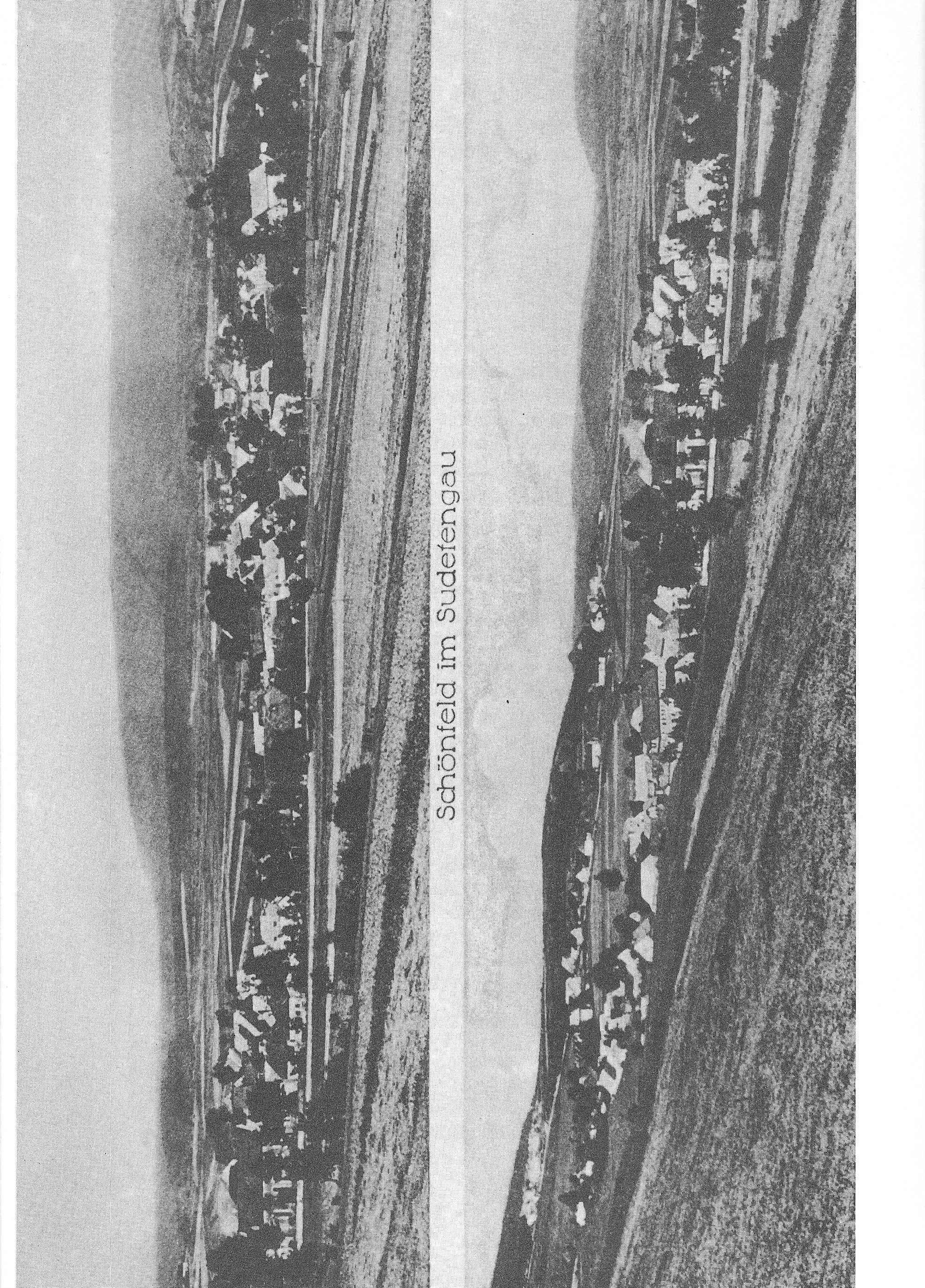 032
Pict
32
032
Pict
32
Page 0032
 033
Forest and Fields
Our local forest, which should be mentioned first here, was a pure
coniferous forest. It consisted almost entirely of spruce trees;
occasionally, one could find a few firs, larches, or pines. In the
felt area, a few sprawling mountain pines had taken root. Deciduous
forest, apart from a few small groves, was virtually
nonexistent. However, Central European trees could be found
everywhere, from mountain ash (rowan) to maple, birch, willow, elm,
and aspen, also known as the quaking aspen.
Among the shrubs, the hazelnut bush deserves special mention—not
only because of its tasty nuts—and was very abundant in the stony
scree area. Blackthorn and rose hips should also be mentioned here.
In the forests west and south of our hometown, there was also a fairly
wide selection of mushrooms, of which we will list only a few edible
ones here, which enriched many a small menu during the mushroom
season. The most popular mushroom was probably the sturdy porcini
mushroom, closely followed by the chanterelle, chestnut mushroom, and
chanterelle, which we call Euåschwammerl. Birch mushrooms were also
popular.
Everyone kept their best spots strictly secret, but what was the
saying back home? "Weå v(ü)l löigt, deå v(ü)l find!"
In addition to the numerous mushrooms, nature also provided us with
delicious berries, of which the blueberry and blackberry were
especially popular for their versatility. Crushed raw and mixed with
cold milk and a little sugar, these delicious berries provided us with
the Schwoåzbeåhgmetsch (Swiss Blackberry Mash), which was
especially popular with children. But it also had a firm place in many
families as a medicinal plant, as its tannic acid content, when dried,
made it an effective remedy for "quick Kathrin," or diarrhea, in plain
English. Alongside the blackberries, the abundant lingonberry berries
also found their way into the household's storage jars—cooked and
thickened. There were numerous places where these two berry varieties
grew, but the White Hill probably held a special place for
lingonberries.
In the Filz, the approximately one-square-kilometer raised bog on
Lauterbacher Straße, two other special "berry species" had
settled. They were the cloudberry or blueberry, similar to the
blackberry but with white flesh. There were also the cranberry or
feltberry.
33
033
Forest and Fields
Our local forest, which should be mentioned first here, was a pure
coniferous forest. It consisted almost entirely of spruce trees;
occasionally, one could find a few firs, larches, or pines. In the
felt area, a few sprawling mountain pines had taken root. Deciduous
forest, apart from a few small groves, was virtually
nonexistent. However, Central European trees could be found
everywhere, from mountain ash (rowan) to maple, birch, willow, elm,
and aspen, also known as the quaking aspen.
Among the shrubs, the hazelnut bush deserves special mention—not
only because of its tasty nuts—and was very abundant in the stony
scree area. Blackthorn and rose hips should also be mentioned here.
In the forests west and south of our hometown, there was also a fairly
wide selection of mushrooms, of which we will list only a few edible
ones here, which enriched many a small menu during the mushroom
season. The most popular mushroom was probably the sturdy porcini
mushroom, closely followed by the chanterelle, chestnut mushroom, and
chanterelle, which we call Euåschwammerl. Birch mushrooms were also
popular.
Everyone kept their best spots strictly secret, but what was the
saying back home? "Weå v(ü)l löigt, deå v(ü)l find!"
In addition to the numerous mushrooms, nature also provided us with
delicious berries, of which the blueberry and blackberry were
especially popular for their versatility. Crushed raw and mixed with
cold milk and a little sugar, these delicious berries provided us with
the Schwoåzbeåhgmetsch (Swiss Blackberry Mash), which was
especially popular with children. But it also had a firm place in many
families as a medicinal plant, as its tannic acid content, when dried,
made it an effective remedy for "quick Kathrin," or diarrhea, in plain
English. Alongside the blackberries, the abundant lingonberry berries
also found their way into the household's storage jars—cooked and
thickened. There were numerous places where these two berry varieties
grew, but the White Hill probably held a special place for
lingonberries.
In the Filz, the approximately one-square-kilometer raised bog on
Lauterbacher Straße, two other special "berry species" had
settled. They were the cloudberry or blueberry, similar to the
blackberry but with white flesh. There were also the cranberry or
feltberry.
33
Page 0033
 034
(Vaccinium oxycoccus). Tastes like the cranberry, but with a larger
fruit. Incidentally, a delicacy for the black grouse that was native
to the Filz at the time.
We'll conclude the list of edible berries with the raspberry,
blackberry, and wild strawberry.
Here are two more representatives of the poisonous species: the
echinacea and the deadly nightshade. From berries to flowers, it's
only a small step, but we can't name them all, as their names would be
too numerous, from the daisy, to the marigold and the
reddish-purple-flowering pitchflower on slopes or roadsides, to the
meadowfoam and the smock. But here, too, we want to list just a
handful, because their home was and isn't "everywhere." Let's start
with arnica (Arnica montana), a sought-after medicinal plant, which we
called "Konåsbloumån." It was particularly abundant at the foot
of the Hoher Stein (High Stone).
In the same area, we picked white and red cat's foot (Antennaria) for
many a Corpus Christi wreath. But also worth mentioning here is the
good ox tongue (Anchura officinalis), which, pulled clean from its
stem in damp meadows, was processed into spinach by the
moåschenweis (pouch-by-pouch), and served on the table. Near the
Himmelteich (Sky Pond), the rich yellow globeflower, also known as the
marigold, had its home; the seven-pointed star (Trinity Flower) was
also found there. In the Elbogen Forest, we even found a native
orchid, the spotted marsh orchid (Dactylorhiza majalis). Finally, we
should mention the cotton grass (Eriophorum), our Filzwuwerl (felt
wormwood).
And now to the game. The selection for hunters, of which there were
quite a few in Schönfeld, wasn't all that extensive. There were deer,
hares – rabbits only in recent years on the Wandelwiese and on the
Weißer Hügel – then partridges and pheasants, and in the
Filz, black grouse. The common snipe, a species of marsh snipe, could
also be found here. Several wild ducks also nested in the Filz. The
capercaillie was only very rarely seen.
But foxes, badgers, martens, polecats, weasels, and ermines also lived
in our area.
Birds of prey include the goshawk, sparrowhawk, kestrel, and
occasionally the common and honey buzzard.
At night, tawny owls, little owls, barn owls, long-eared owls, pygmy
owls, and short-eared owls hunted for prey.
34
034
(Vaccinium oxycoccus). Tastes like the cranberry, but with a larger
fruit. Incidentally, a delicacy for the black grouse that was native
to the Filz at the time.
We'll conclude the list of edible berries with the raspberry,
blackberry, and wild strawberry.
Here are two more representatives of the poisonous species: the
echinacea and the deadly nightshade. From berries to flowers, it's
only a small step, but we can't name them all, as their names would be
too numerous, from the daisy, to the marigold and the
reddish-purple-flowering pitchflower on slopes or roadsides, to the
meadowfoam and the smock. But here, too, we want to list just a
handful, because their home was and isn't "everywhere." Let's start
with arnica (Arnica montana), a sought-after medicinal plant, which we
called "Konåsbloumån." It was particularly abundant at the foot
of the Hoher Stein (High Stone).
In the same area, we picked white and red cat's foot (Antennaria) for
many a Corpus Christi wreath. But also worth mentioning here is the
good ox tongue (Anchura officinalis), which, pulled clean from its
stem in damp meadows, was processed into spinach by the
moåschenweis (pouch-by-pouch), and served on the table. Near the
Himmelteich (Sky Pond), the rich yellow globeflower, also known as the
marigold, had its home; the seven-pointed star (Trinity Flower) was
also found there. In the Elbogen Forest, we even found a native
orchid, the spotted marsh orchid (Dactylorhiza majalis). Finally, we
should mention the cotton grass (Eriophorum), our Filzwuwerl (felt
wormwood).
And now to the game. The selection for hunters, of which there were
quite a few in Schönfeld, wasn't all that extensive. There were deer,
hares – rabbits only in recent years on the Wandelwiese and on the
Weißer Hügel – then partridges and pheasants, and in the
Filz, black grouse. The common snipe, a species of marsh snipe, could
also be found here. Several wild ducks also nested in the Filz. The
capercaillie was only very rarely seen.
But foxes, badgers, martens, polecats, weasels, and ermines also lived
in our area.
Birds of prey include the goshawk, sparrowhawk, kestrel, and
occasionally the common and honey buzzard.
At night, tawny owls, little owls, barn owls, long-eared owls, pygmy
owls, and short-eared owls hunted for prey.
34
Page 0034
 035
Regarding the next group, the songbirds, one could say: blackbirds,
thrushes, finches, starlings, and the whole flock of birds sang their
joyful songs in our gardens, meadows, and forests. There were various
species of tit, the siskin, the greenfinch, as well as the goldfinch,
the crossbill, and the bullfinch, also known as the common
bullfinch. Then there were the robin, the redstart, and the pretty
little goldcrest. Even the grosbeak, the thickest-billed finch in
Europe, could be seen now and again.
From the large, now to the small flyers, the colorful butterflies. But
here, too, only the most well-known species will be listed. These were
the tortoiseshell butterfly, the fritillary, the mourning cloak
butterfly, the brimstone butterfly, and the red admiral, then the
small blue butterfly and the peacock butterfly. Very rare and almost
an exotic species in appearance, the swallowtail butterfly should also
be mentioned.
Of course, there were also lizards, slowworms, and snakes in our
homeland. Of the latter, quite a few. Above all, the poisonous adder
could be seen in many places, especially at Steingröll. There was a
brown and a gray species. But its enemy, the common viper, was also
native to our area. Then there's the gray grass snake, with its pretty
yellow-orange crescent behind its eye.
Numerous ponds and streams were full of life, especially the
trout. And let's not forget the smallest of the species: the numerous
minnows, or Ilitzlå, as we called them, and their young, the
Nåudlkepplå. Rarely, and only with luck, could crayfish be seen
in the stream.
This was a brief overview of the flora and fauna in and around
Schönfeld. A, albeit incomplete, representation of the vegetation and
life that surrounded us. But the picture of our local area would be
incomplete without mentioning the minerals that formed deep within the
Earth millions of years ago. Of interest to mining interests were tin,
tungsten, copper, zinc, uranium, and, in earlier times,
silver. Cobalt, nickel, iron, molybdenum, and iron pyrite were present
in smaller quantities. Other precious and semiprecious stones included
topaz, beryl, apatite, carfolite, amethyst, megapasite, and cap
quartz, which were particularly prized by collectors.
35
035
Regarding the next group, the songbirds, one could say: blackbirds,
thrushes, finches, starlings, and the whole flock of birds sang their
joyful songs in our gardens, meadows, and forests. There were various
species of tit, the siskin, the greenfinch, as well as the goldfinch,
the crossbill, and the bullfinch, also known as the common
bullfinch. Then there were the robin, the redstart, and the pretty
little goldcrest. Even the grosbeak, the thickest-billed finch in
Europe, could be seen now and again.
From the large, now to the small flyers, the colorful butterflies. But
here, too, only the most well-known species will be listed. These were
the tortoiseshell butterfly, the fritillary, the mourning cloak
butterfly, the brimstone butterfly, and the red admiral, then the
small blue butterfly and the peacock butterfly. Very rare and almost
an exotic species in appearance, the swallowtail butterfly should also
be mentioned.
Of course, there were also lizards, slowworms, and snakes in our
homeland. Of the latter, quite a few. Above all, the poisonous adder
could be seen in many places, especially at Steingröll. There was a
brown and a gray species. But its enemy, the common viper, was also
native to our area. Then there's the gray grass snake, with its pretty
yellow-orange crescent behind its eye.
Numerous ponds and streams were full of life, especially the
trout. And let's not forget the smallest of the species: the numerous
minnows, or Ilitzlå, as we called them, and their young, the
Nåudlkepplå. Rarely, and only with luck, could crayfish be seen
in the stream.
This was a brief overview of the flora and fauna in and around
Schönfeld. A, albeit incomplete, representation of the vegetation and
life that surrounded us. But the picture of our local area would be
incomplete without mentioning the minerals that formed deep within the
Earth millions of years ago. Of interest to mining interests were tin,
tungsten, copper, zinc, uranium, and, in earlier times,
silver. Cobalt, nickel, iron, molybdenum, and iron pyrite were present
in smaller quantities. Other precious and semiprecious stones included
topaz, beryl, apatite, carfolite, amethyst, megapasite, and cap
quartz, which were particularly prized by collectors.
35
Page 0035
 036
Village Structure, Architectural Style, and Construction Methods
Schönfeld consisted of a village center, one could almost speak of a
"Trinity-Rathaufen" axis, and the outgoing districts of Staude/Kaunitz
and Hub.
If we base the village length on the course of the main street, i.e.,
the beginning of the village on Lauterbacher Straße, near the
Kirchl church, to Hirtenpaint, the point where settlement declined
sharply again, we measure a length of 1.1 kilometers.
The village districts of Staude/Kaunitz up to Hohen Stein extended for
a length of approximately 0.8 kilometers. Hub, the lower part of
Schönfeld, i.e., the stretch from Hirtenpaint to Jahnheim, which also
marked the border to Schlaggenwald, was approximately one kilometer.
This resulted in a total village length of approximately three
kilometers.
According to investigations, at the time of our expulsion, i.e. in
1946, 435 house numbers were recorded in our hometown. Among them were
only a few new buildings, so the following description primarily
refers to structures erected shortly after the great fire of 1848 or
earlier. This largely reflects the general character of the town.
The houses in our town, with only two or three exceptions confirming
the rule, were all purely functional buildings without any notable
ornamentation. One- and two-story construction styles were common, the
latter particularly in the market square area and along the main
street.
Many of the houses in the town center were built side by side, with
the long fronts usually facing the street.
In earlier years, the timber-framed style was predominantly used, but
this was still visible on only a relatively few houses, as the beams
were often plastered over.
The typical roof shape was a gable or pitched roof. Roofs were
initially covered with shingles, later mostly with roofing felt, which
was periodically freshly tarred. Bricks and asbestos cement were also
common. The single-story houses often had a hatch in the roof area on
the gable end – what we call a Schlooch or Schloochtüårl –
through which hay or straw could be stored or passed through.
The window shape was usually divided into 6 or 8 panes. One of these 6
or 8 panes was often separately framed and pivotable. This
36
036
Village Structure, Architectural Style, and Construction Methods
Schönfeld consisted of a village center, one could almost speak of a
"Trinity-Rathaufen" axis, and the outgoing districts of Staude/Kaunitz
and Hub.
If we base the village length on the course of the main street, i.e.,
the beginning of the village on Lauterbacher Straße, near the
Kirchl church, to Hirtenpaint, the point where settlement declined
sharply again, we measure a length of 1.1 kilometers.
The village districts of Staude/Kaunitz up to Hohen Stein extended for
a length of approximately 0.8 kilometers. Hub, the lower part of
Schönfeld, i.e., the stretch from Hirtenpaint to Jahnheim, which also
marked the border to Schlaggenwald, was approximately one kilometer.
This resulted in a total village length of approximately three
kilometers.
According to investigations, at the time of our expulsion, i.e. in
1946, 435 house numbers were recorded in our hometown. Among them were
only a few new buildings, so the following description primarily
refers to structures erected shortly after the great fire of 1848 or
earlier. This largely reflects the general character of the town.
The houses in our town, with only two or three exceptions confirming
the rule, were all purely functional buildings without any notable
ornamentation. One- and two-story construction styles were common, the
latter particularly in the market square area and along the main
street.
Many of the houses in the town center were built side by side, with
the long fronts usually facing the street.
In earlier years, the timber-framed style was predominantly used, but
this was still visible on only a relatively few houses, as the beams
were often plastered over.
The typical roof shape was a gable or pitched roof. Roofs were
initially covered with shingles, later mostly with roofing felt, which
was periodically freshly tarred. Bricks and asbestos cement were also
common. The single-story houses often had a hatch in the roof area on
the gable end – what we call a Schlooch or Schloochtüårl –
through which hay or straw could be stored or passed through.
The window shape was usually divided into 6 or 8 panes. One of these 6
or 8 panes was often separately framed and pivotable. This
36
Page 0036
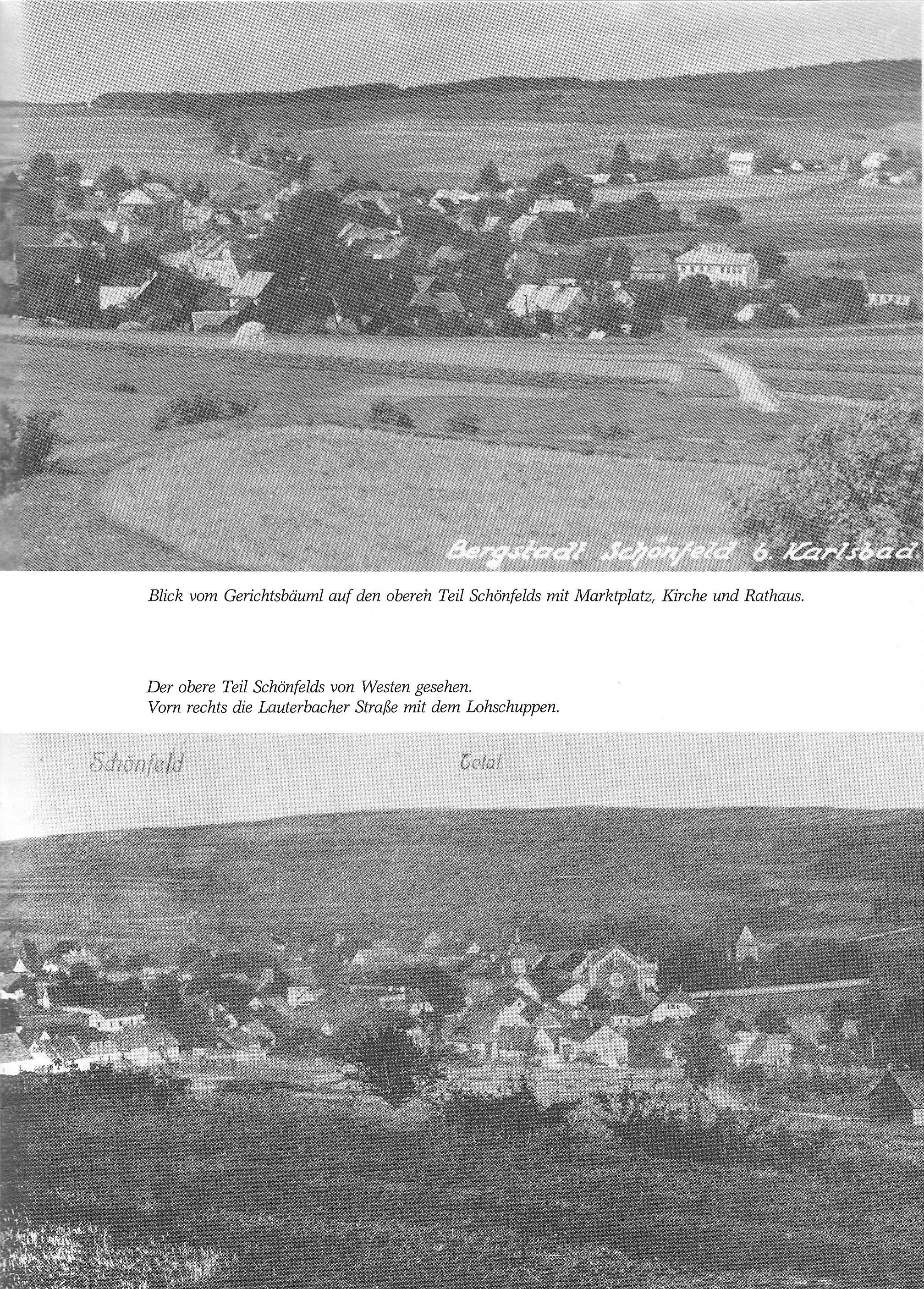 037
Pg 37 picture top view from Gerichtsbäuml to the upper part of
Schönfeld with market square, church and town hall View from the
courthouse to the upper part of Schönfeld with the market square,
church and town hall Pg 37 picture bottom The upper part of Schönfeld
seen from the west. In the front right is Lauterbacher Straße with
the tannery. The upper part of Schönfeld seen from the
west. Lauterbacher Straße with the Lohschuppen on the right.
037
Pg 37 picture top view from Gerichtsbäuml to the upper part of
Schönfeld with market square, church and town hall View from the
courthouse to the upper part of Schönfeld with the market square,
church and town hall Pg 37 picture bottom The upper part of Schönfeld
seen from the west. In the front right is Lauterbacher Straße with
the tannery. The upper part of Schönfeld seen from the
west. Lauterbacher Straße with the Lohschuppen on the right.
Page 0037
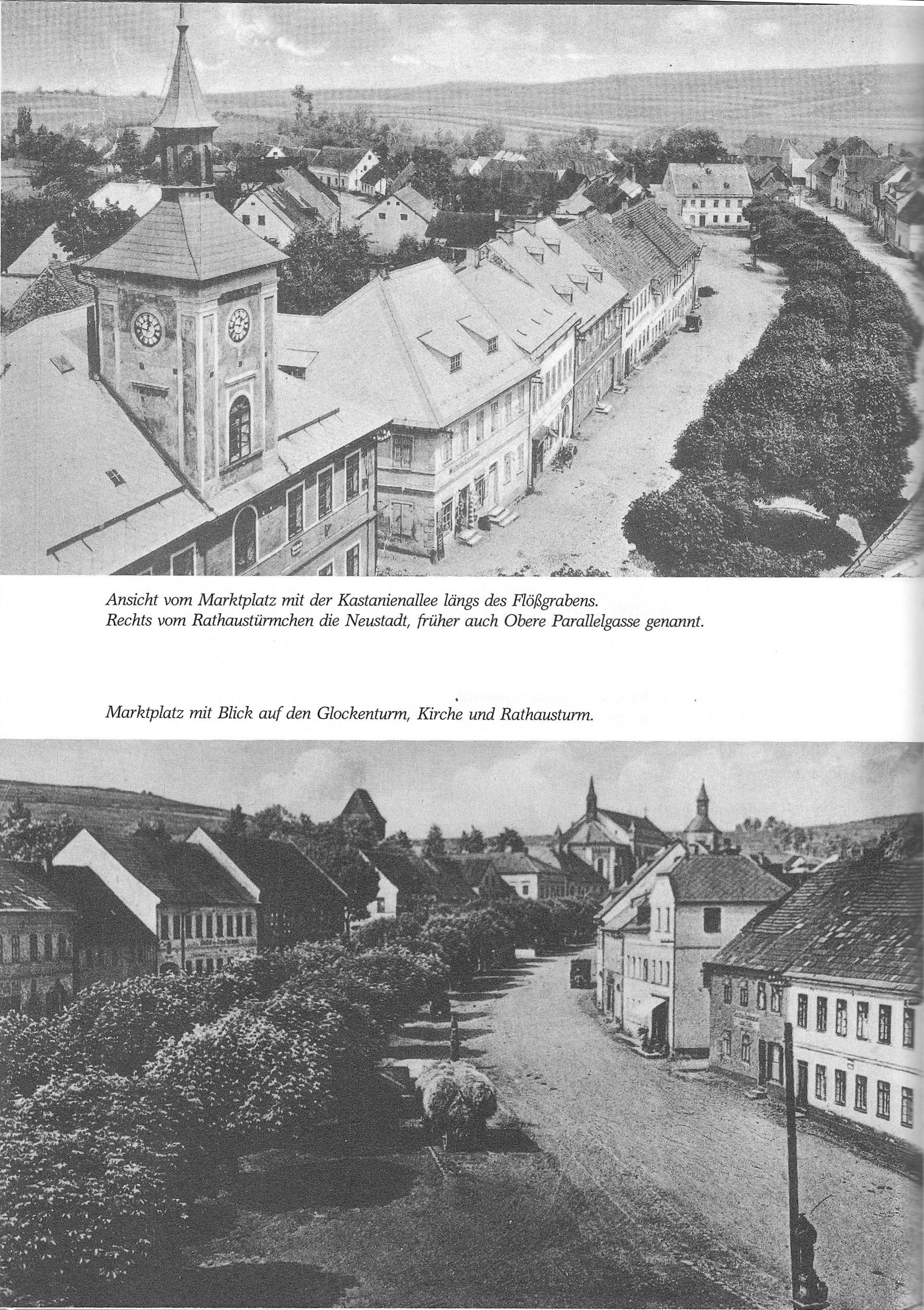 038
Pg 38 top
View from the market square with the chestnut avenue along the
Flößgraben. To the right of the town hall tower is the Neustadt,
formerly also called Obere Parallelgasse. View from the market place
with the chestnut avenue along the raft ditch. To the right of the
town hall tower is Neustadt, formerly also called Obere Parallelgasse.
Pg 38 bottom Market square with a view of the bell tower, church and
town hall tower.
038
Pg 38 top
View from the market square with the chestnut avenue along the
Flößgraben. To the right of the town hall tower is the Neustadt,
formerly also called Obere Parallelgasse. View from the market place
with the chestnut avenue along the raft ditch. To the right of the
town hall tower is Neustadt, formerly also called Obere Parallelgasse.
Pg 38 bottom Market square with a view of the bell tower, church and
town hall tower.
Page 0038
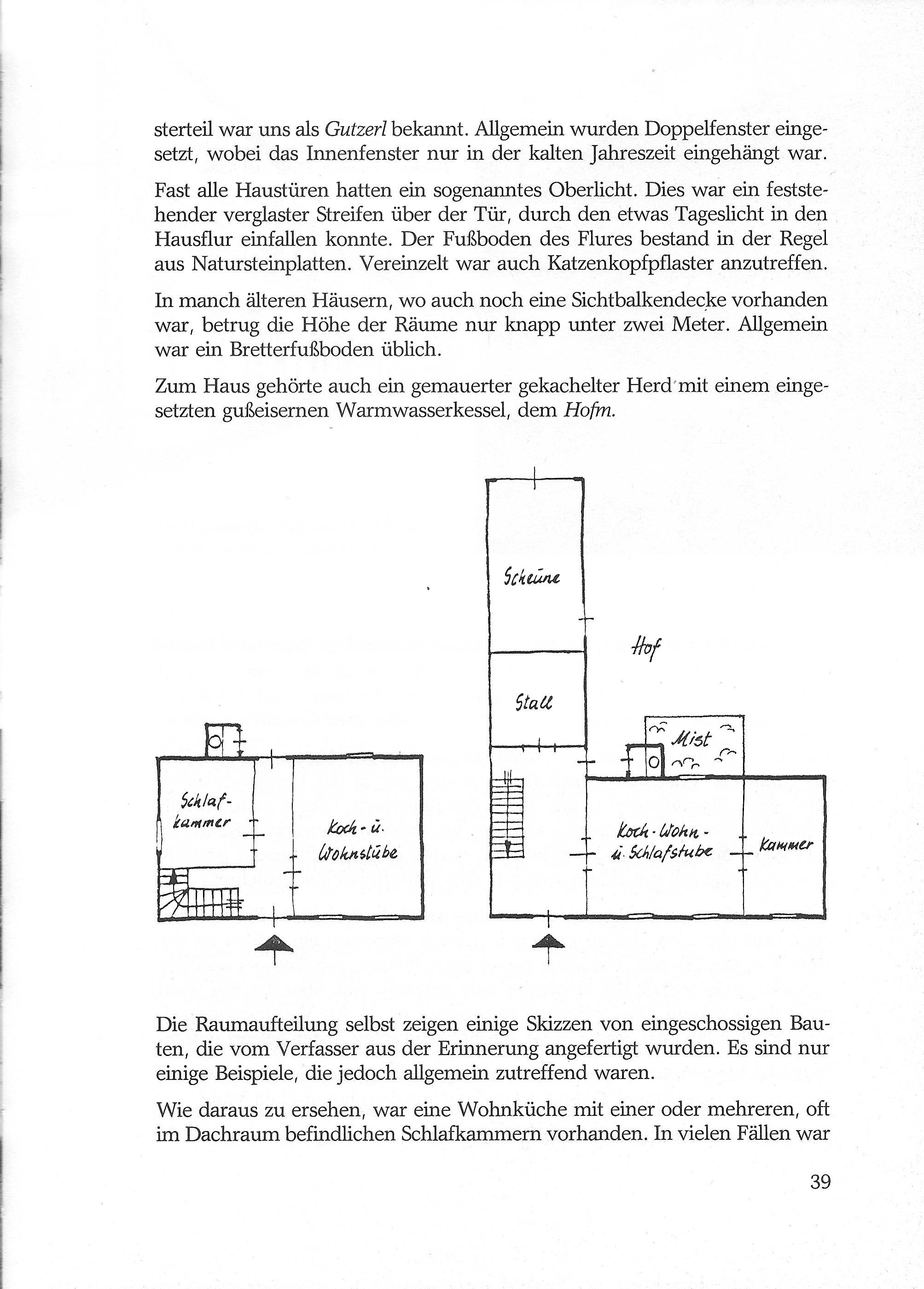 039
The window section was known to us as a "Gutzerl." Double-glazed
windows were generally used, with the inner window only being hung
during the cold season.
Almost all front doors had a so-called fanlight. This was a fixed
glazed strip above the door, through which some daylight could enter
the hallway. The hallway floor was usually made of natural stone
slabs. Occasionally, cobblestone paving was also found.
In some older houses, which still had exposed beam ceilings, the room
height was just under two meters. A plank floor was generally common.
The house also included a brick tiled stove with a cast-iron hot water
boiler, the Hofm.
39 picture
---
The room layout itself is shown in some sketches of single-story
buildings, which the author made from memory. These are just a few
examples, but they were generally accurate.
As can be seen, there was a kitchen-living room with one or more
bedrooms, often located in the attic. In many cases,
39
039
The window section was known to us as a "Gutzerl." Double-glazed
windows were generally used, with the inner window only being hung
during the cold season.
Almost all front doors had a so-called fanlight. This was a fixed
glazed strip above the door, through which some daylight could enter
the hallway. The hallway floor was usually made of natural stone
slabs. Occasionally, cobblestone paving was also found.
In some older houses, which still had exposed beam ceilings, the room
height was just under two meters. A plank floor was generally common.
The house also included a brick tiled stove with a cast-iron hot water
boiler, the Hofm.
39 picture
---
The room layout itself is shown in some sketches of single-story
buildings, which the author made from memory. These are just a few
examples, but they were generally accurate.
As can be seen, there was a kitchen-living room with one or more
bedrooms, often located in the attic. In many cases,
39
Page 0039
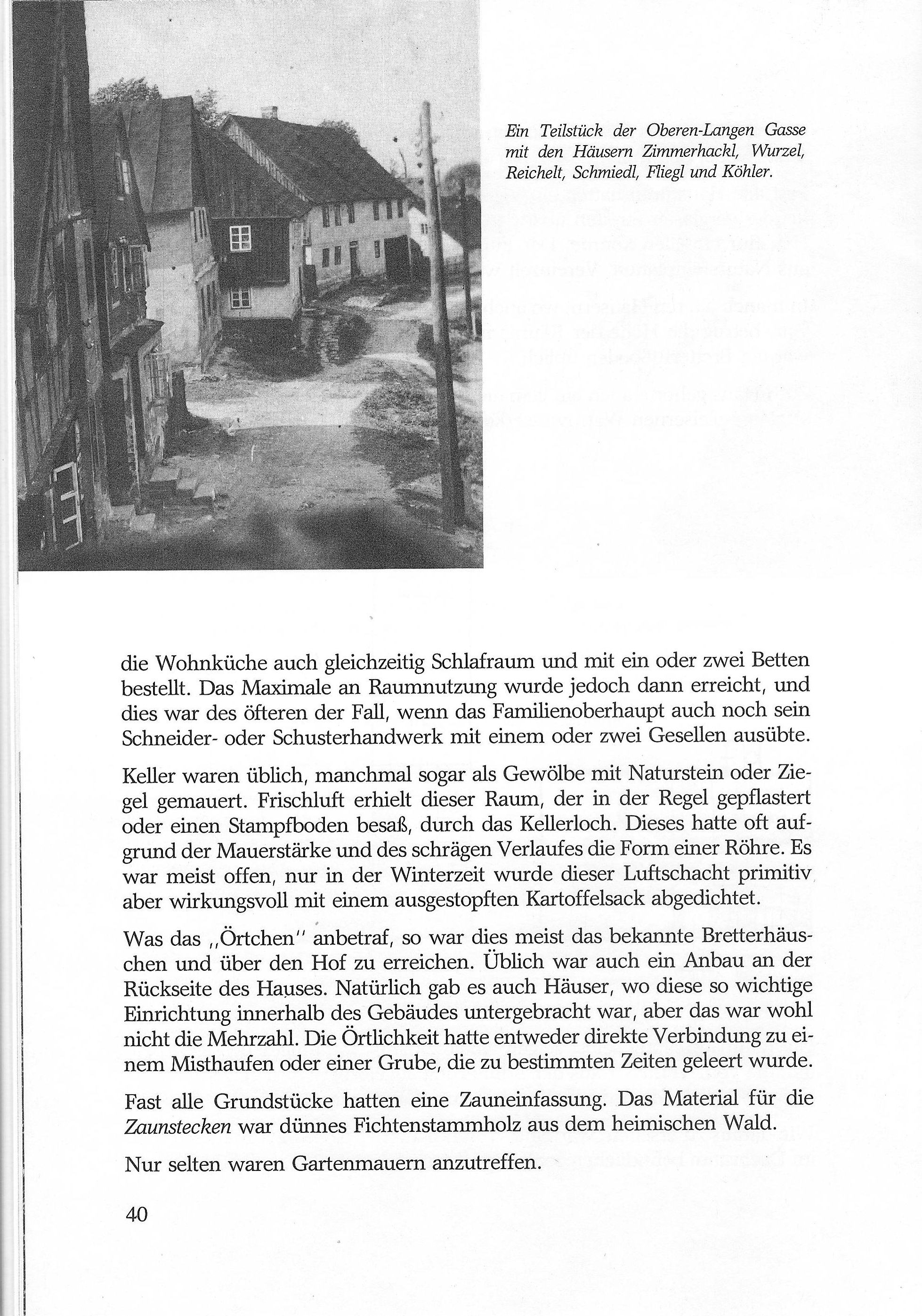 040
A section of the Oberen-Langen Gasse with the houses Zimmerhackl,
Wurzel, Reichelt, Schmiedl, Fliegl and Köhler.
40 picture
The kitchen-living room also served as a bedroom with one or two
beds. Maximum space utilization, however, was achieved, and this was
often the case, when the head of the family also practiced his
tailoring or shoemaking trade with one or two journeymen.
Cellars were common, sometimes even vaulted, built with natural stone
or brick. This room, which was usually paved or had a rammed floor,
received fresh air through the cellar hole. Due to the thickness of
the wall and its sloping shape, this often had the shape of a tube. It
was usually open; only in winter was this air shaft primitively but
effectively sealed with a stuffed potato sack.
As for the "little place," this was usually the familiar wooden hut
and accessible via the yard. An extension at the rear of the house was
also common. Of course, there were also houses where this very
important facility was housed within the building, but this was
probably not the majority. The location had either a direct connection
to a dung heap or a pit that was emptied at specific times.
Almost all properties had a fence. The fence posts were made of thin
spruce logs from the local forest.
Garden walls were rare.
40
040
A section of the Oberen-Langen Gasse with the houses Zimmerhackl,
Wurzel, Reichelt, Schmiedl, Fliegl and Köhler.
40 picture
The kitchen-living room also served as a bedroom with one or two
beds. Maximum space utilization, however, was achieved, and this was
often the case, when the head of the family also practiced his
tailoring or shoemaking trade with one or two journeymen.
Cellars were common, sometimes even vaulted, built with natural stone
or brick. This room, which was usually paved or had a rammed floor,
received fresh air through the cellar hole. Due to the thickness of
the wall and its sloping shape, this often had the shape of a tube. It
was usually open; only in winter was this air shaft primitively but
effectively sealed with a stuffed potato sack.
As for the "little place," this was usually the familiar wooden hut
and accessible via the yard. An extension at the rear of the house was
also common. Of course, there were also houses where this very
important facility was housed within the building, but this was
probably not the majority. The location had either a direct connection
to a dung heap or a pit that was emptied at specific times.
Almost all properties had a fence. The fence posts were made of thin
spruce logs from the local forest.
Garden walls were rare.
40
Page 0040
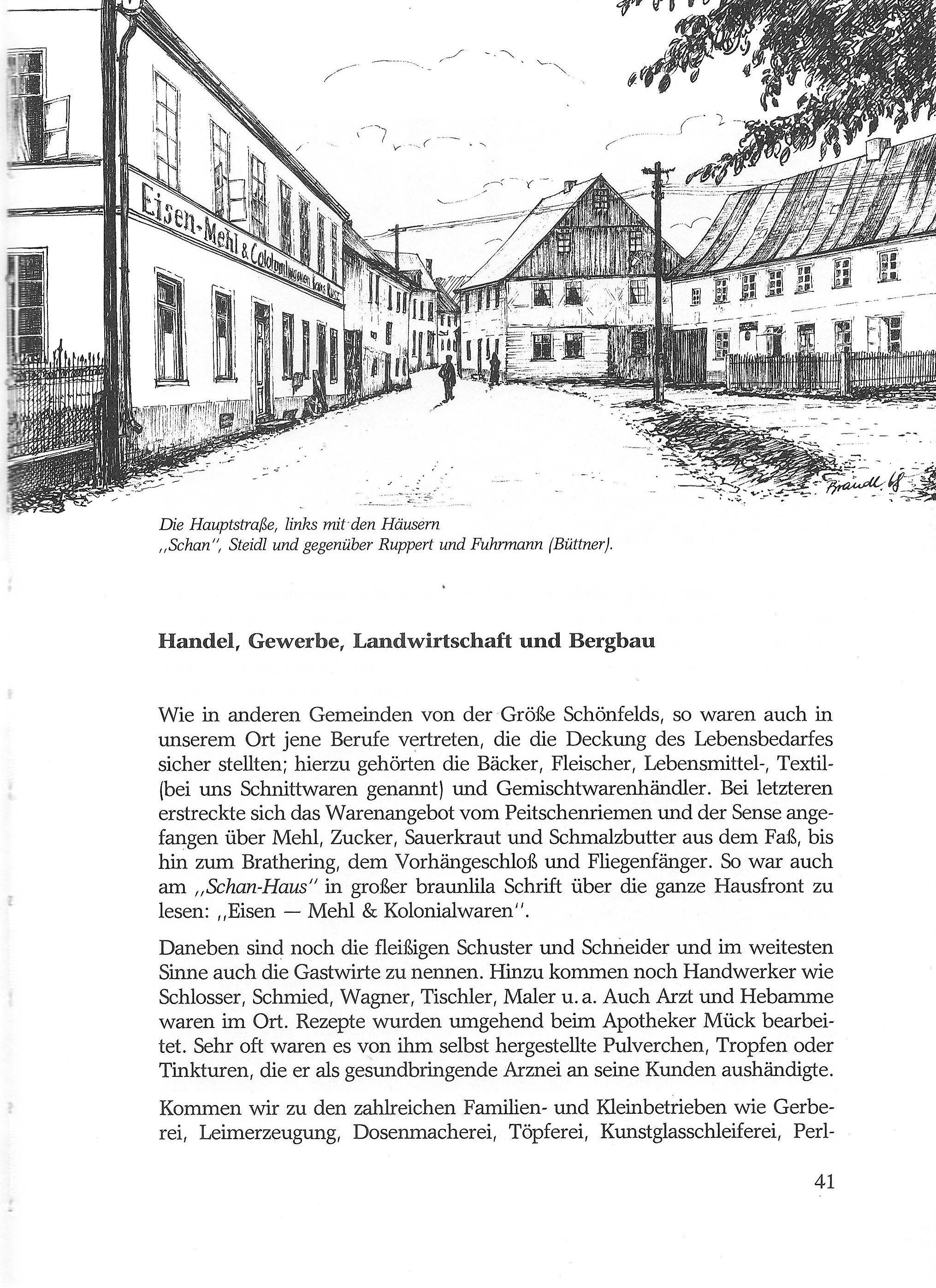 041
The main street, on the left with the houses "Schan", Steidl and
opposite Ruppert and Fuhrmann (Büttner).
Trade, Industry, Agriculture, and Mining
As in other communities the size of Schönfeld, our village also
boasted those professions that ensured the provision of basic
necessities; these included bakers, butchers, grocers, textile
merchants (we call them "trim goods"), and general stores. The latter
offered everything from whip straps and scythes to flour, sugar,
sauerkraut, and butter from the barrel, to fried herring, padlocks,
and flypaper. Thus, the "Schan-Haus" also bore the words "Iron Flour &
Colonial Goods" in large, brownish-purple lettering across the entire
front of the building.
In addition, there are the hard-working shoemakers and tailors, and,
in the broadest sense, the innkeepers. Added to this are artisans such
as locksmiths, blacksmiths, wheelwrights, carpenters, painters, and
others. Doctors and midwives were also present in the
village. Prescriptions were promptly processed by the pharmacist
Mück. Very often, he handed out powders, drops, or tinctures he
made himself to his customers as healing remedies.
Let's look at the numerous family and small businesses such as
tanneries, glue production, can making, pottery, glass grinding,
pearl...
41
041
The main street, on the left with the houses "Schan", Steidl and
opposite Ruppert and Fuhrmann (Büttner).
Trade, Industry, Agriculture, and Mining
As in other communities the size of Schönfeld, our village also
boasted those professions that ensured the provision of basic
necessities; these included bakers, butchers, grocers, textile
merchants (we call them "trim goods"), and general stores. The latter
offered everything from whip straps and scythes to flour, sugar,
sauerkraut, and butter from the barrel, to fried herring, padlocks,
and flypaper. Thus, the "Schan-Haus" also bore the words "Iron Flour &
Colonial Goods" in large, brownish-purple lettering across the entire
front of the building.
In addition, there are the hard-working shoemakers and tailors, and,
in the broadest sense, the innkeepers. Added to this are artisans such
as locksmiths, blacksmiths, wheelwrights, carpenters, painters, and
others. Doctors and midwives were also present in the
village. Prescriptions were promptly processed by the pharmacist
Mück. Very often, he handed out powders, drops, or tinctures he
made himself to his customers as healing remedies.
Let's look at the numerous family and small businesses such as
tanneries, glue production, can making, pottery, glass grinding,
pearl...
41
Page 0041
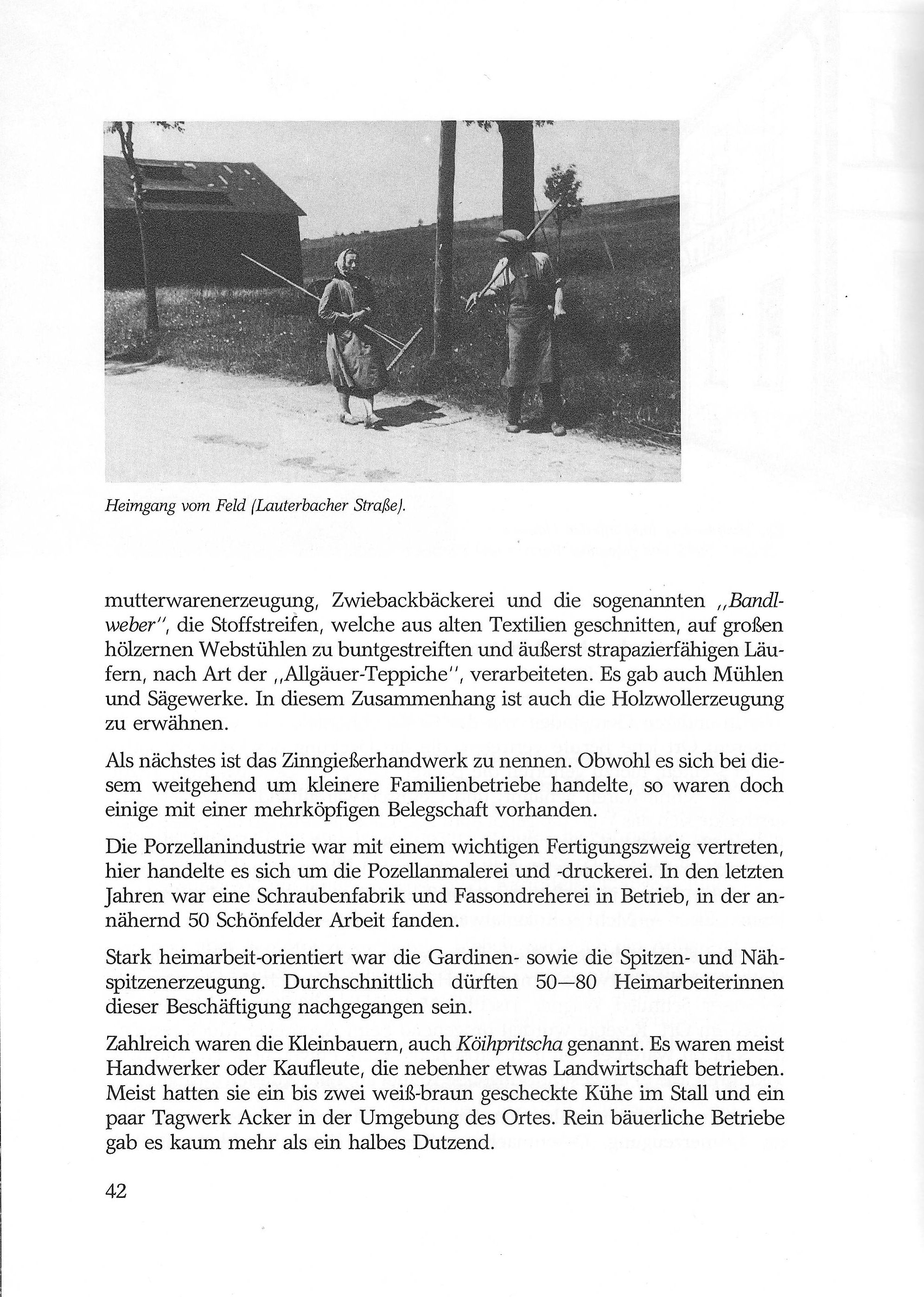 042
Return from the field (Lauterbacher Straße). Departure from the
field (Lauterbacher Strasse).
mother goods production, rusks bakery and the so-called "Bandlweber",
the strips of fabric that were cut from old textiles and processed on
large wooden looms into brightly striped and extremely hard-wearing
rugs, in the style of "Allgäu carpets". There were also mills and
sawmills.
In this context, wood wool production should also be mentioned. Next
up is the tin foundry trade. Although these were largely small family
businesses, there were still some with a workforce of several people.
The porcelain industry was represented with an important production
branch, here it was the porcelain painting and printing. In the last
few years there was a screw factory and a shape turning shop in which
almost 50 Schönfelders found work.
The curtain, lace and sewing lace production was strongly
homework-oriented. An average of 50-80 homeworkers are likely to have
had this job.
The small farmers, also called Köihpritscha, were numerous. Most of
them were artisans or merchants who did some farming on the
side. Usually they had one or two white and brown piebald cows in the
barn and a few days' work in the vicinity of the place. There were
hardly more than half a dozen purely rural businesses.
42
042
Return from the field (Lauterbacher Straße). Departure from the
field (Lauterbacher Strasse).
mother goods production, rusks bakery and the so-called "Bandlweber",
the strips of fabric that were cut from old textiles and processed on
large wooden looms into brightly striped and extremely hard-wearing
rugs, in the style of "Allgäu carpets". There were also mills and
sawmills.
In this context, wood wool production should also be mentioned. Next
up is the tin foundry trade. Although these were largely small family
businesses, there were still some with a workforce of several people.
The porcelain industry was represented with an important production
branch, here it was the porcelain painting and printing. In the last
few years there was a screw factory and a shape turning shop in which
almost 50 Schönfelders found work.
The curtain, lace and sewing lace production was strongly
homework-oriented. An average of 50-80 homeworkers are likely to have
had this job.
The small farmers, also called Köihpritscha, were numerous. Most of
them were artisans or merchants who did some farming on the
side. Usually they had one or two white and brown piebald cows in the
barn and a few days' work in the vicinity of the place. There were
hardly more than half a dozen purely rural businesses.
42
Page 0042
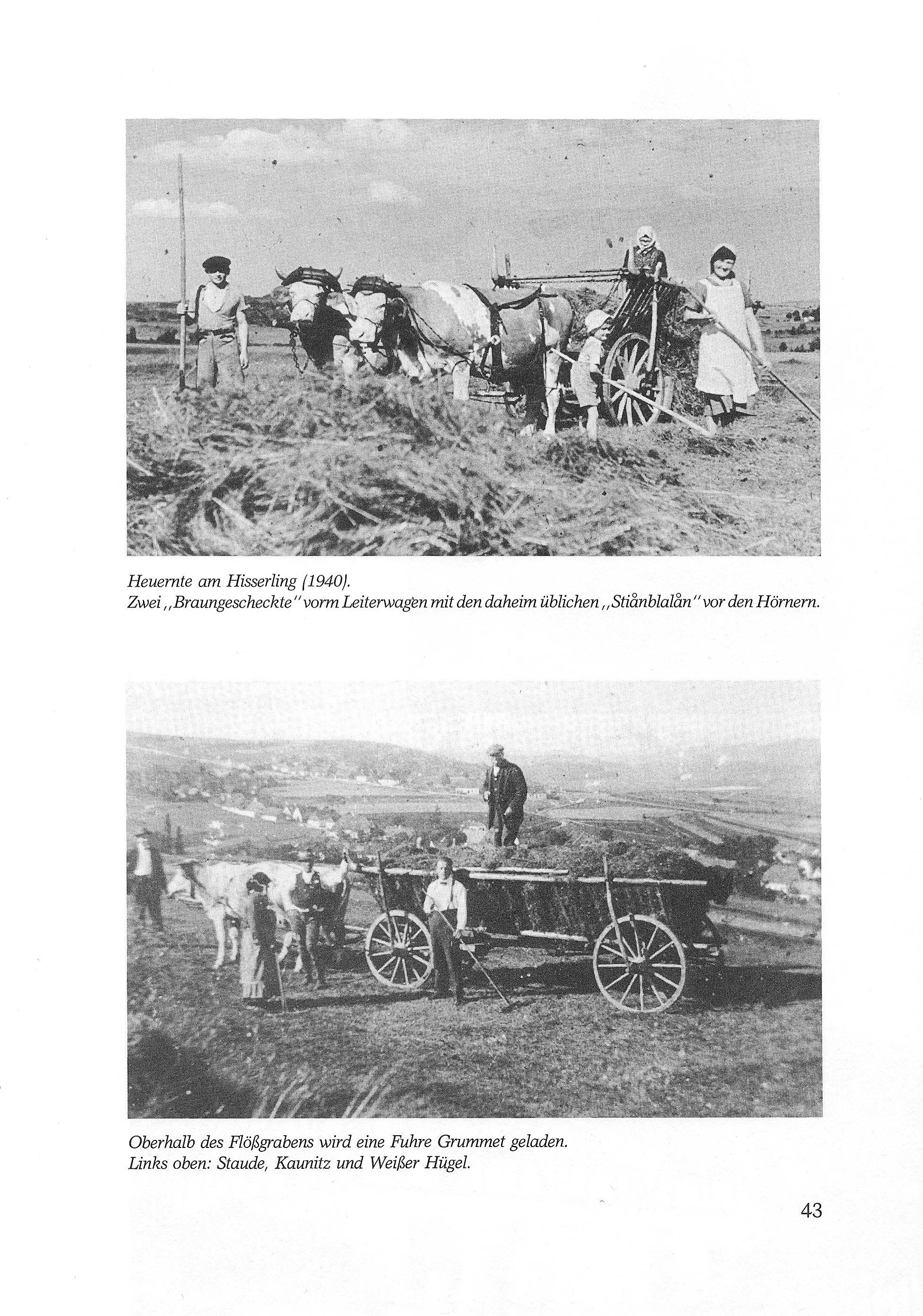 043
Top Hay harvest at Hisserling (1940). Two "brown-spotted" horses in
front of a ladder wagon with the usual "Stiånblalån" in front of
their horns. Bottom A load of grain is being loaded above the
Flößgraben. Top left: Staude, Kaunitz and Weißer Hügel.
Haymaking at Hisserling (1940).
Two "brown pied" in front of the cart with the usual
"Stiånblalån" on the horns.
bottom A load of Grummet is loaded
above the raft trench. Top left: Staude, Kaunitz and Weißer
Hügel.
043
Top Hay harvest at Hisserling (1940). Two "brown-spotted" horses in
front of a ladder wagon with the usual "Stiånblalån" in front of
their horns. Bottom A load of grain is being loaded above the
Flößgraben. Top left: Staude, Kaunitz and Weißer Hügel.
Haymaking at Hisserling (1940).
Two "brown pied" in front of the cart with the usual
"Stiånblalån" on the horns.
bottom A load of Grummet is loaded
above the raft trench. Top left: Staude, Kaunitz and Weißer
Hügel.
Page 0043
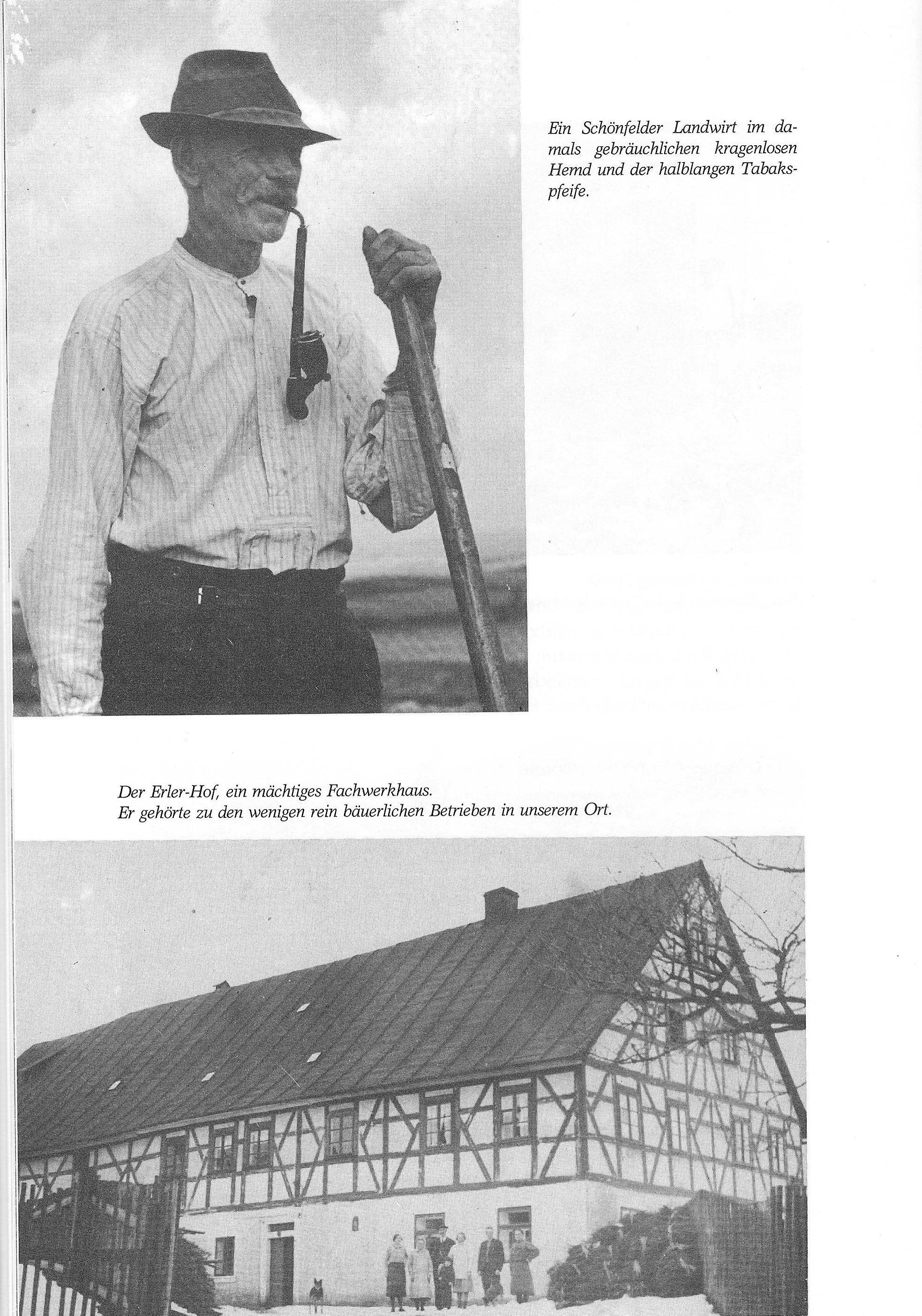 044
Pg 44 top
A Schönfeld farmer in the collarless shirt and half-length tobacco
pipe that were common at the time. A Schönfeld farmer in what was
then a collarless shirt and a half-length tobacco pipe. Pg 44 bottom
The Erler farm, a mighty half-timbered house. It was one of the few
purely agricultural businesses in our town. The Erler-Hof, a mighty
half-timbered house. It was one of the few purely farm businesses in
our town.
044
Pg 44 top
A Schönfeld farmer in the collarless shirt and half-length tobacco
pipe that were common at the time. A Schönfeld farmer in what was
then a collarless shirt and a half-length tobacco pipe. Pg 44 bottom
The Erler farm, a mighty half-timbered house. It was one of the few
purely agricultural businesses in our town. The Erler-Hof, a mighty
half-timbered house. It was one of the few purely farm businesses in
our town.
Page 0044
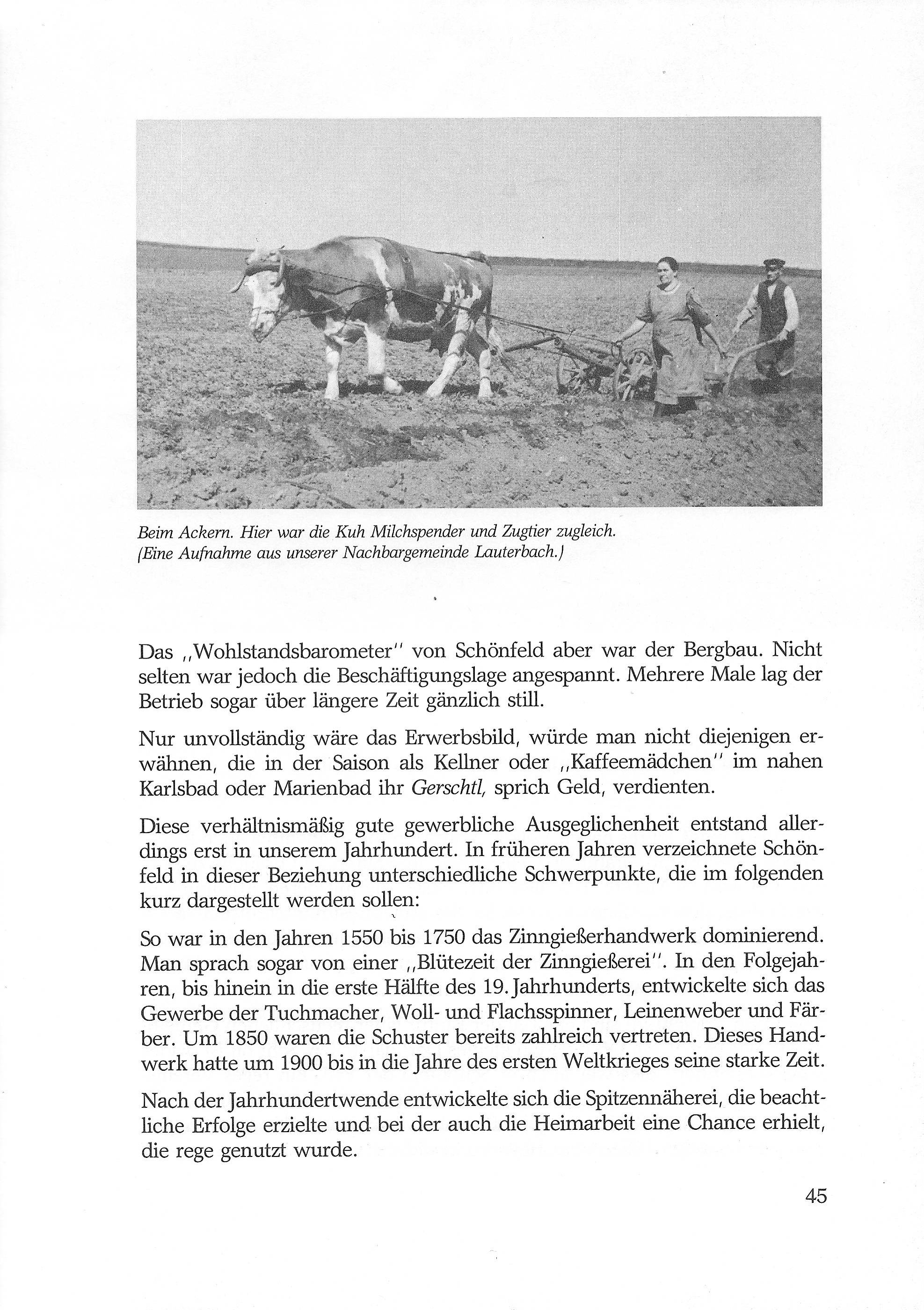 045
While working the land. Here the cow was both a milk producer and a
draft animal. (A photo from our neighboring community of Lauterbach.)
In the fields. Here the cow was both a milk donor and a draft
animal. (A picture from our neighboring community Lauterbach.)
The "prosperity barometer" of Schönfeld, however, was mining. However,
the employment situation was often tense. Several times, the business
was even completely closed for extended periods.
The picture of employment would be incomplete without mentioning those
who earned their "Gerschtl," or money, during the season as waiters or
"coffee girls" in nearby Karlovy Vary or Marienbad.
This relatively good commercial balance, however, only emerged in the
20th century. In earlier years, Schönfeld had different focuses in
this regard, which will be briefly outlined below:
For example, from 1550 to 1750, the pewter casting trade dominated. It
was even referred to as a "heyday of pewter casting." In the following
years, up until the first half of the 19th century, the trades of
cloth makers, wool and flax spinners, linen weavers, and dyers
developed. By 1850, shoemakers were already numerous. This craft
enjoyed its heyday around 1900 until the years of the First World War.
After the turn of the century, lacemaking developed, achieving
considerable success and offering home-based work a chance that was
actively utilized.
45
045
While working the land. Here the cow was both a milk producer and a
draft animal. (A photo from our neighboring community of Lauterbach.)
In the fields. Here the cow was both a milk donor and a draft
animal. (A picture from our neighboring community Lauterbach.)
The "prosperity barometer" of Schönfeld, however, was mining. However,
the employment situation was often tense. Several times, the business
was even completely closed for extended periods.
The picture of employment would be incomplete without mentioning those
who earned their "Gerschtl," or money, during the season as waiters or
"coffee girls" in nearby Karlovy Vary or Marienbad.
This relatively good commercial balance, however, only emerged in the
20th century. In earlier years, Schönfeld had different focuses in
this regard, which will be briefly outlined below:
For example, from 1550 to 1750, the pewter casting trade dominated. It
was even referred to as a "heyday of pewter casting." In the following
years, up until the first half of the 19th century, the trades of
cloth makers, wool and flax spinners, linen weavers, and dyers
developed. By 1850, shoemakers were already numerous. This craft
enjoyed its heyday around 1900 until the years of the First World War.
After the turn of the century, lacemaking developed, achieving
considerable success and offering home-based work a chance that was
actively utilized.
45
Page 0045
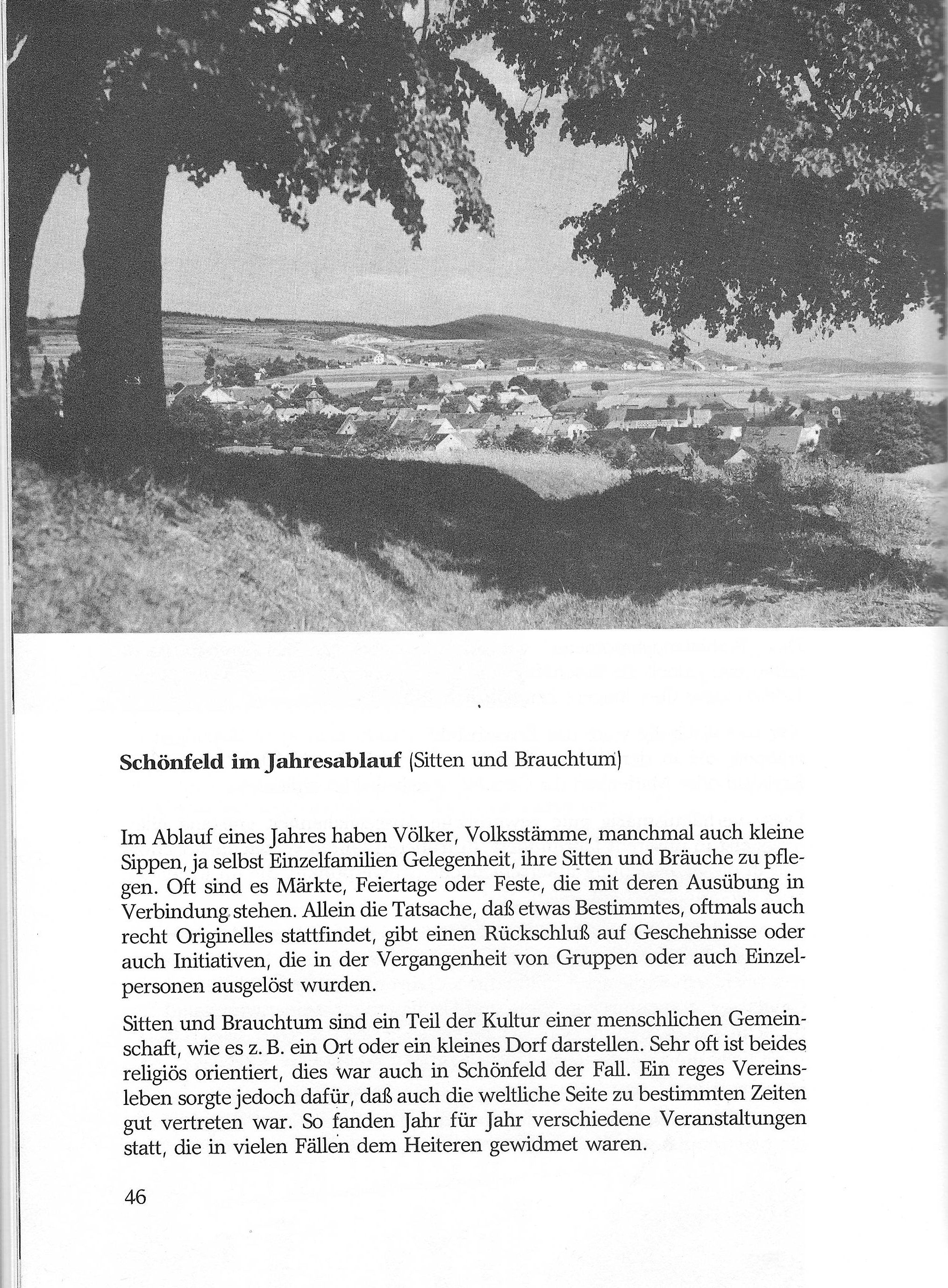 046
Schönfeld in the course of the year (customs and traditions)
In the course of a year, peoples, ethnic groups, sometimes small
clans, even single families have the opportunity to cultivate their
customs and traditions Connected. The mere fact that something
specific, often also quite original, is taking place gives a
conclusion about events or initiatives that were triggered in the past
by groups or individuals. Customs and customs are part of the culture
of a human community, as is the case e.g. B. represent a place or a
small village. Very often both are religiously oriented, this was also
the case in Schönfeld. A lively club life, however, ensured that the
secular side was also well represented at certain times. Different
events took place year after year, many of which were dedicated to
cheerfulness.
46
046
Schönfeld in the course of the year (customs and traditions)
In the course of a year, peoples, ethnic groups, sometimes small
clans, even single families have the opportunity to cultivate their
customs and traditions Connected. The mere fact that something
specific, often also quite original, is taking place gives a
conclusion about events or initiatives that were triggered in the past
by groups or individuals. Customs and customs are part of the culture
of a human community, as is the case e.g. B. represent a place or a
small village. Very often both are religiously oriented, this was also
the case in Schönfeld. A lively club life, however, ensured that the
secular side was also well represented at certain times. Different
events took place year after year, many of which were dedicated to
cheerfulness.
46
Page 0046
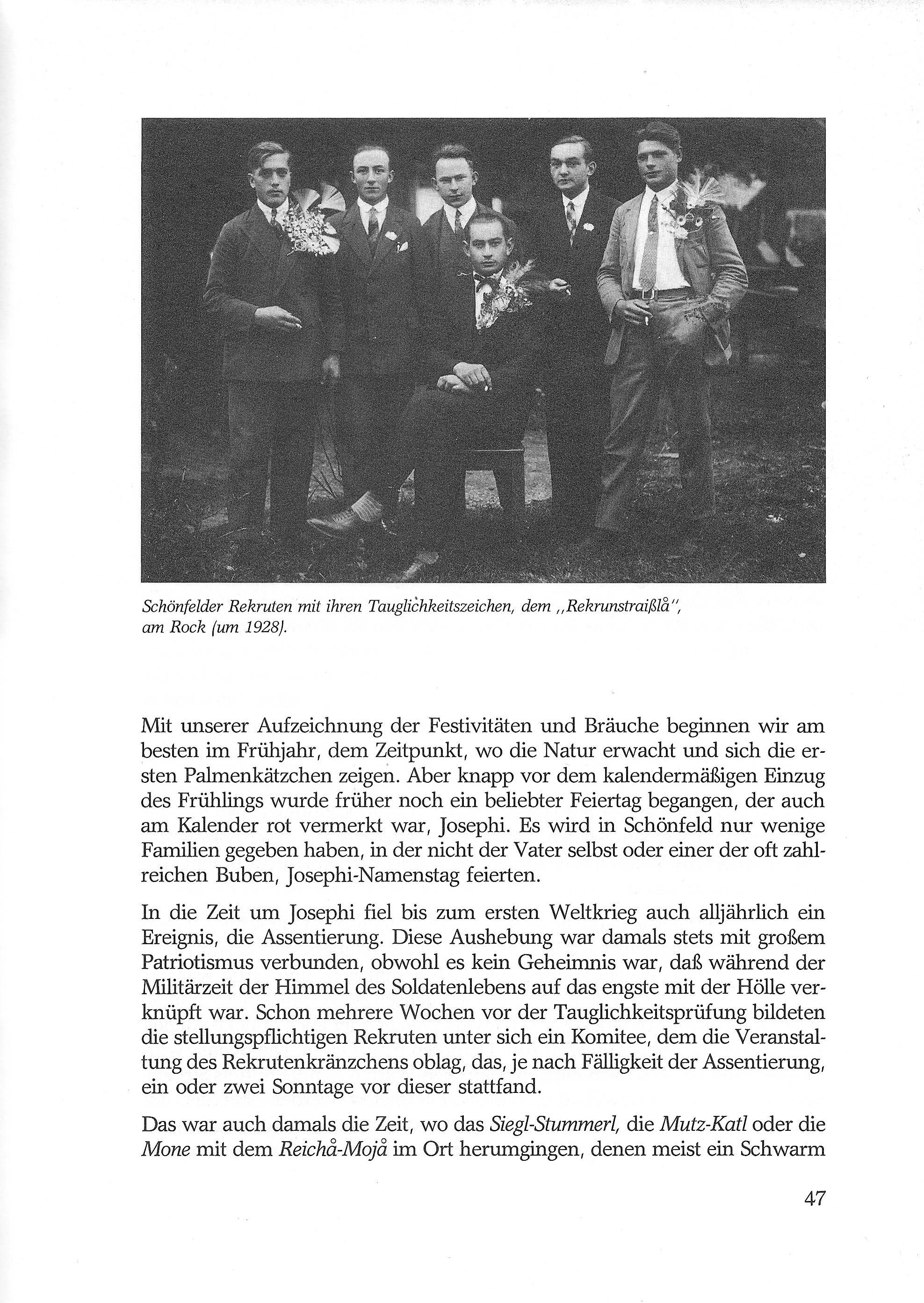 047
Schönfeld recruits with their fitness badge, the
"Rekrunstraißlå", on their coats (around 1928).
The best time to start our recording of the festivities and customs is
in spring, the time when nature awakens and the first palm kittens
appear. But shortly before the arrival of spring, a popular holiday
that was also marked in red on the calendar, Josephi, used to be
celebrated. There were only a few families in Schönfeld in which the
father himself or one of the often numerous boys did not celebrate
Josephi's name day.
In the time around Josephi and up to the First World War there was an
annual event, the notification. At that time this recruitment was
always associated with great patriotism, although it was no secret
that during the military period the heaven of a soldier's life was
intimately connected with hell. Several weeks before the aptitude
test, the recruits who were required to take the position formed a
committee that was responsible for organizing the recruits' wreath,
which, depending on the due date of the notification, took place one
or two Sundays before it. That was also the time when the
Siegl-Stummerl, the Mutz-Katl or the Mone walked around with the
Reichå-Mojå, which were usually a swarm
47
047
Schönfeld recruits with their fitness badge, the
"Rekrunstraißlå", on their coats (around 1928).
The best time to start our recording of the festivities and customs is
in spring, the time when nature awakens and the first palm kittens
appear. But shortly before the arrival of spring, a popular holiday
that was also marked in red on the calendar, Josephi, used to be
celebrated. There were only a few families in Schönfeld in which the
father himself or one of the often numerous boys did not celebrate
Josephi's name day.
In the time around Josephi and up to the First World War there was an
annual event, the notification. At that time this recruitment was
always associated with great patriotism, although it was no secret
that during the military period the heaven of a soldier's life was
intimately connected with hell. Several weeks before the aptitude
test, the recruits who were required to take the position formed a
committee that was responsible for organizing the recruits' wreath,
which, depending on the due date of the notification, took place one
or two Sundays before it. That was also the time when the
Siegl-Stummerl, the Mutz-Katl or the Mone walked around with the
Reichå-Mojå, which were usually a swarm
47
Page 0047
 048
Schoolboys followed suit to throw snowballs at the colorful eggshells
on the decorated spruce trees. Palm Sunday followed soon afterwards,
when the market was already bustling with life at dawn, as the Kramers
who had arrived the evening before were unpacking their goods, because
the Easter market also regularly took place on Palm Sunday. At 8
o'clockalready came from Rabensgrün Steffel, Rippl Annares,
Spieß, Guha, Kilian, Kristl, Hannerich, Strobl, Jessl Oswald and
whatever they were called with a murderous bundle of palm trees on
their backs to the palm consecration. At the same time, Micherl Tone,
Heß Klåra, Kastl Herrmann, Schåffer Wenz and Huwl came up
over the Tiefenbacher Berg with a no less small pack. The palm
consecration gave Sunday a particularly solemn appearance, and there
will hardly have been a house in which at least one consecrated palm
branch was not attached to the holy water kettle or a holy image as a
sign of piety and as a protector of the house.
48a
----
In the days that followed, the uninterrupted cracking showed that
Easter was just around the corner. On Maundy Thursday, it was said,
the bells died, and from then on the schoolboys marched through the
city with rattles, ratchets and, in earlier years, with junk boxes,
but even then the shooting was not forgotten. In the past, key and
carbide sockets, two very original, self-made devices were used here,
which, depending on the quality and load, produced either
Pättschå, Kråchå or even Gölsterer, in German shots, bangs
or thunderbolts. The key box was a hollow key - the bigger it was, the
better it was loaded with match caps. A reinserted iron bolt, which
was driven in various ways with one blow, caused the cargo to
explode. - The carbide canister was a canister with a well-closing
lid. Maggi rifles of all calibers were preferred. A small hole was
punched in the ground with a nail, and the gun was ready. Depending on
the size of the can, it was loaded with a piece of carbide the size of
a hazelnut. Pouring some water or spit on the carbide caused it to
vaporize or gas. The can was locked, and after a few seconds of
waiting, the explosion was triggered by means of a match flame at the
ignition hole, during which the lid usually flew off with a loud
bang. Some shooters or even helpers have pointed out that both devices
were not entirely harmless.
48b
048
Schoolboys followed suit to throw snowballs at the colorful eggshells
on the decorated spruce trees. Palm Sunday followed soon afterwards,
when the market was already bustling with life at dawn, as the Kramers
who had arrived the evening before were unpacking their goods, because
the Easter market also regularly took place on Palm Sunday. At 8
o'clockalready came from Rabensgrün Steffel, Rippl Annares,
Spieß, Guha, Kilian, Kristl, Hannerich, Strobl, Jessl Oswald and
whatever they were called with a murderous bundle of palm trees on
their backs to the palm consecration. At the same time, Micherl Tone,
Heß Klåra, Kastl Herrmann, Schåffer Wenz and Huwl came up
over the Tiefenbacher Berg with a no less small pack. The palm
consecration gave Sunday a particularly solemn appearance, and there
will hardly have been a house in which at least one consecrated palm
branch was not attached to the holy water kettle or a holy image as a
sign of piety and as a protector of the house.
48a
----
In the days that followed, the uninterrupted cracking showed that
Easter was just around the corner. On Maundy Thursday, it was said,
the bells died, and from then on the schoolboys marched through the
city with rattles, ratchets and, in earlier years, with junk boxes,
but even then the shooting was not forgotten. In the past, key and
carbide sockets, two very original, self-made devices were used here,
which, depending on the quality and load, produced either
Pättschå, Kråchå or even Gölsterer, in German shots, bangs
or thunderbolts. The key box was a hollow key - the bigger it was, the
better it was loaded with match caps. A reinserted iron bolt, which
was driven in various ways with one blow, caused the cargo to
explode. - The carbide canister was a canister with a well-closing
lid. Maggi rifles of all calibers were preferred. A small hole was
punched in the ground with a nail, and the gun was ready. Depending on
the size of the can, it was loaded with a piece of carbide the size of
a hazelnut. Pouring some water or spit on the carbide caused it to
vaporize or gas. The can was locked, and after a few seconds of
waiting, the explosion was triggered by means of a match flame at the
ignition hole, during which the lid usually flew off with a loud
bang. Some shooters or even helpers have pointed out that both devices
were not entirely harmless.
48b
Page 0048
 049
who felt it. By the early 1940s, these original utensils were almost
without exception replaced by modern firecrackers.
For Easter itself, Easter loaves were often baked days in advance in
almost every family, and many a young kid had to give its life for the
festive roast.
Another lovely custom was the sowing of Easter plates, which is
certainly still practiced in many Schönfeld families today. A
plate-sized container was filled with a layer of soil about 5
centimeters deep. The oats were sown one to two weeks before the
festival, so that by then the fresh green seeds would be about a
finger high, in which colorfully dyed eggs and usually a
papier-mâché Easter bunny were decoratively placed. Cake-shaped
rollmops tins were very popular as containers, with the fish images
and the lettering "Graby" on the outside cleverly covered with crepe
paper.
Good Friday was considered the most important fasting day of the year
and was observed as such in most families.
49a
------
The Easter highlight was the resurrection on Easter Saturday. No
solemnity of any kind was able to surpass the impression that the
resurrection procession was able to exert on the people when it came
out of the church when it was already dark, accompanied by music
around the Trinity Square and the market square.
All the clubs were represented with their flags and colorful
lanterns. The procession moved slowly and solemnly under the glow of
innumerable candles that were burning in the windows of the
surrounding houses on special slats. Torchbearers accompanied the
music and, as the head of the procession, the clergy strolling under
the sky. It was followed by the mayor and councilors in full wank,
candles burning.
It goes without saying that during the resurrection ceremony the
already mentioned firearms were badly strained and not cold, only they
were drowned out several times by the gun salute from the large
veteran cannon, the so-called firecracker, posted between church and
school.
After the resurrection, the members of the clubs that had moved out
usually went to their club halls, more or less closed, where one or
the other would stay until the reveille that took placeat 5 o'clockin
the morning, that is, Toochrewäll.
49b
049
who felt it. By the early 1940s, these original utensils were almost
without exception replaced by modern firecrackers.
For Easter itself, Easter loaves were often baked days in advance in
almost every family, and many a young kid had to give its life for the
festive roast.
Another lovely custom was the sowing of Easter plates, which is
certainly still practiced in many Schönfeld families today. A
plate-sized container was filled with a layer of soil about 5
centimeters deep. The oats were sown one to two weeks before the
festival, so that by then the fresh green seeds would be about a
finger high, in which colorfully dyed eggs and usually a
papier-mâché Easter bunny were decoratively placed. Cake-shaped
rollmops tins were very popular as containers, with the fish images
and the lettering "Graby" on the outside cleverly covered with crepe
paper.
Good Friday was considered the most important fasting day of the year
and was observed as such in most families.
49a
------
The Easter highlight was the resurrection on Easter Saturday. No
solemnity of any kind was able to surpass the impression that the
resurrection procession was able to exert on the people when it came
out of the church when it was already dark, accompanied by music
around the Trinity Square and the market square.
All the clubs were represented with their flags and colorful
lanterns. The procession moved slowly and solemnly under the glow of
innumerable candles that were burning in the windows of the
surrounding houses on special slats. Torchbearers accompanied the
music and, as the head of the procession, the clergy strolling under
the sky. It was followed by the mayor and councilors in full wank,
candles burning.
It goes without saying that during the resurrection ceremony the
already mentioned firearms were badly strained and not cold, only they
were drowned out several times by the gun salute from the large
veteran cannon, the so-called firecracker, posted between church and
school.
After the resurrection, the members of the clubs that had moved out
usually went to their club halls, more or less closed, where one or
the other would stay until the reveille that took placeat 5 o'clockin
the morning, that is, Toochrewäll.
49b
Page 0049
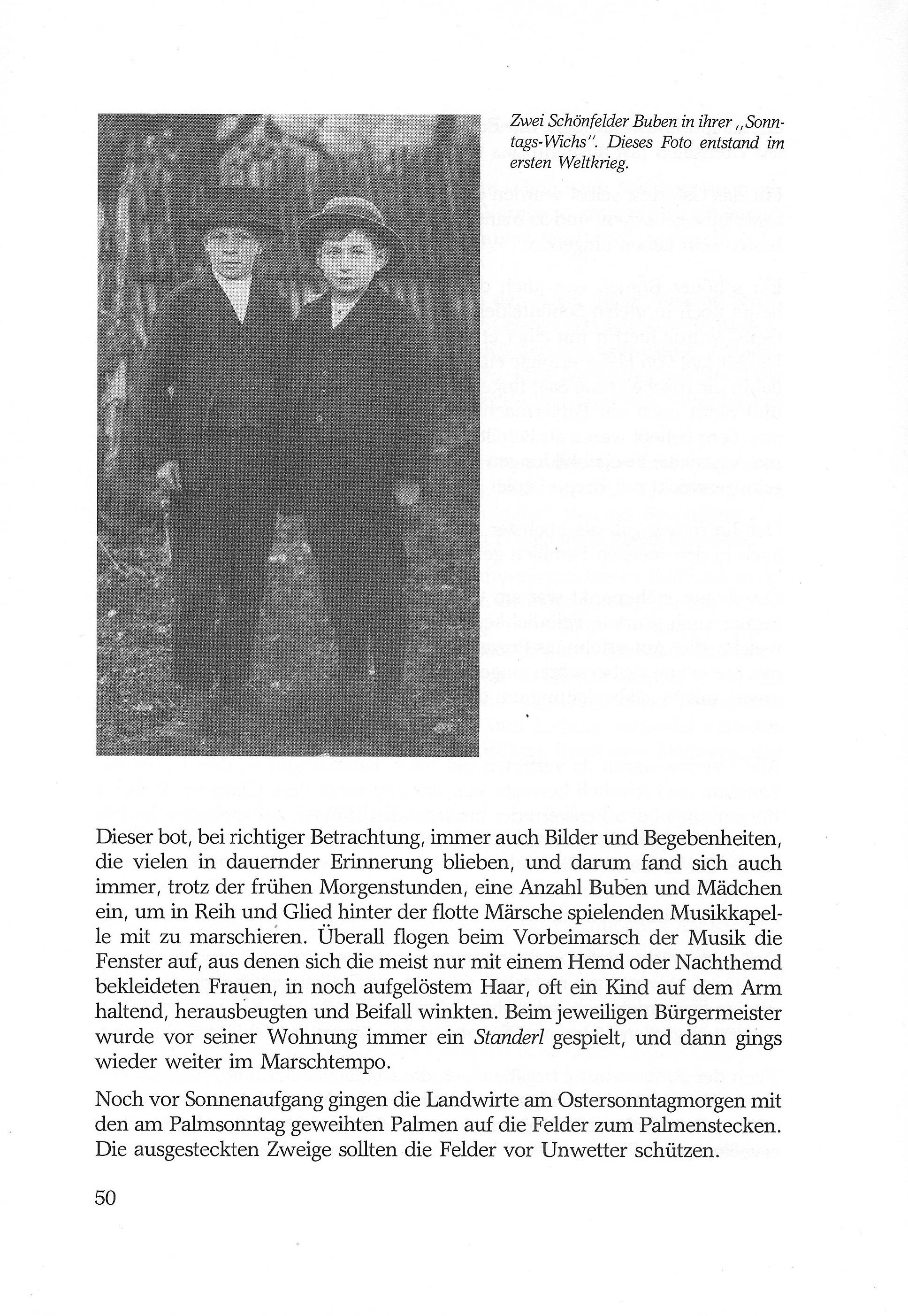 050
Two Schönfeld boys in their "Sunday wanking". This photo was taken in
the First World War.
When viewed properly, this always offered pictures and events that
many remained in permanent memory, and that is why, despite the early
morning hours, a number of boys and girls were always there to join
the band behind the brisk marches - le to march with. Everywhere, as
the music marched past, the windows flew open, from which the women,
mostly clad only in a shirt or nightgown, with their hair still loose,
often holding a child in their arms, leaned out and waved applause. At
the respective mayor's house, a stall was always played in front of
his apartment, and then it went on at a marching pace. Even before
sunrise, the farmers went to the fields on EasterSunday morningwith
the palm trees consecrated on Palm Sunday. The unplugged branches
should protect the fields from
50
050
Two Schönfeld boys in their "Sunday wanking". This photo was taken in
the First World War.
When viewed properly, this always offered pictures and events that
many remained in permanent memory, and that is why, despite the early
morning hours, a number of boys and girls were always there to join
the band behind the brisk marches - le to march with. Everywhere, as
the music marched past, the windows flew open, from which the women,
mostly clad only in a shirt or nightgown, with their hair still loose,
often holding a child in their arms, leaned out and waved applause. At
the respective mayor's house, a stall was always played in front of
his apartment, and then it went on at a marching pace. Even before
sunrise, the farmers went to the fields on EasterSunday morningwith
the palm trees consecrated on Palm Sunday. The unplugged branches
should protect the fields from
50
Page 0050
 051
The following month began with the "April Fools' Day" which is not
only common in Schönfeld. The most simple and popular order from the
large series of jokes was to buy fence stakes or wagon shaft seeds
from the pharmacy or a shop, which of course only the most
inexperienced fell for. April was also the high season for the ball
games Eintschegen and Anradefn, which are so popular with
children. Each district had two or three free and sunny spots which
were teeming with school children of all ages and genders. For many
homeowners this was the most annoying time of the whole year, as it
was quite loud and it was not uncommon for fights to break out.
May brought us several popular holidays in our homeland, and
especially in earlier years. May Day, which is now celebrated as a
holiday almost all over the world, never achieved this significance in
our industrially poor and therefore predominantly middle-class
Schönfeld. The assistants working for wages in industrial professions
and the porcelain painters largely adapted to the political leanings
of their masters and employers, who were naturally opposed to the
introduction of socialism, which included the May Day celebrations
with their demands for an eight-hour day.
But just as the political May Day celebrations in Schönfeld were not
popular, the same thing happened to the traditional folk May Day
celebrations in the villages, which were generally known as the May
Dance. Every year, larger and smaller groups of young girls and boys
went out to the surrounding villages for the May Dances, but in
Schönfeld itself this custom did not take hold. After two attempts at
the Talhâusl in the 1920s to make the May Dance a custom in
Schönfeld, the plan was abandoned despite good attendance; perhaps
also because no one wanted to play the role of the Plozmoåd, the
Plotzknecht, the woodcutter and the food-carrying woman, who were part
of a real May dance. Only once in the 1930s did an attempt take place
in the garden of the Kreuzzeche, probably on the initiative of the
then landlord, Vogl Emil., and no further attempts followed. Only
after the annexation to the Reich was a maypole seen again in
Schönfeld, but this time without the woodcutter and the food-carrying
woman, because from that point on politics and uniforms dominated in
this context.
As a religious holiday in the first half of May we could sometimes
celebrate Ascension Day and St. John of Nepomuk, which always falls on
May 16th and was also considered the last date for planting potatoes
by those who were late.
51
051
The following month began with the "April Fools' Day" which is not
only common in Schönfeld. The most simple and popular order from the
large series of jokes was to buy fence stakes or wagon shaft seeds
from the pharmacy or a shop, which of course only the most
inexperienced fell for. April was also the high season for the ball
games Eintschegen and Anradefn, which are so popular with
children. Each district had two or three free and sunny spots which
were teeming with school children of all ages and genders. For many
homeowners this was the most annoying time of the whole year, as it
was quite loud and it was not uncommon for fights to break out.
May brought us several popular holidays in our homeland, and
especially in earlier years. May Day, which is now celebrated as a
holiday almost all over the world, never achieved this significance in
our industrially poor and therefore predominantly middle-class
Schönfeld. The assistants working for wages in industrial professions
and the porcelain painters largely adapted to the political leanings
of their masters and employers, who were naturally opposed to the
introduction of socialism, which included the May Day celebrations
with their demands for an eight-hour day.
But just as the political May Day celebrations in Schönfeld were not
popular, the same thing happened to the traditional folk May Day
celebrations in the villages, which were generally known as the May
Dance. Every year, larger and smaller groups of young girls and boys
went out to the surrounding villages for the May Dances, but in
Schönfeld itself this custom did not take hold. After two attempts at
the Talhâusl in the 1920s to make the May Dance a custom in
Schönfeld, the plan was abandoned despite good attendance; perhaps
also because no one wanted to play the role of the Plozmoåd, the
Plotzknecht, the woodcutter and the food-carrying woman, who were part
of a real May dance. Only once in the 1930s did an attempt take place
in the garden of the Kreuzzeche, probably on the initiative of the
then landlord, Vogl Emil., and no further attempts followed. Only
after the annexation to the Reich was a maypole seen again in
Schönfeld, but this time without the woodcutter and the food-carrying
woman, because from that point on politics and uniforms dominated in
this context.
As a religious holiday in the first half of May we could sometimes
celebrate Ascension Day and St. John of Nepomuk, which always falls on
May 16th and was also considered the last date for planting potatoes
by those who were late.
51
Page 0051
 052
The next festival, which usually fell in May, was Pentecost. But this
too had lost a lot of its importance after 1900. However, Pentecost
excursions were still popular. In good weather, large and small groups
would go with children and families to Krudum and the villages of
Kohling and Dreihäuser at its feet. Others preferred the Neudorfer
Mühle, and in recent years our beautiful observation tower with its
restaurant has been a popular excursion destination. Those who did not
want to climb a mountain settled down at the Talhäusl. Good hikers,
on the other hand, took an excursion to Almbrünnl, Wolfstein or
Glatzn.
But Pentecost also offered the opportunity for a contemplative and
religious excursion, which, according to old custom, consisted of the
pilgrimage to Maria Kulm, which began every year on Pentecost
Saturday. In addition to the pilgrimage church, a lively market bustle
awaited the pilgrims, hence the saying "zouganga is, woi Pfingstn in
Kulm"
No one will forget that in our old homeland we often celebrated the
Neudorf festival on Holy Trinity Sunday, which falls after Pentecost,
and we will even less forget the Corpus Christi day that followed with
its festivities. Thousands of flowers were picked the day before so
that every girl could get her wreath and have a full basket to scatter
flowers.
The solemn procession with the band then moved out of the church on a
carpet made of grass towards the market square. The first stop was the
Fuhrmann House. Here was one of the four altars made of images and
figures of saints and lined with young birch trees, where the priest
read the gospel. After singing the Corpus Christi song "Oh, Angel of
God hurries down," the procession, the girls dressed in white leading
the way, scattering flowers, moved to the second altar, which was in
Hubl Franz's house, where it was picked up again. At the lower end of
the market square, the procession turned towards the Longer Bridge and
then went up the winter side to Eckl Wilhelm's altar and after the
ceremony to the fourth and last altar, which was set up at the
Gaßbeckhaus (Ruppert Edwin). A mysterious feeling always spread
among the procession participants when the priest gave the blessing,
the cannon shots from the large funnel-shaped cannon thundered through
the village and the command to hand over the flag was given at the
veterans' association.
After the procession had ended, the altars were carefully dismantled
and then a veritable storm on the birch twigs, called Maier, broke
out, which some people could not get enough of, and especially the
farmers of the
52
052
The next festival, which usually fell in May, was Pentecost. But this
too had lost a lot of its importance after 1900. However, Pentecost
excursions were still popular. In good weather, large and small groups
would go with children and families to Krudum and the villages of
Kohling and Dreihäuser at its feet. Others preferred the Neudorfer
Mühle, and in recent years our beautiful observation tower with its
restaurant has been a popular excursion destination. Those who did not
want to climb a mountain settled down at the Talhäusl. Good hikers,
on the other hand, took an excursion to Almbrünnl, Wolfstein or
Glatzn.
But Pentecost also offered the opportunity for a contemplative and
religious excursion, which, according to old custom, consisted of the
pilgrimage to Maria Kulm, which began every year on Pentecost
Saturday. In addition to the pilgrimage church, a lively market bustle
awaited the pilgrims, hence the saying "zouganga is, woi Pfingstn in
Kulm"
No one will forget that in our old homeland we often celebrated the
Neudorf festival on Holy Trinity Sunday, which falls after Pentecost,
and we will even less forget the Corpus Christi day that followed with
its festivities. Thousands of flowers were picked the day before so
that every girl could get her wreath and have a full basket to scatter
flowers.
The solemn procession with the band then moved out of the church on a
carpet made of grass towards the market square. The first stop was the
Fuhrmann House. Here was one of the four altars made of images and
figures of saints and lined with young birch trees, where the priest
read the gospel. After singing the Corpus Christi song "Oh, Angel of
God hurries down," the procession, the girls dressed in white leading
the way, scattering flowers, moved to the second altar, which was in
Hubl Franz's house, where it was picked up again. At the lower end of
the market square, the procession turned towards the Longer Bridge and
then went up the winter side to Eckl Wilhelm's altar and after the
ceremony to the fourth and last altar, which was set up at the
Gaßbeckhaus (Ruppert Edwin). A mysterious feeling always spread
among the procession participants when the priest gave the blessing,
the cannon shots from the large funnel-shaped cannon thundered through
the village and the command to hand over the flag was given at the
veterans' association.
After the procession had ended, the altars were carefully dismantled
and then a veritable storm on the birch twigs, called Maier, broke
out, which some people could not get enough of, and especially the
farmers of the
52
Page 0052
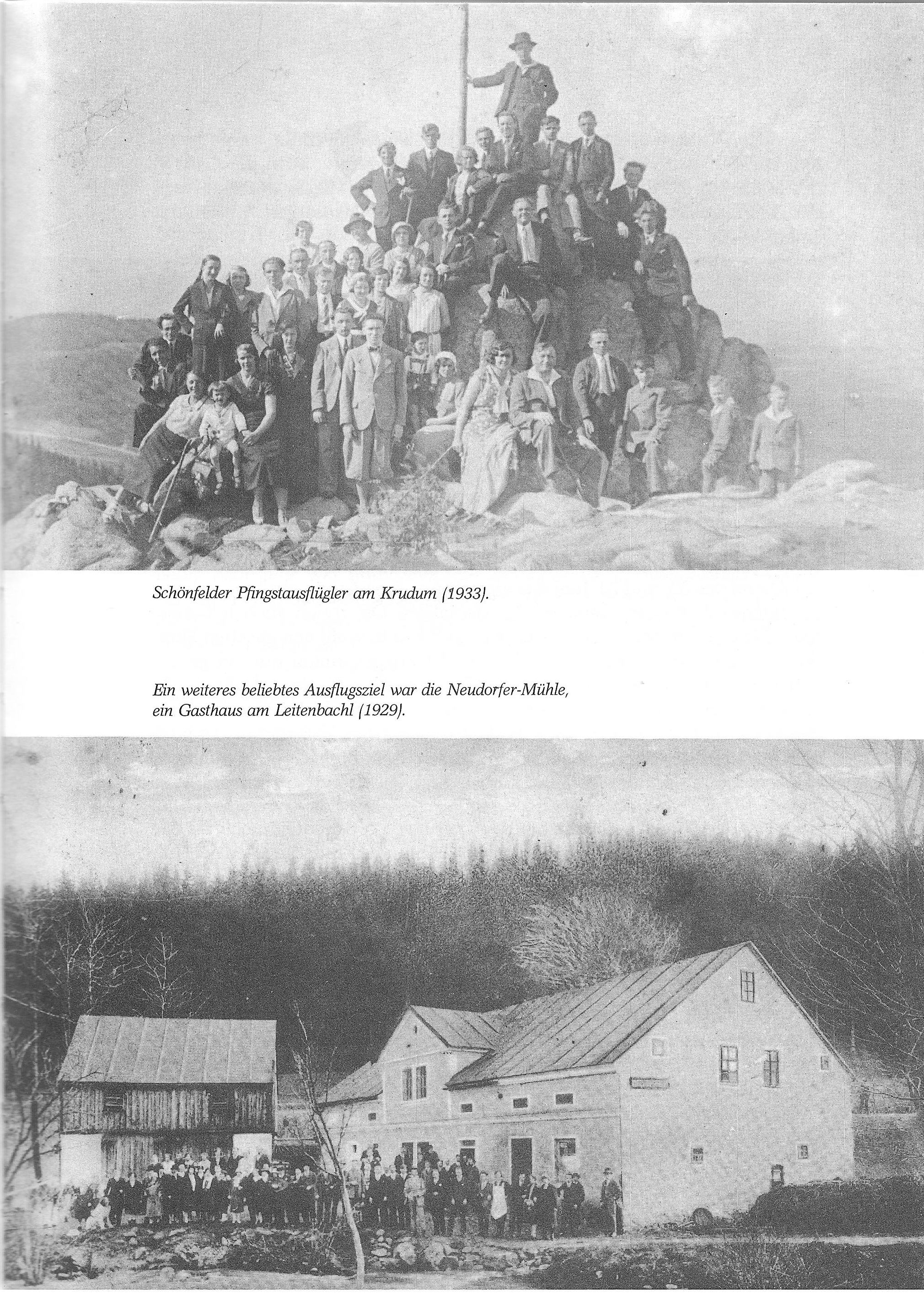 053
53 top
Schönfeld Whitsun (Pentecost) excursionists at Krudum (1933).
53 bottom
Another popular excursion destination was the Neudorfer Mill, an inn
at Leitenbachl (1929).
053
53 top
Schönfeld Whitsun (Pentecost) excursionists at Krudum (1933).
53 bottom
Another popular excursion destination was the Neudorfer Mill, an inn
at Leitenbachl (1929).
Page 0053
 054
The surrounding villages captured quantities they could only carry
with difficulty. To ward off harm and bring blessings, the Maier's
twigs were placed in the fields, under the roofs, and in the
stables. The altar and the house blessing hanging above the living
room door were also decorated with a twig.
June 21st was the next date that brought the population to their feet
for the solstice celebration. However, this didn't happen until 1911
or 1912. That was the first time that gymnasts and veterans marched
together to the upper White Hill to celebrate the solstice.
But it wasn't until the years after the First World War, when we came
under Czech rule, that this celebration gained significance. From then
on, it was held regularly, although this ancient custom was placed in
the service of national and political interests. In the critical
1930s, the solstice celebration was considered subversive and banned
by the Czech authorities.
In the years before the First World War, instead of the solstice
celebration, the so-called Konesfeuerl (Cones Fire), which was also
called St. John's Fire in other German regions of what was then
Austria, was held on the evenings of June 23rd and 24th. The solstice
fire and the Konesfeuerl (Cones Fire) probably had the same purpose,
the only difference being that in the former, only one large fire was
lit, whereas in the Konesfeuerl (Cones Fire), almost every schoolboy
had his own fire or at least a torch. In addition to the joy of the
flickering fire, the young people also enjoyed jumping over the
flames. Even those who considered themselves newlyweds insisted on
jumping hand in hand over the Konesfeuerl at least three times.
In the following month, up until the turn of the century, the people
of Schönfeld commemorated the fateful fire day, July 7, 1848, every
year, when, within the first three hours of the afternoon, over 200
residential and commercial buildings were destroyed by a devastating
conflagration. In the years following the fire, work ceased on this
day in remembrance of this catastrophe. The population attended Holy
Mass, during which the fire song referring to the disaster was sung.
Shortly after this memorial day, Eger Sunday followed, or as we called
it, the "Echrischn," derived from the once large pilgrimage
processions that once made their way from Eger and the surrounding
area to Schönfeld every year on the second Sunday in July to offer
their devotions before the grace-filled Schönfeld statue of the Mother
of God and to be heard by her.
54
054
The surrounding villages captured quantities they could only carry
with difficulty. To ward off harm and bring blessings, the Maier's
twigs were placed in the fields, under the roofs, and in the
stables. The altar and the house blessing hanging above the living
room door were also decorated with a twig.
June 21st was the next date that brought the population to their feet
for the solstice celebration. However, this didn't happen until 1911
or 1912. That was the first time that gymnasts and veterans marched
together to the upper White Hill to celebrate the solstice.
But it wasn't until the years after the First World War, when we came
under Czech rule, that this celebration gained significance. From then
on, it was held regularly, although this ancient custom was placed in
the service of national and political interests. In the critical
1930s, the solstice celebration was considered subversive and banned
by the Czech authorities.
In the years before the First World War, instead of the solstice
celebration, the so-called Konesfeuerl (Cones Fire), which was also
called St. John's Fire in other German regions of what was then
Austria, was held on the evenings of June 23rd and 24th. The solstice
fire and the Konesfeuerl (Cones Fire) probably had the same purpose,
the only difference being that in the former, only one large fire was
lit, whereas in the Konesfeuerl (Cones Fire), almost every schoolboy
had his own fire or at least a torch. In addition to the joy of the
flickering fire, the young people also enjoyed jumping over the
flames. Even those who considered themselves newlyweds insisted on
jumping hand in hand over the Konesfeuerl at least three times.
In the following month, up until the turn of the century, the people
of Schönfeld commemorated the fateful fire day, July 7, 1848, every
year, when, within the first three hours of the afternoon, over 200
residential and commercial buildings were destroyed by a devastating
conflagration. In the years following the fire, work ceased on this
day in remembrance of this catastrophe. The population attended Holy
Mass, during which the fire song referring to the disaster was sung.
Shortly after this memorial day, Eger Sunday followed, or as we called
it, the "Echrischn," derived from the once large pilgrimage
processions that once made their way from Eger and the surrounding
area to Schönfeld every year on the second Sunday in July to offer
their devotions before the grace-filled Schönfeld statue of the Mother
of God and to be heard by her.
54
Page 0054
 055
In the years after 1900, the importance of the Echrischn lay mainly in
the annual fair. However, this lost much of its former size and
importance due to the gradual cessation of the large processions, as
only a few people from the surrounding area - especially the people
from Neudorf, who remained true to this tradition for a long time -
visited the pilgrimage site in our home town.
The summer was also the high season in Filz, where the inexpensive
fuel, the peat bricks, were cut and dried. Filled into sacks and
stowed on handcarts, the brown cargo then rattled down Lauterbacher
Strasse to the storage area in the shed or barn.
But while some in Filz secured their fuel for the often very harsh
winter by the sweat of their brow, others, mostly young people,
frolicked in the refreshing waters of the Ebmet or Sackdamm. The Old
and New Ponds in Muckengrund probably only attracted a few
individualists. The Flößgraben, with its low temperatures not
exactly suitable for bathing, also had its customers. It was mainly
school children who used it. One popular bathing spot was at the Boum-
u Meu(d)l-Bruck. Because of the dam building that was often practiced
there, during which some of the bank reinforcement stones were torn
off and used, this was not in the interest of the ditch
supervisors. So, after the alarm call, "there's a big dam here!", you
could often see the little Adams and Eves "daggering" across the
meadows in all directions.
In the period that followed, when the Köhbl. the parish and hospital
fields, where numerous brightly painted dragons laughed down from the
air, wagging their tails, the description of the potato fires, so
aptly described by Karl Haller and reproduced here in extracts, comes
to mind:
There was hardly a potato field on which a fire did not blaze during
the harvest. The boys of the field owners or the potato diggers, and
sometimes even the potato diggers themselves, gathered the already dry
herb, called "Eadöppikraiterich", into a pile to light the popular
fire, into which a number of not too large potatoes were thrown and
roasted in the most primitive way imaginable, but whose tastiness was
hardly surpassed by anything else edible. Old and young alike would
pull these roasted potatoes out of the fire and from the glowing ashes
with equal joy and devotion, in order to eat them as a rare delicacy
in a state almost burning to the touch. The fact that these roasted
potatoes had field soil and ashes on them played no role at all; they
were eaten with skin and hair and were considered a food for the gods
even when they were half charred.
55
055
In the years after 1900, the importance of the Echrischn lay mainly in
the annual fair. However, this lost much of its former size and
importance due to the gradual cessation of the large processions, as
only a few people from the surrounding area - especially the people
from Neudorf, who remained true to this tradition for a long time -
visited the pilgrimage site in our home town.
The summer was also the high season in Filz, where the inexpensive
fuel, the peat bricks, were cut and dried. Filled into sacks and
stowed on handcarts, the brown cargo then rattled down Lauterbacher
Strasse to the storage area in the shed or barn.
But while some in Filz secured their fuel for the often very harsh
winter by the sweat of their brow, others, mostly young people,
frolicked in the refreshing waters of the Ebmet or Sackdamm. The Old
and New Ponds in Muckengrund probably only attracted a few
individualists. The Flößgraben, with its low temperatures not
exactly suitable for bathing, also had its customers. It was mainly
school children who used it. One popular bathing spot was at the Boum-
u Meu(d)l-Bruck. Because of the dam building that was often practiced
there, during which some of the bank reinforcement stones were torn
off and used, this was not in the interest of the ditch
supervisors. So, after the alarm call, "there's a big dam here!", you
could often see the little Adams and Eves "daggering" across the
meadows in all directions.
In the period that followed, when the Köhbl. the parish and hospital
fields, where numerous brightly painted dragons laughed down from the
air, wagging their tails, the description of the potato fires, so
aptly described by Karl Haller and reproduced here in extracts, comes
to mind:
There was hardly a potato field on which a fire did not blaze during
the harvest. The boys of the field owners or the potato diggers, and
sometimes even the potato diggers themselves, gathered the already dry
herb, called "Eadöppikraiterich", into a pile to light the popular
fire, into which a number of not too large potatoes were thrown and
roasted in the most primitive way imaginable, but whose tastiness was
hardly surpassed by anything else edible. Old and young alike would
pull these roasted potatoes out of the fire and from the glowing ashes
with equal joy and devotion, in order to eat them as a rare delicacy
in a state almost burning to the touch. The fact that these roasted
potatoes had field soil and ashes on them played no role at all; they
were eaten with skin and hair and were considered a food for the gods
even when they were half charred.
55
Page 0055
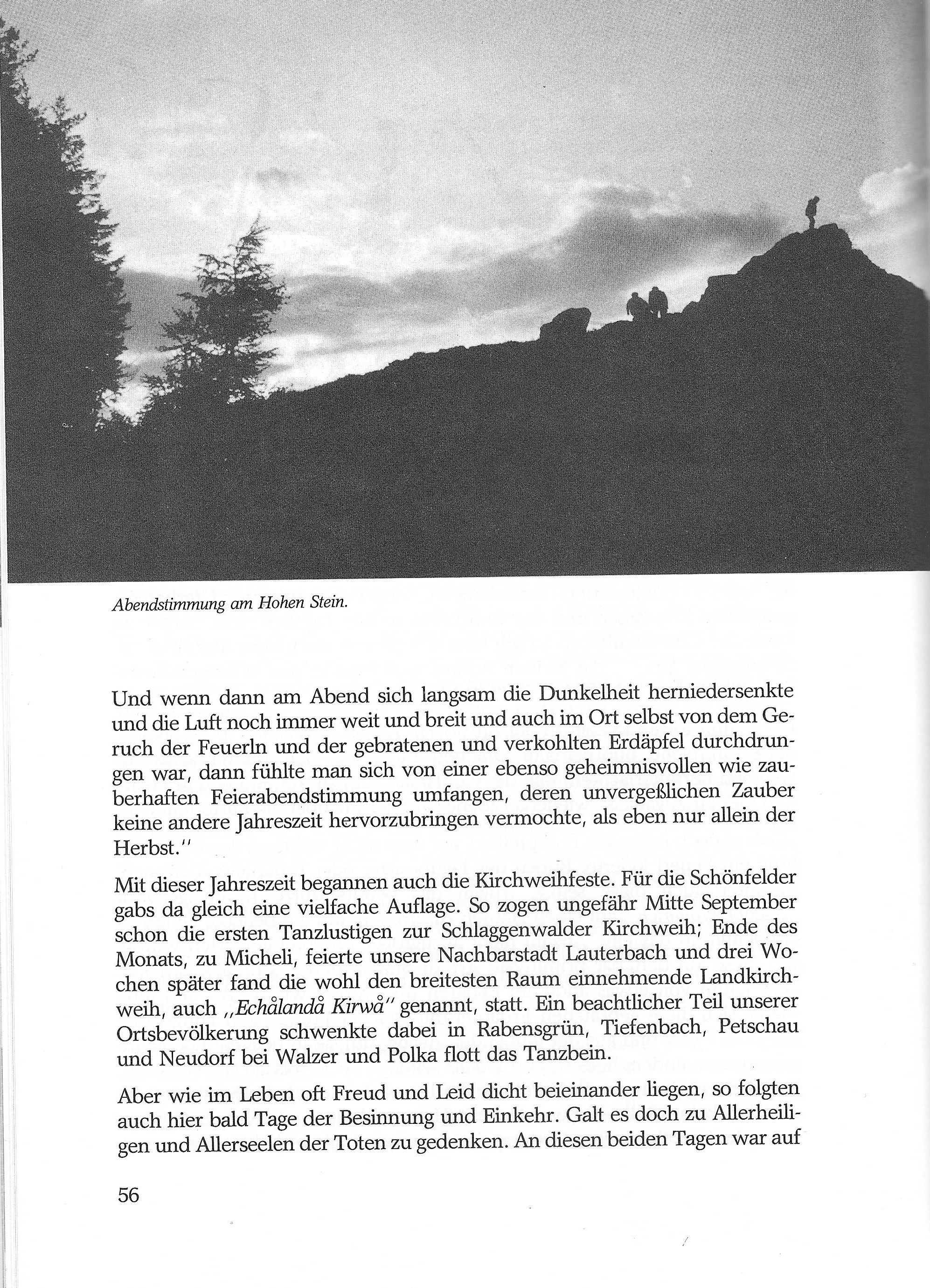 056
Evening atmosphere at the Hohen Stein.
And when darkness slowly descended in the evening and the air was
still filled with the smell of fires and roasted and charred potatoes
far and wide, even in the village itself, then one felt enveloped in
an evening atmosphere that was as mysterious as it was magical, whose
unforgettable magic no other season could produce except autumn.
This season also marked the beginning of the church festivals. For the
Schönfelders
there were many editions of them. So around mid-September, the first
people who wanted to dance went to the Schlaggenwald church fair: at
the end of the month, on St. Michael's Day, our neighboring town of
Lauterbach celebrated and three weeks later the country church fair,
also called the "Echålandd Kirwa", took place, which probably took
up the most space. A considerable part of our local population danced
briskly to the waltz and polka in Rabensgrün, Tiefenbach, Petschau
and Neudorf. But as joy and sorrow often lie close together in life,
days of reflection and contemplation soon followed. After all, it was
important to remember the dead on All Hallows' Day and All Souls'
Day. On these two days, on
56
056
Evening atmosphere at the Hohen Stein.
And when darkness slowly descended in the evening and the air was
still filled with the smell of fires and roasted and charred potatoes
far and wide, even in the village itself, then one felt enveloped in
an evening atmosphere that was as mysterious as it was magical, whose
unforgettable magic no other season could produce except autumn.
This season also marked the beginning of the church festivals. For the
Schönfelders
there were many editions of them. So around mid-September, the first
people who wanted to dance went to the Schlaggenwald church fair: at
the end of the month, on St. Michael's Day, our neighboring town of
Lauterbach celebrated and three weeks later the country church fair,
also called the "Echålandd Kirwa", took place, which probably took
up the most space. A considerable part of our local population danced
briskly to the waltz and polka in Rabensgrün, Tiefenbach, Petschau
and Neudorf. But as joy and sorrow often lie close together in life,
days of reflection and contemplation soon followed. After all, it was
important to remember the dead on All Hallows' Day and All Souls'
Day. On these two days, on
56
Page 0056
 057
There was a lot of activity on Petschauer Straße between the town
and the cemetery, as everyone was out and about decorating the graves
of deceased relatives or acquaintances. At this time of year people
were already wearing quite warm clothing and the landscape was mostly
wearing its first light white dress, confirming the old saying:
"Oållähaaling kinnt då Schnäi gaaling!"
Not quite two weeks later the so-called winter or St. Martin's fair
followed, which in the last years in which we still lived in our
ancestral homeland was not as important as it was in the earlier years
up to the First World War.
In general, St. Martin's Day was the first time of the year that the
geese were caught, and many a virgin shelduck had to give up its life
in order to provide a tasty roast for the fair.
Fair Monday was a fair, and in the past the dance music began in the
afternoon and continued on Tuesday.
When the sounds of the fair had died away and the last quark,
Streußl or Powidl cake had been consumed, the day of the patron
saint of music followed on 22 November. Cecilia, known in Schönfeld as
"Kuhnfünferl" (presumably derived from the Latin "Convivion"
meaning happy get-together). Even though the Kuhnfünferl was only a
festive occasion for the musicians, it was also an experience for many
others to attend the procession of music, which was connected to a
visit to the church service.
Just three days later, the Katharina Festival took place, which, since
our church was dedicated to Saint Catherine, was also the church
festival.
On this day, the traditional festive pastry was the Köichlå, and
the little Katherl attached just as much importance to her name day,
which was already one of the most common in the past, as a Kathe in
her prime or an elderly Kathl. In the 1920s, the Katharina Festival
was moved to the following Sunday for economic reasons, which
completely lost its former glory.
This celebration usually also marked the end of the series of
weddings, which did not have any unusual features in terms of their
course. There was the usual bridal shower with the "lucky" pile of
porcelain shards in front of the bride's front door, and depending on
the club they belonged to, a stand was sometimes sung or played.
After the ceremony, the bride and groom usually drove to the wedding
reception in a carriage or
"Scheesn", as we called it. On the way there,
57
057
There was a lot of activity on Petschauer Straße between the town
and the cemetery, as everyone was out and about decorating the graves
of deceased relatives or acquaintances. At this time of year people
were already wearing quite warm clothing and the landscape was mostly
wearing its first light white dress, confirming the old saying:
"Oållähaaling kinnt då Schnäi gaaling!"
Not quite two weeks later the so-called winter or St. Martin's fair
followed, which in the last years in which we still lived in our
ancestral homeland was not as important as it was in the earlier years
up to the First World War.
In general, St. Martin's Day was the first time of the year that the
geese were caught, and many a virgin shelduck had to give up its life
in order to provide a tasty roast for the fair.
Fair Monday was a fair, and in the past the dance music began in the
afternoon and continued on Tuesday.
When the sounds of the fair had died away and the last quark,
Streußl or Powidl cake had been consumed, the day of the patron
saint of music followed on 22 November. Cecilia, known in Schönfeld as
"Kuhnfünferl" (presumably derived from the Latin "Convivion"
meaning happy get-together). Even though the Kuhnfünferl was only a
festive occasion for the musicians, it was also an experience for many
others to attend the procession of music, which was connected to a
visit to the church service.
Just three days later, the Katharina Festival took place, which, since
our church was dedicated to Saint Catherine, was also the church
festival.
On this day, the traditional festive pastry was the Köichlå, and
the little Katherl attached just as much importance to her name day,
which was already one of the most common in the past, as a Kathe in
her prime or an elderly Kathl. In the 1920s, the Katharina Festival
was moved to the following Sunday for economic reasons, which
completely lost its former glory.
This celebration usually also marked the end of the series of
weddings, which did not have any unusual features in terms of their
course. There was the usual bridal shower with the "lucky" pile of
porcelain shards in front of the bride's front door, and depending on
the club they belonged to, a stand was sometimes sung or played.
After the ceremony, the bride and groom usually drove to the wedding
reception in a carriage or
"Scheesn", as we called it. On the way there,
57
Page 0057
 058
often by good acquaintances or friends, i.e. the bridal carriage was
prevented from moving on by a white ribbon or simple rope stretched
across it. A ransom - it could also be a schnapps - then cleared the
way for the newlywed couple.
Up until the beginning of the First World War, there were also chamber
wagons. They
brought the household goods and furniture of the bride who was moving
away
to her future home. These wagons were usually filled with some of the
bride's already tipsy, cheerful friends who helped with the move.
They were also the ones who skillfully threw the well-known
“Munkeln” (pieces of bread dipped in liquor or liqueur, also
known as bread braids) to the curious onlookers.
On the last evening in November, the well-known Annåresen evening,
young people followed an old custom with great zeal, which involved
useless evils that sometimes caused all kinds of damage. Garden doors
were dug up and dragged away at night, chopping blocks were carried
away and hidden, and even free-standing outhouses were often knocked
over, and it is said that this happened several times while the house
was occupied. Another bad joke was to plug the keyholes with pieces of
lead or tin. Some people were caught by a lurking hand and slapped for
notes, but this did not reduce the number of evildoers.
Before we move on to the Christmas month with our recording, we should
Here, some customs should be mentioned that were not tied to a
specific date. They were simply celebrated during the cold season. In
many houses, this included decorating the double-window
interiors. Miniature landscapes with a moss-upholstered background
were particularly popular. Zammsetzhaislå were also often used as
decorative items. They were designed and remodeled with a lot of love
and pedantry, as if it were an exhibition with an award ceremony.
The unpleasant and cold weather at this time of year also meant that
neighbors and acquaintances would come together in a cozy living room
in the evenings for a social gathering. In earlier times it was the
Rockastuben, where young girls would let their spinning wheels purr
and sing, joke and mock at the same time, while in the days that
followed it was the still well-known Hutscherstuben, where men and
women would kill the long evenings with conversation, singing,
bartering and storytelling. The unwritten and never predictable
program in the Hutscherstuben was usually so rich that everyone got
their money's worth, and especially in the period up to the First
World War people enjoyed a great deal there.
58
058
often by good acquaintances or friends, i.e. the bridal carriage was
prevented from moving on by a white ribbon or simple rope stretched
across it. A ransom - it could also be a schnapps - then cleared the
way for the newlywed couple.
Up until the beginning of the First World War, there were also chamber
wagons. They
brought the household goods and furniture of the bride who was moving
away
to her future home. These wagons were usually filled with some of the
bride's already tipsy, cheerful friends who helped with the move.
They were also the ones who skillfully threw the well-known
“Munkeln” (pieces of bread dipped in liquor or liqueur, also
known as bread braids) to the curious onlookers.
On the last evening in November, the well-known Annåresen evening,
young people followed an old custom with great zeal, which involved
useless evils that sometimes caused all kinds of damage. Garden doors
were dug up and dragged away at night, chopping blocks were carried
away and hidden, and even free-standing outhouses were often knocked
over, and it is said that this happened several times while the house
was occupied. Another bad joke was to plug the keyholes with pieces of
lead or tin. Some people were caught by a lurking hand and slapped for
notes, but this did not reduce the number of evildoers.
Before we move on to the Christmas month with our recording, we should
Here, some customs should be mentioned that were not tied to a
specific date. They were simply celebrated during the cold season. In
many houses, this included decorating the double-window
interiors. Miniature landscapes with a moss-upholstered background
were particularly popular. Zammsetzhaislå were also often used as
decorative items. They were designed and remodeled with a lot of love
and pedantry, as if it were an exhibition with an award ceremony.
The unpleasant and cold weather at this time of year also meant that
neighbors and acquaintances would come together in a cozy living room
in the evenings for a social gathering. In earlier times it was the
Rockastuben, where young girls would let their spinning wheels purr
and sing, joke and mock at the same time, while in the days that
followed it was the still well-known Hutscherstuben, where men and
women would kill the long evenings with conversation, singing,
bartering and storytelling. The unwritten and never predictable
program in the Hutscherstuben was usually so rich that everyone got
their money's worth, and especially in the period up to the First
World War people enjoyed a great deal there.
58
Page 0058
 059
varied course. Things were not uncommonly very lively. A name day or a
new love affair could be the reason why, in addition to a good drink
of beer or schnapps, a zither player also ensured a good gathering.
After this introduction, we want to return to the chronological order
and continue our review with the last month of the year.
On December 4th, St. Barbara's Day, some girls secretly and silently
crept into the garden to break the so-called Barbara branches from a
cherry tree. No one was allowed to see them and not a word was allowed
to escape them if the magic was to work. The branches were put in a
vessel of water and names were given to them. By Christmas, the
branches, or at least the one that bore the name of the lover, were
supposed to be blossoming or green. It was a sign that the heart of
the beloved beats lovingly towards them.
In the times when the Schönfeld ore mine was still in operation, the
miners celebrated in honor of their patron matron, St. Barbara, the
traditional Barbara festival Two days later was Nobriel",
St. Nicholas' Day. For the children, the most exciting day of the
year. Br was, so to speak, the day of reckoning. Since a relative or
close friend usually had to serve as the personification of
St. Nicholas, he was also well informed about all the misdeeds and bad
school grades. The Näinigl, the children were told, came from the
local forests. The Kn dun and the Beanwodld were particularly well
inhabited by St. Nicholas. The most feared came from the Hundachacht,
and this type often had a Krambus as a companion, which, however, was
never allowed to enter the living room because of its strong sulphur
smell. But it rattled its heavy chain of horns all the more in the
entrance hall and made incomprehensible, grim noises, so that even the
hardiest of boys, after the well-known St. Nicholas challenge,
wüdst bee/tin" when reciting it, the voice trembled and the chin
wobbled.
If this had not already happened, the head of the family had to ensure
that nativity scene straw came into the house in the next few
days. The housewives, on the other hand, got their quantities of flour
and other ingredients for the Gernkniaia and Christmas Stollen. In
previous years, when baking Christmas cookies, they called on all the
saints in heaven so that nothing would burn. They were guided by the
then far more widespread
59
059
varied course. Things were not uncommonly very lively. A name day or a
new love affair could be the reason why, in addition to a good drink
of beer or schnapps, a zither player also ensured a good gathering.
After this introduction, we want to return to the chronological order
and continue our review with the last month of the year.
On December 4th, St. Barbara's Day, some girls secretly and silently
crept into the garden to break the so-called Barbara branches from a
cherry tree. No one was allowed to see them and not a word was allowed
to escape them if the magic was to work. The branches were put in a
vessel of water and names were given to them. By Christmas, the
branches, or at least the one that bore the name of the lover, were
supposed to be blossoming or green. It was a sign that the heart of
the beloved beats lovingly towards them.
In the times when the Schönfeld ore mine was still in operation, the
miners celebrated in honor of their patron matron, St. Barbara, the
traditional Barbara festival Two days later was Nobriel",
St. Nicholas' Day. For the children, the most exciting day of the
year. Br was, so to speak, the day of reckoning. Since a relative or
close friend usually had to serve as the personification of
St. Nicholas, he was also well informed about all the misdeeds and bad
school grades. The Näinigl, the children were told, came from the
local forests. The Kn dun and the Beanwodld were particularly well
inhabited by St. Nicholas. The most feared came from the Hundachacht,
and this type often had a Krambus as a companion, which, however, was
never allowed to enter the living room because of its strong sulphur
smell. But it rattled its heavy chain of horns all the more in the
entrance hall and made incomprehensible, grim noises, so that even the
hardiest of boys, after the well-known St. Nicholas challenge,
wüdst bee/tin" when reciting it, the voice trembled and the chin
wobbled.
If this had not already happened, the head of the family had to ensure
that nativity scene straw came into the house in the next few
days. The housewives, on the other hand, got their quantities of flour
and other ingredients for the Gernkniaia and Christmas Stollen. In
previous years, when baking Christmas cookies, they called on all the
saints in heaven so that nothing would burn. They were guided by the
then far more widespread
59
Page 0059
 060
widespread superstition: "If the Christmas tree burns, it must be Christmas."
We are now in the time when Christmas trees waited for their critical
customers in the town hall courtyard. There was so much searching and
rummaging until the one with three, four or even more rows was finally
found that suited their taste.
Although it was strictly forbidden, many people got their Christmas
tree in a cloak-and-dagger operation, by self-sufficiency, in the
nearby local forest.
The highlight of the pre-Christmas period was the Christmas market,
which took place on a Sunday and also attracted the residents of the
surrounding villages in droves. It was the day when the Ziween manna
was in high season and the Stotz brought out nativity figures and
sheep by the dozen.
Haller Karl describes this aptly in his poem, which he wrote in
December Published in the local newsletter in 1950, the atmosphere of
this market day. A few lines from it, in which two Schönfeld "supply
companies" are also mentioned, are reproduced here in extracts:
We were told by the market our own spices, if the skin were to drip
down. And because often the green church is fresh again, we have to
wait.
The shoes and boots were taken from the nativity scene to the "crown",
and with slippers they were accompanied by the Christmas crib.
When Christmas Eve finally arrived, most houses began to set up the
nativity scene.
The shape and type of nativity scene varied greatly. There were those
that fitted into the corner of the living room. Others could be hung
on the wall like a picture or placed on a chest of drawers. Some were
firmly fixed in terms of the landscape and figures, but there were
also some that had to be redesigned year after year with fresh moss
cushions. The nativity scenes in the glass case required the least
effort to set up. Dust-proof and firmly glued, they always looked the
same. The only thing that was uniform about the nativity scene was the
repellent oil lamp, whose small flame almost constantly lit the
Nativity scene lit up. Many of these
60
060
widespread superstition: "If the Christmas tree burns, it must be Christmas."
We are now in the time when Christmas trees waited for their critical
customers in the town hall courtyard. There was so much searching and
rummaging until the one with three, four or even more rows was finally
found that suited their taste.
Although it was strictly forbidden, many people got their Christmas
tree in a cloak-and-dagger operation, by self-sufficiency, in the
nearby local forest.
The highlight of the pre-Christmas period was the Christmas market,
which took place on a Sunday and also attracted the residents of the
surrounding villages in droves. It was the day when the Ziween manna
was in high season and the Stotz brought out nativity figures and
sheep by the dozen.
Haller Karl describes this aptly in his poem, which he wrote in
December Published in the local newsletter in 1950, the atmosphere of
this market day. A few lines from it, in which two Schönfeld "supply
companies" are also mentioned, are reproduced here in extracts:
We were told by the market our own spices, if the skin were to drip
down. And because often the green church is fresh again, we have to
wait.
The shoes and boots were taken from the nativity scene to the "crown",
and with slippers they were accompanied by the Christmas crib.
When Christmas Eve finally arrived, most houses began to set up the
nativity scene.
The shape and type of nativity scene varied greatly. There were those
that fitted into the corner of the living room. Others could be hung
on the wall like a picture or placed on a chest of drawers. Some were
firmly fixed in terms of the landscape and figures, but there were
also some that had to be redesigned year after year with fresh moss
cushions. The nativity scenes in the glass case required the least
effort to set up. Dust-proof and firmly glued, they always looked the
same. The only thing that was uniform about the nativity scene was the
repellent oil lamp, whose small flame almost constantly lit the
Nativity scene lit up. Many of these
60
Page 0060
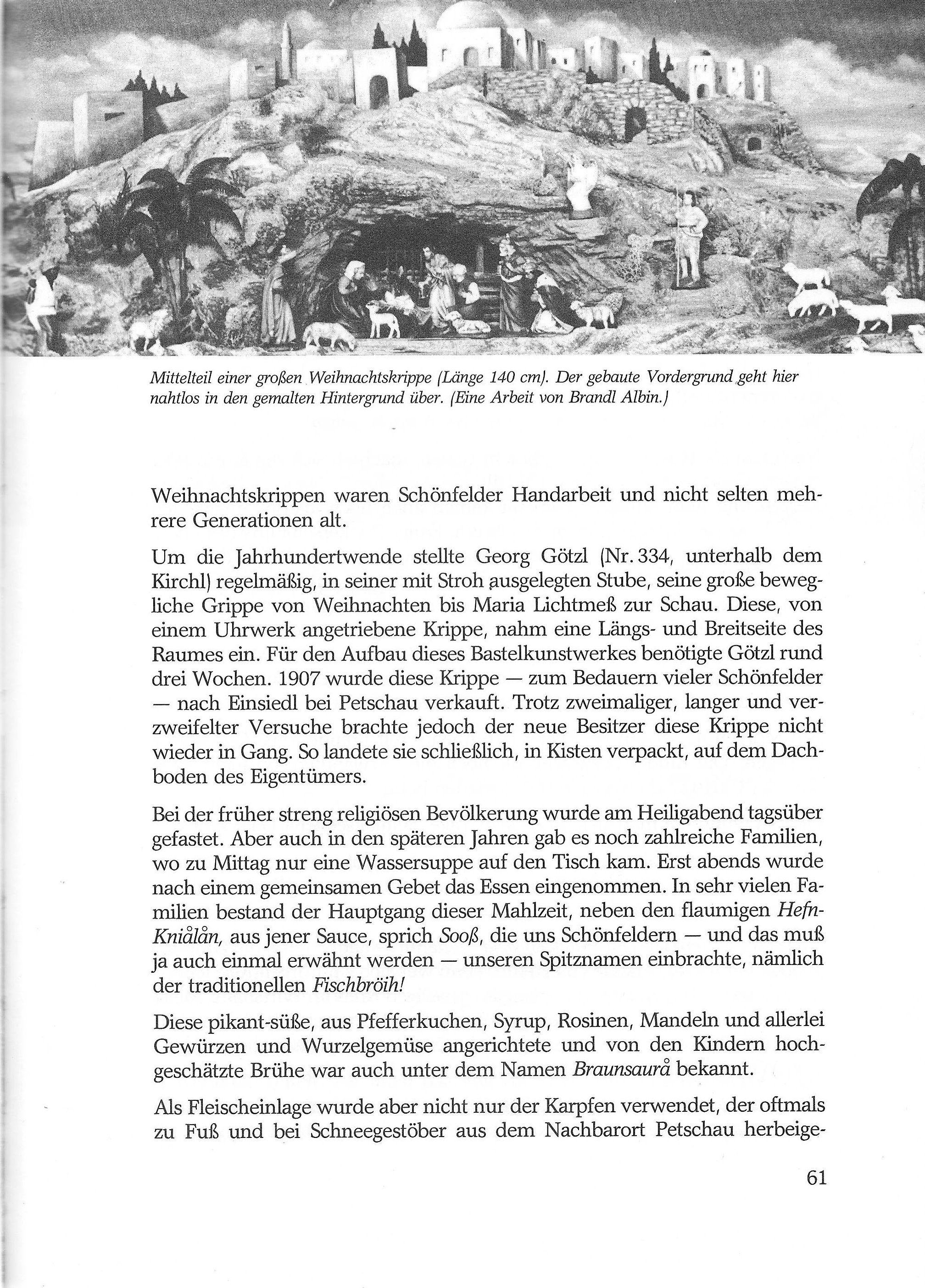 061
Middle section of a large nativity scene (length 140 cm). The
constructed foreground merges seamlessly into the painted
background. (A work by Brandl Albin.]
Christmas cribs were hand-made in Schönfeld and were often several
generations old.
Around the turn of the century, Georg Götzl (No. 334) regularly
displayed his large, moving crib from Christmas to Candlemas in his
straw-lined room below the church. This crib, driven by a clockwork
mechanism, took up one long and wide side of the room. Götzl needed
around three weeks to build this handicraft work of art. In 1907, this
crib was sold to Einsiedl near Petschau - much to the regret of many
Schönfeld residents. Despite two long and desperate attempts, the new
owner was unable to get the crib working again. So it ended up, packed
in boxes, in the owner's attic.
The previously strictly religious population fasted during the day on
Christmas Eve. But even in later years there were still many families
who only had watery soup for lunch. The meal was only eaten in the
evening after a communal prayer. In many families, the main part of
this meal, in addition to the fluffy Hefn Knidlán, was the sauce,
or rather Sooß, which earned us Schönfelders - and this must also
be mentioned - our nickname, namely the traditional Fischbröih!
This piquant-sweet broth, made from gingerbread, syrup, raisins,
almonds and all kinds of spices and root vegetables and highly valued
by the children, was also known as Braunsaurd. But not only the carp
was used as a meat filling, which was often brought
on foot and in snowstorms from the neighboring town of Petschau
61
061
Middle section of a large nativity scene (length 140 cm). The
constructed foreground merges seamlessly into the painted
background. (A work by Brandl Albin.]
Christmas cribs were hand-made in Schönfeld and were often several
generations old.
Around the turn of the century, Georg Götzl (No. 334) regularly
displayed his large, moving crib from Christmas to Candlemas in his
straw-lined room below the church. This crib, driven by a clockwork
mechanism, took up one long and wide side of the room. Götzl needed
around three weeks to build this handicraft work of art. In 1907, this
crib was sold to Einsiedl near Petschau - much to the regret of many
Schönfeld residents. Despite two long and desperate attempts, the new
owner was unable to get the crib working again. So it ended up, packed
in boxes, in the owner's attic.
The previously strictly religious population fasted during the day on
Christmas Eve. But even in later years there were still many families
who only had watery soup for lunch. The meal was only eaten in the
evening after a communal prayer. In many families, the main part of
this meal, in addition to the fluffy Hefn Knidlán, was the sauce,
or rather Sooß, which earned us Schönfelders - and this must also
be mentioned - our nickname, namely the traditional Fischbröih!
This piquant-sweet broth, made from gingerbread, syrup, raisins,
almonds and all kinds of spices and root vegetables and highly valued
by the children, was also known as Braunsaurd. But not only the carp
was used as a meat filling, which was often brought
on foot and in snowstorms from the neighboring town of Petschau
61
Page 0061
 062
it could just as easily have been a decent piece of beef or even a
hare.
The usual desserts usually included a compote of dried plums or pears
(Huzlbiän).
It was customary to cut an apple, with the cutting of a stone
indicating a death in the inner circle. The cracking of a "dead" nut
was also interpreted in a similar way.
Anyone who had livestock in the stable took special care of it on this
evening.
In some families it was customary to gather all the leftovers from the
table in the tablecloth and take them to the garden and spread them
out under the fruit trees. This was called "going to carry Zember's
food".
After the children had been put to bed, the parents or older siblings
set about "dressing up the Christmas tree". In addition to glass
balls, candles and the usual tinsel, all kinds of sweets and small red
winter apples were put on the tree. A few pieces of sugar foam from
Gröicher Girch enhanced the appearance and the wonderful scent that
soon spread through the room. Soon after, Christmas mass was ready,
and when the choir sang "Silent Night, Holy Night" in the church
accompanied by the organ, the Christmas spirit had fully
arrived. After the mass was over, everyone headed back to their homes,
wrapped up warmly, the snow crunching under their feet with every
step.
On the morning of the first day of the holiday, everyone happily
received their presents. The children often visited relatives to see
if Santa Claus had left something for them there too.
On this day, people everywhere wished each other "Happy Holidays".
On the remaining days until the end of the year, many delinquent
debtors quickly "got their finances in order", because it was
considered a disgrace to start the new year with debts.
On New Year's Eve - also known as the "Old Haalichåbnd" - the
innkeepers had their hands full again, because whoever could afford it
met up in a sociable circle at the inn to end the year. The innkeeper
usually also served the obligatory round of punch or
Kaiserbirn. Mulled wine was also popular. It was not uncommon for the
innkeeper to start this round with a short speech to his guests.
The New Year began with the well-known wishes "Happy Holidays" or
"Happy Health".
62
062
it could just as easily have been a decent piece of beef or even a
hare.
The usual desserts usually included a compote of dried plums or pears
(Huzlbiän).
It was customary to cut an apple, with the cutting of a stone
indicating a death in the inner circle. The cracking of a "dead" nut
was also interpreted in a similar way.
Anyone who had livestock in the stable took special care of it on this
evening.
In some families it was customary to gather all the leftovers from the
table in the tablecloth and take them to the garden and spread them
out under the fruit trees. This was called "going to carry Zember's
food".
After the children had been put to bed, the parents or older siblings
set about "dressing up the Christmas tree". In addition to glass
balls, candles and the usual tinsel, all kinds of sweets and small red
winter apples were put on the tree. A few pieces of sugar foam from
Gröicher Girch enhanced the appearance and the wonderful scent that
soon spread through the room. Soon after, Christmas mass was ready,
and when the choir sang "Silent Night, Holy Night" in the church
accompanied by the organ, the Christmas spirit had fully
arrived. After the mass was over, everyone headed back to their homes,
wrapped up warmly, the snow crunching under their feet with every
step.
On the morning of the first day of the holiday, everyone happily
received their presents. The children often visited relatives to see
if Santa Claus had left something for them there too.
On this day, people everywhere wished each other "Happy Holidays".
On the remaining days until the end of the year, many delinquent
debtors quickly "got their finances in order", because it was
considered a disgrace to start the new year with debts.
On New Year's Eve - also known as the "Old Haalichåbnd" - the
innkeepers had their hands full again, because whoever could afford it
met up in a sociable circle at the inn to end the year. The innkeeper
usually also served the obligatory round of punch or
Kaiserbirn. Mulled wine was also popular. It was not uncommon for the
innkeeper to start this round with a short speech to his guests.
The New Year began with the well-known wishes "Happy Holidays" or
"Happy Health".
62
Page 0062
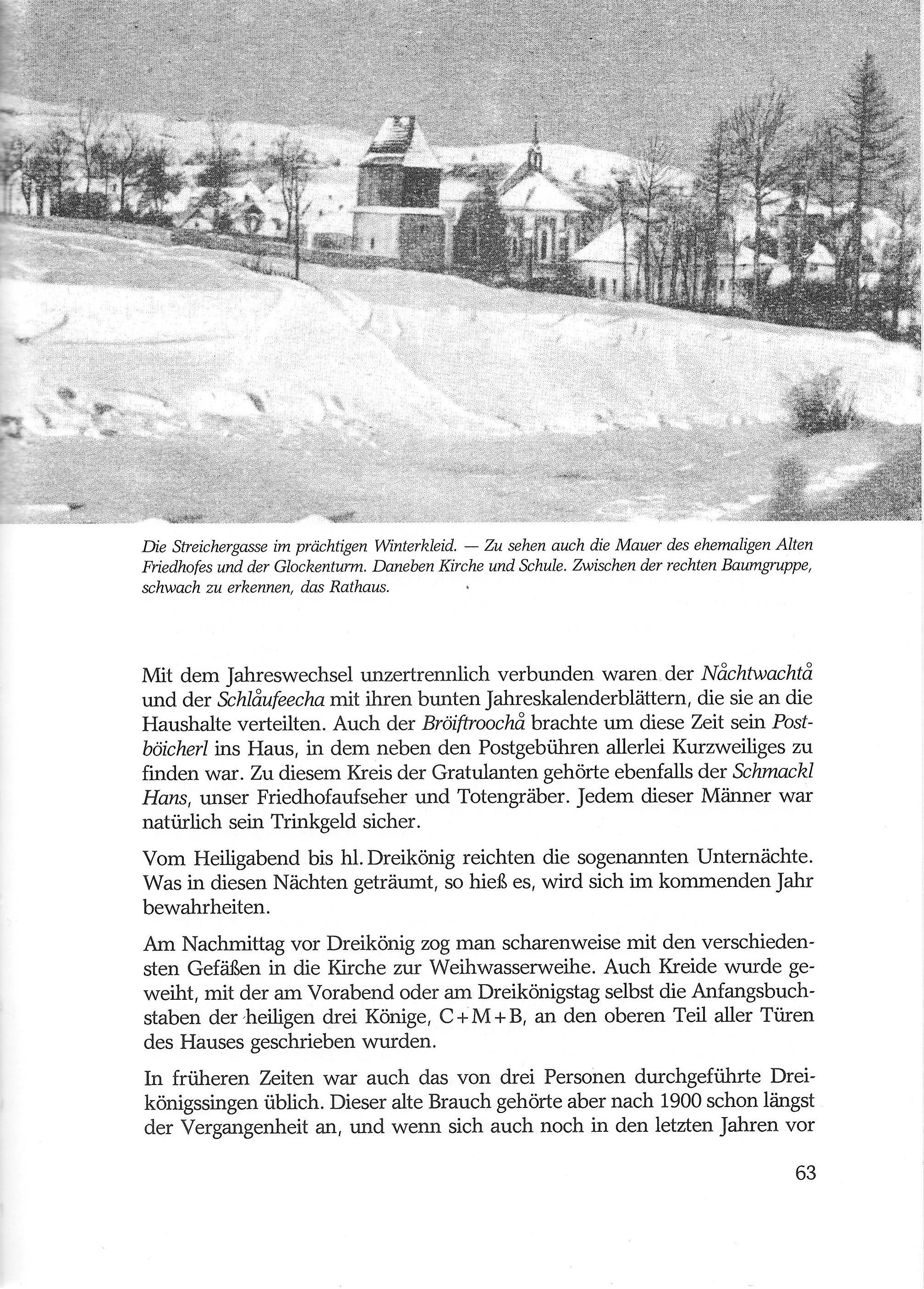 063
The Streichergasse in its splendid winter dress. - You can also see
the wall of the former old cemetery and the bell tower. Next to it is
the church and school. Between the group of trees on the right, you
can faintly see the town hall.
The Nächtwachtå and the Schlåufeecha were inseparably linked
to the turn of the year with their colorful annual calendar pages,
which they distributed to households. The Bräiftroochå also
brought his post böicherl to the house at this time, in which, in
addition to the postage, all kinds of entertaining things could be
found. Schmackl Hans, our cemetery supervisor and gravedigger, was
also part of this circle of well-wishers. Each of these men was of
course guaranteed a tip.
The so-called Unternächte lasted from Christmas Eve to
Epiphany. What was dreamed on these nights, it was said, would come
true in the coming year.
On the afternoon before Epiphany, people went in droves with all sorts
of vessels to the church for the blessing of holy water. Chalk was
also consecrated, with which the initial letters of the three wise
men, C+M+B, were written on the upper part of all the doors of the
house on the evening before or on Epiphany itself.
In earlier times, singing for the Three Kings, performed by three
people, was also common. However, this old custom had long since
become a thing of the past after 1900, and even if in recent years
63
063
The Streichergasse in its splendid winter dress. - You can also see
the wall of the former old cemetery and the bell tower. Next to it is
the church and school. Between the group of trees on the right, you
can faintly see the town hall.
The Nächtwachtå and the Schlåufeecha were inseparably linked
to the turn of the year with their colorful annual calendar pages,
which they distributed to households. The Bräiftroochå also
brought his post böicherl to the house at this time, in which, in
addition to the postage, all kinds of entertaining things could be
found. Schmackl Hans, our cemetery supervisor and gravedigger, was
also part of this circle of well-wishers. Each of these men was of
course guaranteed a tip.
The so-called Unternächte lasted from Christmas Eve to
Epiphany. What was dreamed on these nights, it was said, would come
true in the coming year.
On the afternoon before Epiphany, people went in droves with all sorts
of vessels to the church for the blessing of holy water. Chalk was
also consecrated, with which the initial letters of the three wise
men, C+M+B, were written on the upper part of all the doors of the
house on the evening before or on Epiphany itself.
In earlier times, singing for the Three Kings, performed by three
people, was also common. However, this old custom had long since
become a thing of the past after 1900, and even if in recent years
63
Page 0063
 064
If we were to see and hear a group of these Epiphany singers from time
to time after our expulsion, they were mostly unemployed people from
outside the area who were not interested in keeping the old tradition
alive, but rather in earning a few crowns in this way.
Epiphany was also the date for the sugar tree orama. So the
several-year-old chocolate pieces wrapped in colorful tin foil were
then returned untouched - and by now also long since inedible - to a
box, to be taken out again at the next festival to decorate the
tree. The glass balls were carefully wrapped in tissue paper and the
sugar tree top was packed and stored with the utmost care.
After Epiphany, it was time to remove the goose feathers that were
waiting to be removed in many families, and this marked the beginning
of the period of feather-locking and the time of the feather-locking
rooms.
It is best to let our dear Karl from Hall have his say here again, as
he wrote:
Many a first love was born there, and how many married couples must
have been and still are today whose union was sealed in the
Federschlößstube. Not a few chaste cheek fishes had their first
loving kiss pressed to their lips during the Pölsterl dance, despite
fierce, but mostly only apparent, resistance. Singing took place
during the Federschlößen, and the beautiful old, mostly four-line
Tschunbal songs were not forgotten during the tour.
As there was a little music in almost all Federschlößstuben, there
was usually dancing after 10 o'clock, so that everything shook. As
dancing masters and dancing schools were almost unknown here in the
past, boys and girls usually learned to dance silently in the
Federschlöß.
The climax of the fun was only reached when, after several evenings of
hard work, the last feathers were plucked and the Federmannl was
celebrated at the Schlut."
Here it should be added: The Federmannl consisted of five to ten soft
feathers, barely the length of a finger, which were held together with
a thin thread. This small bundle of feathers was secretly placed by
the housewife in the last portion of feathers, which was brought to
the table as a light white cloud to be plucked. There was a great
cheer when the Federmannl found its owner after being taken away by
the handful.
64
064
If we were to see and hear a group of these Epiphany singers from time
to time after our expulsion, they were mostly unemployed people from
outside the area who were not interested in keeping the old tradition
alive, but rather in earning a few crowns in this way.
Epiphany was also the date for the sugar tree orama. So the
several-year-old chocolate pieces wrapped in colorful tin foil were
then returned untouched - and by now also long since inedible - to a
box, to be taken out again at the next festival to decorate the
tree. The glass balls were carefully wrapped in tissue paper and the
sugar tree top was packed and stored with the utmost care.
After Epiphany, it was time to remove the goose feathers that were
waiting to be removed in many families, and this marked the beginning
of the period of feather-locking and the time of the feather-locking
rooms.
It is best to let our dear Karl from Hall have his say here again, as
he wrote:
Many a first love was born there, and how many married couples must
have been and still are today whose union was sealed in the
Federschlößstube. Not a few chaste cheek fishes had their first
loving kiss pressed to their lips during the Pölsterl dance, despite
fierce, but mostly only apparent, resistance. Singing took place
during the Federschlößen, and the beautiful old, mostly four-line
Tschunbal songs were not forgotten during the tour.
As there was a little music in almost all Federschlößstuben, there
was usually dancing after 10 o'clock, so that everything shook. As
dancing masters and dancing schools were almost unknown here in the
past, boys and girls usually learned to dance silently in the
Federschlöß.
The climax of the fun was only reached when, after several evenings of
hard work, the last feathers were plucked and the Federmannl was
celebrated at the Schlut."
Here it should be added: The Federmannl consisted of five to ten soft
feathers, barely the length of a finger, which were held together with
a thin thread. This small bundle of feathers was secretly placed by
the housewife in the last portion of feathers, which was brought to
the table as a light white cloud to be plucked. There was a great
cheer when the Federmannl found its owner after being taken away by
the handful.
64
Page 0064
 065
But let's hear from Karl Haller again:
It was a lively affair, because the grog heated up everyone's spirits,
and not infrequently the old grandmother who lived in the house would
twitch her legs and dance with the young people. It should also be
mentioned that the atmosphere in the Federschlößstube was often a
stormy place, which would erupt in a long threshing session when the
boys, who were often seized by jealousy, went home. But the girls also
often got into trouble at home because they stayed away too late,
because their parents knew only too well that the Federschlößstube
also harbored dangers, which meant that many a young girl would
prematurely get her toes caught under the cradle roller or pram
rider. These storms did not, however, detract from the
Federschlößstube in the slightest, in fact, they even increased the
romance and made it even more tempting not to miss out on it."
Before we get into the last section, namely the crazy carnival season,
here is a little interweaving
The winter season was used by several Schönfeld residents to collect
pine cones. The cones, which were excellent as fuel, were found in
abundance in the forests around Schönfeld at this time of year. They
were also still fresh and tightly closed and therefore took up very
little space for transport. However, a sack filled with pine cones was
quite heavy. Depending on the weather, the load was brought home by
handcart or on a sleigh.
When mentioning the sleigh, a comment on the winter fun in Schönfeld
is essential. The word sport is not appropriate here because the
skiers, like as we called them at home, it was not about 100ths of a
second back then, but about the pleasure of getting from the tower
over the Scheining and the Schreiwerl into the Leiten to the
Grundmühle in a quick and sociable ride. The skis were simple beech
or ash, with a compact and secure pigskin binding on the shoe, which
did not release the boards even in the worst fall. Despite this - by
today's standards - tricky technology, there was never any report of
broken bones.
The simplest type of ski, or rather the little man's skis, were the
barrel boards.
The Bredlrutschå were on the same level as the sledges. The latter
were mainly used on the Hoffmann and Zusabergl, where
the skis were put on without any accessories, just on foot.
65
065
But let's hear from Karl Haller again:
It was a lively affair, because the grog heated up everyone's spirits,
and not infrequently the old grandmother who lived in the house would
twitch her legs and dance with the young people. It should also be
mentioned that the atmosphere in the Federschlößstube was often a
stormy place, which would erupt in a long threshing session when the
boys, who were often seized by jealousy, went home. But the girls also
often got into trouble at home because they stayed away too late,
because their parents knew only too well that the Federschlößstube
also harbored dangers, which meant that many a young girl would
prematurely get her toes caught under the cradle roller or pram
rider. These storms did not, however, detract from the
Federschlößstube in the slightest, in fact, they even increased the
romance and made it even more tempting not to miss out on it."
Before we get into the last section, namely the crazy carnival season,
here is a little interweaving
The winter season was used by several Schönfeld residents to collect
pine cones. The cones, which were excellent as fuel, were found in
abundance in the forests around Schönfeld at this time of year. They
were also still fresh and tightly closed and therefore took up very
little space for transport. However, a sack filled with pine cones was
quite heavy. Depending on the weather, the load was brought home by
handcart or on a sleigh.
When mentioning the sleigh, a comment on the winter fun in Schönfeld
is essential. The word sport is not appropriate here because the
skiers, like as we called them at home, it was not about 100ths of a
second back then, but about the pleasure of getting from the tower
over the Scheining and the Schreiwerl into the Leiten to the
Grundmühle in a quick and sociable ride. The skis were simple beech
or ash, with a compact and secure pigskin binding on the shoe, which
did not release the boards even in the worst fall. Despite this - by
today's standards - tricky technology, there was never any report of
broken bones.
The simplest type of ski, or rather the little man's skis, were the
barrel boards.
The Bredlrutschå were on the same level as the sledges. The latter
were mainly used on the Hoffmann and Zusabergl, where
the skis were put on without any accessories, just on foot.
65
Page 0065
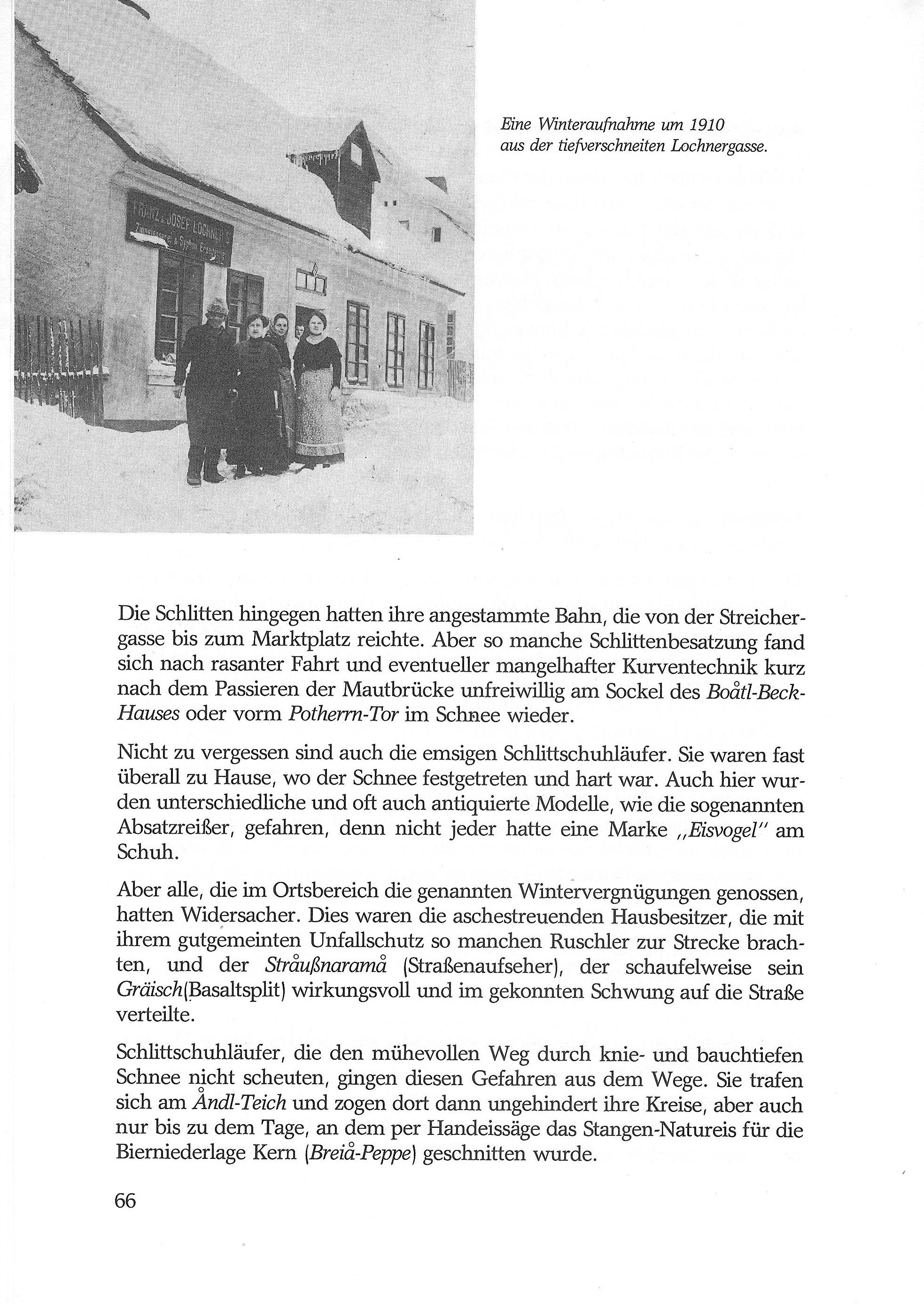 066
A winter photo from around 1910 from the snow-covered Lochnergasse.
The sleighs, on the other hand, had their traditional track, which
stretched from Streichergasse to the market square. But many a sleigh
crew, after a rapid ride and possibly poor cornering technique, found
themselves involuntarily in the snow at the base of the Boatl-Beck
House or in front of the Pothern Gate shortly after passing the toll
bridge.
And we must not forget the industrious ice skaters. They were at home
almost anywhere where the snow was packed and hard. Here too,
different and often antiquated models were used, such as the so-called
heel-rippers, because not everyone had a branded "Kingfisher" on their
shoes.
But everyone who enjoyed the winter pleasures mentioned in the local
area had opponents. These were the homeowners who scattered ash, who
brought down many a scoundrel with their well-intentioned accident
prevention, and the Stråußnaramå (road supervisor), who
spread his shovelful of basalt chippings on the road effectively and
with a skilful swing.
Ice skaters who did not shy away from the arduous journey through
knee- and belly-deep snow avoided these dangers. They met at the Andl
pond and then circled there, completely unhindered, but only until the
day when the natural ice bars for the beer depot Kern (Brei-Parpel
were cut with a hand-held ice saw.
66
066
A winter photo from around 1910 from the snow-covered Lochnergasse.
The sleighs, on the other hand, had their traditional track, which
stretched from Streichergasse to the market square. But many a sleigh
crew, after a rapid ride and possibly poor cornering technique, found
themselves involuntarily in the snow at the base of the Boatl-Beck
House or in front of the Pothern Gate shortly after passing the toll
bridge.
And we must not forget the industrious ice skaters. They were at home
almost anywhere where the snow was packed and hard. Here too,
different and often antiquated models were used, such as the so-called
heel-rippers, because not everyone had a branded "Kingfisher" on their
shoes.
But everyone who enjoyed the winter pleasures mentioned in the local
area had opponents. These were the homeowners who scattered ash, who
brought down many a scoundrel with their well-intentioned accident
prevention, and the Stråußnaramå (road supervisor), who
spread his shovelful of basalt chippings on the road effectively and
with a skilful swing.
Ice skaters who did not shy away from the arduous journey through
knee- and belly-deep snow avoided these dangers. They met at the Andl
pond and then circled there, completely unhindered, but only until the
day when the natural ice bars for the beer depot Kern (Brei-Parpel
were cut with a hand-held ice saw.
66
Page 0066
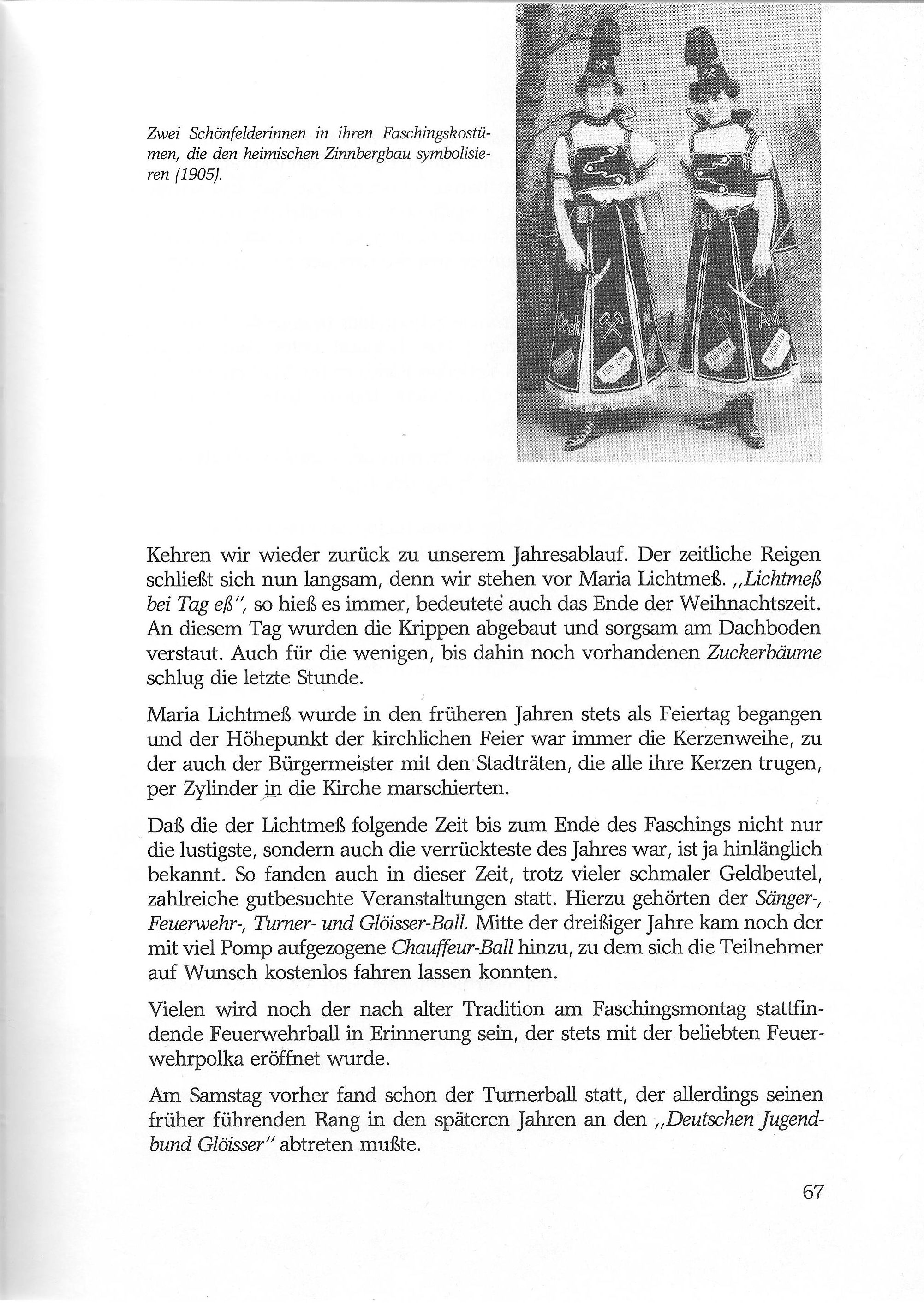 067
Two women from Schönfeld in their carnival costumes, symbolizing the
local tin mining industry (1905).
Let us return to our annual schedule. The time is now slowly coming to
a close, as we are standing before Candlemas. "Candlemas by day" as it
was always called, also meant the end of the Christmas season. On this
day the nativity scenes were dismantled and carefully stored in the
attic. The last hour had also struck for the few sugar trees that were
still there.
In earlier years, Candlemas was always celebrated as a public holiday
and the highlight of the church celebration was always the blessing of
the candles, to which the mayor and the city councilors, all carrying
their candles, marched into the church in top hats.
It is well known that the period following Candlemas until the end of
Carnival was not only the funniest but also the craziest of the
year. So, even during this time, despite many people's tight budgets,
numerous well-attended events took place. These included the singers',
firemen's gymnasts' and Glöisser's ball. In the mid-thirties, there
was also the pompous Chauffeur Ball was added, to which participants
could be driven free of charge if they wished.
Many will still remember the fire brigade ball that took place on
Shrove Monday according to old tradition and was always opened with
the popular fire brigade polka.
The gymnasts' ball took place on the Saturday before, although in
later years it had to give up its previous leading position to the
"German Youth League Gläisser".
67
067
Two women from Schönfeld in their carnival costumes, symbolizing the
local tin mining industry (1905).
Let us return to our annual schedule. The time is now slowly coming to
a close, as we are standing before Candlemas. "Candlemas by day" as it
was always called, also meant the end of the Christmas season. On this
day the nativity scenes were dismantled and carefully stored in the
attic. The last hour had also struck for the few sugar trees that were
still there.
In earlier years, Candlemas was always celebrated as a public holiday
and the highlight of the church celebration was always the blessing of
the candles, to which the mayor and the city councilors, all carrying
their candles, marched into the church in top hats.
It is well known that the period following Candlemas until the end of
Carnival was not only the funniest but also the craziest of the
year. So, even during this time, despite many people's tight budgets,
numerous well-attended events took place. These included the singers',
firemen's gymnasts' and Glöisser's ball. In the mid-thirties, there
was also the pompous Chauffeur Ball was added, to which participants
could be driven free of charge if they wished.
Many will still remember the fire brigade ball that took place on
Shrove Monday according to old tradition and was always opened with
the popular fire brigade polka.
The gymnasts' ball took place on the Saturday before, although in
later years it had to give up its previous leading position to the
"German Youth League Gläisser".
67
Page 0067
 068
The Glöisser balls usually had a specific theme, such as "In the White
Horse Inn", for which the hall was also decorated accordingly. Even
the well-known conductor Baron Schoeneck from Karlsbad was hired to
come to Schönfeld with his band. He played under the motto "This only
happens once, it won't happen again". There was a lot of truth in
that, because the Glöisser could only afford a band like that once.
But now to the carnival itself. For many Schönfelders, preparations
for the masquerade began with Jordan Julius, known as "Tschulle". He
was able to provide clothing for masks, so to speak, which ranged from
China to the Orient, India, Africa and even the American prairie.
Tschulle, still a bachelor at the time, often led the carnival
procession with his harp.
The initiator of the carnival processions was the German Youth
Association Glöisser under its ever-active chairman Josef Gareiß,
known as Gußn-Seff. The first procession took place on Shrove
Tuesday 1921 under the motto "The Bell Fairy", which was played by the
carter Beb.
In the years that followed, these Maschkårå parades became a
permanent fixture and also the highlight of the Schönfeld carnival.
The events, which were always well organized and of good quality,
attracted so many strangers from near and far that the Glöisser felt
compelled to move the parade to Sunday to enable even more interested
people to take part.
Of course, other clubs also took part in these parades. The
preparations, which were very often carried out by individual groups,
usually began months in advance in the strictest secrecy. It was not
uncommon for many a barn window, behind which a float was being
prepared for the carnival parade, to be covered with sacks or blankets
to prevent curious people from seeing in.
What was being sawed, nailed and painted, and how many boards, slats
and battens were being sent from the few sawmills in the area to these
production facilities at a reduced price or even for free during this
pre-carnival period.
The reward for many hours of work was the applause of the audience,
because
only the best received a cash prize, which, however, barely covered
the expenses
68
068
The Glöisser balls usually had a specific theme, such as "In the White
Horse Inn", for which the hall was also decorated accordingly. Even
the well-known conductor Baron Schoeneck from Karlsbad was hired to
come to Schönfeld with his band. He played under the motto "This only
happens once, it won't happen again". There was a lot of truth in
that, because the Glöisser could only afford a band like that once.
But now to the carnival itself. For many Schönfelders, preparations
for the masquerade began with Jordan Julius, known as "Tschulle". He
was able to provide clothing for masks, so to speak, which ranged from
China to the Orient, India, Africa and even the American prairie.
Tschulle, still a bachelor at the time, often led the carnival
procession with his harp.
The initiator of the carnival processions was the German Youth
Association Glöisser under its ever-active chairman Josef Gareiß,
known as Gußn-Seff. The first procession took place on Shrove
Tuesday 1921 under the motto "The Bell Fairy", which was played by the
carter Beb.
In the years that followed, these Maschkårå parades became a
permanent fixture and also the highlight of the Schönfeld carnival.
The events, which were always well organized and of good quality,
attracted so many strangers from near and far that the Glöisser felt
compelled to move the parade to Sunday to enable even more interested
people to take part.
Of course, other clubs also took part in these parades. The
preparations, which were very often carried out by individual groups,
usually began months in advance in the strictest secrecy. It was not
uncommon for many a barn window, behind which a float was being
prepared for the carnival parade, to be covered with sacks or blankets
to prevent curious people from seeing in.
What was being sawed, nailed and painted, and how many boards, slats
and battens were being sent from the few sawmills in the area to these
production facilities at a reduced price or even for free during this
pre-carnival period.
The reward for many hours of work was the applause of the audience,
because
only the best received a cash prize, which, however, barely covered
the expenses
68
Page 0068
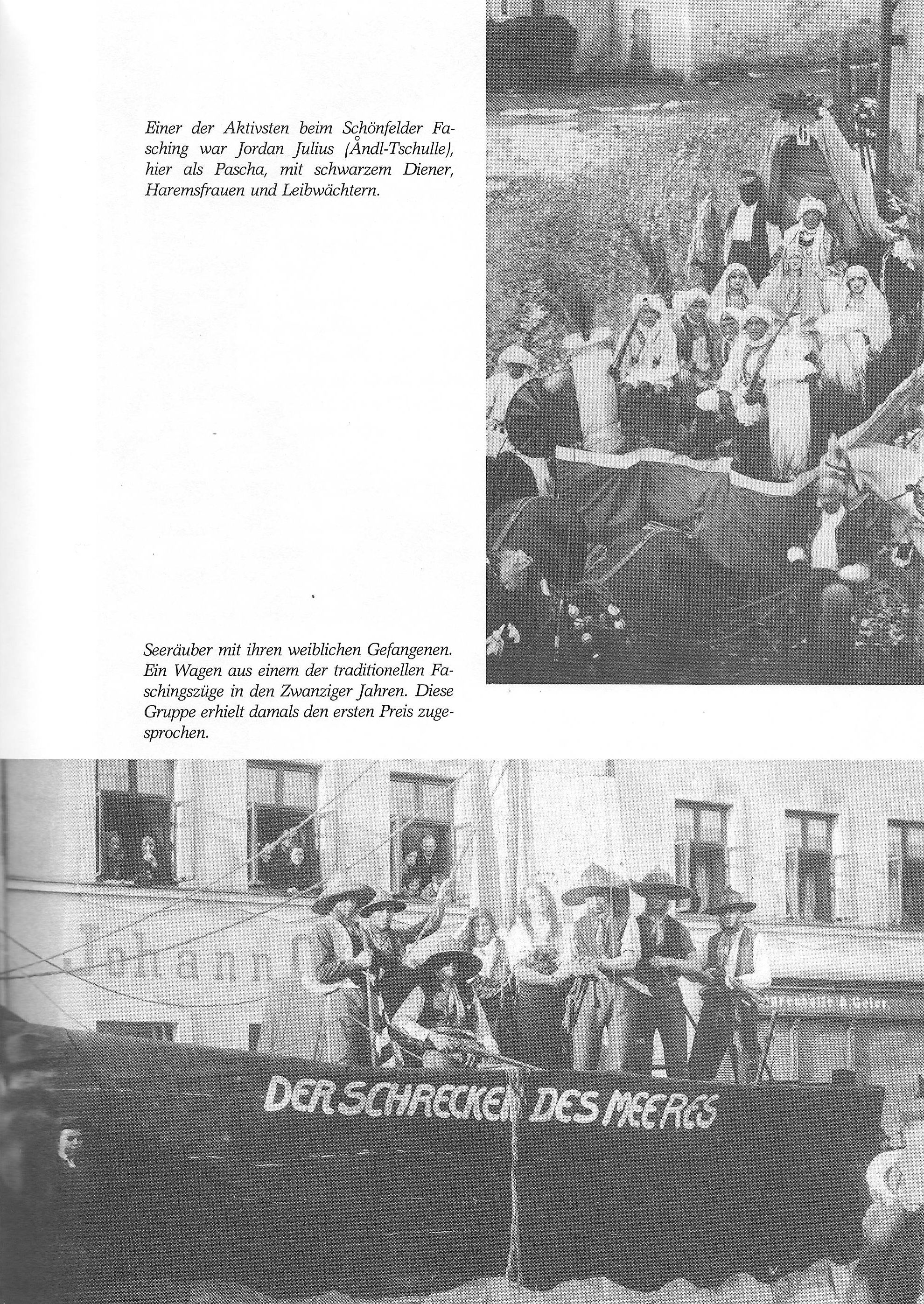 069
One of the most active at the Schönfeld carnival was Jordan Julius
(Andl-Tschulle), here as a pasha, with a black servant, harem women
and bodyguards.
Pirates with their female prisoners. A float from one of the
traditional carnival processions in the 1920s. This group was awarded
first prize at the time.
THE TERRIFYING MEERGS
69
069
One of the most active at the Schönfeld carnival was Jordan Julius
(Andl-Tschulle), here as a pasha, with a black servant, harem women
and bodyguards.
Pirates with their female prisoners. A float from one of the
traditional carnival processions in the 1920s. This group was awarded
first prize at the time.
THE TERRIFYING MEERGS
69
Page 0069
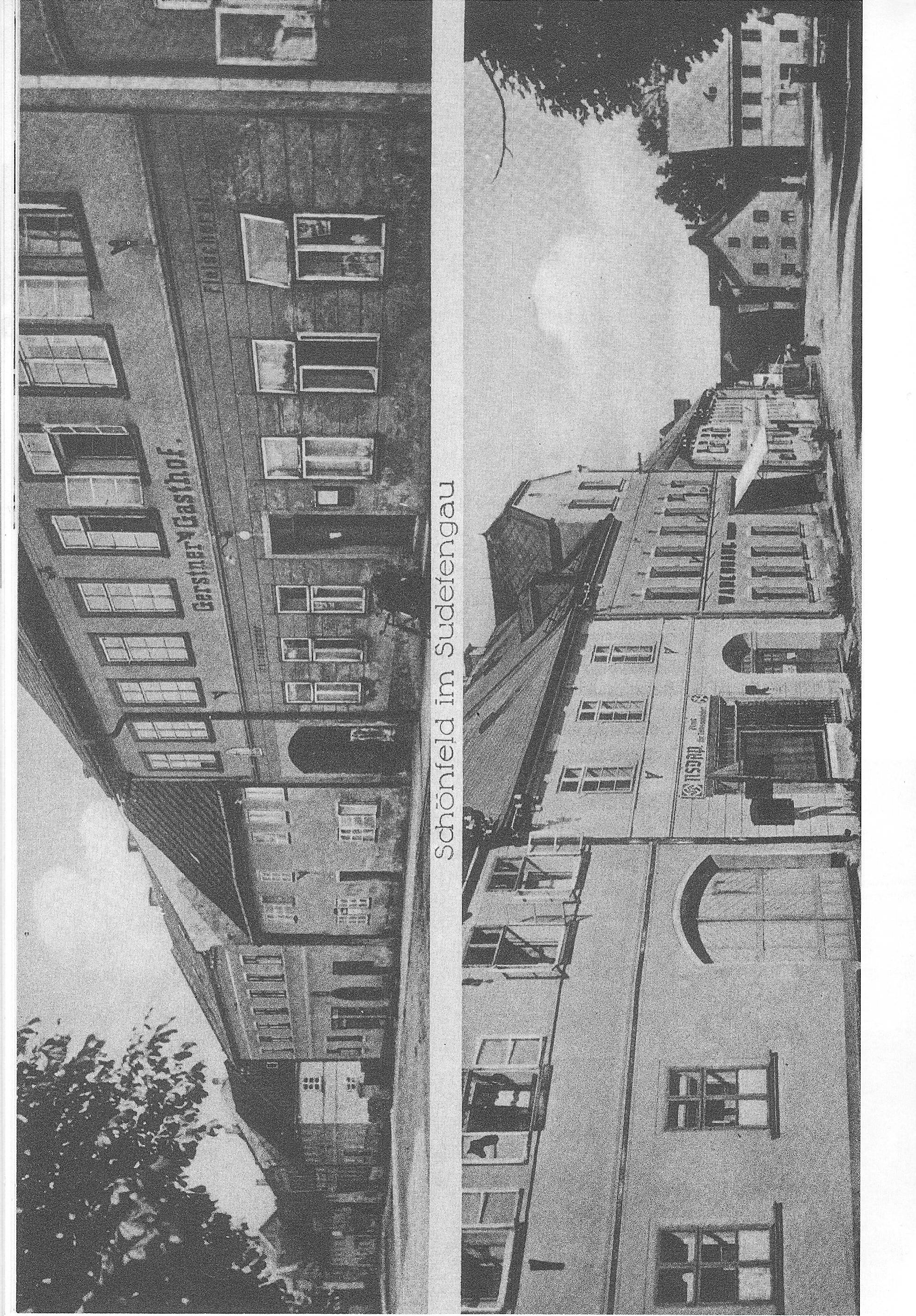 070
Gerstner Gasthaf
Schönfeld in Sudefengau
70
070
Gerstner Gasthaf
Schönfeld in Sudefengau
70
Page 0070
 071
The parades also collected money, for example one of the net proceeds
was used to build the tower.
The last carnival parade took place in 1934. The reason for the
cancellation, which was certainly not easy for the people of Glöisse,
was probably primarily the tense and critical financial situation of
large sections of the population.
In addition to the large parade, the usual activities on a smaller
scale also took place. On Shrove Tuesday, the name day of all fools,
the masquerade was carried out from late afternoon, in smaller or
larger groups, until late at night. The parade was accompanied by
music from the upper land to the lower land, and no inn was left out.
These inns were also visited by the pretzel farmers, who offered their
baskets of fresh, crispy salty pretzels.
At this point, the Plefferbusseriä should also be mentioned, a
small pastry the size of a thumb cap, which consisted of a slightly
sweet and more or less peppered black flour dough. The Pfefferbusserla
were only available during the carnival season!
While in other places the carnival ended on Tuesday, here in
Schonfeld, despite repeated and energetic warnings from the priest,
the carnival was still held on Ash Wednesday afternoon until late at
night, which was usually attended by some people from the surrounding
area in order to make a last-minute Drahrer that they had no chance to
do at home.
For many, the most popular meeting point for the Ash Wednesday
Masquerade was at "då Altn", opposite the pharmacy. There was
always an entertainer here that evening, and people often danced with
her. Some people also took out their anger on her about the impending
end of Carnival, and if she hadn't had straw in her head and body, she
would certainly have sued the landlord for damages.
At the Masquerade on Ash Wednesday, which consisted mainly of male
participants, lanterns were often carried with them to search for the
lost Carnival.
Just as many people searched for the lost Carnival in vain and with
regret on Ash Wednesday, so many people searched for the money they
had lost during the Carnival in vain and with even greater regret on
the following day.
71
071
The parades also collected money, for example one of the net proceeds
was used to build the tower.
The last carnival parade took place in 1934. The reason for the
cancellation, which was certainly not easy for the people of Glöisse,
was probably primarily the tense and critical financial situation of
large sections of the population.
In addition to the large parade, the usual activities on a smaller
scale also took place. On Shrove Tuesday, the name day of all fools,
the masquerade was carried out from late afternoon, in smaller or
larger groups, until late at night. The parade was accompanied by
music from the upper land to the lower land, and no inn was left out.
These inns were also visited by the pretzel farmers, who offered their
baskets of fresh, crispy salty pretzels.
At this point, the Plefferbusseriä should also be mentioned, a
small pastry the size of a thumb cap, which consisted of a slightly
sweet and more or less peppered black flour dough. The Pfefferbusserla
were only available during the carnival season!
While in other places the carnival ended on Tuesday, here in
Schonfeld, despite repeated and energetic warnings from the priest,
the carnival was still held on Ash Wednesday afternoon until late at
night, which was usually attended by some people from the surrounding
area in order to make a last-minute Drahrer that they had no chance to
do at home.
For many, the most popular meeting point for the Ash Wednesday
Masquerade was at "då Altn", opposite the pharmacy. There was
always an entertainer here that evening, and people often danced with
her. Some people also took out their anger on her about the impending
end of Carnival, and if she hadn't had straw in her head and body, she
would certainly have sued the landlord for damages.
At the Masquerade on Ash Wednesday, which consisted mainly of male
participants, lanterns were often carried with them to search for the
lost Carnival.
Just as many people searched for the lost Carnival in vain and with
regret on Ash Wednesday, so many people searched for the money they
had lost during the Carnival in vain and with even greater regret on
the following day.
71
Page 0071
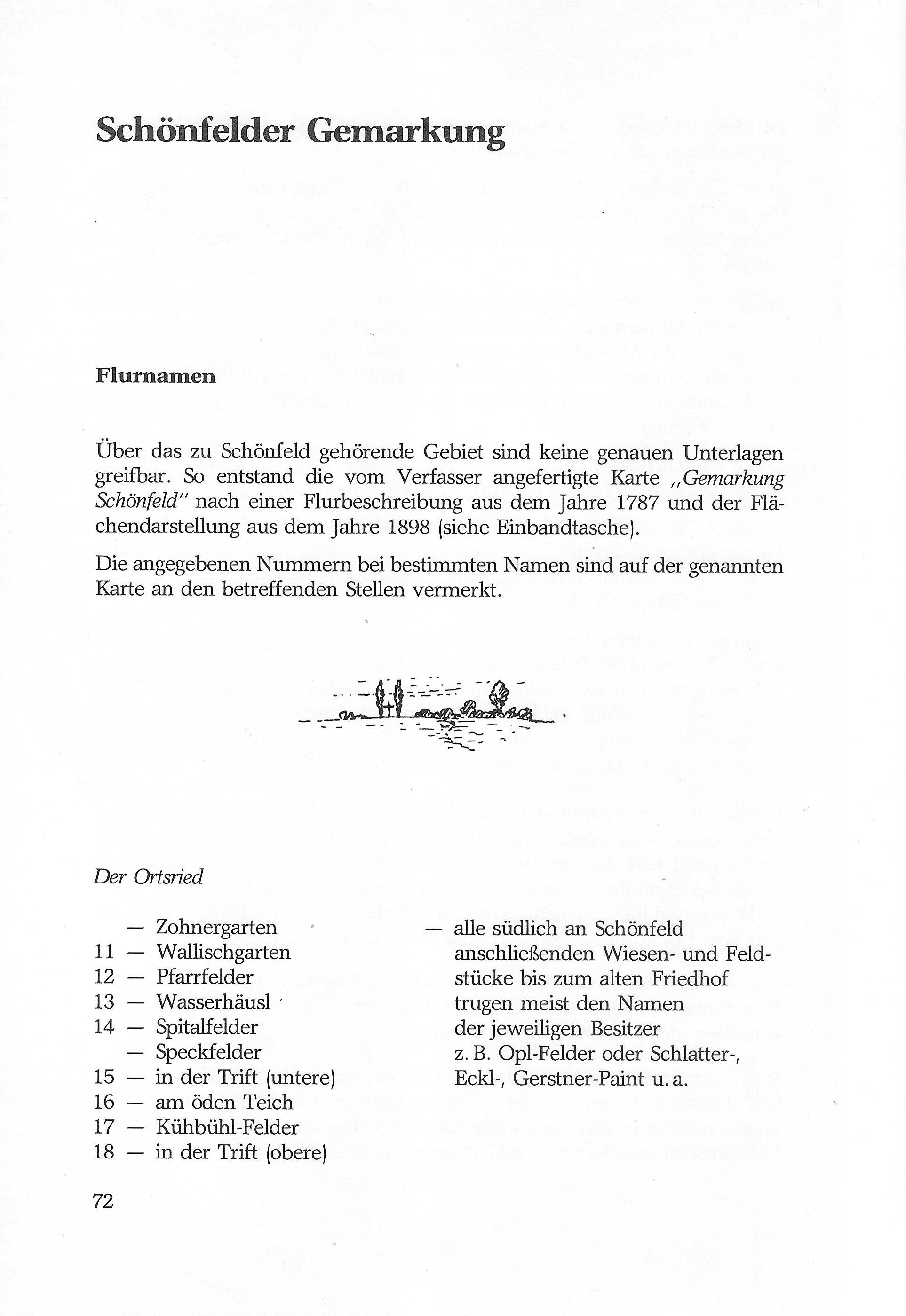 072
Schönfeld district
Field names
No precise documents are available about the area belonging to
Schönfeld. This is how the map "Schönfeld district" was created by the
author based on a field description from 1787 and the area
representation from 1898 (see binding pocket).
The numbers given for certain names are noted on the map at the
relevant places.
picture XXXXXXXXXXXXXXXXXXXX
The local reed
Zohnergarten XXXXXXXXXXXXXXXXXXXX
11 Wallischgarten XXXXXXXXXXXXXXXXXXXX
12 Pfarrfelder XXXXXXXXXXXXXXXXXXXX
13 Wasserhäusl XXXXXXXXXXXXXXXXXXXX
14 Spitalfelder XXXXXXXXXXXXXXXXXXXX
Speckfelder XXXXXXXXXXXXXXXXXXXX
15 in der Trift Juntere XXXXXXXXXXXXXXXXXXXX
16 am öden Teich
17 Kühbühl-Felder
18 in der Trift (obere)
72
072
Schönfeld district
Field names
No precise documents are available about the area belonging to
Schönfeld. This is how the map "Schönfeld district" was created by the
author based on a field description from 1787 and the area
representation from 1898 (see binding pocket).
The numbers given for certain names are noted on the map at the
relevant places.
picture XXXXXXXXXXXXXXXXXXXX
The local reed
Zohnergarten XXXXXXXXXXXXXXXXXXXX
11 Wallischgarten XXXXXXXXXXXXXXXXXXXX
12 Pfarrfelder XXXXXXXXXXXXXXXXXXXX
13 Wasserhäusl XXXXXXXXXXXXXXXXXXXX
14 Spitalfelder XXXXXXXXXXXXXXXXXXXX
Speckfelder XXXXXXXXXXXXXXXXXXXX
15 in der Trift Juntere XXXXXXXXXXXXXXXXXXXX
16 am öden Teich
17 Kühbühl-Felder
18 in der Trift (obere)
72
Page 0072
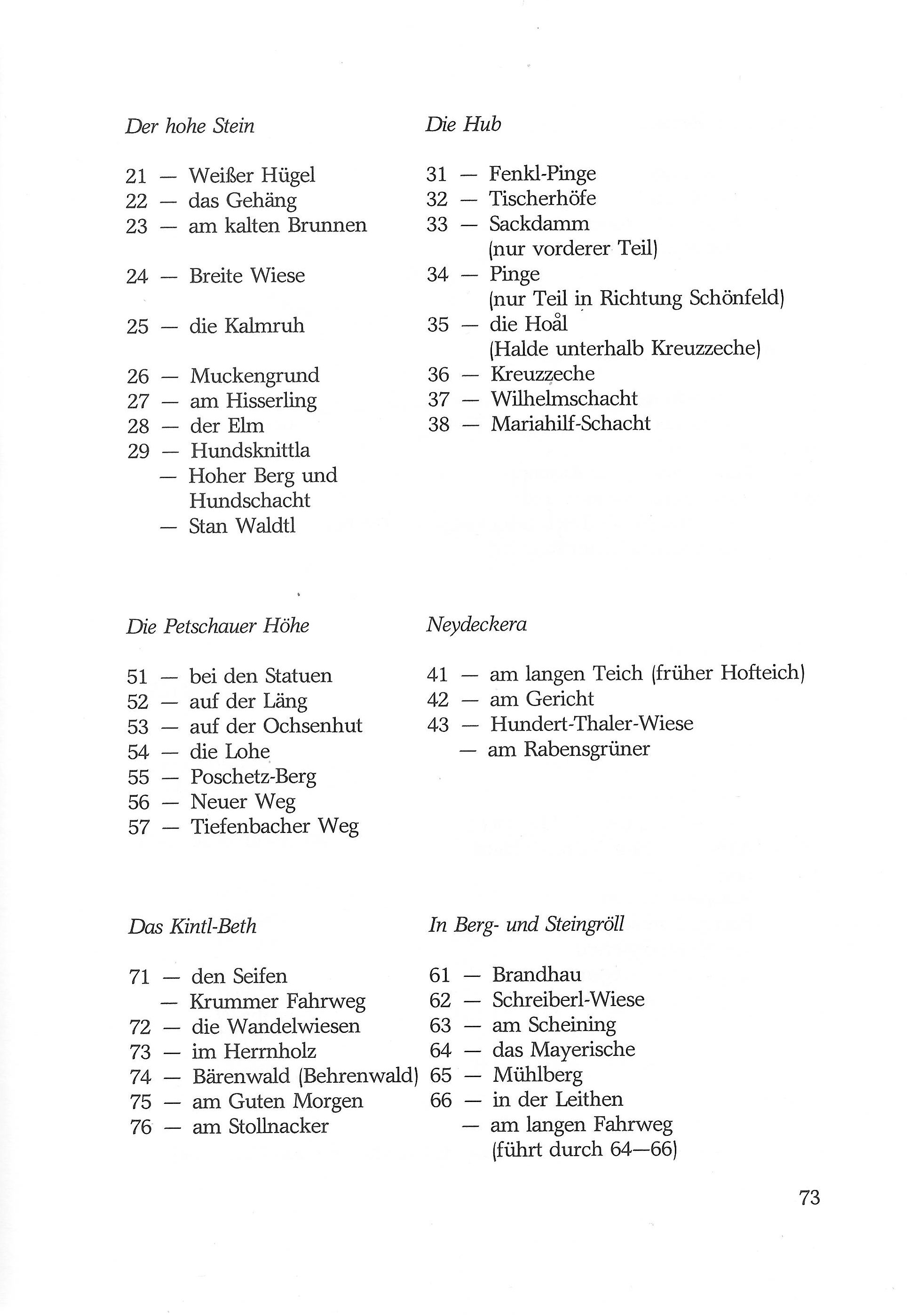 073
The high stone xxxxxxxxxxxxxxxxxxxvvvvvvvv
21 White hill
22 the hang
23 -at the cold well
24 Broad meadow
25 the Kalmruh
26 -Muckengrund
27 at the Hisserling
28 the Elm
29 Hundsknittla
High mountain and Hundschacht
Stan Waldl
The Petschauer Höhe
51 near the statues
52 on the Läng
53 on the Ochsenhut
54 the Lohe
55 Poschetz-Berg
56 New path
57 -Tiefenbacher path
The Huh
----^^^^
31 Fenkl-Pinge
32 Tischerhöfe
33 Sackdamm
(only the front part)
34 Pinge
(only the part towards Schönfeld)
35 the Hoål
Halde below Kreuzzechel
36 Kreuzzeche
37 Wilhelmschacht
38 Mariahilf-Schacht
Neydechera
41 at the long pond (formerly Hofteich)
42 at the court
43 Hundert-Thaler-Wiese
at Rabensgrüner
The Kintl-Beth
71den Seifen
Krummer Fahrweg
72 the Wandelwiesen
73 in Herrnholz
In Berg- wd Steingröll
61 Brandhau
62 Schreiberl-Wiese
63 at Scheining
64 the Mayerische
74 Bärenwald (Behrenwald) 65
75
76
at Guten Morgen
at Stollnacker
Mühlberg
66 in the Leithen
m long road leads through 64-66
73
073
The high stone xxxxxxxxxxxxxxxxxxxvvvvvvvv
21 White hill
22 the hang
23 -at the cold well
24 Broad meadow
25 the Kalmruh
26 -Muckengrund
27 at the Hisserling
28 the Elm
29 Hundsknittla
High mountain and Hundschacht
Stan Waldl
The Petschauer Höhe
51 near the statues
52 on the Läng
53 on the Ochsenhut
54 the Lohe
55 Poschetz-Berg
56 New path
57 -Tiefenbacher path
The Huh
----^^^^
31 Fenkl-Pinge
32 Tischerhöfe
33 Sackdamm
(only the front part)
34 Pinge
(only the part towards Schönfeld)
35 the Hoål
Halde below Kreuzzechel
36 Kreuzzeche
37 Wilhelmschacht
38 Mariahilf-Schacht
Neydechera
41 at the long pond (formerly Hofteich)
42 at the court
43 Hundert-Thaler-Wiese
at Rabensgrüner
The Kintl-Beth
71den Seifen
Krummer Fahrweg
72 the Wandelwiesen
73 in Herrnholz
In Berg- wd Steingröll
61 Brandhau
62 Schreiberl-Wiese
63 at Scheining
64 the Mayerische
74 Bärenwald (Behrenwald) 65
75
76
at Guten Morgen
at Stollnacker
Mühlberg
66 in the Leithen
m long road leads through 64-66
73
Page 0073
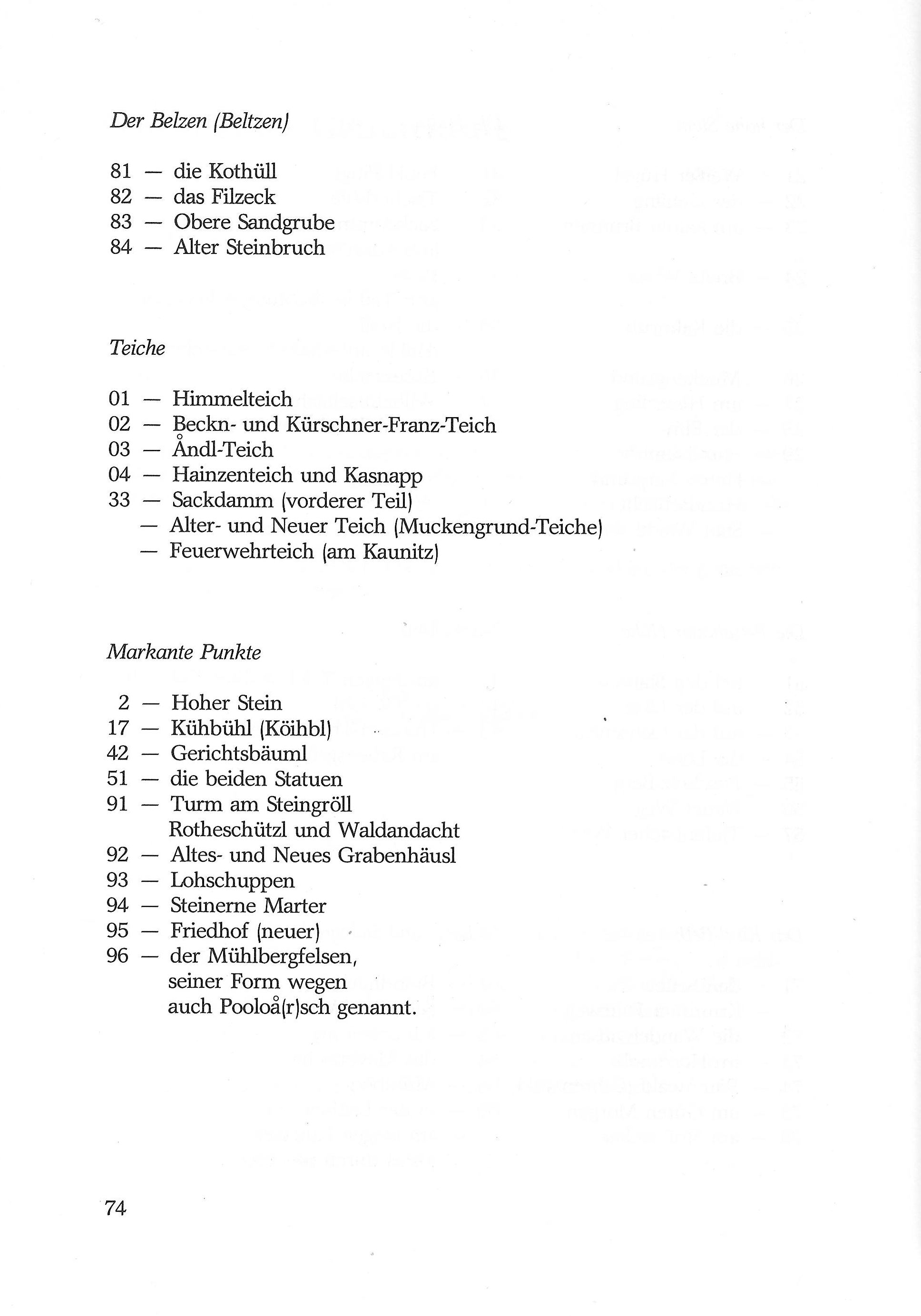 074
The Belzen (Beltzen!
81 the Kothüll
82 the Filzeck
83 Upper Sand Pit
84 -Old Quarry
Ponds
01Himmelteich
02
Beckn- and Kürschner-Franz-Teich
03 Andl-Teich
04 Hainzenteich and Kasnapp
33 Sackdamm (front part)
Old and New Pond in the Muckengrund Ponds)
Fire Brigade Pond (on the Kaunitz
Distinctive points
2 Hoher Stein
17 Kähbühl Koihbl
42 Gerichtsbäuml
51the two statues
91
Tower at Steingröll Rotheschützl and Waldandacht
92 Old and New Grabenhäusl
93-Lohschuppen
94 Steinerne Marter
95-Cemetery (renovated
96
the Mühlberg rock, also called Pooloa'rlsch because of its shape
74
074
The Belzen (Beltzen!
81 the Kothüll
82 the Filzeck
83 Upper Sand Pit
84 -Old Quarry
Ponds
01Himmelteich
02
Beckn- and Kürschner-Franz-Teich
03 Andl-Teich
04 Hainzenteich and Kasnapp
33 Sackdamm (front part)
Old and New Pond in the Muckengrund Ponds)
Fire Brigade Pond (on the Kaunitz
Distinctive points
2 Hoher Stein
17 Kähbühl Koihbl
42 Gerichtsbäuml
51the two statues
91
Tower at Steingröll Rotheschützl and Waldandacht
92 Old and New Grabenhäusl
93-Lohschuppen
94 Steinerne Marter
95-Cemetery (renovated
96
the Mühlberg rock, also called Pooloa'rlsch because of its shape
74
Page 0074
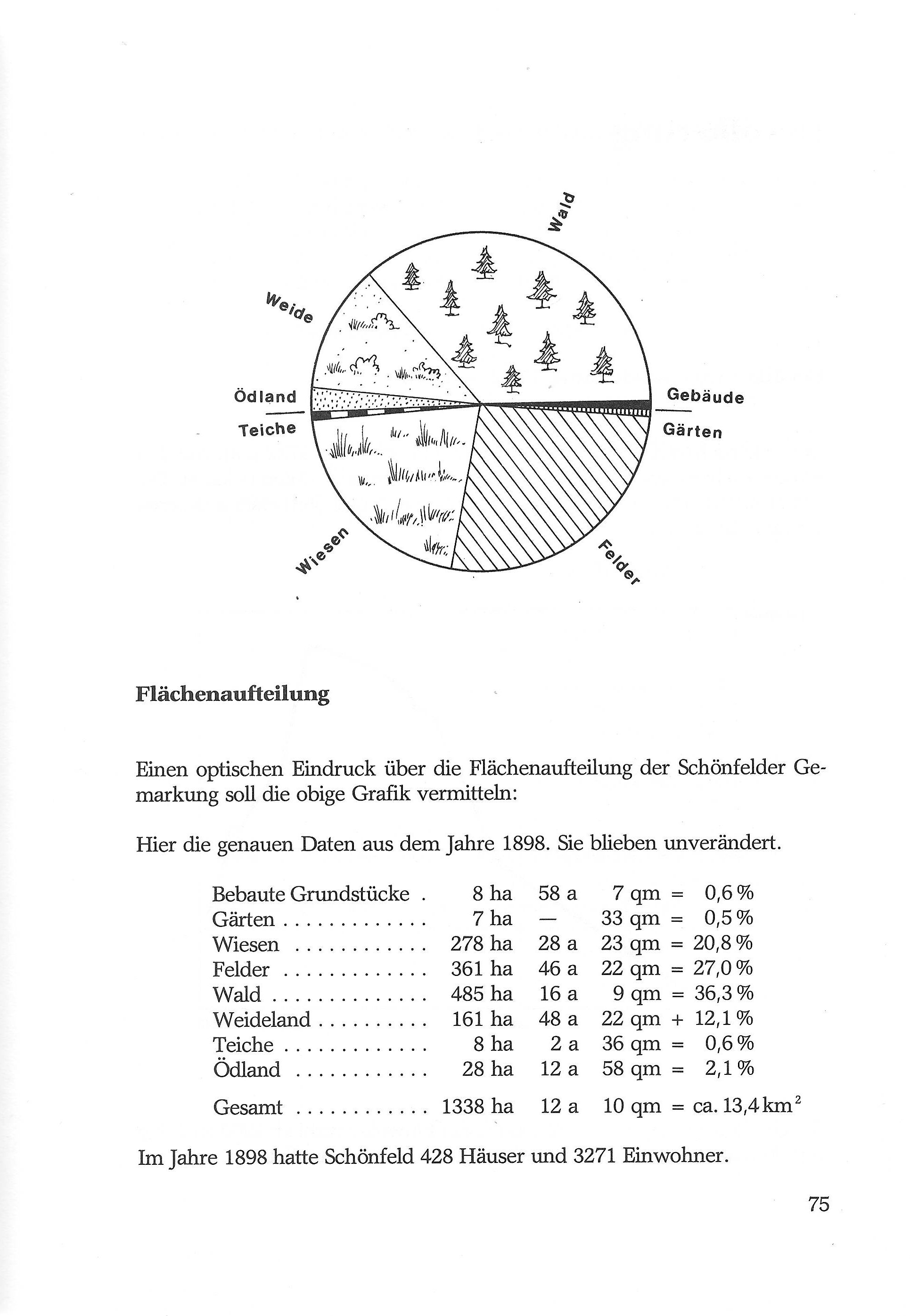 075
Pasture
Wasteland
Ponds
Buildings
Gardens
Fields
Meadows
Area distribution
The graphic below should give a visual impression of the area
distribution of the Schünfeld district:
Here are the exact data from 1898. They remained unchanged.
Developed land
Gardens
Meadows
Fields
Forest
Pastureland
Ponds
Wasteland
Total
8 ha
7 ha
278 ha
361 ha
485 ha
161 ha
8 ha
28 ha
1338 ha
58 a
28 a
46 a
16 a
48 a
7 sqm= 0.6%
33 sqm= 0.5%
23 sqm=20.8%
22 sqm = 27.0%
9 sqm =36.3%
22 sqm + 12.1%
2 a 36 sqm 0.6%
12 a
58 sqm = 2.1%
12 a 10 sqm = approx. 13.4 km2
In 1898, Schönfeld had 428 houses and 3271 inhabitants.
75
075
Pasture
Wasteland
Ponds
Buildings
Gardens
Fields
Meadows
Area distribution
The graphic below should give a visual impression of the area
distribution of the Schünfeld district:
Here are the exact data from 1898. They remained unchanged.
Developed land
Gardens
Meadows
Fields
Forest
Pastureland
Ponds
Wasteland
Total
8 ha
7 ha
278 ha
361 ha
485 ha
161 ha
8 ha
28 ha
1338 ha
58 a
28 a
46 a
16 a
48 a
7 sqm= 0.6%
33 sqm= 0.5%
23 sqm=20.8%
22 sqm = 27.0%
9 sqm =36.3%
22 sqm + 12.1%
2 a 36 sqm 0.6%
12 a
58 sqm = 2.1%
12 a 10 sqm = approx. 13.4 km2
In 1898, Schönfeld had 428 houses and 3271 inhabitants.
75
Page 0075
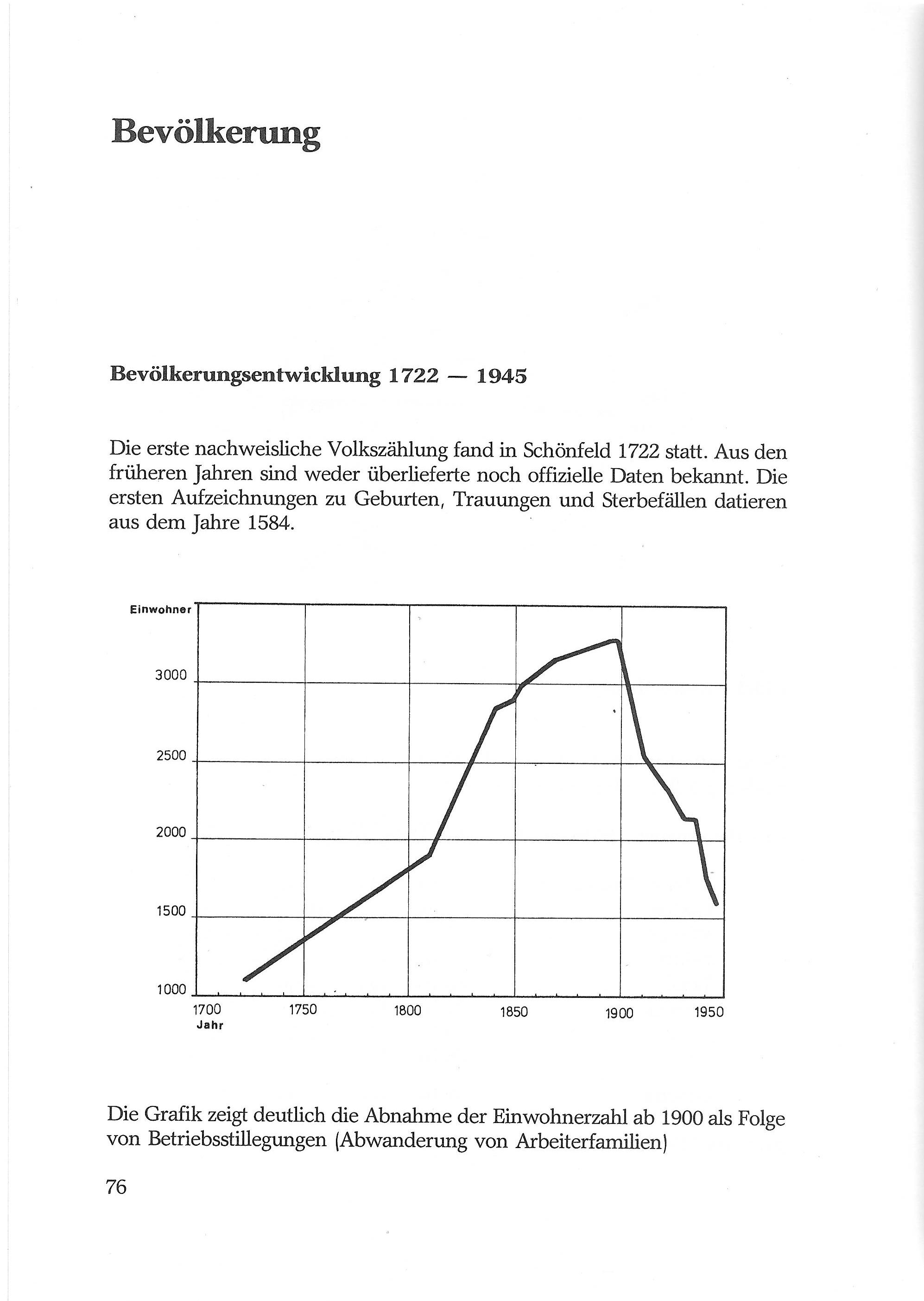 076
Population
Population development 1722-1945
The first verifiable census took place in Schonfeld in 1722. Neither
traditional nor official data is known from earlier years. The first
records of births, marriages and deaths date from 1584.
Inhabitants xxxx graph xxzxxxxx
3000
2500
2000
1500
1000
1700
Year
1750
1800
1850
1900
1950
The graph clearly shows the decrease in the number of inhabitants from
1900 as a result of factory closures (migration of working-class
families)
76
076
Population
Population development 1722-1945
The first verifiable census took place in Schonfeld in 1722. Neither
traditional nor official data is known from earlier years. The first
records of births, marriages and deaths date from 1584.
Inhabitants xxxx graph xxzxxxxx
3000
2500
2000
1500
1000
1700
Year
1750
1800
1850
1900
1950
The graph clearly shows the decrease in the number of inhabitants from
1900 as a result of factory closures (migration of working-class
families)
76
Page 0076
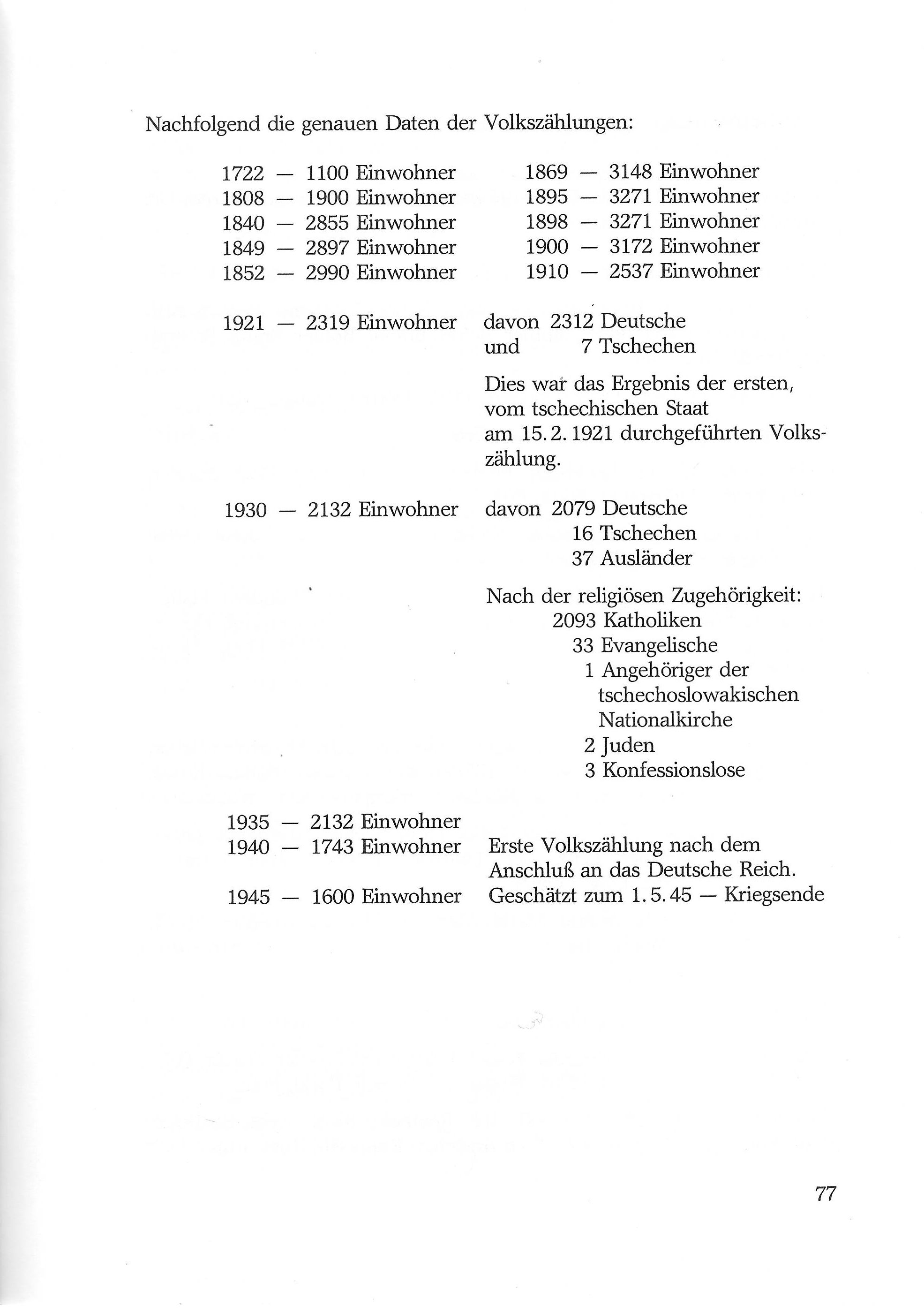 077
The exact data from the census are as follows:
1722 1100 inhabitants
1808 1900 inhabitants
1840 2855 inhabitants
18492897 inhabitants
1852 -2990 inhabitants
19212319 inhabitants
1869 3148 inhabitants
1895
3271 inhabitants
1898 3271 inhabitants
1900
3172 inhabitants
1910 2537 inhabitants
of which 2312 Germans and 7 Czechs
This was the result of the first census carried out by the Czech state
15.2. Census carried out in 1921
of which 2079 Germans
16 Czechs 37 foreigners
According to religious affiliation:
2093 Catholics 1 member of the national church
33 Protestants
Czechoslovakians
2 Jews
3 non-denominational
First census after the annexation to the German Reich. Estimated as of
May 1st, 1945 end of the war
1930
2132 inhabitants
1935 2132 inhabitants
1940
1743 inhabitants
1945 1600 inhabitants
77
077
The exact data from the census are as follows:
1722 1100 inhabitants
1808 1900 inhabitants
1840 2855 inhabitants
18492897 inhabitants
1852 -2990 inhabitants
19212319 inhabitants
1869 3148 inhabitants
1895
3271 inhabitants
1898 3271 inhabitants
1900
3172 inhabitants
1910 2537 inhabitants
of which 2312 Germans and 7 Czechs
This was the result of the first census carried out by the Czech state
15.2. Census carried out in 1921
of which 2079 Germans
16 Czechs 37 foreigners
According to religious affiliation:
2093 Catholics 1 member of the national church
33 Protestants
Czechoslovakians
2 Jews
3 non-denominational
First census after the annexation to the German Reich. Estimated as of
May 1st, 1945 end of the war
1930
2132 inhabitants
1935 2132 inhabitants
1940
1743 inhabitants
1945 1600 inhabitants
77
Page 0077
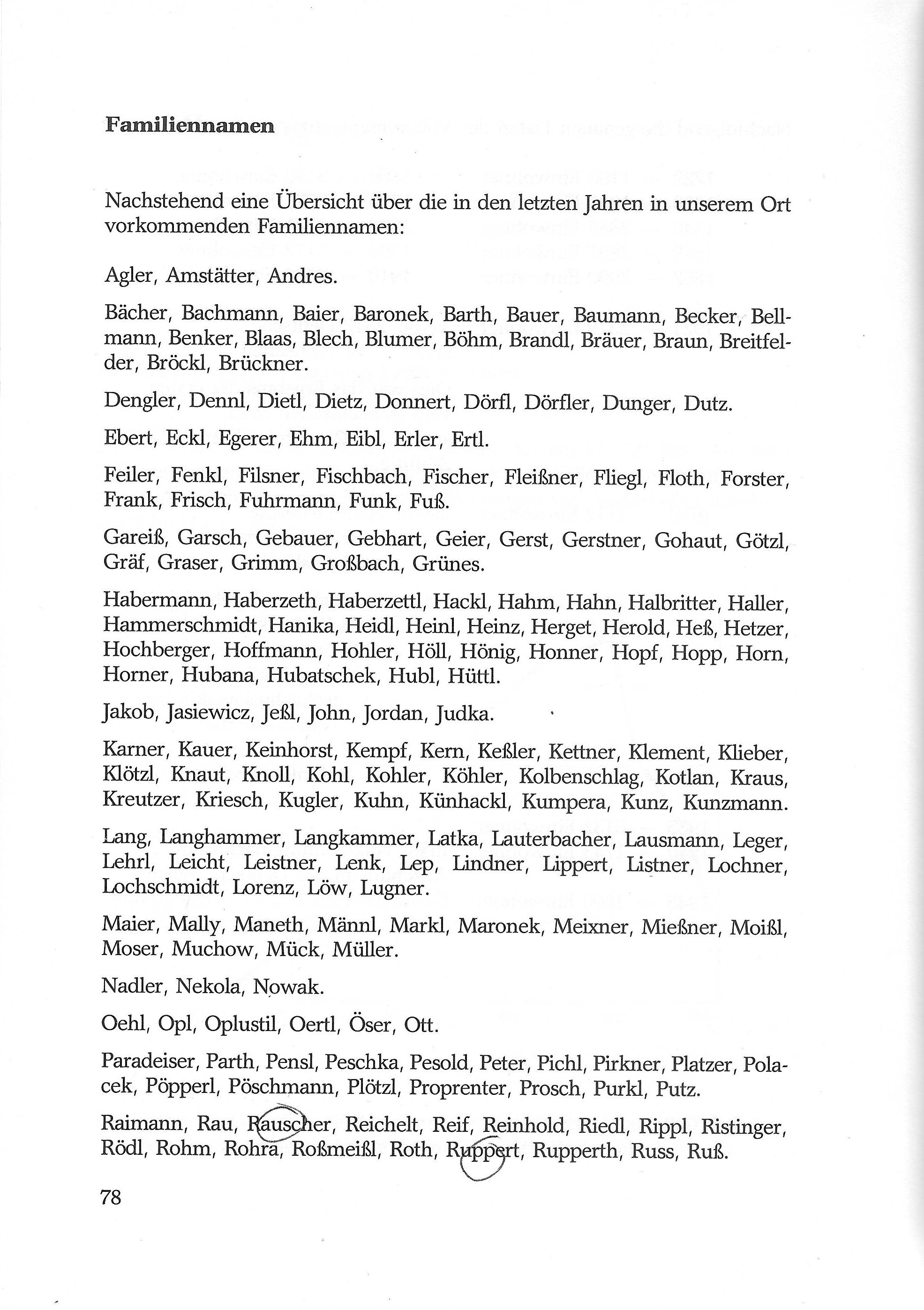 078
Surnames
Below is an overview of the surnames that have appeared in our town in
recent years:
Agler, Amstätter, Andres.
Bächer, Bachmann, Baier. Baronek, Barth, Bauer,
Baumann. Becker. Bell mann, Benker, Blaas, Blech. Blumer, Böhm,
Brandl, Bräuer. Braun. Breitfeld, Bröckl, Brückner.
Dengler, Dennl, Dietl, Dietz, Donnert, Dörfl. Dörfler, Dunger, Dutz
Ebert, Eckl, Egerer, Ehm, Eibl, Erler, Ertl.
Feiler, Fenkl, Filsner, Fischbach, Fischer, Fleißner, Fliegl,
Floth, Forster Frank, Frisch. Fuhrmann, Funk. Fut
Gareiß, Garsch, Gebauer, Gebhart, Geier, Gerst, Gerstner, Gohaut,
Götzl Gräf, Graser, Grimm. Großbach, Greens.
Habermann, Haberzeth, Haberzettl, Hackl, Hahm, Hahn, Halbritter,
Haller Hammerschmidt, Hanika, Heidl, Heinl, Heinz, Herget, Herold,
Heß, Hetzer Hochberger, Hoffmann, Hohler, Höll, Honig, Honner,
Hopf, Hopp, Horm Horner, Hubana, Hubatschek. Hubl, Huttl.
Jakob, Jasiewicz, Jeßl, John, Jordan, Judka.
Karner, Kauer, Keinhorst, Kempf, Kern, Keßler, Kettner, Klement,
Klieber Klötzl. Knaut. Knoll. Kohl. Kohler, Kähler, Kolbenschlag,
Kotlan, Kraus, Kreutzer, Kriesch, Kugler, Kuhn, Künhacki, Kumpera,
Kunz, Kunzmann
Lang, Langhammer, Langkammer, Latka, Lauterbacher, Lausmann, Leger
Lehrl, Leicht, Leistner, Lenk, Lep. Lindner, Lippert, Listner, Lochner
Lochschmidt, Lorenz. Low. Lugner.
Maier, Mally, Maneth, Männl, Markl, Maronek, Meixner, Mießner,
Moißl Moser. Muchow. Mück. Müller.
Nadler, Nekola, Nowak.
Oehl, Opl, Oplustil, Oertl, Öser, Ott.
Paradeiser, Parth, Pensl, Peschka, Pesold. Peter, Pichl,
Pirkner. Platzer. Pola cek, Pöpperl, Pöschmann, Plötzl. Proprenter,
Prosch, Purkl, Putz.
Raimann, Rau, Reuscher. Reichelt, Reif, Reinhold, Riedl, Rippl,
Ristinger Rödl, Rohm, Rohra, Roßmeißl, Roth, Rappgrt, Rupperth,
Russ, Ruß.
78
078
Surnames
Below is an overview of the surnames that have appeared in our town in
recent years:
Agler, Amstätter, Andres.
Bächer, Bachmann, Baier. Baronek, Barth, Bauer,
Baumann. Becker. Bell mann, Benker, Blaas, Blech. Blumer, Böhm,
Brandl, Bräuer. Braun. Breitfeld, Bröckl, Brückner.
Dengler, Dennl, Dietl, Dietz, Donnert, Dörfl. Dörfler, Dunger, Dutz
Ebert, Eckl, Egerer, Ehm, Eibl, Erler, Ertl.
Feiler, Fenkl, Filsner, Fischbach, Fischer, Fleißner, Fliegl,
Floth, Forster Frank, Frisch. Fuhrmann, Funk. Fut
Gareiß, Garsch, Gebauer, Gebhart, Geier, Gerst, Gerstner, Gohaut,
Götzl Gräf, Graser, Grimm. Großbach, Greens.
Habermann, Haberzeth, Haberzettl, Hackl, Hahm, Hahn, Halbritter,
Haller Hammerschmidt, Hanika, Heidl, Heinl, Heinz, Herget, Herold,
Heß, Hetzer Hochberger, Hoffmann, Hohler, Höll, Honig, Honner,
Hopf, Hopp, Horm Horner, Hubana, Hubatschek. Hubl, Huttl.
Jakob, Jasiewicz, Jeßl, John, Jordan, Judka.
Karner, Kauer, Keinhorst, Kempf, Kern, Keßler, Kettner, Klement,
Klieber Klötzl. Knaut. Knoll. Kohl. Kohler, Kähler, Kolbenschlag,
Kotlan, Kraus, Kreutzer, Kriesch, Kugler, Kuhn, Künhacki, Kumpera,
Kunz, Kunzmann
Lang, Langhammer, Langkammer, Latka, Lauterbacher, Lausmann, Leger
Lehrl, Leicht, Leistner, Lenk, Lep. Lindner, Lippert, Listner, Lochner
Lochschmidt, Lorenz. Low. Lugner.
Maier, Mally, Maneth, Männl, Markl, Maronek, Meixner, Mießner,
Moißl Moser. Muchow. Mück. Müller.
Nadler, Nekola, Nowak.
Oehl, Opl, Oplustil, Oertl, Öser, Ott.
Paradeiser, Parth, Pensl, Peschka, Pesold. Peter, Pichl,
Pirkner. Platzer. Pola cek, Pöpperl, Pöschmann, Plötzl. Proprenter,
Prosch, Purkl, Putz.
Raimann, Rau, Reuscher. Reichelt, Reif, Reinhold, Riedl, Rippl,
Ristinger Rödl, Rohm, Rohra, Roßmeißl, Roth, Rappgrt, Rupperth,
Russ, Ruß.
78
Page 0078
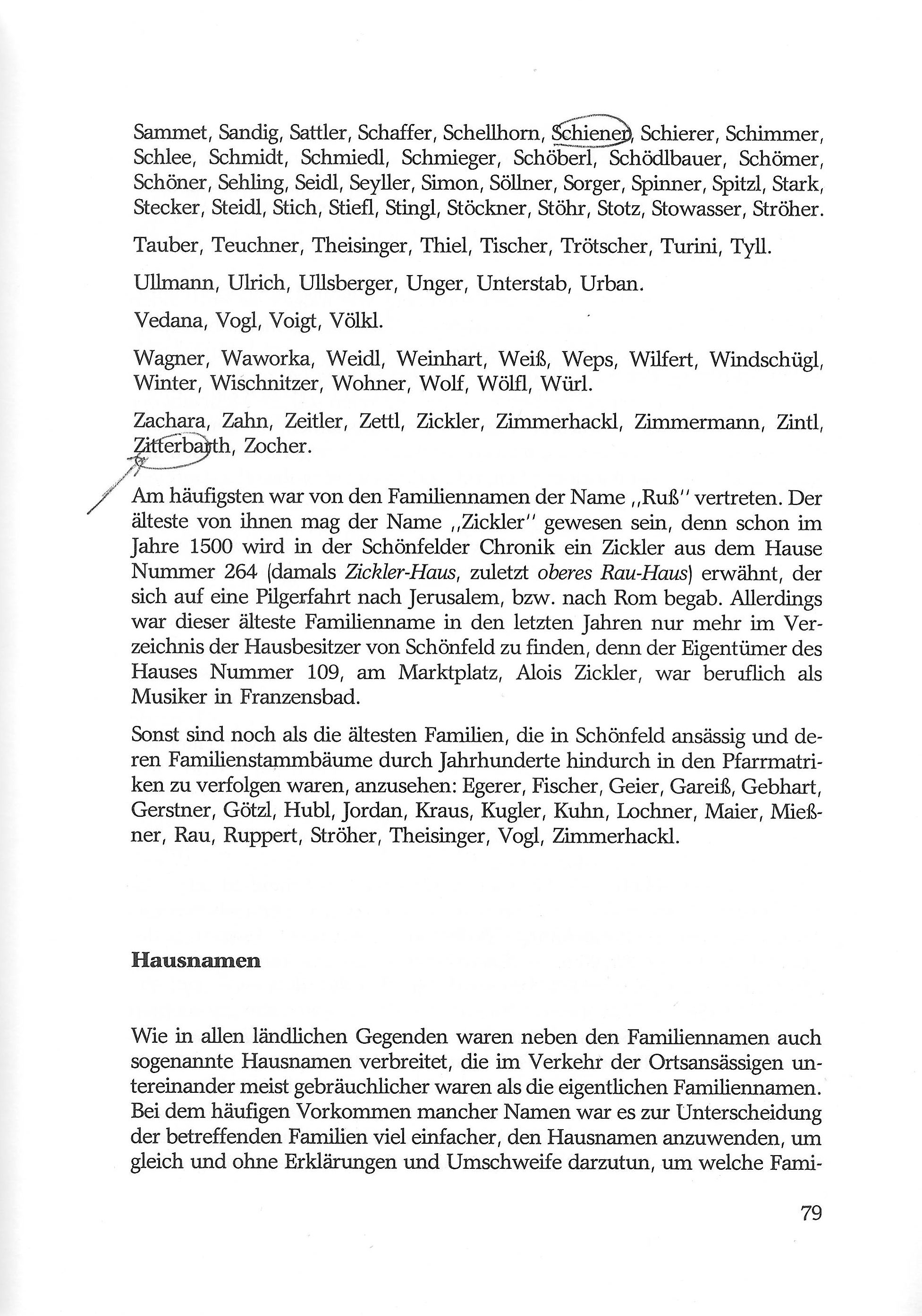 079
Sammet, Sandig, Sattler, Schaffer, Schellhorn, Schiened Schierer,
Schimmer, Schlee, Schmidt, Schmiedl, Schmieger, Schöberl, Schödlbauer,
Schömer Schöner, Sehling, Seidl, Seyller, Simon, Söllner, Sorger,
Spinner, Spitzl, Stark, Stecker, Steidl, Stich, Stiefl, Stingl,
Stöckner, Stöhr, Stotz, Stowasser, Ströher
Tauber, Teuchner, Theisinger, Thiel, Tischer, Trötscher, Turini, Tyll.
Ullmann, Ulrich, Ullsberger, Unger, Unterstab, Urban.
Vedana, Vogl, Voigt, Völkl.
Wagner, Waworka, Weidl, Weinhart, Weiß, Weps, Wilfert,
Windschügl, Winter, Wischnitzer, Wohner, Wolf, Wölfl, Würl.
Zachara, Zahn, Zeitler, Zettl, Zickler, Zimmerhackd, Zimmermann, Zintl
Zitterbajth, Zocher.
The most common family name was "Ruß". The oldest of these may have
been the name "Zickler", because as early as 1500, the Schönfeld
Chronicle mentions a Zickler from house number 264 (then the Zickler
House, later the upper Rau House), who went on a pilgrimage to
Jerusalem or Rome. However, in recent years this oldest family name
could only be found in the list of house owners in Schönfeld, because
the owner of house number 109 on the market square, Alois Zickler, was
a musician in Franzensbad.
The oldest families that lived in Schönfeld and whose family trees
could be traced through the centuries in the parish registers are:
Egerer, Fischer, Geier, Gareiß, Gebhart Gerstner, Götzl, Hubl,
Jordan, Kraus, Kugler, Kuhn, Lochner, Maier, Miener, Rau, Ruppert,
Ströher, Theisinger, Vogl, Zimmerhackl.
House names
As in all rural areas, in addition to family names, so-called house
names were common, which were usually more common among local
residents than the actual family names. Given the frequent occurrence
of some names, it was much easier to use the house name to distinguish
between the families in question and to show without explanations or
beating around the bush which families were involved.
79
079
Sammet, Sandig, Sattler, Schaffer, Schellhorn, Schiened Schierer,
Schimmer, Schlee, Schmidt, Schmiedl, Schmieger, Schöberl, Schödlbauer,
Schömer Schöner, Sehling, Seidl, Seyller, Simon, Söllner, Sorger,
Spinner, Spitzl, Stark, Stecker, Steidl, Stich, Stiefl, Stingl,
Stöckner, Stöhr, Stotz, Stowasser, Ströher
Tauber, Teuchner, Theisinger, Thiel, Tischer, Trötscher, Turini, Tyll.
Ullmann, Ulrich, Ullsberger, Unger, Unterstab, Urban.
Vedana, Vogl, Voigt, Völkl.
Wagner, Waworka, Weidl, Weinhart, Weiß, Weps, Wilfert,
Windschügl, Winter, Wischnitzer, Wohner, Wolf, Wölfl, Würl.
Zachara, Zahn, Zeitler, Zettl, Zickler, Zimmerhackd, Zimmermann, Zintl
Zitterbajth, Zocher.
The most common family name was "Ruß". The oldest of these may have
been the name "Zickler", because as early as 1500, the Schönfeld
Chronicle mentions a Zickler from house number 264 (then the Zickler
House, later the upper Rau House), who went on a pilgrimage to
Jerusalem or Rome. However, in recent years this oldest family name
could only be found in the list of house owners in Schönfeld, because
the owner of house number 109 on the market square, Alois Zickler, was
a musician in Franzensbad.
The oldest families that lived in Schönfeld and whose family trees
could be traced through the centuries in the parish registers are:
Egerer, Fischer, Geier, Gareiß, Gebhart Gerstner, Götzl, Hubl,
Jordan, Kraus, Kugler, Kuhn, Lochner, Maier, Miener, Rau, Ruppert,
Ströher, Theisinger, Vogl, Zimmerhackl.
House names
As in all rural areas, in addition to family names, so-called house
names were common, which were usually more common among local
residents than the actual family names. Given the frequent occurrence
of some names, it was much easier to use the house name to distinguish
between the families in question and to show without explanations or
beating around the bush which families were involved.
79
Page 0079
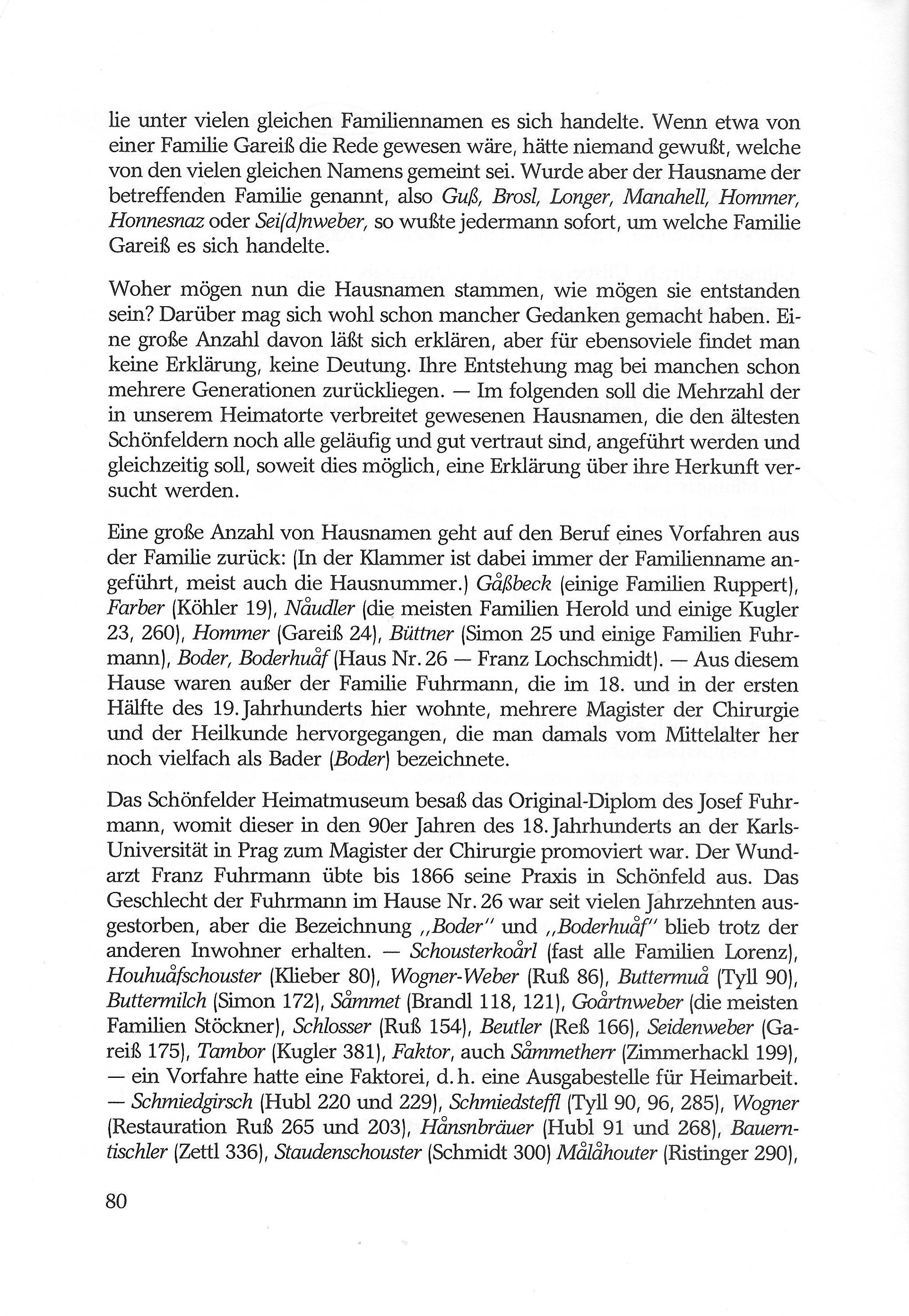 080
lie among many of the same family names. If, for example, there had
been talk of a Gareiß family, no one would have known which of the
many with the same name was meant. But if the family name of the
family in question was mentioned, i.e. Gu, Brosl Longer, Manahell,
Hommer, Honnesnaz or Seifd/nweber, everyone knew immediately which
Gareiß family it was.
Where do the family names come from, how did they come about? Many
people may have already thought about this. A large number of them can
be explained, but for just as many there is no explanation, no
interpretation. In some cases their origin may have been several
generations ago.-In the following, the majority of the family names
that were common in our hometown, all of which are still common and
well known to the oldest Schönfelders, will be listed and at the same
time an attempt will be made to explain their origin, as far as
possible.
A large number of house names can be traced back to the profession of
an ancestor in the family: (The family name ar is always given in
brackets, usually also the house number.) Gásbeck (some Ruppert
families), Farber (Köhler 191, Näudler (most Herold families and
some Kugler 23, 260), Hommer (Gareiß 24), Büttner (Simon 25 and
some Fuhrmann families), Boder, Boderhuåf (house no. 26 Franz
Lochschmidt). — In addition to the Fuhrmann family, who lived here
in the 18th and first half of the 19th century, this house also
produced several masters of surgery and medicine, who were often
referred to as Bader (Boder) from the Middle Ages.
The Schönfeld Local History Museum possessed the original diploma of
Josef Fuhrmann, with which he was awarded a master's degree at Charles
University in Prague in the 1790s. in surgery. The surgeon Franz
Fuhrmann practiced in Schönfeld until 1866. The Fuhrmann family in
house no. 26 had died out many decades ago, but the name Boder" and
Boderhuaf remained despite the other residents. Schousterkodr almost
all the Lorenz families), Houhuafschouster [Klieber 801, Wogner Weber
(Ruß 85), Buttermuå (Tyll 90), Buttermilch (Simon 172), Saronet
Brandl 118, 1211, Godrtnweber (most of the Stöckner families),
Schlosser (Ruß 154, Beudier Reß 1661, Seidenweber (Ga reiß
175), Tambor Kugler 381), Faktor, also Såmomethherr (Zimmerhackl
199)
an ancestor had a factory, i.e. a distribution point for home
work. -Schmiedgirsch (Hubl 220 and 2291, Schmiedsteff (Tyll 90, 96,
285), Wogner (Restauration Ruß 265 and 203), Hänsnbräuer
(Hubl 91 and 268), Bauern tischler (Zettl 336), Staudenschouster
(Schmidt 300) Målähouter (Ristinger 290),
80
080
lie among many of the same family names. If, for example, there had
been talk of a Gareiß family, no one would have known which of the
many with the same name was meant. But if the family name of the
family in question was mentioned, i.e. Gu, Brosl Longer, Manahell,
Hommer, Honnesnaz or Seifd/nweber, everyone knew immediately which
Gareiß family it was.
Where do the family names come from, how did they come about? Many
people may have already thought about this. A large number of them can
be explained, but for just as many there is no explanation, no
interpretation. In some cases their origin may have been several
generations ago.-In the following, the majority of the family names
that were common in our hometown, all of which are still common and
well known to the oldest Schönfelders, will be listed and at the same
time an attempt will be made to explain their origin, as far as
possible.
A large number of house names can be traced back to the profession of
an ancestor in the family: (The family name ar is always given in
brackets, usually also the house number.) Gásbeck (some Ruppert
families), Farber (Köhler 191, Näudler (most Herold families and
some Kugler 23, 260), Hommer (Gareiß 24), Büttner (Simon 25 and
some Fuhrmann families), Boder, Boderhuåf (house no. 26 Franz
Lochschmidt). — In addition to the Fuhrmann family, who lived here
in the 18th and first half of the 19th century, this house also
produced several masters of surgery and medicine, who were often
referred to as Bader (Boder) from the Middle Ages.
The Schönfeld Local History Museum possessed the original diploma of
Josef Fuhrmann, with which he was awarded a master's degree at Charles
University in Prague in the 1790s. in surgery. The surgeon Franz
Fuhrmann practiced in Schönfeld until 1866. The Fuhrmann family in
house no. 26 had died out many decades ago, but the name Boder" and
Boderhuaf remained despite the other residents. Schousterkodr almost
all the Lorenz families), Houhuafschouster [Klieber 801, Wogner Weber
(Ruß 85), Buttermuå (Tyll 90), Buttermilch (Simon 172), Saronet
Brandl 118, 1211, Godrtnweber (most of the Stöckner families),
Schlosser (Ruß 154, Beudier Reß 1661, Seidenweber (Ga reiß
175), Tambor Kugler 381), Faktor, also Såmomethherr (Zimmerhackl
199)
an ancestor had a factory, i.e. a distribution point for home
work. -Schmiedgirsch (Hubl 220 and 2291, Schmiedsteff (Tyll 90, 96,
285), Wogner (Restauration Ruß 265 and 203), Hänsnbräuer
(Hubl 91 and 268), Bauern tischler (Zettl 336), Staudenschouster
(Schmidt 300) Målähouter (Ristinger 290),
80
Page 0080
 081
Bergmaster IRuppert 384), Gromstefger IRau-Gotal 741. Waiker
(Rußlosef and Franz
A further number of house names can be traced back to the first names
of some ancestors: Gabrihell from Gabriel Unger 27, Adlwert from
Adalbert Kuhn 28), Kåschper from Kaspar (some families Mießner
32, 146, 176, 405), Grücher from Gregor (some families RuBl, Balzer
from Balthasar |Gebhart 75, Boårtl from Bartholomãus Ruppert
107, 352), as well as Batti (Seidl 303), Houtermåtz: Måtz from
Mathias, Houter Hutmacher (Rau 161, 741, beim Måtzn Reichelt 195),
Michl from Michael (Reichelt-Zimmerhackl 196), Manaheli from Emanuel
(Gareis 214, Brosl from Ambrosius Gareiß 271), Engl from Engelbert
iStowasser 284), Matthes Matthäus (Listner 366), Schan from the
French Jan = Johann (Ruß 418), Schoustermichl (Lorenz 437)
Some house names may derive their origin from earlier family names
that may have been present in the family through marriage: Richter
Girch, Pep (Götzl 16. 204, 382), Schafer (Eckl 134), Gerstner-Wenl
(Stowasser 222). Meinl (Geier 242, 388, 4171, Stan = Steinl (Roth
252. Bock (Ott 304, Lindner 257), Klupp-Beck (Tischer 3211, Kober
(Vogl 331, Sna leiter, probably von Sonnleitner Schmieger
Gusterl-Moifl 427).
A few house names indicate the origin of the ancestors of the families
in question: Neukirchner (Pensl 16), Berliner (Kuhn 122), Koburger
(Rup pert 2351, Toifenbecher Tone (Hochberger 2761. Kubner (Riedl
365. Kaunitzl. Gromhaisl Frånz (157), Theising (Lochschmidt -
Schiener 77).
In the last century, a family near the "Himmelreich" house was called
Himmelreich-Haus No. 2711. Karl Haller's grandmother, who grew up in
this house, was therefore also generally known as the Hirmebreich-Katl
The following house names can be explained in another way: Potherr
Hotel Potherr 108): The grandfather of the last owner. Wenzl
Rofmeißl, the innkeeper and mayor Anton Rub, was appointed
godfather at baptisms and confirmations 33 times. In addition to his
many "Potboum" (godchildren), over time a large part of the population
referred to him as Potherr. This prompted Anton Ruß to name his
restaurant "Gasthaus zum Potherrn". Tischerhuåf Ialmost all
families Zimmerhackll. The farm was probably originally called
Tischlerhof, since at the time of the Thirty Years' War, when the farm
is already mentioned, several Zimmerhackl were carpenters by
profession, including the master carpenter and councilor Zimmerhackd.,
who created the beautiful statue of the Mother of God in 1677. Langer,
Långer Naz (Gareiß 116, 224, because some members of this family
were of exceptional height.
81
081
Bergmaster IRuppert 384), Gromstefger IRau-Gotal 741. Waiker
(Rußlosef and Franz
A further number of house names can be traced back to the first names
of some ancestors: Gabrihell from Gabriel Unger 27, Adlwert from
Adalbert Kuhn 28), Kåschper from Kaspar (some families Mießner
32, 146, 176, 405), Grücher from Gregor (some families RuBl, Balzer
from Balthasar |Gebhart 75, Boårtl from Bartholomãus Ruppert
107, 352), as well as Batti (Seidl 303), Houtermåtz: Måtz from
Mathias, Houter Hutmacher (Rau 161, 741, beim Måtzn Reichelt 195),
Michl from Michael (Reichelt-Zimmerhackl 196), Manaheli from Emanuel
(Gareis 214, Brosl from Ambrosius Gareiß 271), Engl from Engelbert
iStowasser 284), Matthes Matthäus (Listner 366), Schan from the
French Jan = Johann (Ruß 418), Schoustermichl (Lorenz 437)
Some house names may derive their origin from earlier family names
that may have been present in the family through marriage: Richter
Girch, Pep (Götzl 16. 204, 382), Schafer (Eckl 134), Gerstner-Wenl
(Stowasser 222). Meinl (Geier 242, 388, 4171, Stan = Steinl (Roth
252. Bock (Ott 304, Lindner 257), Klupp-Beck (Tischer 3211, Kober
(Vogl 331, Sna leiter, probably von Sonnleitner Schmieger
Gusterl-Moifl 427).
A few house names indicate the origin of the ancestors of the families
in question: Neukirchner (Pensl 16), Berliner (Kuhn 122), Koburger
(Rup pert 2351, Toifenbecher Tone (Hochberger 2761. Kubner (Riedl
365. Kaunitzl. Gromhaisl Frånz (157), Theising (Lochschmidt -
Schiener 77).
In the last century, a family near the "Himmelreich" house was called
Himmelreich-Haus No. 2711. Karl Haller's grandmother, who grew up in
this house, was therefore also generally known as the Hirmebreich-Katl
The following house names can be explained in another way: Potherr
Hotel Potherr 108): The grandfather of the last owner. Wenzl
Rofmeißl, the innkeeper and mayor Anton Rub, was appointed
godfather at baptisms and confirmations 33 times. In addition to his
many "Potboum" (godchildren), over time a large part of the population
referred to him as Potherr. This prompted Anton Ruß to name his
restaurant "Gasthaus zum Potherrn". Tischerhuåf Ialmost all
families Zimmerhackll. The farm was probably originally called
Tischlerhof, since at the time of the Thirty Years' War, when the farm
is already mentioned, several Zimmerhackl were carpenters by
profession, including the master carpenter and councilor Zimmerhackd.,
who created the beautiful statue of the Mother of God in 1677. Langer,
Långer Naz (Gareiß 116, 224, because some members of this family
were of exceptional height.
81
Page 0081
 082
"Bå då Altn" (Jordan Inn 419). This name is actually based on
her husband, the Altn And! lordan), after whose death his wife Anna
Jordan was given this name, although she was not yet old at the
time. This name remained in use even after the death of the
91-year-old landlady. Gabi (Kugler 51): Perhaps the ancestors lived at
the so-called Gablschacht on the Hirtenpaint (house no. 395). Gabl in
turn seems to be derived from Göpl, who belonged to the mine. Neintl
(almost all Rödl families): This house name also apparently goes back
to ore mining. Neintl comes from Neuntel. A Rödl from house 208 on the
Neustadt collected the insurance amounts from the miners for the
Bruderlade, the forerunner of today's miners' insurance. The
contributions amounted to one ninth of the respective earnings. With
At that time, the cashier Rödl himself was called Neuntel and this
name was passed down to his descendants in the dialect
Neintl. Windwah-Naz (Lochschmidt 3061, because in winter huge
snowdrifts piled up in front of his house. Barracks of carpenter Pichl
358 on the Kaunitzl, because the carpenter Pichl worked as a nurse in
the hospital barracks during the Tvphus epidemic in 1905. Bernond
(Garsch 411), he came from the area around Eger, came to Schönfeld as
a tailor's apprentice after completing his military service in the
1880s and very often used the phrase "miå san bernond" in his
frequent capital binges, from which he got this house name. Hausherr
(Dennl 541 arose because he lived at the town hall tower before buying
his house and the town hall officials jokingly called him Hausherr,
which became generalized.
For a large part of the house names, however, no evidence for an
explanation could be found. Such names are: Schattl (house number 15
Brichet (Leicht 22), Pul (most families Ott), Konderer (some families
Müller 68, 114, 4441, Oarl (Gareis 72, 232), Rauthuas leine Familie
Kugler Duckes (Spitzl 153, 366), Scharrer (Lorenz 155), Schwilm
[Kugler 156), Boihm naz (Mießner 162), Lomodl Geier 173),
Tscheischich (Kugler 188), Mutz (Kug ler 191), Bacher (Kugler 376, 94,
233). Temes (Tyll 90), Kodlong (Mießner 78 Quere (Hubl-Spengler
40), Måterer (some families Lochschmidt 13, former owner of the
inn, "Zur Krone", 26, 211, 272, 306), Poschetz (Rup pert 392), Andl
(fordan 401, 419), Kuderer (Gerstner 90), Klápperer (Hubl 404
Schnapper Boum Geier 2011, Muckl Lugner 146, 2531, Nees (Gebhart 3091
Guß /Gareiß 315), Streicher Hahm 215, 277), Bebl (Gebhart 282),
Bolon (Dennl 292), Rahm Stöckner 295), Zellerer (Kugler 298)
Most of these house names will still sound very familiar to many of
the older generation. But even younger people will certainly recall
one or two names through this recording.
82
082
"Bå då Altn" (Jordan Inn 419). This name is actually based on
her husband, the Altn And! lordan), after whose death his wife Anna
Jordan was given this name, although she was not yet old at the
time. This name remained in use even after the death of the
91-year-old landlady. Gabi (Kugler 51): Perhaps the ancestors lived at
the so-called Gablschacht on the Hirtenpaint (house no. 395). Gabl in
turn seems to be derived from Göpl, who belonged to the mine. Neintl
(almost all Rödl families): This house name also apparently goes back
to ore mining. Neintl comes from Neuntel. A Rödl from house 208 on the
Neustadt collected the insurance amounts from the miners for the
Bruderlade, the forerunner of today's miners' insurance. The
contributions amounted to one ninth of the respective earnings. With
At that time, the cashier Rödl himself was called Neuntel and this
name was passed down to his descendants in the dialect
Neintl. Windwah-Naz (Lochschmidt 3061, because in winter huge
snowdrifts piled up in front of his house. Barracks of carpenter Pichl
358 on the Kaunitzl, because the carpenter Pichl worked as a nurse in
the hospital barracks during the Tvphus epidemic in 1905. Bernond
(Garsch 411), he came from the area around Eger, came to Schönfeld as
a tailor's apprentice after completing his military service in the
1880s and very often used the phrase "miå san bernond" in his
frequent capital binges, from which he got this house name. Hausherr
(Dennl 541 arose because he lived at the town hall tower before buying
his house and the town hall officials jokingly called him Hausherr,
which became generalized.
For a large part of the house names, however, no evidence for an
explanation could be found. Such names are: Schattl (house number 15
Brichet (Leicht 22), Pul (most families Ott), Konderer (some families
Müller 68, 114, 4441, Oarl (Gareis 72, 232), Rauthuas leine Familie
Kugler Duckes (Spitzl 153, 366), Scharrer (Lorenz 155), Schwilm
[Kugler 156), Boihm naz (Mießner 162), Lomodl Geier 173),
Tscheischich (Kugler 188), Mutz (Kug ler 191), Bacher (Kugler 376, 94,
233). Temes (Tyll 90), Kodlong (Mießner 78 Quere (Hubl-Spengler
40), Måterer (some families Lochschmidt 13, former owner of the
inn, "Zur Krone", 26, 211, 272, 306), Poschetz (Rup pert 392), Andl
(fordan 401, 419), Kuderer (Gerstner 90), Klápperer (Hubl 404
Schnapper Boum Geier 2011, Muckl Lugner 146, 2531, Nees (Gebhart 3091
Guß /Gareiß 315), Streicher Hahm 215, 277), Bebl (Gebhart 282),
Bolon (Dennl 292), Rahm Stöckner 295), Zellerer (Kugler 298)
Most of these house names will still sound very familiar to many of
the older generation. But even younger people will certainly recall
one or two names through this recording.
82
Page 0082
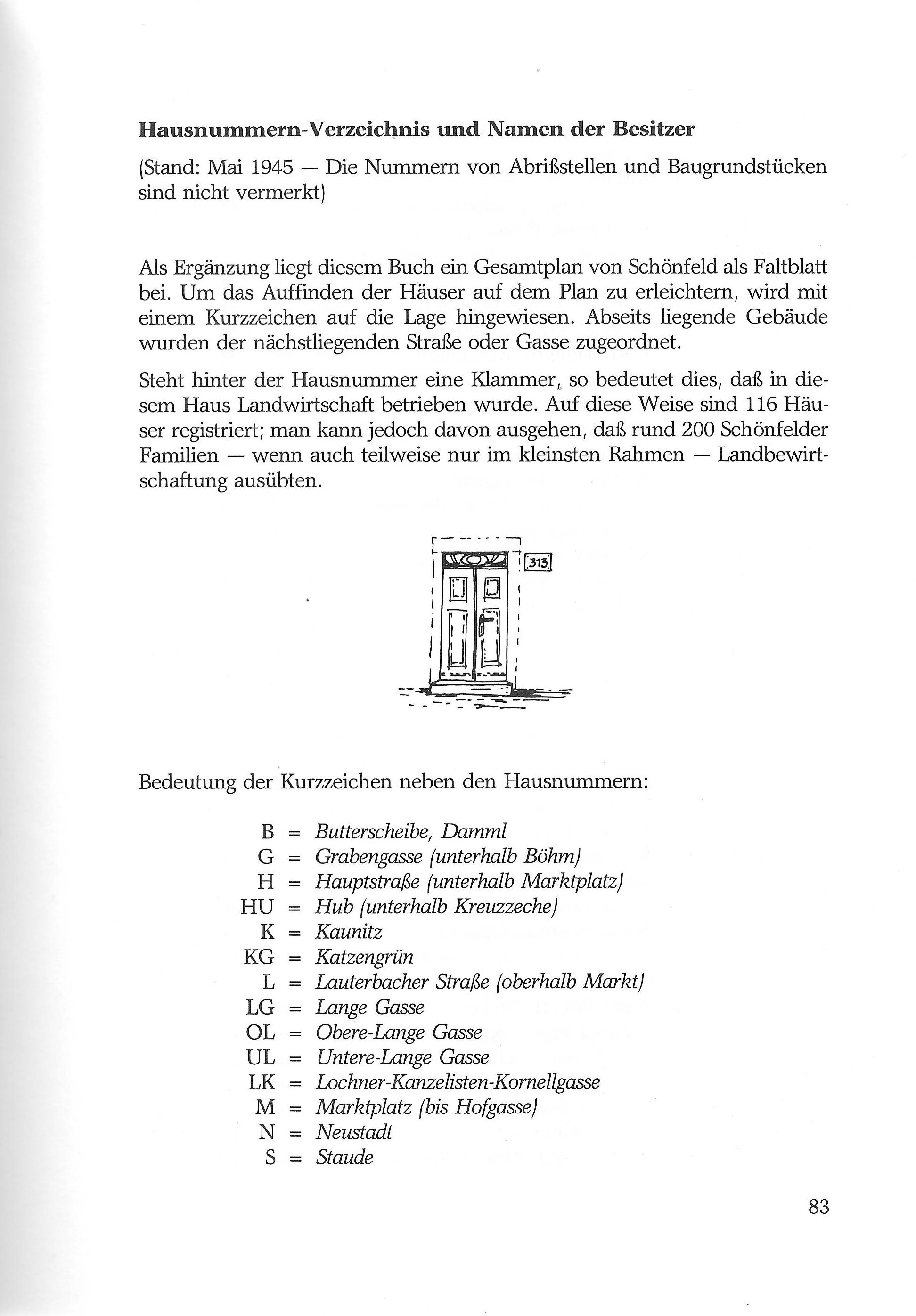 083
List of house numbers and names of owners
(As of May 1945 The numbers of demolition sites and building plots are
not noted
As a supplement, this book is accompanied by a complete plan of
Schönfeld as a leaflet. To make it easier to find the houses on the
plan, an abbreviation indicates their location. Buildings that are
located further away were assigned to the nearest street or alley.
If there is a bracket after the house number, this means that farming
was carried out in the house. 116 houses are registered in this way;
however, it can be assumed that around 200 Schönfeld families - albeit
sometimes only on a very small scale - were involved in farming.
Meaning of the abbreviations next to the house numbers
B Butterscheibe, Dammt
G Grabengasse (below Böhm
H Hauptstraße below Marktplatz)
HU Hub (below Kreuzzechel
K-Kaunitz
KG = Katzengrün
L =Lauterbacher Straße (above the market)
LG =Lange Gasse
OL =Obere-Lange Gasse UL =Untere-Lange Gasse
LK M = Marktplatz (to Hofgasse)
=Lochner-Kanzelisten-Kornellgasse
N Neustadt
S=Staude
83
083
List of house numbers and names of owners
(As of May 1945 The numbers of demolition sites and building plots are
not noted
As a supplement, this book is accompanied by a complete plan of
Schönfeld as a leaflet. To make it easier to find the houses on the
plan, an abbreviation indicates their location. Buildings that are
located further away were assigned to the nearest street or alley.
If there is a bracket after the house number, this means that farming
was carried out in the house. 116 houses are registered in this way;
however, it can be assumed that around 200 Schönfeld families - albeit
sometimes only on a very small scale - were involved in farming.
Meaning of the abbreviations next to the house numbers
B Butterscheibe, Dammt
G Grabengasse (below Böhm
H Hauptstraße below Marktplatz)
HU Hub (below Kreuzzechel
K-Kaunitz
KG = Katzengrün
L =Lauterbacher Straße (above the market)
LG =Lange Gasse
OL =Obere-Lange Gasse UL =Untere-Lange Gasse
LK M = Marktplatz (to Hofgasse)
=Lochner-Kanzelisten-Kornellgasse
N Neustadt
S=Staude
83
Page 0083
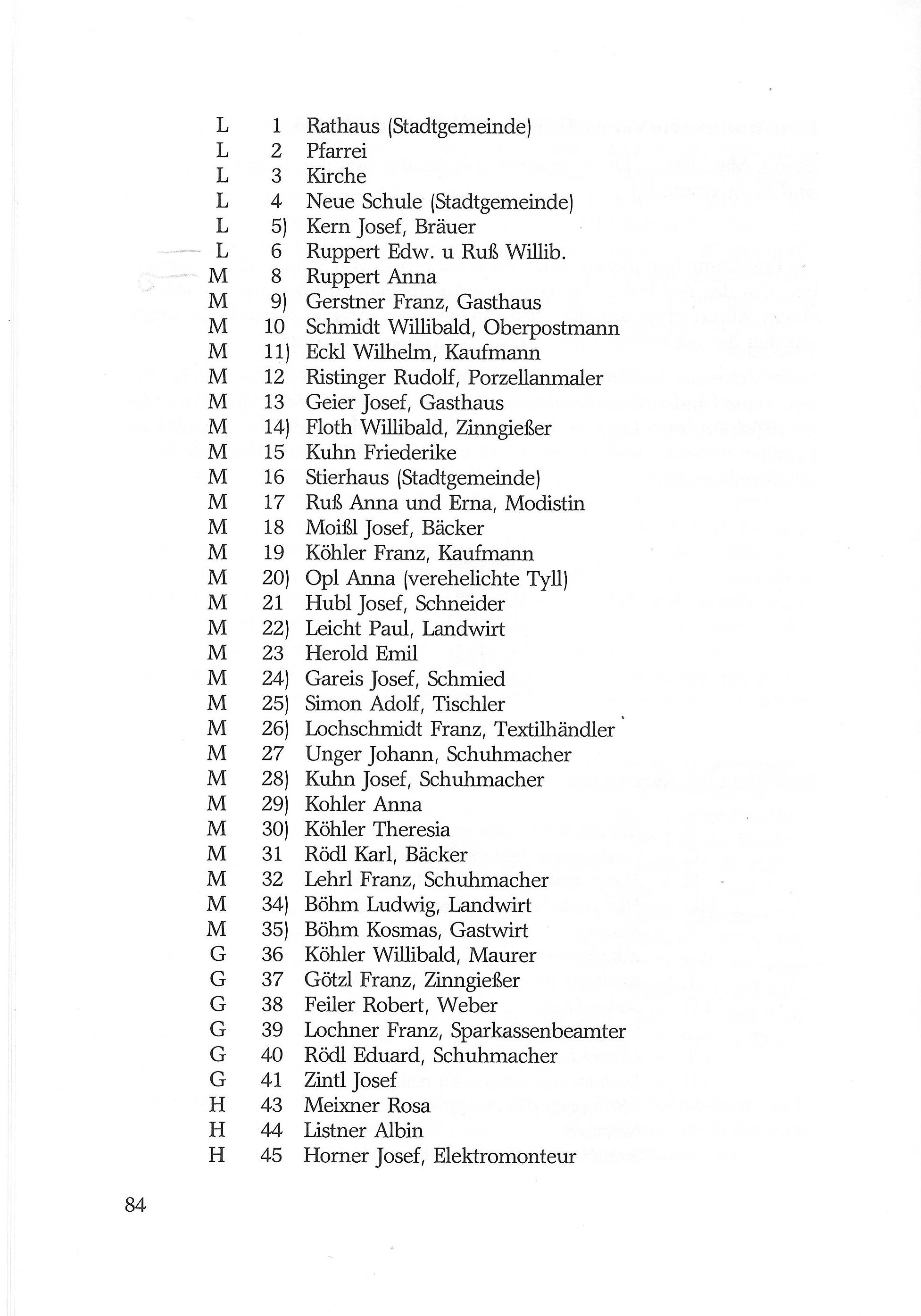 084
084
Page 0084
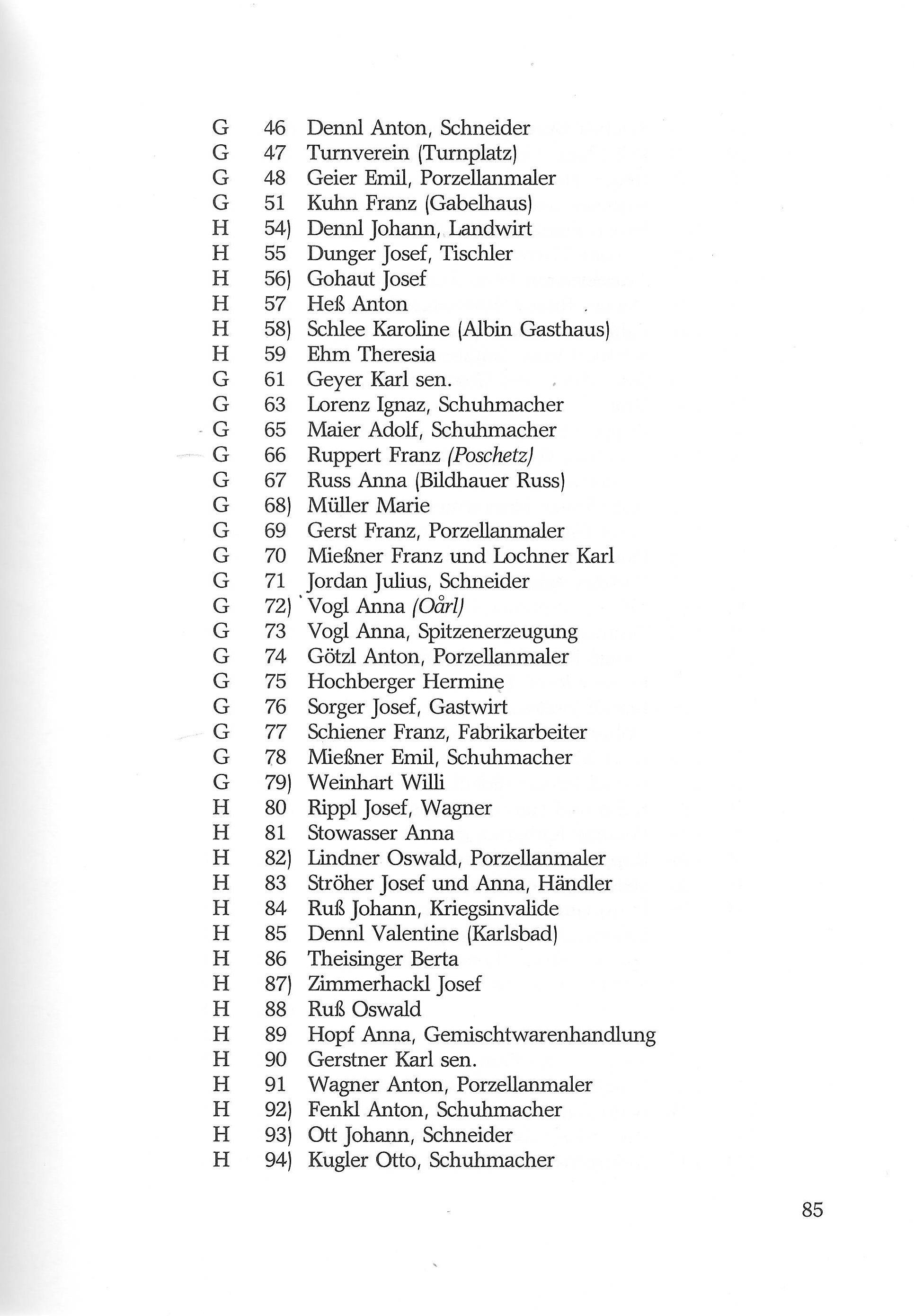 085
085
Page 0085
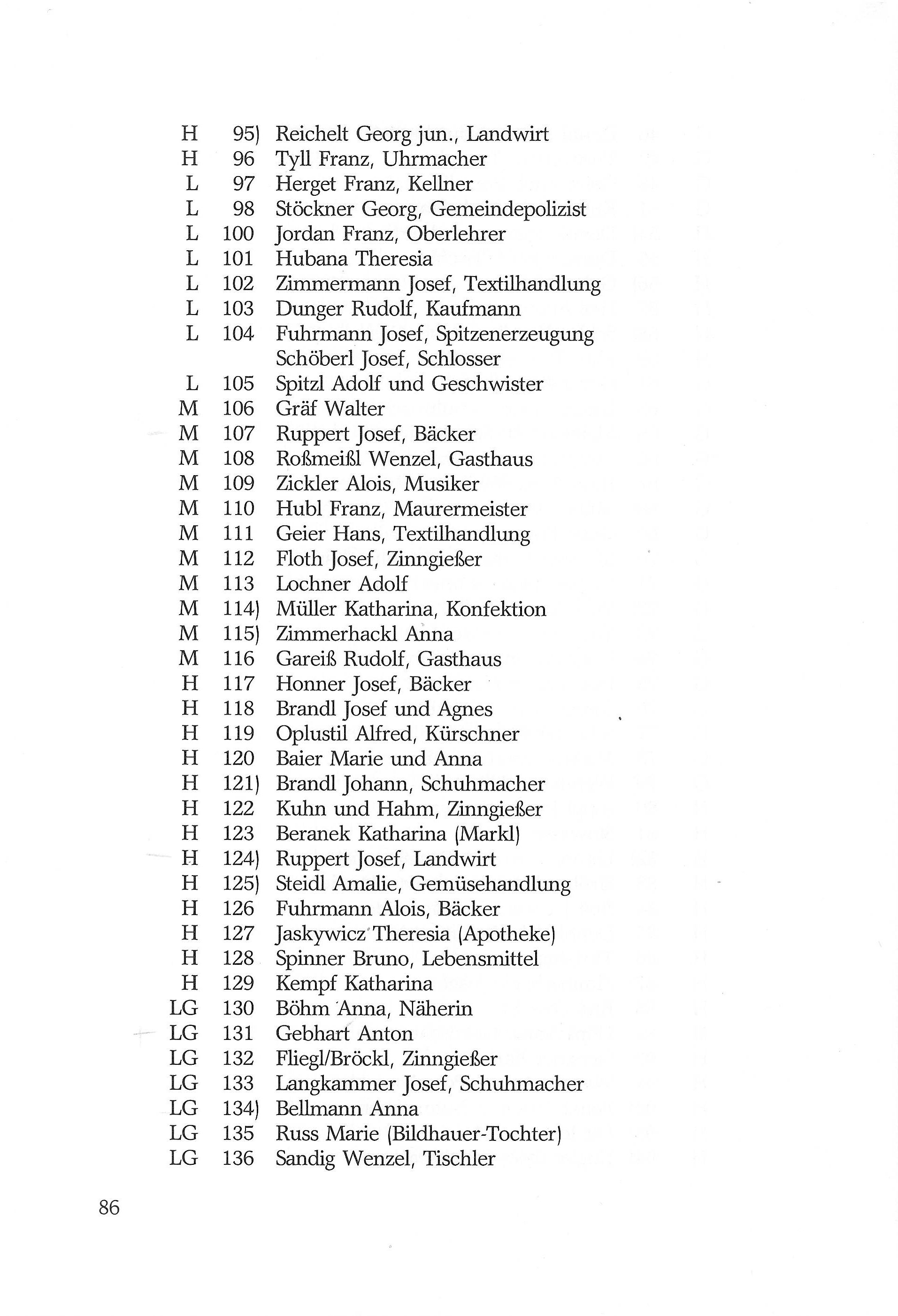 086
086
Page 0086
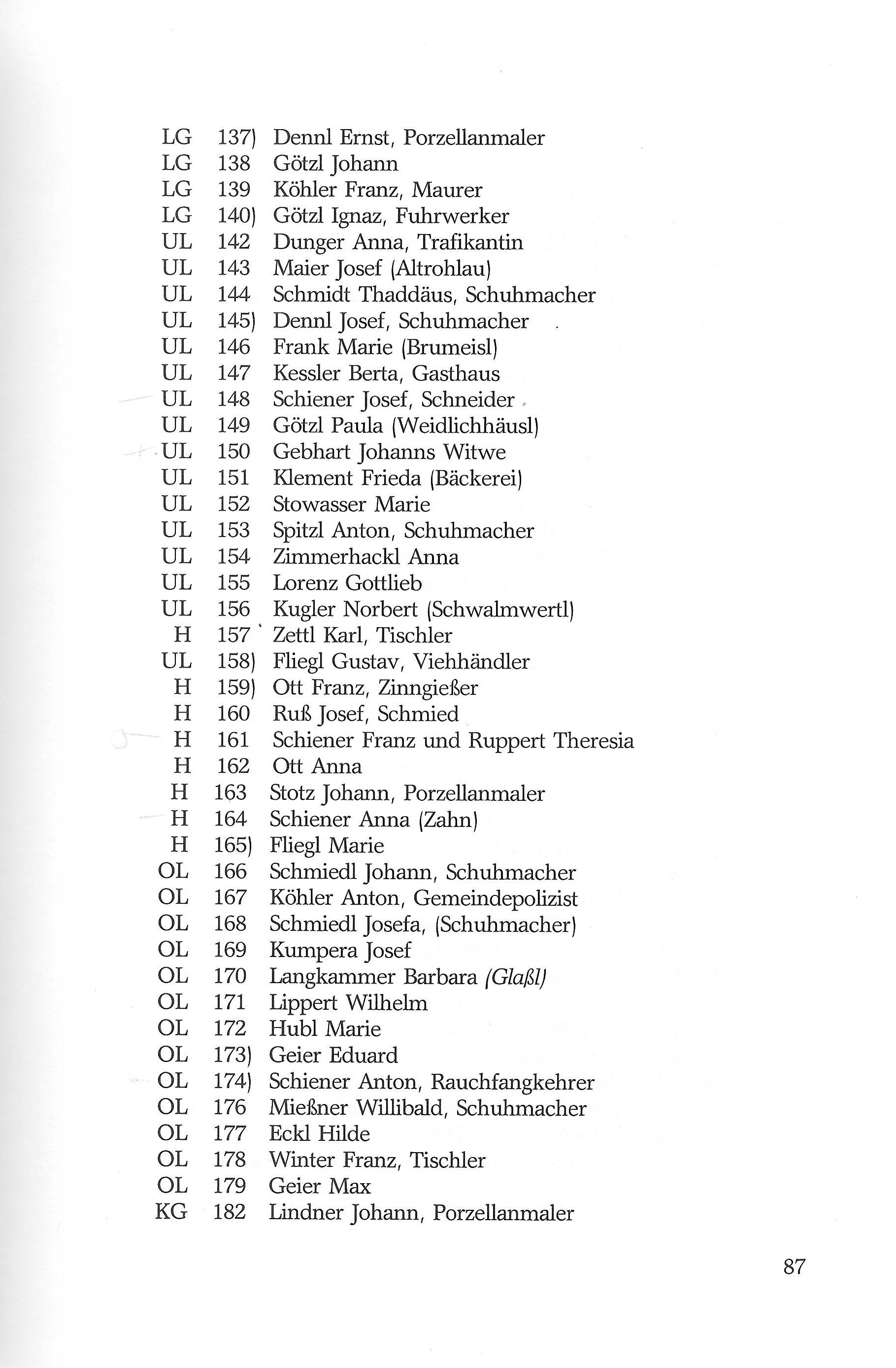 087
087
Page 0087
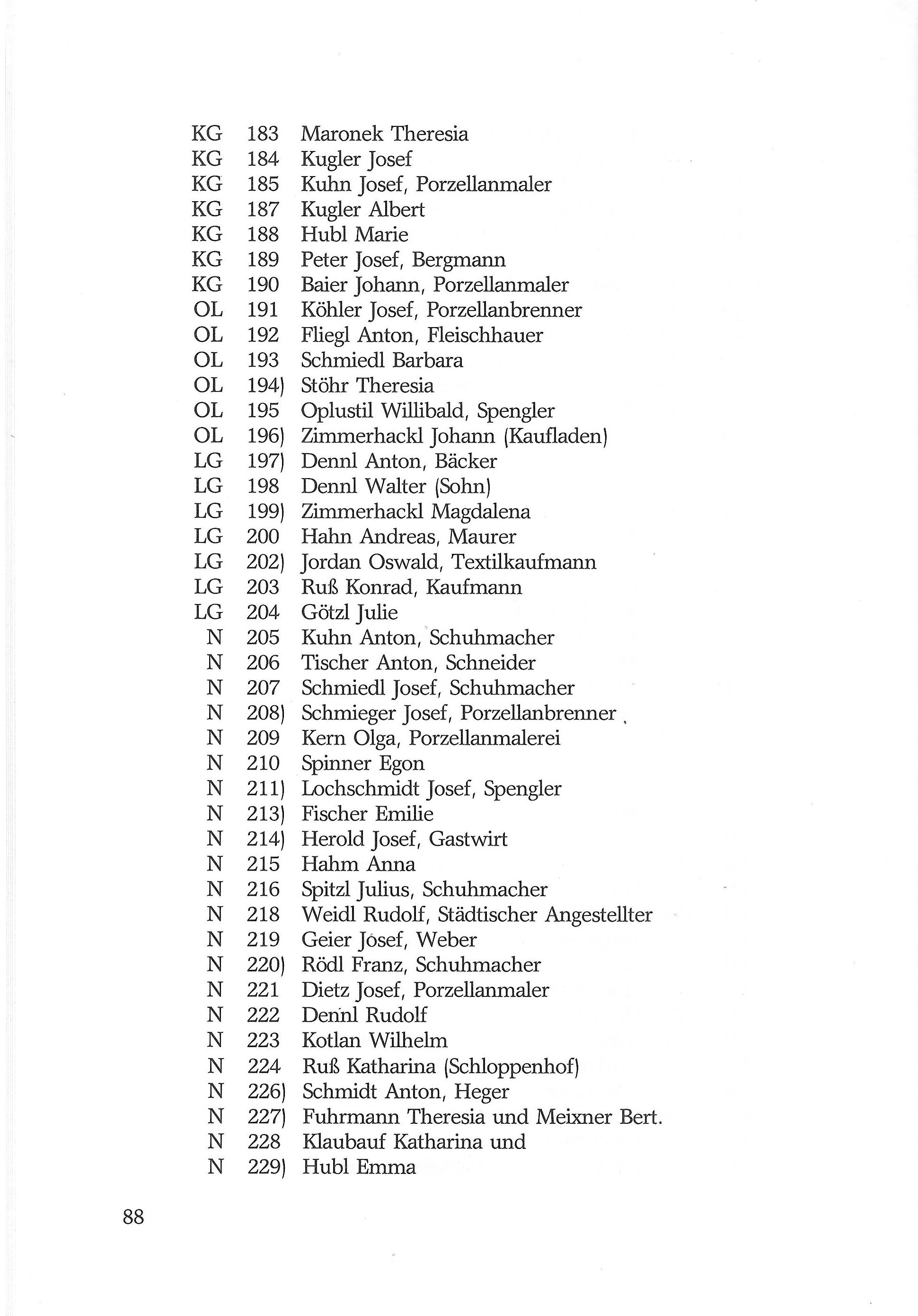 088
088
Page 0088
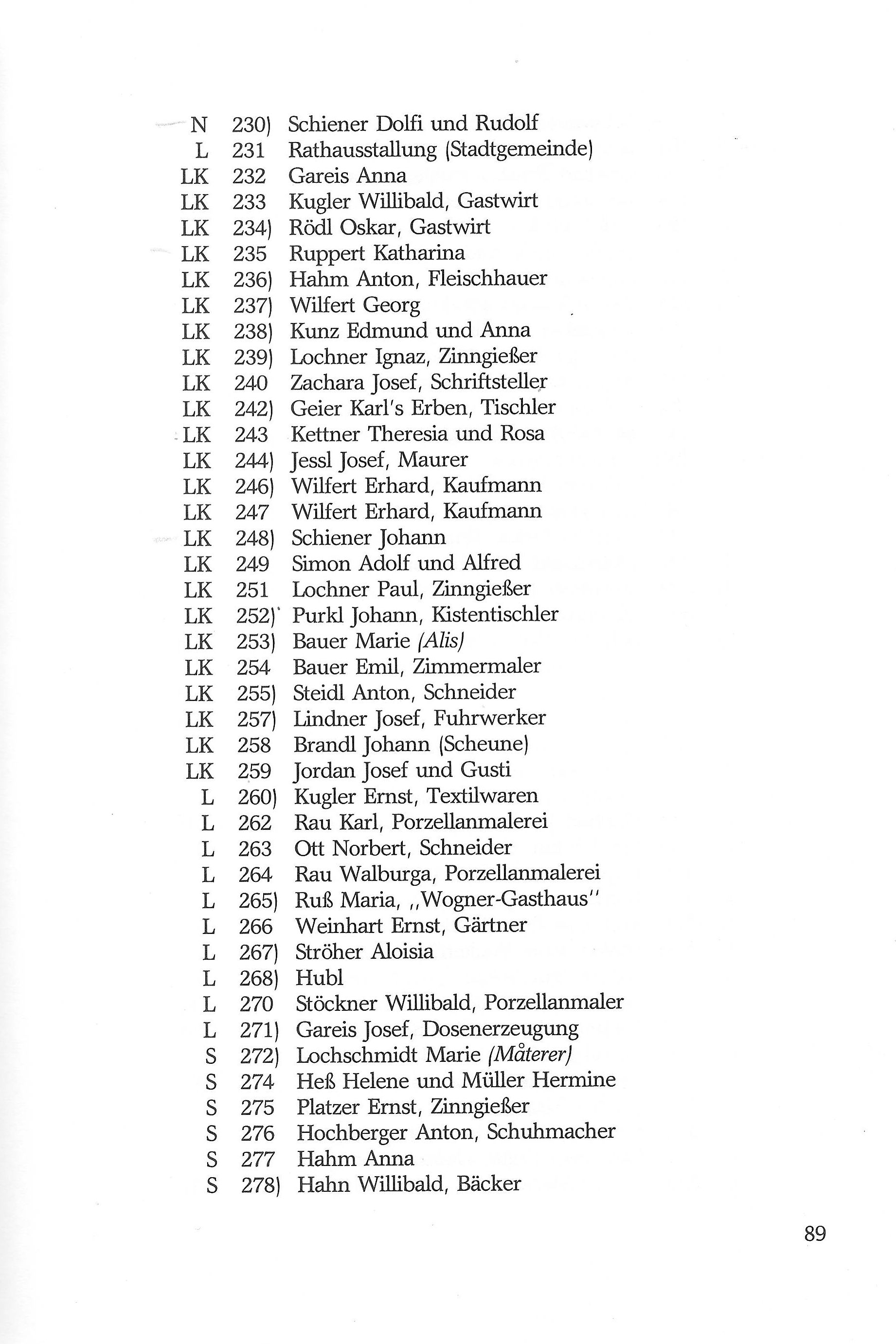 089
089
Page 0089
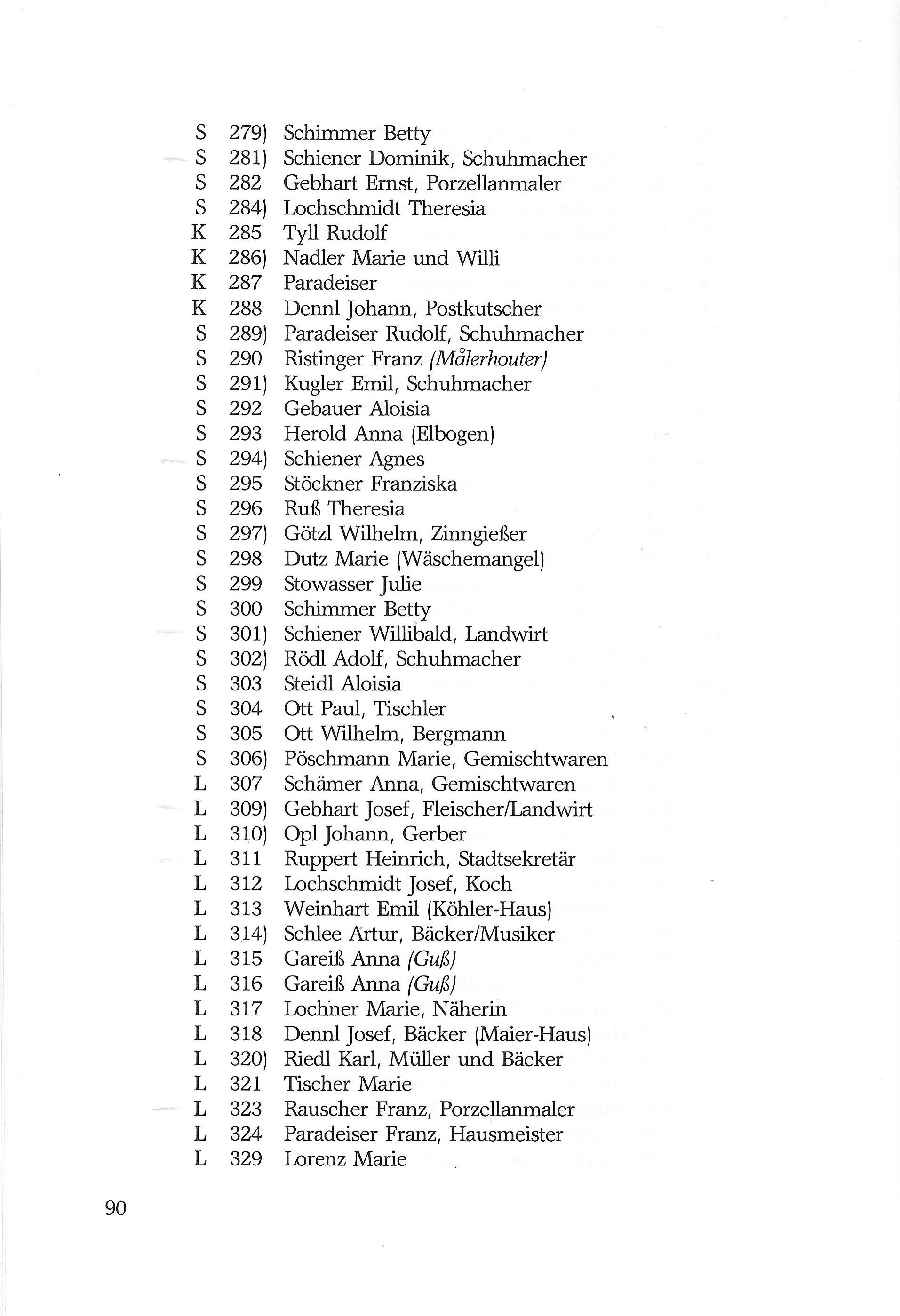 090
090
Page 0090
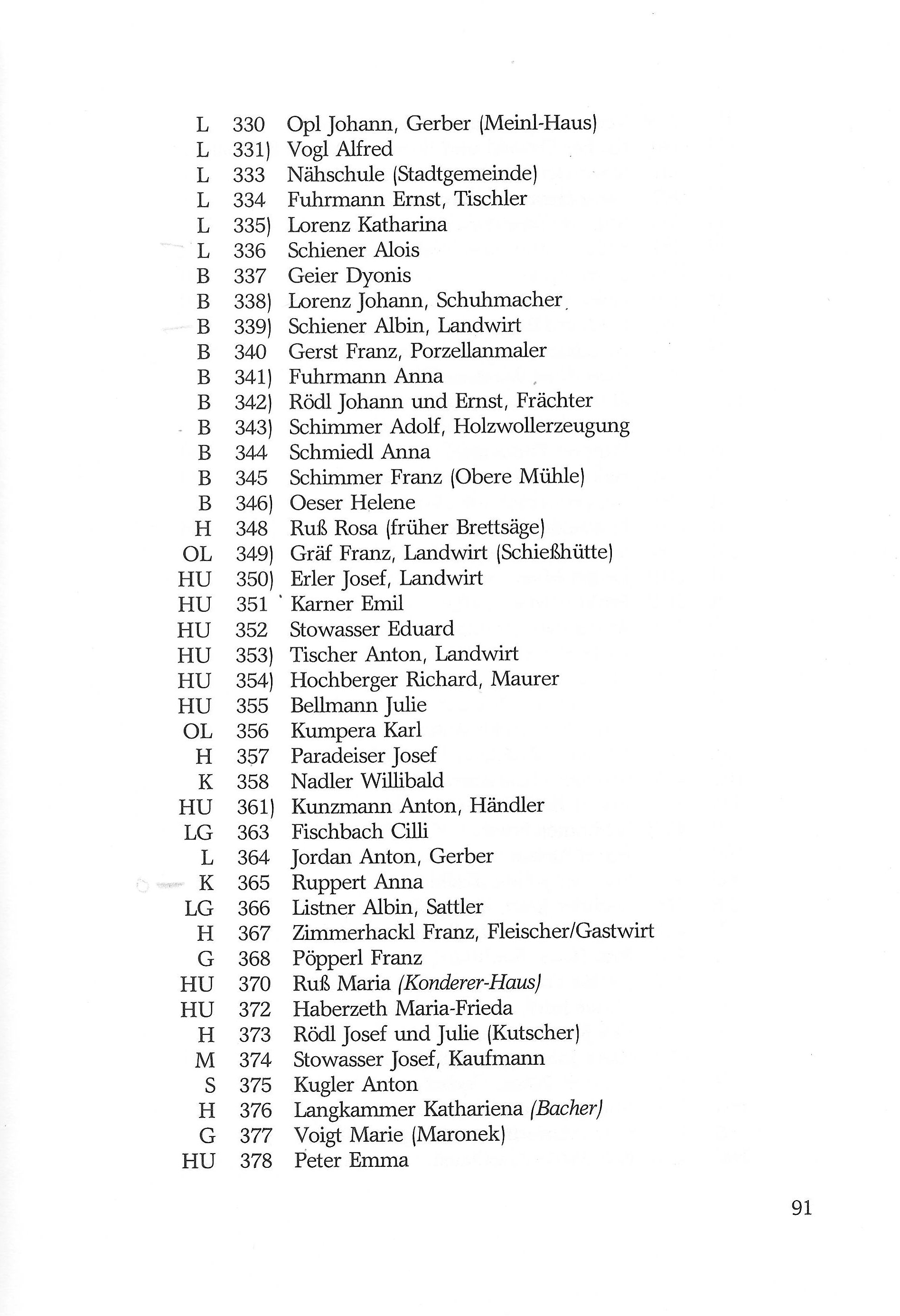 091
091
Page 0091
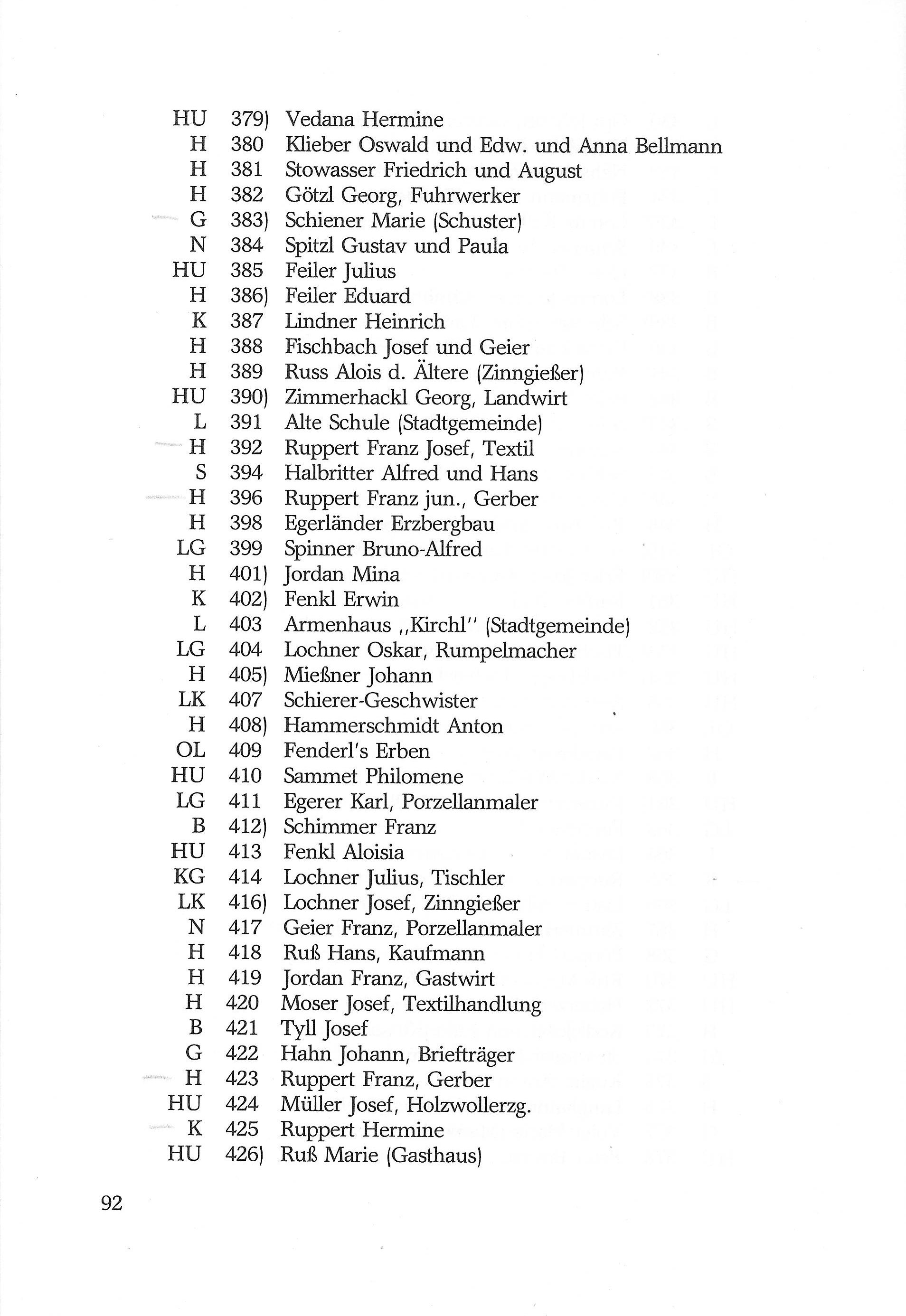 092
092
Page 0092
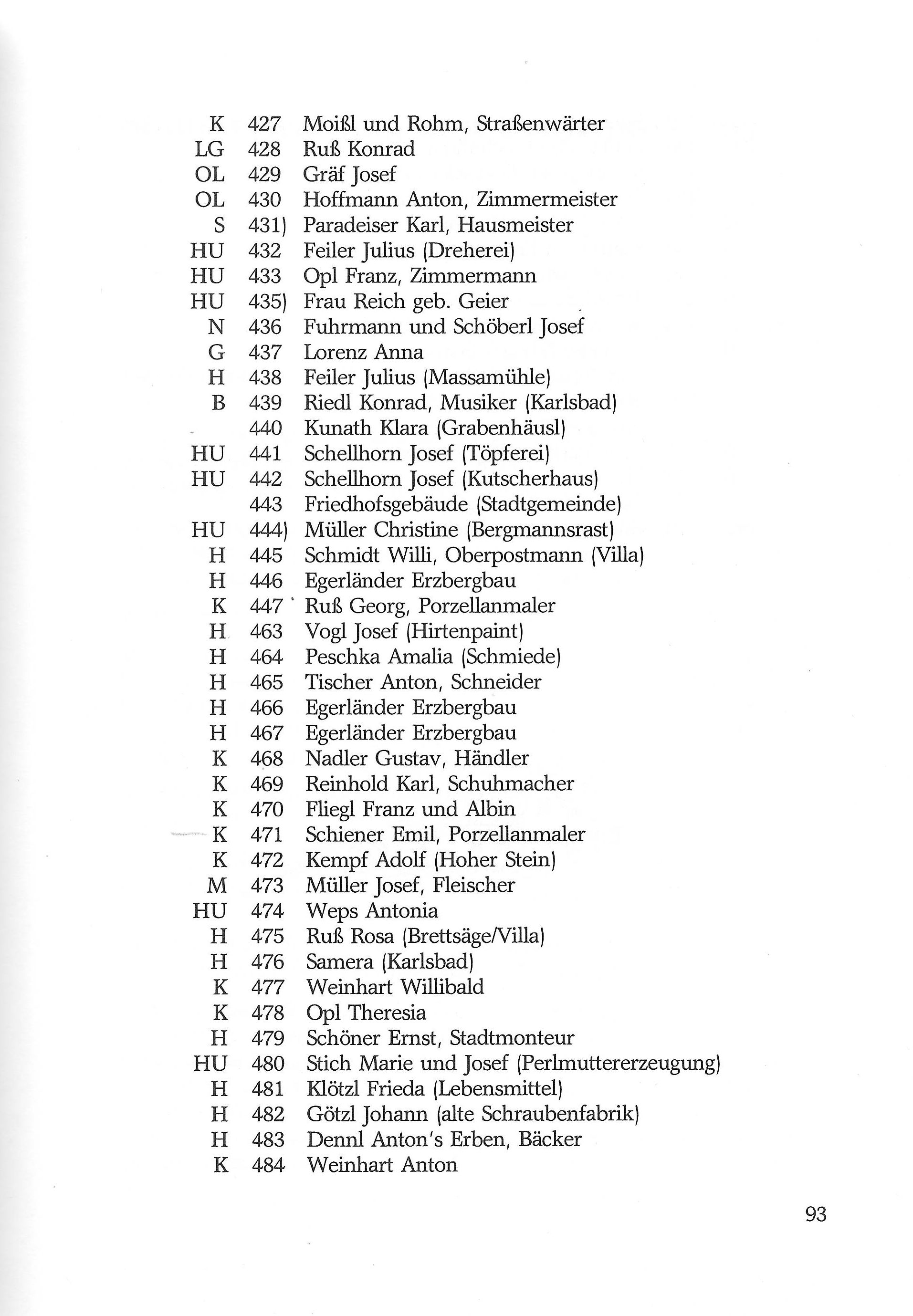 093
093
Page 0093
 094
094
Page 0094
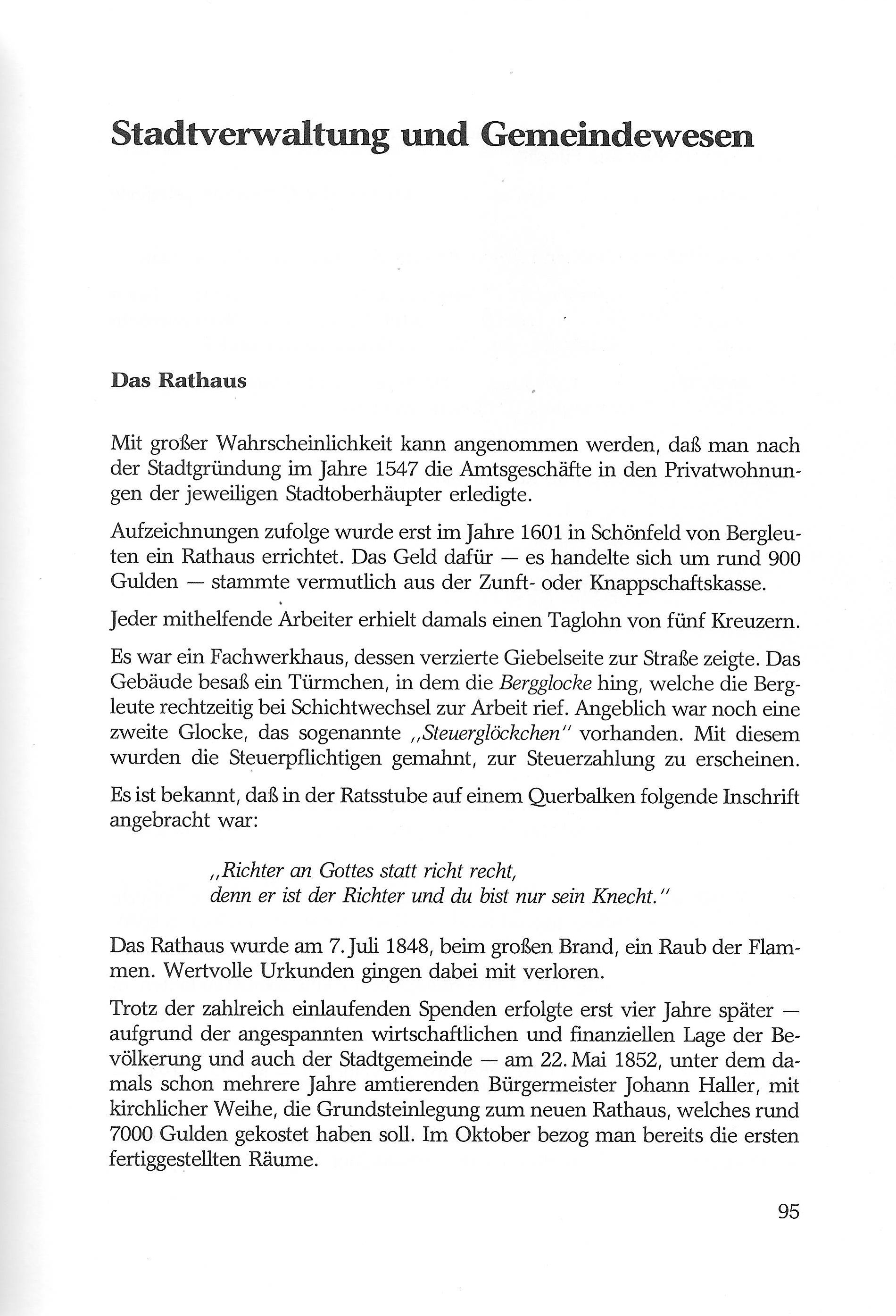 095
City administration and community life
The town hall
It can be assumed with great probability that after the town was
founded in 1547, official business was carried out in the private
homes of the respective town leaders.
According to records, a town hall was not built in Schönfeld until
1601 by miners. The money for this - around 900 guilders - probably
came from the guild or miners' coffers.
At that time, every worker who helped out received a daily wage of
five kreuzers.
It was a half-timbered house with a decorated gable facing the
street. The building had a small tower in which the miners' bell hung,
which called the miners to work in good time when the shift
changed. There was supposedly a second bell, the so-called "tax
bell". This was used to remind taxpayers to appear to pay their
taxes. It is known that the following inscription was affixed to a
crossbeam in the council chamber:
Judge in God's place, judge rightly,
for he is the judge and you are only his servant."
The town hall was destroyed by flames in the great fire on July 7,
1848. Valuable documents were lost.
Despite the numerous donations that came in, it was not until four
years later - due to the strained economic and financial situation of
the population and also of the town council - on May 22, 1852, under
the then mayor Johann Haller, who had already been in office for
several years, that the foundation stone for the new town hall was
laid with a church consecration, which is said to have cost around
7,000 guilders. In October, the first completed rooms were already
occupied.
95
095
City administration and community life
The town hall
It can be assumed with great probability that after the town was
founded in 1547, official business was carried out in the private
homes of the respective town leaders.
According to records, a town hall was not built in Schönfeld until
1601 by miners. The money for this - around 900 guilders - probably
came from the guild or miners' coffers.
At that time, every worker who helped out received a daily wage of
five kreuzers.
It was a half-timbered house with a decorated gable facing the
street. The building had a small tower in which the miners' bell hung,
which called the miners to work in good time when the shift
changed. There was supposedly a second bell, the so-called "tax
bell". This was used to remind taxpayers to appear to pay their
taxes. It is known that the following inscription was affixed to a
crossbeam in the council chamber:
Judge in God's place, judge rightly,
for he is the judge and you are only his servant."
The town hall was destroyed by flames in the great fire on July 7,
1848. Valuable documents were lost.
Despite the numerous donations that came in, it was not until four
years later - due to the strained economic and financial situation of
the population and also of the town council - on May 22, 1852, under
the then mayor Johann Haller, who had already been in office for
several years, that the foundation stone for the new town hall was
laid with a church consecration, which is said to have cost around
7,000 guilders. In October, the first completed rooms were already
occupied.
95
Page 0095
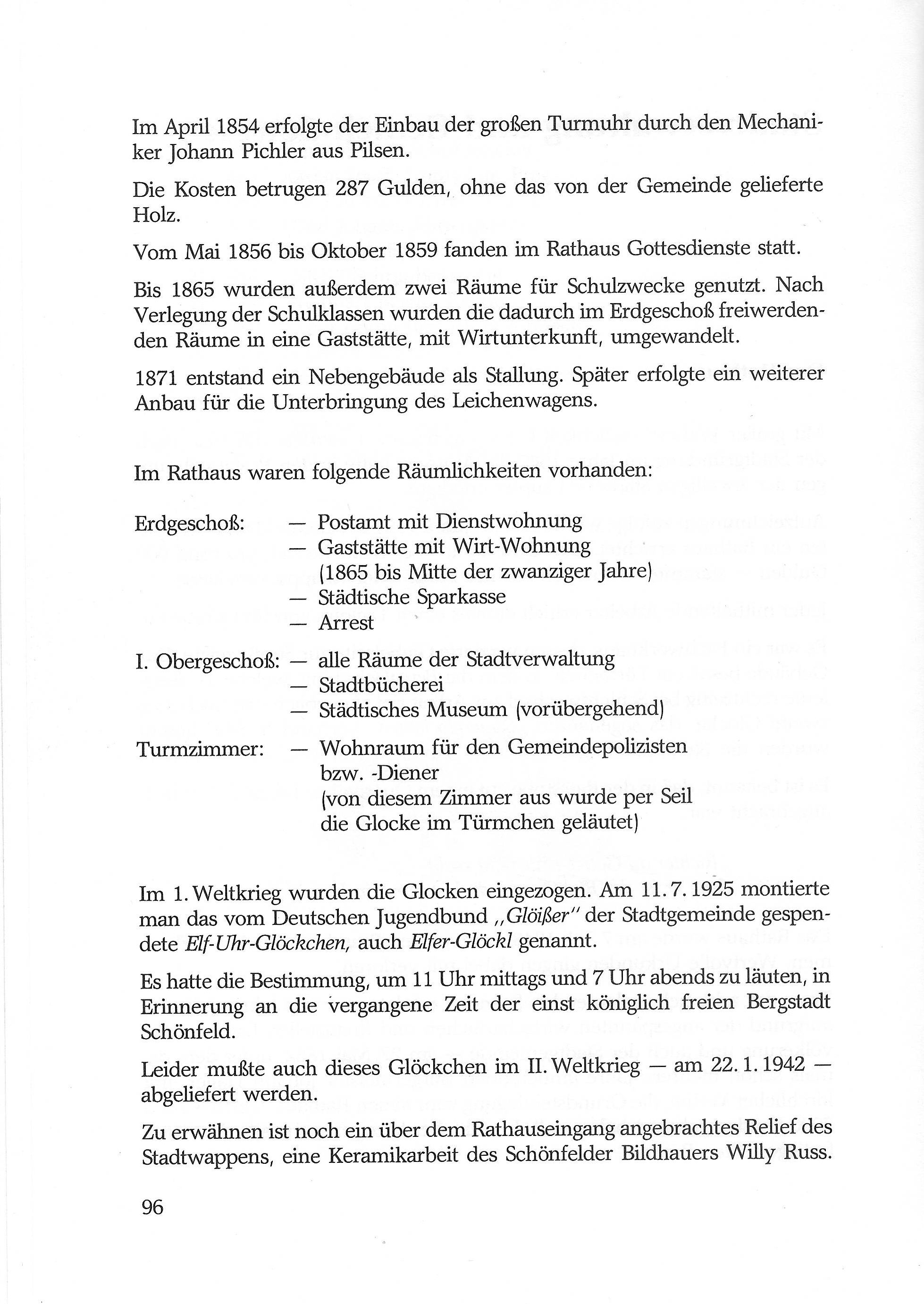 096
In April 1854, the large tower clock was installed by the mechanic
Johann Pichler from Pilsen.
The cost was 287 guilders, not including the wood supplied by the
municipality.
From May 1856 to October 1859, church services were held in the town
hall.
Two rooms were also used for school purposes until 1865. After the
school classes were relocated, the rooms on the ground floor that
became available were converted into a restaurant with accommodation
for the innkeeper.
In 1871, an outbuilding was built as a stable. Later, another
extension was built to house the hearse.
The following rooms were available in the town hall:
Ground floor:
Post office with official residence
Restaurant with landlord's residence
(1865 to the mid-1920s
Municipal savings bank
-arrest
all rooms of the town administration, town library
Municipal museum (temporary
living room for the local police officer or servant
from this room the bell in the tower was rung by rope)
During World War I the bells were taken away. On July 11, 1925 the
eleven o'clock bell, also known as the Elfer-Glöckl, donated to the
town by the German Youth League, "Gleißer", was installed.
It was intended to ring at 11 noon and 7 p.m. in memory of the past
times of the once royal free mining town of Schönfeld.
Unfortunately this bell also had to be removed during World War II -
on 22. 1.1942.
Also worth mentioning is a relief of the city's coat of arms above the
town hall entrance, a ceramic work by the Schönfeld sculptor Willy
Russ.
First floor:
Tower room:
96
096
In April 1854, the large tower clock was installed by the mechanic
Johann Pichler from Pilsen.
The cost was 287 guilders, not including the wood supplied by the
municipality.
From May 1856 to October 1859, church services were held in the town
hall.
Two rooms were also used for school purposes until 1865. After the
school classes were relocated, the rooms on the ground floor that
became available were converted into a restaurant with accommodation
for the innkeeper.
In 1871, an outbuilding was built as a stable. Later, another
extension was built to house the hearse.
The following rooms were available in the town hall:
Ground floor:
Post office with official residence
Restaurant with landlord's residence
(1865 to the mid-1920s
Municipal savings bank
-arrest
all rooms of the town administration, town library
Municipal museum (temporary
living room for the local police officer or servant
from this room the bell in the tower was rung by rope)
During World War I the bells were taken away. On July 11, 1925 the
eleven o'clock bell, also known as the Elfer-Glöckl, donated to the
town by the German Youth League, "Gleißer", was installed.
It was intended to ring at 11 noon and 7 p.m. in memory of the past
times of the once royal free mining town of Schönfeld.
Unfortunately this bell also had to be removed during World War II -
on 22. 1.1942.
Also worth mentioning is a relief of the city's coat of arms above the
town hall entrance, a ceramic work by the Schönfeld sculptor Willy
Russ.
First floor:
Tower room:
96
Page 0096
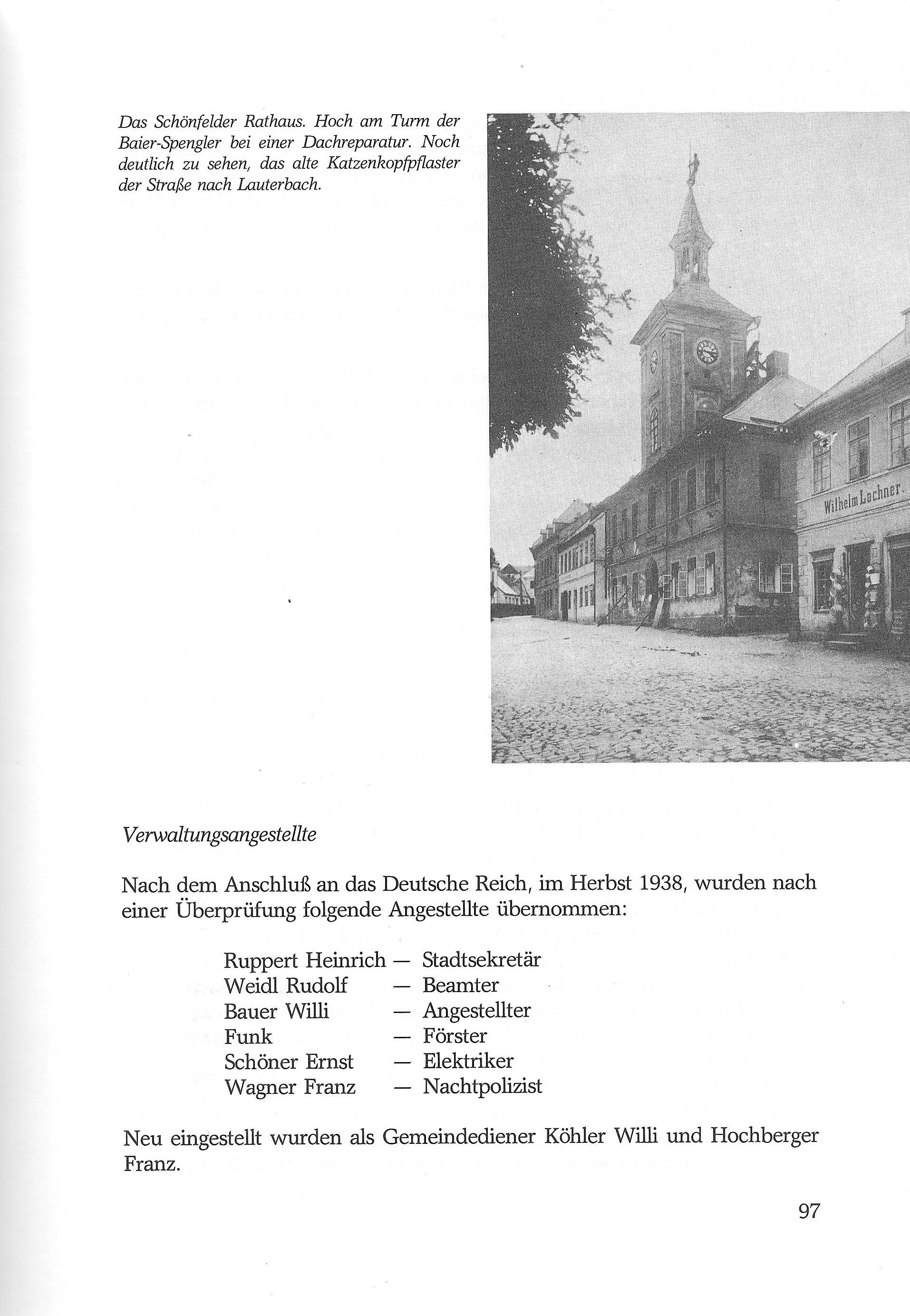 097
The Schönfeld town hall. High up on the tower, the Baier-Spengler is
repairing the roof. The old cobblestones of the road to Lauterbach are
still clearly visible.
Wilhelm Lachner
Administrative employee
After the annexation to the German Reich in the autumn of 1938, the
following employees were taken on after an inspection
Ruppert Heinrich-City secretary
Weidl Rudolf Civil servant Bauer Willi
Employee
Forester
Electrician
Night policeman
Radio
Schöner Ernst
Wagner Franz
Newly hired as community servants were Köhler Willi and Hochberger
Franz.
97
097
The Schönfeld town hall. High up on the tower, the Baier-Spengler is
repairing the roof. The old cobblestones of the road to Lauterbach are
still clearly visible.
Wilhelm Lachner
Administrative employee
After the annexation to the German Reich in the autumn of 1938, the
following employees were taken on after an inspection
Ruppert Heinrich-City secretary
Weidl Rudolf Civil servant Bauer Willi
Employee
Forester
Electrician
Night policeman
Radio
Schöner Ernst
Wagner Franz
Newly hired as community servants were Köhler Willi and Hochberger
Franz.
97
Page 0097
 098
Due to the changed situation in the social sector (family support,
economic aid, welfare support) and the war-related rationing measures
(introduction of food stamps, also vouchers for clothing and other
necessities), an increase in personnel took place from autumn 1939. It
was all Schönfelders who were hired for the following areas:
Administration: Fuhrmann Hilde. Stiller Klara (apprentice
Roßmeißl Ernst, Am stätter Eduard (appointment as community
servant only after Köhler and Hochberger were called up)
Food and Economic Office: Lochschmidt Hahn) Anna, Böhm Anna. Schmieger
Gerda, Habermann Ilse (temporarily) and Hahm Franz (after Köhler was
called up.
Fixed assets of the municipality
School building no. 4 built in 1877/78
School building no. 391 built in 1821
Bell tower including bells built in 1560
Old cemetery and park
New cemetery and cemetery building (built in 1901
Fire engine store no. 21
Hose house on Streichergasse
Zona house no. 333 with: State top school, garage for fire engine
no. II, rental apartments on the upper floor
Poor house no. 403 known as Kirch! built in 17601
Bull house no. 16
Slaughterhouse (built in 1872, was still in its original state in
1946)
Slaughterhouse ... Original condition) Weighing house and weighbridge
on the market square (built in 1912)
Municipal water pipe with upper and lower basin (built in 1906)
Sand pit on the Weissen Hügei
500 ha forest
Plant nursery
For the sake of completeness, the hearse should also be mentioned here.
98
098
Due to the changed situation in the social sector (family support,
economic aid, welfare support) and the war-related rationing measures
(introduction of food stamps, also vouchers for clothing and other
necessities), an increase in personnel took place from autumn 1939. It
was all Schönfelders who were hired for the following areas:
Administration: Fuhrmann Hilde. Stiller Klara (apprentice
Roßmeißl Ernst, Am stätter Eduard (appointment as community
servant only after Köhler and Hochberger were called up)
Food and Economic Office: Lochschmidt Hahn) Anna, Böhm Anna. Schmieger
Gerda, Habermann Ilse (temporarily) and Hahm Franz (after Köhler was
called up.
Fixed assets of the municipality
School building no. 4 built in 1877/78
School building no. 391 built in 1821
Bell tower including bells built in 1560
Old cemetery and park
New cemetery and cemetery building (built in 1901
Fire engine store no. 21
Hose house on Streichergasse
Zona house no. 333 with: State top school, garage for fire engine
no. II, rental apartments on the upper floor
Poor house no. 403 known as Kirch! built in 17601
Bull house no. 16
Slaughterhouse (built in 1872, was still in its original state in
1946)
Slaughterhouse ... Original condition) Weighing house and weighbridge
on the market square (built in 1912)
Municipal water pipe with upper and lower basin (built in 1906)
Sand pit on the Weissen Hügei
500 ha forest
Plant nursery
For the sake of completeness, the hearse should also be mentioned here.
98
Page 0098
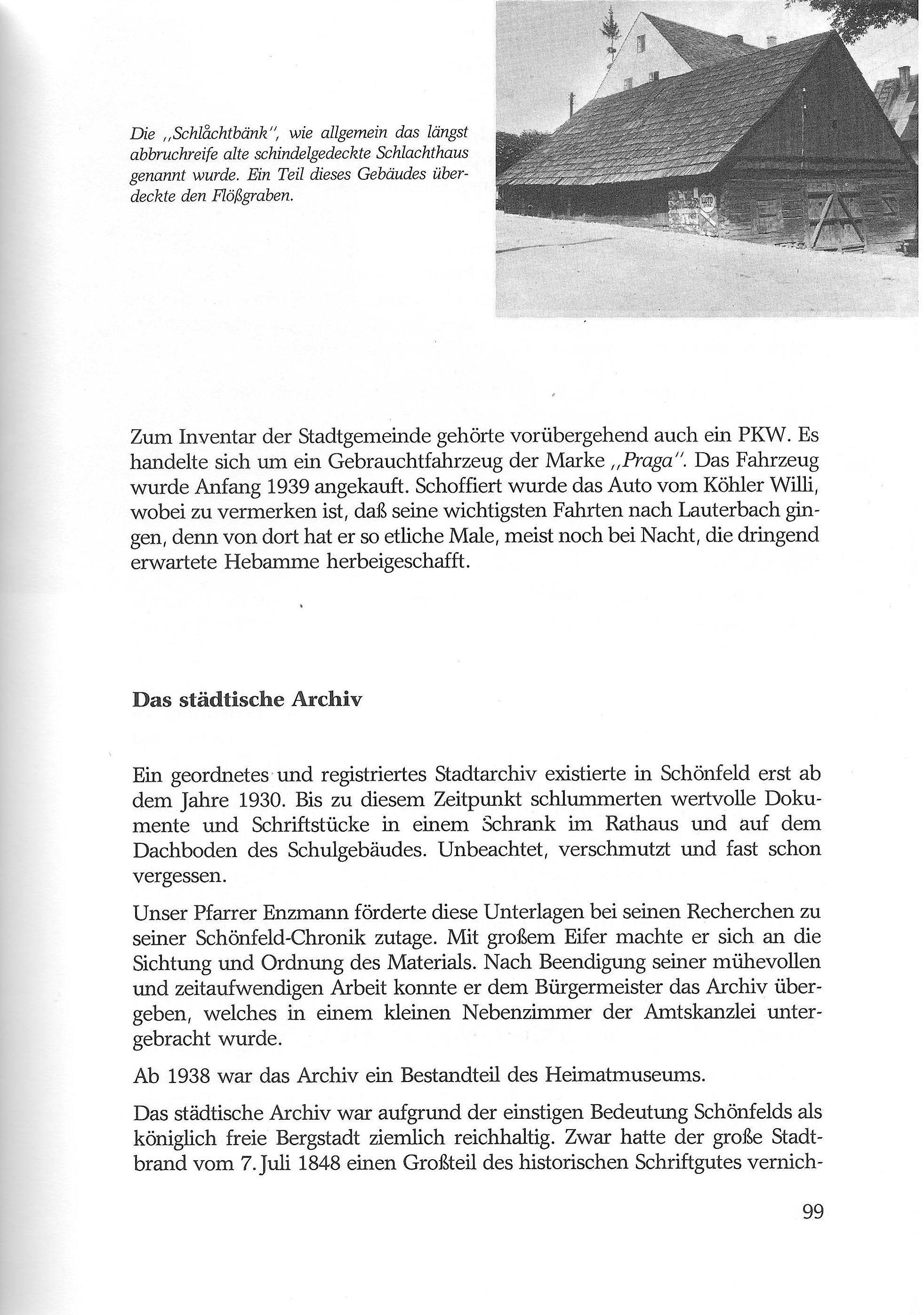 099
The slaughterhouse, which was long since ready for demolition, was
generally called “The Slaughterhouse”. Part of this building
covered the raft ditch.
[picture ^^^^^^^]
A car was also temporarily part of the municipality’s inventory. It
was a used vehicle of the Praga brand. The vehicle was purchased at
the beginning of 1939. The car was driven by the charcoal burner
Willi, and it should be noted that his most important trips were to
Lauterbach, because from there he often fetched the urgently awaited
midwife, usually at night.
The municipal archive
An organized and registered municipal archive did not exist in
Schönfeld until 1930. Up until that point, valuable documents and
papers lay dormant in a cupboard in the town hall and in the attic of
the school building. Unnoticed, dirty and almost forgotten.
Our pastor Enzmann uncovered these documents during his research for
his Schönfeld chronicle. He set about sorting through and organizing
the material with great enthusiasm. After completing his laborious and
time-consuming work, he was able to hand over the archive to the
mayor, which was housed in a small side room of the municipal office.
From 1938, the archive was part of the local museum.
The municipal archive was quite extensive due to Schönfeld's former
importance as a royal free mining town. The great town fire of July 7,
1848 had destroyed a large part of the historical documents.
99
099
The slaughterhouse, which was long since ready for demolition, was
generally called “The Slaughterhouse”. Part of this building
covered the raft ditch.
[picture ^^^^^^^]
A car was also temporarily part of the municipality’s inventory. It
was a used vehicle of the Praga brand. The vehicle was purchased at
the beginning of 1939. The car was driven by the charcoal burner
Willi, and it should be noted that his most important trips were to
Lauterbach, because from there he often fetched the urgently awaited
midwife, usually at night.
The municipal archive
An organized and registered municipal archive did not exist in
Schönfeld until 1930. Up until that point, valuable documents and
papers lay dormant in a cupboard in the town hall and in the attic of
the school building. Unnoticed, dirty and almost forgotten.
Our pastor Enzmann uncovered these documents during his research for
his Schönfeld chronicle. He set about sorting through and organizing
the material with great enthusiasm. After completing his laborious and
time-consuming work, he was able to hand over the archive to the
mayor, which was housed in a small side room of the municipal office.
From 1938, the archive was part of the local museum.
The municipal archive was quite extensive due to Schönfeld's former
importance as a royal free mining town. The great town fire of July 7,
1848 had destroyed a large part of the historical documents.
99
Page 0099
 100
tet, but 59 important documents and privileges - some of them kept in
wooden capsules - from the years 1341 to 1842 were saved. These were
all kept in an iron box provided by the mayor's office.
The oldest of these documents was that of November 30, 1341, by which
the brothers Borso and Slavko von der Riesenburg granted their people
in Schönfeld
free inheritance rights. This document, written in Latin, was still
available in 1857. The original was
lost through loan. A copy was preserved.
probably
Another important original dates from 1355. It was the Begabnus
letter, with which the town was granted the Gerickt, the Zomwag and
the tin mines in Schönfeld on the Petschau grounds.
Another important document from that time was the Privilegium of
Borso. Lord of Riesenburg, given on St. Thomas' Day 1380, with which
his men and women in the village of Schönfeld were granted the
"Luditzer Law".
Of greatest importance in the history of Schönfeld was the document of
September 1, 1547, with which Schönfeld was declared a royal free
mining town and given its own coat of arms.
This document, written on the best parchment and bearing a mighty
imperial seal, was of great importance for our Schönfeld. It was thus
included in the category of imperial and royal mining towns and their
righteous and righteous people. In this capacity, the mining towns
were brought into direct subordination to the Bohemian Court Chamber.
The centuries-long affiliation to the Petschau dominion had thus
ended.
Another valuable piece, a privilege book from Empress Maria Theresa,
in which the Empress at the beginning of her reign (1740-1780) renewed
and confirmed all privileges granted by previous kings and emperors.
In addition, there were some so-called "letters of freedom" from
generals from the time of the Thirty Years' War, through which
Schönfeld was to be exempted from military billeting and war payments.
In contrast to many other municipal archives, Schönfeld was in
possession of a complete copy of the "Rolla" and the so-called
Theresian cadastre.
The originals are in the State Archives in Prague.
100
100
tet, but 59 important documents and privileges - some of them kept in
wooden capsules - from the years 1341 to 1842 were saved. These were
all kept in an iron box provided by the mayor's office.
The oldest of these documents was that of November 30, 1341, by which
the brothers Borso and Slavko von der Riesenburg granted their people
in Schönfeld
free inheritance rights. This document, written in Latin, was still
available in 1857. The original was
lost through loan. A copy was preserved.
probably
Another important original dates from 1355. It was the Begabnus
letter, with which the town was granted the Gerickt, the Zomwag and
the tin mines in Schönfeld on the Petschau grounds.
Another important document from that time was the Privilegium of
Borso. Lord of Riesenburg, given on St. Thomas' Day 1380, with which
his men and women in the village of Schönfeld were granted the
"Luditzer Law".
Of greatest importance in the history of Schönfeld was the document of
September 1, 1547, with which Schönfeld was declared a royal free
mining town and given its own coat of arms.
This document, written on the best parchment and bearing a mighty
imperial seal, was of great importance for our Schönfeld. It was thus
included in the category of imperial and royal mining towns and their
righteous and righteous people. In this capacity, the mining towns
were brought into direct subordination to the Bohemian Court Chamber.
The centuries-long affiliation to the Petschau dominion had thus
ended.
Another valuable piece, a privilege book from Empress Maria Theresa,
in which the Empress at the beginning of her reign (1740-1780) renewed
and confirmed all privileges granted by previous kings and emperors.
In addition, there were some so-called "letters of freedom" from
generals from the time of the Thirty Years' War, through which
Schönfeld was to be exempted from military billeting and war payments.
In contrast to many other municipal archives, Schönfeld was in
possession of a complete copy of the "Rolla" and the so-called
Theresian cadastre.
The originals are in the State Archives in Prague.
100
Page 0100
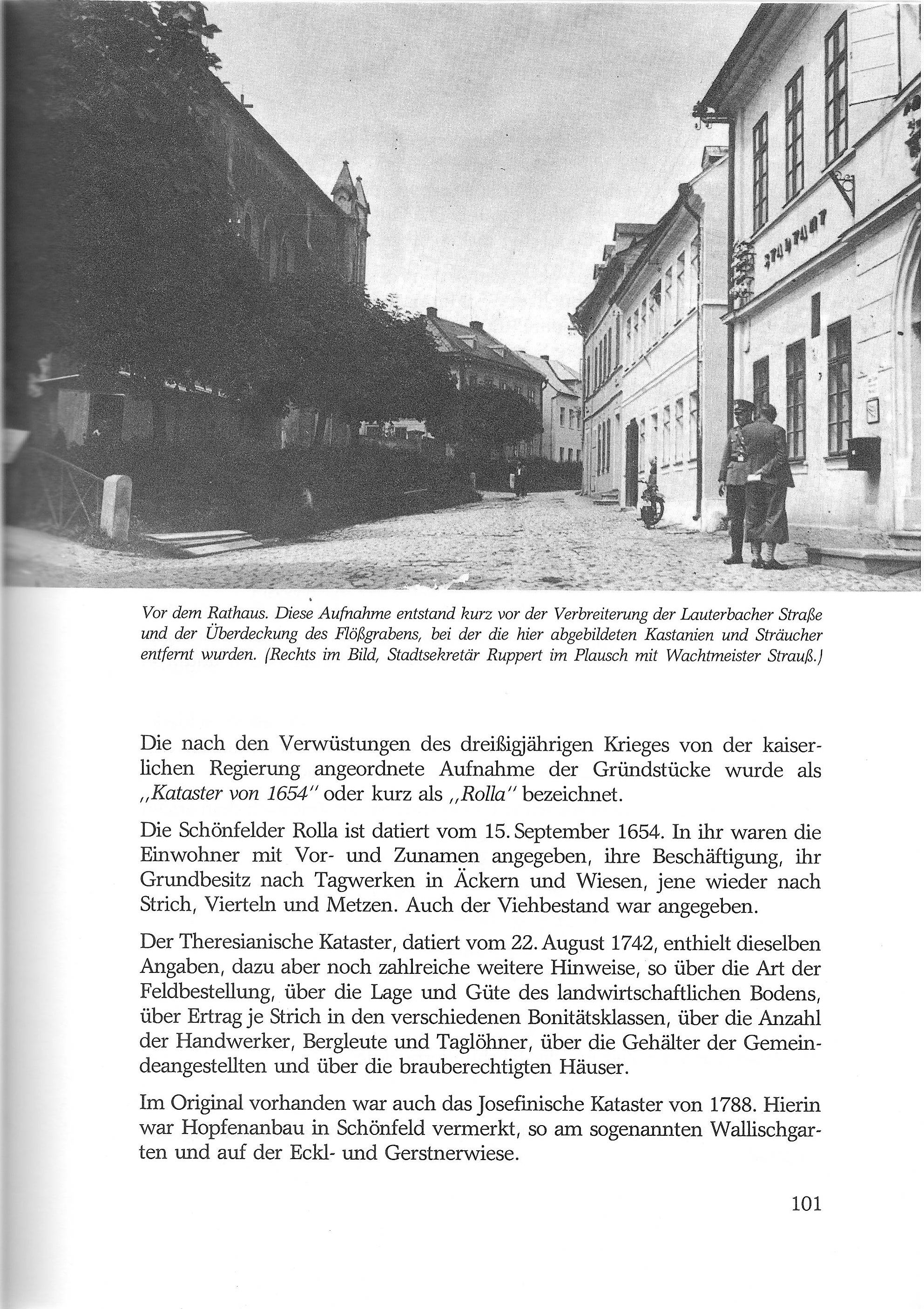 101
In front of the town hall. This photo was taken shortly before the
widening of Lauterbacher Strasse and the covering of the
Flößgraben, during which the chestnut trees and bushes shown here
were removed. (On the right in the photo, city secretary Ruppert
chatting with Sergeant Strauß.)
The survey of land plots ordered by the imperial government after the
devastation of the Thirty Years' War was called the "Cadastre of 1654"
or "Rolla" for short.
The Schönfelder Rolla is dated September 15, 1654. It listed the
residents by their first and last names, their occupation, their land
holdings by day's work in fields and meadows, and the latter again by
line, quarters and metzen. The number of livestock was also listed.
The Theresian cadastre, dated August 22, 1742, contained the same
information, but also numerous other references, such as the type of
field cultivation, the location and quality of the agricultural land,
the yield per line in the various creditworthiness classes, the number
of craftsmen, miners and day laborers, the salaries of municipal
employees and the houses with brewing rights.
The original Josephinian cadastre from 1788 was also available. In it
hop cultivation in Schönfeld was noted, for example at the so-called
Wallischgarten
and on the Eckl and Gerstnerwiese.
101
101
In front of the town hall. This photo was taken shortly before the
widening of Lauterbacher Strasse and the covering of the
Flößgraben, during which the chestnut trees and bushes shown here
were removed. (On the right in the photo, city secretary Ruppert
chatting with Sergeant Strauß.)
The survey of land plots ordered by the imperial government after the
devastation of the Thirty Years' War was called the "Cadastre of 1654"
or "Rolla" for short.
The Schönfelder Rolla is dated September 15, 1654. It listed the
residents by their first and last names, their occupation, their land
holdings by day's work in fields and meadows, and the latter again by
line, quarters and metzen. The number of livestock was also listed.
The Theresian cadastre, dated August 22, 1742, contained the same
information, but also numerous other references, such as the type of
field cultivation, the location and quality of the agricultural land,
the yield per line in the various creditworthiness classes, the number
of craftsmen, miners and day laborers, the salaries of municipal
employees and the houses with brewing rights.
The original Josephinian cadastre from 1788 was also available. In it
hop cultivation in Schönfeld was noted, for example at the so-called
Wallischgarten
and on the Eckl and Gerstnerwiese.
101
Page 0101
 102
The existing town books only began in the 18th century. These included
council minutes, a will book, town and tax accounts, an orphan book,
submission minutes and the complete copies of marriage contract books
1 and 2. The originals, along with a few others, had to be handed over
to the State Archives in Prague in 1850.
The guild archives date back to the beginning of the 17th
century. These include a shoemaker's guild book, the guild articles of
the butcher's guild from 1600, a confirmation of the carpenters' guild
articles and the entire documentation of the pewterers.
The archive also contained a large number of files that resulted from
the contact between the municipality of Schönfeld and the former
Petschau dominion, with the mining authorities, with church
authorities and other municipalities.
The oldest of these documents was dated April 29, 1404. It stated
that: Anna, widow of Borso of the Riesenburg, mistress of Petschau,
donated an altarist (chaplain) for the chapel of St. Katharin in
Schönfeld.
Individual letters indicate that Schönfeld repeatedly borrowed the
executioner from Eger for the execution of criminals, since it had the
high and neck jurisdiction over life and death until 1751.
Numerous files reveal discrepancies that repeatedly arose at different
times for different reasons between the two mining towns of
Schlaggenwald and Schönfeld.
The latest status of the archive showed documents up to the time after
the First World War.
Tax revenue around 1900
An excerpt from the time around the turn of the century.
In 1898, Schönfeld paid the following taxes to the tax office in
Elbogen:
102
102
The existing town books only began in the 18th century. These included
council minutes, a will book, town and tax accounts, an orphan book,
submission minutes and the complete copies of marriage contract books
1 and 2. The originals, along with a few others, had to be handed over
to the State Archives in Prague in 1850.
The guild archives date back to the beginning of the 17th
century. These include a shoemaker's guild book, the guild articles of
the butcher's guild from 1600, a confirmation of the carpenters' guild
articles and the entire documentation of the pewterers.
The archive also contained a large number of files that resulted from
the contact between the municipality of Schönfeld and the former
Petschau dominion, with the mining authorities, with church
authorities and other municipalities.
The oldest of these documents was dated April 29, 1404. It stated
that: Anna, widow of Borso of the Riesenburg, mistress of Petschau,
donated an altarist (chaplain) for the chapel of St. Katharin in
Schönfeld.
Individual letters indicate that Schönfeld repeatedly borrowed the
executioner from Eger for the execution of criminals, since it had the
high and neck jurisdiction over life and death until 1751.
Numerous files reveal discrepancies that repeatedly arose at different
times for different reasons between the two mining towns of
Schlaggenwald and Schönfeld.
The latest status of the archive showed documents up to the time after
the First World War.
Tax revenue around 1900
An excerpt from the time around the turn of the century.
In 1898, Schönfeld paid the following taxes to the tax office in
Elbogen:
102
Page 0102
 103
Property tax
Building class tax
House rent tax
Trade tax
Income tax
Total
.1937 guilders
847 guilders
671 guilders
1884 guilders
669 guilders
.6030 guilders
22 kreuzers 0 kreuzers
58 kreuzers
12 kreuzers
21 kreuzers
3 kreuzers
(In addition to this was the levy rate levied by the municipality.)
With a population of 3271 souls at the time, Schönfeld paid 2 guilders
65 2 kreuzers per capita per year in direct taxes.
For comparison, the top taxpayers in the Elbogen district:
Neusattl 17,304 guilders Chodau 16,867 guilders
Elbogen 16,325 guilders
The village of Sponsl paid the lowest tax at that time, at 360
guilders
103
103
Property tax
Building class tax
House rent tax
Trade tax
Income tax
Total
.1937 guilders
847 guilders
671 guilders
1884 guilders
669 guilders
.6030 guilders
22 kreuzers 0 kreuzers
58 kreuzers
12 kreuzers
21 kreuzers
3 kreuzers
(In addition to this was the levy rate levied by the municipality.)
With a population of 3271 souls at the time, Schönfeld paid 2 guilders
65 2 kreuzers per capita per year in direct taxes.
For comparison, the top taxpayers in the Elbogen district:
Neusattl 17,304 guilders Chodau 16,867 guilders
Elbogen 16,325 guilders
The village of Sponsl paid the lowest tax at that time, at 360
guilders
103
Page 0103
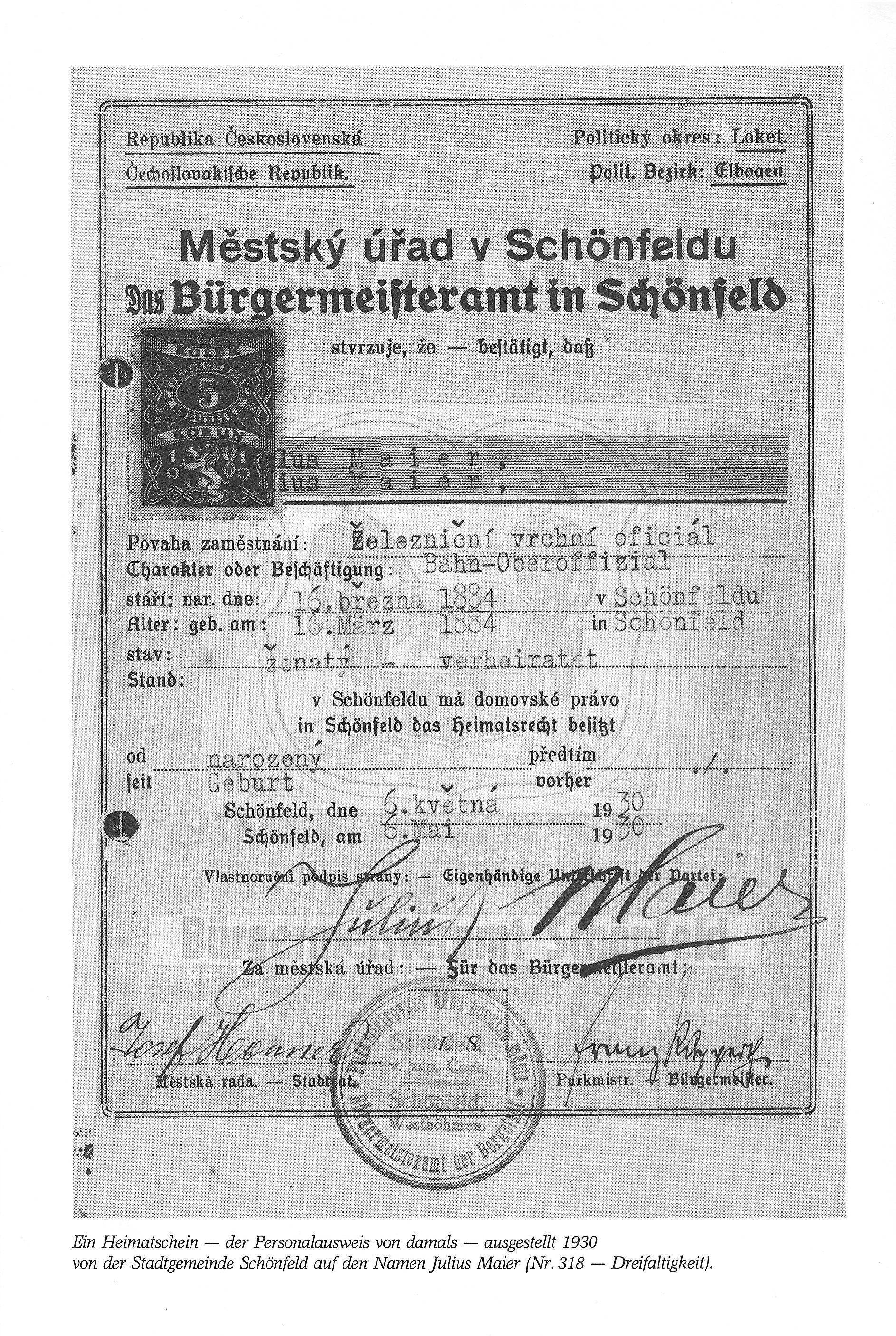 104
***** a document *******
Republika Ceskoslovenska.
Cechollovak Republic.
Politicky okres: Loket.
Dolit. Owner: Elbngen
Municipal office in Schönfeld
The mayor's office in Schönfeld
hereby confirms that
Chairman
of the board of directors
Ownership: Official council
Character or qualification:
Name: no, dne:/1A
Age: born on:
stav:
Status:
or
jeit 16.Brezna 1004
16.March1884
born
in Sahönf ldu
in Schinela
in Schönfeld the home law
in Schönfeld the home law is defeated
narratives
birth
Schönfeld, dne
Schönfeld, on
the
dated
1930
6th quarter
Vlastnorge certificate and:Eigenhandig
Z4 municipal certificate: —For the Burceetleramt
For
Untid
M?stská rada. -- Stadtitat
Pyrkmistr. Büngetmeister.
West Bohemia
A certificate of origin - the identity card from back then - issued in
1930 by the town of Schönfeld in the name of Julius Maier
(No. 318-Trinity).
104
104
***** a document *******
Republika Ceskoslovenska.
Cechollovak Republic.
Politicky okres: Loket.
Dolit. Owner: Elbngen
Municipal office in Schönfeld
The mayor's office in Schönfeld
hereby confirms that
Chairman
of the board of directors
Ownership: Official council
Character or qualification:
Name: no, dne:/1A
Age: born on:
stav:
Status:
or
jeit 16.Brezna 1004
16.March1884
born
in Sahönf ldu
in Schinela
in Schönfeld the home law
in Schönfeld the home law is defeated
narratives
birth
Schönfeld, dne
Schönfeld, on
the
dated
1930
6th quarter
Vlastnorge certificate and:Eigenhandig
Z4 municipal certificate: —For the Burceetleramt
For
Untid
M?stská rada. -- Stadtitat
Pyrkmistr. Büngetmeister.
West Bohemia
A certificate of origin - the identity card from back then - issued in
1930 by the town of Schönfeld in the name of Julius Maier
(No. 318-Trinity).
104
Page 0104
 105
Mayor
General overview
The following list of the city leaders begins in 1898. From this point
until 1919, i.e. for around 20 years, the management of the official
business was in the hands of a man whose performance was hardly
matched by any of his predecessors. The fact that his successors were
not able to do this in terms of time is shown by the fact that in the
following years, up to our expulsion, no fewer than 13 different
mayors guided the city's fortunes.
But it was not only the often very short term of office, but also the
political situation of the German communities under the Czech
government that made things difficult during this time. There was a
lack of the appropriate contacts and influences with the relevant
government offices. In this respect, a slight change only occurred in
the years 1936 to 1938.
In the following term of office, some measures were taken that were
detrimental to Schönfeld, but these were followed or accepted without
protest by the mayor at the time.
Only two Schönfeld citizens were then entrusted with running the
town's affairs for a short time.
From September 1945, the Czechs administered our hometown.
Norbert Rau (owner of the famous Raul porcelain painting shop)
His term as mayor lasted from 1898 to 1919. During these more than 20
years, he served the town in an exemplary manner. He carried out
official duties on a voluntary basis at his own request, and not
infrequently he generously waived expenses in favor of the town.
The following projects and facilities were carried out and created
through his initiative (see also Chronicle 1898-1919):
New cemetery, municipal savings bank, opening of a pharmacy,
high-spring water pipe, connection to the telephone network, top
school, and, particularly noteworthy, the electrification of the town
in 1915.
Recognizing the favorable opportunity in good time, he secured the
connection to the Schönfelder power plant, which was built at the
expense of the Austrian War Ministry
105
105
Mayor
General overview
The following list of the city leaders begins in 1898. From this point
until 1919, i.e. for around 20 years, the management of the official
business was in the hands of a man whose performance was hardly
matched by any of his predecessors. The fact that his successors were
not able to do this in terms of time is shown by the fact that in the
following years, up to our expulsion, no fewer than 13 different
mayors guided the city's fortunes.
But it was not only the often very short term of office, but also the
political situation of the German communities under the Czech
government that made things difficult during this time. There was a
lack of the appropriate contacts and influences with the relevant
government offices. In this respect, a slight change only occurred in
the years 1936 to 1938.
In the following term of office, some measures were taken that were
detrimental to Schönfeld, but these were followed or accepted without
protest by the mayor at the time.
Only two Schönfeld citizens were then entrusted with running the
town's affairs for a short time.
From September 1945, the Czechs administered our hometown.
Norbert Rau (owner of the famous Raul porcelain painting shop)
His term as mayor lasted from 1898 to 1919. During these more than 20
years, he served the town in an exemplary manner. He carried out
official duties on a voluntary basis at his own request, and not
infrequently he generously waived expenses in favor of the town.
The following projects and facilities were carried out and created
through his initiative (see also Chronicle 1898-1919):
New cemetery, municipal savings bank, opening of a pharmacy,
high-spring water pipe, connection to the telephone network, top
school, and, particularly noteworthy, the electrification of the town
in 1915.
Recognizing the favorable opportunity in good time, he secured the
connection to the Schönfelder power plant, which was built at the
expense of the Austrian War Ministry
105
Page 0105
 106
He managed to build the power grid of the mining works in
Unterreichenau, which was laid for the mining industry. He managed
this under such favorable conditions that Schönfeld had an extremely
low price of electricity until the Second World War. This benefited
not only the local industrial, commercial and agricultural companies,
but also the Schönfeld population. In addition, considerable sums of
money flowed into the municipality's coffers from the "electricity"
sector.
In addition to his work as mayor, Norbert Rau was commander of the
military veterans' association for many years, a member of the
district committee and the district school board. He was a strong
supporter of all local associations.
His successful work was even highly recognized by the government in
Vienna. For his services, the then Emperor Franz Josef awarded him the
"Order of the Golden Cross of Merit with the Crown". Norbert Rau was
buried on Candlemas 1922, with great sympathy from the population, by
mourners from near and far.
Franz Ruß. also known as Schlatter-RuS. Kaufmam
He was the first mayor in Schönfeld under Czech rule.
Ruß owned the porcelain factory in Toppeles a few years before the
First World War. In the turbulent period after the First World War
caused by political and nationalist movements, he was chairman of the
soldiers' council founded in Schönfeld, as well as elsewhere.
Josef Muchow, insurance salesman (Staudengasse No. 274)
Elected mayor on February 23, 1922. Unfortunately, Muchow died just
two years later, on June 28, 1924, at the early age of 41, presumably
from an illness stemming from the First World War.
Roman Kempf, master butcher (Lange Gasse No. 129
His term of office lasted from 1924 to 1926. Kempf was a member of the
Schönfel music corporation. He was also the director of the Theater
Amateurs Association for a long time and at the same time a successful
actor in many popular plays on the local stage.
He played the zither and delighted many a company with his singing
Roman Kempf died in August 1926. not yet 50 years old.
106
106
He managed to build the power grid of the mining works in
Unterreichenau, which was laid for the mining industry. He managed
this under such favorable conditions that Schönfeld had an extremely
low price of electricity until the Second World War. This benefited
not only the local industrial, commercial and agricultural companies,
but also the Schönfeld population. In addition, considerable sums of
money flowed into the municipality's coffers from the "electricity"
sector.
In addition to his work as mayor, Norbert Rau was commander of the
military veterans' association for many years, a member of the
district committee and the district school board. He was a strong
supporter of all local associations.
His successful work was even highly recognized by the government in
Vienna. For his services, the then Emperor Franz Josef awarded him the
"Order of the Golden Cross of Merit with the Crown". Norbert Rau was
buried on Candlemas 1922, with great sympathy from the population, by
mourners from near and far.
Franz Ruß. also known as Schlatter-RuS. Kaufmam
He was the first mayor in Schönfeld under Czech rule.
Ruß owned the porcelain factory in Toppeles a few years before the
First World War. In the turbulent period after the First World War
caused by political and nationalist movements, he was chairman of the
soldiers' council founded in Schönfeld, as well as elsewhere.
Josef Muchow, insurance salesman (Staudengasse No. 274)
Elected mayor on February 23, 1922. Unfortunately, Muchow died just
two years later, on June 28, 1924, at the early age of 41, presumably
from an illness stemming from the First World War.
Roman Kempf, master butcher (Lange Gasse No. 129
His term of office lasted from 1924 to 1926. Kempf was a member of the
Schönfel music corporation. He was also the director of the Theater
Amateurs Association for a long time and at the same time a successful
actor in many popular plays on the local stage.
He played the zither and delighted many a company with his singing
Roman Kempf died in August 1926. not yet 50 years old.
106
Page 0106
 107
Josef Jordan, owner of a glue factory (family business, No. 401)
Mayor from 1926 to 1928. Jordan was also chairman of the veterans'
association for several years.
He died in his hometown of Schönfeld in the spring of 1946.
Franz Ruppert, tannery owner (Hauptstrasse no. 396)
Mayor of the town from 1928 to 1933. He was the oldest and also the
tallest of his brothers, which is why he was also called the "great
Ruppert". His heart belonged to the German gymnastics club and the
German people
in general. For many years he was the spokesman of the gymnastics club
and later
honorary spokesman. His rousing and passionate speeches
will remain in the memory of many.
Emil Vogl
He was elected mayor in 1933. The building plan for the Schönfeld
observation tower bears his signature next to the official stamp of
the town council. His term of office was only short, because the
entire town council was dissolved at that time by the Czech district
authority in Elbogen.
As a replacement, an administrative commission was formed or appointed
by order of the authority, headed by the sawmill owner Emil Ruß
stood
Johann Stotz, porcelain painting (family business)
As a member of the trade party, he was elected mayor.
Josef Köhler, (Lange Gasse No. 191)
He was chairman of the administrative commission until the summer of
1936.
Dr. Erwin Roßmeißl, lawyer
Born in Schönfeld on June 20, 1903 (Marktplatz No. 108- Hotel
Potherr).
Dr. Roßmeißl, a convinced social democrat, was chairman of the
administrative commission from the summer of 1936 until the end of
September 1938
107
107
Josef Jordan, owner of a glue factory (family business, No. 401)
Mayor from 1926 to 1928. Jordan was also chairman of the veterans'
association for several years.
He died in his hometown of Schönfeld in the spring of 1946.
Franz Ruppert, tannery owner (Hauptstrasse no. 396)
Mayor of the town from 1928 to 1933. He was the oldest and also the
tallest of his brothers, which is why he was also called the "great
Ruppert". His heart belonged to the German gymnastics club and the
German people
in general. For many years he was the spokesman of the gymnastics club
and later
honorary spokesman. His rousing and passionate speeches
will remain in the memory of many.
Emil Vogl
He was elected mayor in 1933. The building plan for the Schönfeld
observation tower bears his signature next to the official stamp of
the town council. His term of office was only short, because the
entire town council was dissolved at that time by the Czech district
authority in Elbogen.
As a replacement, an administrative commission was formed or appointed
by order of the authority, headed by the sawmill owner Emil Ruß
stood
Johann Stotz, porcelain painting (family business)
As a member of the trade party, he was elected mayor.
Josef Köhler, (Lange Gasse No. 191)
He was chairman of the administrative commission until the summer of
1936.
Dr. Erwin Roßmeißl, lawyer
Born in Schönfeld on June 20, 1903 (Marktplatz No. 108- Hotel
Potherr).
Dr. Roßmeißl, a convinced social democrat, was chairman of the
administrative commission from the summer of 1936 until the end of
September 1938
107
Page 0107
 108
At the time he took office, the town was said to have been heavily in
debt. The sum was allegedly around 70,000 K?. Despite the poor
economic situation (half of the Schönfeld families were directly
affected by the general unemployment), he managed to get the town's
finances in order in the following years. In connection with the high
unemployment and the associated hardship of many Schönfeld residents,
he wrote an appeal for donations in the autumn of 1936, which appeared
in several foreign newspapers. The appeal brought in donations of
around 12,000 K?. Among other things, this was used to set up a
weaving room in the town hall.
During his term of office, the electricity network was modernized and
expanded, a fire pond was created on the Kaunitz, the partially
damaged drinking water pipe was repaired and further expanded, and the
White Hill was cultivated.
In addition, a German kindergarten was set up and a school kitchen
opened. In Lange Gasse there was a food stall for the unemployed
(No. 135/Russ Willyl.
He was also a supporter of the local museum.
At the end of September 1938, before the German troops invaded,
Dr. Roßmeißl fled to Prague. In Vienna he was arrested by the
Gestapo on December 18, 1938. He was accused of having contacts with
leading social democrats and of writing some political articles for
the newspapers "Volkswille" and "Sozialdemokrat 1938". He was later
released and drafted into the police force in Prague in August
1941. In May 1945 Dr. Roßmeißl was arrested and interned by the
Czechs in Prague. In September of the same year he managed to escape
to Germany.
Heinrich Ruppert, city secretary
was temporarily appointed mayor by the local commander of the German
army at the beginning of October 1938, as this position was not
available at the time. was occupied.
Josef Tauber (No. 12
As a former local leader of the Sudeten German Party (SdPl), Tauber
was appointed mayor of Schönfeld by the new German district
administrator in Elbogen. His work was voluntary, as Schönfeld was
only considered a medium-sized community at the time. Tauber was also
an employee of the district administration office in Elbogen, where he
only worked part-time.
108
108
At the time he took office, the town was said to have been heavily in
debt. The sum was allegedly around 70,000 K?. Despite the poor
economic situation (half of the Schönfeld families were directly
affected by the general unemployment), he managed to get the town's
finances in order in the following years. In connection with the high
unemployment and the associated hardship of many Schönfeld residents,
he wrote an appeal for donations in the autumn of 1936, which appeared
in several foreign newspapers. The appeal brought in donations of
around 12,000 K?. Among other things, this was used to set up a
weaving room in the town hall.
During his term of office, the electricity network was modernized and
expanded, a fire pond was created on the Kaunitz, the partially
damaged drinking water pipe was repaired and further expanded, and the
White Hill was cultivated.
In addition, a German kindergarten was set up and a school kitchen
opened. In Lange Gasse there was a food stall for the unemployed
(No. 135/Russ Willyl.
He was also a supporter of the local museum.
At the end of September 1938, before the German troops invaded,
Dr. Roßmeißl fled to Prague. In Vienna he was arrested by the
Gestapo on December 18, 1938. He was accused of having contacts with
leading social democrats and of writing some political articles for
the newspapers "Volkswille" and "Sozialdemokrat 1938". He was later
released and drafted into the police force in Prague in August
1941. In May 1945 Dr. Roßmeißl was arrested and interned by the
Czechs in Prague. In September of the same year he managed to escape
to Germany.
Heinrich Ruppert, city secretary
was temporarily appointed mayor by the local commander of the German
army at the beginning of October 1938, as this position was not
available at the time. was occupied.
Josef Tauber (No. 12
As a former local leader of the Sudeten German Party (SdPl), Tauber
was appointed mayor of Schönfeld by the new German district
administrator in Elbogen. His work was voluntary, as Schönfeld was
only considered a medium-sized community at the time. Tauber was also
an employee of the district administration office in Elbogen, where he
only worked part-time.
108
Page 0108
 109
The following projects were carried out during his term of office:
Sidewalk and paving on the winter side of the market square,
modernization of the two school buildings, repaving of the road to
Lauterbach in the "Mautbrücke/Gussn" section, the houses on the
summer side were given a sewer system, redesign and renovation of the
town hall rooms, sidewalk from Geier (Textil) to Porzellanmalerei Rau,
sewerage and paving in the Rathausgasse area, expansion of the
Zohnerhaus.
The construction of Rabensgrüner Straße, carried out from autumn
1938 to summer 1939, and the covering of the raft ditch in the
school/Untere Mühle section were ordered by the state.
In addition to the above-mentioned series of projects that deserve
recognition (it is not known to what extent state support was provided
in this context), unfortunately three unpleasant events took place
during Tauber's term of office that were strongly condemned by the
citizens at the time. These concern the topics of "post office, bell
delivery and ore mining". Haller Karl has already made a very sharp
statement on this in his letter to all Schönfeld residents, No. 4/1950
and No. 19/1953. The mayor at the time - but also the NSDAP local
leadership, who had a say at the time - are accused of not having
acted in the interests of the community in this regard. In the
interests of a correct presentation of local history, the relevant
chapters are addressed here:
After more than 70 years of existence, the post office in Schönfeld
was downgraded in 1940, and it was now just a post office. This
decision by the General Post Office in Karlsbad was accepted without
objection.
The same was true of the delivery of the middle bell, cast in 1592,
where no attempt was made to preserve the historically valuable
piece. That petitions with the appropriate emphasis could be
successful was demonstrated in our neighboring town of Schlaggenwald,
where a retained a bell of almost the same age
A heavy blow to the history of the Schönfeld mine was the acceptance
of a confirmation that was supposedly attributable to the activities
of key men in our neighboring town of Schlaggenwald, because in 1942,
when the Schönfeld mine was already under the control of the Krupp
company, the company name suddenly became "Egerländer
Erzbergbau-GmbH. Schlaggenwald"
109
109
The following projects were carried out during his term of office:
Sidewalk and paving on the winter side of the market square,
modernization of the two school buildings, repaving of the road to
Lauterbach in the "Mautbrücke/Gussn" section, the houses on the
summer side were given a sewer system, redesign and renovation of the
town hall rooms, sidewalk from Geier (Textil) to Porzellanmalerei Rau,
sewerage and paving in the Rathausgasse area, expansion of the
Zohnerhaus.
The construction of Rabensgrüner Straße, carried out from autumn
1938 to summer 1939, and the covering of the raft ditch in the
school/Untere Mühle section were ordered by the state.
In addition to the above-mentioned series of projects that deserve
recognition (it is not known to what extent state support was provided
in this context), unfortunately three unpleasant events took place
during Tauber's term of office that were strongly condemned by the
citizens at the time. These concern the topics of "post office, bell
delivery and ore mining". Haller Karl has already made a very sharp
statement on this in his letter to all Schönfeld residents, No. 4/1950
and No. 19/1953. The mayor at the time - but also the NSDAP local
leadership, who had a say at the time - are accused of not having
acted in the interests of the community in this regard. In the
interests of a correct presentation of local history, the relevant
chapters are addressed here:
After more than 70 years of existence, the post office in Schönfeld
was downgraded in 1940, and it was now just a post office. This
decision by the General Post Office in Karlsbad was accepted without
objection.
The same was true of the delivery of the middle bell, cast in 1592,
where no attempt was made to preserve the historically valuable
piece. That petitions with the appropriate emphasis could be
successful was demonstrated in our neighboring town of Schlaggenwald,
where a retained a bell of almost the same age
A heavy blow to the history of the Schönfeld mine was the acceptance
of a confirmation that was supposedly attributable to the activities
of key men in our neighboring town of Schlaggenwald, because in 1942,
when the Schönfeld mine was already under the control of the Krupp
company, the company name suddenly became "Egerländer
Erzbergbau-GmbH. Schlaggenwald"
109
Page 0109
 110
That's the brief description of these matters.
With the end of the war, Mayor Tauber's term of office also
expired. He died of a heart attack in Langen in 1955.
Willi Bauer (author of this local history book)
He was appointed mayor temporarily on May 8, 1945 by the then US
government. Not an easy task in those days, because Schönfeld was full
of refugees and disarmed German soldiers at the time. The number of
people being cared for was estimated at over 5,000.
Ernst Weinhart (No. 266
Appointed by the Czech administrative commission on July 1, 1945. His
term of office also lasted only two months. After that, the Czechs
took over the office.
Schönfeld town councilors
The order has no connection with the succession of offices, as no
information is available on this.
The earliest term of office in this context probably goes back to
1900.
Johann Köhler, bricklayer (No. 30), building inspector after the First
World War.
Ernst Klement sen., bricklayer (No. 29), was in the municipal council
and later City councillor.
Karl Pischer /Neustodt No. 2131 was a member of the municipal council
and the city council for many years until the end of the First World
War.
Franz Hubl, master bricklayer (Marktplatz No. 110). He worked as a
forest councillor for a long time in the early 1920s
110
110
That's the brief description of these matters.
With the end of the war, Mayor Tauber's term of office also
expired. He died of a heart attack in Langen in 1955.
Willi Bauer (author of this local history book)
He was appointed mayor temporarily on May 8, 1945 by the then US
government. Not an easy task in those days, because Schönfeld was full
of refugees and disarmed German soldiers at the time. The number of
people being cared for was estimated at over 5,000.
Ernst Weinhart (No. 266
Appointed by the Czech administrative commission on July 1, 1945. His
term of office also lasted only two months. After that, the Czechs
took over the office.
Schönfeld town councilors
The order has no connection with the succession of offices, as no
information is available on this.
The earliest term of office in this context probably goes back to
1900.
Johann Köhler, bricklayer (No. 30), building inspector after the First
World War.
Ernst Klement sen., bricklayer (No. 29), was in the municipal council
and later City councillor.
Karl Pischer /Neustodt No. 2131 was a member of the municipal council
and the city council for many years until the end of the First World
War.
Franz Hubl, master bricklayer (Marktplatz No. 110). He worked as a
forest councillor for a long time in the early 1920s
110
Page 0110
 111
Gustav Schmieger, owner of the porcelain painting studio (No. 262),
was a city council member for several years.
Anton Ruß (Wognal, innkeeper, butcher and farmer (No. 265), served
as building councilor for a long time
Josef Gareiß sen. and Josef Gareiß jun. (Brosl, No. 271/ were
active in the municipal council for many years as city councilors for
agriculture.
Adolf RödI (Staudengasse No. 302/ was a member of the ruling soldiers'
council after the First World War and the later city council
Paul Schmidt (Staudengasse No. 2791) was a city councilor for a long
time. He also had an important say in commercial and agricultural
bodies
Franz Hahm, porcelain painter (known as Streicher Pranz,
No. 277-Staudengasse). In addition to his office as city councilor, he
was the leader of the socialist movement in Schönfeld for many years
and as such a good representative of the poor section of the
population. He was constantly in fierce conflict with the bourgeois
majority in the municipal council.
Wilhelm Götzl, (Staudengasse No. 297) served in the municipal council
and as a city councilor. He was a member of several clubs and deputy
chairman of the fire brigade and the veterans.
Josef Honner, master baker (No. 117) was the forest councillor for
several years.
Ignaz Ruß, private citizen (Buhl-Naz, Dernl-Schneider-Haus
No. 46). He was also a forest councillor for a while.
Anton Jordan sen., tannery owner (No. 364), member of the town council
and for over 30 years a member of the town savings bank committee,
where he also served as chairman from time to time.
Hans Lorenz (Butterscheibe No. 338), member of the local council and
town councillor in the 1920s and 1930s. He was one of the most active
local representatives, repeatedly elected and deployed in various
sectors.
Karl Reinhold (Neukaunitz, No. 469). As a representative of the
extreme left,
he was a member of the local council in the 1930s.
111
111
Gustav Schmieger, owner of the porcelain painting studio (No. 262),
was a city council member for several years.
Anton Ruß (Wognal, innkeeper, butcher and farmer (No. 265), served
as building councilor for a long time
Josef Gareiß sen. and Josef Gareiß jun. (Brosl, No. 271/ were
active in the municipal council for many years as city councilors for
agriculture.
Adolf RödI (Staudengasse No. 302/ was a member of the ruling soldiers'
council after the First World War and the later city council
Paul Schmidt (Staudengasse No. 2791) was a city councilor for a long
time. He also had an important say in commercial and agricultural
bodies
Franz Hahm, porcelain painter (known as Streicher Pranz,
No. 277-Staudengasse). In addition to his office as city councilor, he
was the leader of the socialist movement in Schönfeld for many years
and as such a good representative of the poor section of the
population. He was constantly in fierce conflict with the bourgeois
majority in the municipal council.
Wilhelm Götzl, (Staudengasse No. 297) served in the municipal council
and as a city councilor. He was a member of several clubs and deputy
chairman of the fire brigade and the veterans.
Josef Honner, master baker (No. 117) was the forest councillor for
several years.
Ignaz Ruß, private citizen (Buhl-Naz, Dernl-Schneider-Haus
No. 46). He was also a forest councillor for a while.
Anton Jordan sen., tannery owner (No. 364), member of the town council
and for over 30 years a member of the town savings bank committee,
where he also served as chairman from time to time.
Hans Lorenz (Butterscheibe No. 338), member of the local council and
town councillor in the 1920s and 1930s. He was one of the most active
local representatives, repeatedly elected and deployed in various
sectors.
Karl Reinhold (Neukaunitz, No. 469). As a representative of the
extreme left,
he was a member of the local council in the 1930s.
111
Page 0111
 112
Municipal police officers
Let's start the list of law enforcement officers in Schönfeld with the
well-known Stöckner Georg, who still carries the old Austrian sword,
and is generally known as Stöckner Girch.
A police officer with heart and the most popular in his position due
to his 40 years of service; feared by all schoolboys whose pranks did
not fit in with his framework.
He was particularly busy in the years 1905 to 1908. He had to deal
with some "hard-to-tame" people from Graslitz and Styria. There were
also Italians, Croats, Slovenians and Hungarians, all of whom lived in
our town as miners. He often had to clean up in a heated and seething
group.
During his term of office, Stöckner and his wife lived in a room in
the town hall tower. Together with his wife, he looked after the
offices in the town hall.
Other police officers followed him: Bellman Karl, Bellman Anton and
Charcoal-burner Anton
Municipal servants were: Hochberger Franz, Charcoal-burner Willi,
Charcoal-burner Eduard and Fenkl Erwin
These men were not only responsible for keeping order, but also for
the "trampling" that was common at home until the last few years. If
the town council had one or more announcements to make to its
citizens, the local policeman or municipal servant was sent out to
announce the relevant news loudly at certain places in the town. The
designated places where the crier read his announcement from the sheet
of paper were the well-distributed water pumps in the town.
It was always an event for the children when the local policeman
walked through the town with a light drum roll, then played his
instrument a little more vigorously at the announcement point before
unfolding his announcement and informing the population, who listened
tensely and attentively from open windows and doors. When the crier
then left again with a restrained "Taramm-Taramm", he usually left
behind, depending on the content and importance of the announcement,
small or large groups of people who discussed in detail what they had
just heard. Here is a list of the announcement or pumping points, as
far as I can remember:
112
112
Municipal police officers
Let's start the list of law enforcement officers in Schönfeld with the
well-known Stöckner Georg, who still carries the old Austrian sword,
and is generally known as Stöckner Girch.
A police officer with heart and the most popular in his position due
to his 40 years of service; feared by all schoolboys whose pranks did
not fit in with his framework.
He was particularly busy in the years 1905 to 1908. He had to deal
with some "hard-to-tame" people from Graslitz and Styria. There were
also Italians, Croats, Slovenians and Hungarians, all of whom lived in
our town as miners. He often had to clean up in a heated and seething
group.
During his term of office, Stöckner and his wife lived in a room in
the town hall tower. Together with his wife, he looked after the
offices in the town hall.
Other police officers followed him: Bellman Karl, Bellman Anton and
Charcoal-burner Anton
Municipal servants were: Hochberger Franz, Charcoal-burner Willi,
Charcoal-burner Eduard and Fenkl Erwin
These men were not only responsible for keeping order, but also for
the "trampling" that was common at home until the last few years. If
the town council had one or more announcements to make to its
citizens, the local policeman or municipal servant was sent out to
announce the relevant news loudly at certain places in the town. The
designated places where the crier read his announcement from the sheet
of paper were the well-distributed water pumps in the town.
It was always an event for the children when the local policeman
walked through the town with a light drum roll, then played his
instrument a little more vigorously at the announcement point before
unfolding his announcement and informing the population, who listened
tensely and attentively from open windows and doors. When the crier
then left again with a restrained "Taramm-Taramm", he usually left
behind, depending on the content and importance of the announcement,
small or large groups of people who discussed in detail what they had
just heard. Here is a list of the announcement or pumping points, as
far as I can remember:
112
Page 0112
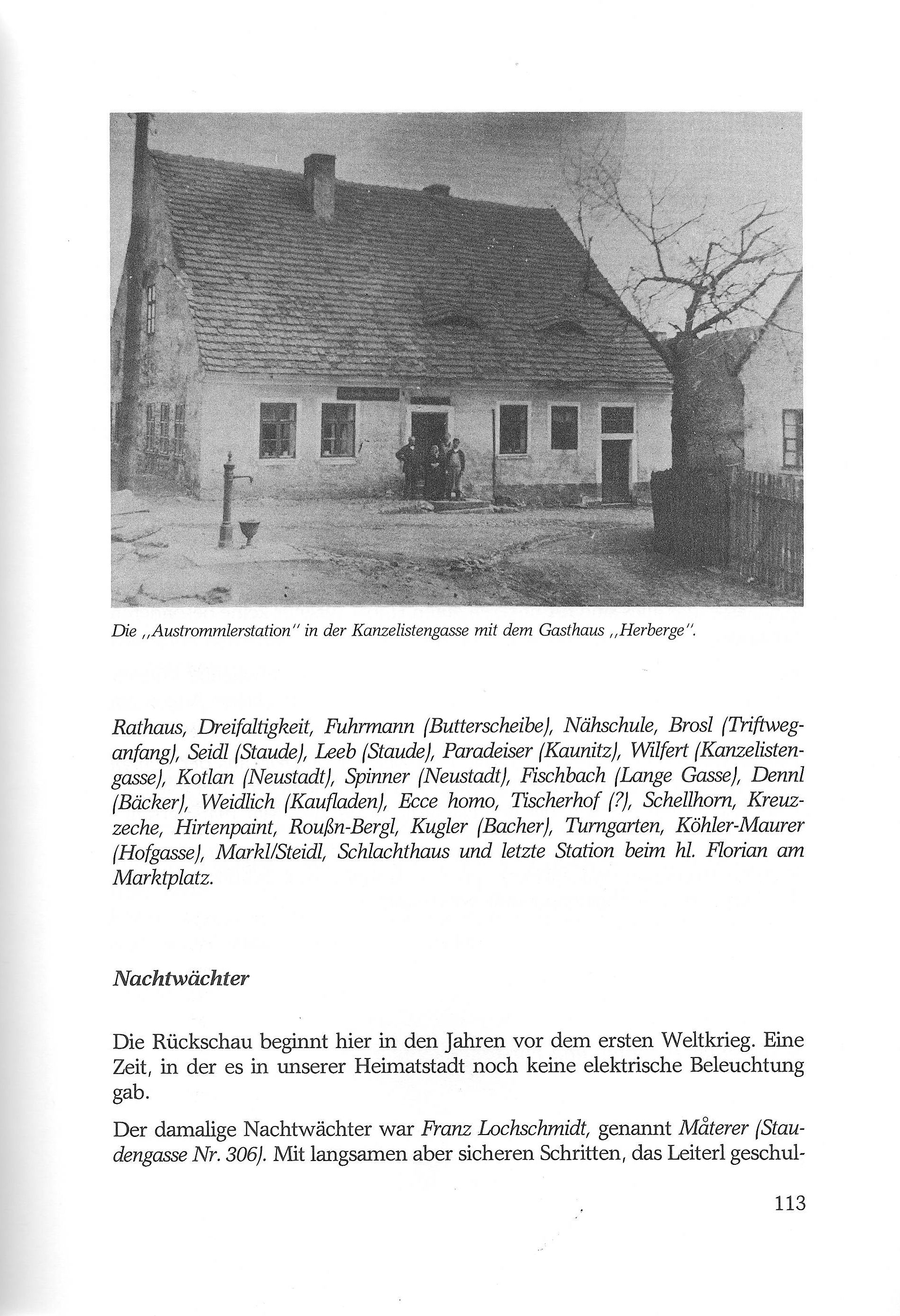 113
The "Austrommlerstation" in the Kanzelistengasse with the guesthouse
"Herberge".
Town hall, Trinity, Fuhrmarn (Butterscheibel, sewing school, Brosl
(beginning of Triftweg), Seid! (Staudel, Leeb (Staude), Paradeiser
(Kaunitz), Wilfert (Kanzelistengasse), Kotlan (Neustadt), Spinner
(Neustadt), Fischbach (Lange Gassel, Dennl Bäckerl, Weidlich
(shop), Ecce homo, Tischerhof (7, Schellhom, Kreuz zeche, Hirtenpaint
Roußn-Bergl, Kugler (Bacher), Turngarten, Köhler-Maurer (Hofsassel,
Markl/Steidl, slaughterhouse and last stop at St. Florian market
square.
Night watchman
The review begins here in the years before the First World War. A time
when there was no electric lighting in our home town.
The night watchman at the time was Franz Lochschmidt, known as
Måterer (Staudengasse no. 306). With slow but sure steps, the
ladder trained
113
113
The "Austrommlerstation" in the Kanzelistengasse with the guesthouse
"Herberge".
Town hall, Trinity, Fuhrmarn (Butterscheibel, sewing school, Brosl
(beginning of Triftweg), Seid! (Staudel, Leeb (Staude), Paradeiser
(Kaunitz), Wilfert (Kanzelistengasse), Kotlan (Neustadt), Spinner
(Neustadt), Fischbach (Lange Gassel, Dennl Bäckerl, Weidlich
(shop), Ecce homo, Tischerhof (7, Schellhom, Kreuz zeche, Hirtenpaint
Roußn-Bergl, Kugler (Bacher), Turngarten, Köhler-Maurer (Hofsassel,
Markl/Steidl, slaughterhouse and last stop at St. Florian market
square.
Night watchman
The review begins here in the years before the First World War. A time
when there was no electric lighting in our home town.
The night watchman at the time was Franz Lochschmidt, known as
Måterer (Staudengasse no. 306). With slow but sure steps, the
ladder trained
113
Page 0113
 114
With his arms folded and a large can of petroleum in his hand, he went
from lantern to lantern through the streets and alleys of Schönfeld to
refill the petroleum needed for night lighting and to clean the sooty
cylinders. At night he made his obligatory rounds with his four-legged
companion.
Lochschmidt was also responsible for trimming the chestnut trees on
the market square for many years.
After his death, Franz Wagner (school bailiff) held the post of night
watchman in our town for almost 20 years. Like his predecessor, he
also carried out his night duty very conscientiously. Only once, on
the night of September 12, 1938 (see also Chronicle), was his
superior, the then chairman of the administrative commission,
Dr. Roßmeißl, does not entirely agree with his "Night Report",
because to his great surprise he found Wagner's entry in the report
book kept at the time: "No special events."
Dr. Roßmeißl's comment on this: "'A nighttime demonstration, a
fiery political speech at Dreifaltigkeitsplatz, broken windows at the
Hotel Potherr" and the Josef Wurzl family in the Lange Gasse, none of
these are special events for our good Mr. Wagner."
It should be clear to everyone that in this case the night watchman
Wagner only "turned a blind eye" for purely political reasons.
The next night policeman was Willi Mießner (Kaspar) from Lange
Gasse No. 176. Mießner was in the municipal service until 1942. He
was followed in 1943 by Josef Hahm (No. 122), who was on night duty
until May 1945.
Hahm ends the line of men who, night after night, in all weathers,
reliably and attentively carried out their duties for the protection
and well-being of the citizens and the municipality.
Schönfelder forest and forestry employees
According to information from 1898, the forest area belonging to the
Schönfelder district had an area of ??around 500 hectares.
114
114
With his arms folded and a large can of petroleum in his hand, he went
from lantern to lantern through the streets and alleys of Schönfeld to
refill the petroleum needed for night lighting and to clean the sooty
cylinders. At night he made his obligatory rounds with his four-legged
companion.
Lochschmidt was also responsible for trimming the chestnut trees on
the market square for many years.
After his death, Franz Wagner (school bailiff) held the post of night
watchman in our town for almost 20 years. Like his predecessor, he
also carried out his night duty very conscientiously. Only once, on
the night of September 12, 1938 (see also Chronicle), was his
superior, the then chairman of the administrative commission,
Dr. Roßmeißl, does not entirely agree with his "Night Report",
because to his great surprise he found Wagner's entry in the report
book kept at the time: "No special events."
Dr. Roßmeißl's comment on this: "'A nighttime demonstration, a
fiery political speech at Dreifaltigkeitsplatz, broken windows at the
Hotel Potherr" and the Josef Wurzl family in the Lange Gasse, none of
these are special events for our good Mr. Wagner."
It should be clear to everyone that in this case the night watchman
Wagner only "turned a blind eye" for purely political reasons.
The next night policeman was Willi Mießner (Kaspar) from Lange
Gasse No. 176. Mießner was in the municipal service until 1942. He
was followed in 1943 by Josef Hahm (No. 122), who was on night duty
until May 1945.
Hahm ends the line of men who, night after night, in all weathers,
reliably and attentively carried out their duties for the protection
and well-being of the citizens and the municipality.
Schönfelder forest and forestry employees
According to information from 1898, the forest area belonging to the
Schönfelder district had an area of ??around 500 hectares.
114
Page 0114
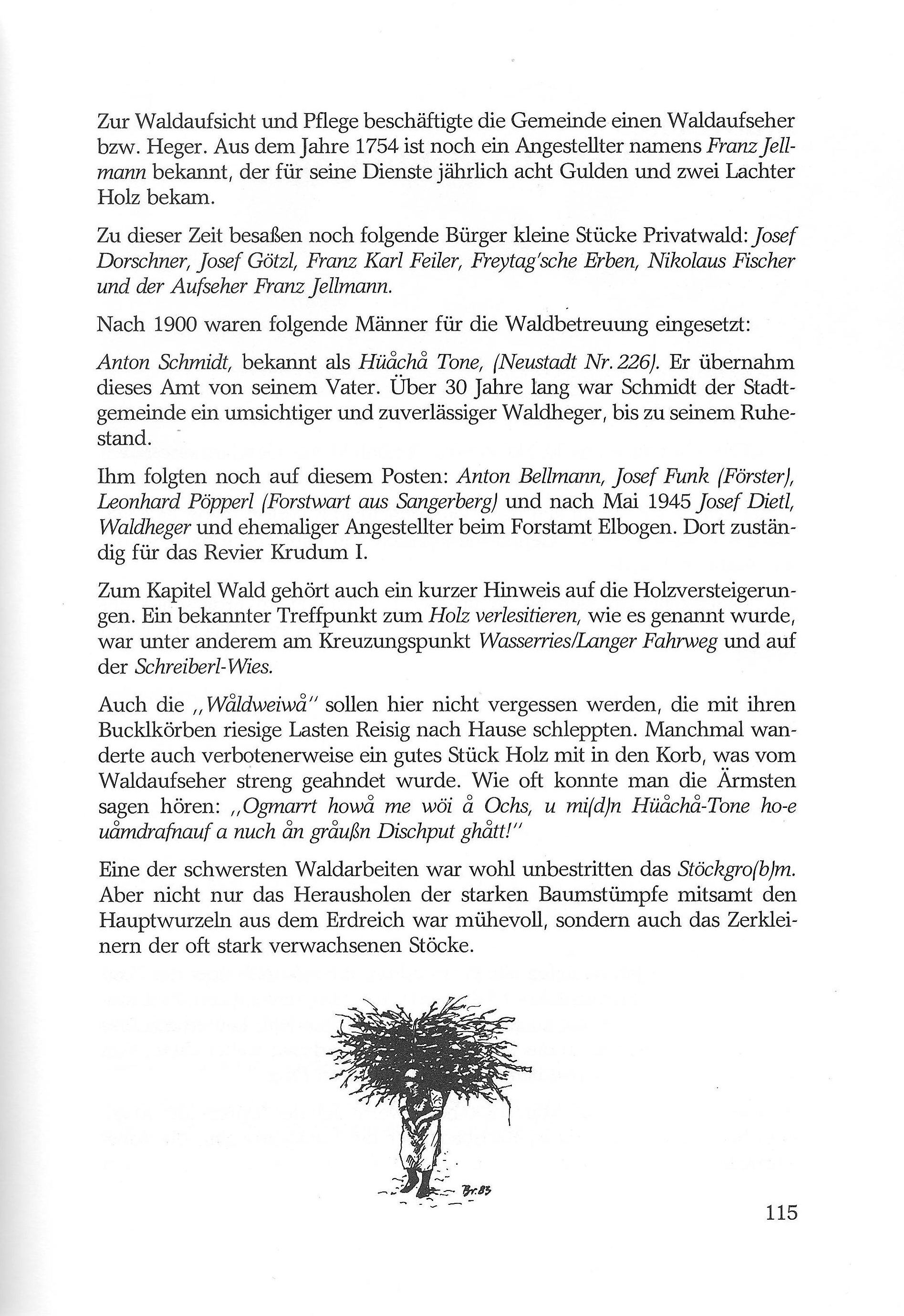 115
The community employed a forest ranger to oversee and maintain the
forest. An employee named Franz Jellmann is known from 1754, who
received eight guilders and two fathoms of wood annually for his
services.
At that time, the following citizens still owned small pieces of
private forest: Josef Dorschner, Josef Götzl, Franz Karl Feiler,
Preytag'sche Erben, Nikolaus Fischer
and the ranger Franz Fellmann.
After 1900, the following men were employed to look after the forest:
Anton Schmidt, known as Hüächå Tone, (Neustadt No. 2261, He
took over this position from his father. For over 30 years, Schmidt
was a prudent and reliable forest ranger for the town until his
retirement.
He was followed in this position by: Anton Bellmarn. Tosef Funh
(Foresterl
Leonhard Popperl (Forestry warden from Sangerberg) and after May 1945
Josef Dieti,
forest ranger and permanent employee at the Elbogen Forestry
Office. Responsible for the Krudum I district
The forest chapter also includes a brief reference to the wood
auctions. A well-known meeting place for the sale of wood, as it was
called, was at the Wasserries/Langer Fahrweg intersection and on the
Schreiberl-Wies.
The "Wäldweiwä" should not be forgotten here either. who lugged
huge loads of brushwood home in their hunched baskets. Sometimes,
illegally, a good piece of wood was also put into the basket, which
was severely punished by the forest ranger. How often could you hear
the poor people say: "Ogmarrt howå we öi an ox, u mit den
Hüåchå-Tone unddrafn eine viel ån ån ån dischput
ghatt!"
One of the hardest forest jobs was undoubtedly the stumps. But not
only was getting the strong tree stumps out of the ground with their
main roots laborious, but also breaking up the often heavily overgrown
stumps.
115
115
The community employed a forest ranger to oversee and maintain the
forest. An employee named Franz Jellmann is known from 1754, who
received eight guilders and two fathoms of wood annually for his
services.
At that time, the following citizens still owned small pieces of
private forest: Josef Dorschner, Josef Götzl, Franz Karl Feiler,
Preytag'sche Erben, Nikolaus Fischer
and the ranger Franz Fellmann.
After 1900, the following men were employed to look after the forest:
Anton Schmidt, known as Hüächå Tone, (Neustadt No. 2261, He
took over this position from his father. For over 30 years, Schmidt
was a prudent and reliable forest ranger for the town until his
retirement.
He was followed in this position by: Anton Bellmarn. Tosef Funh
(Foresterl
Leonhard Popperl (Forestry warden from Sangerberg) and after May 1945
Josef Dieti,
forest ranger and permanent employee at the Elbogen Forestry
Office. Responsible for the Krudum I district
The forest chapter also includes a brief reference to the wood
auctions. A well-known meeting place for the sale of wood, as it was
called, was at the Wasserries/Langer Fahrweg intersection and on the
Schreiberl-Wies.
The "Wäldweiwä" should not be forgotten here either. who lugged
huge loads of brushwood home in their hunched baskets. Sometimes,
illegally, a good piece of wood was also put into the basket, which
was severely punished by the forest ranger. How often could you hear
the poor people say: "Ogmarrt howå we öi an ox, u mit den
Hüåchå-Tone unddrafn eine viel ån ån ån dischput
ghatt!"
One of the hardest forest jobs was undoubtedly the stumps. But not
only was getting the strong tree stumps out of the ground with their
main roots laborious, but also breaking up the often heavily overgrown
stumps.
115
Page 0115
 116
State and municipal institutions
Gendarmerie
According to the chronicle, a gendarmerie station was set up in
Schönfeld on May 20, 1850.
Later it was probably moved to Lauterbach/Stadt, because it is said
that on March 1, 1917 the gendarmerie post was moved from Lauterbach
to Schonfeld.
The office, which was on the ground floor of the parish until we were
expelled, was manned by a senior sergeant and two sergeants
The Schonfeld gendarmerie area included the two communities
Lauterbach and Rabensgrün.
Post office
In earlier years, all mail from Schönfeld went through the post office
in Karlsbad. It was not until 1830 that a mail collection point was
set up in Schlaggenwald, which also forwarded mail from Schönfeld,
Lauterbach and other neighboring towns to the k.u.k. post office in
Karlsbad. From there, a mail coach traveled to Prague twice a week. In
a petition dated March 26, 1830, the Schönfeld magistrate complained
to the Imperial and Royal Post Office in Karlovy Vary about the delays
that occurred.
116
116
State and municipal institutions
Gendarmerie
According to the chronicle, a gendarmerie station was set up in
Schönfeld on May 20, 1850.
Later it was probably moved to Lauterbach/Stadt, because it is said
that on March 1, 1917 the gendarmerie post was moved from Lauterbach
to Schonfeld.
The office, which was on the ground floor of the parish until we were
expelled, was manned by a senior sergeant and two sergeants
The Schonfeld gendarmerie area included the two communities
Lauterbach and Rabensgrün.
Post office
In earlier years, all mail from Schönfeld went through the post office
in Karlsbad. It was not until 1830 that a mail collection point was
set up in Schlaggenwald, which also forwarded mail from Schönfeld,
Lauterbach and other neighboring towns to the k.u.k. post office in
Karlsbad. From there, a mail coach traveled to Prague twice a week. In
a petition dated March 26, 1830, the Schönfeld magistrate complained
to the Imperial and Royal Post Office in Karlovy Vary about the delays
that occurred.
116
Page 0116
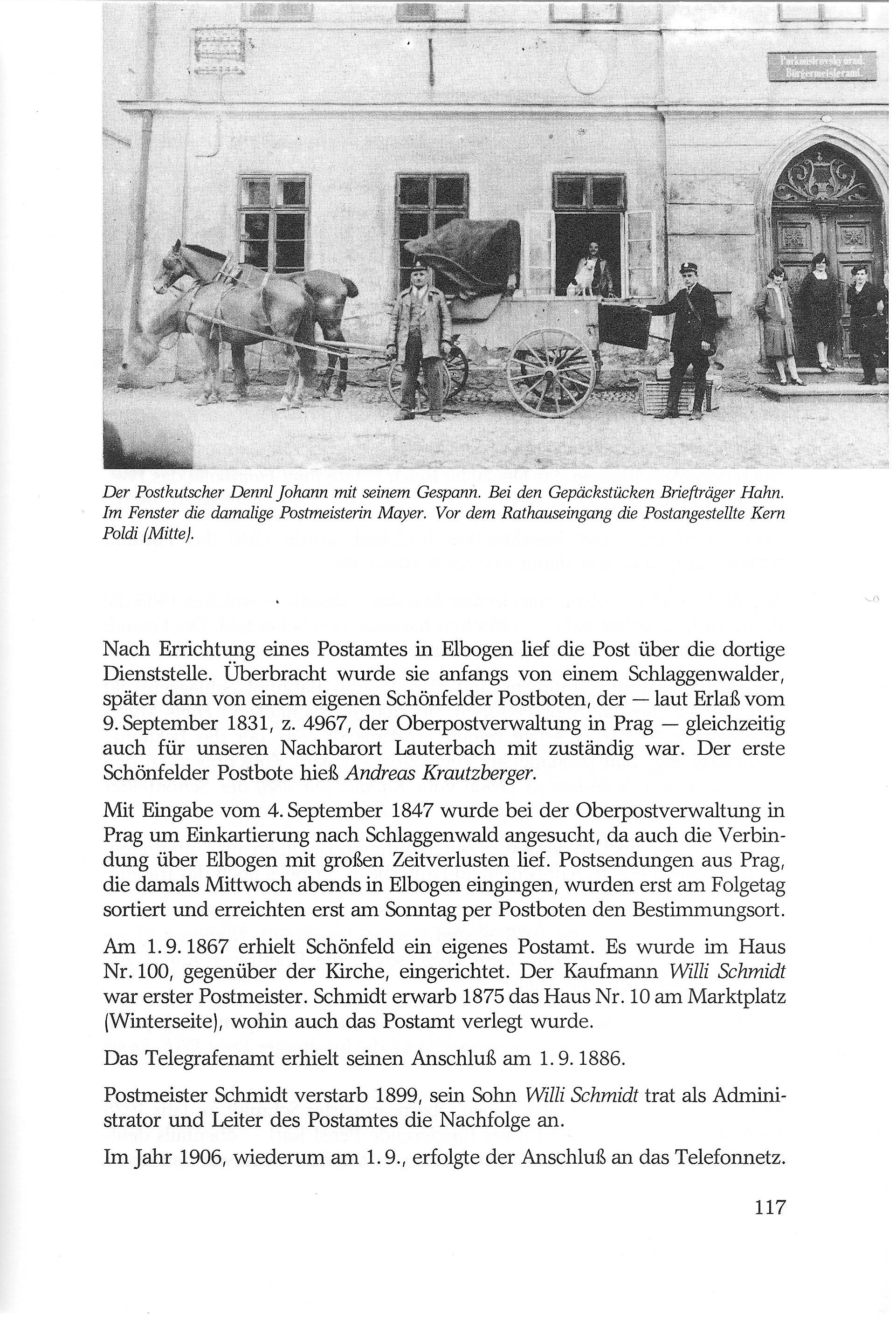 117
picture vvvvvvvv
The postman Dennl Johann with his team. Postman Hahn with the
luggage. In the window is the then postmistress Mayer. In front of the
town hall entrance is the postal worker Kern Poldi (centre).
After a post office was set up in Elbogen, the mail went through the
office there. It was initially delivered by a Schlaggenwalder, later
by a Schönfeld postman who - according to the decree of September 9,
1831, no. 4967, of the General Postal Administration in Prague - was
also responsible for our neighboring town of Lauterbach. The first
Schönfeld postman was Andreas Krautzberger.
On September 4, 1847, an application was made to the General Postal
Administration in Prague to be mapped to Schlaggenwald, as the
connection via Elbogen also took a lot of time. Mail from Prague that
arrived in Elbogen on Wednesday evenings was not sorted until the
following day and only reached its destination by postman on Sunday.
On September 1st, 1867, Schönfeld received its own post office. It was
set up in house number 100, opposite the church. The merchant Willi
Schmidt was the first postmaster. In 1875, Schmidt acquired house
number 10 on the market square (winter side), where the post office
was also moved.
The telegraph office was connected on September 1st, 1886.
Postmaster Schmidt died in 1899, and his son Willi Schmidt succeeded
him as administrator and head of the post office.
In 1906, again on September 1st, the telephone network was connected.
117
117
picture vvvvvvvv
The postman Dennl Johann with his team. Postman Hahn with the
luggage. In the window is the then postmistress Mayer. In front of the
town hall entrance is the postal worker Kern Poldi (centre).
After a post office was set up in Elbogen, the mail went through the
office there. It was initially delivered by a Schlaggenwalder, later
by a Schönfeld postman who - according to the decree of September 9,
1831, no. 4967, of the General Postal Administration in Prague - was
also responsible for our neighboring town of Lauterbach. The first
Schönfeld postman was Andreas Krautzberger.
On September 4, 1847, an application was made to the General Postal
Administration in Prague to be mapped to Schlaggenwald, as the
connection via Elbogen also took a lot of time. Mail from Prague that
arrived in Elbogen on Wednesday evenings was not sorted until the
following day and only reached its destination by postman on Sunday.
On September 1st, 1867, Schönfeld received its own post office. It was
set up in house number 100, opposite the church. The merchant Willi
Schmidt was the first postmaster. In 1875, Schmidt acquired house
number 10 on the market square (winter side), where the post office
was also moved.
The telegraph office was connected on September 1st, 1886.
Postmaster Schmidt died in 1899, and his son Willi Schmidt succeeded
him as administrator and head of the post office.
In 1906, again on September 1st, the telephone network was connected.
117
Page 0117
 118
And this date is worth mentioning again, because on the same day, just
five years later, Schmidt was appointed postmaster. In 1919 he was
promoted to Oberostmeister. As he was not willing to learn the Czech
language under the new Czech government, he was sent into retirement
at the age of 46 under a law that provided for the reduction of German
officials, although the authorities had repeatedly expressed their
appreciation for his exemplary conduct in office. In 1928 the post
office was moved to the town hall. From this point on, until 1938,
only Czech postmasters worked. The names of Mrs. Mayer and
Mrs. Theresia Kettner are still known here. After the annexation to
the German Reich, Josef Fuhrmann headed the post office in
Schönfeld. By order of the Karlshad postal directorate, the post
office was downgraded in 1940 and was thus only a post office. On
January 24, 1942, the post bus - which had replaced the stagecoach in
1938 - ran for the last time between Karlsbad and Schönfeld. The
reason: a general shortage of fuel and tires. The delivery of mail, in
the morning and evening to Schlaggenwald station
and at midday to Petschau station, was then taken over by Hans Milller
(Grabengasse no. 68), he used his "oat motor" which pulled the
well-known
Steierwagl. For a while Zint! also sat on the coach box. In the
earlier years, Johann Dennl from Kaunitz (no. 288] was the Schönfeld
mail coachman
Before Dennl, i.e. still in the k.u.k. era, a postillion from
Untertiefenbach drove the Petschau-Schonfeld-Lauterbach route. He
still blew the traditional post horn.
Postal employees — before 1938 — are known to include: Hambach
(?) from Lauterbach, Wenzl Glaubauf, Ken Poldi, as well as the postmen
Kari Pensi Haln and the Czech Miler
After this time, i.e. after 1938, Also to be mentioned: Hahm Frieda
(married Rödll), Dennl Gertrud (married Zimmerhackl/ and the postmen
Enst Rödi, Franz Mießner and Willi Pensl.
It should be noted that in addition to the head postmaster Schmidt in
1925,
Pensl Karl, who had been a postman since 1900 and was also a German
civil servant, was also retired. Pensl was 50 at the time
118
118
And this date is worth mentioning again, because on the same day, just
five years later, Schmidt was appointed postmaster. In 1919 he was
promoted to Oberostmeister. As he was not willing to learn the Czech
language under the new Czech government, he was sent into retirement
at the age of 46 under a law that provided for the reduction of German
officials, although the authorities had repeatedly expressed their
appreciation for his exemplary conduct in office. In 1928 the post
office was moved to the town hall. From this point on, until 1938,
only Czech postmasters worked. The names of Mrs. Mayer and
Mrs. Theresia Kettner are still known here. After the annexation to
the German Reich, Josef Fuhrmann headed the post office in
Schönfeld. By order of the Karlshad postal directorate, the post
office was downgraded in 1940 and was thus only a post office. On
January 24, 1942, the post bus - which had replaced the stagecoach in
1938 - ran for the last time between Karlsbad and Schönfeld. The
reason: a general shortage of fuel and tires. The delivery of mail, in
the morning and evening to Schlaggenwald station
and at midday to Petschau station, was then taken over by Hans Milller
(Grabengasse no. 68), he used his "oat motor" which pulled the
well-known
Steierwagl. For a while Zint! also sat on the coach box. In the
earlier years, Johann Dennl from Kaunitz (no. 288] was the Schönfeld
mail coachman
Before Dennl, i.e. still in the k.u.k. era, a postillion from
Untertiefenbach drove the Petschau-Schonfeld-Lauterbach route. He
still blew the traditional post horn.
Postal employees — before 1938 — are known to include: Hambach
(?) from Lauterbach, Wenzl Glaubauf, Ken Poldi, as well as the postmen
Kari Pensi Haln and the Czech Miler
After this time, i.e. after 1938, Also to be mentioned: Hahm Frieda
(married Rödll), Dennl Gertrud (married Zimmerhackl/ and the postmen
Enst Rödi, Franz Mießner and Willi Pensl.
It should be noted that in addition to the head postmaster Schmidt in
1925,
Pensl Karl, who had been a postman since 1900 and was also a German
civil servant, was also retired. Pensl was 50 at the time
118
Page 0118
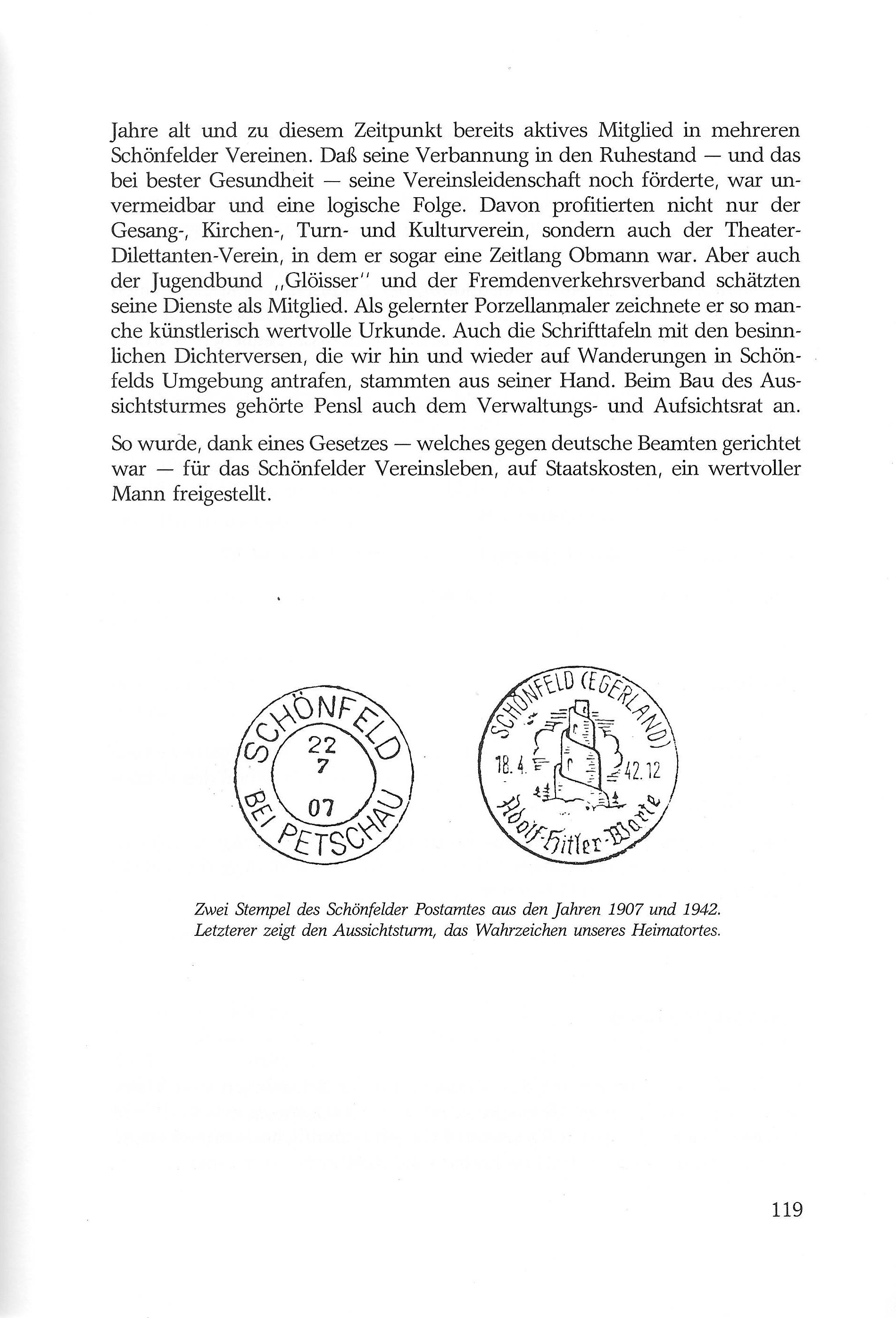 119
years old and at that time already an active member of several
Schönfeld clubs. His retirement - which, despite being in the best of
health, still encouraged his passion for clubs - was unavoidable and a
logical consequence. Not only the singing, church, gymnastics and
cultural clubs benefited from this, but also the Theater Amateurs'
Club, of which he was even chairman for a while. But the "Glöisser"
youth association and the tourist association also valued his services
as a member. As a trained porcelain painter, he drew such artistically
valuable documents. The plaques with the contemplative poetic verses
that we occasionally encountered on hikes in the Schönfeld area were
also his work. When the observation tower was built, Pensl was also
part of the administrative and supervisory boards. Thanks to a law
that was directed against German officials, a valuable man was
released for Schönfeld's club life at state expense.
HONE
22
7
07 PE SCHA
ONFELD
Two stamps from the Schönfeld post office from 1907 and 1942. The
latter shows the observation tower, the landmark of our hometown.
pictures vvvvvv
EGERLAN
242.
Barte
119
119
years old and at that time already an active member of several
Schönfeld clubs. His retirement - which, despite being in the best of
health, still encouraged his passion for clubs - was unavoidable and a
logical consequence. Not only the singing, church, gymnastics and
cultural clubs benefited from this, but also the Theater Amateurs'
Club, of which he was even chairman for a while. But the "Glöisser"
youth association and the tourist association also valued his services
as a member. As a trained porcelain painter, he drew such artistically
valuable documents. The plaques with the contemplative poetic verses
that we occasionally encountered on hikes in the Schönfeld area were
also his work. When the observation tower was built, Pensl was also
part of the administrative and supervisory boards. Thanks to a law
that was directed against German officials, a valuable man was
released for Schönfeld's club life at state expense.
HONE
22
7
07 PE SCHA
ONFELD
Two stamps from the Schönfeld post office from 1907 and 1942. The
latter shows the observation tower, the landmark of our hometown.
pictures vvvvvv
EGERLAN
242.
Barte
119
Page 0119
 120
Municipal savings bank in Schönfeld
Even before the founding of the municipal savings bank on April 1,
1902, a savings and loan association with unlimited liability had
existed in Schonfeld since 1872. This association was dissolved in
1912.
When the municipal savings bank was founded, the town council had to
deposit a special guarantee fund of 20,000 crowns. The cost of setting
up the savings bank, which was paid from the town treasury, was 1,974
crowns at the time.
The employees were: a director, a cashier and a clerk. The first
director was Adolf Tyll (died of typhus in 1905).
His successor was Wilhelm Ruppert, who had previously been treasurer
of the Schönfeld savings and loan association. Br served as director
until his death in September 1940
He was succeeded by his long-time deputy Franz Lochner
The kindergarten
In 1936, the local school committee decided to set up a
kindergarten. A suitable room was found on the ground floor of house
no. 6 (Edwin Ruppert, next to the Macbricke!
The first kindergarten teacher was Hildegard Schaffelhofer, who came
from Karlsbad. She was replaced - probably in 1940 - by Miss John, who
looked after the children's home until 1945.
The city library
Following a decree from the Ministry of Education and National
Structure in Prague, which made it compulsory for all communities with
over 1000 inhabitants to set up a public library within a set period,
the city library was opened in the town hall on August 31, 1921.
120
120
Municipal savings bank in Schönfeld
Even before the founding of the municipal savings bank on April 1,
1902, a savings and loan association with unlimited liability had
existed in Schonfeld since 1872. This association was dissolved in
1912.
When the municipal savings bank was founded, the town council had to
deposit a special guarantee fund of 20,000 crowns. The cost of setting
up the savings bank, which was paid from the town treasury, was 1,974
crowns at the time.
The employees were: a director, a cashier and a clerk. The first
director was Adolf Tyll (died of typhus in 1905).
His successor was Wilhelm Ruppert, who had previously been treasurer
of the Schönfeld savings and loan association. Br served as director
until his death in September 1940
He was succeeded by his long-time deputy Franz Lochner
The kindergarten
In 1936, the local school committee decided to set up a
kindergarten. A suitable room was found on the ground floor of house
no. 6 (Edwin Ruppert, next to the Macbricke!
The first kindergarten teacher was Hildegard Schaffelhofer, who came
from Karlsbad. She was replaced - probably in 1940 - by Miss John, who
looked after the children's home until 1945.
The city library
Following a decree from the Ministry of Education and National
Structure in Prague, which made it compulsory for all communities with
over 1000 inhabitants to set up a public library within a set period,
the city library was opened in the town hall on August 31, 1921.
120
Page 0120
 121
There were 1142 volumes available in the library
The first bookkeeper was the writer Zachara from Kornellgasse.
In 1935, 1834 books were borrowed. The loan fee per volume and week
was 20 Heller at the time.
In 1940-41, the library was looked after by Brandl Albin. During this
period, a so-called "book-dumping operation" took place, which was
carried out by two party-appointed gentlemen from Falkenau. A
considerable number of the books that the residents liked to read were
confiscated and replaced with Nazi literature. However, this did not
meet with the hoped-for interest among readers, so that loans fell
sharply.
The Town Hall Inn
In 1865, a restaurant was set up on the ground floor of the town hall.
From 1904 onwards, we know of the following names of innkeepers:
Zimmerhackl Johann, Kempf Roman, Zimmerhacki Franz, Zimmerhackl
Josef. Schmieger Josef and, last but not least, Deronl Johann.
In the mid-twenties, the town council decided to close the restaurant
and give the premises to the state.
The Schönfeld Local History Museum
By Josef Hubl
Schonfeld should have had a museum long ago due to its tradition as an
ancient, formerly royal free mining town. Although The idea of
??founding a local museum was discussed here and there, but the lack
of suitable space to house it meant that the plan was never put into
practice. In the meantime, in recent decades, a lot of goods, some of
them very valuable, have been sold to other museums.
121
121
There were 1142 volumes available in the library
The first bookkeeper was the writer Zachara from Kornellgasse.
In 1935, 1834 books were borrowed. The loan fee per volume and week
was 20 Heller at the time.
In 1940-41, the library was looked after by Brandl Albin. During this
period, a so-called "book-dumping operation" took place, which was
carried out by two party-appointed gentlemen from Falkenau. A
considerable number of the books that the residents liked to read were
confiscated and replaced with Nazi literature. However, this did not
meet with the hoped-for interest among readers, so that loans fell
sharply.
The Town Hall Inn
In 1865, a restaurant was set up on the ground floor of the town hall.
From 1904 onwards, we know of the following names of innkeepers:
Zimmerhackl Johann, Kempf Roman, Zimmerhacki Franz, Zimmerhackl
Josef. Schmieger Josef and, last but not least, Deronl Johann.
In the mid-twenties, the town council decided to close the restaurant
and give the premises to the state.
The Schönfeld Local History Museum
By Josef Hubl
Schonfeld should have had a museum long ago due to its tradition as an
ancient, formerly royal free mining town. Although The idea of
??founding a local museum was discussed here and there, but the lack
of suitable space to house it meant that the plan was never put into
practice. In the meantime, in recent decades, a lot of goods, some of
them very valuable, have been sold to other museums.
121
Page 0121
 122
When at the beginning of the 1930s, during a time of high
unemployment, the tourism commission was trying to develop Schönfeld
into a "summer resort", the idea of ??establishing a local museum was
also taken up again. However, it was not until 1937 that the
realization of this plan seemed to be within reach. The apartment of
the Czech postmistress Mayerova on the ground floor of the town hall
had become vacant when she moved away, and the then administrative
commissioner of the town, Dr. Erwin Roßmeißl, willingly made
these two rooms available for a museum to be founded, as he himself
was an enthusiastic supporter of the tourism commission's efforts in
every respect.
Dr. Roßmeifl approached teacher losef Hubl with the request to take
on the task of establishing a museum for Schönfeld and to carry it
out. Hubl happily agreed, as it was a long-cherished dream of his
own. It was his wish that Schönfeld should also have a museum. He
found a small stock of museum items in the form of some objects from
Schönfeld's past, which Vicar Kari Enzmann had casually shown to the
public at the trade fair held by the Tourism Commission in the
elementary school in 1933. The next step was to search house by house
throughout Schönfeld for suitable objects. Equipped with a list of
houses he had prepared beforehand, Hubl set out in the autumn of 1937
and devoted every free hour of the winter to this task. Contrary to
expectations, his collecting activities were far more successful than
he had dared to hope.
He acquired objects either as a gift for the museum or on loan,
i.e. the object remained the property of the previous owner and was
made available to the museum for exhibition. A very valuable
contribution was also made when Mrs. Anna Hanika loaned her late
husband's private collection of old tin and porcelain
items. Administrative Commissioner Dr. Roßmeill willingly provided
the necessary funds on behalf of the municipality to purchase some
display cabinets and tables. In the summer of 1938, Mr. Hubl, the
teacher, had collected enough items to open the municipal museum in
the town hall on August 12, 1938.
When Director Karl Lochner came to Schönfeld shortly afterwards, he
was delighted that a local history museum had finally been founded, as
this had been his wish for many years. Since he had meanwhile decided
to take up permanent residence in his hometown, he devoted himself to
the further development of the museum.
122
122
When at the beginning of the 1930s, during a time of high
unemployment, the tourism commission was trying to develop Schönfeld
into a "summer resort", the idea of ??establishing a local museum was
also taken up again. However, it was not until 1937 that the
realization of this plan seemed to be within reach. The apartment of
the Czech postmistress Mayerova on the ground floor of the town hall
had become vacant when she moved away, and the then administrative
commissioner of the town, Dr. Erwin Roßmeißl, willingly made
these two rooms available for a museum to be founded, as he himself
was an enthusiastic supporter of the tourism commission's efforts in
every respect.
Dr. Roßmeifl approached teacher losef Hubl with the request to take
on the task of establishing a museum for Schönfeld and to carry it
out. Hubl happily agreed, as it was a long-cherished dream of his
own. It was his wish that Schönfeld should also have a museum. He
found a small stock of museum items in the form of some objects from
Schönfeld's past, which Vicar Kari Enzmann had casually shown to the
public at the trade fair held by the Tourism Commission in the
elementary school in 1933. The next step was to search house by house
throughout Schönfeld for suitable objects. Equipped with a list of
houses he had prepared beforehand, Hubl set out in the autumn of 1937
and devoted every free hour of the winter to this task. Contrary to
expectations, his collecting activities were far more successful than
he had dared to hope.
He acquired objects either as a gift for the museum or on loan,
i.e. the object remained the property of the previous owner and was
made available to the museum for exhibition. A very valuable
contribution was also made when Mrs. Anna Hanika loaned her late
husband's private collection of old tin and porcelain
items. Administrative Commissioner Dr. Roßmeill willingly provided
the necessary funds on behalf of the municipality to purchase some
display cabinets and tables. In the summer of 1938, Mr. Hubl, the
teacher, had collected enough items to open the municipal museum in
the town hall on August 12, 1938.
When Director Karl Lochner came to Schönfeld shortly afterwards, he
was delighted that a local history museum had finally been founded, as
this had been his wish for many years. Since he had meanwhile decided
to take up permanent residence in his hometown, he devoted himself to
the further development of the museum.
122
Page 0122
 123
He turned to Augustin Roth, a painter he knew personally and who was
born in Schönfeld and lives in Vienna, and asked him if he would like
to contribute to the design of the Schönfeld Museum by donating one of
his paintings. Soon after, Roth informed him that he would send two of
his early works, favorite works of his, which he had often been able
to sell for high prices but which he did not want to part with,
because he could not think of a more worthy place for his favorite
works than the museum in his hometown. The two large oil paintings
soon arrived.
At the beginning of 1939, the municipal savings bank wanted to move
into the lower rooms of the town hall. the museum had to move its
holdings to the large mayor's office on the first floor, and when this
room also had to be cleared for the purposes of the mayor's office
when the town hall was demolished, the museum moved to the hall in the
Gareiß (Gußl) inn, which was divided into two rooms by a
partition wall and rented by the mayor for this purpose. At the end of
1944, however, Mrs. Gareiß canceled the rent because she needed the
space for her daughters. Nowhere could a room be found that could
accommodate the museum. The museum administration was forced to pack
the holdings in boxes and store them as best as possible in different
houses.
This happened in the attic of the school, in the shop of the Hubana
house, in the rear vault of the party building (Franz Hubi) and in the
meat vault of the Gareiß (Guß) inn.
Then came the unfortunate end of the war. The Czechs sniffed through
everything, right down to the last corner, and so one day, when they
opened a drawer in the vault of the former party building, they came
across old rifles that were stored there. Half triumphant at having
discovered a hidden weapons cache, half indignant at the audacity of
the evil Germans, the discoverer was finally reassured by a German
that these were old, unusable weapons that belonged to the municipal
museum
123
123
He turned to Augustin Roth, a painter he knew personally and who was
born in Schönfeld and lives in Vienna, and asked him if he would like
to contribute to the design of the Schönfeld Museum by donating one of
his paintings. Soon after, Roth informed him that he would send two of
his early works, favorite works of his, which he had often been able
to sell for high prices but which he did not want to part with,
because he could not think of a more worthy place for his favorite
works than the museum in his hometown. The two large oil paintings
soon arrived.
At the beginning of 1939, the municipal savings bank wanted to move
into the lower rooms of the town hall. the museum had to move its
holdings to the large mayor's office on the first floor, and when this
room also had to be cleared for the purposes of the mayor's office
when the town hall was demolished, the museum moved to the hall in the
Gareiß (Gußl) inn, which was divided into two rooms by a
partition wall and rented by the mayor for this purpose. At the end of
1944, however, Mrs. Gareiß canceled the rent because she needed the
space for her daughters. Nowhere could a room be found that could
accommodate the museum. The museum administration was forced to pack
the holdings in boxes and store them as best as possible in different
houses.
This happened in the attic of the school, in the shop of the Hubana
house, in the rear vault of the party building (Franz Hubi) and in the
meat vault of the Gareiß (Guß) inn.
Then came the unfortunate end of the war. The Czechs sniffed through
everything, right down to the last corner, and so one day, when they
opened a drawer in the vault of the former party building, they came
across old rifles that were stored there. Half triumphant at having
discovered a hidden weapons cache, half indignant at the audacity of
the evil Germans, the discoverer was finally reassured by a German
that these were old, unusable weapons that belonged to the municipal
museum
123
Page 0123
 124
The most important museum values
It should be emphasized that every object that was on display in the
Schönfeld local history museum had some connection to Schönfeld. Be it
that it was produced, used, found or at least owned by a Schönfeld
resident.
Documents: The original documents from the municipal archives were of
the highest documentary value and were a valuable historical part of
the municipal museum (see "Municipal Archives").
Oil paintings: By August Roth (born 19.6.1864 in Schönfeld No. 8):
"The landlady's daughter", painted in 1888, "Portrait of my mother",
1889, "Portrait of my father", 1940. - Self-portrait by the sculptor
Karl Wilfert in Eger (honorary citizen of Schönfeld). Smaller
paintings by Dietz and unknown painters.
Wooden sculptures: Mother of God with the baby Jesus, carved in 1677
by loh. And. Zimmerhackl (image of the "Mother of God in the
church"). Artistic figure of the Virgin Mary (allegedly from the old
church). Saint Florian. Jesus in prison.
Guild system: Guild chest of the Baker 1658, the pewterer. 1660, the
meat chopper, master, journeyman, apprentice or free speech books,
master certificates. Guild sash, several palls of the butcher 1610,
the baker, the pewterer, the shoemaker. Numerous coffin signs that
were hung on the guild pall. Coffin cross of the miners. Journeyman or
master piece of a shoemaker: a pair of small shoes made from a suede
bag and sewn with the name: David Scharff, 1644.
Crafts: Numerous printing blocks of the former dyers. Old baking molds
carved in wood of the confectioners. Spice mortar and spice sieve of
the merchants. Sausage syringe of the butcher. Components from the
workshop of a Nadler. Old loom. Pewter caster wheel. Many old molds
from the
pewter casters: engraved crucifixes, candlesticks, traffic lights,
cups, salt barrels, tea
services and even cutlery shapes from more recent times.
Homework: Several glass frames with patterns from the early days of
lace sewing in Schönfeld (around 1856). Many templates, sample letters
and real patterns from pearl sewing, which was very popular in
Schönfeld until around 1910.
124
124
The most important museum values
It should be emphasized that every object that was on display in the
Schönfeld local history museum had some connection to Schönfeld. Be it
that it was produced, used, found or at least owned by a Schönfeld
resident.
Documents: The original documents from the municipal archives were of
the highest documentary value and were a valuable historical part of
the municipal museum (see "Municipal Archives").
Oil paintings: By August Roth (born 19.6.1864 in Schönfeld No. 8):
"The landlady's daughter", painted in 1888, "Portrait of my mother",
1889, "Portrait of my father", 1940. - Self-portrait by the sculptor
Karl Wilfert in Eger (honorary citizen of Schönfeld). Smaller
paintings by Dietz and unknown painters.
Wooden sculptures: Mother of God with the baby Jesus, carved in 1677
by loh. And. Zimmerhackl (image of the "Mother of God in the
church"). Artistic figure of the Virgin Mary (allegedly from the old
church). Saint Florian. Jesus in prison.
Guild system: Guild chest of the Baker 1658, the pewterer. 1660, the
meat chopper, master, journeyman, apprentice or free speech books,
master certificates. Guild sash, several palls of the butcher 1610,
the baker, the pewterer, the shoemaker. Numerous coffin signs that
were hung on the guild pall. Coffin cross of the miners. Journeyman or
master piece of a shoemaker: a pair of small shoes made from a suede
bag and sewn with the name: David Scharff, 1644.
Crafts: Numerous printing blocks of the former dyers. Old baking molds
carved in wood of the confectioners. Spice mortar and spice sieve of
the merchants. Sausage syringe of the butcher. Components from the
workshop of a Nadler. Old loom. Pewter caster wheel. Many old molds
from the
pewter casters: engraved crucifixes, candlesticks, traffic lights,
cups, salt barrels, tea
services and even cutlery shapes from more recent times.
Homework: Several glass frames with patterns from the early days of
lace sewing in Schönfeld (around 1856). Many templates, sample letters
and real patterns from pearl sewing, which was very popular in
Schönfeld until around 1910.
124
Page 0124
 125
Furnishings and household goods: Wardrobes and chests in the
Egerländer style from the beginning of the 19th century. A large
wooden chest, previously used as an archive chest in the rectory,
richly decorated with carvings by Margarethe Gruberin in
1671. Egerländer crockery cupboard, Biedermeier chest of
drawers. Several old hand-operated sewing machines, wall pictures with
wax figures, porcelain transparents, decorated clay jugs, old irons,
including those with charcoal firing. Light cleaning scissors, old
writing utensils, wooden and clay bonnet sticks.
Pewter. Porcelain. Glass: Numerous pewter plates. Bowls, jugs, mugs
Spoons, tea service, some cast in Schönfeld, some in
Schlaggenwald. Numerous rich porcelain plates from the beginning of
the 19th century. Heidinger and Novotny plates. Wall plates, porcelain
figurines. Knick-knacks, crystal glass were from the estate of the
glass grinder Beranek in Schönfeld.
Weapons: Several old rifles from the former rifle corps. Other old
rifles and pistols. Numerous sabers, some of which were allegedly
found in the felt. Lances and night watchman's spears.
Flags: The old flags of the gymnastics fire brigade from 1876, the
voluntary fire brigade, the German gymnastics club, the military
veterans' association from 1911, the flags of the youth fire brigade
and the Faulenzia.
Minerals: A collection of the most important species found in
Schönfeld, mostly ore-bearing rocks from the mine.
Books, pictures: Many old prayer books and other books, including the
valuable old book "Flos campi" or "Maria, the beautiful field
flower". That is: Kurtz designed origin of the rich mother of God in
the ancient royal and wicked mining town of Schönfeld in the Kingdom
of Böheim Written by Christof Adam Ernst A.A.L.L. et Philosophiae
Magister et St. Theol. Baccalaureum and pastor there, published in
1727. Many pictures from the club and cooperative life in Schönfeld.
The following memorabilia of the Schönfeld-born conductor and composer
Josef Labitzhy: A large portrait of Labitzky, printed concert programs
and tickets from the time of his concert activity
A picture chronicle, created as a supplement to the written community
chronicle, with over 700 slides, postcards, and recordings
of various public events.
125
125
Furnishings and household goods: Wardrobes and chests in the
Egerländer style from the beginning of the 19th century. A large
wooden chest, previously used as an archive chest in the rectory,
richly decorated with carvings by Margarethe Gruberin in
1671. Egerländer crockery cupboard, Biedermeier chest of
drawers. Several old hand-operated sewing machines, wall pictures with
wax figures, porcelain transparents, decorated clay jugs, old irons,
including those with charcoal firing. Light cleaning scissors, old
writing utensils, wooden and clay bonnet sticks.
Pewter. Porcelain. Glass: Numerous pewter plates. Bowls, jugs, mugs
Spoons, tea service, some cast in Schönfeld, some in
Schlaggenwald. Numerous rich porcelain plates from the beginning of
the 19th century. Heidinger and Novotny plates. Wall plates, porcelain
figurines. Knick-knacks, crystal glass were from the estate of the
glass grinder Beranek in Schönfeld.
Weapons: Several old rifles from the former rifle corps. Other old
rifles and pistols. Numerous sabers, some of which were allegedly
found in the felt. Lances and night watchman's spears.
Flags: The old flags of the gymnastics fire brigade from 1876, the
voluntary fire brigade, the German gymnastics club, the military
veterans' association from 1911, the flags of the youth fire brigade
and the Faulenzia.
Minerals: A collection of the most important species found in
Schönfeld, mostly ore-bearing rocks from the mine.
Books, pictures: Many old prayer books and other books, including the
valuable old book "Flos campi" or "Maria, the beautiful field
flower". That is: Kurtz designed origin of the rich mother of God in
the ancient royal and wicked mining town of Schönfeld in the Kingdom
of Böheim Written by Christof Adam Ernst A.A.L.L. et Philosophiae
Magister et St. Theol. Baccalaureum and pastor there, published in
1727. Many pictures from the club and cooperative life in Schönfeld.
The following memorabilia of the Schönfeld-born conductor and composer
Josef Labitzhy: A large portrait of Labitzky, printed concert programs
and tickets from the time of his concert activity
A picture chronicle, created as a supplement to the written community
chronicle, with over 700 slides, postcards, and recordings
of various public events.
125
Page 0125
 126
One day in May 1946, teachers Hubl and Karl Lochner were summoned to
the town hall. There they were told that the museum had to be
re-established immediately. They were to decide where it should go:
either in the Gußn Hall or in the Ruß restaurant, in which the
entire ground floor was to be used. They decided on the latter, as
these rooms were all vaulted and therefore fireproof. They then began
to gather the things together again, unpack them and arrange them
properly. Women had to help with the cleaning.
At the same time, Hubl was also commissioned to incorporate the
Roßmeiß family museum into the municipal museum.
The following items were taken over from the Roßmeißl family
museum into the Schönfel museum: Numerous display cases with an
extensive butterfly and beetle collection. Models of all the
agricultural equipment that belonged to an Egerland farm. The
individual stages of scythe production. Match production. Table made
from matchboxes. Model ship. Stylish and artistic large nativity
scene. Crucifixion of Christ and other motifs built into bottles. A
large number of other handicrafts.
All of the objects were made by the specialist teacher Josef
Roßmeißl in Königsberg an der Eger over many years of
painstaking handicraft work.
Now all three rooms were packed to the brim. With matching curtains on
the windows and the aisles between the tables covered with carpet
runners, which Steiskal brought in a wide selection, the home now
looked like a jewel box. Lochner Karl had to move out just as the
furnishings were being completed. His luggage was in the courtyard and
he waited for Rödl Ernst and Hans, who were supposed to take it to the
"Gasthaus zur Kreuzzeche" for inspection. But they were a long time
coming. Lochner probably came over to Ruß six or eight times to see
how we were doing and to give advice. He could hardly bear to part
with the Schönfeld Museum, which he had set up with all his love and
devotion and which was now unfortunately in foreign hands.
In the summer of 1946, Hubl, as museum administrator, often had to
give tours to Czech visitors. Only a few days before his expulsion on
September 28, was he able to hand the museum over to a Czech appointed
by the Narodni wbor as museum director, who of course showed neither
interest nor understanding for this completely foreign matter.
In 1947, Hubl then learned from a letter from home that in the course
of the major maneuvers in the Schönfeld-Lauterbach area, in connection
with which
126
126
One day in May 1946, teachers Hubl and Karl Lochner were summoned to
the town hall. There they were told that the museum had to be
re-established immediately. They were to decide where it should go:
either in the Gußn Hall or in the Ruß restaurant, in which the
entire ground floor was to be used. They decided on the latter, as
these rooms were all vaulted and therefore fireproof. They then began
to gather the things together again, unpack them and arrange them
properly. Women had to help with the cleaning.
At the same time, Hubl was also commissioned to incorporate the
Roßmeiß family museum into the municipal museum.
The following items were taken over from the Roßmeißl family
museum into the Schönfel museum: Numerous display cases with an
extensive butterfly and beetle collection. Models of all the
agricultural equipment that belonged to an Egerland farm. The
individual stages of scythe production. Match production. Table made
from matchboxes. Model ship. Stylish and artistic large nativity
scene. Crucifixion of Christ and other motifs built into bottles. A
large number of other handicrafts.
All of the objects were made by the specialist teacher Josef
Roßmeißl in Königsberg an der Eger over many years of
painstaking handicraft work.
Now all three rooms were packed to the brim. With matching curtains on
the windows and the aisles between the tables covered with carpet
runners, which Steiskal brought in a wide selection, the home now
looked like a jewel box. Lochner Karl had to move out just as the
furnishings were being completed. His luggage was in the courtyard and
he waited for Rödl Ernst and Hans, who were supposed to take it to the
"Gasthaus zur Kreuzzeche" for inspection. But they were a long time
coming. Lochner probably came over to Ruß six or eight times to see
how we were doing and to give advice. He could hardly bear to part
with the Schönfeld Museum, which he had set up with all his love and
devotion and which was now unfortunately in foreign hands.
In the summer of 1946, Hubl, as museum administrator, often had to
give tours to Czech visitors. Only a few days before his expulsion on
September 28, was he able to hand the museum over to a Czech appointed
by the Narodni wbor as museum director, who of course showed neither
interest nor understanding for this completely foreign matter.
In 1947, Hubl then learned from a letter from home that in the course
of the major maneuvers in the Schönfeld-Lauterbach area, in connection
with which
126
Page 0126
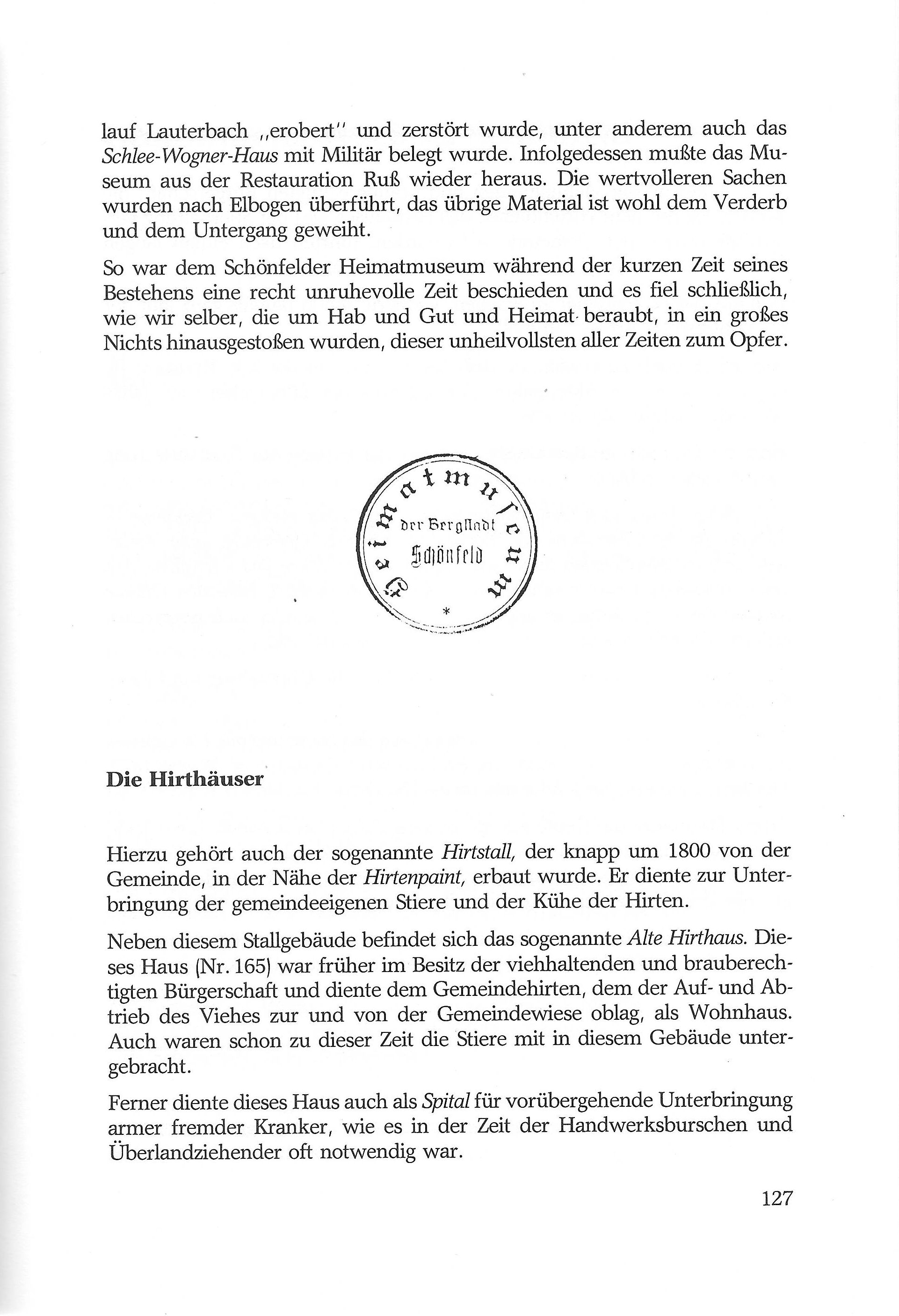 127
lauf Lauterbach was "conquered" and destroyed, and the Schlee-Womer
House was occupied by the military. As a result, the museum had to be
removed from the restoration. The more valuable items were transferred
to Elbogen, the rest of the material is probably doomed to decay and
destruction.
Thus, the Schönfeld local history museum had a very turbulent time
during the short period of its existence and, like us, who were robbed
of our possessions and homeland and cast out into a great nothingness,
it finally fell victim to this most disastrous of all times.
the Berglladt
Sdönfeld
The shepherds' houses
This also includes the so-called shepherd's stable, which was built by
the community around 1800, near the shepherds' pavilion. It was used
to house the community's own bulls and the shepherds' cows.
Next to this stable building is the so-called old shepherd's
house. This
house (No. 165) was formerly owned by the cattle-keeping and brewing
citizens and served as the home of the community shepherd, who was
responsible for driving the cattle to and from the community
meadow. Even at that time, the bulls were also housed in this
building. Furthermore, this house also served as a hospital for the
temporary accommodation of poor, foreign sick people, as was often
necessary in the days of journeymen and overland migrants.
127
127
lauf Lauterbach was "conquered" and destroyed, and the Schlee-Womer
House was occupied by the military. As a result, the museum had to be
removed from the restoration. The more valuable items were transferred
to Elbogen, the rest of the material is probably doomed to decay and
destruction.
Thus, the Schönfeld local history museum had a very turbulent time
during the short period of its existence and, like us, who were robbed
of our possessions and homeland and cast out into a great nothingness,
it finally fell victim to this most disastrous of all times.
the Berglladt
Sdönfeld
The shepherds' houses
This also includes the so-called shepherd's stable, which was built by
the community around 1800, near the shepherds' pavilion. It was used
to house the community's own bulls and the shepherds' cows.
Next to this stable building is the so-called old shepherd's
house. This
house (No. 165) was formerly owned by the cattle-keeping and brewing
citizens and served as the home of the community shepherd, who was
responsible for driving the cattle to and from the community
meadow. Even at that time, the bulls were also housed in this
building. Furthermore, this house also served as a hospital for the
temporary accommodation of poor, foreign sick people, as was often
necessary in the days of journeymen and overland migrants.
127
Page 0127
 128
The so-called hospital probably also got its name from the building's
role as a hospital.
Many attempts by the cattle-keeping and brewing-licensed citizens to
burden the community with the costs associated with the shepherding
service, the shepherd's house and the breeding of bulls finally led to
success in November 1872 after a long effort since 1836.
As can be seen from this period, the never-ending bureaucracy was
already neighing loudly at that time.
It should also be mentioned that all of the property transferred to
the k.k. The package of documents submitted to the Elbogen district
office entitled "The silting up of the shepherds' fields" remained
unfinished for eleven years.
Here is the verbatim resolution from the town council meeting on
October 1, 1872:
All of the community representatives present - with one exception -
voted for the community to take over the bull farming, subject to a
compensation to be determined for the three bulls and utensils. The
representatives expect increased income for the community treasury
from rational management of the land previously used for bull farming
and from leasing the community land that will become available.
On November 1, the minutes for the takeover were drawn up with the
following content:
"The town council will take over the existing three bulls and all
utensils as full property of the community for the price of 325
guilders, starting on Martinmas Day 1872. The amount will be paid to
the brewery fund in three annual installments."
At the same time, the community took over fields measuring 3
loch. 1386 fathoms and meadows measuring 6 yoke. 1540 fathoms. The
communal grazing and thus also the shepherd service were abandoned,
and a bull keeper was employed in place of the shepherd.
Around 1920, the community sold the old buildings and acquired the
shepherd's house (No. 16), opposite the slaughterhouse.
128
128
The so-called hospital probably also got its name from the building's
role as a hospital.
Many attempts by the cattle-keeping and brewing-licensed citizens to
burden the community with the costs associated with the shepherding
service, the shepherd's house and the breeding of bulls finally led to
success in November 1872 after a long effort since 1836.
As can be seen from this period, the never-ending bureaucracy was
already neighing loudly at that time.
It should also be mentioned that all of the property transferred to
the k.k. The package of documents submitted to the Elbogen district
office entitled "The silting up of the shepherds' fields" remained
unfinished for eleven years.
Here is the verbatim resolution from the town council meeting on
October 1, 1872:
All of the community representatives present - with one exception -
voted for the community to take over the bull farming, subject to a
compensation to be determined for the three bulls and utensils. The
representatives expect increased income for the community treasury
from rational management of the land previously used for bull farming
and from leasing the community land that will become available.
On November 1, the minutes for the takeover were drawn up with the
following content:
"The town council will take over the existing three bulls and all
utensils as full property of the community for the price of 325
guilders, starting on Martinmas Day 1872. The amount will be paid to
the brewery fund in three annual installments."
At the same time, the community took over fields measuring 3
loch. 1386 fathoms and meadows measuring 6 yoke. 1540 fathoms. The
communal grazing and thus also the shepherd service were abandoned,
and a bull keeper was employed in place of the shepherd.
Around 1920, the community sold the old buildings and acquired the
shepherd's house (No. 16), opposite the slaughterhouse.
128
Page 0128
 129
Health care in Schönfeld
Doctors
In 1654 a doctor named Hieronymus Liftner is mentioned. Before 1800
the surgeon Josef Fuhrmann worked in our hometown. A Franz Fuhrmann is
known from 1809. A Dr. Josef Fuhrmann is registered in the period from
1840-1844. He was followed by the surgeon Franz Fuhrmann, who
practiced until 1866. It can be assumed that the medical practice
changed from father to son.
In the following years the following doctors practiced in our
hometown:
Franz Klug, Johann Stich, Dr. Moritz Lang, Dr. Norbert Spinner, Johann
Weber, Dr. Gustay Hoffer, Dr. Ascher, Dr. Pockschaner, Dr. Uhli?,
Dr. Sausgruber, Dr. Hanff, Dr. Gottlieb Pollak and Dr. Adolf Polacek
Dr. Gottlieb Pollak had his practice in house number 264
(Dreifaltigkeitsplatz). He was of the Jewish faith and was highly
valued as a doctor by the population. He died on November 29, 1936.
On September 1, 1937, Dr. Adolf Polacek from Karlsbad opened his
practice
(Spinner-Haus number 209, Neustadt). He was a trustworthy and good
doctor
who was very popular. Dr. Polacek practiced in Schönfeld until the end
of 1946.
The dentist was Werner Stingl (house number 80, Rippl-Wagner). From
1936 to 1946 he helped many Schönfeld residents with the most
well-known of all pains, the "Zuån}wäih"
In earlier years, Hudchå Tone" (Schonidt, Neustadt/) also
occasionally used the pliers; the fact that this was a little more
rustic than in Stingl's practice probably needs no special mention.
129
129
Health care in Schönfeld
Doctors
In 1654 a doctor named Hieronymus Liftner is mentioned. Before 1800
the surgeon Josef Fuhrmann worked in our hometown. A Franz Fuhrmann is
known from 1809. A Dr. Josef Fuhrmann is registered in the period from
1840-1844. He was followed by the surgeon Franz Fuhrmann, who
practiced until 1866. It can be assumed that the medical practice
changed from father to son.
In the following years the following doctors practiced in our
hometown:
Franz Klug, Johann Stich, Dr. Moritz Lang, Dr. Norbert Spinner, Johann
Weber, Dr. Gustay Hoffer, Dr. Ascher, Dr. Pockschaner, Dr. Uhli?,
Dr. Sausgruber, Dr. Hanff, Dr. Gottlieb Pollak and Dr. Adolf Polacek
Dr. Gottlieb Pollak had his practice in house number 264
(Dreifaltigkeitsplatz). He was of the Jewish faith and was highly
valued as a doctor by the population. He died on November 29, 1936.
On September 1, 1937, Dr. Adolf Polacek from Karlsbad opened his
practice
(Spinner-Haus number 209, Neustadt). He was a trustworthy and good
doctor
who was very popular. Dr. Polacek practiced in Schönfeld until the end
of 1946.
The dentist was Werner Stingl (house number 80, Rippl-Wagner). From
1936 to 1946 he helped many Schönfeld residents with the most
well-known of all pains, the "Zuån}wäih"
In earlier years, Hudchå Tone" (Schonidt, Neustadt/) also
occasionally used the pliers; the fact that this was a little more
rustic than in Stingl's practice probably needs no special mention.
129
Page 0129
 130
Midwives
The information about midwives in Schönfeld only goes back to the
second half of the last century. At that time, our hometown recorded
an average of around 120 births per year. Two midwives practiced their
responsible profession at this time - until around 1910. They were
Fliegl Wawe (Rus! and Buhischneider Liesi (Schienerl. Then came: Dernl
Anna (No. 108), Denml Marie (No. 44) and Mrs. Heid ler (No. 203, Lange
Gasse). The midwife from Lauterbach, Mrs. Eberl, was also called to
Schönfeld for a while. In the years 1940-1946 Franziska Müller from
Chiesch worked as a midwife in our town. Nursing also falls within the
area of ??health care. Sister Maria Horn worked here for many
years. Before 1938 she was employed by the Carilas or Catholic Women's
Association. After this time she worked for the NSV National Socialist
People's Welfare. The so-called nurses' station was in house no. 321
(Tisch).
130
130
Midwives
The information about midwives in Schönfeld only goes back to the
second half of the last century. At that time, our hometown recorded
an average of around 120 births per year. Two midwives practiced their
responsible profession at this time - until around 1910. They were
Fliegl Wawe (Rus! and Buhischneider Liesi (Schienerl. Then came: Dernl
Anna (No. 108), Denml Marie (No. 44) and Mrs. Heid ler (No. 203, Lange
Gasse). The midwife from Lauterbach, Mrs. Eberl, was also called to
Schönfeld for a while. In the years 1940-1946 Franziska Müller from
Chiesch worked as a midwife in our town. Nursing also falls within the
area of ??health care. Sister Maria Horn worked here for many
years. Before 1938 she was employed by the Carilas or Catholic Women's
Association. After this time she worked for the NSV National Socialist
People's Welfare. The so-called nurses' station was in house no. 321
(Tisch).
130
Page 0130
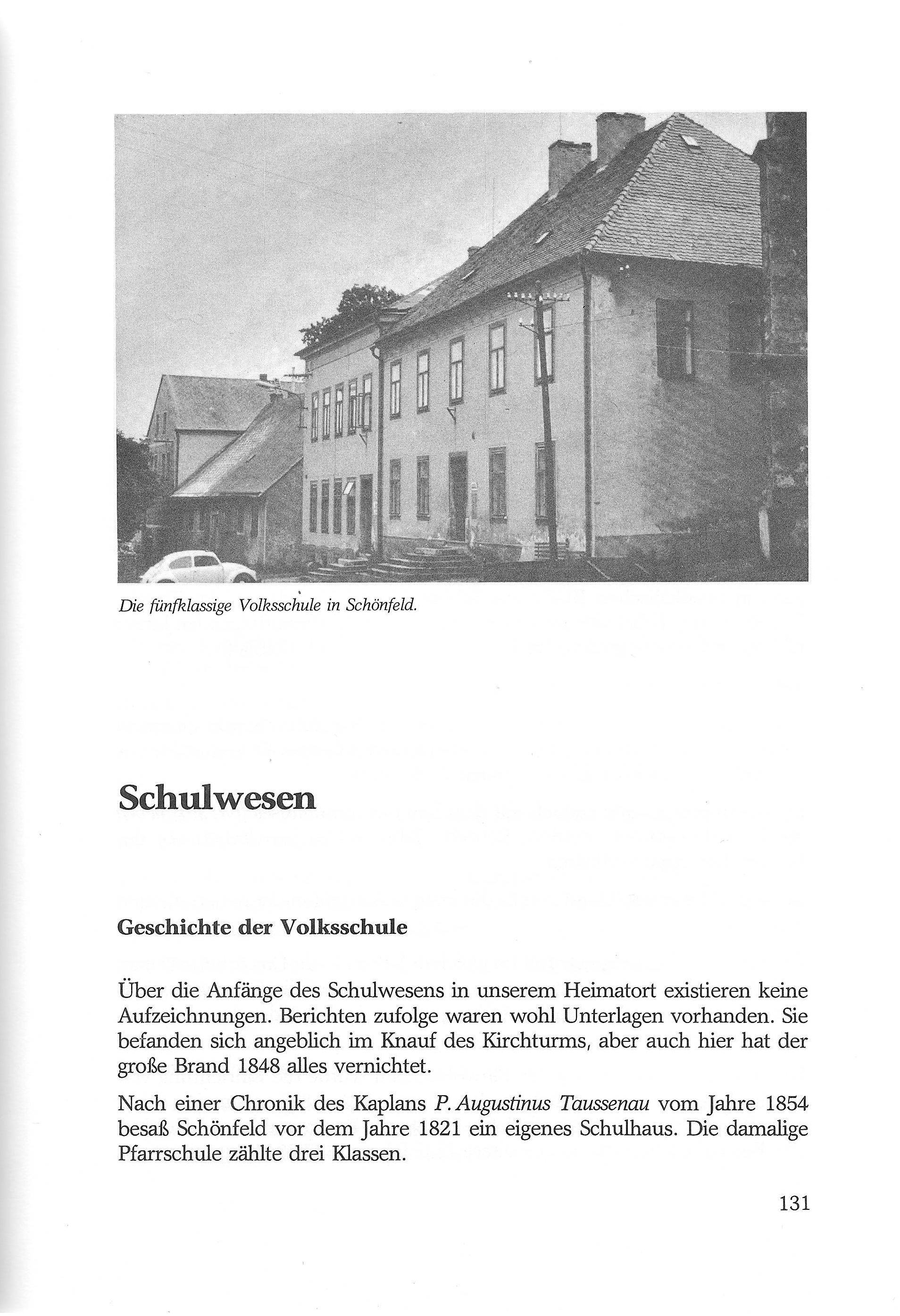 131
The five-class elementary school in Schönfeld.
School system
History of the elementary school
There are no records of the beginnings of the school system in our
hometown. According to reports, there were documents. They were
supposedly in the top of the church tower, but here too the great fire
of 1848 destroyed everything. According to a chronicle by the chaplain
P. Augustinus Taussenau from 1854, Schönfeld had its own school
building before 1821. The parish school at that time had three
classes.
131
131
The five-class elementary school in Schönfeld.
School system
History of the elementary school
There are no records of the beginnings of the school system in our
hometown. According to reports, there were documents. They were
supposedly in the top of the church tower, but here too the great fire
of 1848 destroyed everything. According to a chronicle by the chaplain
P. Augustinus Taussenau from 1854, Schönfeld had its own school
building before 1821. The parish school at that time had three
classes.
131
Page 0131
 132
This building was in a very dilapidated state and was demolished in
1821. A new school building with four classrooms and two living
quarters was built on the same site. The mining office as patron and
the municipality provided a sum of 9652 guilders for this.
Until November 1842, the elementary school had two boys' and one
girls' class, the latter was then divided. The younger girls were
taught by teacher Joharn Ruppert, who was also a watchman. 120 girls
attended the upper class. A fourth teacher was also hired around this
time.
The school building was also destroyed by the flames in the great
fire. School operations were suspended for sixteen weeks. Only when
two rooms in private houses were rented could lessons be continued. In
1852, the school moved to the newly built town hall, where two rooms
could be made available for school purposes.
To rebuild the completely destroyed school library, the then chaplain
Taussenau organized an evening of entertainment at the "Gasthaus zum
Bergmann" on the second day of Christmas 1854, during which there were
recitals and music. As the parish chronicle states, "the finest
musical talent from Schönfeld and the surrounding area" were in action
that evening. The net proceeds amounted to 42 guilders. In June of the
following year, a large consignment of books for the school library
arrived from Vienna.
In 1864, a school chronicle was created.
An unexpected donation arrived in 1865. It came from a brewery
assistant who had died in Girsch, named Johann Gubka. He bequeathed
645 guilders and 74 kreutzers to the elementary school in Schönfeld.
In this year, construction of the school building (No. 391, next to
the church) could finally begin. Seventeen years had passed since the
fire disaster.
At the beginning of October 1865, the first lessons were held in the
newly built
school.
A new elementary school law came into force in the same year. The
school patronage, which had been held by the state until then, was
transferred to the municipality: all efforts by the city council to
get rid of this burden were in vain.
Due to the sharp increase in the number of inhabitants, the
establishment of parallel classes became unavoidable. In the years
1870-1873, three classes of this type were therefore created. A room
had to be rented for the last one. The cramped conditions lasted
another five years. In 1877/78, the
132
132
This building was in a very dilapidated state and was demolished in
1821. A new school building with four classrooms and two living
quarters was built on the same site. The mining office as patron and
the municipality provided a sum of 9652 guilders for this.
Until November 1842, the elementary school had two boys' and one
girls' class, the latter was then divided. The younger girls were
taught by teacher Joharn Ruppert, who was also a watchman. 120 girls
attended the upper class. A fourth teacher was also hired around this
time.
The school building was also destroyed by the flames in the great
fire. School operations were suspended for sixteen weeks. Only when
two rooms in private houses were rented could lessons be continued. In
1852, the school moved to the newly built town hall, where two rooms
could be made available for school purposes.
To rebuild the completely destroyed school library, the then chaplain
Taussenau organized an evening of entertainment at the "Gasthaus zum
Bergmann" on the second day of Christmas 1854, during which there were
recitals and music. As the parish chronicle states, "the finest
musical talent from Schönfeld and the surrounding area" were in action
that evening. The net proceeds amounted to 42 guilders. In June of the
following year, a large consignment of books for the school library
arrived from Vienna.
In 1864, a school chronicle was created.
An unexpected donation arrived in 1865. It came from a brewery
assistant who had died in Girsch, named Johann Gubka. He bequeathed
645 guilders and 74 kreutzers to the elementary school in Schönfeld.
In this year, construction of the school building (No. 391, next to
the church) could finally begin. Seventeen years had passed since the
fire disaster.
At the beginning of October 1865, the first lessons were held in the
newly built
school.
A new elementary school law came into force in the same year. The
school patronage, which had been held by the state until then, was
transferred to the municipality: all efforts by the city council to
get rid of this burden were in vain.
Due to the sharp increase in the number of inhabitants, the
establishment of parallel classes became unavoidable. In the years
1870-1873, three classes of this type were therefore created. A room
had to be rented for the last one. The cramped conditions lasted
another five years. In 1877/78, the
132
Page 0132
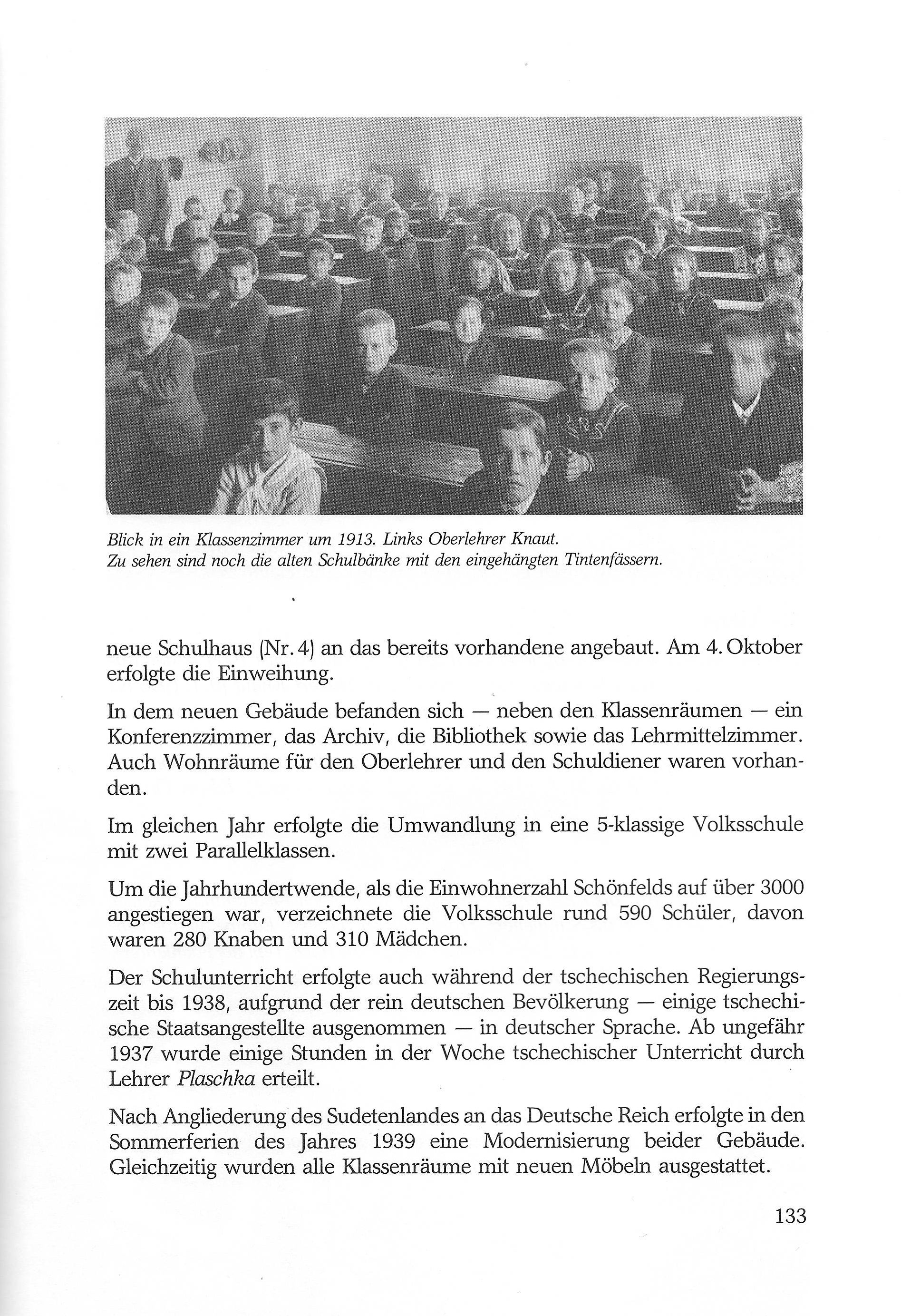 133
View into a classroom around 1913. On the left is senior teacher
Knaut. The old school desks with the inkwells hanging on them can
still be seen.
The new school building (No. 4) was added to the existing one. It was
inaugurated on October 4th.
In addition to the classrooms, the new building contained a conference
room, the archive, the library and the teaching materials room. There
were also living quarters for the senior teacher and the school
janitor.
In the same year, it was converted into a 5-class elementary school
with two parallel classes.
At the turn of the century, when the population of Schönfeld had risen
to over 3000, the elementary school had around 590 students, of which
280 were boys and 310 were girls.
School lessons were also held in German during the Czech government
until 1938, due to the purely German population - with the exception
of some Czech state employees. From around 1937, Czech lessons were
given a few hours a week by teacher Plaschka.
After the Sudetenland was annexed to the German Reich, both buildings
were modernized during the
summer holidays of 1939.
At the same time, all classrooms were equipped with new furniture.
133
133
View into a classroom around 1913. On the left is senior teacher
Knaut. The old school desks with the inkwells hanging on them can
still be seen.
The new school building (No. 4) was added to the existing one. It was
inaugurated on October 4th.
In addition to the classrooms, the new building contained a conference
room, the archive, the library and the teaching materials room. There
were also living quarters for the senior teacher and the school
janitor.
In the same year, it was converted into a 5-class elementary school
with two parallel classes.
At the turn of the century, when the population of Schönfeld had risen
to over 3000, the elementary school had around 590 students, of which
280 were boys and 310 were girls.
School lessons were also held in German during the Czech government
until 1938, due to the purely German population - with the exception
of some Czech state employees. From around 1937, Czech lessons were
given a few hours a week by teacher Plaschka.
After the Sudetenland was annexed to the German Reich, both buildings
were modernized during the
summer holidays of 1939.
At the same time, all classrooms were equipped with new furniture.
133
Page 0133
 134
After the end of the Second World War, our elementary school was
closed on May 8, 1945. In connection with the Schönfeld school system,
it should also be noted that numerous students transferred to the
middle school (after 1938 "secondary school") in Schlaggenwald after
the fourth or fifth grade. Transfer to the secondary school (after
1938 "high school") in Elbogen was less common. Teachers at the
elementary school
The list begins with the head teachers in 1876. There is no data for
the male and female teachers
Senior teacher:
Kart Puschner /October 18761. Josef Bartl (29. 9. 1876 to August 1905,
retired and moved to Schlackenwerthl, Hubert Knaut 19. 1. 1906 until
his death on 18. 5. 1914), Anton Pompl (1. 9. 1917 to 21. 8. 1921, was
previously a senior teacher in Dotterwies!l Friedrich Stum (1. 9. 1924
to 31. 8. 1928, previously a teacher in Schlapgenwald, retired), Franz
Jordan fborn in Schönfeld 1. 9. 1928 to 31. 8. 1938, retired
transferred), Edwin Grünes (September 1, 1938 until the school
closed on May 8, 1945).
Teachers:
Art went to Lanz as senior teacher), Bergauer (went to Oberloha),
Dichler went to Nallesgrün as headmaster), Frank, Geiger, Langer,
Lumpe (retired) Michler, Morawetz, Peter, Franz Pompl (went to Tepl as
specialist teacher Sollner (went to Lauterbach as senior teacher),
Wied Martin Fenderl, Josef Hubl (born in Schönfeld), Oskar Hubl
(brother of Josef, born in Schönfeld), Ott jaus Rabensgrün), Alfred
Plaschka, Friedrich Pompl, Franz Rippl faus Rabens grin
Female teachers:
Schachtner, Marie Prosch, Zoch, Irene Gareiß (from Elbogen), Agnes
Schellhorn (from Schönfeld, June 20, 1939 to December 2, 1939).
134
134
After the end of the Second World War, our elementary school was
closed on May 8, 1945. In connection with the Schönfeld school system,
it should also be noted that numerous students transferred to the
middle school (after 1938 "secondary school") in Schlaggenwald after
the fourth or fifth grade. Transfer to the secondary school (after
1938 "high school") in Elbogen was less common. Teachers at the
elementary school
The list begins with the head teachers in 1876. There is no data for
the male and female teachers
Senior teacher:
Kart Puschner /October 18761. Josef Bartl (29. 9. 1876 to August 1905,
retired and moved to Schlackenwerthl, Hubert Knaut 19. 1. 1906 until
his death on 18. 5. 1914), Anton Pompl (1. 9. 1917 to 21. 8. 1921, was
previously a senior teacher in Dotterwies!l Friedrich Stum (1. 9. 1924
to 31. 8. 1928, previously a teacher in Schlapgenwald, retired), Franz
Jordan fborn in Schönfeld 1. 9. 1928 to 31. 8. 1938, retired
transferred), Edwin Grünes (September 1, 1938 until the school
closed on May 8, 1945).
Teachers:
Art went to Lanz as senior teacher), Bergauer (went to Oberloha),
Dichler went to Nallesgrün as headmaster), Frank, Geiger, Langer,
Lumpe (retired) Michler, Morawetz, Peter, Franz Pompl (went to Tepl as
specialist teacher Sollner (went to Lauterbach as senior teacher),
Wied Martin Fenderl, Josef Hubl (born in Schönfeld), Oskar Hubl
(brother of Josef, born in Schönfeld), Ott jaus Rabensgrün), Alfred
Plaschka, Friedrich Pompl, Franz Rippl faus Rabens grin
Female teachers:
Schachtner, Marie Prosch, Zoch, Irene Gareiß (from Elbogen), Agnes
Schellhorn (from Schönfeld, June 20, 1939 to December 2, 1939).
134
Page 0134
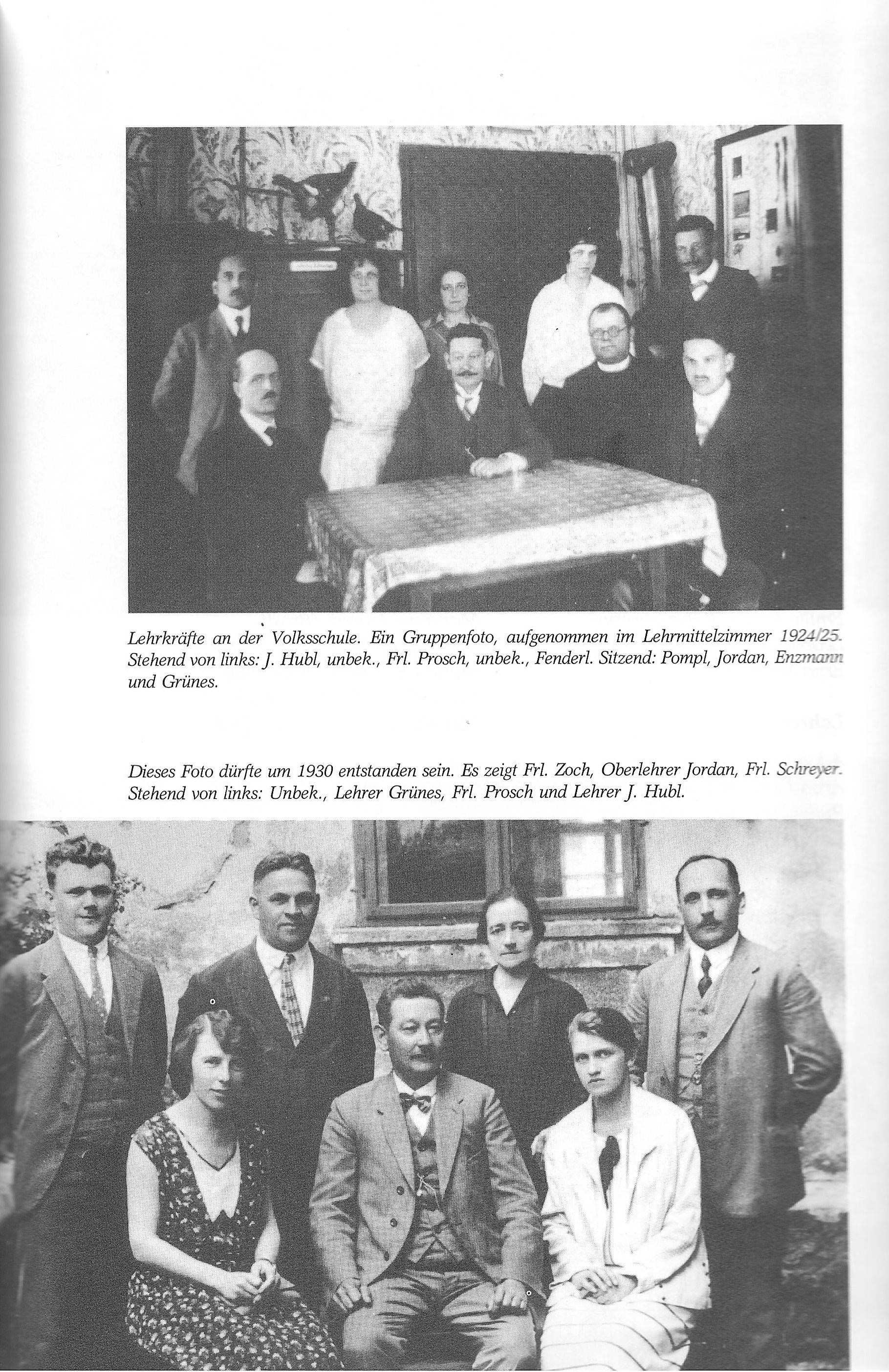 135
Teachers at the elementary school. A group photo taken in the teaching
materials room in 1924/25. Standing from left: J. Hubl, unknown, Miss
Prosch, unknown, Fenderl. Sitting: Pompl, Jordan, Enzmann and
Grünes.
This photo was probably taken around 1930. It shows Miss Zoch, senior
teacher Jordan, Miss Schreyer. Standing from left: unknown, teacher
Grünes, Miss Prosch and teacher J. Hubl.
135
135
Teachers at the elementary school. A group photo taken in the teaching
materials room in 1924/25. Standing from left: J. Hubl, unknown, Miss
Prosch, unknown, Fenderl. Sitting: Pompl, Jordan, Enzmann and
Grünes.
This photo was probably taken around 1930. It shows Miss Zoch, senior
teacher Jordan, Miss Schreyer. Standing from left: unknown, teacher
Grünes, Miss Prosch and teacher J. Hubl.
135
Page 0135
 136
Handicraft teachers:
Gardner, Schreier jaus Bleistadt!, Könler, Ema Pensi verk. Eibi).
At the end of this chapter, the school janitors should be mentioned,
who always ensured order and cleanliness in the school area. These
include: Paradeiser, Franz Wagner (also a club janitor in several
Schonfeld clubs) and after him Erich Klement (son of the bricklayer
foreman Ernst Klement), who was a school janitor until it closed in
1945.
Teachers
who were born in Schönfeld but taught at schools outside of the
school.
Teachers
Emilie Jordan (senior teacher Leopoldine Kern (married Schuiz! Erna
Schmidt
Teachers
Adolf Gareis
Arno Gerstner (head teacher) Rudolf Hubana (head teacher! Erwin
Keßler
Alfred Lockner
Josef Röd
Josef Ruppert
Rudolf Zimmermann (head teacher]
Handicraft teachers
Mariame Gareis (Bros Seina Gareiß Bros!! Marie Schmidt (Hunter's
daughter Eisa Ruß fvermarried Fischer) Hub
Marie Opl (married Roßmeißi
136
136
Handicraft teachers:
Gardner, Schreier jaus Bleistadt!, Könler, Ema Pensi verk. Eibi).
At the end of this chapter, the school janitors should be mentioned,
who always ensured order and cleanliness in the school area. These
include: Paradeiser, Franz Wagner (also a club janitor in several
Schonfeld clubs) and after him Erich Klement (son of the bricklayer
foreman Ernst Klement), who was a school janitor until it closed in
1945.
Teachers
who were born in Schönfeld but taught at schools outside of the
school.
Teachers
Emilie Jordan (senior teacher Leopoldine Kern (married Schuiz! Erna
Schmidt
Teachers
Adolf Gareis
Arno Gerstner (head teacher) Rudolf Hubana (head teacher! Erwin
Keßler
Alfred Lockner
Josef Röd
Josef Ruppert
Rudolf Zimmermann (head teacher]
Handicraft teachers
Mariame Gareis (Bros Seina Gareiß Bros!! Marie Schmidt (Hunter's
daughter Eisa Ruß fvermarried Fischer) Hub
Marie Opl (married Roßmeißi
136
Page 0136
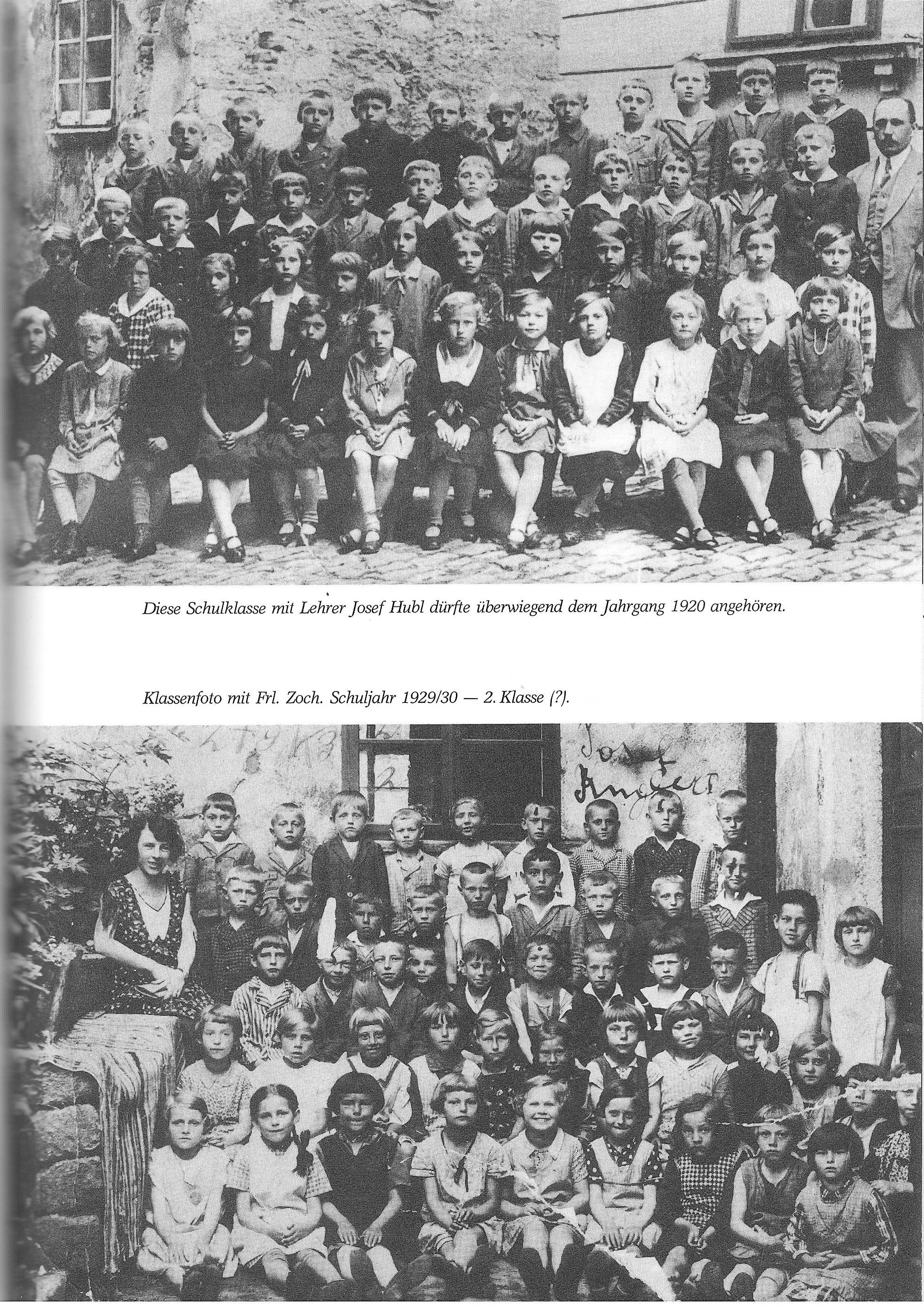 137
This school class with teacher Josef Hubl probably belongs mainly to
the class of 1920.
Class photo with Miss Zoch. School year 1929/30 — 2nd grade (?).
137
137
This school class with teacher Josef Hubl probably belongs mainly to
the class of 1920.
Class photo with Miss Zoch. School year 1929/30 — 2nd grade (?).
137
Page 0137
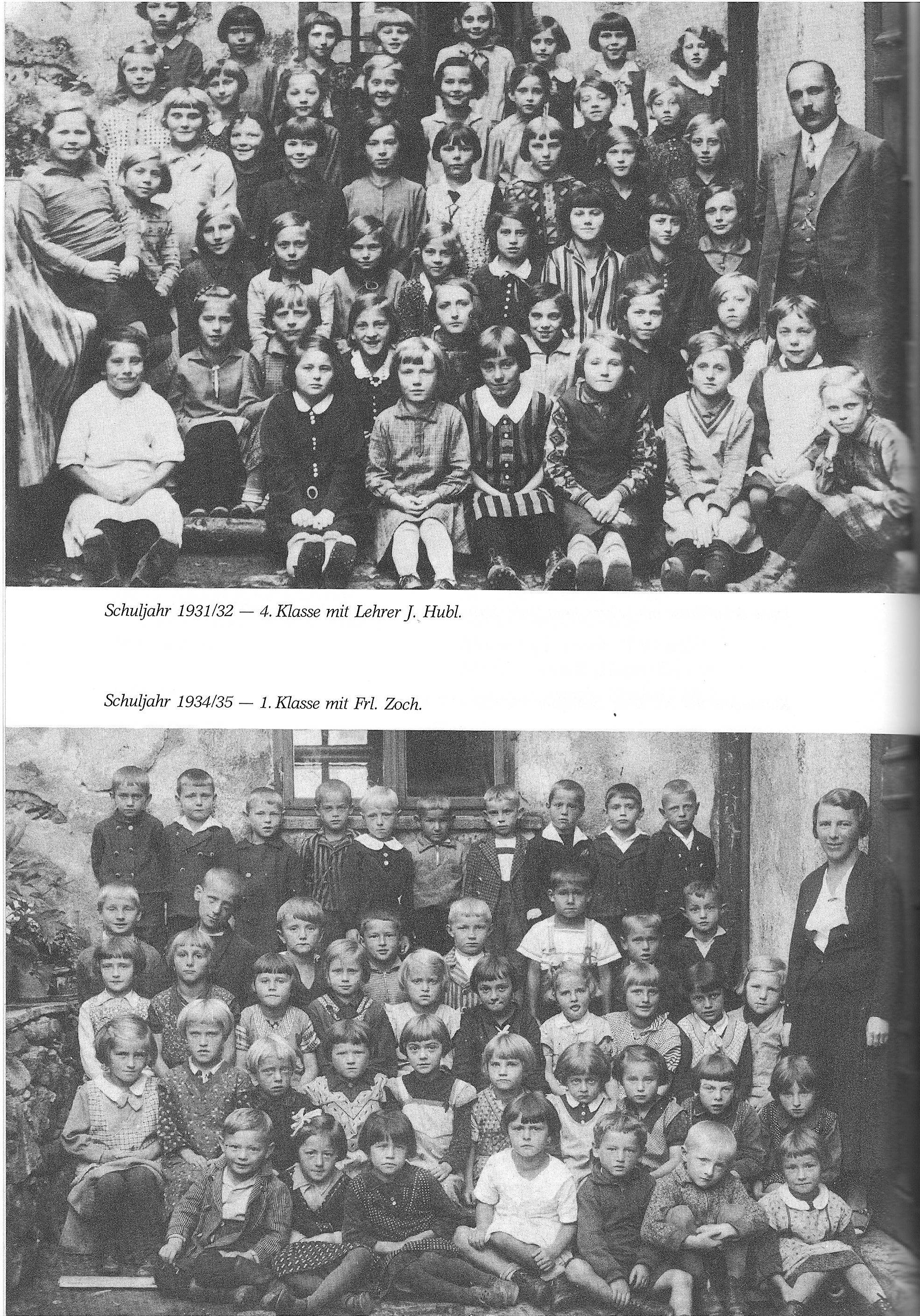 138
School year 1931/32 - 4th grade with teacher J. Hubl.
School year 1934/35 - 1st grade with Miss Zoch.
138
138
School year 1931/32 - 4th grade with teacher J. Hubl.
School year 1934/35 - 1st grade with Miss Zoch.
138
Page 0138
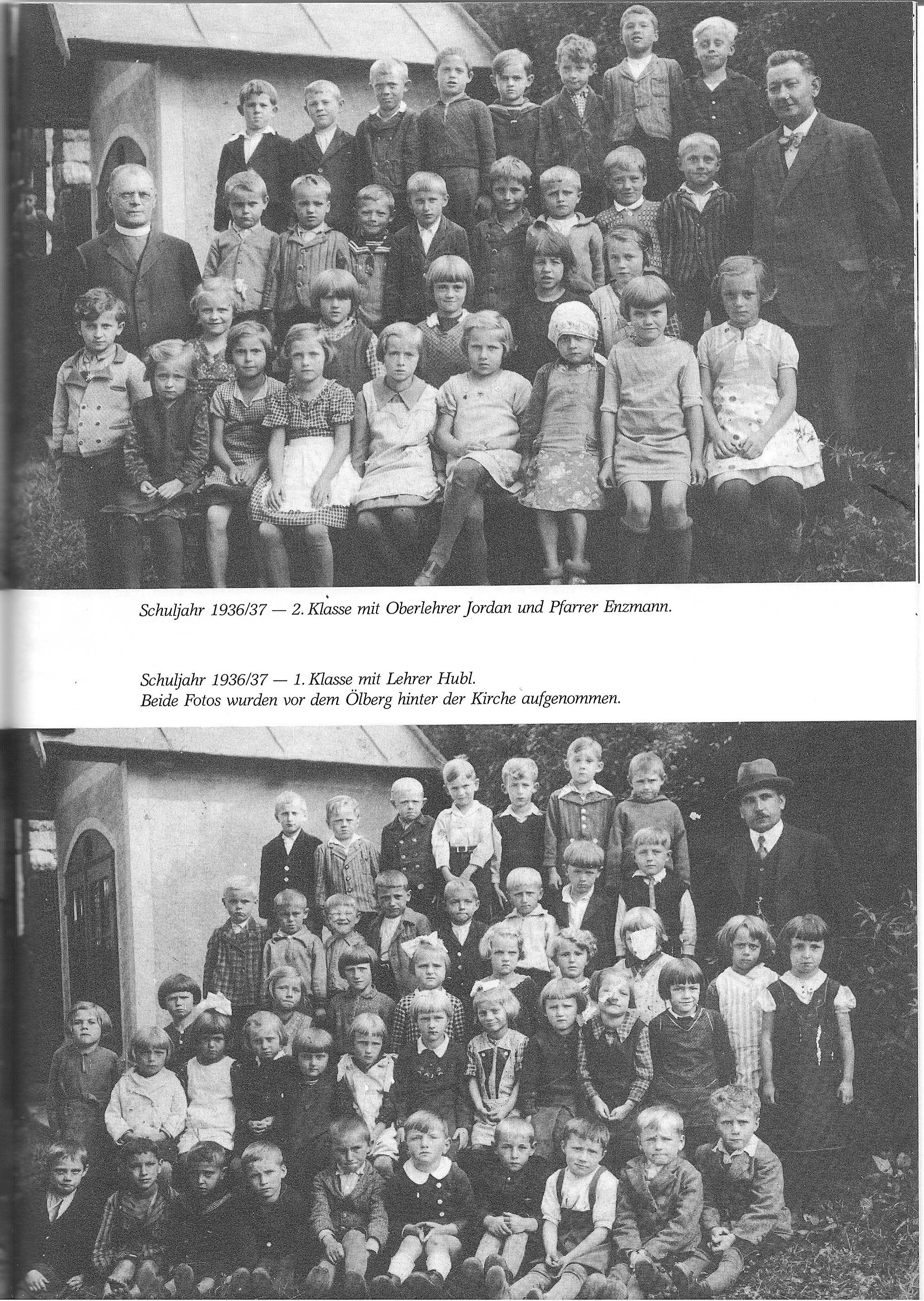 139
School year 1936/37 — 2nd grade with senior teacher Jordan and
pastor Enzmann.
School year 1936/37 —
1st grade with teacher Hubl.
Both photos were taken in front of the Mount of Olives behind the
church.
139
139
School year 1936/37 — 2nd grade with senior teacher Jordan and
pastor Enzmann.
School year 1936/37 —
1st grade with teacher Hubl.
Both photos were taken in front of the Mount of Olives behind the
church.
139
Page 0139
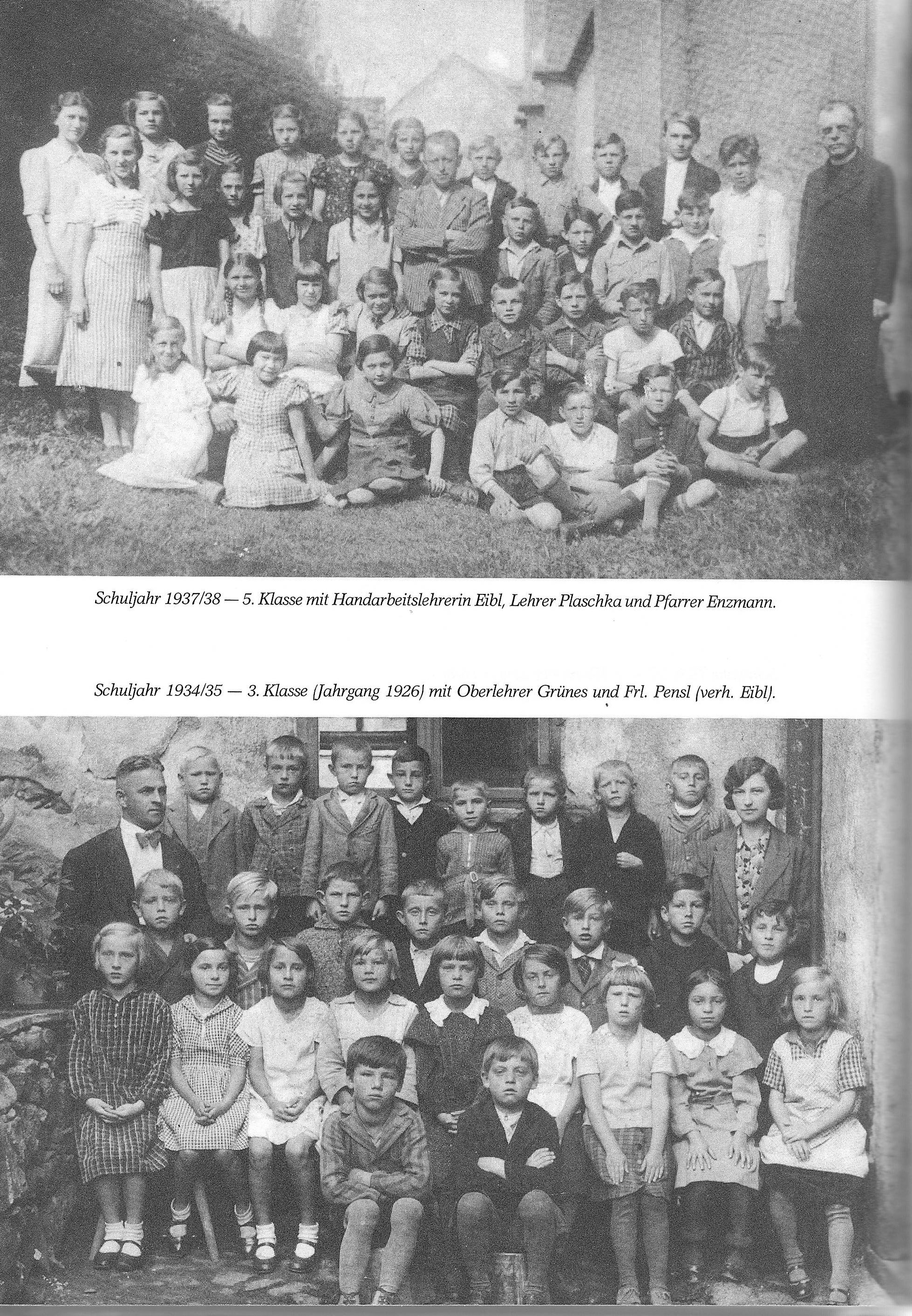 140
School year
1937/38 — 5th grade with needlework teacher Eibl, teacher Plaschka
and pastor Enzmann.
School year 1934/35
3rd grade (class of 1926) with senior teacher Grünes and Miss Pensl
(married Eibl).
140
140
School year
1937/38 — 5th grade with needlework teacher Eibl, teacher Plaschka
and pastor Enzmann.
School year 1934/35
3rd grade (class of 1926) with senior teacher Grünes and Miss Pensl
(married Eibl).
140
Page 0140
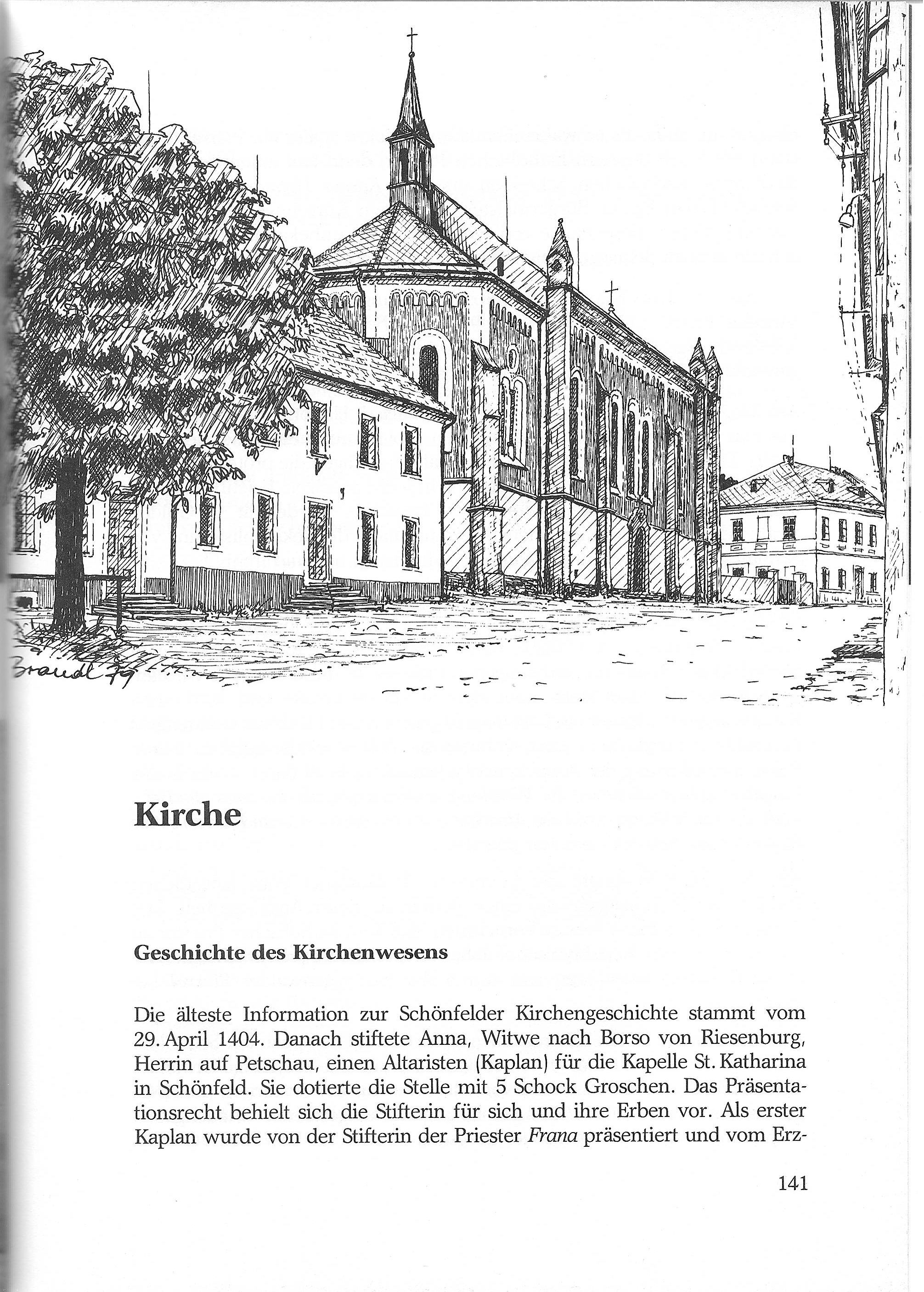 141
History of the Church
The oldest information on the history of the church in Schönfeld dates
from April 29, 1404. According to this, Anna, widow of Borso von
Riesenburg, mistress of Petschau, donated an altarist (chaplain) for
the chapel of St. Katharina in Schönfeld. She endowed the position
with 5 Schock Groschen. The donor reserved the right of presentation
for herself and her heirs. The priest Frana was presented as the first
chaplain by the donor and was appointed by the Archbishop.
141
History of the Church
The oldest information on the history of the church in Schönfeld dates
from April 29, 1404. According to this, Anna, widow of Borso von
Riesenburg, mistress of Petschau, donated an altarist (chaplain) for
the chapel of St. Katharina in Schönfeld. She endowed the position
with 5 Schock Groschen. The donor reserved the right of presentation
for herself and her heirs. The priest Frana was presented as the first
chaplain by the donor and was appointed by the Archbishop.
Page 0141
 142
bishop. It is likely that years later a parish was established with
its own Catholic priest, because according to a letter in the Eger
city archives, Kaspar Hofmann, pastor in Schönfeld, asked the mayor of
Eger to negotiate with a furrier named Wolff. It is unknown when this
parish was established. Before that, Schönfeld was part of the parish
of Schlaggenwald (see Chronicle 1519).
Around 1523, Protestantization began in our area. According to Vincenz
Pröckl's "History of the royal mining towns of Schlaggenwald and
Schönfeld", Eger 1887, a separate parish was founded in Schönfeld in
1550, when Schlaggenwald was separated.
On August 24, 1624, on the orders of the imperial captain Vahel von
Lilienau, the church in Schönfeld was closed to Protestant
worship. The council was instructed to abolish the Protestant
preachers within three days; they were no longer allowed to preach,
hear confessions or baptize. Anyone who visited the Protestant church
was fined 10 guilders. At the same time, the captain ordered the
re-Catholicization of Schönfeld. (The original document was in the
parish archive.)
Schönfeld was temporarily incorporated into the parish of
Schlaggenwald. In 1629 it was again an independent Catholic parish. In
a petition to the Bohemian Court Chamber (4.1.1629), the mayor, judges
and council in Schönfeld request the employment of their own
pastor. In this petition it is stated that the town has always had its
own pastor and a chaplain, for which the emperor had given a
stipend. Since this stipend is no longer being given, they request
that it be given again and that the double forest rent be waived. The
petition then continues: "For no one in the world can say otherwise
than that this old mining town, which is older than Schlaggenwald, has
always had its own pastor, who inhabited the local parish."
On January 12, 1629, the Bohemian Court Chamber demanded a report on
this matter from the imperial captain in Schlaggenwald. The answer of
February 2 stated that no Catholic priest was available and that the
Archbishop had therefore brought the three towns (presumably including
Lauterbach) together and had them looked after by the Schlaggenwald
pastor.
In his letter, Captain T. Walzel von Lilienkron doubted the right to a
parish office, citing a 150-year-old document according to which the
church in Schönfeld had only been an oratory (prayer house) from
ancient times. He recommended the reinstatement of the grace gifts
that had been suspended because of the mining town's poverty.
142
bishop. It is likely that years later a parish was established with
its own Catholic priest, because according to a letter in the Eger
city archives, Kaspar Hofmann, pastor in Schönfeld, asked the mayor of
Eger to negotiate with a furrier named Wolff. It is unknown when this
parish was established. Before that, Schönfeld was part of the parish
of Schlaggenwald (see Chronicle 1519).
Around 1523, Protestantization began in our area. According to Vincenz
Pröckl's "History of the royal mining towns of Schlaggenwald and
Schönfeld", Eger 1887, a separate parish was founded in Schönfeld in
1550, when Schlaggenwald was separated.
On August 24, 1624, on the orders of the imperial captain Vahel von
Lilienau, the church in Schönfeld was closed to Protestant
worship. The council was instructed to abolish the Protestant
preachers within three days; they were no longer allowed to preach,
hear confessions or baptize. Anyone who visited the Protestant church
was fined 10 guilders. At the same time, the captain ordered the
re-Catholicization of Schönfeld. (The original document was in the
parish archive.)
Schönfeld was temporarily incorporated into the parish of
Schlaggenwald. In 1629 it was again an independent Catholic parish. In
a petition to the Bohemian Court Chamber (4.1.1629), the mayor, judges
and council in Schönfeld request the employment of their own
pastor. In this petition it is stated that the town has always had its
own pastor and a chaplain, for which the emperor had given a
stipend. Since this stipend is no longer being given, they request
that it be given again and that the double forest rent be waived. The
petition then continues: "For no one in the world can say otherwise
than that this old mining town, which is older than Schlaggenwald, has
always had its own pastor, who inhabited the local parish."
On January 12, 1629, the Bohemian Court Chamber demanded a report on
this matter from the imperial captain in Schlaggenwald. The answer of
February 2 stated that no Catholic priest was available and that the
Archbishop had therefore brought the three towns (presumably including
Lauterbach) together and had them looked after by the Schlaggenwald
pastor.
In his letter, Captain T. Walzel von Lilienkron doubted the right to a
parish office, citing a 150-year-old document according to which the
church in Schönfeld had only been an oratory (prayer house) from
ancient times. He recommended the reinstatement of the grace gifts
that had been suspended because of the mining town's poverty.
Page 0142
 143
According to a letter from the Bohemian Court Chamber, written in
Prague on March 1, 1629, the archbishopric granted the Schönfeld
residents a priest.
The chronicle provides the following information about the financial
and asset situation of the church and parish in 1722:
At that time, it owned five day's work of land, 6 lines of cornfields,
2 cows and 3 head of young cattle.
The priest received three guilders a week from the community, but
often he received nothing because of the town's great poverty. He
received an adjutant's allowance from the state out of grace, namely
12 guilders 30 kreutzers quarterly, but often this money was not paid
to him. He received 20 guilders annually from mass donations. The
priest had the right to a brew, but due to poverty he was often unable
to have it brewed.
In that year, the magistrate owed the parish church 523 guilders in
capital and 561 guilders in arrears in interest. These debts were
forgiven by the archbishop because of the great poverty of the
community.
The parish church had a capital of 3090 guilders at that time,
invested in mortgages from the citizens of Schönfeld. The money was
lent to 74 debtors at 5%. The interest income was used for general
church expenses and for building purposes.
At this time, a major change occurred in the church life of Schönfeld,
because on October 19, 1723, the miraculous statue of the Mother of
God was declared to be blessed by the princely archbishop's consistory
in Prague. Schönfeld soon became a well-visited place of
pilgrimage. At the end of the 18th century, however, the flow of
pilgrims dropped sharply. The so-called "Marian Cash" - created from
pilgrimage funds, which in 1774 had a convention coin of 9030
guilders, was merged with the church treasury; only then did the
parish church acquire its own assets. However, the financial patent,
which was issued on March 1, 1811, resulted in an enormous
devaluation. 100 guilders became just 20; the wars with France were to
blame for this.
In 1784, the government sent a survey to the mining towns asking
whether they wanted to take over the patronage of the church and
parish. A number of mining towns, such as Kuttenberg, Budweis,
St. Joachimsthal, Abertham, Weipert, Schlaggenwald, P?ibram, Neuknyn,
Eule, Bergreichenstein and Preßnitz, took over the patronage rights
with all rights and obligations.
Other mining towns, however, such as Gang, Platten, Gottesgab,
Wiesenthal, Lauterbach, Unterreichenstein, Bergstädtl and Schönfeld
asked to be exempted from this obligation in the future.
143
According to a letter from the Bohemian Court Chamber, written in
Prague on March 1, 1629, the archbishopric granted the Schönfeld
residents a priest.
The chronicle provides the following information about the financial
and asset situation of the church and parish in 1722:
At that time, it owned five day's work of land, 6 lines of cornfields,
2 cows and 3 head of young cattle.
The priest received three guilders a week from the community, but
often he received nothing because of the town's great poverty. He
received an adjutant's allowance from the state out of grace, namely
12 guilders 30 kreutzers quarterly, but often this money was not paid
to him. He received 20 guilders annually from mass donations. The
priest had the right to a brew, but due to poverty he was often unable
to have it brewed.
In that year, the magistrate owed the parish church 523 guilders in
capital and 561 guilders in arrears in interest. These debts were
forgiven by the archbishop because of the great poverty of the
community.
The parish church had a capital of 3090 guilders at that time,
invested in mortgages from the citizens of Schönfeld. The money was
lent to 74 debtors at 5%. The interest income was used for general
church expenses and for building purposes.
At this time, a major change occurred in the church life of Schönfeld,
because on October 19, 1723, the miraculous statue of the Mother of
God was declared to be blessed by the princely archbishop's consistory
in Prague. Schönfeld soon became a well-visited place of
pilgrimage. At the end of the 18th century, however, the flow of
pilgrims dropped sharply. The so-called "Marian Cash" - created from
pilgrimage funds, which in 1774 had a convention coin of 9030
guilders, was merged with the church treasury; only then did the
parish church acquire its own assets. However, the financial patent,
which was issued on March 1, 1811, resulted in an enormous
devaluation. 100 guilders became just 20; the wars with France were to
blame for this.
In 1784, the government sent a survey to the mining towns asking
whether they wanted to take over the patronage of the church and
parish. A number of mining towns, such as Kuttenberg, Budweis,
St. Joachimsthal, Abertham, Weipert, Schlaggenwald, P?ibram, Neuknyn,
Eule, Bergreichenstein and Preßnitz, took over the patronage rights
with all rights and obligations.
Other mining towns, however, such as Gang, Platten, Gottesgab,
Wiesenthal, Lauterbach, Unterreichenstein, Bergstädtl and Schönfeld
asked to be exempted from this obligation in the future.
Page 0143
 144
The Imperial and Royal Mining Authority took over the patronage of
these last-mentioned mining towns.
This was announced to the Imperial and Royal State Government in
Prague for further use and observance by a resolution of the highest
order on January 3, 1785.
Schönfeld was therefore a so-called mining patronage parish for
centuries, i.e. the patronage was held by the highest mining
authority. Later the patronage passed to the Ministry of Agriculture,
then to the religious budget, and then to the religious fund.
The Schönfeld parish belonged to the Lichtenstadt vicariate for
centuries. From January 1, 1850 to December 31, 1930 the Theusing
vicariate was the superior authority. Then, from January 1, 1931,
Schönfeld was affiliated to the Falkenau vicariate.
Of the approximately 2100 inhabitants of our hometown, about 98% were
Catholic at that time.
The pastor at the time, archbishop consistory councilor and notary
Karl Enzmann, was also the district vicar of the Falkenau vicariate.
Schönfel Parish Office
??z Elbogen
144
The Imperial and Royal Mining Authority took over the patronage of
these last-mentioned mining towns.
This was announced to the Imperial and Royal State Government in
Prague for further use and observance by a resolution of the highest
order on January 3, 1785.
Schönfeld was therefore a so-called mining patronage parish for
centuries, i.e. the patronage was held by the highest mining
authority. Later the patronage passed to the Ministry of Agriculture,
then to the religious budget, and then to the religious fund.
The Schönfeld parish belonged to the Lichtenstadt vicariate for
centuries. From January 1, 1850 to December 31, 1930 the Theusing
vicariate was the superior authority. Then, from January 1, 1931,
Schönfeld was affiliated to the Falkenau vicariate.
Of the approximately 2100 inhabitants of our hometown, about 98% were
Catholic at that time.
The pastor at the time, archbishop consistory councilor and notary
Karl Enzmann, was also the district vicar of the Falkenau vicariate.
Schönfel Parish Office
??z Elbogen
Page 0144
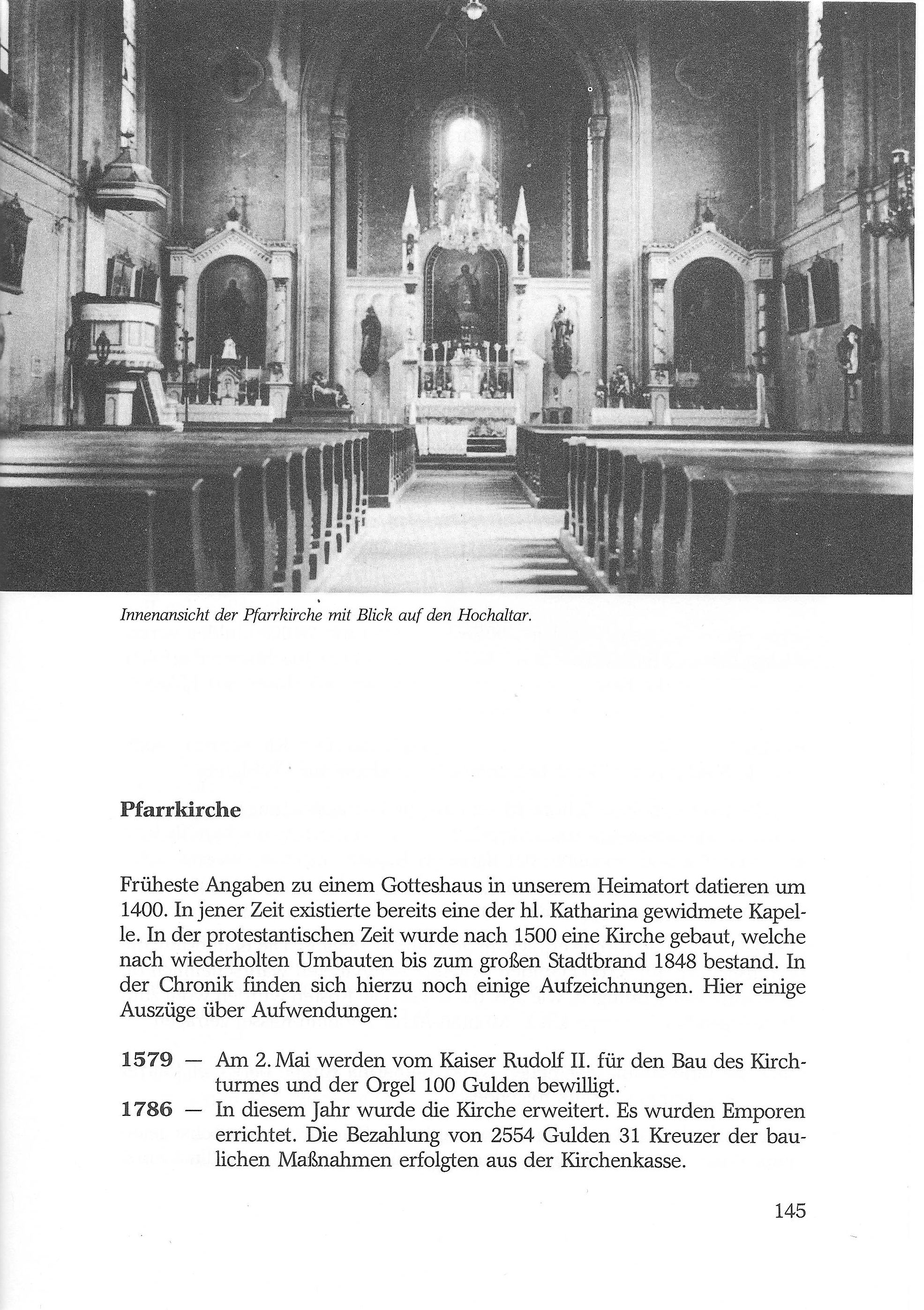 145
Interior view of the parish church with a view of the high altar.
The earliest information about a place of worship in our hometown
dates back to around 1400. At that time, a chapel dedicated to
St. Catherine already existed. In the Protestant period, a church was
built after 1500, which, after repeated renovations, stood until the
great town fire in 1848. There are still some records of this in the
chronicle. Here are some excerpts about expenses:
1579 On May 2, Emperor Rudolf II approved 100 guilders for the
construction of the church tower and the organ.
1786 In this year, the church was expanded. Galleries were built. The
construction work cost 2,554 guilders and 31 kreuzers and was paid for
from the church treasury.
145
Interior view of the parish church with a view of the high altar.
The earliest information about a place of worship in our hometown
dates back to around 1400. At that time, a chapel dedicated to
St. Catherine already existed. In the Protestant period, a church was
built after 1500, which, after repeated renovations, stood until the
great town fire in 1848. There are still some records of this in the
chronicle. Here are some excerpts about expenses:
1579 On May 2, Emperor Rudolf II approved 100 guilders for the
construction of the church tower and the organ.
1786 In this year, the church was expanded. Galleries were built. The
construction work cost 2,554 guilders and 31 kreuzers and was paid for
from the church treasury.
Page 0145
 146
1787 The high altar was rebuilt. The upper part of the altar was made
by Father Pleyer, an ex-Jesuit. The lower part was paid for by
pilgrims from Eger. The old high altar was brought to the church of
the dead in Elbogen. Chaplain Georg Frank had part of the church floor
paved with cobblestones at his own expense; the costs amounted to 322
guilders. 1843
On July 7, 1848, the church, including the rectory, fell victim to a
great fire. The service then took place on the market square, near the
statue of St. Anthony, until All Saints Day. When the weather became
unfavorable, people gathered in the vestibule of the church ruins to
pray. Later, the mining authority had a temporary roof built over the
remains of the church walls, at a cost of 800 guilders. A pulpit and
an altar were built.
Although the consistory promised a new building, it was never
realized. A building plan that was submitted was rejected as
unsuitable, a second one was deemed too expensive. In 1854, it was
again said that the burned-down church should only be repaired.
On January 29, 1856, the Ministry of Culture in Vienna finally
approved the construction of a new church. The construction costs were
estimated at 28,000 guilders. In the office of the Imperial and Royal
Mining Authority in St. Joachimsthal, the construction contract was
awarded to the master builder Scherbaum from Elbogen on May 24,
1856. His offer was 26,967 guilders.
The last service took place in the old church ruins on May 26, 1856,
after which premises in the town hall were available.
In order to help the town of Schönfeld, which was legally obliged to
contribute to the construction of the new church, in its poverty, the
then chaplain Augustin Tausenau wrote and sent numerous letters of
petition to external agencies and private individuals; his efforts
brought in a sum of 2934 guilders.
The new church was built in 1858/59. The construction costs, which
totaled 33,000 guilders, probably included various interior fittings,
such as the organ. The costs were probably largely borne by the
k.u.k. Montan-Aerar (Mining Fund).
Pastor Enzmann reports the following about the inauguration of the new
St. Catherine's Church in his chronicle:
"On October 2, 1859, the newly built parish church was consecrated in
a very solemn manner by His Eminence, the Most Reverend Cardinal
Fürst.
146
1787 The high altar was rebuilt. The upper part of the altar was made
by Father Pleyer, an ex-Jesuit. The lower part was paid for by
pilgrims from Eger. The old high altar was brought to the church of
the dead in Elbogen. Chaplain Georg Frank had part of the church floor
paved with cobblestones at his own expense; the costs amounted to 322
guilders. 1843
On July 7, 1848, the church, including the rectory, fell victim to a
great fire. The service then took place on the market square, near the
statue of St. Anthony, until All Saints Day. When the weather became
unfavorable, people gathered in the vestibule of the church ruins to
pray. Later, the mining authority had a temporary roof built over the
remains of the church walls, at a cost of 800 guilders. A pulpit and
an altar were built.
Although the consistory promised a new building, it was never
realized. A building plan that was submitted was rejected as
unsuitable, a second one was deemed too expensive. In 1854, it was
again said that the burned-down church should only be repaired.
On January 29, 1856, the Ministry of Culture in Vienna finally
approved the construction of a new church. The construction costs were
estimated at 28,000 guilders. In the office of the Imperial and Royal
Mining Authority in St. Joachimsthal, the construction contract was
awarded to the master builder Scherbaum from Elbogen on May 24,
1856. His offer was 26,967 guilders.
The last service took place in the old church ruins on May 26, 1856,
after which premises in the town hall were available.
In order to help the town of Schönfeld, which was legally obliged to
contribute to the construction of the new church, in its poverty, the
then chaplain Augustin Tausenau wrote and sent numerous letters of
petition to external agencies and private individuals; his efforts
brought in a sum of 2934 guilders.
The new church was built in 1858/59. The construction costs, which
totaled 33,000 guilders, probably included various interior fittings,
such as the organ. The costs were probably largely borne by the
k.u.k. Montan-Aerar (Mining Fund).
Pastor Enzmann reports the following about the inauguration of the new
St. Catherine's Church in his chronicle:
"On October 2, 1859, the newly built parish church was consecrated in
a very solemn manner by His Eminence, the Most Reverend Cardinal
Fürst.
Page 0146
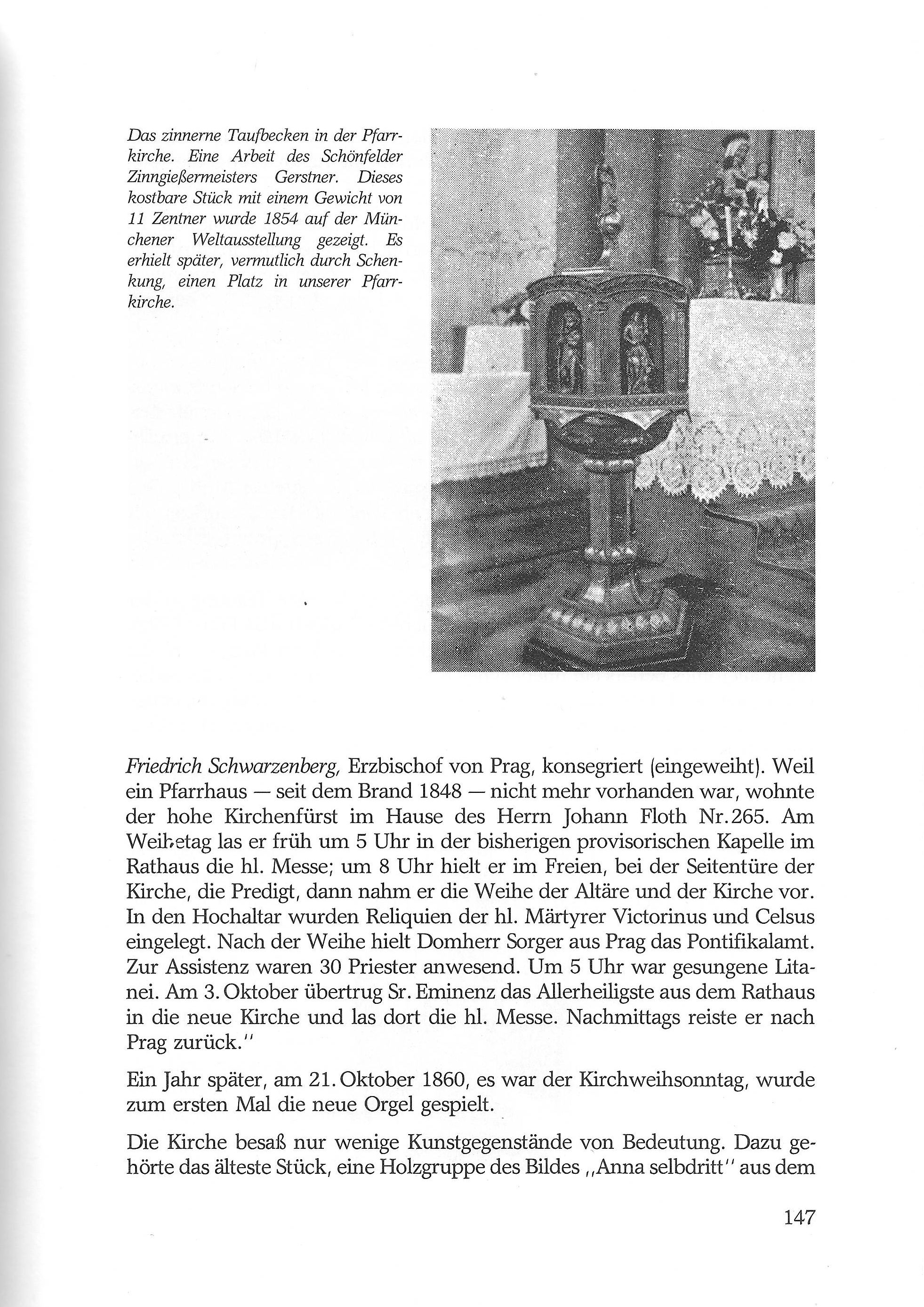 147
The pewter baptismal font in the parish church. A work by the
Schönfeld pewter master Gerstner. This precious piece, weighing 11
hundredweight, was shown at the Munich World Exhibition in 1854. It
was later given a place in our parish church, probably through a
donation.
Friedrich Schwarzenberg, Archbishop of Prague, consecrated. Since
there was no longer a rectory - since the fire in 1848 - the high
prince of the church lived in the house of Mr. Johann Floth at
No. 265. On the day of the consecration, he read Holy Mass at 5
a.m. in the temporary chapel in the town hall; at 8 a.m. he held the
sermon outside, by the side door of the church, then he consecrated
the altars and the church. Relics of the holy martyrs Victorinus and
Celsus were placed in the high altar. After the consecration, Canon
Sorger from Prague held the pontifical mass. 30 priests were present
to assist. At 5 o'clock there was a sung litany. On October 3rd, His
Eminence transferred the Blessed Sacrament from the town hall to the
new church and read the Holy Mass there. In the afternoon he travelled
back to Prague."
One year later, on October 21st, 1860, which was the church
consecration Sunday, the new organ was played for the first time.
The church had only a few works of art of importance. These included
the oldest piece, a wooden group of the picture "St. Anne's Third"
from the
147
The pewter baptismal font in the parish church. A work by the
Schönfeld pewter master Gerstner. This precious piece, weighing 11
hundredweight, was shown at the Munich World Exhibition in 1854. It
was later given a place in our parish church, probably through a
donation.
Friedrich Schwarzenberg, Archbishop of Prague, consecrated. Since
there was no longer a rectory - since the fire in 1848 - the high
prince of the church lived in the house of Mr. Johann Floth at
No. 265. On the day of the consecration, he read Holy Mass at 5
a.m. in the temporary chapel in the town hall; at 8 a.m. he held the
sermon outside, by the side door of the church, then he consecrated
the altars and the church. Relics of the holy martyrs Victorinus and
Celsus were placed in the high altar. After the consecration, Canon
Sorger from Prague held the pontifical mass. 30 priests were present
to assist. At 5 o'clock there was a sung litany. On October 3rd, His
Eminence transferred the Blessed Sacrament from the town hall to the
new church and read the Holy Mass there. In the afternoon he travelled
back to Prague."
One year later, on October 21st, 1860, which was the church
consecration Sunday, the new organ was played for the first time.
The church had only a few works of art of importance. These included
the oldest piece, a wooden group of the picture "St. Anne's Third"
from the
Page 0147
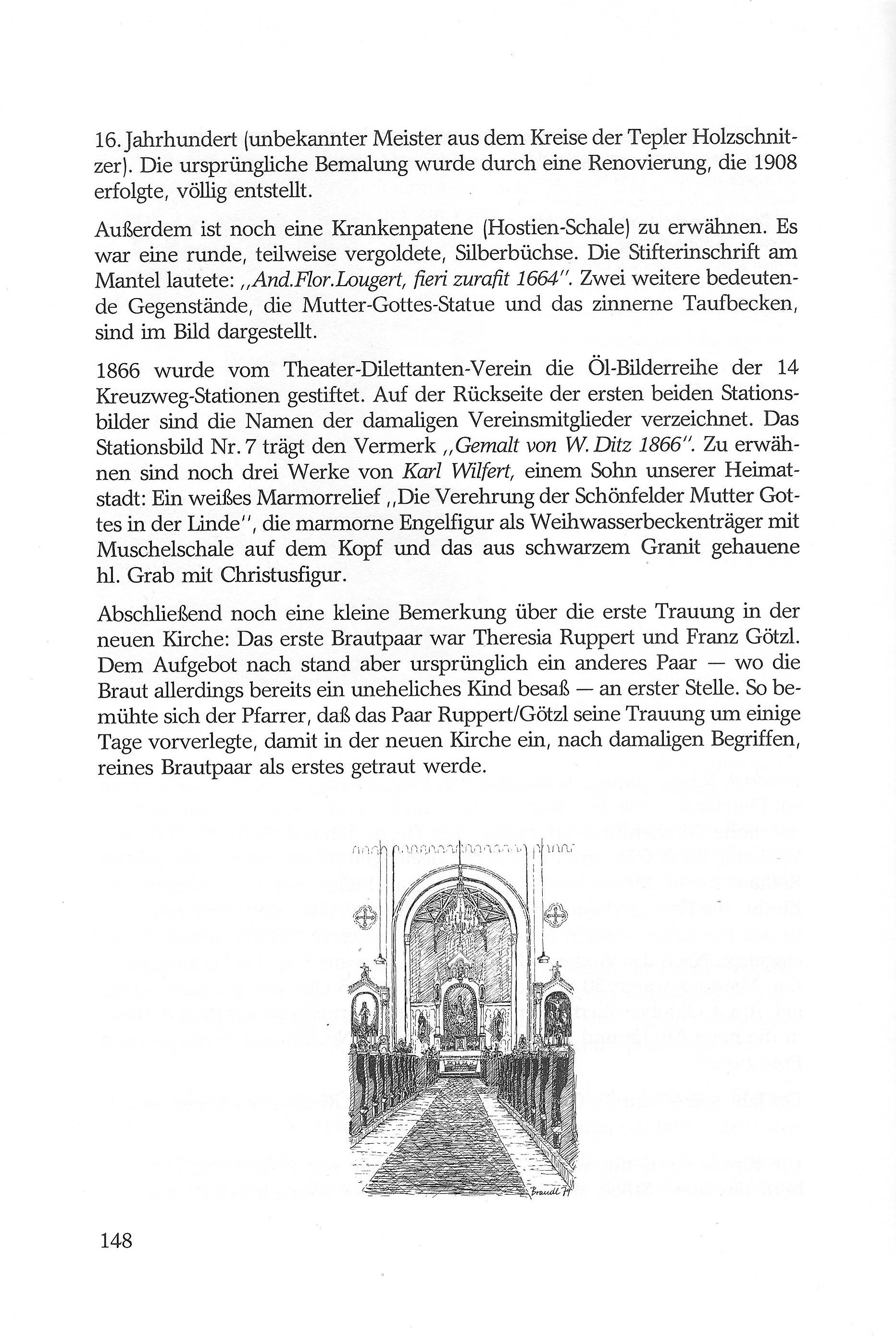 148
16th century (unknown master from the circle of Tepler
woodcarvers). The original painting was completely disfigured by a
renovation that took place in 1908.
A paten (host bowl) is also worth mentioning. It was a round,
partially gold-plated silver box. The donor's inscription on the
mantle read: "And. Flor. Lougert, fieri zurafit 1664". Two other
important objects, the statue of the Mother of God and the pewter
baptismal font, are shown in the picture.
In 1866, the Theater Amateurs' Association donated the series of oil
paintings of the 14 Stations of the Cross. The names of the
association's members at the time are listed on the back of the first
two station paintings. Station painting no. 7 bears the note "Painted
by W. Ditz 1866". Three works by Karl Wilfert, a son of our home town,
are also worth mentioning: a white marble relief, "The Adoration of
the Schönfeld Mother of God in the Linden Tree", the marble angel
figure carrying a holy water font with a mussel shell on its head, and
the holy grave carved from black granite with a figure of Christ.
Finally, a small note about the first wedding in the new church: the
first couple were Theresia Ruppert and Franz Götzl. According to the
banns, another couple was originally in first place, although the
bride already had an illegitimate child. So the priest tried to get
the Ruppert/Götzl couple to bring their wedding forward by a few days
so that a pure couple, according to the concepts of the time, would be
the first to be married in the new church.
148
16th century (unknown master from the circle of Tepler
woodcarvers). The original painting was completely disfigured by a
renovation that took place in 1908.
A paten (host bowl) is also worth mentioning. It was a round,
partially gold-plated silver box. The donor's inscription on the
mantle read: "And. Flor. Lougert, fieri zurafit 1664". Two other
important objects, the statue of the Mother of God and the pewter
baptismal font, are shown in the picture.
In 1866, the Theater Amateurs' Association donated the series of oil
paintings of the 14 Stations of the Cross. The names of the
association's members at the time are listed on the back of the first
two station paintings. Station painting no. 7 bears the note "Painted
by W. Ditz 1866". Three works by Karl Wilfert, a son of our home town,
are also worth mentioning: a white marble relief, "The Adoration of
the Schönfeld Mother of God in the Linden Tree", the marble angel
figure carrying a holy water font with a mussel shell on its head, and
the holy grave carved from black granite with a figure of Christ.
Finally, a small note about the first wedding in the new church: the
first couple were Theresia Ruppert and Franz Götzl. According to the
banns, another couple was originally in first place, although the
bride already had an illegitimate child. So the priest tried to get
the Ruppert/Götzl couple to bring their wedding forward by a few days
so that a pure couple, according to the concepts of the time, would be
the first to be married in the new church.
Page 0148
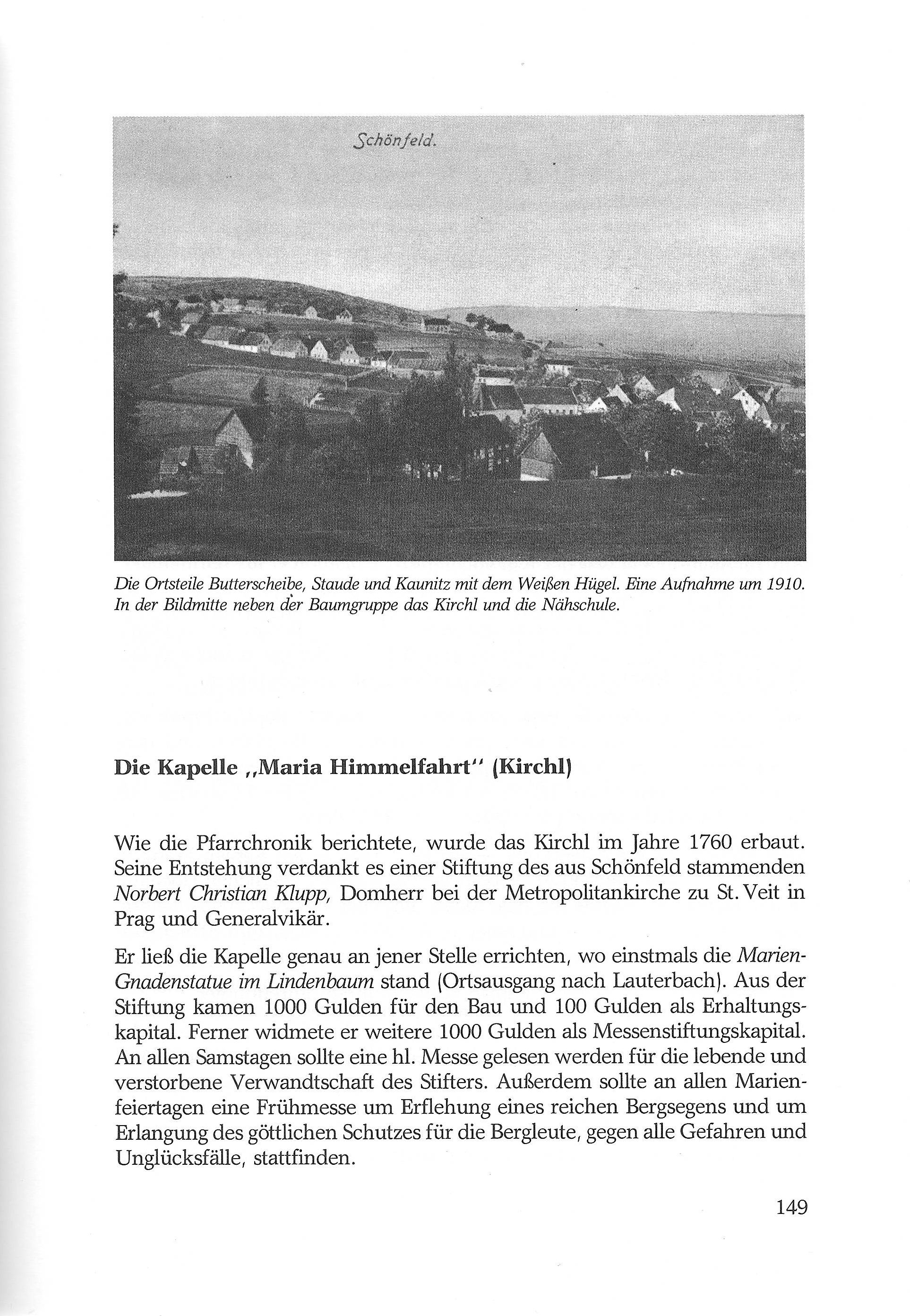 149
The districts of Butterscheibe, Staude and Kaunitz with the White
Hill. A photo taken around 1910. In the middle of the picture next to
the group of trees is the church and the sewing school.
The Chapel of the Assumption of Mary (Kirchl)
As the parish chronicle reports, the little church was built in
1760. It owes its existence to a donation from Norbert Christian
Klupp, a native of Schönfeld, canon at the Metropolitan Church of
St. Veit in Prague and vicar general.
He had the chapel built on the exact spot where the statue of the
Virgin Mary once stood in the linden tree (at the exit to
Lauterbach). The donation provided 1,000 guilders for the construction
and 100 guilders as maintenance capital. He also donated another 1,000
guilders as mass foundation capital. A holy mass was to be read every
Saturday for the living and deceased relatives of the founder. In
addition, an early mass was to be held on all Marian feast days to
implore a rich blessing from the mountains and to obtain divine
protection for the miners against all dangers and misfortunes.
149
The districts of Butterscheibe, Staude and Kaunitz with the White
Hill. A photo taken around 1910. In the middle of the picture next to
the group of trees is the church and the sewing school.
The Chapel of the Assumption of Mary (Kirchl)
As the parish chronicle reports, the little church was built in
1760. It owes its existence to a donation from Norbert Christian
Klupp, a native of Schönfeld, canon at the Metropolitan Church of
St. Veit in Prague and vicar general.
He had the chapel built on the exact spot where the statue of the
Virgin Mary once stood in the linden tree (at the exit to
Lauterbach). The donation provided 1,000 guilders for the construction
and 100 guilders as maintenance capital. He also donated another 1,000
guilders as mass foundation capital. A holy mass was to be read every
Saturday for the living and deceased relatives of the founder. In
addition, an early mass was to be held on all Marian feast days to
implore a rich blessing from the mountains and to obtain divine
protection for the miners against all dangers and misfortunes.
Page 0149
 150
The founder himself did not live to see the completion of his plan, as
he died in 1758. However, his cousin Johann Andreas Klupp and his
brother-in-law Norbert Benedikt Zickler, as well as the local pastor,
arranged the construction according to his wishes. After completion,
the statue of grace was brought from the parish church to the newly
built chapel. The statue of Mary was thus returned to its original
location, but now in a different frame than before.
Almost 80 years later - in 1837 - the church was officially closed due
to dilapidation. The statue of grace was brought back to the parish
church. The altar stone was first kept in the rectory and later taken
to Prague.
In 1843, the chapel was publicly auctioned for demolition. The then
chaplain in Schönfeld, Georg Frank, bought it with the highest bid for
197 guilders and 42 1/2 kreuzers. He had the church converted into a
poorhouse at his own expense. The cost - recorded in detail in the
parish chronicle - amounted to 989 guilders.
The building was completed on August 15, 1844.
Chaplain Frank had many worries during the construction phase, most of
them financial. His brother Anton Frank was a great support to him,
selflessly putting his labor to good use. Some of the town's citizens
occasionally made free donations.
With a deed of gift dated April 28, 1845, Chaplain Frank bequeathed
the poorhouse to the town, with all the equipment and the bell. In
accordance with his wishes, the poor of Schönfeld were to be housed in
this poorhouse free of charge for life. The donor donated another 200
guilders as maintenance capital.
One week before the donation on April 19, 1845, Chaplain Frank fed 30
poor people in the new poorhouse. After a solemn high mass
in the parish church, the noble man was led to the poorhouse,
accompanied by two poor fathers,
by the city magistrate and a large crowd. The poor cried tears of joy,
so it is reported.
The town of Schönfeld made chaplain Frank its honorary citizen.
The church served as a poorhouse until we were expelled. One of the
last inmates was, among others, the well-known judge Rudl.
150
The founder himself did not live to see the completion of his plan, as
he died in 1758. However, his cousin Johann Andreas Klupp and his
brother-in-law Norbert Benedikt Zickler, as well as the local pastor,
arranged the construction according to his wishes. After completion,
the statue of grace was brought from the parish church to the newly
built chapel. The statue of Mary was thus returned to its original
location, but now in a different frame than before.
Almost 80 years later - in 1837 - the church was officially closed due
to dilapidation. The statue of grace was brought back to the parish
church. The altar stone was first kept in the rectory and later taken
to Prague.
In 1843, the chapel was publicly auctioned for demolition. The then
chaplain in Schönfeld, Georg Frank, bought it with the highest bid for
197 guilders and 42 1/2 kreuzers. He had the church converted into a
poorhouse at his own expense. The cost - recorded in detail in the
parish chronicle - amounted to 989 guilders.
The building was completed on August 15, 1844.
Chaplain Frank had many worries during the construction phase, most of
them financial. His brother Anton Frank was a great support to him,
selflessly putting his labor to good use. Some of the town's citizens
occasionally made free donations.
With a deed of gift dated April 28, 1845, Chaplain Frank bequeathed
the poorhouse to the town, with all the equipment and the bell. In
accordance with his wishes, the poor of Schönfeld were to be housed in
this poorhouse free of charge for life. The donor donated another 200
guilders as maintenance capital.
One week before the donation on April 19, 1845, Chaplain Frank fed 30
poor people in the new poorhouse. After a solemn high mass
in the parish church, the noble man was led to the poorhouse,
accompanied by two poor fathers,
by the city magistrate and a large crowd. The poor cried tears of joy,
so it is reported.
The town of Schönfeld made chaplain Frank its honorary citizen.
The church served as a poorhouse until we were expelled. One of the
last inmates was, among others, the well-known judge Rudl.
Page 0150
 151
Origin and history of the Schönfeld statue of the Mother of God
(A largely literal reproduction of the text written by Pastor Enzmann)
The parish church of St. Catherine in Schönfeld has a shrine in the
statue of the "Schönfeld Mother of God" that was highly revered in
earlier times when a deeply religious spirit still prevailed. Large
numbers of pilgrims came to our town not only from the nearest but
also from far away places to perform their devotions at the Schönfeld
image of grace and to present their requests to the most holy Mother
of God. And as the chronicles tell us, the Blessed Virgin has richly
rewarded the trust and love of all those who took refuge in her in
various distresses and worries: history tells us of countless prayers
being answered and numerous miraculous healings of the sick. In our
time, pilgrimages to the Schönfeld Mother of God have almost
completely ceased; even the inhabitants of Schönfeld themselves have
lost much of their memory of the old shrine of our parish church. In
order to remind the current generation of the piety and faith with
which their ancestors once looked up to the Schönfeld Mother of God
and prayed, the origin and history of the Schönfeld image of grace is
presented here.
On the road that leads to Lauterbach and further to Eger, there once
stood, in a meadow that belonged to a Schönfeld councilor and master
carpenter named Zimmerhackl, an old, mighty linden tree that, as the
chronicle says, stretched its arms and branches high into the clouds
and delighted hikers with its pleasant shade and the sweet smell of
its flowers. In the autumn of 1677, such a violent storm raged over
our mountains that this linden tree fell victim to it and was torn to
the ground. Since it was now impossible to completely rebuild the
beautiful and stately tree, the aforementioned Zimmerhackl alleviated
its weight by cutting off the top and straightening the trunk; this
began to grow green again and even sprouted new branches.
Mr. Zimmerhackl, who was also a skilled woodcarver, carved two
identical statues of the Virgin Mary from the cut-off top, with the
intention of selling them both. He actually sold one for 5 guilders;
since a buyer only wanted to give him 5 guilders less 3 kreutzers for
the other, he decided not to sell it, but to use it for something
else. He made
151
Origin and history of the Schönfeld statue of the Mother of God
(A largely literal reproduction of the text written by Pastor Enzmann)
The parish church of St. Catherine in Schönfeld has a shrine in the
statue of the "Schönfeld Mother of God" that was highly revered in
earlier times when a deeply religious spirit still prevailed. Large
numbers of pilgrims came to our town not only from the nearest but
also from far away places to perform their devotions at the Schönfeld
image of grace and to present their requests to the most holy Mother
of God. And as the chronicles tell us, the Blessed Virgin has richly
rewarded the trust and love of all those who took refuge in her in
various distresses and worries: history tells us of countless prayers
being answered and numerous miraculous healings of the sick. In our
time, pilgrimages to the Schönfeld Mother of God have almost
completely ceased; even the inhabitants of Schönfeld themselves have
lost much of their memory of the old shrine of our parish church. In
order to remind the current generation of the piety and faith with
which their ancestors once looked up to the Schönfeld Mother of God
and prayed, the origin and history of the Schönfeld image of grace is
presented here.
On the road that leads to Lauterbach and further to Eger, there once
stood, in a meadow that belonged to a Schönfeld councilor and master
carpenter named Zimmerhackl, an old, mighty linden tree that, as the
chronicle says, stretched its arms and branches high into the clouds
and delighted hikers with its pleasant shade and the sweet smell of
its flowers. In the autumn of 1677, such a violent storm raged over
our mountains that this linden tree fell victim to it and was torn to
the ground. Since it was now impossible to completely rebuild the
beautiful and stately tree, the aforementioned Zimmerhackl alleviated
its weight by cutting off the top and straightening the trunk; this
began to grow green again and even sprouted new branches.
Mr. Zimmerhackl, who was also a skilled woodcarver, carved two
identical statues of the Virgin Mary from the cut-off top, with the
intention of selling them both. He actually sold one for 5 guilders;
since a buyer only wanted to give him 5 guilders less 3 kreutzers for
the other, he decided not to sell it, but to use it for something
else. He made
Page 0151
 152
He therefore dug a niche in the trunk of the linden tree and placed
the statue of the Virgin Mary in it so that passers-by could pray next
to it. Later, branches grew out again next to the image and shaded the
statue with their beautiful green leaves. At the suggestion of Karl
Jellmann, who came from Italy and was a tradesman and chimney sweep in
Schönfeld, a few years later he, the carpenter Zimmerhackl and several
others built a simple chapel made of timber and slats around the
linden tree and provided it with a door. This chapel stood for 20
years until it fell victim to the elements.
But it was not long before a new, better chapel was built under the
then pastor Stefan Rotter and provided with a door and windows as well
as a lighted lamp. This second chapel, which was already visited by
numerous worshipers from Schönfeld and the surrounding area, had
become quite damaged by 1711; because the door and the two windows had
collapsed. When the chapel collapsed completely in the spring of 1717
as a result of the bad weather caused by snowfalls and downpours, the
then pastor, Christof Ernst, set about building a new, third
chapel. As soon as it became known that the pastor intended to tear
down the old chapel and build a completely new one, a real competition
arose among the residents of Schönfeld to make the rapid construction
of the chapel possible by donating money, iron, shingles, nails and
other building materials or by providing free labour. Some farmers
even came voluntarily from the neighbouring Neudorf with their
equipment and helped to complete the new building by bringing
supplies. The new chapel was said to have been finished within eight
days!
From then on, the statue of the Mother of God was increasingly
venerated. As the chronicle tells us, whole crowds of believers of
both sexes came from all over the mountainous region. Pilgrimages from
neighboring and distant places became more and more numerous and
frequent, and stories were told of remarkable prayers being answered
and miraculous healings of the sick.
When the Most Reverend Prince-Archbishop's Consistory in Prague heard
of the rumors about miraculous healings and prayers being answered at
the Schönfeld Mother of God, it ordered that a commission should
investigate the matter. This commission, consisting of Mr. Franz Wild,
retired vicar and dean in Schlaggenwald, and Mr. Heinrich
Brettschneider, pastor in Kirchenbirk, decided that the statue should
be sent to the retired consistory in Prague for the time being.
152
He therefore dug a niche in the trunk of the linden tree and placed
the statue of the Virgin Mary in it so that passers-by could pray next
to it. Later, branches grew out again next to the image and shaded the
statue with their beautiful green leaves. At the suggestion of Karl
Jellmann, who came from Italy and was a tradesman and chimney sweep in
Schönfeld, a few years later he, the carpenter Zimmerhackl and several
others built a simple chapel made of timber and slats around the
linden tree and provided it with a door. This chapel stood for 20
years until it fell victim to the elements.
But it was not long before a new, better chapel was built under the
then pastor Stefan Rotter and provided with a door and windows as well
as a lighted lamp. This second chapel, which was already visited by
numerous worshipers from Schönfeld and the surrounding area, had
become quite damaged by 1711; because the door and the two windows had
collapsed. When the chapel collapsed completely in the spring of 1717
as a result of the bad weather caused by snowfalls and downpours, the
then pastor, Christof Ernst, set about building a new, third
chapel. As soon as it became known that the pastor intended to tear
down the old chapel and build a completely new one, a real competition
arose among the residents of Schönfeld to make the rapid construction
of the chapel possible by donating money, iron, shingles, nails and
other building materials or by providing free labour. Some farmers
even came voluntarily from the neighbouring Neudorf with their
equipment and helped to complete the new building by bringing
supplies. The new chapel was said to have been finished within eight
days!
From then on, the statue of the Mother of God was increasingly
venerated. As the chronicle tells us, whole crowds of believers of
both sexes came from all over the mountainous region. Pilgrimages from
neighboring and distant places became more and more numerous and
frequent, and stories were told of remarkable prayers being answered
and miraculous healings of the sick.
When the Most Reverend Prince-Archbishop's Consistory in Prague heard
of the rumors about miraculous healings and prayers being answered at
the Schönfeld Mother of God, it ordered that a commission should
investigate the matter. This commission, consisting of Mr. Franz Wild,
retired vicar and dean in Schlaggenwald, and Mr. Heinrich
Brettschneider, pastor in Kirchenbirk, decided that the statue should
be sent to the retired consistory in Prague for the time being.
Page 0152
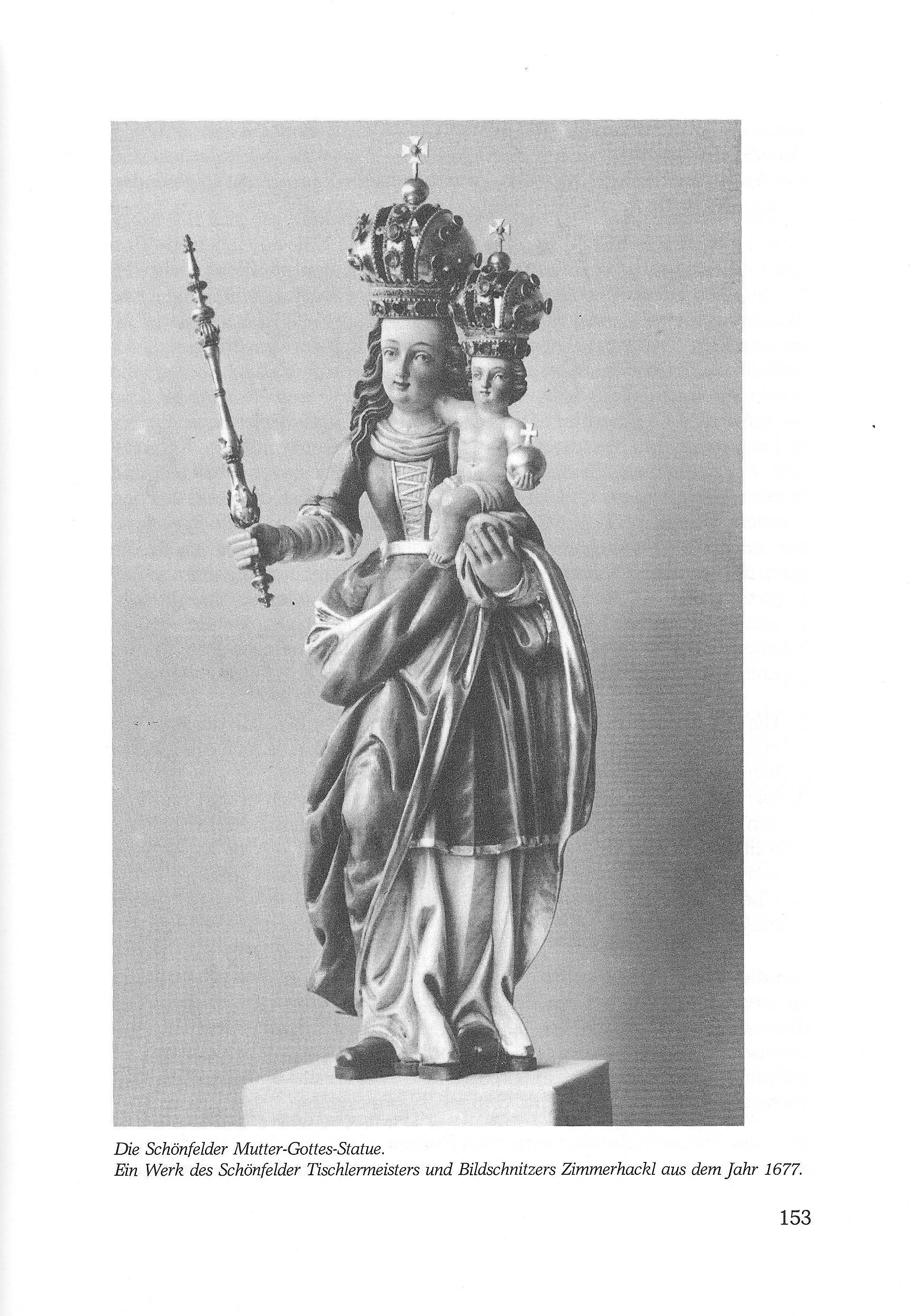 153
The Schönfeld statue of the Mother of God.
A work by the Schönfeld master carpenter and woodcarver Zimmerhackl
from 1677.
153
The Schönfeld statue of the Mother of God.
A work by the Schönfeld master carpenter and woodcarver Zimmerhackl
from 1677.
Page 0153
 154
until the miracles that were spoken of had been investigated more
closely. So on August 15, 1719, the statue, carefully packed and
bearing the vicariate seal, was sent to the consistory in Prague.
In order to get the statue back from Prague as soon as possible, the
magistrate of the town of Schönfeld made every effort to collect all
those cases of answered prayers and miraculous healings that were
attributed to the intercession of the Schönfeld Mother of God. A large
number were collected. As a result, the magistrate asked the
free-educational consistory in Prague to send a second commission to
examine these cases. The spiritual authority also complied with this
request and appointed Father Johann Maria Hloczek von Zampach, a
member of the Theatine Order, and Franz Wanzemann, pastor in
Lauterbach, as members. In the presence of the magistrate, 40 people
were questioned under oath by this commission after they had
previously confessed and communed, and they gave their statements
about the graces they had received. After the 12 most important cases
had been described and written down and confirmed by oaths from
witnesses, the commission stopped its investigation after eight days
and reported to Prague. Now, as the chronicle says, the Schönfeld
residents were torn between fear and hope as to whether they would get
their image of grace back and what decision the consistory would
make. By decree of July 3, 1720, this authority made the following
decision:
1. The statue will be returned to Schönfeld and should be placed in
the parish church, i.e. no longer in the linden tree, but without
celebrations and without the people attending. . The statue is not
declared to be miraculous or full of grace, and
2 the miraculous events that have occurred and been investigated so
far should not be talked about or preached about; the statue should
not be
revered more highly than any other image of the Virgin Mary. 3. Any
new graces that may occur should be reported to Prague immediately.
From this decision of the royal consistory in Prague, as well as from
all subsequent correspondence on the same matter, it can be seen that
this highest spiritual authority proceeded with great precision,
caution and conscientiousness and was by no means immediately willing
and compliant to comply with the requests of the Schönfeld magistrate
and parish office and to declare the statue miraculous.
Because the priest was unable to travel to Prague to bring the statue
home, the syndic (city secretary) Mr. Mathias Jordan went with
154
until the miracles that were spoken of had been investigated more
closely. So on August 15, 1719, the statue, carefully packed and
bearing the vicariate seal, was sent to the consistory in Prague.
In order to get the statue back from Prague as soon as possible, the
magistrate of the town of Schönfeld made every effort to collect all
those cases of answered prayers and miraculous healings that were
attributed to the intercession of the Schönfeld Mother of God. A large
number were collected. As a result, the magistrate asked the
free-educational consistory in Prague to send a second commission to
examine these cases. The spiritual authority also complied with this
request and appointed Father Johann Maria Hloczek von Zampach, a
member of the Theatine Order, and Franz Wanzemann, pastor in
Lauterbach, as members. In the presence of the magistrate, 40 people
were questioned under oath by this commission after they had
previously confessed and communed, and they gave their statements
about the graces they had received. After the 12 most important cases
had been described and written down and confirmed by oaths from
witnesses, the commission stopped its investigation after eight days
and reported to Prague. Now, as the chronicle says, the Schönfeld
residents were torn between fear and hope as to whether they would get
their image of grace back and what decision the consistory would
make. By decree of July 3, 1720, this authority made the following
decision:
1. The statue will be returned to Schönfeld and should be placed in
the parish church, i.e. no longer in the linden tree, but without
celebrations and without the people attending. . The statue is not
declared to be miraculous or full of grace, and
2 the miraculous events that have occurred and been investigated so
far should not be talked about or preached about; the statue should
not be
revered more highly than any other image of the Virgin Mary. 3. Any
new graces that may occur should be reported to Prague immediately.
From this decision of the royal consistory in Prague, as well as from
all subsequent correspondence on the same matter, it can be seen that
this highest spiritual authority proceeded with great precision,
caution and conscientiousness and was by no means immediately willing
and compliant to comply with the requests of the Schönfeld magistrate
and parish office and to declare the statue miraculous.
Because the priest was unable to travel to Prague to bring the statue
home, the syndic (city secretary) Mr. Mathias Jordan went with
Page 0154
 155
istory, and it was safely brought back to Schönfeld with the renewed
written order that Schönfeld should strictly adhere to the decree of
July 3, 1720.
The statue was now placed in the church, near the cross
altar. Although the consistory had given the instruction that it
should not be venerated by the people more than any other image of
Mary or saint, this could not prevent the people from once again
coming in large numbers to the Schönfeld Mother of God, praying and
devoting themselves before her, and miraculous healings of illnesses
again occurred. The matter was therefore reported to the royal
consistory again and a new commission was requested to examine the
miracles. This request was rejected. But the Schönfeld residents did
not give up. A petition was sent to Prague again. The royal consistory
then announced in a letter dated September 11, 1723 that the highly
learned Father Johann Hloczek of Zampach would come to Schönfeld
before the feast of St. Wenceslas to investigate the miracles.
The aforementioned Father Johann Maria Hloczek of Zampach came to
Schönfeld on September 27 as a royal commissioner. With him came other
members of the commission, Mr. Johann Christian Kuhn, archdean in
Falkenau and royal vicar, and Mr. Franz Wanzemann, pastor in
Lauterbach. This commission and the presence of the magistrate
summoned and questioned all those people who were known to have
received special divine graces through the intercession of the Mother
of God of Schönfeld. This time, too, a large number of such people
came. All the people who were questioned had to confess and receive
communion beforehand and had to confirm their statements with a solemn
oath. Some facts are now listed which, according to the sworn
statements of those questioned, occurred and were investigated by the
commission.
Maria Breitfelder, wife of Johann Breitfelder, tailor in Tiefenbach,
stated that her 1 1/4 year old daughter Maria Elisabeth had fallen
into a water trough while playing on August 28, 1723 and when she was
pulled out, she had shown no signs of life. By invoking the Mother of
God of Schönfeld, she had come back to life.
Laurenz Fritsch, citizen and shoemaker in Gossengrün, stated that
in the spring of 1722 he had driven from Gossengrün to Eger in a
wagon loaded with iron; on the way he slipped and
155
istory, and it was safely brought back to Schönfeld with the renewed
written order that Schönfeld should strictly adhere to the decree of
July 3, 1720.
The statue was now placed in the church, near the cross
altar. Although the consistory had given the instruction that it
should not be venerated by the people more than any other image of
Mary or saint, this could not prevent the people from once again
coming in large numbers to the Schönfeld Mother of God, praying and
devoting themselves before her, and miraculous healings of illnesses
again occurred. The matter was therefore reported to the royal
consistory again and a new commission was requested to examine the
miracles. This request was rejected. But the Schönfeld residents did
not give up. A petition was sent to Prague again. The royal consistory
then announced in a letter dated September 11, 1723 that the highly
learned Father Johann Hloczek of Zampach would come to Schönfeld
before the feast of St. Wenceslas to investigate the miracles.
The aforementioned Father Johann Maria Hloczek of Zampach came to
Schönfeld on September 27 as a royal commissioner. With him came other
members of the commission, Mr. Johann Christian Kuhn, archdean in
Falkenau and royal vicar, and Mr. Franz Wanzemann, pastor in
Lauterbach. This commission and the presence of the magistrate
summoned and questioned all those people who were known to have
received special divine graces through the intercession of the Mother
of God of Schönfeld. This time, too, a large number of such people
came. All the people who were questioned had to confess and receive
communion beforehand and had to confirm their statements with a solemn
oath. Some facts are now listed which, according to the sworn
statements of those questioned, occurred and were investigated by the
commission.
Maria Breitfelder, wife of Johann Breitfelder, tailor in Tiefenbach,
stated that her 1 1/4 year old daughter Maria Elisabeth had fallen
into a water trough while playing on August 28, 1723 and when she was
pulled out, she had shown no signs of life. By invoking the Mother of
God of Schönfeld, she had come back to life.
Laurenz Fritsch, citizen and shoemaker in Gossengrün, stated that
in the spring of 1722 he had driven from Gossengrün to Eger in a
wagon loaded with iron; on the way he slipped and
Page 0155
 156
with his left foot under the heavily loaded wagon. He then prayed to
the Mother of God of Schönfeld for help and his prayer was indeed
answered, so that he suffered no harm and was able to continue on his
way.
Anna Maria Zeitler, a widowed citizen and messenger in Schönfeld, made
the following sworn statement before the commission: One day when she
was standing at the door with her four-month-old child, soot flew into
the child's right eye; the child's eye became inflamed and all the
remedies used did not help. On September 6, 1719, she prayed to the
Mother of God of Schönfeld for help and suddenly the child's eye was
healed.
Another act of grace received through the intercession of the
Schönfeld Mother of God was related by Mrs. Maria Rosalia Zickler,
wife of the town judge in Schönfeld: When she moved from Elbogen to
Schönfeld several years ago, she suffered from constant homesickness,
to the extent that she could no longer find peace, could not find any
work in the house and was therefore very annoyed with her husband. As
this condition had already lasted for over a year, she took refuge in
the Mother of God and also received help, so that her sadness and
melancholy left her.
Mrs. Eva Päuerl, wife of Johann Päuerl, mayor, baker and hops
dealer in Einsiedl, stated that she had suffered severe fainting
spells for three years and could not find any help from a doctor. She
then went to the Mother of God in Schönfeld, prayed for healing and
her prayer was heard and she regained her full health.
Marie Tischer, a woman from Neudorf, made another statement. She
suffered for many weeks from a leprosy that covered her body and she
had to endure a lot of pain. In her distress she took refuge in the
Mother of God in Schönfeld and was healed.
Martin Tischer, a hops merchant from Neudorf, also appeared before the
commission and made an oath that he had suffered severe pain in his
right arm for many weeks so that he could not work. Through his prayer
to the Mother of God in Schönfeld he was freed from his suffering.
Johann Andreas Lippert, a citizen and surgeon in Unterchodau, reported
that during a fire that raged in Chodau in 1722, a spark had jumped
into his right eye and severely injured it. Since the pain had lasted
for over half a year and despite all the efforts
156
with his left foot under the heavily loaded wagon. He then prayed to
the Mother of God of Schönfeld for help and his prayer was indeed
answered, so that he suffered no harm and was able to continue on his
way.
Anna Maria Zeitler, a widowed citizen and messenger in Schönfeld, made
the following sworn statement before the commission: One day when she
was standing at the door with her four-month-old child, soot flew into
the child's right eye; the child's eye became inflamed and all the
remedies used did not help. On September 6, 1719, she prayed to the
Mother of God of Schönfeld for help and suddenly the child's eye was
healed.
Another act of grace received through the intercession of the
Schönfeld Mother of God was related by Mrs. Maria Rosalia Zickler,
wife of the town judge in Schönfeld: When she moved from Elbogen to
Schönfeld several years ago, she suffered from constant homesickness,
to the extent that she could no longer find peace, could not find any
work in the house and was therefore very annoyed with her husband. As
this condition had already lasted for over a year, she took refuge in
the Mother of God and also received help, so that her sadness and
melancholy left her.
Mrs. Eva Päuerl, wife of Johann Päuerl, mayor, baker and hops
dealer in Einsiedl, stated that she had suffered severe fainting
spells for three years and could not find any help from a doctor. She
then went to the Mother of God in Schönfeld, prayed for healing and
her prayer was heard and she regained her full health.
Marie Tischer, a woman from Neudorf, made another statement. She
suffered for many weeks from a leprosy that covered her body and she
had to endure a lot of pain. In her distress she took refuge in the
Mother of God in Schönfeld and was healed.
Martin Tischer, a hops merchant from Neudorf, also appeared before the
commission and made an oath that he had suffered severe pain in his
right arm for many weeks so that he could not work. Through his prayer
to the Mother of God in Schönfeld he was freed from his suffering.
Johann Andreas Lippert, a citizen and surgeon in Unterchodau, reported
that during a fire that raged in Chodau in 1722, a spark had jumped
into his right eye and severely injured it. Since the pain had lasted
for over half a year and despite all the efforts
Page 0156
 157
When the remedies used did not subside, he turned to Schönfeld on the
advice of some pious Christians and asked the Mother of God for
help. His prayer was also heard and he recovered.
Katharina Lorenz from Schönfeld, wife of Andreas Lorenz, miller in the
lower mill, testified that in 1718 she suffered from severe limb pain
after giving birth. She sought help from doctors in Carlsbad in vain;
it was only through her prayer to the Mother of God in Schönfeld that
she was cured.
Johann Friedrich from Sattl was also questioned. He stated that his
child Thomas had been blind for nine weeks as a result of smallpox and
had been cured as a result of his parents' pilgrimage to Schönfeld.
Georg Wara, a hop merchant in Einsiedl, reported the following to the
commission: When he went on a business trip to Nuremberg in 1719, he
was struck by a serious illness on the way there, so that he had to
stay in the village of Reitersdorf, about three hours from
Nuremberg. From there, his son-in-law brought him home with great
difficulty. The hop merchant was ill for several weeks. Then, on the
advice of his housemates, he turned to Schönfeld and asked the Mother
of God for intercession. In fact, he recovered completely from his
illness.
Josef Voith, a citizen and cloth maker from Theussing, stated that his
nine-year-old son Hans Wenzel suffered fatal injuries as a result of a
fall from the stairs, but that after invoking the Mother of God in
Schönfeld, he recovered completely.
These and several other cases of graces, which according to the sworn
testimony of the witnesses were attributed to the intercession of the
Schönfeld Mother of God, were examined by the commission for their
truth and after the investigation was completed a detailed report was
sent to the consistory in Prague. Based on this report, the statue was
declared to be gracious by the imperial consistory in a letter dated
October 19, 1723 and in a further letter dated October 23, 1723 it was
ordered that the statue should be placed on the high altar, between
the tabernacle and the altarpiece (image of St. Catherine).
So the image now stood on the high altar, to the great joy of all
worshippers of the dear Mother of God. Now the Schönfeld people had
one more wish: they submitted a request to the imperial consistory to
be allowed to hold a solemn procession around the market square with
the statue of grace. The Consistory also granted this request by
writing on 15 May 1724 to
157
When the remedies used did not subside, he turned to Schönfeld on the
advice of some pious Christians and asked the Mother of God for
help. His prayer was also heard and he recovered.
Katharina Lorenz from Schönfeld, wife of Andreas Lorenz, miller in the
lower mill, testified that in 1718 she suffered from severe limb pain
after giving birth. She sought help from doctors in Carlsbad in vain;
it was only through her prayer to the Mother of God in Schönfeld that
she was cured.
Johann Friedrich from Sattl was also questioned. He stated that his
child Thomas had been blind for nine weeks as a result of smallpox and
had been cured as a result of his parents' pilgrimage to Schönfeld.
Georg Wara, a hop merchant in Einsiedl, reported the following to the
commission: When he went on a business trip to Nuremberg in 1719, he
was struck by a serious illness on the way there, so that he had to
stay in the village of Reitersdorf, about three hours from
Nuremberg. From there, his son-in-law brought him home with great
difficulty. The hop merchant was ill for several weeks. Then, on the
advice of his housemates, he turned to Schönfeld and asked the Mother
of God for intercession. In fact, he recovered completely from his
illness.
Josef Voith, a citizen and cloth maker from Theussing, stated that his
nine-year-old son Hans Wenzel suffered fatal injuries as a result of a
fall from the stairs, but that after invoking the Mother of God in
Schönfeld, he recovered completely.
These and several other cases of graces, which according to the sworn
testimony of the witnesses were attributed to the intercession of the
Schönfeld Mother of God, were examined by the commission for their
truth and after the investigation was completed a detailed report was
sent to the consistory in Prague. Based on this report, the statue was
declared to be gracious by the imperial consistory in a letter dated
October 19, 1723 and in a further letter dated October 23, 1723 it was
ordered that the statue should be placed on the high altar, between
the tabernacle and the altarpiece (image of St. Catherine).
So the image now stood on the high altar, to the great joy of all
worshippers of the dear Mother of God. Now the Schönfeld people had
one more wish: they submitted a request to the imperial consistory to
be allowed to hold a solemn procession around the market square with
the statue of grace. The Consistory also granted this request by
writing on 15 May 1724 to
Page 0157
 158
Pastor Christof Ernst gave his consent for a solemn procession to be
held around the market square with the statue of grace on a Marian
feast day. The Feast of the Visitation of the Virgin Mary, July 2,
1724, was chosen for this.
All of Schönfeld was in a highly festive, joyful mood when the
festival arrived. It was a splendid summer day. The sun shone down
brightly, as if to express that nature was also taking part in the
festive joy of the ancient mining town of Schönfeld.
At eight o'clock in the morning, all the bells rang to signal the
sermon. Since the church could not accommodate the many thousands of
listeners and pilgrims who had flocked to it, a pulpit was erected in
the cemetery under a large linden tree. In wonderful, heart-rending
words, the festival preacher, Mr. Johann Michael Hönig, pastor of
Chodau, described the origin and provenance of the image of the Mother
of God, full of grace. Deeply moved, with tears of emotion and joy in
their eyes, the listeners listened to the preacher's words, especially
those who had received grace and mercy from God through the
intercession of the Mother of God.
After the sermon, the procession lined up and then moved around the
market square in great devotion. The miners walked at the head of the
procession, followed by the clergy; a large number of priests from the
secular and religious clergy had gathered. Now came the statue of
grace, decorated with many gold and silver offerings and surmounted by
a canopy with a gilded halo. It was carried on a beautifully decorated
pedestal by six Premonstratensian canons from the Tepl
monastery. Since the statue and its supporting frame were very heavy,
these men were relieved from time to time by six other strong men who
walked beside them and wore long coats that reached down to the
ground; these six men also had laurel wreaths on their heads. On
either side of the statue walked 12 miners with halberds and 12
torchbearers each. Behind the statue walked a large number of noble
men and women as well as the entire magistrate of Schönfeld and
Lauterbach. With the permission of the royal consistory in Prague, a
procession had come from this neighboring town and had brought an
offering of 20 Reichstaler. Now the other devout people and pilgrims
followed in extremely large numbers. It should also be noted that all
the people taking part in the procession carried burning candles. The
number of people present in Schönfeld that day was estimated at
20,000. After the parade around the market square, they went to the
church, where Mr. Johann Christian
158
Pastor Christof Ernst gave his consent for a solemn procession to be
held around the market square with the statue of grace on a Marian
feast day. The Feast of the Visitation of the Virgin Mary, July 2,
1724, was chosen for this.
All of Schönfeld was in a highly festive, joyful mood when the
festival arrived. It was a splendid summer day. The sun shone down
brightly, as if to express that nature was also taking part in the
festive joy of the ancient mining town of Schönfeld.
At eight o'clock in the morning, all the bells rang to signal the
sermon. Since the church could not accommodate the many thousands of
listeners and pilgrims who had flocked to it, a pulpit was erected in
the cemetery under a large linden tree. In wonderful, heart-rending
words, the festival preacher, Mr. Johann Michael Hönig, pastor of
Chodau, described the origin and provenance of the image of the Mother
of God, full of grace. Deeply moved, with tears of emotion and joy in
their eyes, the listeners listened to the preacher's words, especially
those who had received grace and mercy from God through the
intercession of the Mother of God.
After the sermon, the procession lined up and then moved around the
market square in great devotion. The miners walked at the head of the
procession, followed by the clergy; a large number of priests from the
secular and religious clergy had gathered. Now came the statue of
grace, decorated with many gold and silver offerings and surmounted by
a canopy with a gilded halo. It was carried on a beautifully decorated
pedestal by six Premonstratensian canons from the Tepl
monastery. Since the statue and its supporting frame were very heavy,
these men were relieved from time to time by six other strong men who
walked beside them and wore long coats that reached down to the
ground; these six men also had laurel wreaths on their heads. On
either side of the statue walked 12 miners with halberds and 12
torchbearers each. Behind the statue walked a large number of noble
men and women as well as the entire magistrate of Schönfeld and
Lauterbach. With the permission of the royal consistory in Prague, a
procession had come from this neighboring town and had brought an
offering of 20 Reichstaler. Now the other devout people and pilgrims
followed in extremely large numbers. It should also be noted that all
the people taking part in the procession carried burning candles. The
number of people present in Schönfeld that day was estimated at
20,000. After the parade around the market square, they went to the
church, where Mr. Johann Christian
Page 0158
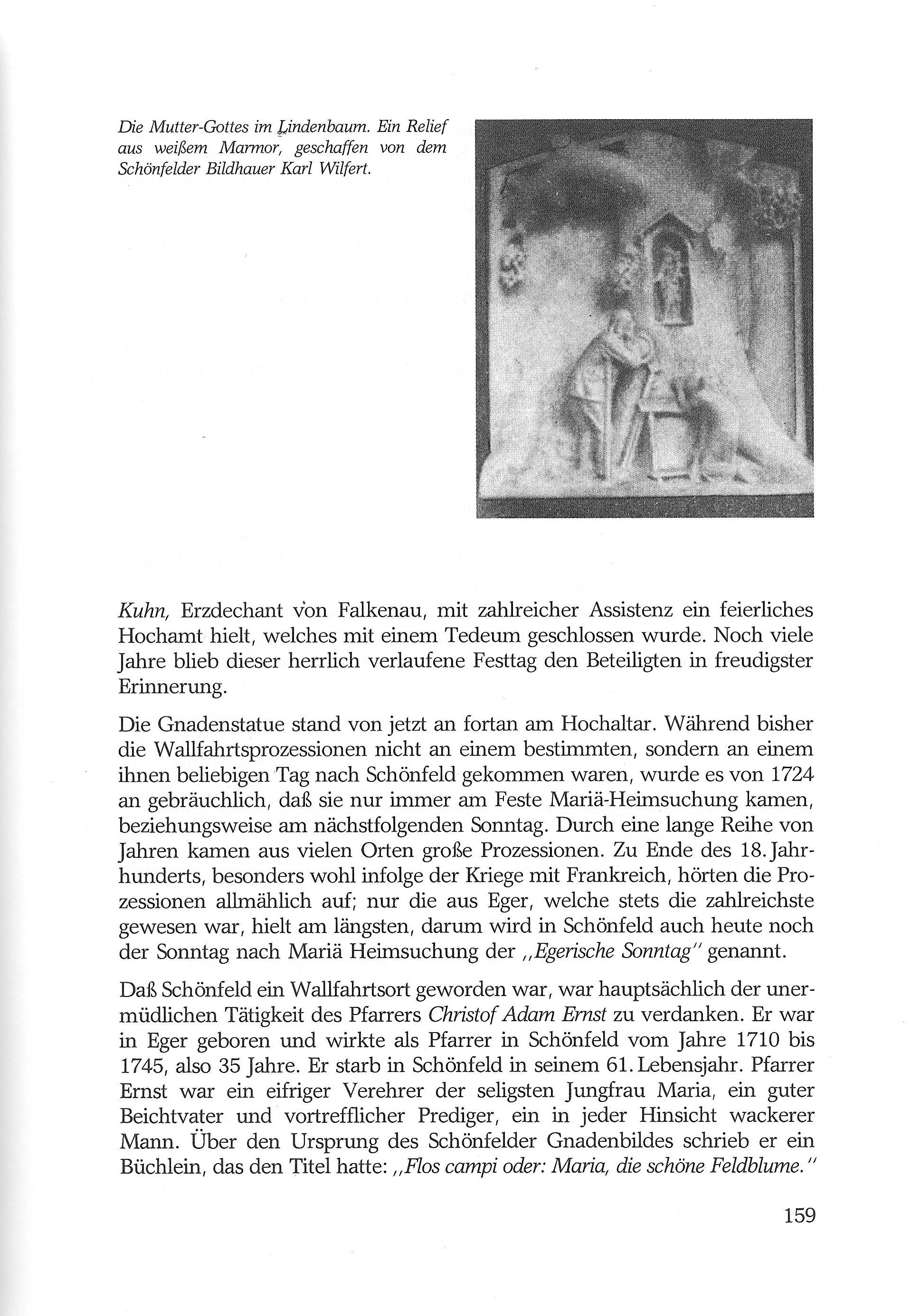 159
The Mother of God in the Linden Tree. A relief made of white marble,
created by the Schönfeld sculptor Karl Wilfert.
Kuhn, Archdean of Falkenau, held a solemn high mass with numerous
assistants, which was concluded with a Te Deum. For many years to
come, this splendid festival day remained in the joyful memories of
those involved.
From now on, the statue of grace stood on the high altar. While
previously the pilgrimage processions had not come to Schönfeld on a
specific day, but on any day they chose, from 1724 onwards it became
customary for them to only come on the Feast of the Visitation of the
Virgin Mary, or on the Sunday following. For a long series of years,
large processions came from many places. At the end of the 18th
century, particularly as a result of the wars with France, the
processions gradually stopped; only the one from Eger, which had
always been the most numerous, lasted the longest, which is why in
Schönfeld the Sunday after the Visitation of the Virgin Mary is still
called "Eger Sunday".
The fact that Schönfeld became a place of pilgrimage was mainly due to
the tireless work of the pastor Christof Adam Ernst. He was born in
Eger and worked as a pastor in Schönfeld from 1710 to 1745, i.e. for
35 years. He died in Schönfeld at the age of 61. Pastor Ernst was a
zealous admirer of the Blessed Virgin Mary, a good confessor and
excellent preacher, a brave man in every respect. He wrote a booklet
about the origin of the Schönfeld image of grace, entitled "Flos campi
or: Mary, the beautiful field flower."
159
The Mother of God in the Linden Tree. A relief made of white marble,
created by the Schönfeld sculptor Karl Wilfert.
Kuhn, Archdean of Falkenau, held a solemn high mass with numerous
assistants, which was concluded with a Te Deum. For many years to
come, this splendid festival day remained in the joyful memories of
those involved.
From now on, the statue of grace stood on the high altar. While
previously the pilgrimage processions had not come to Schönfeld on a
specific day, but on any day they chose, from 1724 onwards it became
customary for them to only come on the Feast of the Visitation of the
Virgin Mary, or on the Sunday following. For a long series of years,
large processions came from many places. At the end of the 18th
century, particularly as a result of the wars with France, the
processions gradually stopped; only the one from Eger, which had
always been the most numerous, lasted the longest, which is why in
Schönfeld the Sunday after the Visitation of the Virgin Mary is still
called "Eger Sunday".
The fact that Schönfeld became a place of pilgrimage was mainly due to
the tireless work of the pastor Christof Adam Ernst. He was born in
Eger and worked as a pastor in Schönfeld from 1710 to 1745, i.e. for
35 years. He died in Schönfeld at the age of 61. Pastor Ernst was a
zealous admirer of the Blessed Virgin Mary, a good confessor and
excellent preacher, a brave man in every respect. He wrote a booklet
about the origin of the Schönfeld image of grace, entitled "Flos campi
or: Mary, the beautiful field flower."
Page 0159
 160
This is: A brief outline of the origin of the gracious Mother of God
in the ancient royal free mining town of Schönfeld in the Kingdom of
Böheim. Published in 1727. Written by Christof Adam Ernst, A.A.L.L. et
Philosophie Magister et St. Theol Baccalaureum and pastor there.
The fact that around 250 years ago the carpenter Zimmerhackl placed a
statue of the Virgin Mary carved by him in the trunk of a linden tree
that had been knocked down by a violent storm but then re-erected is
represented in our parish church by a valuable work of art. A son of
our parish, Mr. Karl Wilfert in Eger, who is well known as a sculptor,
donated a marble relief to the parish church of his hometown in 1897,
on which the linden tree with the statue of the Virgin Mary is
depicted (see photo). This sculpture, a truly classic work of art,
represents a very high value.
As already mentioned, the statue of the Mother of God stood on the
high altar in the old parish church, which burned down in 1848. It was
placed in the same place in the newly built church, but every year it
was placed on the altar table from the Feast of the Visitation of the
Virgin Mary to the Assumption of the Virgin Mary so that it could be
better seen and venerated by pilgrims. Taking the statue down and
putting it back up again each time was very difficult. Later it was
therefore placed on the altar of the Virgin Mary. However, as it was
located quite out of the way in this place and therefore attracted
less attention, a new place was chosen in 1911, namely the middle of
the long side of the church facing south. Decorated with a red velvet
canopy, the venerable, gracious statue of the Schönfeld Mother of God
now sits enthroned on a pedestal that stands on a high altar table.
160
This is: A brief outline of the origin of the gracious Mother of God
in the ancient royal free mining town of Schönfeld in the Kingdom of
Böheim. Published in 1727. Written by Christof Adam Ernst, A.A.L.L. et
Philosophie Magister et St. Theol Baccalaureum and pastor there.
The fact that around 250 years ago the carpenter Zimmerhackl placed a
statue of the Virgin Mary carved by him in the trunk of a linden tree
that had been knocked down by a violent storm but then re-erected is
represented in our parish church by a valuable work of art. A son of
our parish, Mr. Karl Wilfert in Eger, who is well known as a sculptor,
donated a marble relief to the parish church of his hometown in 1897,
on which the linden tree with the statue of the Virgin Mary is
depicted (see photo). This sculpture, a truly classic work of art,
represents a very high value.
As already mentioned, the statue of the Mother of God stood on the
high altar in the old parish church, which burned down in 1848. It was
placed in the same place in the newly built church, but every year it
was placed on the altar table from the Feast of the Visitation of the
Virgin Mary to the Assumption of the Virgin Mary so that it could be
better seen and venerated by pilgrims. Taking the statue down and
putting it back up again each time was very difficult. Later it was
therefore placed on the altar of the Virgin Mary. However, as it was
located quite out of the way in this place and therefore attracted
less attention, a new place was chosen in 1911, namely the middle of
the long side of the church facing south. Decorated with a red velvet
canopy, the venerable, gracious statue of the Schönfeld Mother of God
now sits enthroned on a pedestal that stands on a high altar table.
Page 0160
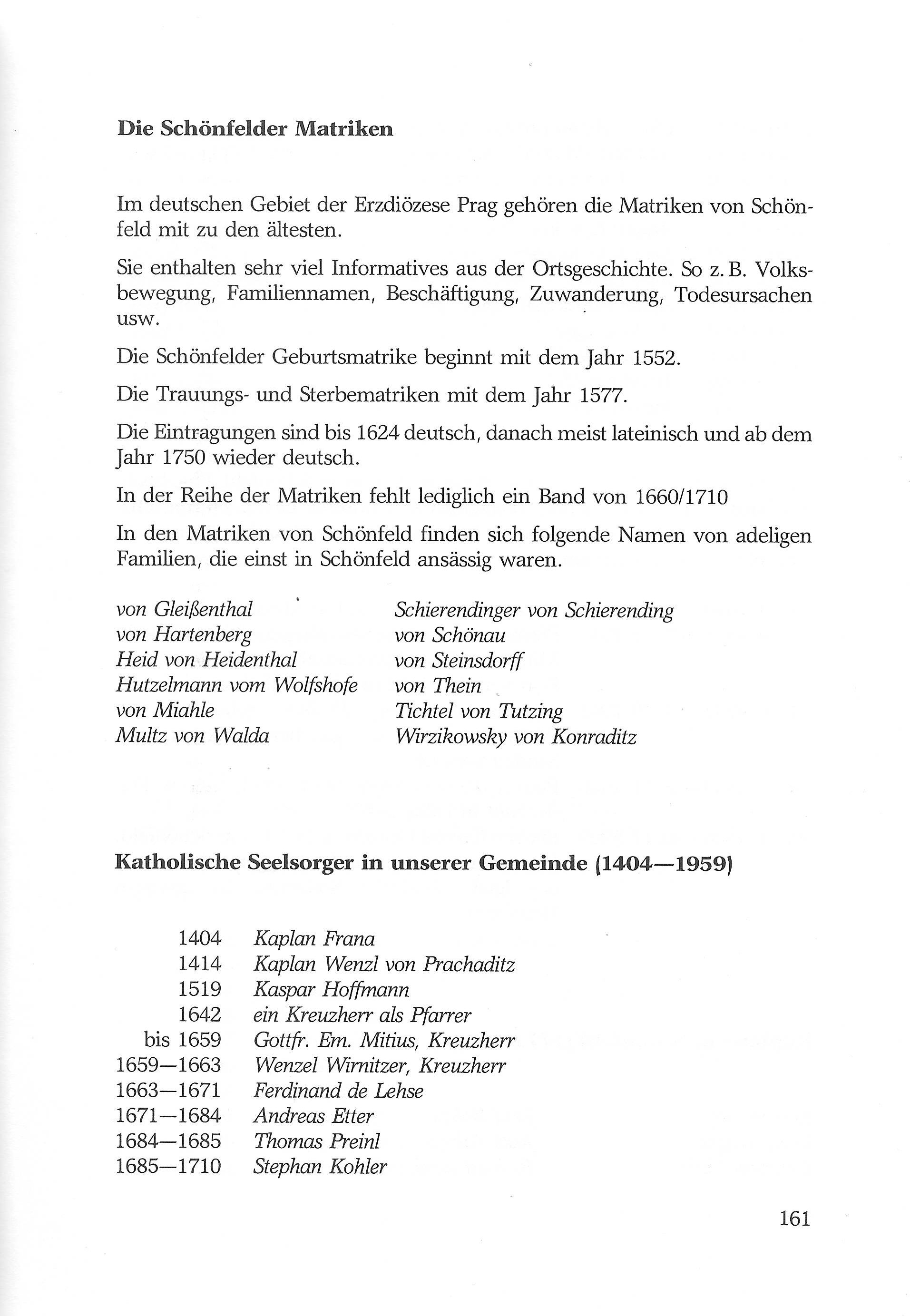 161
The Schönfeld registers In the German area of ??the Archdiocese of
Prague, the Schönfeld registers are among the oldest. They contain a
lot of information about the local history. For example, popular
movement, family names, employment, immigration, causes of death, etc.
The Schönfeld birth register begins in 1552. The marriage and death
registers begin in 1577. The entries are in German until 1624, then
mostly in Latin and from 1750 onwards in German again. The series of
registers is only missing a volume from 1660/1710 The Schönfeld
registers contain the following names of noble families who once lived
in Schönfeld.
von Gleißenthal
von Hartenberg
Schierendinger von Schierend
von Schönau
von Steinsdorff
Hutzelmann vom Wolfshofe
von Thein
Heid von Heidenthal
von Miahle
Multz von Walda
Tichtel von Tutzing
Wirzikowsky von Konraditz
Catholic pastors in our community (1404-1959)
1404 Chaplain Frana
1414
1519
1642
to 1659
1659-1663
1663-1671
Chaplain Wenzl von Prachaditz
Kaspar Hoffmann
a member of the Cross as pastor
Gottfr. Em. Mitius, Knight of the Cross
Wenzel Wirnitzer, Knight of the Cross Ferdinand de Lehse
1671-1684 Andreas Etter
1684-1685 Thomas Preinl
1685-1710 Stephan Kohler
161
161
The Schönfeld registers In the German area of ??the Archdiocese of
Prague, the Schönfeld registers are among the oldest. They contain a
lot of information about the local history. For example, popular
movement, family names, employment, immigration, causes of death, etc.
The Schönfeld birth register begins in 1552. The marriage and death
registers begin in 1577. The entries are in German until 1624, then
mostly in Latin and from 1750 onwards in German again. The series of
registers is only missing a volume from 1660/1710 The Schönfeld
registers contain the following names of noble families who once lived
in Schönfeld.
von Gleißenthal
von Hartenberg
Schierendinger von Schierend
von Schönau
von Steinsdorff
Hutzelmann vom Wolfshofe
von Thein
Heid von Heidenthal
von Miahle
Multz von Walda
Tichtel von Tutzing
Wirzikowsky von Konraditz
Catholic pastors in our community (1404-1959)
1404 Chaplain Frana
1414
1519
1642
to 1659
1659-1663
1663-1671
Chaplain Wenzl von Prachaditz
Kaspar Hoffmann
a member of the Cross as pastor
Gottfr. Em. Mitius, Knight of the Cross
Wenzel Wirnitzer, Knight of the Cross Ferdinand de Lehse
1671-1684 Andreas Etter
1684-1685 Thomas Preinl
1685-1710 Stephan Kohler
161
Page 0161
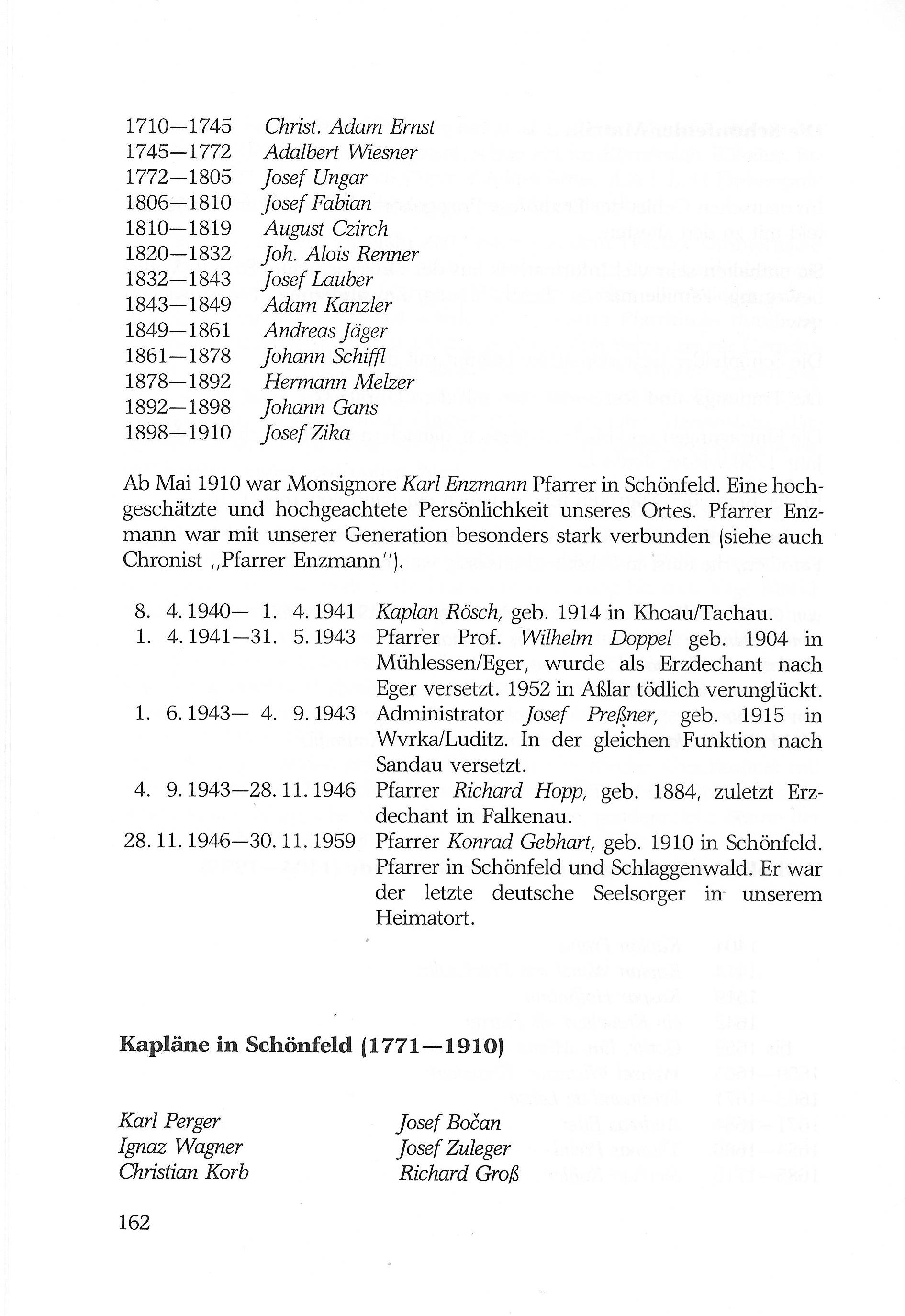 162
1710-1745
Christ. Adam Ernst
1745-1772
Adalbert Wiesner
1772-1805
Josef Ungar
1806-1810
Josef Fabian
1810-1819
August Czirch
1820-1832
Joh. Alois Renner
1832-1843
Josef Lauber
1843-1849
Adam Kanzler
1849-1861
Andreas Jäger
1861-1878
Johann Schiffl
1878-1892
Hermann Melzer
1892-1898
1898-1910
Johann Gans
Josef Zika
From May 1910, Monsignor Karl Enzmann was the pastor in Schönfeld. A
highly valued and highly respected personality in our town. Pastor
Enzmann was particularly closely connected with our generation (see
also chronicler, "Pastor Enzmann").
8. 4. 1940- 1. 4. 1941 1. 4. 1941-31. 5. 1943
Kaplan Rösch, born 1914 in Khoau/Tachau. Pastor Prof. Wilhelm Doppel,
born 1904 in Mühlessen/Eger, was transferred to Eger as
archdean. Fatally injured in an accident in A?lar in 1952.
1. 6. 1943 4. 9. 1943
Administrator Josef Preßner, born 1915 in Wvrka/Luditz. Transferred
to Sandau in the same function.
4. 9. 1943-28. 11. 1946
Pastor Richard Hopp, born in 1884, most recently archdean in Falkenau.
28. 11. 1946-30.11.1959
Pastor Konrad Gebhart, born in 1910 in Schönfeld. Pastor in Schönfeld
and Schlaggenwald. He was the last German pastor in our hometown.
Chaplains in Schönfeld (1771-1910)
Karl Perger
Josef Bo?an
Ignaz Wagner
Josef Zuleger
Christian Korb
Richard Groß
162
162
1710-1745
Christ. Adam Ernst
1745-1772
Adalbert Wiesner
1772-1805
Josef Ungar
1806-1810
Josef Fabian
1810-1819
August Czirch
1820-1832
Joh. Alois Renner
1832-1843
Josef Lauber
1843-1849
Adam Kanzler
1849-1861
Andreas Jäger
1861-1878
Johann Schiffl
1878-1892
Hermann Melzer
1892-1898
1898-1910
Johann Gans
Josef Zika
From May 1910, Monsignor Karl Enzmann was the pastor in Schönfeld. A
highly valued and highly respected personality in our town. Pastor
Enzmann was particularly closely connected with our generation (see
also chronicler, "Pastor Enzmann").
8. 4. 1940- 1. 4. 1941 1. 4. 1941-31. 5. 1943
Kaplan Rösch, born 1914 in Khoau/Tachau. Pastor Prof. Wilhelm Doppel,
born 1904 in Mühlessen/Eger, was transferred to Eger as
archdean. Fatally injured in an accident in A?lar in 1952.
1. 6. 1943 4. 9. 1943
Administrator Josef Preßner, born 1915 in Wvrka/Luditz. Transferred
to Sandau in the same function.
4. 9. 1943-28. 11. 1946
Pastor Richard Hopp, born in 1884, most recently archdean in Falkenau.
28. 11. 1946-30.11.1959
Pastor Konrad Gebhart, born in 1910 in Schönfeld. Pastor in Schönfeld
and Schlaggenwald. He was the last German pastor in our hometown.
Chaplains in Schönfeld (1771-1910)
Karl Perger
Josef Bo?an
Ignaz Wagner
Josef Zuleger
Christian Korb
Richard Groß
162
Page 0162
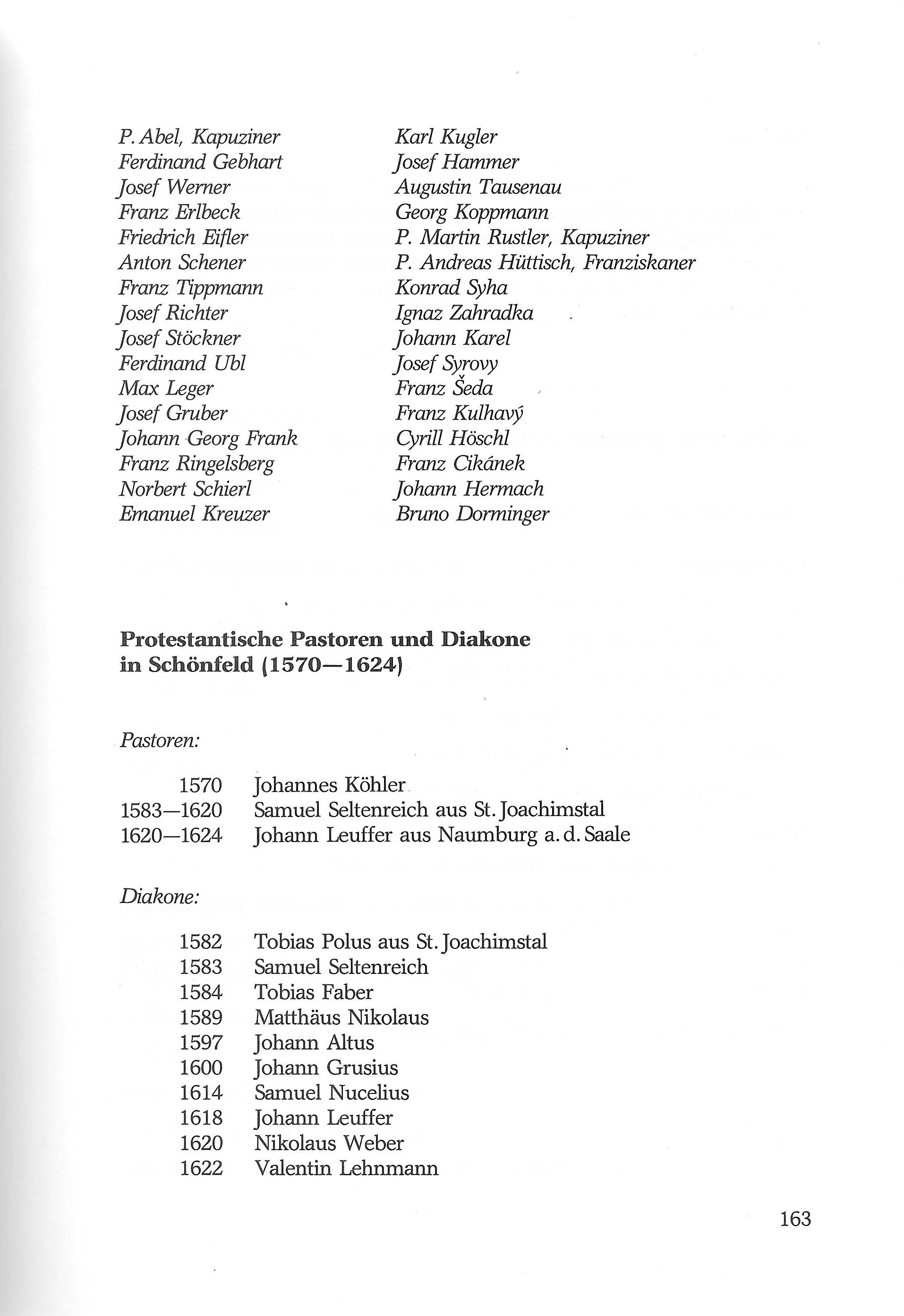 163
P. Abel, Capuchin Ferdinand Gebhart
Josef Werner Franz Erlbeck
Friedrich Eifler Anton Schener
Franz Tippmann
Josef Richter
Josef Stöckner Ferdinand Ubl Max Leger Josef Gruber
Johann Georg Frank Franz Ringelsberg Norbert Schierl
Karl Kugler Josef Hammer Augustin Tausenau Georg Koppmann
P. Martin Rustler, Capuchin
P. Andreas Hüttisch, Franciscan Konrad Syha
Ignaz Zahradka
Johann Karel
Josef Syrovy Franz Seda
Franz Kulhavý Cyrill Höschl
Franz Cikánek Johann Hermach
Emanuel Kreuzer
Bruno Dorminger
Protestant pastors and deacons in Schönfeld (1570-1624)
Pastors:
1570
Johannes Köhler
1583-1620
1620-1624
Samuel Seltenreich from St. Joachimstal Johann Leuffer from Naumburg on the Saale
Deacons:
1582
Tobias Polus from St. Joachimstal
1583 Samuel Seltenreich
1584 Tobias Faber
1589
Matthäus Nikolaus
1597 Johann Altus
1600 Johann Grusius 1614 Samuel Nucelius
1618 Johann Leuffer
1620
1622
Nikolaus Weber
Valentin Lehnmann
163
163
P. Abel, Capuchin Ferdinand Gebhart
Josef Werner Franz Erlbeck
Friedrich Eifler Anton Schener
Franz Tippmann
Josef Richter
Josef Stöckner Ferdinand Ubl Max Leger Josef Gruber
Johann Georg Frank Franz Ringelsberg Norbert Schierl
Karl Kugler Josef Hammer Augustin Tausenau Georg Koppmann
P. Martin Rustler, Capuchin
P. Andreas Hüttisch, Franciscan Konrad Syha
Ignaz Zahradka
Johann Karel
Josef Syrovy Franz Seda
Franz Kulhavý Cyrill Höschl
Franz Cikánek Johann Hermach
Emanuel Kreuzer
Bruno Dorminger
Protestant pastors and deacons in Schönfeld (1570-1624)
Pastors:
1570
Johannes Köhler
1583-1620
1620-1624
Samuel Seltenreich from St. Joachimstal Johann Leuffer from Naumburg on the Saale
Deacons:
1582
Tobias Polus from St. Joachimstal
1583 Samuel Seltenreich
1584 Tobias Faber
1589
Matthäus Nikolaus
1597 Johann Altus
1600 Johann Grusius 1614 Samuel Nucelius
1618 Johann Leuffer
1620
1622
Nikolaus Weber
Valentin Lehnmann
163
Page 0163
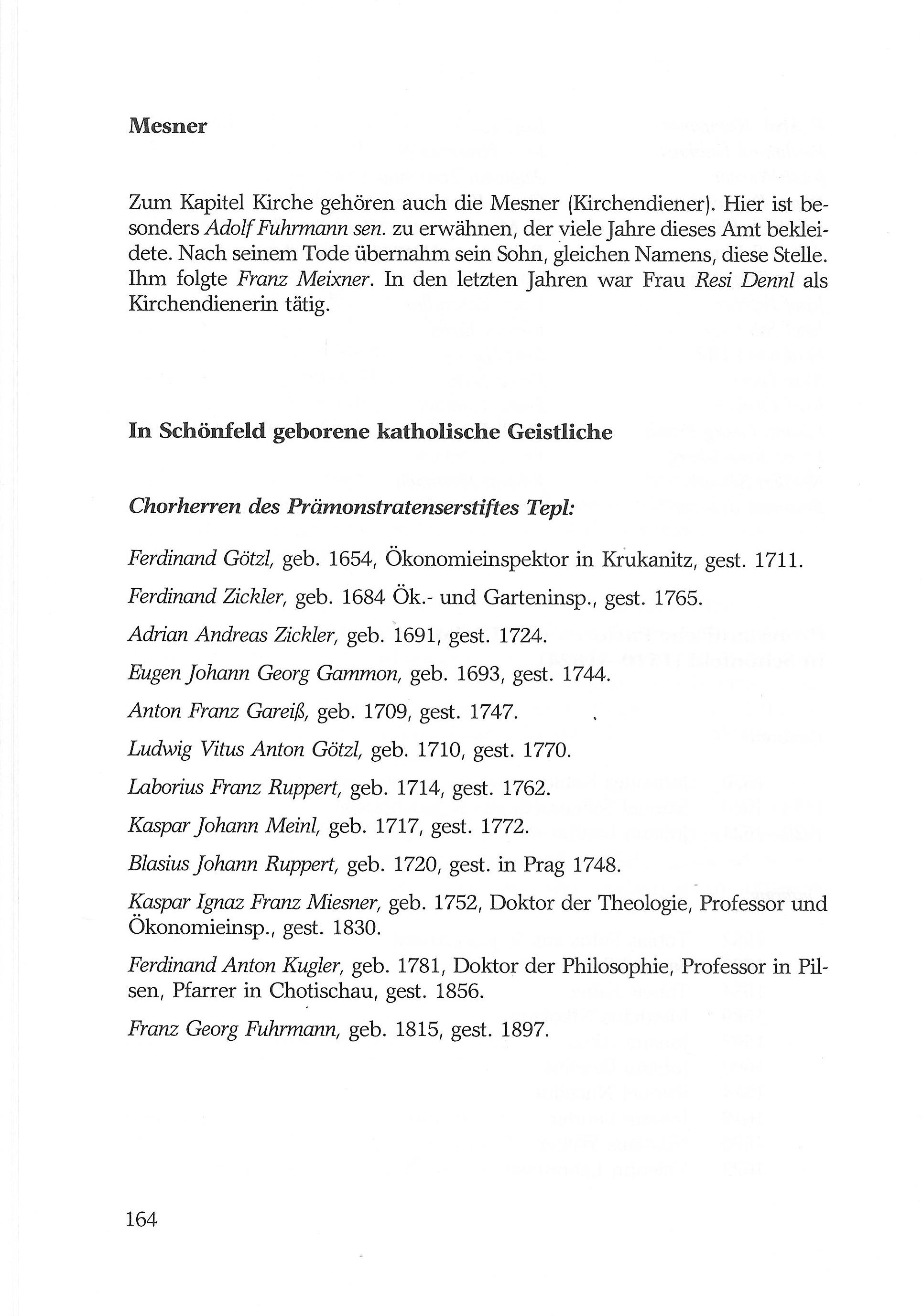 164
Sacristan
The chapter on the church also includes the sacristans (church
servants). Adolf Fuhrmann Sr. deserves special mention here, as he
held this office for many years. After his death, his son, of the same
name, took over the position. He was succeeded by Franz Meixner. In
recent years, Mrs. Resi Dennl has worked as a church servant. Catholic
clergy born in Schönfeld
Canons of the Premonstratensian monastery in Tepl:
Ferdinand Götzl, born 1654, economic inspector in Krukanitz, died 1711.
Ferdinand Zickler, born 1684, economic and garden inspector, died 1765.
Adrian Andreas Zickler, born 1691, died 1724.
Eugen Johann Georg Gammon, born 1693, died 1744.
Anton Franz Gareiß, born 1709, died 1747.
Ludwig Vitus Anton Götzl, born 1710, died 1770.
Laborius Franz Ruppert, born 1714, died 1762.
Kaspar Johann Meinl, born 1717, died 1772.
Blasius Johann Ruppert, born 1720, died in Prague 1748.
Kaspar Ignaz Franz Miesner, born 1752, doctor of theology,
professor and economics expert, died 1830.
Ferdinand Anton Kugler, born 1781, doctor of philosophy,
professor in Pilsen, pastor in Chotiš?a, died 1856.
Franz Georg Fuhrmann, born 1815, died 1897.
164
164
Sacristan
The chapter on the church also includes the sacristans (church
servants). Adolf Fuhrmann Sr. deserves special mention here, as he
held this office for many years. After his death, his son, of the same
name, took over the position. He was succeeded by Franz Meixner. In
recent years, Mrs. Resi Dennl has worked as a church servant. Catholic
clergy born in Schönfeld
Canons of the Premonstratensian monastery in Tepl:
Ferdinand Götzl, born 1654, economic inspector in Krukanitz, died 1711.
Ferdinand Zickler, born 1684, economic and garden inspector, died 1765.
Adrian Andreas Zickler, born 1691, died 1724.
Eugen Johann Georg Gammon, born 1693, died 1744.
Anton Franz Gareiß, born 1709, died 1747.
Ludwig Vitus Anton Götzl, born 1710, died 1770.
Laborius Franz Ruppert, born 1714, died 1762.
Kaspar Johann Meinl, born 1717, died 1772.
Blasius Johann Ruppert, born 1720, died in Prague 1748.
Kaspar Ignaz Franz Miesner, born 1752, doctor of theology,
professor and economics expert, died 1830.
Ferdinand Anton Kugler, born 1781, doctor of philosophy,
professor in Pilsen, pastor in Chotiš?a, died 1856.
Franz Georg Fuhrmann, born 1815, died 1897.
164
Page 0164
 165
Other priests:
Norbert Christian Klupp, pastor in Zinnwald, metropolitan capitular at
St. Veit in Prague and vicar general. Died in Prague in 1758. He was
the founder and builder of the large and once very beautiful chapel at
the exit of our town to Lauterbach. Later known as a poorhouse under
the name "Kirchl".
Franz Adalbert Josef Caroli, born 1757, doctor of theology. Cathedral
provost at St. Veit in Prague. Vicar General. Died 1830.
Franz Fuhrmann, born 1770, chaplain in Neudek and Zwetbau, localist
and pastor in Sachsengrün. Died 1833.
Anton Fuhrmann, was in Lanz in 1801.
Wenzl Lorenz, 1757-1788 chaplain and pastor in Koßlau.
Franz Karl Jordan, died in 1796 as a secular priest in Prague.
P. Innozenz Josef Schneider, Benedictine in the Emmaus Abbey in
Prague, prefect at the grammar school in Klattau. Born 1791, died 1835
in Schönfeld.
Ferdinand Gebhard, dean in Schweißing, 1798-1823.
Franz Miesner, born 1833, 1857/1871 chaplain and pastor in Plan,
1884-1898 dean in Mies.
Richard Zickler, born 1830, died 1874.
Josef Anton Lorenz, born 1798, was pastor in Gottesgab in 1861.
Franz Dörfler, born 1775, chaplain in Donawitz, administrator in
Kirchenbirk. Died 1810.
Josef Kuhn, was pastor in Neukirchen in 1754.
Michael Hönig, was pastor in Grottau.
Andreas Langkammer, was provost in Raudnitz.
Gabriel Richter, was pastor in Neustadl.
P. Gaudentius Ruppert
Josef Miesner, born in 1796, chaplain and pastor in Tschernoschin from
1822 to 1874.
Franz Anton Gebhard, was the monastery chaplain in Waltsch in 1861.
Josef Haller, died around 1761 as a cleric.
Karl Ruppert, chaplain in Eger, died in 1882 as pastor in Trebendorf.
65
165
Other priests:
Norbert Christian Klupp, pastor in Zinnwald, metropolitan capitular at
St. Veit in Prague and vicar general. Died in Prague in 1758. He was
the founder and builder of the large and once very beautiful chapel at
the exit of our town to Lauterbach. Later known as a poorhouse under
the name "Kirchl".
Franz Adalbert Josef Caroli, born 1757, doctor of theology. Cathedral
provost at St. Veit in Prague. Vicar General. Died 1830.
Franz Fuhrmann, born 1770, chaplain in Neudek and Zwetbau, localist
and pastor in Sachsengrün. Died 1833.
Anton Fuhrmann, was in Lanz in 1801.
Wenzl Lorenz, 1757-1788 chaplain and pastor in Koßlau.
Franz Karl Jordan, died in 1796 as a secular priest in Prague.
P. Innozenz Josef Schneider, Benedictine in the Emmaus Abbey in
Prague, prefect at the grammar school in Klattau. Born 1791, died 1835
in Schönfeld.
Ferdinand Gebhard, dean in Schweißing, 1798-1823.
Franz Miesner, born 1833, 1857/1871 chaplain and pastor in Plan,
1884-1898 dean in Mies.
Richard Zickler, born 1830, died 1874.
Josef Anton Lorenz, born 1798, was pastor in Gottesgab in 1861.
Franz Dörfler, born 1775, chaplain in Donawitz, administrator in
Kirchenbirk. Died 1810.
Josef Kuhn, was pastor in Neukirchen in 1754.
Michael Hönig, was pastor in Grottau.
Andreas Langkammer, was provost in Raudnitz.
Gabriel Richter, was pastor in Neustadl.
P. Gaudentius Ruppert
Josef Miesner, born in 1796, chaplain and pastor in Tschernoschin from
1822 to 1874.
Franz Anton Gebhard, was the monastery chaplain in Waltsch in 1861.
Josef Haller, died around 1761 as a cleric.
Karl Ruppert, chaplain in Eger, died in 1882 as pastor in Trebendorf.
65
Page 0165
 166
Ignaz Ruppert, died in 1876 as pastor in Tüppelsgrün.
Josef Hackenschmidt, chaplain in Heinrichsgrün and Falkenau,
pastor in Neurohlau and Lauterbach.
Andreas Hackenschmidt, chaplain and pastor in Gossengrün.
Josef Jordan, pastor in Washington/USA and Prague.
Konrad Gebhart, pastor in Diwischkau/Prague, Falkenau,
Trebeschitz, Schlaggenwald and Schönfeld.
Rectory
The first references to the rectory building can be found at the end
of the 18th century. A letter dated September 11, 1780 from the then
district vicar to the consistory in Prague shows that at that time the
Schönfeld rectory (the date of construction is unknown) was in a very
poor condition and was in danger of collapsing. In this letter, His
Excellency Count Karl Clary is asked to arrange the necessary steps
with the patronage, as the community cannot raise the necessary funds
for the repairs. The Supreme Mining and Mint Office in Prague then
contacted the Mining Authority in St. Joachimsthal and asked for a
building plan and cost estimate. A district administrator inspected
the property in Schönfeld. In his report dated February 27th: 1781,
in, in which the futility of repairs is pointed out and a new
building, placed on the lower walls, is recommended, there is also
mention of a chaplain's house that stood in the immediate vicinity. It
was suggested that the chaplain's apartment be moved to the rectory
and that the chaplain's house be sold. Estimated value 130
guilders. The proceeds were to be used for the new building.
The master builder Wenzl Hausmann in Tepl was asked to draw up a plan
with a cost estimate. Hausmann calculated a construction cost of 1475
guilders. A number of citizens committed themselves to manual work and
to taking on transport. Estimated value of these services 135
guilders.
166
166
Ignaz Ruppert, died in 1876 as pastor in Tüppelsgrün.
Josef Hackenschmidt, chaplain in Heinrichsgrün and Falkenau,
pastor in Neurohlau and Lauterbach.
Andreas Hackenschmidt, chaplain and pastor in Gossengrün.
Josef Jordan, pastor in Washington/USA and Prague.
Konrad Gebhart, pastor in Diwischkau/Prague, Falkenau,
Trebeschitz, Schlaggenwald and Schönfeld.
Rectory
The first references to the rectory building can be found at the end
of the 18th century. A letter dated September 11, 1780 from the then
district vicar to the consistory in Prague shows that at that time the
Schönfeld rectory (the date of construction is unknown) was in a very
poor condition and was in danger of collapsing. In this letter, His
Excellency Count Karl Clary is asked to arrange the necessary steps
with the patronage, as the community cannot raise the necessary funds
for the repairs. The Supreme Mining and Mint Office in Prague then
contacted the Mining Authority in St. Joachimsthal and asked for a
building plan and cost estimate. A district administrator inspected
the property in Schönfeld. In his report dated February 27th: 1781,
in, in which the futility of repairs is pointed out and a new
building, placed on the lower walls, is recommended, there is also
mention of a chaplain's house that stood in the immediate vicinity. It
was suggested that the chaplain's apartment be moved to the rectory
and that the chaplain's house be sold. Estimated value 130
guilders. The proceeds were to be used for the new building.
The master builder Wenzl Hausmann in Tepl was asked to draw up a plan
with a cost estimate. Hausmann calculated a construction cost of 1475
guilders. A number of citizens committed themselves to manual work and
to taking on transport. Estimated value of these services 135
guilders.
166
Page 0166
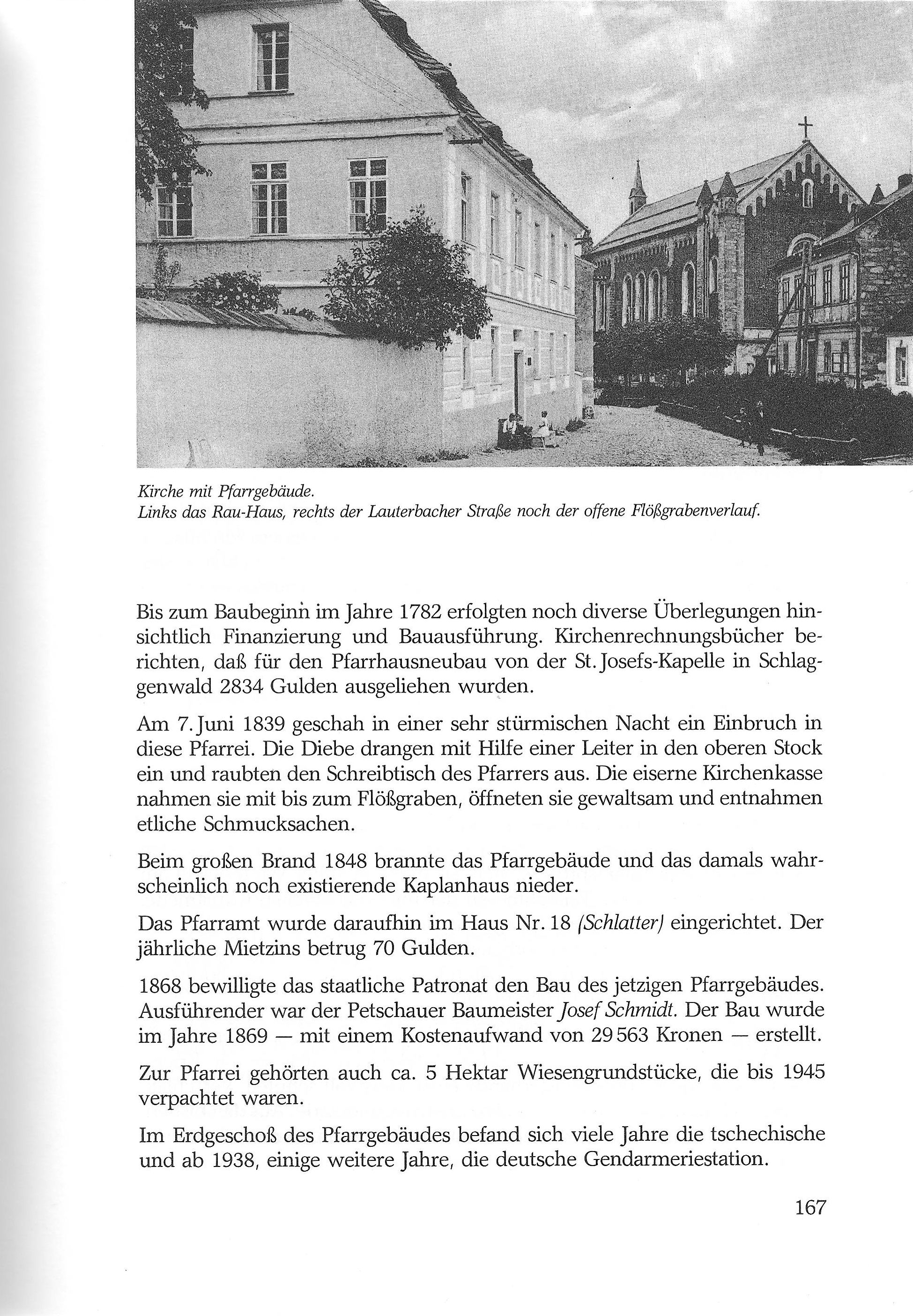 167
Church with rectory.
To the left is the Rau House, to the right of Lauterbacher Street is
the open course of the rafting ditch.
Before construction began in 1782, various considerations regarding
financing and construction were made. Church account books report that
2,834 guilders were borrowed from St. Joseph's Chapel in Schlaggenwald
for the construction of the new rectory.
On June 7, 1839, a break-in occurred at this parish on a very stormy
night. The thieves used a ladder to enter the upper floor and robbed
the pastor's desk. They took the iron church treasury to the rafting
ditch, opened it by force, and stole several pieces of jewelry.
In the great fire of 1848, the rectory building and the chaplain's
house, which probably still existed at the time, burned down. The
parish office was subsequently established in house number 18
(Schlatter). The annual rent was 70 guilders. In 1868, the state
patronage approved the construction of the current parish building.
The construction was carried out by the Be?ov master builder Josef
Schmidt. The building was completed in 1869 at a cost of 29,563
crowns. The parish also owned approximately 5 hectares of meadowland,
which was leased until 1945.
The ground floor of the parish building housed the Czech gendarmerie
station for many years, and from 1938 onward, for several more years,
the German gendarmerie station.
167
167
Church with rectory.
To the left is the Rau House, to the right of Lauterbacher Street is
the open course of the rafting ditch.
Before construction began in 1782, various considerations regarding
financing and construction were made. Church account books report that
2,834 guilders were borrowed from St. Joseph's Chapel in Schlaggenwald
for the construction of the new rectory.
On June 7, 1839, a break-in occurred at this parish on a very stormy
night. The thieves used a ladder to enter the upper floor and robbed
the pastor's desk. They took the iron church treasury to the rafting
ditch, opened it by force, and stole several pieces of jewelry.
In the great fire of 1848, the rectory building and the chaplain's
house, which probably still existed at the time, burned down. The
parish office was subsequently established in house number 18
(Schlatter). The annual rent was 70 guilders. In 1868, the state
patronage approved the construction of the current parish building.
The construction was carried out by the Be?ov master builder Josef
Schmidt. The building was completed in 1869 at a cost of 29,563
crowns. The parish also owned approximately 5 hectares of meadowland,
which was leased until 1945.
The ground floor of the parish building housed the Czech gendarmerie
station for many years, and from 1938 onward, for several more years,
the German gendarmerie station.
167
Page 0167
 168
Bell Tower and Bells
The bell tower at the old cemetery
It dates back to 1560. A massive, freestanding structure, its lower
section consists of strong, thick stone walls; the upper section is
clad in wood, and the roof was shingled. The old wooden staircase
leads steeply up through a massive framework of beams into the bell
cage. In earlier years, several linden trees stood in front of the
bell tower. The last of these was uprooted by a terrible night storm
in the first weeks of 1861. This linden tree, with its broad canopy of
leaves, is said to have saved the bell tower from destruction by fire
during the great fire of 1848. History of the Bells
In a period of almost 400 years, our hometown – as far as is known
– had no fewer than 11 bells of various sizes. They called the
faithful to worship and to solemn high mass on major feast days. They
resounded at the Resurrection celebrations during the Supplication Day
and the solemn Corpus Christi processions; they invited people to
participate in the midnight mass three times on cold winter nights on
Christmas Eve. With solemn sounds, they accompanied the wedding couple
to the altar and with plaintive voices, they accompanied the deceased
on their final journey to the cemetery. In earlier years, one of the
brazen voices was also directed at the miner, warning him to enter the
mine.
It was left to the 20th century to bring about change here. Like
humans, they too were drafted for war purposes in the two world
wars. What master hands had once skillfully created was now
mercilessly devoured by the smelting furnaces of the war
industry. Previous heralds and admonishers of peace and harmony now
became instruments of death.
168
Bell Tower and Bells
The bell tower at the old cemetery
It dates back to 1560. A massive, freestanding structure, its lower
section consists of strong, thick stone walls; the upper section is
clad in wood, and the roof was shingled. The old wooden staircase
leads steeply up through a massive framework of beams into the bell
cage. In earlier years, several linden trees stood in front of the
bell tower. The last of these was uprooted by a terrible night storm
in the first weeks of 1861. This linden tree, with its broad canopy of
leaves, is said to have saved the bell tower from destruction by fire
during the great fire of 1848. History of the Bells
In a period of almost 400 years, our hometown – as far as is known
– had no fewer than 11 bells of various sizes. They called the
faithful to worship and to solemn high mass on major feast days. They
resounded at the Resurrection celebrations during the Supplication Day
and the solemn Corpus Christi processions; they invited people to
participate in the midnight mass three times on cold winter nights on
Christmas Eve. With solemn sounds, they accompanied the wedding couple
to the altar and with plaintive voices, they accompanied the deceased
on their final journey to the cemetery. In earlier years, one of the
brazen voices was also directed at the miner, warning him to enter the
mine.
It was left to the 20th century to bring about change here. Like
humans, they too were drafted for war purposes in the two world
wars. What master hands had once skillfully created was now
mercilessly devoured by the smelting furnaces of the war
industry. Previous heralds and admonishers of peace and harmony now
became instruments of death.
Page 0168
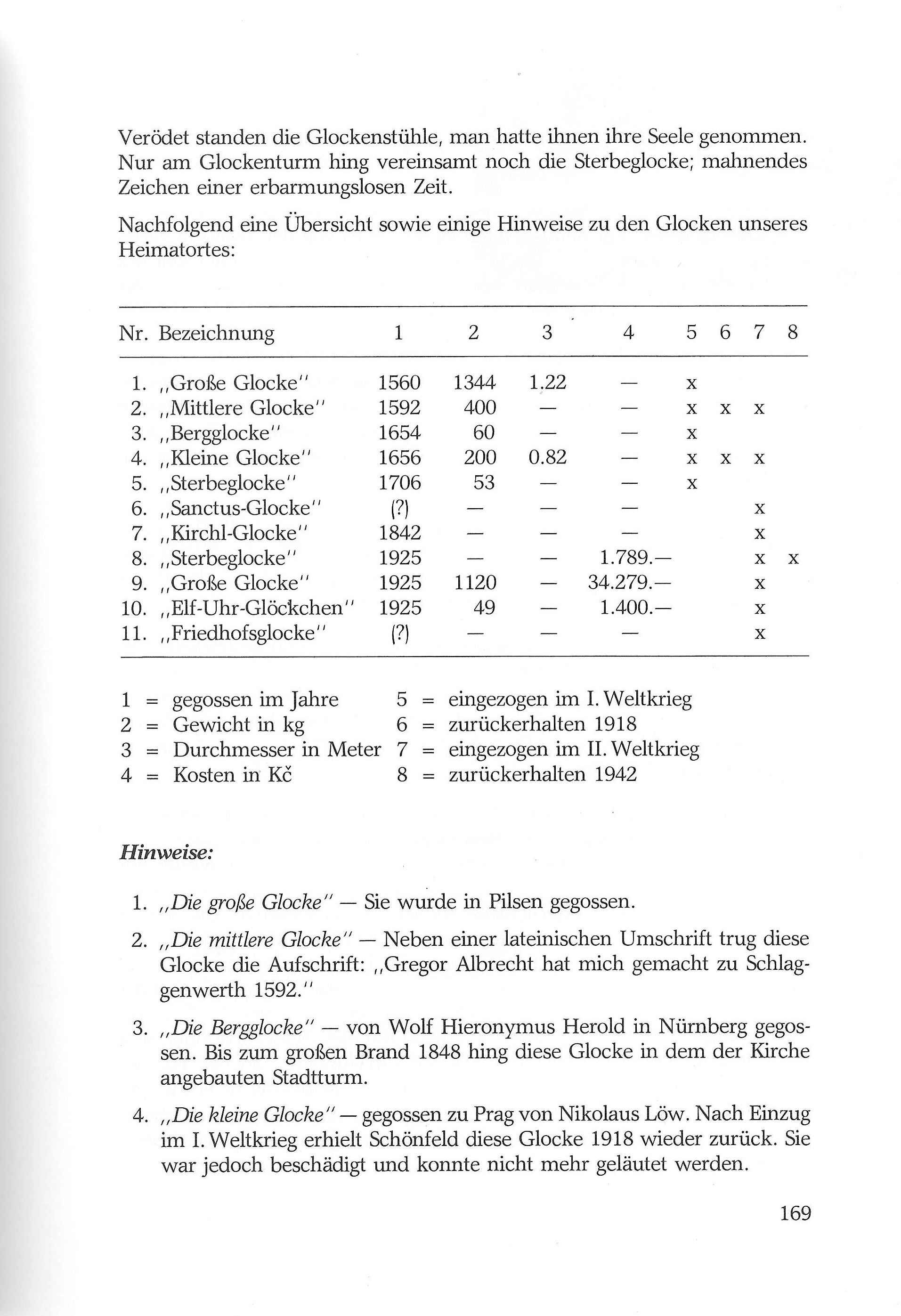 169
The bell towers stood desolate, their souls robbed. Only the death
bell still hung lonely on the bell tower: a warning sign of a
merciless time. Below is an overview and some information about the
bells in our hometown:
No. Description
1
2
3
4
5 6 7 8
1. "Large Bell"
1560 1344
1.22
X
2. "Middle Bell"
1592 400
X
X X
3. "Mountain Bell"
1654
60
X
4. "Small Bell"
1656
200
0.82
X
X
X
5. "Death Bell"
1706
53
X
6. "Sanctus Bell"
(?)
X
7. "Church Bell"
1842
X
8. "Death Bell"
1925
1,789
X
X
9. "Large Bell" Bell"
1925
1120
34,279.-
X
10. "Eleven O'Clock Bell"
1925
49
1,400.-
X
11. "Cemetery Bell"
(?)
X
1
=
2
3
=
=
4
=
Cast in
Weight in kg
5
=
6
Diameter in meters 7
Cost in CZK
=
=
Consigned during World War I, recovered in 1918
Consigned during World War II
8 = recovered in 1942
Notes:
1. "The Large Bell" - It was cast in Pilsen.
2. "The Middle Bell" - In addition to a Latin inscription, this bell
bore the inscription: "Gregor Albrecht made me in Schlaggenwerth
1592."
3. "The Mountain Bell" - cast by Wolf Hieronymus Herold in
Nuremberg. Until the great fire of 1848, this bell hung in the city
tower attached to the church.
4. "The Small Bell" cast in Prague by Nikolaus Löw. After the
conscription into World War I, Schönfeld received this bell back in
1918. However, it was damaged and could no longer be rung. 169
169
The bell towers stood desolate, their souls robbed. Only the death
bell still hung lonely on the bell tower: a warning sign of a
merciless time. Below is an overview and some information about the
bells in our hometown:
No. Description
1
2
3
4
5 6 7 8
1. "Large Bell"
1560 1344
1.22
X
2. "Middle Bell"
1592 400
X
X X
3. "Mountain Bell"
1654
60
X
4. "Small Bell"
1656
200
0.82
X
X
X
5. "Death Bell"
1706
53
X
6. "Sanctus Bell"
(?)
X
7. "Church Bell"
1842
X
8. "Death Bell"
1925
1,789
X
X
9. "Large Bell" Bell"
1925
1120
34,279.-
X
10. "Eleven O'Clock Bell"
1925
49
1,400.-
X
11. "Cemetery Bell"
(?)
X
1
=
2
3
=
=
4
=
Cast in
Weight in kg
5
=
6
Diameter in meters 7
Cost in CZK
=
=
Consigned during World War I, recovered in 1918
Consigned during World War II
8 = recovered in 1942
Notes:
1. "The Large Bell" - It was cast in Pilsen.
2. "The Middle Bell" - In addition to a Latin inscription, this bell
bore the inscription: "Gregor Albrecht made me in Schlaggenwerth
1592."
3. "The Mountain Bell" - cast by Wolf Hieronymus Herold in
Nuremberg. Until the great fire of 1848, this bell hung in the city
tower attached to the church.
4. "The Small Bell" cast in Prague by Nikolaus Löw. After the
conscription into World War I, Schönfeld received this bell back in
1918. However, it was damaged and could no longer be rung. 169
Page 0169
 170
6...Sanctus Bell" - This bell hung in the church tower; it was rung
during services for the Holy Communion and blessing.
7. "Church Bell" - The so-called "Kirgl-Glöckl" hung in the tower of
the poorhouse. Before World War I, it was rung by the inmates at
funerals for a small fee. Due to the dilapidated state of the
building, it was removed and later stored in the local museum until
the residents moved in.
In the first years after World War I, a bell committee was founded
with the goal of acquiring new bells. This committee included, among
others: Pastor Karl Enzmann, Mayor Roman Kempf, City Secretary Josef
Keßler, and Savings Bank Director Wilhelm Ruppert. The following
bells were purchased with the donations received:
8. "The Death Bell" — It was the replacement bell for the one used
in World War I. The necessary funds were provided by the Catholic
Women's Relief Society in Schönfeld. The bell was cast in 1925 by
Richard Herold in Komotau.
9. "The Large Bell" - This was made in the same bell foundry; it had a
"C" pitch. The funds for this precious piece, weighing more than a
ton, came from house collections and donations from Schönfeld
residents living abroad. In addition, the net proceeds from several
theater events flowed into the bell fund.
On Thursday, July 9, 1925, the "Great Bell" arrived in
Schönfeld. Despite the preceding days of rain, the bell consecration
took place on July 12, Eger Sunday. This festive day began early at
7:00 a.m. with a musical wake-up call and several cannon
shots. Wonderful summer Sunday weather, with a bright blue sky,
further enhanced the already festive mood among the population. Soon
after, all local clubs, as well as members of the city administration
and the clergy, gathered. Accompanied by music, the procession,
including the decorated floats with the bell sponsors and their maids
of honor, moved to the lower edge of the village, where the
flower-garlanded float bearing the bell, which had already been
waiting at the Rupperth Tannery, was added to the
procession. Afterwards, the procession returned to the market square,
where a festive stage had been set up days before.
170
170
6...Sanctus Bell" - This bell hung in the church tower; it was rung
during services for the Holy Communion and blessing.
7. "Church Bell" - The so-called "Kirgl-Glöckl" hung in the tower of
the poorhouse. Before World War I, it was rung by the inmates at
funerals for a small fee. Due to the dilapidated state of the
building, it was removed and later stored in the local museum until
the residents moved in.
In the first years after World War I, a bell committee was founded
with the goal of acquiring new bells. This committee included, among
others: Pastor Karl Enzmann, Mayor Roman Kempf, City Secretary Josef
Keßler, and Savings Bank Director Wilhelm Ruppert. The following
bells were purchased with the donations received:
8. "The Death Bell" — It was the replacement bell for the one used
in World War I. The necessary funds were provided by the Catholic
Women's Relief Society in Schönfeld. The bell was cast in 1925 by
Richard Herold in Komotau.
9. "The Large Bell" - This was made in the same bell foundry; it had a
"C" pitch. The funds for this precious piece, weighing more than a
ton, came from house collections and donations from Schönfeld
residents living abroad. In addition, the net proceeds from several
theater events flowed into the bell fund.
On Thursday, July 9, 1925, the "Great Bell" arrived in
Schönfeld. Despite the preceding days of rain, the bell consecration
took place on July 12, Eger Sunday. This festive day began early at
7:00 a.m. with a musical wake-up call and several cannon
shots. Wonderful summer Sunday weather, with a bright blue sky,
further enhanced the already festive mood among the population. Soon
after, all local clubs, as well as members of the city administration
and the clergy, gathered. Accompanied by music, the procession,
including the decorated floats with the bell sponsors and their maids
of honor, moved to the lower edge of the village, where the
flower-garlanded float bearing the bell, which had already been
waiting at the Rupperth Tannery, was added to the
procession. Afterwards, the procession returned to the market square,
where a festive stage had been set up days before.
170
Page 0170
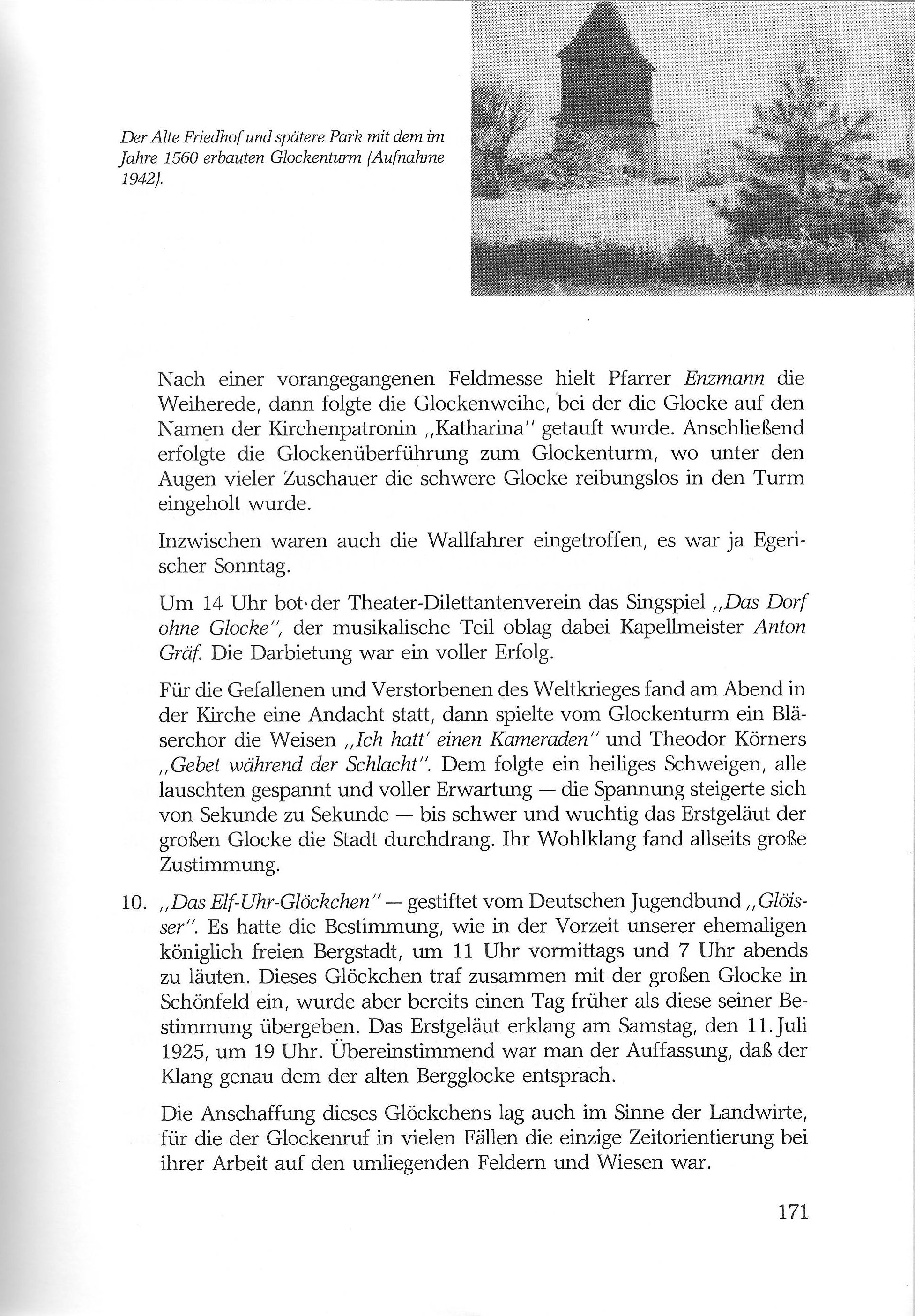 171
The Old Cemetery and later park with the bell tower built in 1560
(photo taken in 1942).
After a field mass, Pastor Enzmann gave the consecration speech,
followed by the bell consecration, during which the bell was named
after the church's patron saint, "Katharina." The bell was then
transferred to the bell tower, where, under the watchful eyes of many
spectators, the heavy bell was smoothly lowered into the tower.
Meanwhile, the pilgrims had also arrived; it was Eger Sunday, after
all. At 2 p.m., the Theater-Amateursverein presented the musical "The
Village Without a Bell." The musical part was conducted by conductor
Anton Gräf. The performance was a complete success.
A service for the fallen and deceased of the World War was held in the
church that evening, followed by a brass choir playing the tunes "I
Had a Comrade" and Theodor Körner's "Prayer During the Battle" from
the bell tower. This was followed by a sacred silence, as everyone
listened intently and full of anticipation – the tension increasing
from second to second – until the heavy and powerful first ringing
of the great bell pierced the town. Its melodious sound was met with
universal approval.
10. "The Eleven O'Clock Bell" donated by the German Youth Association,
"Glöisser." Its purpose was to ring, as in the ancient times of our
former royal free mining town, at 11 a.m. and 7 p.m. This bell
coincided. with the large bell in Schönfeld, but was dedicated to its
intended purpose one day earlier. The first ringing took place on
Saturday, July 11, 1925, at 7 p.m. There was unanimous agreement that
the sound exactly matched that of the old mountain bell. The
acquisition of this small bell was also in the interest of the
farmers, for whom the ringing of the bell was often the only way to
determine time while working in the surrounding fields and meadows.
171
171
The Old Cemetery and later park with the bell tower built in 1560
(photo taken in 1942).
After a field mass, Pastor Enzmann gave the consecration speech,
followed by the bell consecration, during which the bell was named
after the church's patron saint, "Katharina." The bell was then
transferred to the bell tower, where, under the watchful eyes of many
spectators, the heavy bell was smoothly lowered into the tower.
Meanwhile, the pilgrims had also arrived; it was Eger Sunday, after
all. At 2 p.m., the Theater-Amateursverein presented the musical "The
Village Without a Bell." The musical part was conducted by conductor
Anton Gräf. The performance was a complete success.
A service for the fallen and deceased of the World War was held in the
church that evening, followed by a brass choir playing the tunes "I
Had a Comrade" and Theodor Körner's "Prayer During the Battle" from
the bell tower. This was followed by a sacred silence, as everyone
listened intently and full of anticipation – the tension increasing
from second to second – until the heavy and powerful first ringing
of the great bell pierced the town. Its melodious sound was met with
universal approval.
10. "The Eleven O'Clock Bell" donated by the German Youth Association,
"Glöisser." Its purpose was to ring, as in the ancient times of our
former royal free mining town, at 11 a.m. and 7 p.m. This bell
coincided. with the large bell in Schönfeld, but was dedicated to its
intended purpose one day earlier. The first ringing took place on
Saturday, July 11, 1925, at 7 p.m. There was unanimous agreement that
the sound exactly matched that of the old mountain bell. The
acquisition of this small bell was also in the interest of the
farmers, for whom the ringing of the bell was often the only way to
determine time while working in the surrounding fields and meadows.
171
Page 0171
 172
Cemeteries
The Old Cemetery and Later Park
In earlier years, the old cemetery surrounded the church, as confirmed
by bone discoveries – especially during the covering of the raft
ditch. Later, the cemetery grounds were located only behind the
church. It extended as far as the bell tower and the mortuary that was
then attached to it. In 1839, the cemetery wall was renewed, and just
two years later, the then mayor, Alois Roth, had 23 poplars
planted. In 1860, the entire width of the cemetery was expanded to the
south (Paint), and this section also received a wall enclosure.
Burials at that time took place at 10 a.m., with coffins being carried
to the grave on a stretcher. In 1901, the new cemetery was
established on Petschauer Straße, and the old cemetery was closed
in 1918. In 1922, the last remaining gravestones were removed, the
burial mounds leveled, and the entire area was sown with grass
seed. The municipality later leased the meadow. The only memento of
the former churchyard was a 16th-century epitaph (memorial monument)
set into the upper wall. From 1925 to 1934/35, every year on "Tree
Day," the upper elementary school class planted fruit trees on this
site. In this way, under the expert guidance of senior teacher Franz
Jordan, the fruit tree population grew to 35 trees. At the suggestion
of the Tourism Commission, under its then chairman Fredl Ruppert, the
municipality approved the creation of a park. Work began in the spring
of 1935. 172
172
Cemeteries
The Old Cemetery and Later Park
In earlier years, the old cemetery surrounded the church, as confirmed
by bone discoveries – especially during the covering of the raft
ditch. Later, the cemetery grounds were located only behind the
church. It extended as far as the bell tower and the mortuary that was
then attached to it. In 1839, the cemetery wall was renewed, and just
two years later, the then mayor, Alois Roth, had 23 poplars
planted. In 1860, the entire width of the cemetery was expanded to the
south (Paint), and this section also received a wall enclosure.
Burials at that time took place at 10 a.m., with coffins being carried
to the grave on a stretcher. In 1901, the new cemetery was
established on Petschauer Straße, and the old cemetery was closed
in 1918. In 1922, the last remaining gravestones were removed, the
burial mounds leveled, and the entire area was sown with grass
seed. The municipality later leased the meadow. The only memento of
the former churchyard was a 16th-century epitaph (memorial monument)
set into the upper wall. From 1925 to 1934/35, every year on "Tree
Day," the upper elementary school class planted fruit trees on this
site. In this way, under the expert guidance of senior teacher Franz
Jordan, the fruit tree population grew to 35 trees. At the suggestion
of the Tourism Commission, under its then chairman Fredl Ruppert, the
municipality approved the creation of a park. Work began in the spring
of 1935. 172
Page 0172
 173
Teacher Oskar Hubl took over the design, working on this task with
great zeal and dedication. He was also the most suitable man for this
project, as he possessed the necessary botanical knowledge. From time
to time, he was able to involve some students in this work, who were a
valuable help to him. He also received support from his brother,
teacher Josef Hubl, and later from Amtstätter Eduard.
Probably inspired by our local landscape, he paid particular attention
to the rock gardens. The stones, brought by Roßmeißl Beb by
truck, came from the Hohenstein. Some of them were quite heavy,
lichen- and moss-covered boulders, which were then dragged to their
intended locations by strong, young men. The plants and ornamental
trees came from the castle gardens in Petschau and from the tree
nurseries in D??ín and Eisenberg. Twelve conifers arrived from
local Schönfeld residents in Komotau, and they were given a special
place, later called the "Komotau Corner." Schönfeld residents also
contributed financially to the planting.
Next to the bell tower, Hubl built a playground for the kindergarten.
In July 1943, a memorial to the fallen was erected in the center of
the park (see also Chronicle).
Most visitors enjoyed holding a short prayer at the Mount of Olives
Chapel after leaving the park via the wide stone steps.
This chapel was built by Josef Zickler and several other donors in
1837. The cost was 137 guilders. The Mount of Olives Chapel was the
property of the church.
173
173
Teacher Oskar Hubl took over the design, working on this task with
great zeal and dedication. He was also the most suitable man for this
project, as he possessed the necessary botanical knowledge. From time
to time, he was able to involve some students in this work, who were a
valuable help to him. He also received support from his brother,
teacher Josef Hubl, and later from Amtstätter Eduard.
Probably inspired by our local landscape, he paid particular attention
to the rock gardens. The stones, brought by Roßmeißl Beb by
truck, came from the Hohenstein. Some of them were quite heavy,
lichen- and moss-covered boulders, which were then dragged to their
intended locations by strong, young men. The plants and ornamental
trees came from the castle gardens in Petschau and from the tree
nurseries in D??ín and Eisenberg. Twelve conifers arrived from
local Schönfeld residents in Komotau, and they were given a special
place, later called the "Komotau Corner." Schönfeld residents also
contributed financially to the planting.
Next to the bell tower, Hubl built a playground for the kindergarten.
In July 1943, a memorial to the fallen was erected in the center of
the park (see also Chronicle).
Most visitors enjoyed holding a short prayer at the Mount of Olives
Chapel after leaving the park via the wide stone steps.
This chapel was built by Josef Zickler and several other donors in
1837. The cost was 137 guilders. The Mount of Olives Chapel was the
property of the church.
173
Page 0173
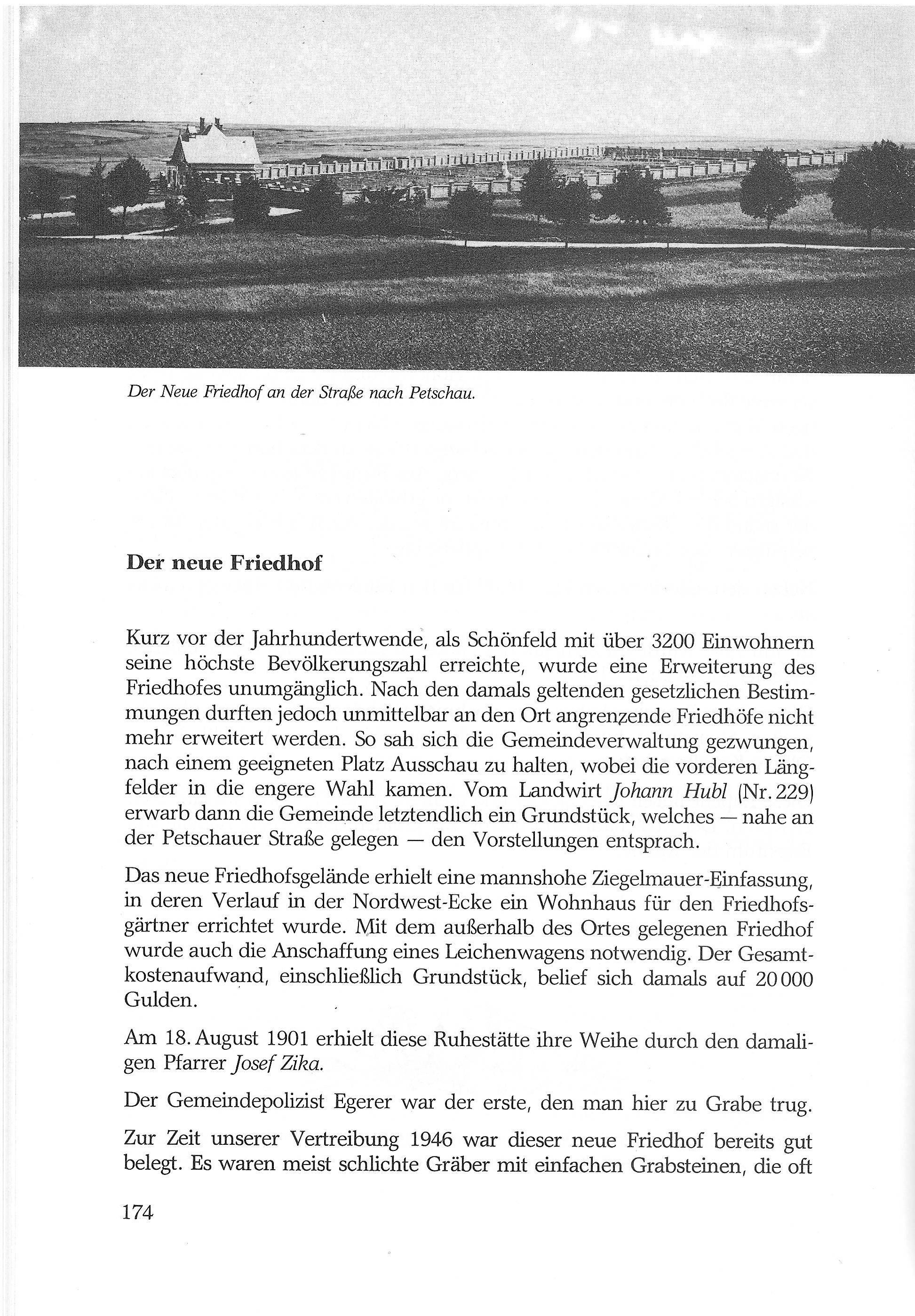 174
The New Cemetery on the road to Petschau.
The New Cemetery
Shortly before the turn of the century, when Schönfeld reached its
peak population of over 3,200 residents, an expansion of the cemetery
became unavoidable. However, according to the legal regulations in
force at the time, cemeteries directly adjacent to the village were no
longer allowed to be expanded. The municipal administration was
therefore forced to search for a suitable site, with the front
Längfelder being shortlisted. The municipality ultimately acquired
a plot of land from farmer Johann Hubl (No. 229), which – located
near Petschauer Straße – met their requirements.
The new cemetery grounds were enclosed by a man-high brick wall,
within which a house for the cemetery gardener was built in the
northwest corner. With the cemetery located outside the village, the
purchase of a hearse also became necessary. The total cost, including
the land, amounted to 20,000 guilders at the time. On August 18, 1901,
this resting place was consecrated by the then pastor, Josef Zika.
The local policeman Egerer was the first to be buried here. By the
time of our expulsion in 1946, this new cemetery was already well
occupied. The graves were mostly simple with simple headstones, often
174
174
The New Cemetery on the road to Petschau.
The New Cemetery
Shortly before the turn of the century, when Schönfeld reached its
peak population of over 3,200 residents, an expansion of the cemetery
became unavoidable. However, according to the legal regulations in
force at the time, cemeteries directly adjacent to the village were no
longer allowed to be expanded. The municipal administration was
therefore forced to search for a suitable site, with the front
Längfelder being shortlisted. The municipality ultimately acquired
a plot of land from farmer Johann Hubl (No. 229), which – located
near Petschauer Straße – met their requirements.
The new cemetery grounds were enclosed by a man-high brick wall,
within which a house for the cemetery gardener was built in the
northwest corner. With the cemetery located outside the village, the
purchase of a hearse also became necessary. The total cost, including
the land, amounted to 20,000 guilders at the time. On August 18, 1901,
this resting place was consecrated by the then pastor, Josef Zika.
The local policeman Egerer was the first to be buried here. By the
time of our expulsion in 1946, this new cemetery was already well
occupied. The graves were mostly simple with simple headstones, often
174
Page 0174
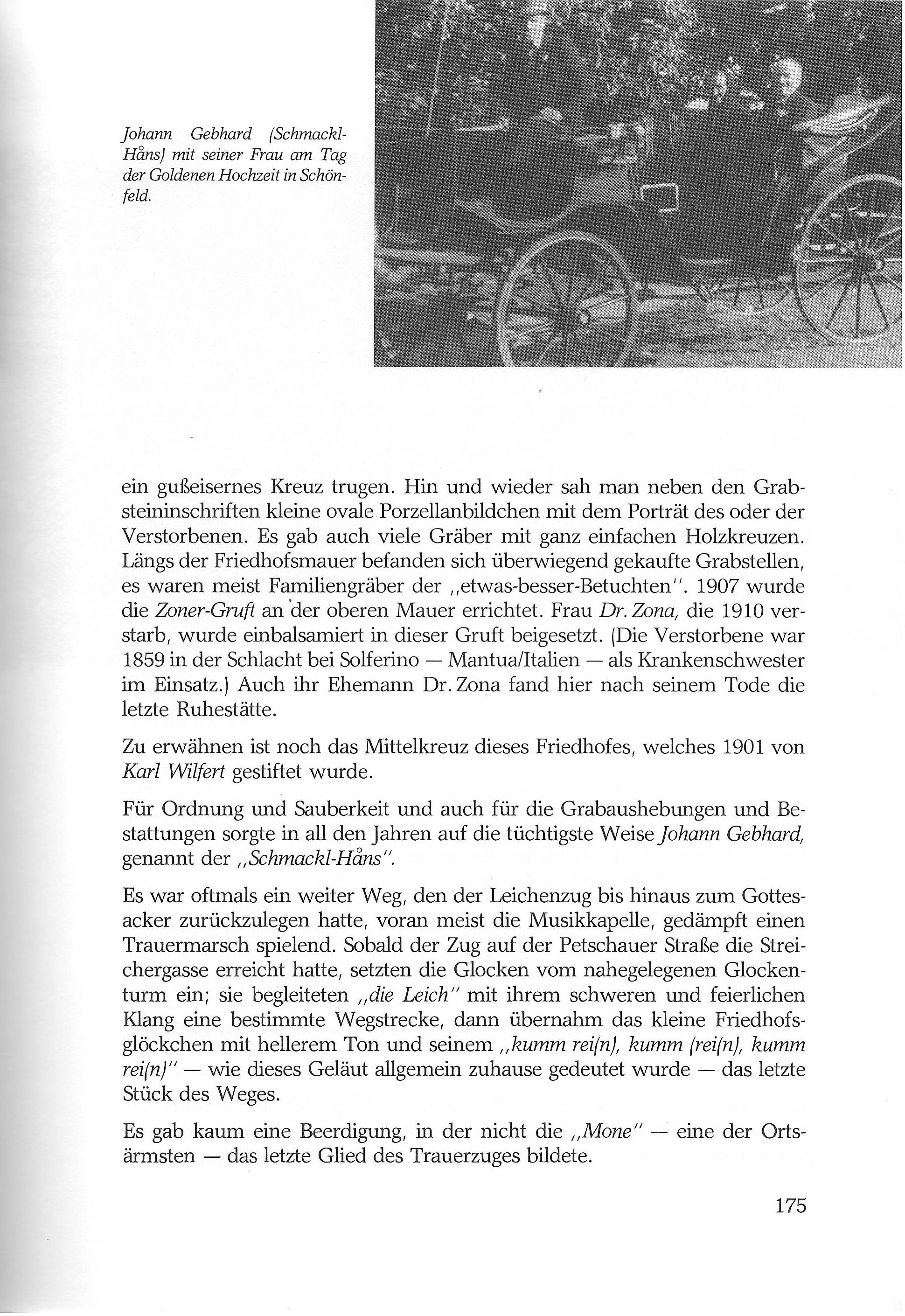 175
Johann Gebhard (Schmackl-Håns) with his wife on their golden
wedding anniversary in Schönfeld. carried a cast-iron
cross. Occasionally, one could see small oval porcelain pictures with
the portrait of the deceased next to the gravestone
inscriptions. There were also many graves with very simple wooden
crosses. Along the cemetery wall, there were mostly purchased graves,
mostly family graves of the "slightly better-off." In 1907, the Zoner
crypt was built on the upper wall. Dr. Zona, who died in 1910, was
embalmed and buried in this crypt. (The deceased served as a nurse in
the Battle of Solferino - Mantua, Italy - in 1859.) Her husband,
Dr. Zona, also found his final resting place here after his death.
Also worth mentioning is the central cross of this cemetery, donated
by Karl Wilfert in 1901.
Johann Gebhard, known as "Schmackl-Hans," skillfully ensured order and
cleanliness, as well as grave digging and burials, throughout the
years. It was often a long journey for the funeral procession to reach
the churchyard, usually led by the band, playing a muted funeral
march. As soon as the procession reached Streichergasse on Petschauer
Straße, the bells from the nearby bell tower began to ring; they
accompanied "the corpse" with their heavy and solemn sound for a
certain distance, then the small cemetery bell, with its brighter tone
and its "come in, come in, come in"—as this ringing was generally
interpreted at home—took over the last part of the journey.
There was hardly a funeral in which the poorest "Mone" did not form
the last part of the funeral procession. one of the local 175
175
Johann Gebhard (Schmackl-Håns) with his wife on their golden
wedding anniversary in Schönfeld. carried a cast-iron
cross. Occasionally, one could see small oval porcelain pictures with
the portrait of the deceased next to the gravestone
inscriptions. There were also many graves with very simple wooden
crosses. Along the cemetery wall, there were mostly purchased graves,
mostly family graves of the "slightly better-off." In 1907, the Zoner
crypt was built on the upper wall. Dr. Zona, who died in 1910, was
embalmed and buried in this crypt. (The deceased served as a nurse in
the Battle of Solferino - Mantua, Italy - in 1859.) Her husband,
Dr. Zona, also found his final resting place here after his death.
Also worth mentioning is the central cross of this cemetery, donated
by Karl Wilfert in 1901.
Johann Gebhard, known as "Schmackl-Hans," skillfully ensured order and
cleanliness, as well as grave digging and burials, throughout the
years. It was often a long journey for the funeral procession to reach
the churchyard, usually led by the band, playing a muted funeral
march. As soon as the procession reached Streichergasse on Petschauer
Straße, the bells from the nearby bell tower began to ring; they
accompanied "the corpse" with their heavy and solemn sound for a
certain distance, then the small cemetery bell, with its brighter tone
and its "come in, come in, come in"—as this ringing was generally
interpreted at home—took over the last part of the journey.
There was hardly a funeral in which the poorest "Mone" did not form
the last part of the funeral procession. one of the local 175
Page 0175
 176
Chapels, Statues, Wayside Crosses, and Martyrs
According to a list from the mid-19th century in the Schönfeld parish
archives, 29 statues and wayside crosses were distributed throughout
the parish at that time. The most important and well-known ones will
be briefly mentioned here:
"The Maria Schnee Chapel," also popularly known as the Streicher or
Zickler Chapel. In the vaulted space of the chapel stood a statue of
St. Mary with the Infant Jesus. The baroque painted wooden figures
dated from the 18th century. This chapel, at the exit of
Streichergasse, was flanked by two chestnut trees.
"The Trinity Column" at the old market. A tall column placed on a
stepped pedestal bore a group image of the Holy Trinity. The pedestal
had a protruding base supporting a statue of St. Mary. The sacred
square had a circular enclosure consisting of four base pillars with
iron railings between them. On the two door pillars were statues of
St. Joachim and St. Anne. The pillar slab of the monument bore the
inscription: J. Wild 1806 on the back. The sculptor Wild from Elbogen
received the commission for the Trinity statue group from the Zickler
family in Schönfeld (264).
"St. Florian Statue" on the market square (opposite Floth 112). The
base with the patron saint against fire bore the inscription: "Pray
for us, O St. Florian!" - 1809.
Not far from it stood the Baroque statue of "St. Anthony of Padua."
The statue had no inscription.
Both statues presented a rather bare appearance; a fence with some
floral decorations would have contributed not only to their
beautification, but also to the beautification of the entire market
square.
176
176
Chapels, Statues, Wayside Crosses, and Martyrs
According to a list from the mid-19th century in the Schönfeld parish
archives, 29 statues and wayside crosses were distributed throughout
the parish at that time. The most important and well-known ones will
be briefly mentioned here:
"The Maria Schnee Chapel," also popularly known as the Streicher or
Zickler Chapel. In the vaulted space of the chapel stood a statue of
St. Mary with the Infant Jesus. The baroque painted wooden figures
dated from the 18th century. This chapel, at the exit of
Streichergasse, was flanked by two chestnut trees.
"The Trinity Column" at the old market. A tall column placed on a
stepped pedestal bore a group image of the Holy Trinity. The pedestal
had a protruding base supporting a statue of St. Mary. The sacred
square had a circular enclosure consisting of four base pillars with
iron railings between them. On the two door pillars were statues of
St. Joachim and St. Anne. The pillar slab of the monument bore the
inscription: J. Wild 1806 on the back. The sculptor Wild from Elbogen
received the commission for the Trinity statue group from the Zickler
family in Schönfeld (264).
"St. Florian Statue" on the market square (opposite Floth 112). The
base with the patron saint against fire bore the inscription: "Pray
for us, O St. Florian!" - 1809.
Not far from it stood the Baroque statue of "St. Anthony of Padua."
The statue had no inscription.
Both statues presented a rather bare appearance; a fence with some
floral decorations would have contributed not only to their
beautification, but also to the beautification of the entire market
square.
176
Page 0176
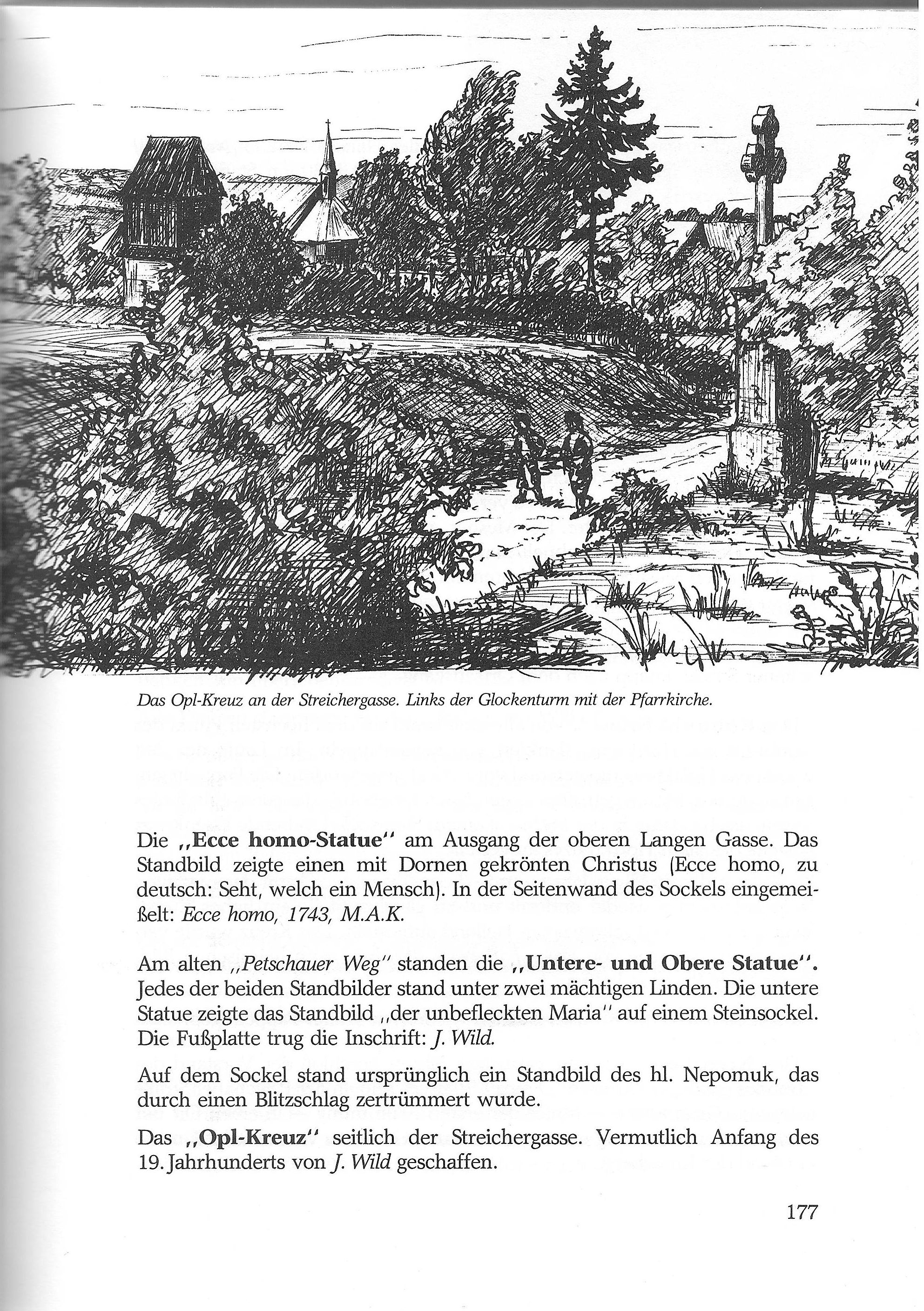 177
The Opl Cross on Streichergasse. To the left, the bell tower with the
parish church.
The "Ecce homo" statue at the exit of the upper Lange Gasse. The
statue depicted a Christ crowned with thorns (Ecce homo, in German:
Behold, what a man). Carved into the side wall of the base: Belt: Ecce
homo, 1743, M.A.K.
On the old "Petschauer Weg" stood the "Lower and Upper Statues." Each
of the two statues stood beneath two mighty linden trees. The lower
statue depicted the statue of "the Immaculate Mary" on a stone
pedestal. The baseplate bore the inscription: J. Wild.
The pedestal originally held a statue of St. Nepomuk, which was
shattered by a lightning strike.
The "Opl Cross" on the side of Streichergasse. Probably created by
J. Wild in the early 19th century.
177
177
The Opl Cross on Streichergasse. To the left, the bell tower with the
parish church.
The "Ecce homo" statue at the exit of the upper Lange Gasse. The
statue depicted a Christ crowned with thorns (Ecce homo, in German:
Behold, what a man). Carved into the side wall of the base: Belt: Ecce
homo, 1743, M.A.K.
On the old "Petschauer Weg" stood the "Lower and Upper Statues." Each
of the two statues stood beneath two mighty linden trees. The lower
statue depicted the statue of "the Immaculate Mary" on a stone
pedestal. The baseplate bore the inscription: J. Wild.
The pedestal originally held a statue of St. Nepomuk, which was
shattered by a lightning strike.
The "Opl Cross" on the side of Streichergasse. Probably created by
J. Wild in the early 19th century.
177
Page 0177
 178
In Rathausgasse, a vaulted niche was built into the gate wall of house
no. 233 (Neue Welt). Since 1830, a statue of "St. Nepomuk" had stood
in it. Also well known is the statue of "St. Mother Anna" below the
district of "Neukaunitz" (New Moscow). On the road to Lauterbach,
before the junction of Herrenholzweg, stood a pillar, the "Stone
Martyrdom." It was 4.5 meters high. It was erected in 1678 by the then
pastor of Schönfeld, Andreas Friedrich Etter.
According to popular belief, Pastor Etter and his sacristan, a very
old man, were supposedly visiting a sick man in Lauterbach, which at
that time was still part of the parish of Schönfeld, during the winter
to administer the last rites. On their way back, they encountered a
terrible storm. The sacristan, completely exhausted, could go no
further. The pastor quickly rushed to Schönfeld for help. However, the
sacristan was found frozen to death, supposedly at the spot where the
stone pillar still stood today.
"The Fourteen Holy Helpers," a picture panel on a poplar tree to the
left of Petschauer Straße, Just after leaving the village. The
Kühbühl Cross. Since ancient times, a wooden cross stood on the
highest point of Kühbühl, flanked by two poplars. Over time, the
wooden cross became rotten and toppled by the wind. The poplars died
– often struck by lightning. After the Old Cemetery was leveled,
the iron cross, which had previously stood in the center on a stone
base, was erected in place of the old wooden cross.
At the beginning of the 1930s, this iron cross, along with its massive
stone pedestal, was removed, and a tall artificial stone cross
depicting the crucified Savior was erected in its place. The cross was
probably created by the local sculptor Willy Russ on behalf of Franz
J. Ruppert (Poschetz). Poplars were planted on both sides of the
cross, as before.
"The Cross Mountain." In the 1920s, the chairman of the "Association
of Believing Christians," Franz J. Ruppert, decided to transform his
property on Petschauer Straße – beyond the first bend – into
a place of prayer, contemplation, and worship of God. And so the
Kreuzberg was born.
178
178
In Rathausgasse, a vaulted niche was built into the gate wall of house
no. 233 (Neue Welt). Since 1830, a statue of "St. Nepomuk" had stood
in it. Also well known is the statue of "St. Mother Anna" below the
district of "Neukaunitz" (New Moscow). On the road to Lauterbach,
before the junction of Herrenholzweg, stood a pillar, the "Stone
Martyrdom." It was 4.5 meters high. It was erected in 1678 by the then
pastor of Schönfeld, Andreas Friedrich Etter.
According to popular belief, Pastor Etter and his sacristan, a very
old man, were supposedly visiting a sick man in Lauterbach, which at
that time was still part of the parish of Schönfeld, during the winter
to administer the last rites. On their way back, they encountered a
terrible storm. The sacristan, completely exhausted, could go no
further. The pastor quickly rushed to Schönfeld for help. However, the
sacristan was found frozen to death, supposedly at the spot where the
stone pillar still stood today.
"The Fourteen Holy Helpers," a picture panel on a poplar tree to the
left of Petschauer Straße, Just after leaving the village. The
Kühbühl Cross. Since ancient times, a wooden cross stood on the
highest point of Kühbühl, flanked by two poplars. Over time, the
wooden cross became rotten and toppled by the wind. The poplars died
– often struck by lightning. After the Old Cemetery was leveled,
the iron cross, which had previously stood in the center on a stone
base, was erected in place of the old wooden cross.
At the beginning of the 1930s, this iron cross, along with its massive
stone pedestal, was removed, and a tall artificial stone cross
depicting the crucified Savior was erected in its place. The cross was
probably created by the local sculptor Willy Russ on behalf of Franz
J. Ruppert (Poschetz). Poplars were planted on both sides of the
cross, as before.
"The Cross Mountain." In the 1920s, the chairman of the "Association
of Believing Christians," Franz J. Ruppert, decided to transform his
property on Petschauer Straße – beyond the first bend – into
a place of prayer, contemplation, and worship of God. And so the
Kreuzberg was born.
178
Page 0178
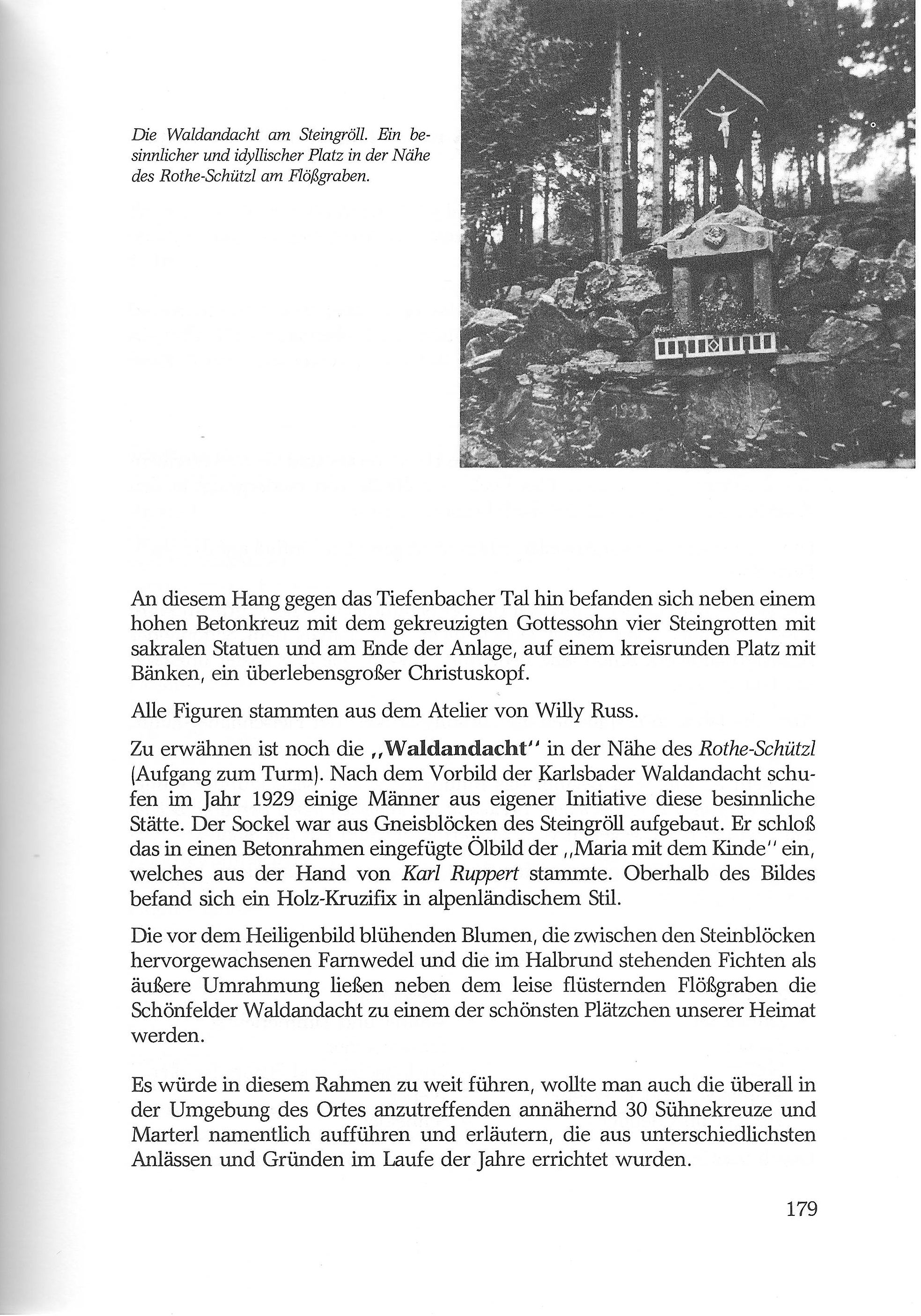 179
The Forest Prayer at Steingröll. A contemplative and idyllic spot near
the Rothe-Schützl on the Flößgraben. 1925
On this slope facing the Tiefenbach Valley, next to a tall concrete
cross depicting the crucified Son of God, there were four stone
grottoes with sacred statues, and at the end of the complex, in a
circular square with benches, a larger-than-life head of Christ.
All figures came from the studio of Willy Russ.
Also worth mentioning is the "Forest Prayer" near the Rothe-Schützl
(stairway to the tower). In 1929, following the example of the
Carlsbad Forest Prayer, a few men created this contemplative site on
their own initiative. The base was constructed from gneiss blocks from
the Steingröll (stone rock). It contained an oil painting of "Mary and
Child" by Karl Ruppert, set in a concrete frame. Above the painting
was a wooden crucifix in Alpine style. The flowers blooming in front
of the holy image, the fern fronds growing between the stone blocks,
and the spruce trees standing in a semicircle as an outer frame, along
with the gently whispering rafting ditch, made the Schönfeld Forest
Prayer one of the most beautiful places in our region. It would go
beyond the scope of this article to list and explain by name the
approximately 30 atonement crosses and shrines found throughout the
area, which were erected over the years for a variety of reasons and
occasions.
179
179
The Forest Prayer at Steingröll. A contemplative and idyllic spot near
the Rothe-Schützl on the Flößgraben. 1925
On this slope facing the Tiefenbach Valley, next to a tall concrete
cross depicting the crucified Son of God, there were four stone
grottoes with sacred statues, and at the end of the complex, in a
circular square with benches, a larger-than-life head of Christ.
All figures came from the studio of Willy Russ.
Also worth mentioning is the "Forest Prayer" near the Rothe-Schützl
(stairway to the tower). In 1929, following the example of the
Carlsbad Forest Prayer, a few men created this contemplative site on
their own initiative. The base was constructed from gneiss blocks from
the Steingröll (stone rock). It contained an oil painting of "Mary and
Child" by Karl Ruppert, set in a concrete frame. Above the painting
was a wooden crucifix in Alpine style. The flowers blooming in front
of the holy image, the fern fronds growing between the stone blocks,
and the spruce trees standing in a semicircle as an outer frame, along
with the gently whispering rafting ditch, made the Schönfeld Forest
Prayer one of the most beautiful places in our region. It would go
beyond the scope of this article to list and explain by name the
approximately 30 atonement crosses and shrines found throughout the
area, which were erected over the years for a variety of reasons and
occasions.
179
Page 0179
 180
Trade and Commerce
The Guild System
Craftsmen and tradespeople were organized in various guilds. The
guilds' rights were laid down in the guild rolls, which were approved
by the city council. The guilds also occasionally exerted
considerable influence on the city's government.
The oldest Schönfeld guild was that of the shoemakers, founded in
1562. This does not, however, mean that the Schönfeld shoemaking trade
already enjoyed the same importance at that time as it would later
around 1900.
The "guild articles" of the Butchers' Guild, issued by the mayor and
the city council of Schönfeld, date from 1600. The guild book of the
Bakers' Guild, "an honorable trade of the basins in the royal free
mining town of Schönfeld," as it is called, begins on July 21, 1644;
issued by the mayor and the city council.
In 1732, the tinsmiths founded their guild; until then, they had
belonged to the Schlaggenwalder guild. According to an Imperial and
Royal circular dated April 15, 1830, item no. 14,412, the following
guilds existed in Schönfeld that year:
Butchers
Masons and Carpenters
Shoemakers
Tearmakers
Pewterers
Bakers
Millers
Blacksmiths,
Binders,
Wheelwrights
Weavers
Tailors
Cloth Makers and Hosiery Makers
Joiners and Bag Makers
All guilds were dissolved by state decree in 1851.
180
180
Trade and Commerce
The Guild System
Craftsmen and tradespeople were organized in various guilds. The
guilds' rights were laid down in the guild rolls, which were approved
by the city council. The guilds also occasionally exerted
considerable influence on the city's government.
The oldest Schönfeld guild was that of the shoemakers, founded in
1562. This does not, however, mean that the Schönfeld shoemaking trade
already enjoyed the same importance at that time as it would later
around 1900.
The "guild articles" of the Butchers' Guild, issued by the mayor and
the city council of Schönfeld, date from 1600. The guild book of the
Bakers' Guild, "an honorable trade of the basins in the royal free
mining town of Schönfeld," as it is called, begins on July 21, 1644;
issued by the mayor and the city council.
In 1732, the tinsmiths founded their guild; until then, they had
belonged to the Schlaggenwalder guild. According to an Imperial and
Royal circular dated April 15, 1830, item no. 14,412, the following
guilds existed in Schönfeld that year:
Butchers
Masons and Carpenters
Shoemakers
Tearmakers
Pewterers
Bakers
Millers
Blacksmiths,
Binders,
Wheelwrights
Weavers
Tailors
Cloth Makers and Hosiery Makers
Joiners and Bag Makers
All guilds were dissolved by state decree in 1851.
180
Page 0180
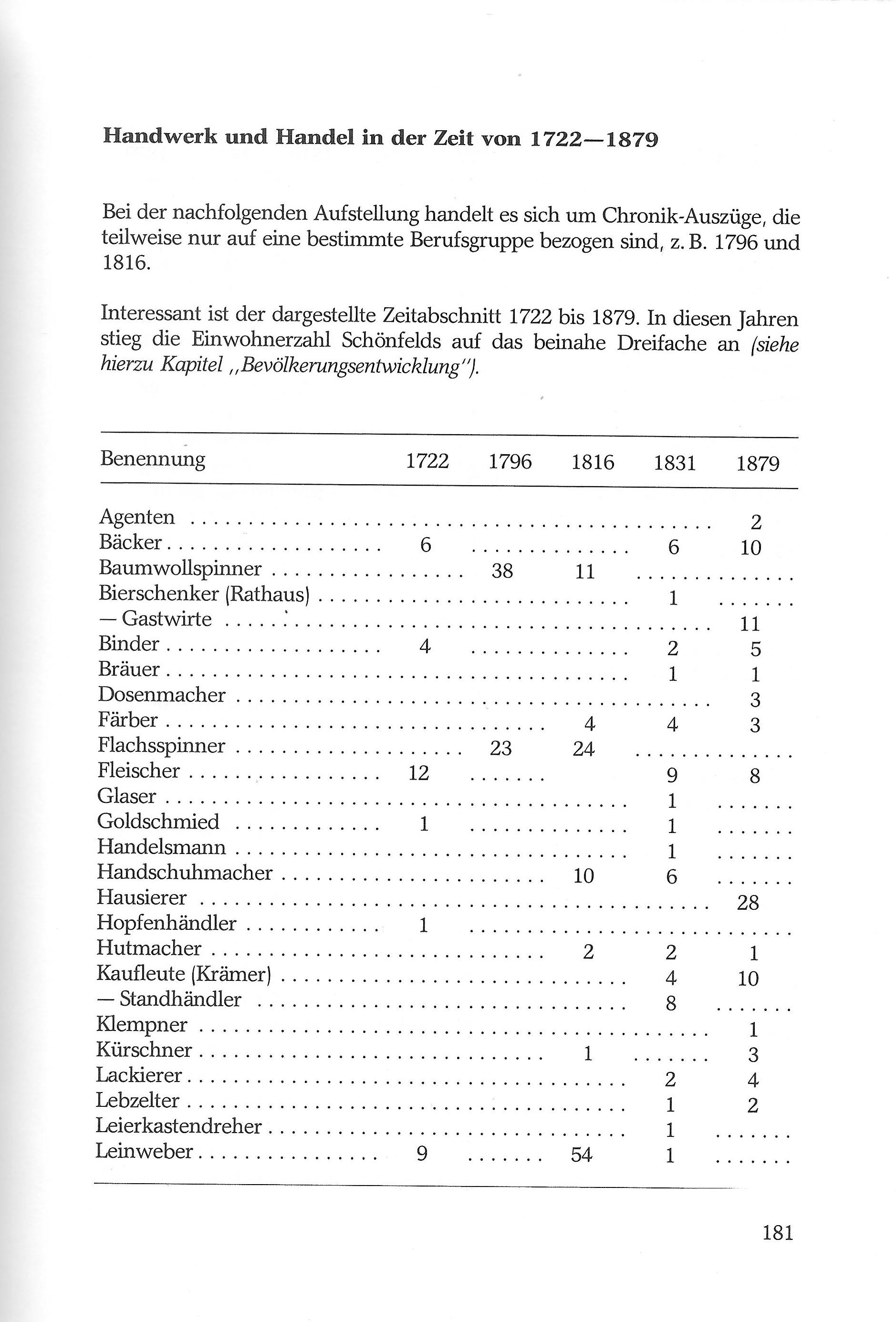 181
Crafts and Trade in the Period 1722-1879
The following list consists of excerpts from chronicles, some of which
relate only to a specific professional group, e.g. B. 1796 and 1816.
The period from 1722 to 1879 is interesting. During these years,
Schönfeld's population almost tripled (see the chapter "Population
Development").
Name
Agents
1722 1796 1816 1831 1879
2
Bakers
6
6
10
Cotton Spinners
Beer Merchants (Town Hall)
38
11
1
- Innkeepers
Binders
11
4
2
5
Brewers
Can Makers
Dyers
Flax Spinners
Butchers
1
1
0
4
4
3
33
23
24
12
9
8
Glaziers
Goldsmiths
1
1
Hat Makers
Merchants
Glove Makers
Peddlers
Hop Merchants
Merchants (Grocer)
- Stallholder
Plumber
1
10
6
28
1
2
24
1
10
8
1
Furrier
1
3
Laquerer
2
4
Gingerbread Maker
1
2
Organ Organ Maker
1
Linen Weaver...
9
54
1
181
181
Crafts and Trade in the Period 1722-1879
The following list consists of excerpts from chronicles, some of which
relate only to a specific professional group, e.g. B. 1796 and 1816.
The period from 1722 to 1879 is interesting. During these years,
Schönfeld's population almost tripled (see the chapter "Population
Development").
Name
Agents
1722 1796 1816 1831 1879
2
Bakers
6
6
10
Cotton Spinners
Beer Merchants (Town Hall)
38
11
1
- Innkeepers
Binders
11
4
2
5
Brewers
Can Makers
Dyers
Flax Spinners
Butchers
1
1
0
4
4
3
33
23
24
12
9
8
Glaziers
Goldsmiths
1
1
Hat Makers
Merchants
Glove Makers
Peddlers
Hop Merchants
Merchants (Grocer)
- Stallholder
Plumber
1
10
6
28
1
2
24
1
10
8
1
Furrier
1
3
Laquerer
2
4
Gingerbread Maker
1
2
Organ Organ Maker
1
Linen Weaver...
9
54
1
181
Page 0181
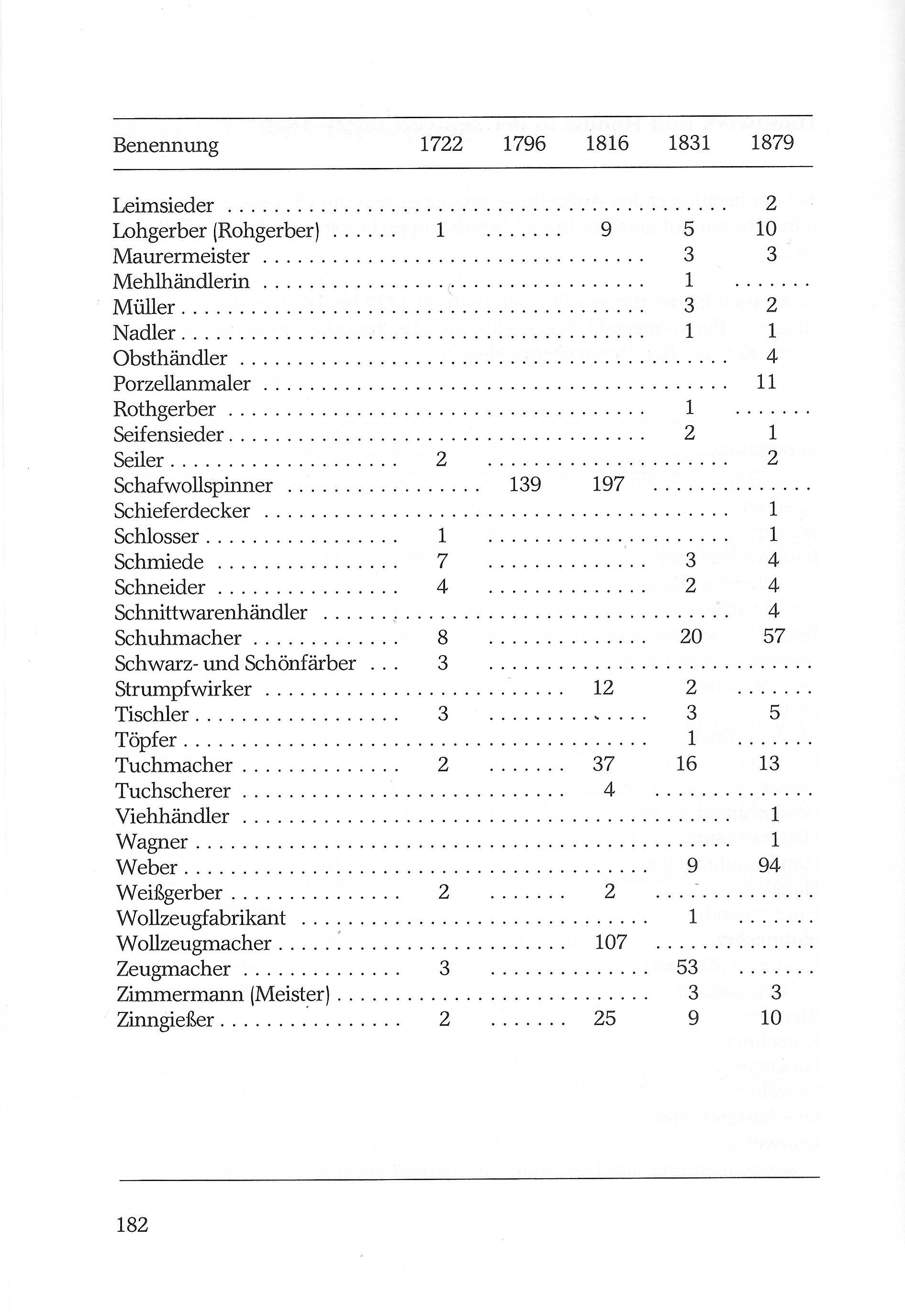 182
Name
Glue Maker
Raw Tanner (Raw Tanner) Master Bricklayer
Flour Merchant
•
1722 1796 1816
1831
1879
2
9
531
5
10
3
Miller
3
2
Needle-maker
Fruit dealer
Porcelain painter
Tanner
1
1
4
11
1
Soap maker
Rope maker
2
1
2
2
Sheep wool spinner
139
197
Slater
Locksmith
1
1
1
Blacksmith
Tailor
Crafts dealer
Shoemaker
Blacksmith and Dyer
Hosier
Carpenter
7
3
4
4
2
4
4
8
20
57
3
•
12
2
3
3
5
Potter
1
Clothmaker
2
37
16
13
Cloth shearer
4
Cattle dealer
1
Wagon driver
1
Weaver
9
94
Tanner
2
2
Woolener manufacturer
1
Woolener
107
Craftsman
3
53
Master carpenter
3
3
Pewterer
2
25
9
10
182
182
Name
Glue Maker
Raw Tanner (Raw Tanner) Master Bricklayer
Flour Merchant
•
1722 1796 1816
1831
1879
2
9
531
5
10
3
Miller
3
2
Needle-maker
Fruit dealer
Porcelain painter
Tanner
1
1
4
11
1
Soap maker
Rope maker
2
1
2
2
Sheep wool spinner
139
197
Slater
Locksmith
1
1
1
Blacksmith
Tailor
Crafts dealer
Shoemaker
Blacksmith and Dyer
Hosier
Carpenter
7
3
4
4
2
4
4
8
20
57
3
•
12
2
3
3
5
Potter
1
Clothmaker
2
37
16
13
Cloth shearer
4
Cattle dealer
1
Wagon driver
1
Weaver
9
94
Tanner
2
2
Woolener manufacturer
1
Woolener
107
Craftsman
3
53
Master carpenter
3
3
Pewterer
2
25
9
10
182
Page 0182
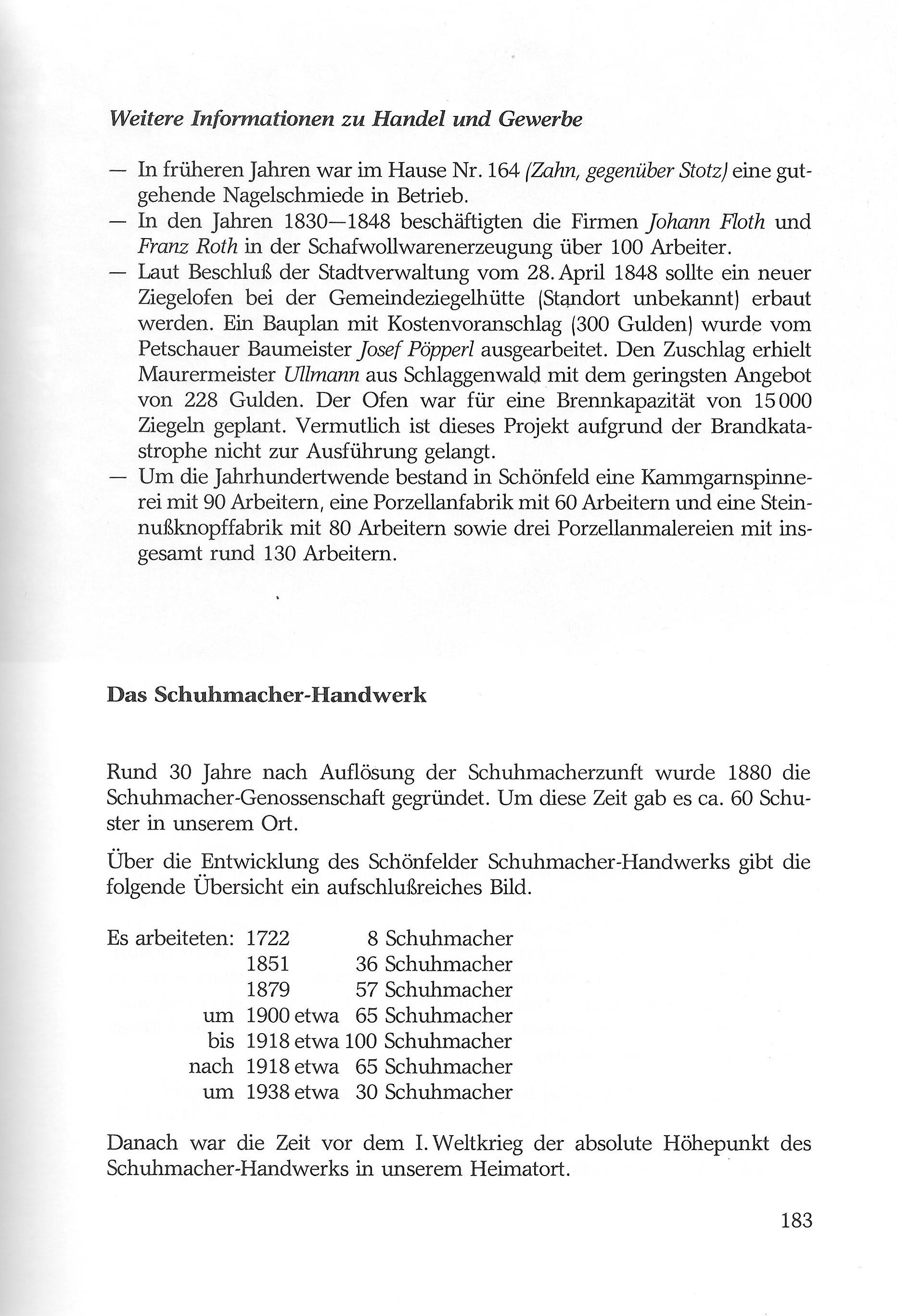 183
Further information on trade and commerce
In earlier years, a thriving nail forge operated at house number 164
(Zahn, opposite Stotz).
- Between 1830 and 1848, the companies Johann Floth and Franz Roth
employed over 100 workers in sheep's wool production.
- According to a resolution passed by the city administration on April
28, 1848, a new brick kiln was to be built at the municipal brickworks
(location unknown). A construction plan with a cost estimate (300
guilders) was drawn up by the Petschau master builder Josef
Pöpperl. Master bricklayer Ullmann from Schlaggenwald was awarded the
contract with the lowest bid of 228 guilders. The kiln was designed to
have a firing capacity of 15,000 bricks. This project was presumably
not implemented due to the fire disaster.
At the turn of the century, Schönfeld was home to a worsted spinning
mill with 90 workers, a porcelain factory with 60 workers, a stone nut
button factory with 80 workers, and three porcelain painting workshops
with a total of around 130 workers.
The Shoemaking Trade
Around 30 years after the dissolution of the shoemakers' guild, the
shoemakers' cooperative was founded in 1880. At that time, there were
approximately 60 shoemakers in our village. The following overview
provides an insightful picture of the development of the Schönfeld
shoemaking trade.
The following worked: 1722 1851 1879 8 shoemakers 36 shoemakers 57
shoemakers around 1900, about 65 shoemakers; until 1918, about 100
shoemakers; after 1918, about 65 shoemakers around 1938, about 30
shoemakers After that, the period before World War I was the absolute
peak of the shoemaking trade in our hometown. 183
183
Further information on trade and commerce
In earlier years, a thriving nail forge operated at house number 164
(Zahn, opposite Stotz).
- Between 1830 and 1848, the companies Johann Floth and Franz Roth
employed over 100 workers in sheep's wool production.
- According to a resolution passed by the city administration on April
28, 1848, a new brick kiln was to be built at the municipal brickworks
(location unknown). A construction plan with a cost estimate (300
guilders) was drawn up by the Petschau master builder Josef
Pöpperl. Master bricklayer Ullmann from Schlaggenwald was awarded the
contract with the lowest bid of 228 guilders. The kiln was designed to
have a firing capacity of 15,000 bricks. This project was presumably
not implemented due to the fire disaster.
At the turn of the century, Schönfeld was home to a worsted spinning
mill with 90 workers, a porcelain factory with 60 workers, a stone nut
button factory with 80 workers, and three porcelain painting workshops
with a total of around 130 workers.
The Shoemaking Trade
Around 30 years after the dissolution of the shoemakers' guild, the
shoemakers' cooperative was founded in 1880. At that time, there were
approximately 60 shoemakers in our village. The following overview
provides an insightful picture of the development of the Schönfeld
shoemaking trade.
The following worked: 1722 1851 1879 8 shoemakers 36 shoemakers 57
shoemakers around 1900, about 65 shoemakers; until 1918, about 100
shoemakers; after 1918, about 65 shoemakers around 1938, about 30
shoemakers After that, the period before World War I was the absolute
peak of the shoemaking trade in our hometown. 183
Page 0183
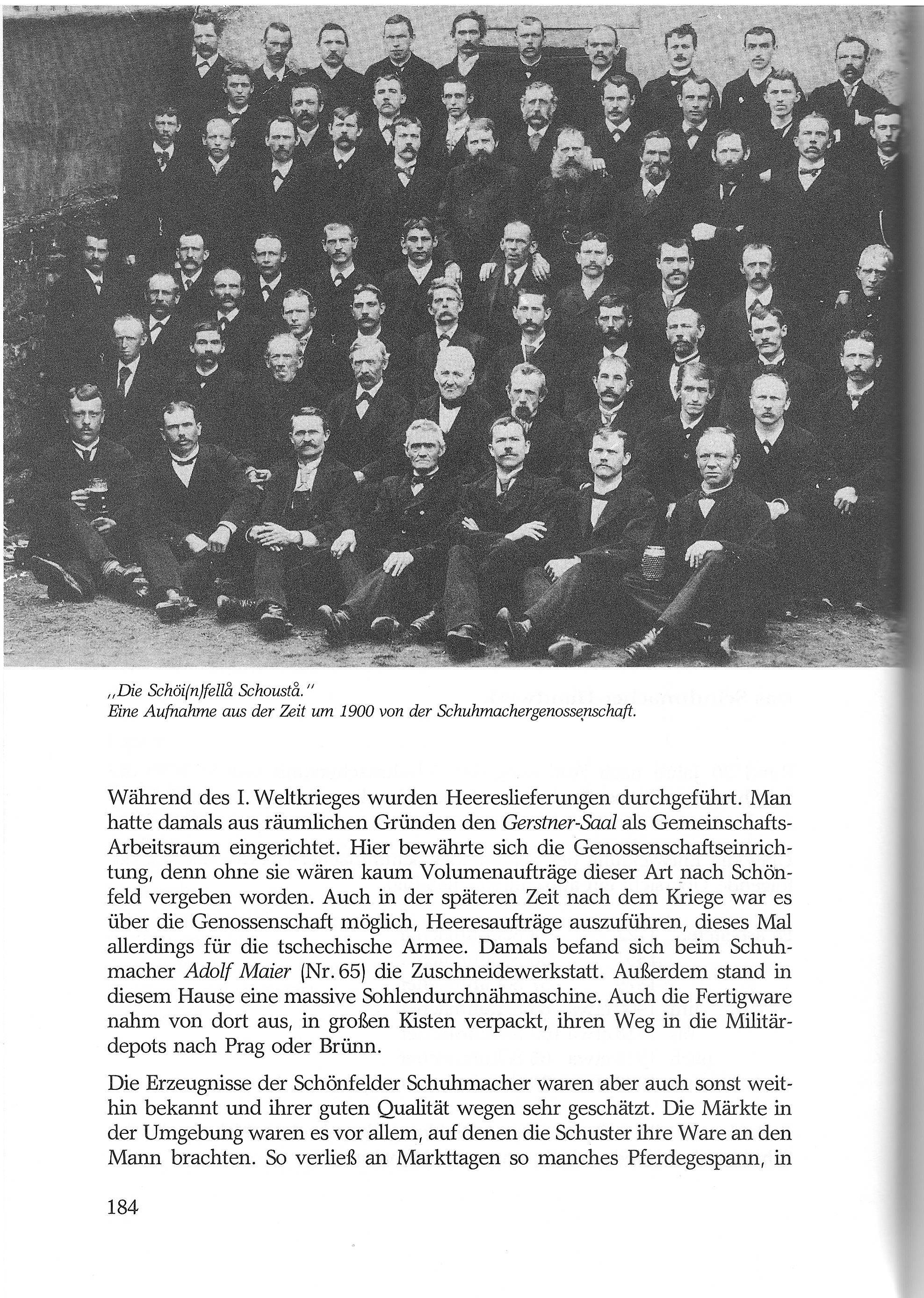 184
"The Beautiful Schoustå."
A photo from around 1900 of the shoemakers' cooperative. During World
War I, military deliveries were made. For space reasons, the Gerstner
Hall was converted into a communal workroom. The cooperative's
facilities proved their worth here, as without them, hardly any
high-volume orders of this kind would have been placed with
Schönfeld. Even later after the war, the cooperative was able to
fulfill military orders, but this time for the Czech Army. At that
time, the cutting workshop was located at the shoemaker Adolf Maier's
(No. 65) shop. A massive sole-stitching machine was also located in
this building. The finished goods, packed in large crates, also made
their way from there to the military depots in Prague or Brno. The
products of the Schönfeld shoemakers were also widely known and highly
valued for their high quality. The surrounding markets were primarily
where the shoemakers sold their wares. Thus, on market days, many a
horse-drawn carriage left the market, in
184
184
"The Beautiful Schoustå."
A photo from around 1900 of the shoemakers' cooperative. During World
War I, military deliveries were made. For space reasons, the Gerstner
Hall was converted into a communal workroom. The cooperative's
facilities proved their worth here, as without them, hardly any
high-volume orders of this kind would have been placed with
Schönfeld. Even later after the war, the cooperative was able to
fulfill military orders, but this time for the Czech Army. At that
time, the cutting workshop was located at the shoemaker Adolf Maier's
(No. 65) shop. A massive sole-stitching machine was also located in
this building. The finished goods, packed in large crates, also made
their way from there to the military depots in Prague or Brno. The
products of the Schönfeld shoemakers were also widely known and highly
valued for their high quality. The surrounding markets were primarily
where the shoemakers sold their wares. Thus, on market days, many a
horse-drawn carriage left the market, in
184
Page 0184
 185
very early in the morning, our town, packed with several "market
crates" containing the shoes, boots, and slippers made by the master
shoemaker and his journeymen. Usually, several shoemakers joined
forces for such a trip for cost reasons. In this way, they visited
the somewhat closer towns such as Buchau, Theusing, and Bad
Königswart. Further-away towns, such as Saaz, were reached by truck.
With the rise of the shoe industry, this traditional craft began to
decline. Demand for custom-made low shoes or "mountain climbers"
declined sharply; repair work became increasingly important. The best
indicator of the status of this profession was the number of
shoemaking apprentices, or "Schousterboum," as they were called
locally. While in the years before World War I, they could be counted
by the dozens, in the years up to 1945, barely five people chose the
shoemaking profession.
Pewter Foundry and Master Pewter Foundry
Crafts
Friedrich Tischer probably provides the best information on this
chapter in his book "Bohemian Tin and Its Brands" (Leipzig 1928); On
page 253, under "SCHÖNFELD," we read: "The development of the tin
foundry here, as in Schlaggenwald, can probably be traced back to the
16th century. No records have survived from this period of
development, but it can be established that the local tinsmiths
belonged to the Schlaggenwald guild until 1732. In that year, they
separated from it to found their own guild, which the tinsmiths from
Petschau, Einsiedl, and Lauterbach joined. Records with the guild
chest have been preserved since that year. From these records, one can
see that a large number of masters practiced the craft and passed it
down through families for centuries. The list of masters is complete
from 1732, but prior to this time, a separation of Schönfeld from
Schlaggenwald is not possible due to a lack of records.
185
185
very early in the morning, our town, packed with several "market
crates" containing the shoes, boots, and slippers made by the master
shoemaker and his journeymen. Usually, several shoemakers joined
forces for such a trip for cost reasons. In this way, they visited
the somewhat closer towns such as Buchau, Theusing, and Bad
Königswart. Further-away towns, such as Saaz, were reached by truck.
With the rise of the shoe industry, this traditional craft began to
decline. Demand for custom-made low shoes or "mountain climbers"
declined sharply; repair work became increasingly important. The best
indicator of the status of this profession was the number of
shoemaking apprentices, or "Schousterboum," as they were called
locally. While in the years before World War I, they could be counted
by the dozens, in the years up to 1945, barely five people chose the
shoemaking profession.
Pewter Foundry and Master Pewter Foundry
Crafts
Friedrich Tischer probably provides the best information on this
chapter in his book "Bohemian Tin and Its Brands" (Leipzig 1928); On
page 253, under "SCHÖNFELD," we read: "The development of the tin
foundry here, as in Schlaggenwald, can probably be traced back to the
16th century. No records have survived from this period of
development, but it can be established that the local tinsmiths
belonged to the Schlaggenwald guild until 1732. In that year, they
separated from it to found their own guild, which the tinsmiths from
Petschau, Einsiedl, and Lauterbach joined. Records with the guild
chest have been preserved since that year. From these records, one can
see that a large number of masters practiced the craft and passed it
down through families for centuries. The list of masters is complete
from 1732, but prior to this time, a separation of Schönfeld from
Schlaggenwald is not possible due to a lack of records.
185
Page 0185
 186
Since the town mark is the same is—not possible. The guild chest
with the records is in the possession of the pewter caster Ignaz
Lochner in Schönfeld." Let's turn back to Tischer's work; on page
238, he reports the following about our neighboring town of
Schlaggenwald: "Almost no records have survived from the time of the
development of the craft and from later times, but the surviving works
give us a fairly clear picture of the skill and versatility of the
masters. The first pewter casters seem to have settled here, as well
as the bell casters, in the 16th century. It is also likely that the
first masters, as in many Bohemian towns, mastered both crafts. In any
case, the craft quickly experienced great growth, for the guild of
pewter and candle casters was probably founded as early as the end of
the aforementioned century. The pewter casters from the surrounding
area, namely from Schönfeld, Elbogen, and Petschau, also belonged to
this guild.
In the earliest times, it seems that mainly ecclesiastical utensils
were manufactured. With the development of the guild system, items for
the guild halls were added. Pewter foundry reached its peak with the
mass production of household utensils. This meant that individual
masters concentrated on the manufacture of specific items. Thus, we
find masters who made only plates and bowls, or crucifixes, holy water
fonts, and candlesticks, or only spoons. As far as the mass production
of common church and household items is concerned, the pewter
foundries of Schönfeld and Schlaggenwald were the most prolific in
Bohemia. Due to the nearby and abundant tin deposits, the pewter
foundries there were able to supply cheaper goods than those in other
towns. They also seem to have dominated the markets of the former
Austro-Hungarian Empire with their wares. This may also be the reason
for the early decline of the craft in most Bohemian towns. If we
examine the preserved pewter objects, we find mostly Schönfeld and
Schlaggenwald products. Most of the objects are smooth, and
occasionally we find household utensils decorated only with simple
relief bands. Among the preserved ecclesiastical objects, the most
notable are the Baroque-style altar and ceremonial candlesticks, which
feature sculptural ornamentation. We often find smooth, beautifully
profiled candlesticks with engraved bases. The guild objects,
patronage bowls, and other objects show my- 186
186
Since the town mark is the same is—not possible. The guild chest
with the records is in the possession of the pewter caster Ignaz
Lochner in Schönfeld." Let's turn back to Tischer's work; on page
238, he reports the following about our neighboring town of
Schlaggenwald: "Almost no records have survived from the time of the
development of the craft and from later times, but the surviving works
give us a fairly clear picture of the skill and versatility of the
masters. The first pewter casters seem to have settled here, as well
as the bell casters, in the 16th century. It is also likely that the
first masters, as in many Bohemian towns, mastered both crafts. In any
case, the craft quickly experienced great growth, for the guild of
pewter and candle casters was probably founded as early as the end of
the aforementioned century. The pewter casters from the surrounding
area, namely from Schönfeld, Elbogen, and Petschau, also belonged to
this guild.
In the earliest times, it seems that mainly ecclesiastical utensils
were manufactured. With the development of the guild system, items for
the guild halls were added. Pewter foundry reached its peak with the
mass production of household utensils. This meant that individual
masters concentrated on the manufacture of specific items. Thus, we
find masters who made only plates and bowls, or crucifixes, holy water
fonts, and candlesticks, or only spoons. As far as the mass production
of common church and household items is concerned, the pewter
foundries of Schönfeld and Schlaggenwald were the most prolific in
Bohemia. Due to the nearby and abundant tin deposits, the pewter
foundries there were able to supply cheaper goods than those in other
towns. They also seem to have dominated the markets of the former
Austro-Hungarian Empire with their wares. This may also be the reason
for the early decline of the craft in most Bohemian towns. If we
examine the preserved pewter objects, we find mostly Schönfeld and
Schlaggenwald products. Most of the objects are smooth, and
occasionally we find household utensils decorated only with simple
relief bands. Among the preserved ecclesiastical objects, the most
notable are the Baroque-style altar and ceremonial candlesticks, which
feature sculptural ornamentation. We often find smooth, beautifully
profiled candlesticks with engraved bases. The guild objects,
patronage bowls, and other objects show my- 186
Page 0186
 187
Extremely rich engraving and confirm the skill of the pewterers in
this field. Here, the craft has been preserved to this day;
Candlesticks, crucifixes, holy water fonts, small lanterns, capacity
measures, and toys for children were made and sold at fairs." So much
for Tischer's remarks in his book, published in 1928.
In Schönfeld, the production of pewter spoons gained great importance
during these and the following years. Some companies (Floth, Lochner)
produced considerable quantities in this branch of production. This
traditional pewter foundry suffered a severe blow at the beginning of
World War II, as all pewter foundries of this type were shut down as
part of the war economy control measures, effective February 29, 1940.
Only one master craftsman (Josef Ott) was little or not at all
affected by this measure, as it was primarily concerned with the
manufacture and repair of sacred, i.e., church-related objects. Older
pewter items were also frequently reworked here.
On closer inspection, this was the last pewter foundry in
Schönfeld. This fact is further emphasized by the fact that It was
emphasized that Ott's grandson, who still lives in Schönfeld today,
still runs the pewter foundry on a small scale, using his
grandfather's old molds - as a hobby.
Pewter Marks
On this topic, Dr. Hans Sehling writes in the Schönfeld Heimatbrief
No. 50 (March 1959):
The origin of a pewter object can be traced based on its master's mark
and the town mark. On larger pieces (baptismal fonts), even the
master's name and place of residence can be found in full.
There is an article about the mark of pewter work in the guild
regulations of the Schönfeld pewterers from 1732 with the following
wording (2; p. 17): "Every master should also use the correct
Nuremberg weight, if it is not too light, and should also check the
work of the pewter to the correct tithe test; The fifth digit, which
must be without a single false addition, is struck three times.
187
187
Extremely rich engraving and confirm the skill of the pewterers in
this field. Here, the craft has been preserved to this day;
Candlesticks, crucifixes, holy water fonts, small lanterns, capacity
measures, and toys for children were made and sold at fairs." So much
for Tischer's remarks in his book, published in 1928.
In Schönfeld, the production of pewter spoons gained great importance
during these and the following years. Some companies (Floth, Lochner)
produced considerable quantities in this branch of production. This
traditional pewter foundry suffered a severe blow at the beginning of
World War II, as all pewter foundries of this type were shut down as
part of the war economy control measures, effective February 29, 1940.
Only one master craftsman (Josef Ott) was little or not at all
affected by this measure, as it was primarily concerned with the
manufacture and repair of sacred, i.e., church-related objects. Older
pewter items were also frequently reworked here.
On closer inspection, this was the last pewter foundry in
Schönfeld. This fact is further emphasized by the fact that It was
emphasized that Ott's grandson, who still lives in Schönfeld today,
still runs the pewter foundry on a small scale, using his
grandfather's old molds - as a hobby.
Pewter Marks
On this topic, Dr. Hans Sehling writes in the Schönfeld Heimatbrief
No. 50 (March 1959):
The origin of a pewter object can be traced based on its master's mark
and the town mark. On larger pieces (baptismal fonts), even the
master's name and place of residence can be found in full.
There is an article about the mark of pewter work in the guild
regulations of the Schönfeld pewterers from 1732 with the following
wording (2; p. 17): "Every master should also use the correct
Nuremberg weight, if it is not too light, and should also check the
work of the pewter to the correct tithe test; The fifth digit, which
must be without a single false addition, is struck three times.
187
Page 0187
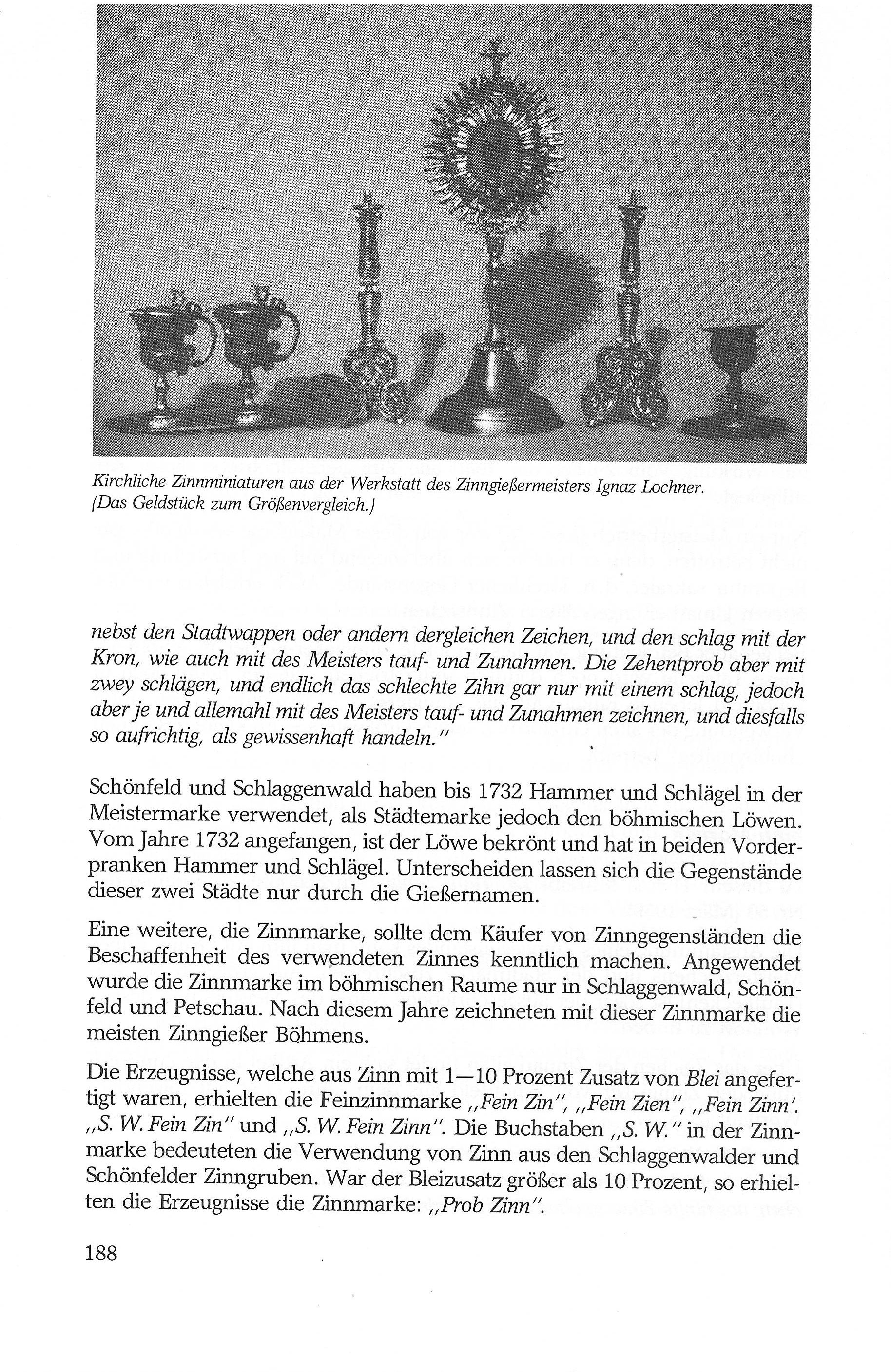 188
Ecclesiastical pewter miniatures from the workshop of master pewterer
Ignaz Lochner. (The coin is for size comparison.)
along with the city coat of arms or other similar symbols, and the
strike with the crown, as well as with the master's baptismal and
accretions. The tithe test, however, is to be marked with two strikes,
and finally the bad tithe with only one strike, but always with the
master's initials and increases, and in this case, act as honestly and
conscientiously."
Schönfeld and Schlaggenwald used the hammer and mallet in the master's
mark until 1732, but the Bohemian lion was used as the city
mark. Starting in 1732, the lion is crowned and has a hammer and
mallet in both forepaws. The objects from these two cities can only be
distinguished by the founder's names.
Another mark, the tin mark, was intended to inform the buyer of pewter
objects of the quality of the pewter used. The tin mark was used in
Bohemia only in Schlaggenwald, Schönfeld, and Petschau. After this
year, most pewterers in Bohemia used this tin mark.
The products made of tin with 1-10 percent lead added received the
fine tin mark, "Fein Zin", "Fein Zien", "Fein Zinn". "S. W. Fein Zin"
and "S. W. Fein Zinn". The letters "S. W." in the tin mark indicated
the use of tin from the Schlaggenwald and Schönfeld tin mines. If the
lead content was greater than 10 percent, the products received the
tin mark: "Prob Zinn".
188
188
Ecclesiastical pewter miniatures from the workshop of master pewterer
Ignaz Lochner. (The coin is for size comparison.)
along with the city coat of arms or other similar symbols, and the
strike with the crown, as well as with the master's baptismal and
accretions. The tithe test, however, is to be marked with two strikes,
and finally the bad tithe with only one strike, but always with the
master's initials and increases, and in this case, act as honestly and
conscientiously."
Schönfeld and Schlaggenwald used the hammer and mallet in the master's
mark until 1732, but the Bohemian lion was used as the city
mark. Starting in 1732, the lion is crowned and has a hammer and
mallet in both forepaws. The objects from these two cities can only be
distinguished by the founder's names.
Another mark, the tin mark, was intended to inform the buyer of pewter
objects of the quality of the pewter used. The tin mark was used in
Bohemia only in Schlaggenwald, Schönfeld, and Petschau. After this
year, most pewterers in Bohemia used this tin mark.
The products made of tin with 1-10 percent lead added received the
fine tin mark, "Fein Zin", "Fein Zien", "Fein Zinn". "S. W. Fein Zin"
and "S. W. Fein Zinn". The letters "S. W." in the tin mark indicated
the use of tin from the Schlaggenwald and Schönfeld tin mines. If the
lead content was greater than 10 percent, the products received the
tin mark: "Prob Zinn".
188
Page 0188
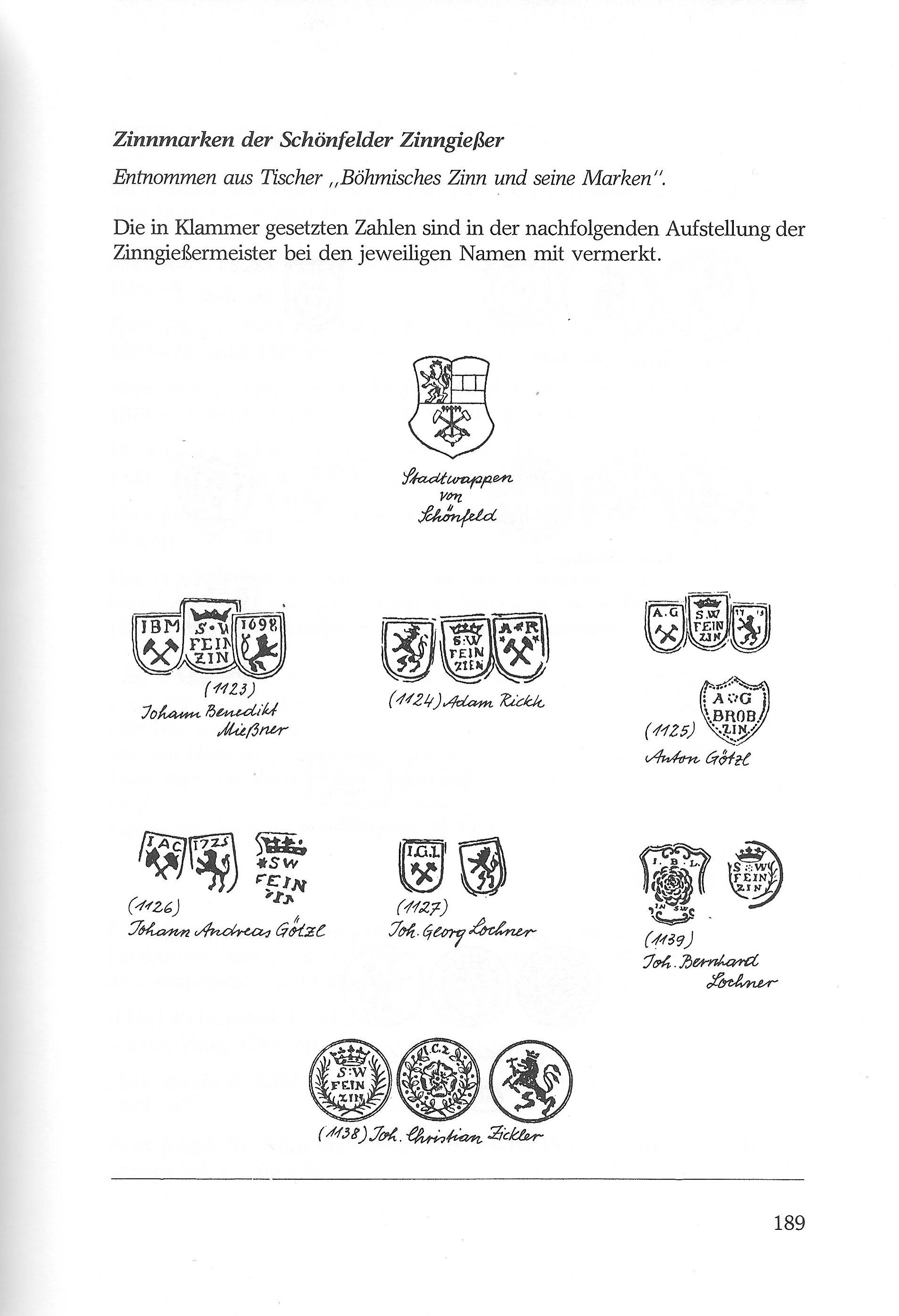 189
Pewter marks of the Schönfeld tinsmiths
Taken from Tischer, "Bohemian Tin and Its Marks."
The numbers in parentheses are noted next to the respective names in
the following list of master tinsmiths.
City coat of arms
of
Schönfeld
IBM SW1698 FEIN
ZIN (1123)
Johan Benedikt
Mießner
WAR 5:W FEIN ZIEN
IN
???
(1124) Adam Rickh
A.G
S.W FEIN
XZN
117
AVG BROB.
(1125)ZIN Anton Götzl
and
AC 172
IGL
SW
**
FEIN
SW FEINY
ZIN
(1126)
Johann Andreas Götzl
(1127) Joh. Georg Lochner
(1139) Joh. Bernhard Lochner
S:W FINE ZIN
(1138) John Christian Zickler
189
189
Pewter marks of the Schönfeld tinsmiths
Taken from Tischer, "Bohemian Tin and Its Marks."
The numbers in parentheses are noted next to the respective names in
the following list of master tinsmiths.
City coat of arms
of
Schönfeld
IBM SW1698 FEIN
ZIN (1123)
Johan Benedikt
Mießner
WAR 5:W FEIN ZIEN
IN
???
(1124) Adam Rickh
A.G
S.W FEIN
XZN
117
AVG BROB.
(1125)ZIN Anton Götzl
and
AC 172
IGL
SW
**
FEIN
SW FEINY
ZIN
(1126)
Johann Andreas Götzl
(1127) Joh. Georg Lochner
(1139) Joh. Bernhard Lochner
S:W FINE ZIN
(1138) John Christian Zickler
189
Page 0189
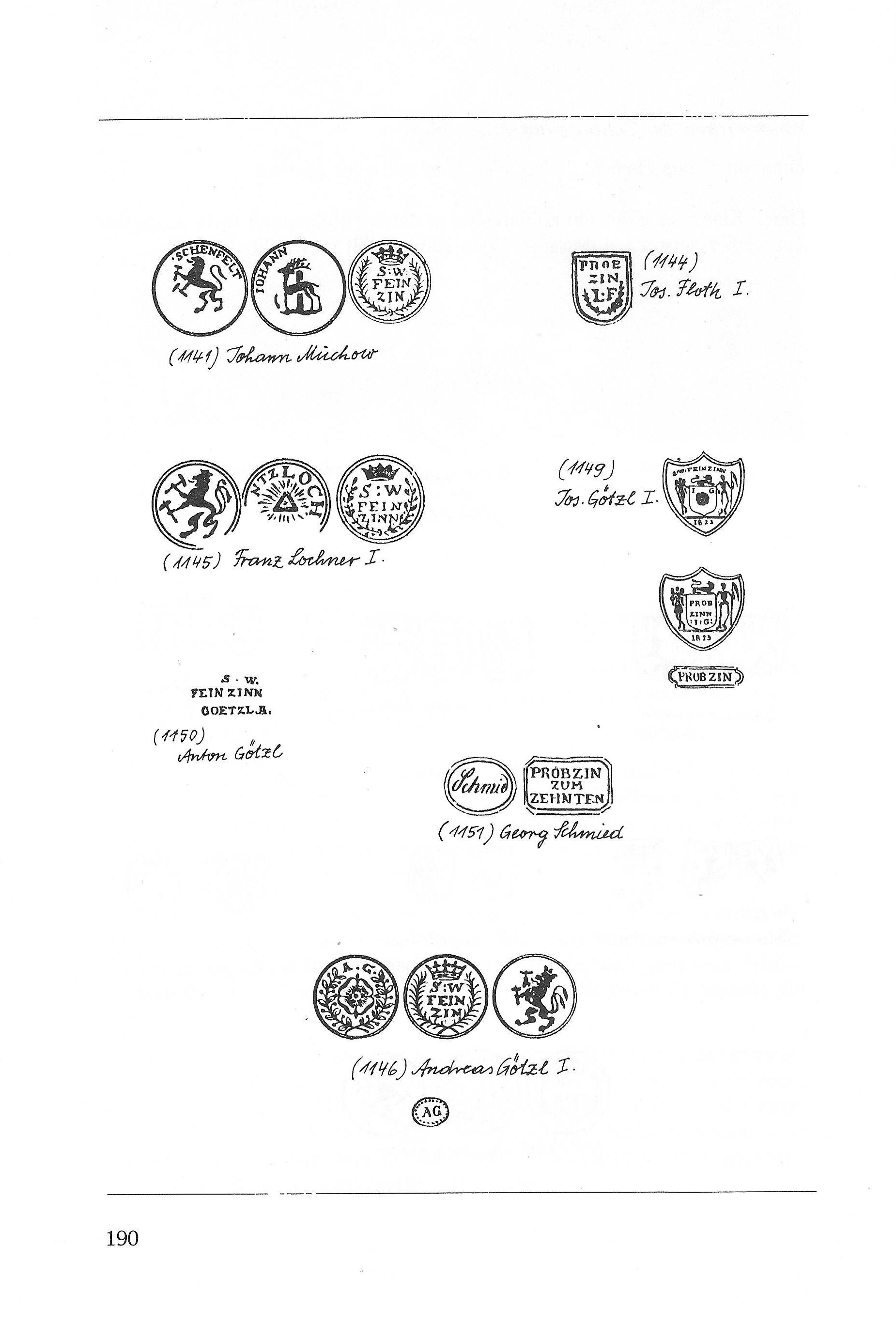 190
SCHENFELY
(1141) Johann Müchow
S:w FEIN ZIN
PROE (1144)
IN
LF
Jos. Floth. I.
NTZ
L
S:W FEIN
?????,
(1145) Franz Lochner I.
S.W.
(1149) Jos. Gotzl I.
FEIN ZINN GOETZLA.
(1150)
Anton Götzl
(Schmid)
PROBZIN TO THE TITH
(1151) Georg Schmied
S:W TEIN
(1146) Andreas Götzl I.
AG
WIFEINZINN
1623
PROB
ZINN
IG:
18 73
PROB ZIN
190
SCHENFELY
(1141) Johann Müchow
S:w FEIN ZIN
PROE (1144)
IN
LF
Jos. Floth. I.
NTZ
L
S:W FEIN
?????,
(1145) Franz Lochner I.
S.W.
(1149) Jos. Gotzl I.
FEIN ZINN GOETZLA.
(1150)
Anton Götzl
(Schmid)
PROBZIN TO THE TITH
(1151) Georg Schmied
S:W TEIN
(1146) Andreas Götzl I.
AG
WIFEINZINN
1623
PROB
ZINN
IG:
18 73
PROB ZIN
Page 0190
 191
Schönfeld pewter masters
The names and references up to 1928 are largely taken from Friedrich
Tischer's book.
Floth Albrecht, son of the pewterer Martin Floth, apprenticed with his
father from 1865 to 1867.
Floth August, son of the pewterer Martin Floth, apprenticed with his
father from 1870 to 1873, and was listed as a master in 1893.Floth
Franz, son of the pewterer Josef Floth, apprenticed with his father
from 1872 to 1874, and was listed as a master in 1893.
Floth Georg, son of the pewterer Franz Floth, apprenticed with his
father from 1832 to 1836; obtained the master craftsman's certificate
in the same year. Floth Johann Georg, apprenticed with Johann Georg
Lochner from 1767 to 1774. Received the master craftsman's license in
1771.
Here is the wording of the appointment, an excerpt from the former
guild book, page 75, of the tinsmith's trade in the royal free mining
town of Schönfeld, by the chronicler Karl Lochner: The Honorable
Johann Flodth appears today at an open shop at an honorable trade of
master tinsmiths. Since he has still not received permission to
conduct a highly commendable business, he requests an honorable
trade. He is to be made a master and accepted, and is wished luck and
blessings by an honorable trade."
Done at Schönfeld, September 3, 1771Georgij Roth, yours, Inspector
Floth Ignaz, son of the pewterer Johann Georg Floth, began his
apprenticeship with his father in 1803 and, after his father's death,
completed it with the pewterer Joseph Floth in 1811, obtaining the
master craftsman's certificate in 1817.
(1144) Floth Joseph I, son of the pewterer Johann Georg Floth,
apprenticed with his father from 1787 to 1791 and obtained the master
craftsman's certificate in 1801.
Floth Joseph II, son of the pewterer Ignaz Floth, apprenticed with his
father from 1845 to 1847.
Floth Joseph III, son of the pewterer Joseph Floth the Elder,
apprenticed with his father from 1869 to 1874.
191
191
Schönfeld pewter masters
The names and references up to 1928 are largely taken from Friedrich
Tischer's book.
Floth Albrecht, son of the pewterer Martin Floth, apprenticed with his
father from 1865 to 1867.
Floth August, son of the pewterer Martin Floth, apprenticed with his
father from 1870 to 1873, and was listed as a master in 1893.Floth
Franz, son of the pewterer Josef Floth, apprenticed with his father
from 1872 to 1874, and was listed as a master in 1893.
Floth Georg, son of the pewterer Franz Floth, apprenticed with his
father from 1832 to 1836; obtained the master craftsman's certificate
in the same year. Floth Johann Georg, apprenticed with Johann Georg
Lochner from 1767 to 1774. Received the master craftsman's license in
1771.
Here is the wording of the appointment, an excerpt from the former
guild book, page 75, of the tinsmith's trade in the royal free mining
town of Schönfeld, by the chronicler Karl Lochner: The Honorable
Johann Flodth appears today at an open shop at an honorable trade of
master tinsmiths. Since he has still not received permission to
conduct a highly commendable business, he requests an honorable
trade. He is to be made a master and accepted, and is wished luck and
blessings by an honorable trade."
Done at Schönfeld, September 3, 1771Georgij Roth, yours, Inspector
Floth Ignaz, son of the pewterer Johann Georg Floth, began his
apprenticeship with his father in 1803 and, after his father's death,
completed it with the pewterer Joseph Floth in 1811, obtaining the
master craftsman's certificate in 1817.
(1144) Floth Joseph I, son of the pewterer Johann Georg Floth,
apprenticed with his father from 1787 to 1791 and obtained the master
craftsman's certificate in 1801.
Floth Joseph II, son of the pewterer Ignaz Floth, apprenticed with his
father from 1845 to 1847.
Floth Joseph III, son of the pewterer Joseph Floth the Elder,
apprenticed with his father from 1869 to 1874.
191
Page 0191
 192
In 1885, he founded a pewter foundry (Marktplatz 112), which later
focused primarily on the production of pewter spoons (Brittania pewter
spoons). Around 1908, Floth acquired the ruins near the so-called
Opl-Tümpl, above house number 94, along with the water power
plant. On this ruined property, presumably where the former stamp mill
stood, he had the grinder's house built. Here, the spoons received
their final polish. Afterwards, the greasy coating created during
grinding was removed with a rag and a wood or cork-like substance. The
grinder's house also housed a spring hammer, where the steel spoon
inserts were forged.
The company, which Joseph Floth began as a craft business, grew over
the years to employ up to 20 people and achieve an average daily
production of around 2,500 pewter spoons, most of which were
exported. Based on these production figures, Josef Floth Jr., who took
over the business from his father in 1928, was awarded the title of
"Largest Company in this Industry in Czechoslovakia" by the Chamber of
Commerce and Industry in Cheb.
After his father's death, Joseph Floth Jr. enlarged the building with
a rear extension, thus enabling him to further expand his business.
He himself crafted ornate plates, jugs, and vases, but probably only
in individual pieces and small quantities.
Floth Martin I, son of the pewterer Joseph Floth, apprenticed with his
father from 1829 to 1832 and obtained the master craftsman's
certificate in 1836.
Floth Martin II, son of the pewterer Ignaz Floth, apprenticed with
Franz Anton Lochner from 1837 to 1840 and obtained the master
craftsman's certificate in the same year. Floth Willibald, son of the
pewterer Franz Floth, began his apprenticeship with his father in
1897.
Fuhrmann Johann, apprenticed with Pewter caster Franz Götzl 1830-35;
likely obtained the master craftsman's certificate in the same year.
Fuhrmann Josef, probably a son of the pewter caster Johann Fuhrmann,
is listed as a master craftsman in 1893.
Gareiß Franz, apprenticed with the pewter caster Adolf Lochner
1864-67, obtained the master craftsman's certificate in 1875.
Gebhardt Franz, apprenticed in Carlsbad 1763-68 and obtained the
master craftsman's certificate in 1779.
192
192
In 1885, he founded a pewter foundry (Marktplatz 112), which later
focused primarily on the production of pewter spoons (Brittania pewter
spoons). Around 1908, Floth acquired the ruins near the so-called
Opl-Tümpl, above house number 94, along with the water power
plant. On this ruined property, presumably where the former stamp mill
stood, he had the grinder's house built. Here, the spoons received
their final polish. Afterwards, the greasy coating created during
grinding was removed with a rag and a wood or cork-like substance. The
grinder's house also housed a spring hammer, where the steel spoon
inserts were forged.
The company, which Joseph Floth began as a craft business, grew over
the years to employ up to 20 people and achieve an average daily
production of around 2,500 pewter spoons, most of which were
exported. Based on these production figures, Josef Floth Jr., who took
over the business from his father in 1928, was awarded the title of
"Largest Company in this Industry in Czechoslovakia" by the Chamber of
Commerce and Industry in Cheb.
After his father's death, Joseph Floth Jr. enlarged the building with
a rear extension, thus enabling him to further expand his business.
He himself crafted ornate plates, jugs, and vases, but probably only
in individual pieces and small quantities.
Floth Martin I, son of the pewterer Joseph Floth, apprenticed with his
father from 1829 to 1832 and obtained the master craftsman's
certificate in 1836.
Floth Martin II, son of the pewterer Ignaz Floth, apprenticed with
Franz Anton Lochner from 1837 to 1840 and obtained the master
craftsman's certificate in the same year. Floth Willibald, son of the
pewterer Franz Floth, began his apprenticeship with his father in
1897.
Fuhrmann Johann, apprenticed with Pewter caster Franz Götzl 1830-35;
likely obtained the master craftsman's certificate in the same year.
Fuhrmann Josef, probably a son of the pewter caster Johann Fuhrmann,
is listed as a master craftsman in 1893.
Gareiß Franz, apprenticed with the pewter caster Adolf Lochner
1864-67, obtained the master craftsman's certificate in 1875.
Gebhardt Franz, apprenticed in Carlsbad 1763-68 and obtained the
master craftsman's certificate in 1779.
192
Page 0192
 193
Gebhardt Johann, son of the pewter caster Franz Gebhardt, probably
apprenticed with his father, is listed as a key master in 1811 and as
an assessor in 1819.
Gerstner Franz, apprenticed with the pewter caster Norbert Zickler
1819-23, obtained the master craftsman's certificate in 1827 (see
photo "Baptismal Font," p. 147).
Gerstner Norbert, son of the pewterer Franz Gerstner, studied with his
father and was acquitted in 1841. Götzl Adolf, son of the pewterer
Andreas Götzl, studied with his father from 1846 to 1847 and was named
a master in 1859.
(1146) Götzl Andreas I studied with the pewterer Georg Floth from 1788
to 1791 and obtained the master craftsman's certificate in 1797 .
Götzl Andreas II obtained the master craftsman's certificate in 1801.
Götzl Andreas III, son of the pewterer Andreas Götzl I, studied with
his father from 1814 to 1818 and obtained the master craftsman's
certificate in 1820.
(1125) Götzl Anton I obtained the master craftsman's certificate in
1713.
Götzl Antoni was named an old master in 1767. Perhaps identical to
Götzl Anton I.
Götzl Anton Ignaz, apprenticed under pewterer Johann Andreas Götzl
from 1762 to 1767, obtaining the master craftsman's certificate in
1773.
(1150) Götzl Anton II, son of the pewterer Antoni Götzl, apprenticed
under his father from 1802 to 1811, obtaining the master craftsman's
certificate in 1814.
Götzl Franz I, son of the pewterer Andreas Götzl II, apprenticed under
his father from 1818 to 1820 and obtaining the master craftsman's
certificate in 1827.
Götzl Franz II, son of the pewterer Andreas Götzl, apprenticed under
pewterer Franz Götzl from 1836 to 1839. Probably obtained the master
craftsman's certificate in 1849.
Götzl Georg, son of the pewterer Joseph Götzl, apprenticed under his
father from 1846 to 1850 and obtained the master craftsman's
certificate in 1859.
(1126) Götzl Johann Andreas I, obtained the master craftsman's
certificate in 1725.
Götzl Johann Andreas II, apprenticed to Johann Georg Lochner from 1754
to 1759; likely obtained the master craftsman's certificate in 1767.
(1149) Götzl Joseph I, son of the pewterer Anton Götzl, trained with
his father from 1795 to 1801 and obtained the master craftsman's
certificate in 1812.
Götzl Joseph II, son of the pewterer Andreas Götzl I, completed his
apprenticeship with his father in 1817 and obtained the master
craftsman's certificate in 1861.
193
193
Gebhardt Johann, son of the pewter caster Franz Gebhardt, probably
apprenticed with his father, is listed as a key master in 1811 and as
an assessor in 1819.
Gerstner Franz, apprenticed with the pewter caster Norbert Zickler
1819-23, obtained the master craftsman's certificate in 1827 (see
photo "Baptismal Font," p. 147).
Gerstner Norbert, son of the pewterer Franz Gerstner, studied with his
father and was acquitted in 1841. Götzl Adolf, son of the pewterer
Andreas Götzl, studied with his father from 1846 to 1847 and was named
a master in 1859.
(1146) Götzl Andreas I studied with the pewterer Georg Floth from 1788
to 1791 and obtained the master craftsman's certificate in 1797 .
Götzl Andreas II obtained the master craftsman's certificate in 1801.
Götzl Andreas III, son of the pewterer Andreas Götzl I, studied with
his father from 1814 to 1818 and obtained the master craftsman's
certificate in 1820.
(1125) Götzl Anton I obtained the master craftsman's certificate in
1713.
Götzl Antoni was named an old master in 1767. Perhaps identical to
Götzl Anton I.
Götzl Anton Ignaz, apprenticed under pewterer Johann Andreas Götzl
from 1762 to 1767, obtaining the master craftsman's certificate in
1773.
(1150) Götzl Anton II, son of the pewterer Antoni Götzl, apprenticed
under his father from 1802 to 1811, obtaining the master craftsman's
certificate in 1814.
Götzl Franz I, son of the pewterer Andreas Götzl II, apprenticed under
his father from 1818 to 1820 and obtaining the master craftsman's
certificate in 1827.
Götzl Franz II, son of the pewterer Andreas Götzl, apprenticed under
pewterer Franz Götzl from 1836 to 1839. Probably obtained the master
craftsman's certificate in 1849.
Götzl Georg, son of the pewterer Joseph Götzl, apprenticed under his
father from 1846 to 1850 and obtained the master craftsman's
certificate in 1859.
(1126) Götzl Johann Andreas I, obtained the master craftsman's
certificate in 1725.
Götzl Johann Andreas II, apprenticed to Johann Georg Lochner from 1754
to 1759; likely obtained the master craftsman's certificate in 1767.
(1149) Götzl Joseph I, son of the pewterer Anton Götzl, trained with
his father from 1795 to 1801 and obtained the master craftsman's
certificate in 1812.
Götzl Joseph II, son of the pewterer Andreas Götzl I, completed his
apprenticeship with his father in 1817 and obtained the master
craftsman's certificate in 1861.
193
Page 0193
 194
Götzl Joseph III, son of the pewterer Andreas Götzl, studied with his
father from 1816 to 1818 and received his master craftsman's
certificate in 1823.
Götzl Joseph IV, son of the pewterer Andreas Götzl, studied with his
father from 1833 to 1837 and received his master craftsman's
certificate in the same year.
Götzl Karl, son of the pewterer Joseph Götzl, studied from 1850 to
1853 and was appointed master craftsman in 1859.
Götzl Wilhelm, son of the pewterer Georg Götzl, studied with Franz
Lochner from 1894 to 1899. He made primarily sacred objects. Hahn
August, probably a son of the pewterer Joseph Hahn, received his
master craftsman's certificate in 1876.
Hahn Joseph, stepson of the pewterer Franz Listner, studied with his
stepfather from 1833 to 1842. Hahn Karl, trained from 1874 to 1876,
was named a master craftsman in 1893.
Herold Joseph, obtained the master craftsman's certificate in 1873.
Hofmann Johannes von Erfurt, trained under the pewterer Andreas Götzl
from 1798 to 1801, and obtained the master craftsman's certificate in
1815.
Hubl Joseph, was named a master craftsman in 1893.
Jollmann Johann Franz II (apprenticeship certificate dated January 22,
1764).
Listner Franz, son of the pewterer Joseph Listner, trained under the
pewterer Ignaz Floth from 1819 to 1823, and obtained the master
craftsman's certificate in 1828.
Listner Johann, son of the pewterer Joseph Listner, obtained the
master craftsman's certificate in 1816.
Listner Joseph, trained under the pewterer Johann Georg Floth from
1768 to 1771 and obtained the master craftsman's certificate in 1781.
Lochner Adolf the Elder, son of the pewterer Ignaz Lochner, trained
under his father from 1846 to 1847.
Lochner Adolf the Younger, son of the pewterer Lochner the Elder,
trained under his father from 1875 to 1878 and was named Old Master in
1893.
Lochner Anton, son of the pewterer Ignaz Lochner, trained under his
father from 1850 to 1853 and was named Master in 1859.
Lochner Eduard, trained under the pewterer Adolf Lochner from 1865 to
1867 and was named Master in 1893.
(1145) Lochner Franz I, probably obtained the Master Craftsman's
Certificate in 1782.
194
194
Götzl Joseph III, son of the pewterer Andreas Götzl, studied with his
father from 1816 to 1818 and received his master craftsman's
certificate in 1823.
Götzl Joseph IV, son of the pewterer Andreas Götzl, studied with his
father from 1833 to 1837 and received his master craftsman's
certificate in the same year.
Götzl Karl, son of the pewterer Joseph Götzl, studied from 1850 to
1853 and was appointed master craftsman in 1859.
Götzl Wilhelm, son of the pewterer Georg Götzl, studied with Franz
Lochner from 1894 to 1899. He made primarily sacred objects. Hahn
August, probably a son of the pewterer Joseph Hahn, received his
master craftsman's certificate in 1876.
Hahn Joseph, stepson of the pewterer Franz Listner, studied with his
stepfather from 1833 to 1842. Hahn Karl, trained from 1874 to 1876,
was named a master craftsman in 1893.
Herold Joseph, obtained the master craftsman's certificate in 1873.
Hofmann Johannes von Erfurt, trained under the pewterer Andreas Götzl
from 1798 to 1801, and obtained the master craftsman's certificate in
1815.
Hubl Joseph, was named a master craftsman in 1893.
Jollmann Johann Franz II (apprenticeship certificate dated January 22,
1764).
Listner Franz, son of the pewterer Joseph Listner, trained under the
pewterer Ignaz Floth from 1819 to 1823, and obtained the master
craftsman's certificate in 1828.
Listner Johann, son of the pewterer Joseph Listner, obtained the
master craftsman's certificate in 1816.
Listner Joseph, trained under the pewterer Johann Georg Floth from
1768 to 1771 and obtained the master craftsman's certificate in 1781.
Lochner Adolf the Elder, son of the pewterer Ignaz Lochner, trained
under his father from 1846 to 1847.
Lochner Adolf the Younger, son of the pewterer Lochner the Elder,
trained under his father from 1875 to 1878 and was named Old Master in
1893.
Lochner Anton, son of the pewterer Ignaz Lochner, trained under his
father from 1850 to 1853 and was named Master in 1859.
Lochner Eduard, trained under the pewterer Adolf Lochner from 1865 to
1867 and was named Master in 1893.
(1145) Lochner Franz I, probably obtained the Master Craftsman's
Certificate in 1782.
194
Page 0194
 195
Lochner Franz II, trained under the pewterer Franz Gerstner from 1842
to 1851.
Lochner Franz III, son of the pewterer Joseph Lochner, studied with
his father from 1846 to 1848.
Lochner Franz IV, son of the pewterer Joseph Lochner, studied with his
father from 1874 to 1876, and was listed as a master in 1893.
Lochner Franz Joseph the Elder, son of the pewterer Franz Lochner,
studied with his father from 1797 to 1801 and obtained the master
craftsman's certificate in 1813.
Lochner Franz Joseph the Younger, son of Franz Joseph Lochner the
Elder, studied with his father from 1819 to 1823 and obtained the
master craftsman's certificate in 1828.
Lochner Hermann, son of the pewterer Joseph Lochner, studied with his
father from 1850 to 1853 and is believed to have obtained the master
craftsman's certificate in 1864.
Lochner Johann, studied with the pewterer Anton Lochner and was
acquitted in 1871. (1139) Lochner Johann Bernhard, son of Johann Georg
Lochner, trained under his father from 1762 to 1767 and obtained the
master craftsman's certificate in 1781.
(1127) Lochner Johann Georg von Schlaggenwald, trained under the
pewter caster Johann Heinrich Ulrich in Schlaggenwald from 1716 to
1720, and is believed to have obtained the master craftsman's
certificate around 1725.
Lochner Ignaz I, son of the pewter caster Franz Lochner, trained under
his father from 1814 to 1818 and obtained the master craftsman's
certificate in 1820.
Lochner Ignaz II, was acquitted in 1875 and named master in 1893.
Initially focused on the production of sacred objects and toy figures,
Lochner later switched to the production of pewter spoons. The
business was initially located at Kornellgasse No. 239; later, the
pewter foundry was relocated to Lochnergasse No. 251. The spoon
grinding shop, which also housed a spring hammer, was located in an
adjacent building.
The two sons, Edwin and Paul Lochner, were co-owners of the pewter
foundry.
This business employed several apprentices and journeymen. In spoon
production, it followed the Floth pewter foundry only a short distance
behind. Lochner Joseph I, son of the pewter caster Franz Lochner,
trained under his father from 1809 to 1814 and obtained the master
craftsman's certificate in 1818.
Lochner Joseph the Younger, son of the pewter caster Joseph Lochner
the Elder, trained under his father from 1879 and was named master
craftsman in 1893.
195
195
Lochner Franz II, trained under the pewterer Franz Gerstner from 1842
to 1851.
Lochner Franz III, son of the pewterer Joseph Lochner, studied with
his father from 1846 to 1848.
Lochner Franz IV, son of the pewterer Joseph Lochner, studied with his
father from 1874 to 1876, and was listed as a master in 1893.
Lochner Franz Joseph the Elder, son of the pewterer Franz Lochner,
studied with his father from 1797 to 1801 and obtained the master
craftsman's certificate in 1813.
Lochner Franz Joseph the Younger, son of Franz Joseph Lochner the
Elder, studied with his father from 1819 to 1823 and obtained the
master craftsman's certificate in 1828.
Lochner Hermann, son of the pewterer Joseph Lochner, studied with his
father from 1850 to 1853 and is believed to have obtained the master
craftsman's certificate in 1864.
Lochner Johann, studied with the pewterer Anton Lochner and was
acquitted in 1871. (1139) Lochner Johann Bernhard, son of Johann Georg
Lochner, trained under his father from 1762 to 1767 and obtained the
master craftsman's certificate in 1781.
(1127) Lochner Johann Georg von Schlaggenwald, trained under the
pewter caster Johann Heinrich Ulrich in Schlaggenwald from 1716 to
1720, and is believed to have obtained the master craftsman's
certificate around 1725.
Lochner Ignaz I, son of the pewter caster Franz Lochner, trained under
his father from 1814 to 1818 and obtained the master craftsman's
certificate in 1820.
Lochner Ignaz II, was acquitted in 1875 and named master in 1893.
Initially focused on the production of sacred objects and toy figures,
Lochner later switched to the production of pewter spoons. The
business was initially located at Kornellgasse No. 239; later, the
pewter foundry was relocated to Lochnergasse No. 251. The spoon
grinding shop, which also housed a spring hammer, was located in an
adjacent building.
The two sons, Edwin and Paul Lochner, were co-owners of the pewter
foundry.
This business employed several apprentices and journeymen. In spoon
production, it followed the Floth pewter foundry only a short distance
behind. Lochner Joseph I, son of the pewter caster Franz Lochner,
trained under his father from 1809 to 1814 and obtained the master
craftsman's certificate in 1818.
Lochner Joseph the Younger, son of the pewter caster Joseph Lochner
the Elder, trained under his father from 1879 and was named master
craftsman in 1893.
195
Page 0195
 196
He ranked third in Schönfeld's pewter spoon production, as his work
also included the manufacture of pewter boxes and siphon bottle
heads. This workshop, located at Lochnergasse No. 416, also produced
pewter objects that reflected the Lochner family's renowned crafting
talent. In addition to pewter toys and figurines, festival badges and
other objects were also made here, such as a pewter miniature of the
Schönfeld observation tower (see photo). His two sons, Josef and Karl
Lochner, also worked in the business. Lochner Paul began an
apprenticeship with the pewter caster Wilhelm Lochner in 1895. Lochner
Wilhelm, son of the pewter caster Franz Anton Lochner, obtained the
master craftsman's certificate in 1877. The workshop was located at
No. 317. His artfully crafted products, such as ornamental beer glass
lids with engravings, decorative tankards, church utensils, and even
toys, were admired. Wilhelm Lochner made all of his casting molds
himself. He also worked in this field for other pewter foundries on
many occasions.Mießner Franz, apprenticed under the pewterer Franz
Josef Lochner from 1827 to 1830. He obtained the master craftsman's
certificate in 1836.
(1123) Mießner Johann Benedikt, obtained the master craftsman's
certificate in 1698. Mießner Joseph, apprenticed under the pewterer
Joseph Floth from 1815 to 1818. Muchow Andreas, son of Johann
Christoph Muchow, obtained the master craftsman's certificate in 1805.
Muchow Benedikt, son of Andreas Muchow, apprenticed under the pewterer
Josef Muchow from 1828 to 1832. He probably obtained the master
craftsman's certificate in 1836.Muchow Franz Karl, son of the pewterer
Johann Christian Muchow, apprenticed under his father from 1778 to
1783 and obtained the master craftsman's certificate in 1783. Muchow
Johann Christian from Berlin. He created the masterpiece for the
Prague-Neustadt guild. He was assigned to the Schönfeld guild as a
master in 1762. (1141) Muchow Johann, son of the pewterer Johann
Christian Muchow, studied with his father from 1774 to 1778 and
obtained the master craftsman's certificate in 1789.
Muchow Josef, son of the pewterer Franz Muchow, studied with his
father from 1809 to 1814 and obtained the master craftsman's
certificate in 1818.
Muchow Norbert, son of the pewterer Joseph Muchow, studied with his
father from 1837 to 1840 and obtained the master craftsman's
certificate in 1842.
Opl Karl, is listed as a master craftsman in 1893.
196
196
He ranked third in Schönfeld's pewter spoon production, as his work
also included the manufacture of pewter boxes and siphon bottle
heads. This workshop, located at Lochnergasse No. 416, also produced
pewter objects that reflected the Lochner family's renowned crafting
talent. In addition to pewter toys and figurines, festival badges and
other objects were also made here, such as a pewter miniature of the
Schönfeld observation tower (see photo). His two sons, Josef and Karl
Lochner, also worked in the business. Lochner Paul began an
apprenticeship with the pewter caster Wilhelm Lochner in 1895. Lochner
Wilhelm, son of the pewter caster Franz Anton Lochner, obtained the
master craftsman's certificate in 1877. The workshop was located at
No. 317. His artfully crafted products, such as ornamental beer glass
lids with engravings, decorative tankards, church utensils, and even
toys, were admired. Wilhelm Lochner made all of his casting molds
himself. He also worked in this field for other pewter foundries on
many occasions.Mießner Franz, apprenticed under the pewterer Franz
Josef Lochner from 1827 to 1830. He obtained the master craftsman's
certificate in 1836.
(1123) Mießner Johann Benedikt, obtained the master craftsman's
certificate in 1698. Mießner Joseph, apprenticed under the pewterer
Joseph Floth from 1815 to 1818. Muchow Andreas, son of Johann
Christoph Muchow, obtained the master craftsman's certificate in 1805.
Muchow Benedikt, son of Andreas Muchow, apprenticed under the pewterer
Josef Muchow from 1828 to 1832. He probably obtained the master
craftsman's certificate in 1836.Muchow Franz Karl, son of the pewterer
Johann Christian Muchow, apprenticed under his father from 1778 to
1783 and obtained the master craftsman's certificate in 1783. Muchow
Johann Christian from Berlin. He created the masterpiece for the
Prague-Neustadt guild. He was assigned to the Schönfeld guild as a
master in 1762. (1141) Muchow Johann, son of the pewterer Johann
Christian Muchow, studied with his father from 1774 to 1778 and
obtained the master craftsman's certificate in 1789.
Muchow Josef, son of the pewterer Franz Muchow, studied with his
father from 1809 to 1814 and obtained the master craftsman's
certificate in 1818.
Muchow Norbert, son of the pewterer Joseph Muchow, studied with his
father from 1837 to 1840 and obtained the master craftsman's
certificate in 1842.
Opl Karl, is listed as a master craftsman in 1893.
196
Page 0196
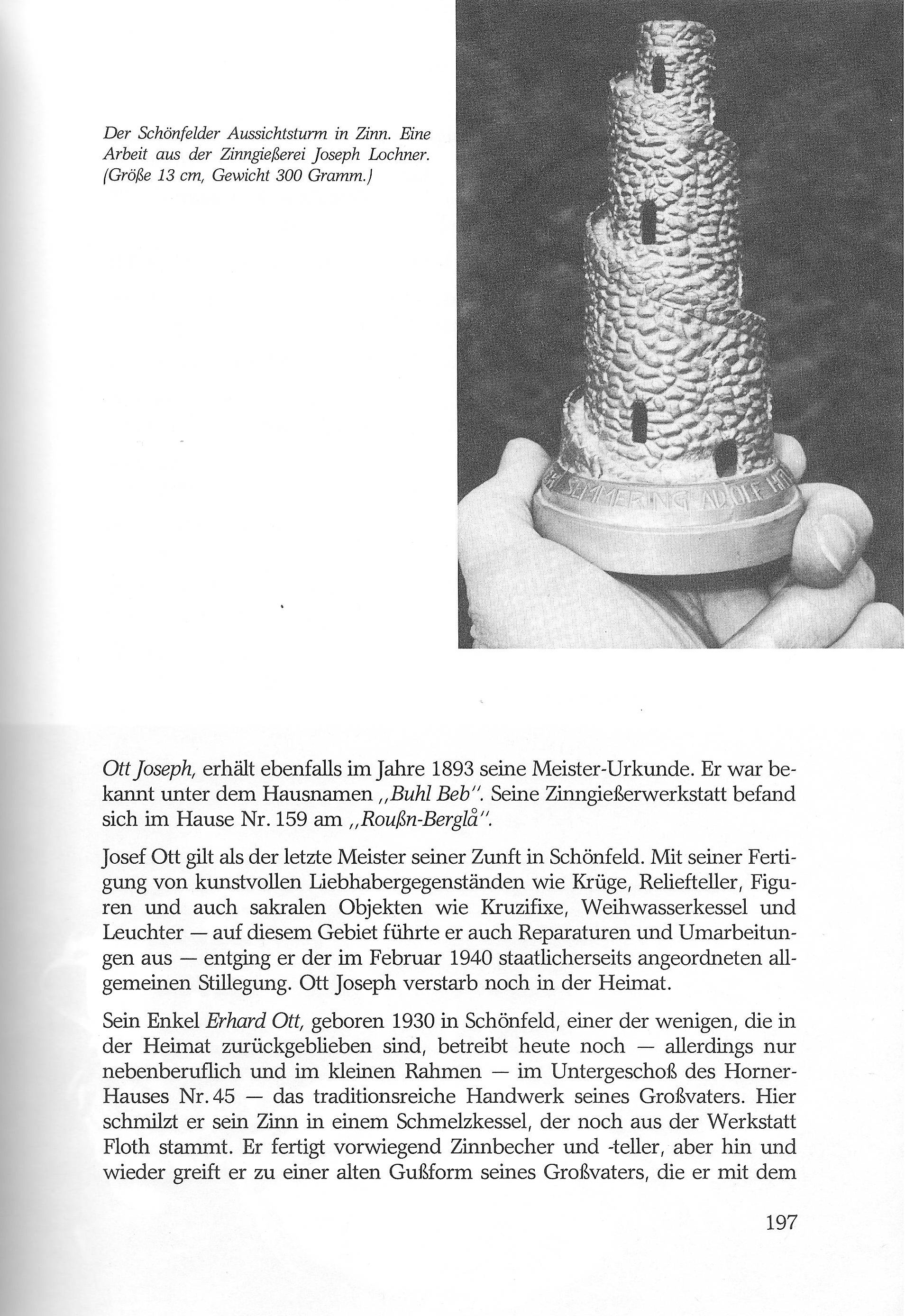 197
The Schönfeld observation tower in pewter. A work from the Joseph
Lochner pewter foundry. (Size 13 cm, weight 300 grams.)
AUTOLE HO
Ott Joseph also received his master craftsman certificate in 1893. He
was known by the family name "Buhl Beb." His pewter workshop was
located at No. 159 on "Roussin-Berglå." Josef Ott is considered
the last master of his guild in Schönfeld. With his production of
artistic collector's items such as jugs, relief plates, figurines, and
also sacred objects such as crucifixes, holy water stoups, and
candlesticks—in this field he also carried out repairs and
alterations—he escaped the general shutdown ordered by the state in
February 1940. Ott Joseph died in his homeland.
His grandson Erhard Ott, born in 1930 in Schönfeld, one of the few who
remained in his homeland, still practices his grandfather's
traditional craft, albeit only part-time and on a small scale, in the
basement of Horner House No. 45. Here, he melts his pewter in a
melting pot that dates back to the Floth workshop. He primarily makes
pewter cups and plates, but every now and then he uses one of his
grandfather's old molds, which he uses with the
197
197
The Schönfeld observation tower in pewter. A work from the Joseph
Lochner pewter foundry. (Size 13 cm, weight 300 grams.)
AUTOLE HO
Ott Joseph also received his master craftsman certificate in 1893. He
was known by the family name "Buhl Beb." His pewter workshop was
located at No. 159 on "Roussin-Berglå." Josef Ott is considered
the last master of his guild in Schönfeld. With his production of
artistic collector's items such as jugs, relief plates, figurines, and
also sacred objects such as crucifixes, holy water stoups, and
candlesticks—in this field he also carried out repairs and
alterations—he escaped the general shutdown ordered by the state in
February 1940. Ott Joseph died in his homeland.
His grandson Erhard Ott, born in 1930 in Schönfeld, one of the few who
remained in his homeland, still practices his grandfather's
traditional craft, albeit only part-time and on a small scale, in the
basement of Horner House No. 45. Here, he melts his pewter in a
melting pot that dates back to the Floth workshop. He primarily makes
pewter cups and plates, but every now and then he uses one of his
grandfather's old molds, which he uses with the
197
Page 0197
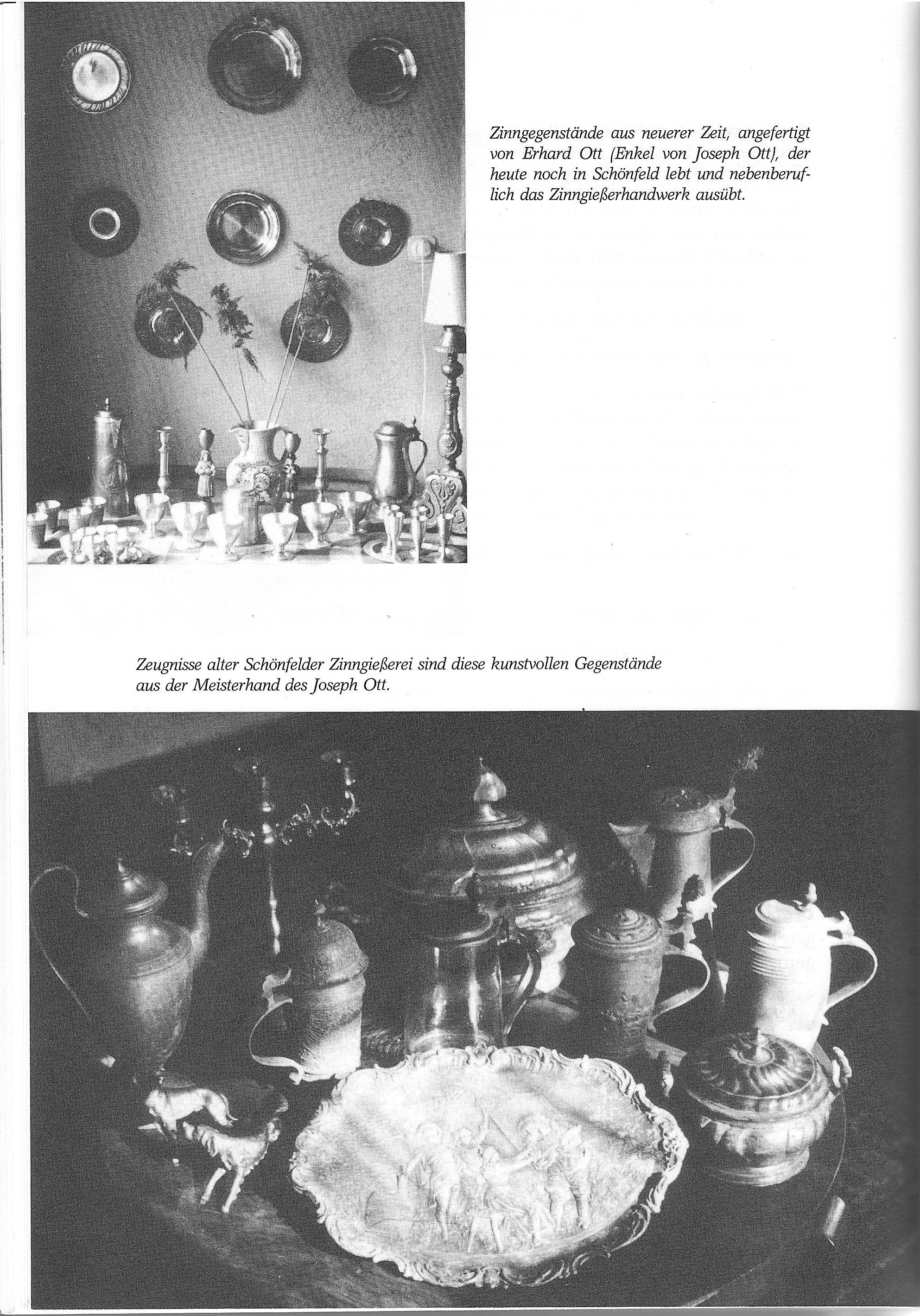 198
Pewter objects from recent times, made by Erhard Ott (grandson of
Joseph Ott), who still lives in Schönfeld today and practices the
pewter trade part-time. These artistic objects, from the master hand
of Joseph Ott, are testaments to old Schönfeld pewter foundries.
198
Pewter objects from recent times, made by Erhard Ott (grandson of
Joseph Ott), who still lives in Schönfeld today and practices the
pewter trade part-time. These artistic objects, from the master hand
of Joseph Ott, are testaments to old Schönfeld pewter foundries.
Page 0198
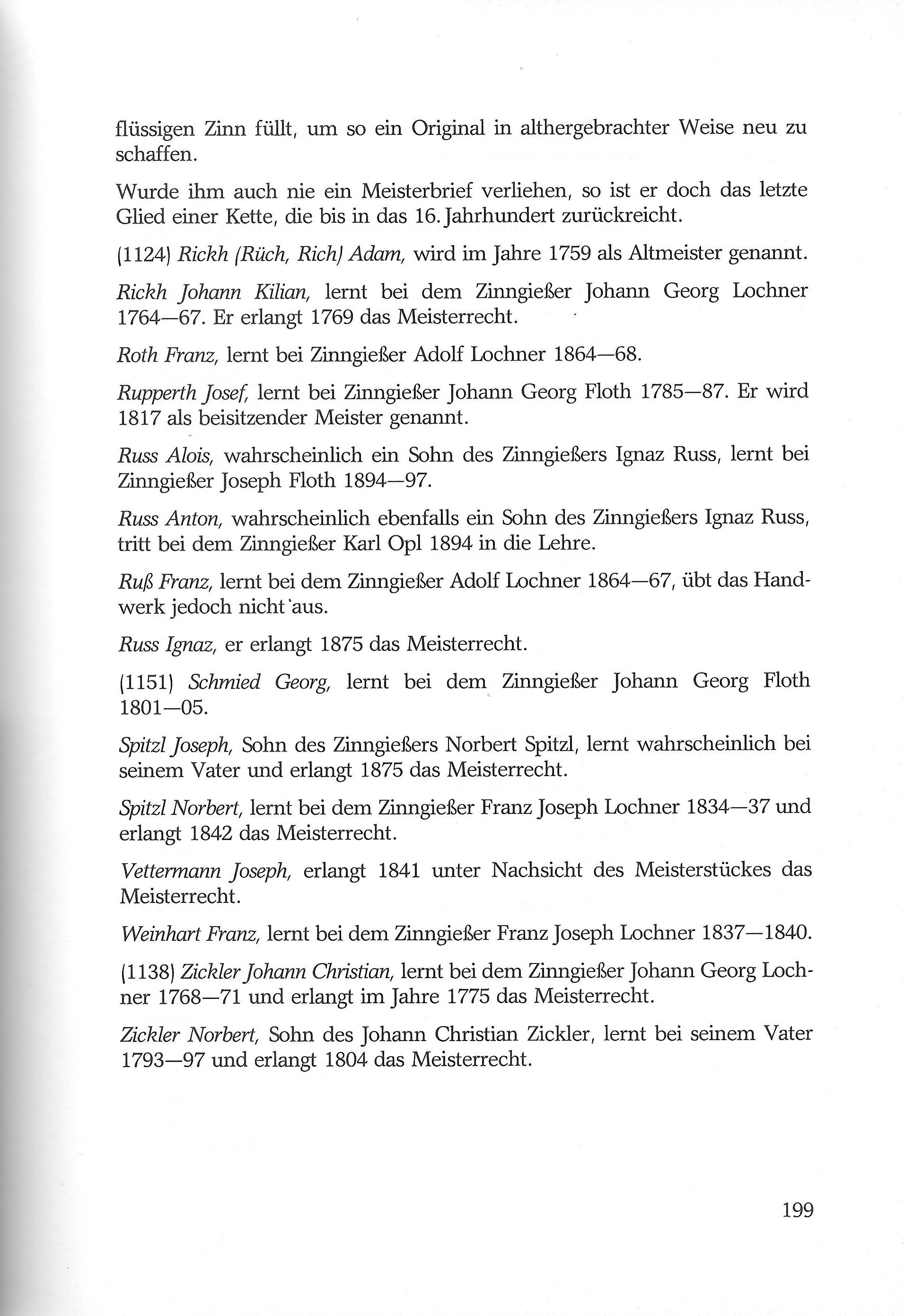 199
fills with liquid tin to recreate an original in the traditional way.
Although he was never awarded a master craftsman's certificate, he is
nevertheless the last link in a chain dating back to the 16th century.
(1124) Rickh (Rüch, Rich) Adam, is listed as an old master in
1759. Rickh Johann Kilian, apprenticed under the pewterer Johann Georg
Lochner from 1764 to 1767. He obtained the master craftsman's
certificate in 1769.
Roth Franz, apprenticed under the pewterer Adolf Lochner from 1864 to
1868.
Rupperth Josef, apprenticed to pewterer Johann Georg Floth from 1785
to 1787. He is listed as an assistant master in 1817.
Russ Alois, probably a son of the pewterer Ignaz Russ, apprenticed to
pewterer Joseph Floth from 1894 to 1897.
Russ Anton, probably also a son of the pewterer Ignaz Russ,
apprenticed to pewterer Karl Opl in 1894.
Ruß Franz, apprenticed to pewterer Adolf Lochner from 1864 to 1867,
but did not practice the craft.
Russ Ignaz, who obtained the master craftsman's certificate in 1875.
(1151) Blacksmith Georg, apprenticed to pewterer Johann Georg Floth
from 1801 to 1805.
Spitzl Joseph, son of the pewterer Norbert Spitzl, probably
apprenticed to his father and obtained the master craftsman's
certificate in 1875. Spitzl Norbert, apprenticed with the pewterer
Franz Joseph Lochner from 1834 to 1837 and obtained the master
craftsman's certificate in 1842.
Vettermann Joseph, obtained the master craftsman's certificate in
1841, subject to the masterpiece.
Weinhart Franz, apprenticed with the pewterer Franz Joseph Lochner
from 1837 to 1840. (1138) Zickler Johann Christian, apprenticed with
the pewterer Johann Georg Lochner from 1768 to 1771 and obtained the
master craftsman's certificate in 1775.
Zickler Norbert, son of Johann Christian Zickler, apprenticed with his
father from 1793 to 1797 and obtained the master craftsman's
certificate in 1804.
199
199
fills with liquid tin to recreate an original in the traditional way.
Although he was never awarded a master craftsman's certificate, he is
nevertheless the last link in a chain dating back to the 16th century.
(1124) Rickh (Rüch, Rich) Adam, is listed as an old master in
1759. Rickh Johann Kilian, apprenticed under the pewterer Johann Georg
Lochner from 1764 to 1767. He obtained the master craftsman's
certificate in 1769.
Roth Franz, apprenticed under the pewterer Adolf Lochner from 1864 to
1868.
Rupperth Josef, apprenticed to pewterer Johann Georg Floth from 1785
to 1787. He is listed as an assistant master in 1817.
Russ Alois, probably a son of the pewterer Ignaz Russ, apprenticed to
pewterer Joseph Floth from 1894 to 1897.
Russ Anton, probably also a son of the pewterer Ignaz Russ,
apprenticed to pewterer Karl Opl in 1894.
Ruß Franz, apprenticed to pewterer Adolf Lochner from 1864 to 1867,
but did not practice the craft.
Russ Ignaz, who obtained the master craftsman's certificate in 1875.
(1151) Blacksmith Georg, apprenticed to pewterer Johann Georg Floth
from 1801 to 1805.
Spitzl Joseph, son of the pewterer Norbert Spitzl, probably
apprenticed to his father and obtained the master craftsman's
certificate in 1875. Spitzl Norbert, apprenticed with the pewterer
Franz Joseph Lochner from 1834 to 1837 and obtained the master
craftsman's certificate in 1842.
Vettermann Joseph, obtained the master craftsman's certificate in
1841, subject to the masterpiece.
Weinhart Franz, apprenticed with the pewterer Franz Joseph Lochner
from 1837 to 1840. (1138) Zickler Johann Christian, apprenticed with
the pewterer Johann Georg Lochner from 1768 to 1771 and obtained the
master craftsman's certificate in 1775.
Zickler Norbert, son of Johann Christian Zickler, apprenticed with his
father from 1793 to 1797 and obtained the master craftsman's
certificate in 1804.
199
Page 0199
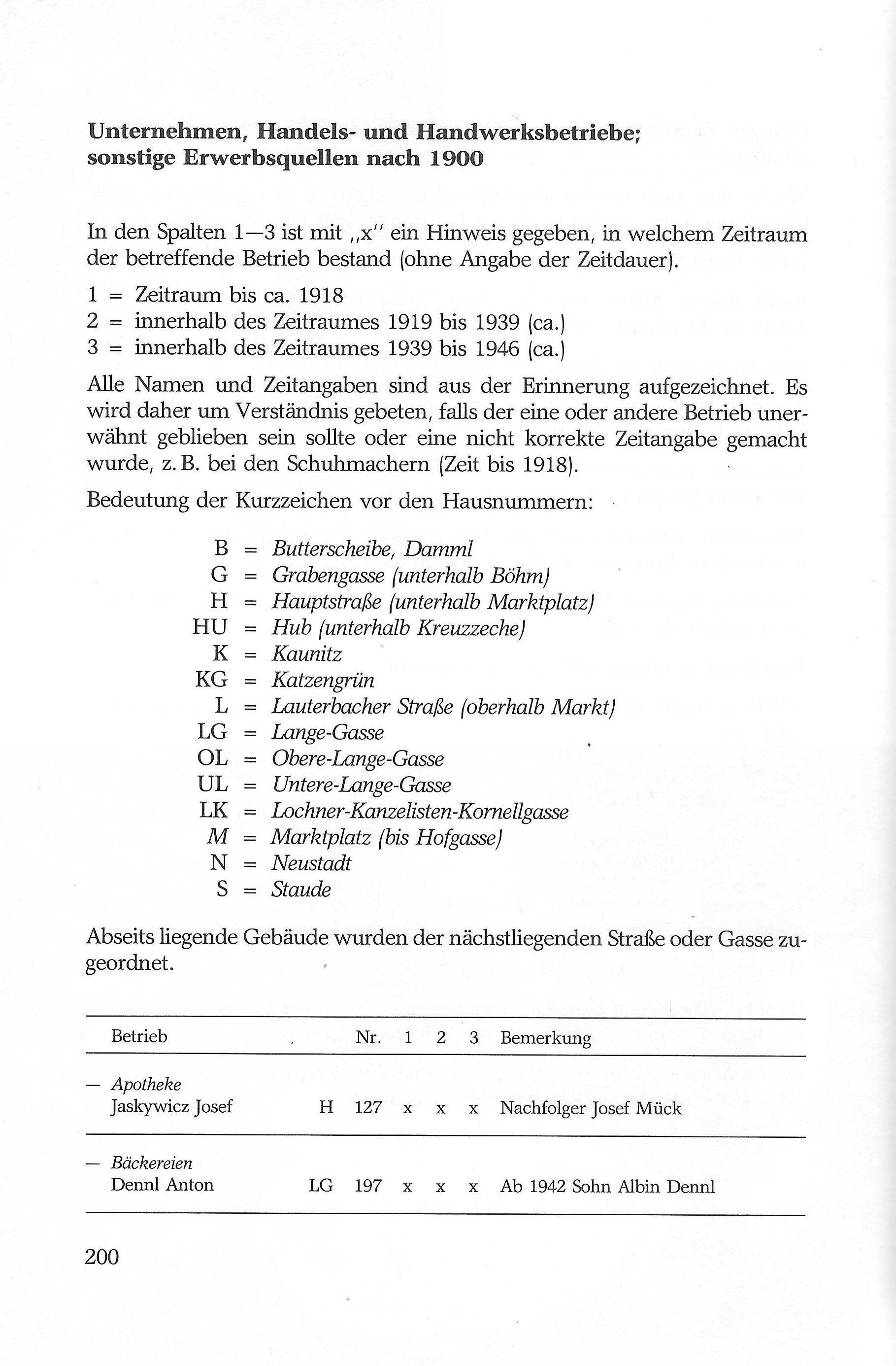 200
companies, trade and craft businesses; Other sources of income after
1900
In columns 1-3, an "x" indicates the period during which the business
in question existed (without specifying the duration).
1 Period up to approx. 1918
2 Within the period 1919 to 1939 (approx.)
3 Within the period 1939 to 1946 (approx.)
All names and dates are recorded from memory. We therefore apologize
if one or more businesses have been omitted or if an incorrect date
has been given, e.g., for the shoemakers (period up to 1918).
Meaning of the abbreviations before the house numbers:
B Butterscheibe, Damml
G Grabengasse (below Böhm)
H Hauptstraße (below Marktplatz)
HU Hub (below Kreuzzeche
K Kaunitz
KU Katzengrün
L Lauterbacher Straße (above market)
LG Lange-Gasse
OL Obere-Lange-Gasse
UL Untere-Lange-Gasse
LK Lochner-Kanzelisten-Kornellgasse
M Marktplatz (up to Hofgasse)
N Neustadt
S Staude
Remotely located buildings were assigned to the nearest street or
alley.
Business
Pharmacy Jaskywicz Josef
No. 1 2
3 Remark
H
127 X X
X Successor Josef Mück
Bakeries
Dennl Anton
LG 197
X X
X
From 1942, son Albin Dennl
200
200
companies, trade and craft businesses; Other sources of income after
1900
In columns 1-3, an "x" indicates the period during which the business
in question existed (without specifying the duration).
1 Period up to approx. 1918
2 Within the period 1919 to 1939 (approx.)
3 Within the period 1939 to 1946 (approx.)
All names and dates are recorded from memory. We therefore apologize
if one or more businesses have been omitted or if an incorrect date
has been given, e.g., for the shoemakers (period up to 1918).
Meaning of the abbreviations before the house numbers:
B Butterscheibe, Damml
G Grabengasse (below Böhm)
H Hauptstraße (below Marktplatz)
HU Hub (below Kreuzzeche
K Kaunitz
KU Katzengrün
L Lauterbacher Straße (above market)
LG Lange-Gasse
OL Obere-Lange-Gasse
UL Untere-Lange-Gasse
LK Lochner-Kanzelisten-Kornellgasse
M Marktplatz (up to Hofgasse)
N Neustadt
S Staude
Remotely located buildings were assigned to the nearest street or
alley.
Business
Pharmacy Jaskywicz Josef
No. 1 2
3 Remark
H
127 X X
X Successor Josef Mück
Bakeries
Dennl Anton
LG 197
X X
X
From 1942, son Albin Dennl
200
Page 0200
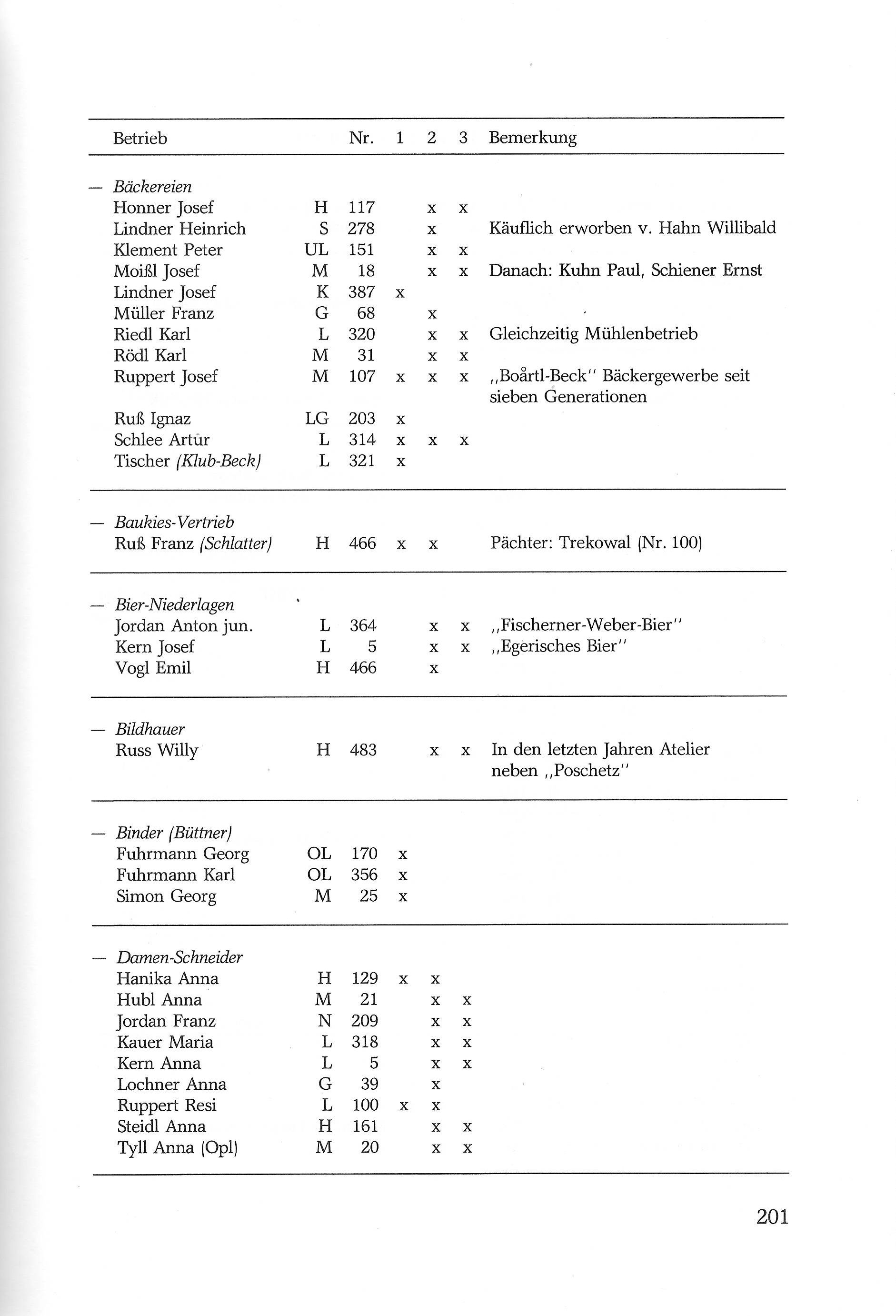 201
201
201
201
Page 0201
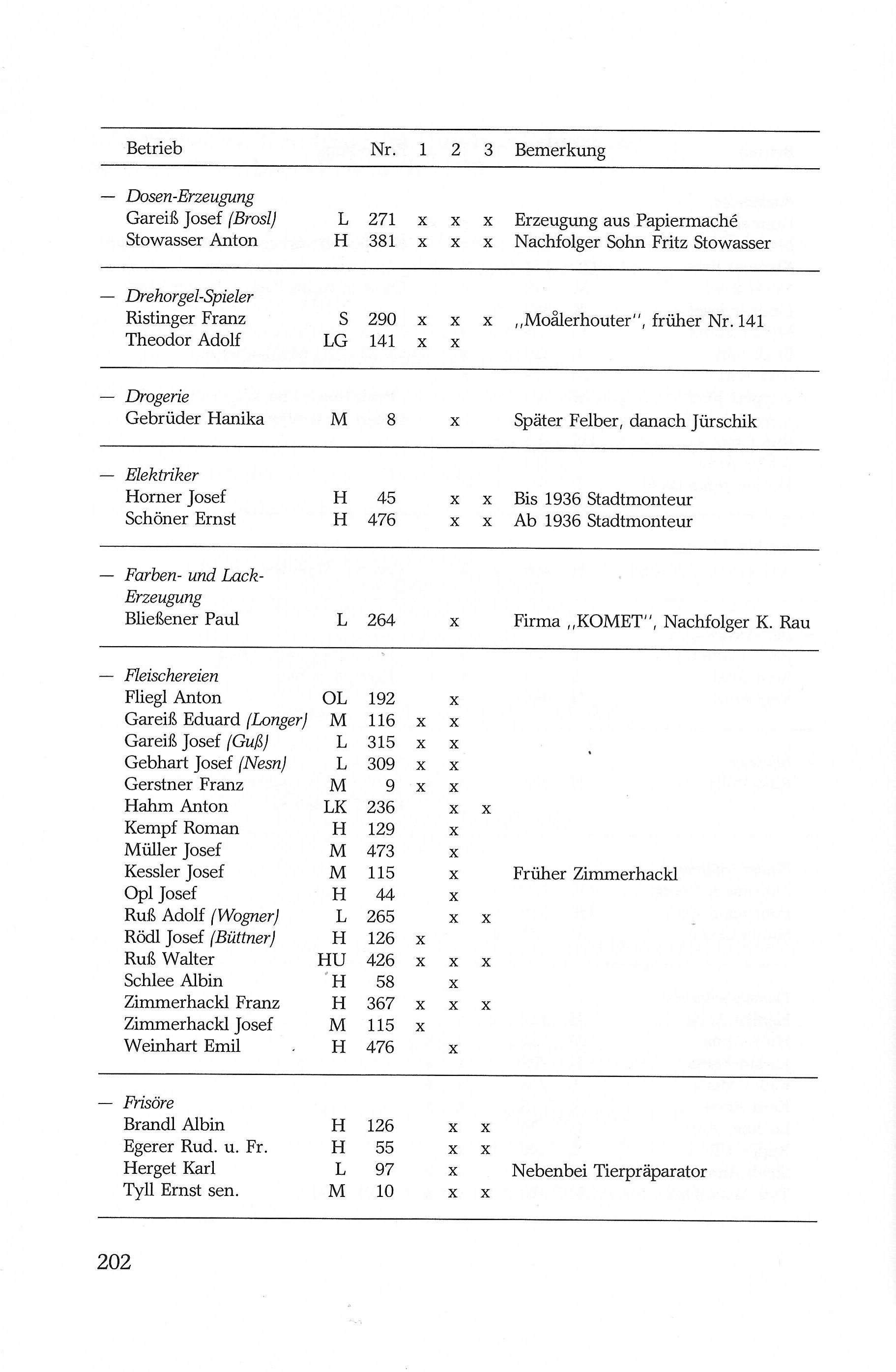 202
202
202
202
Page 0202
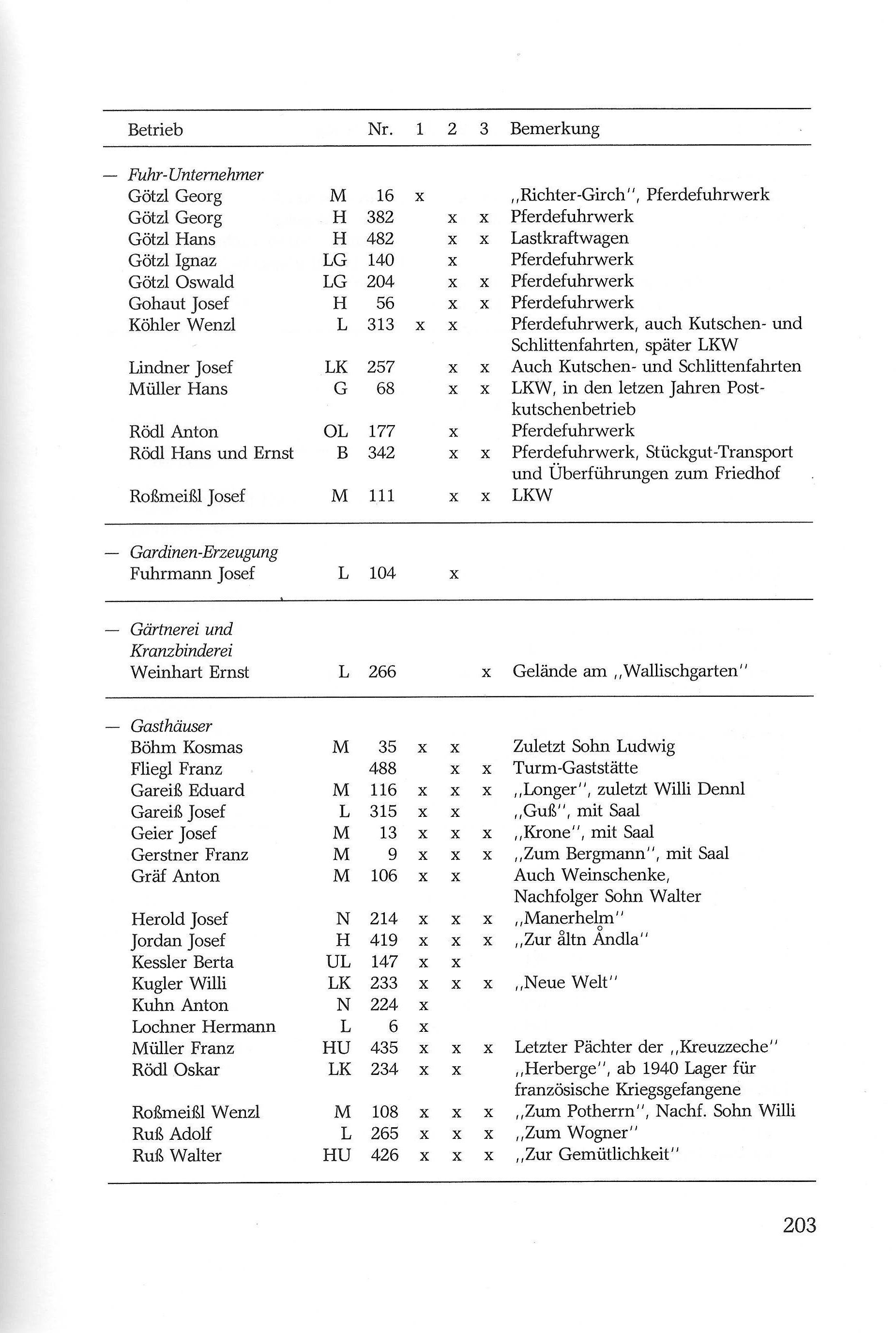 203
203
203
203
Page 0203
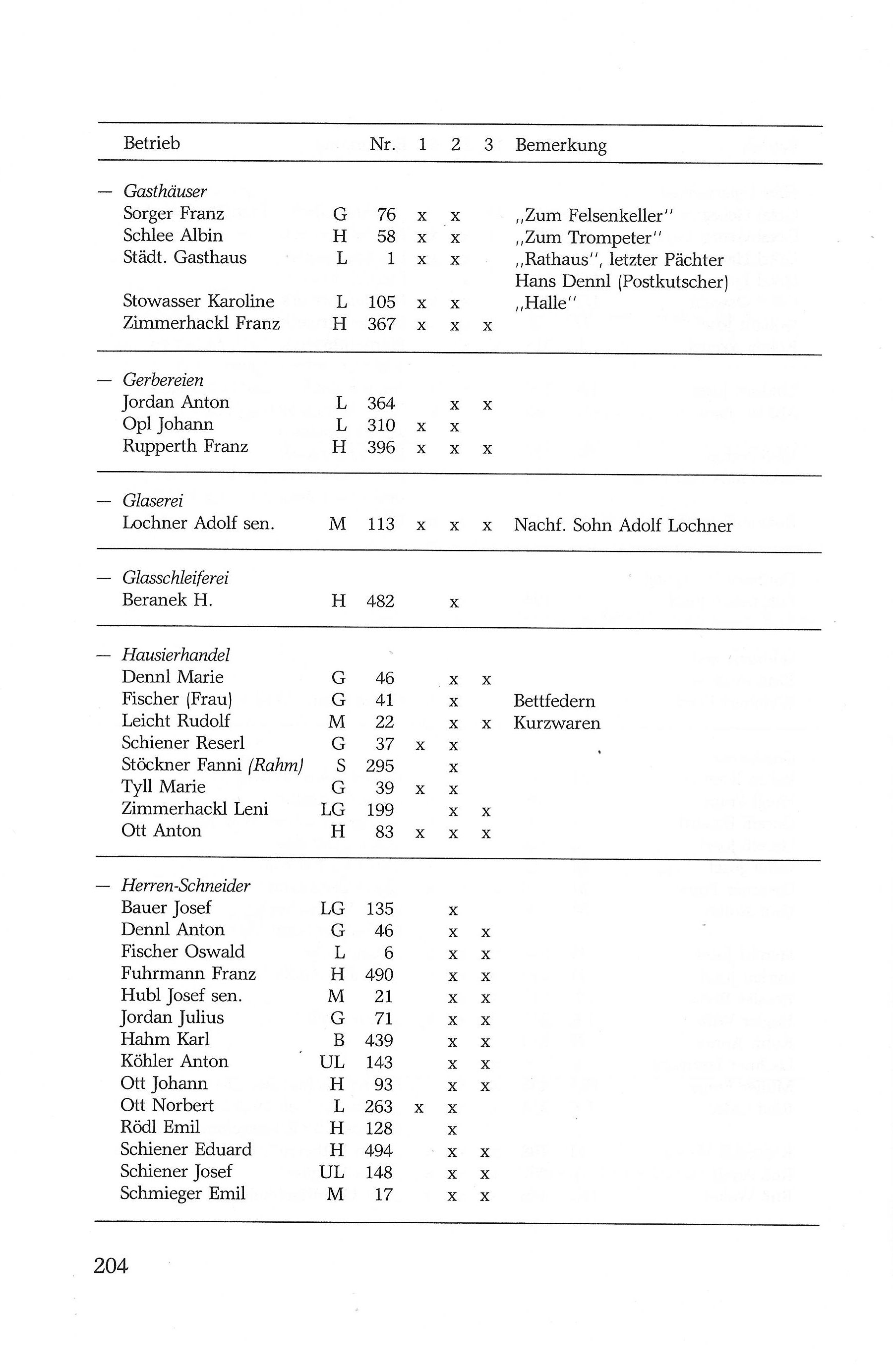 204
204
Page 0204
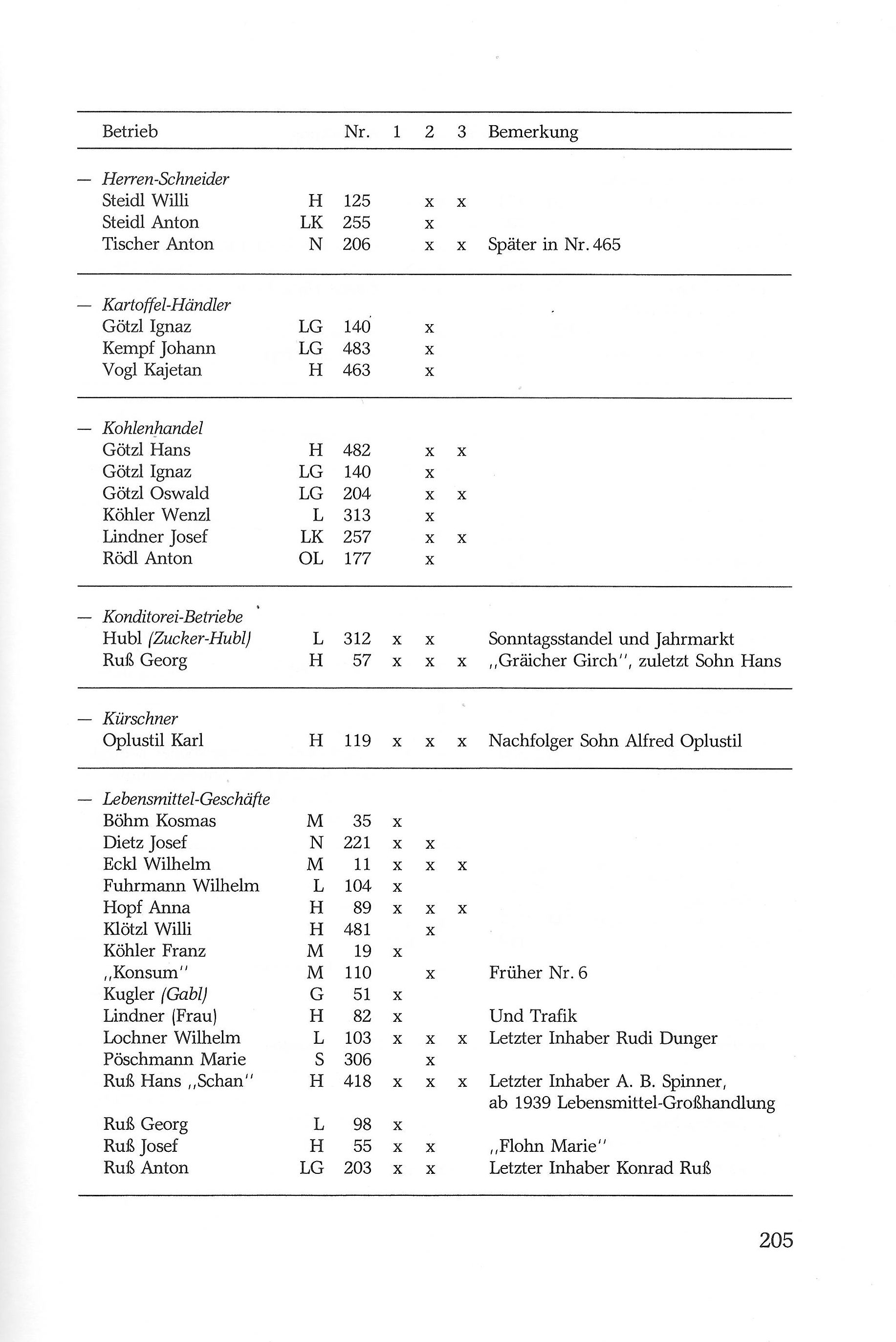 205
205
Page 0205
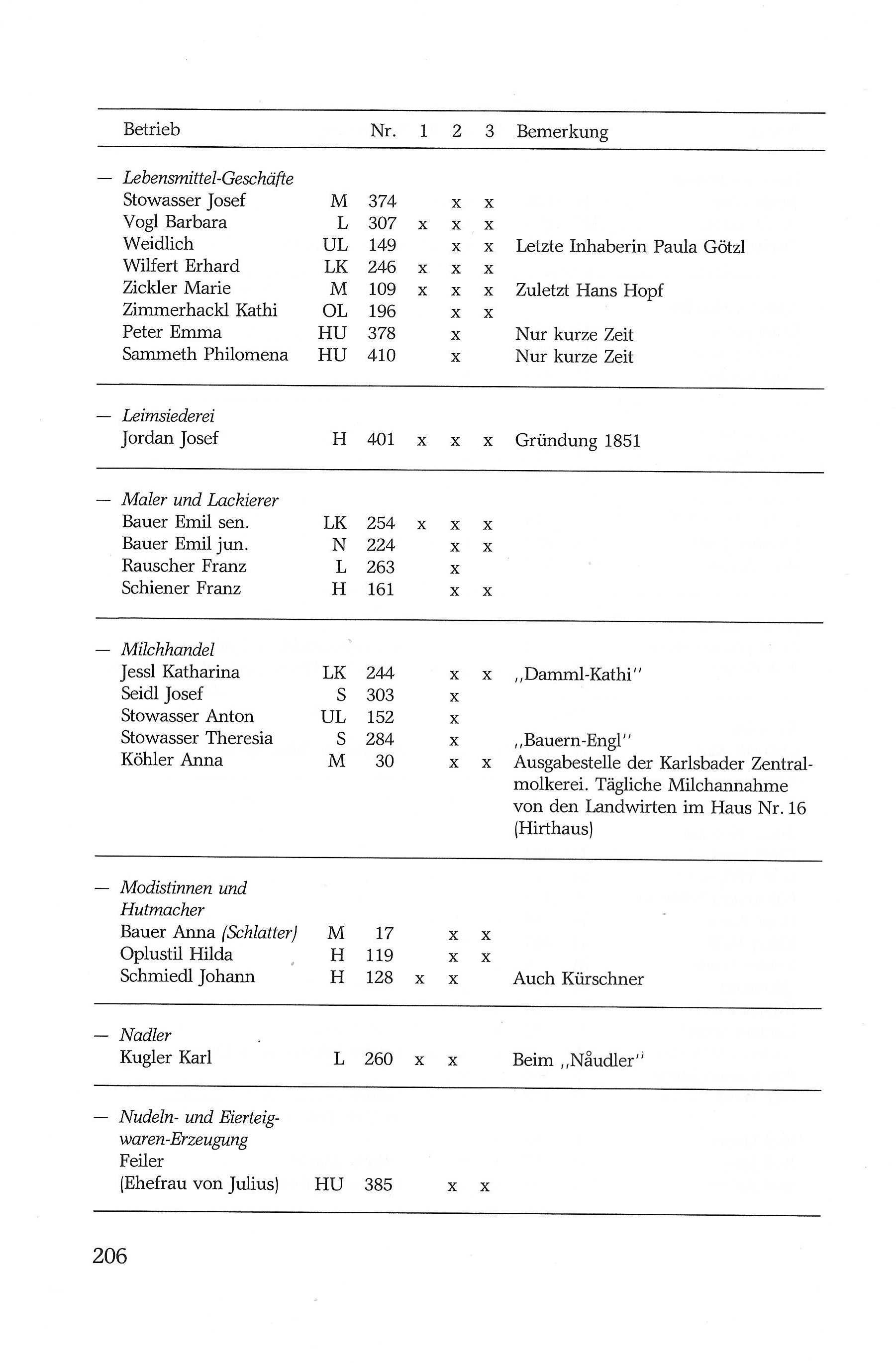 206
206
206
206
Page 0206
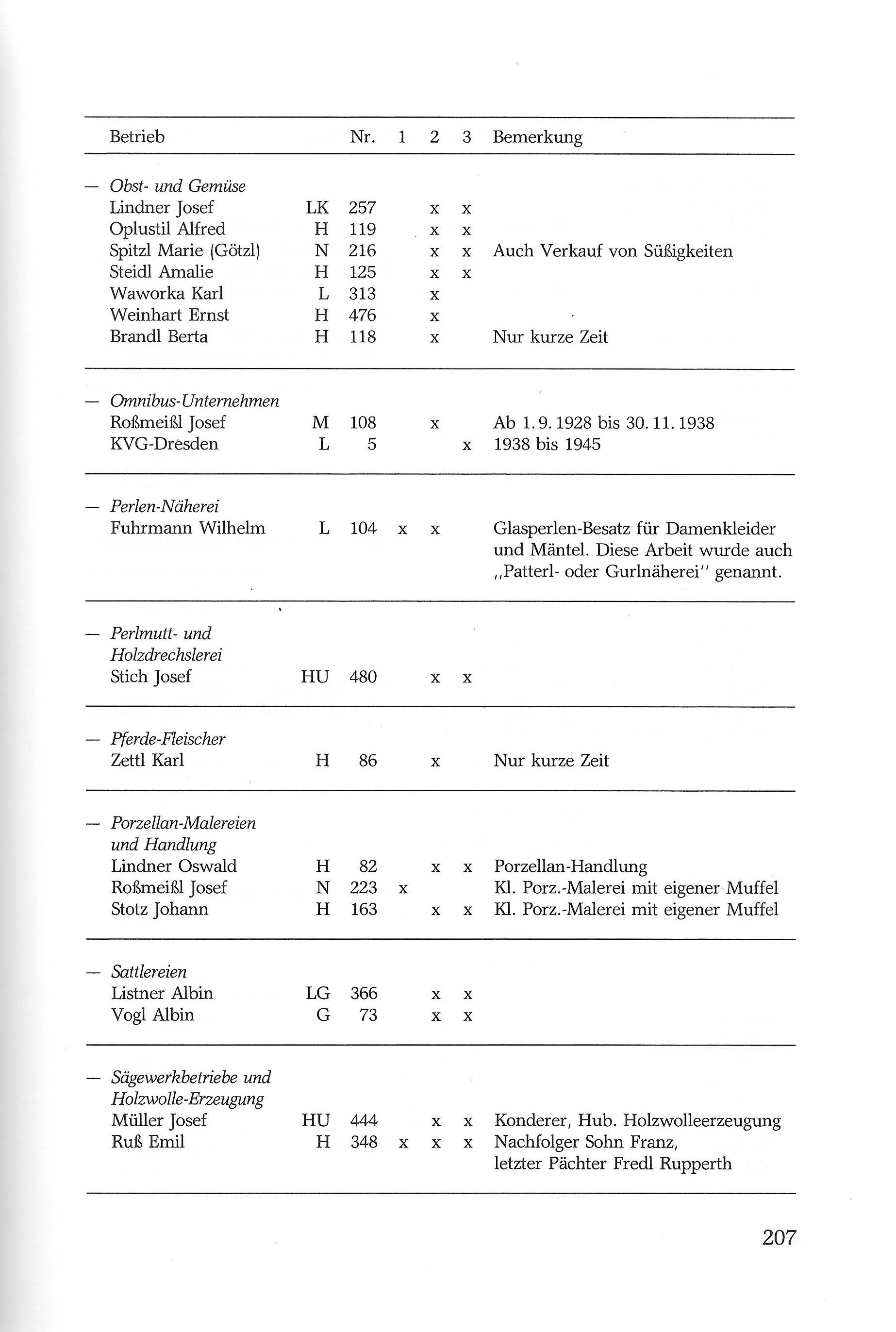 207
last tenant Fredl Rupperth
207
207
last tenant Fredl Rupperth
207
Page 0207
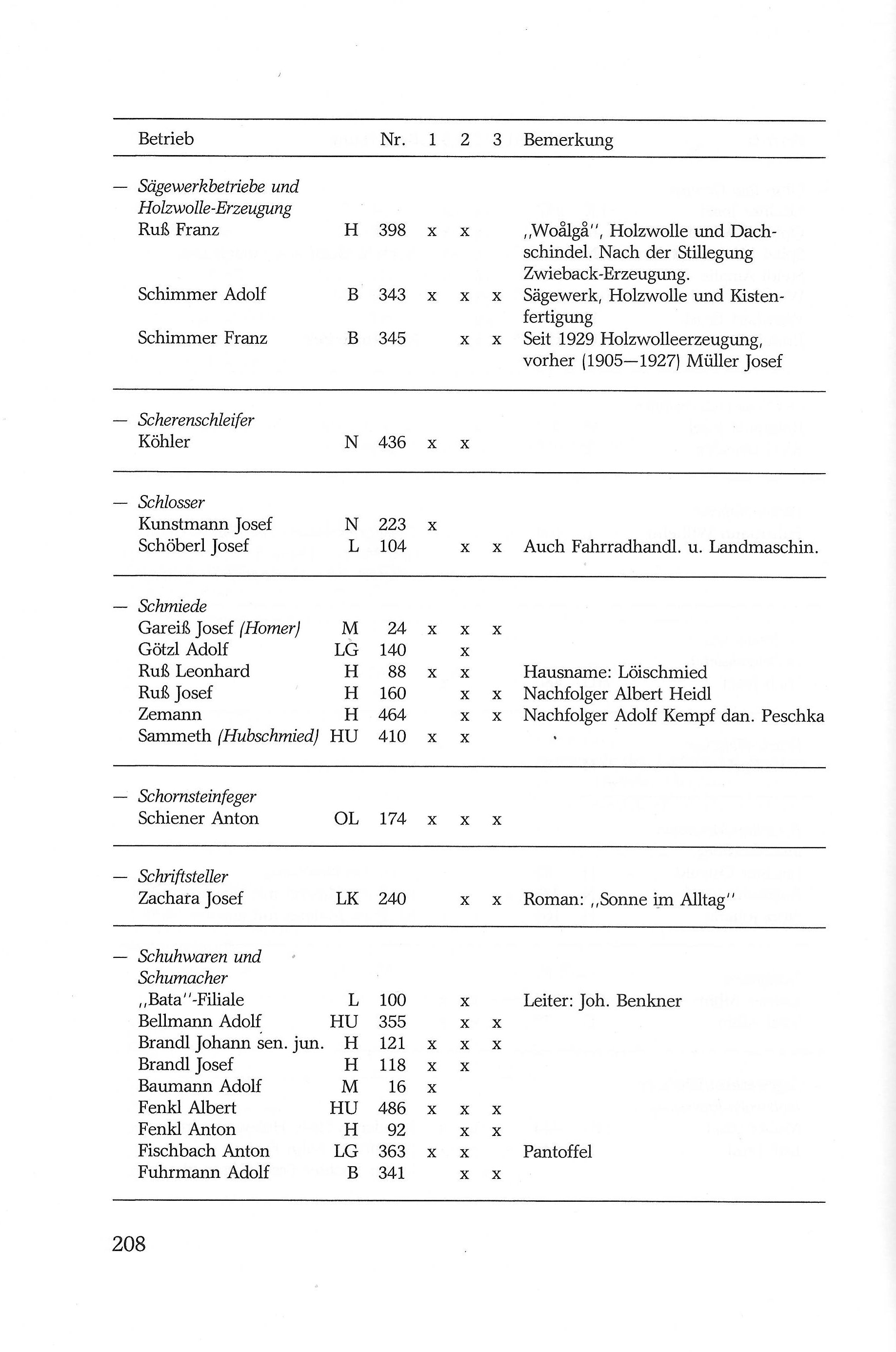 208
X X
208
208
X X
208
Page 0208
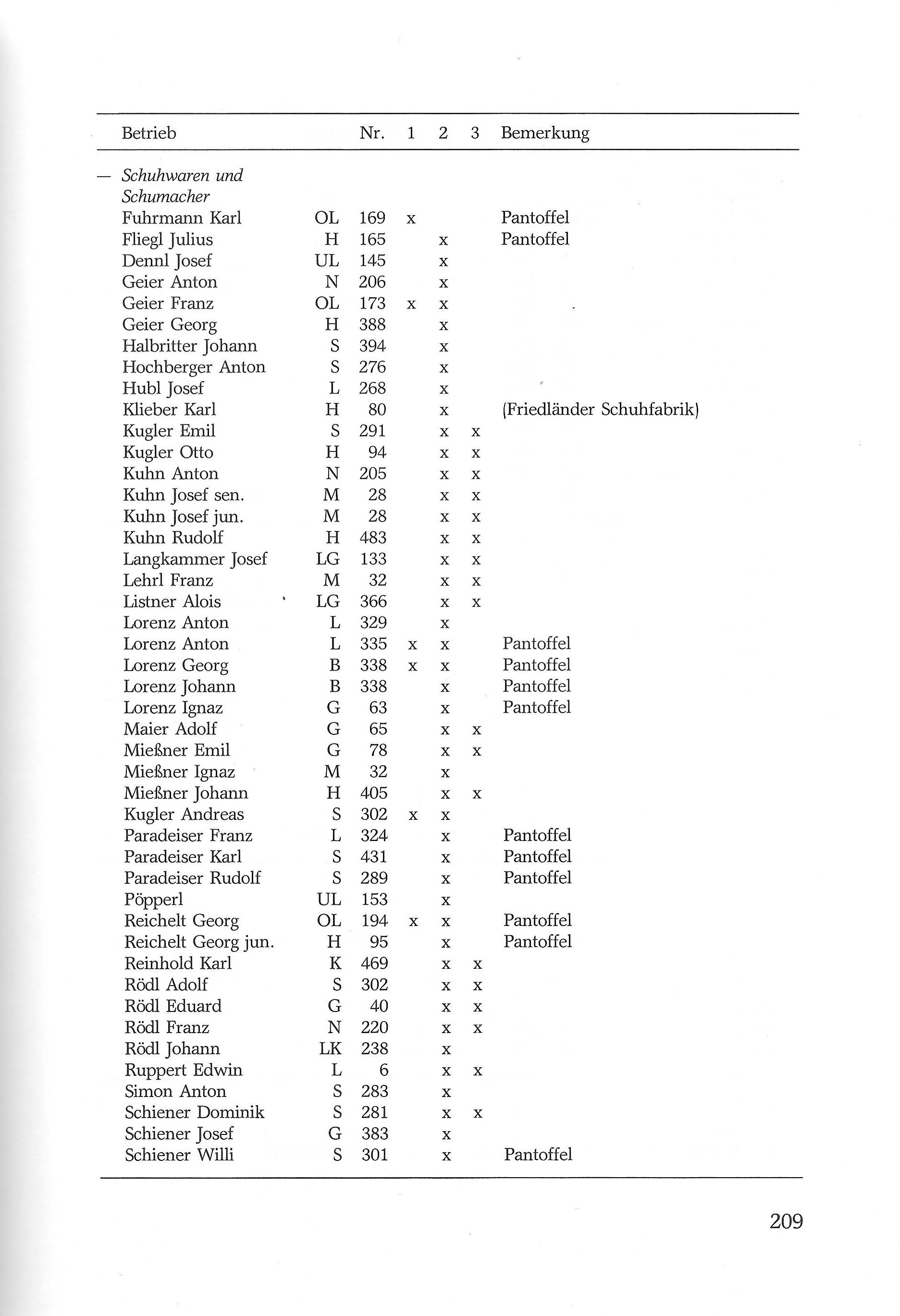 209
Pantoffel
209
209
Pantoffel
209
Page 0209
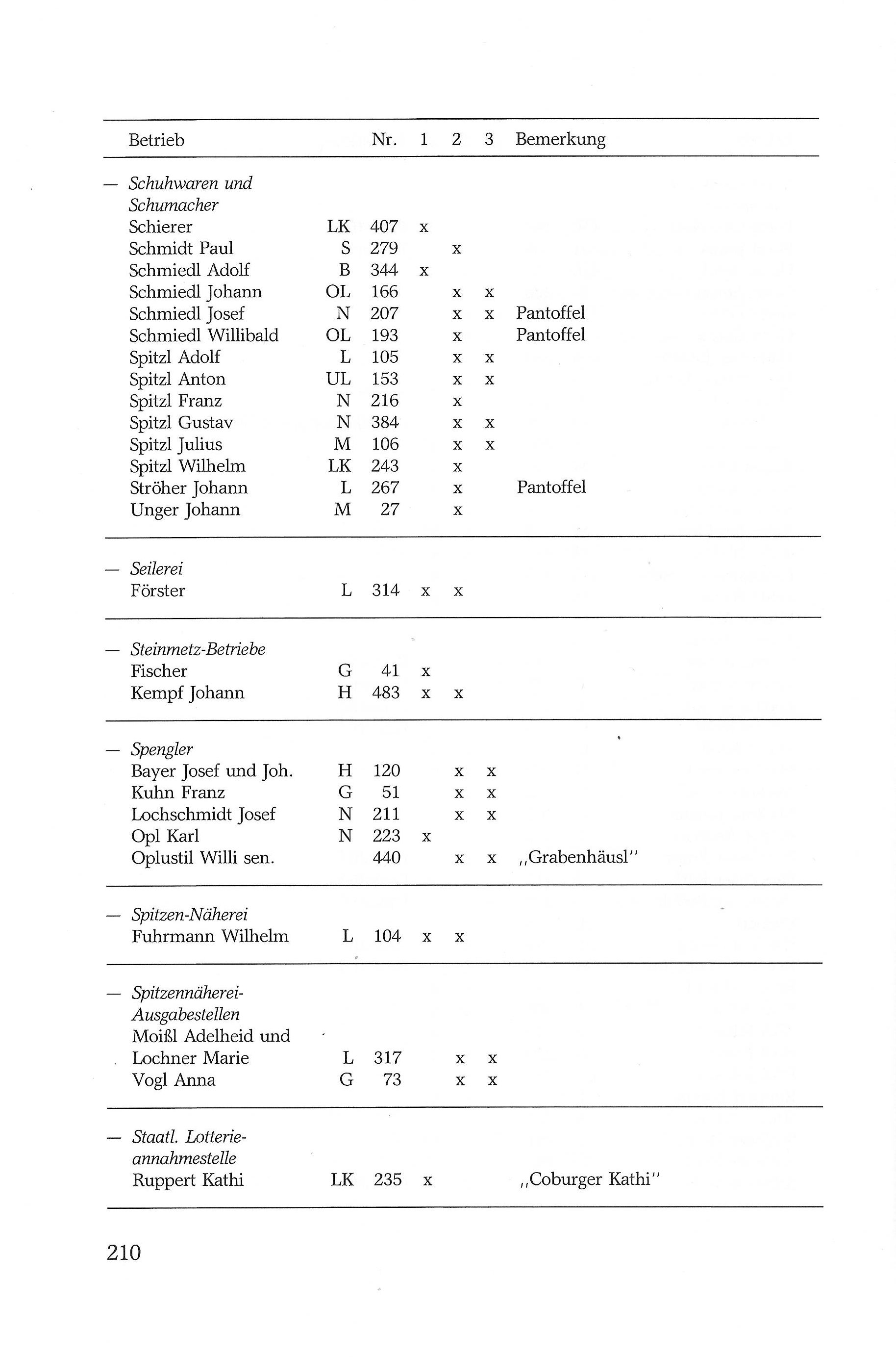 210
210
Page 0210
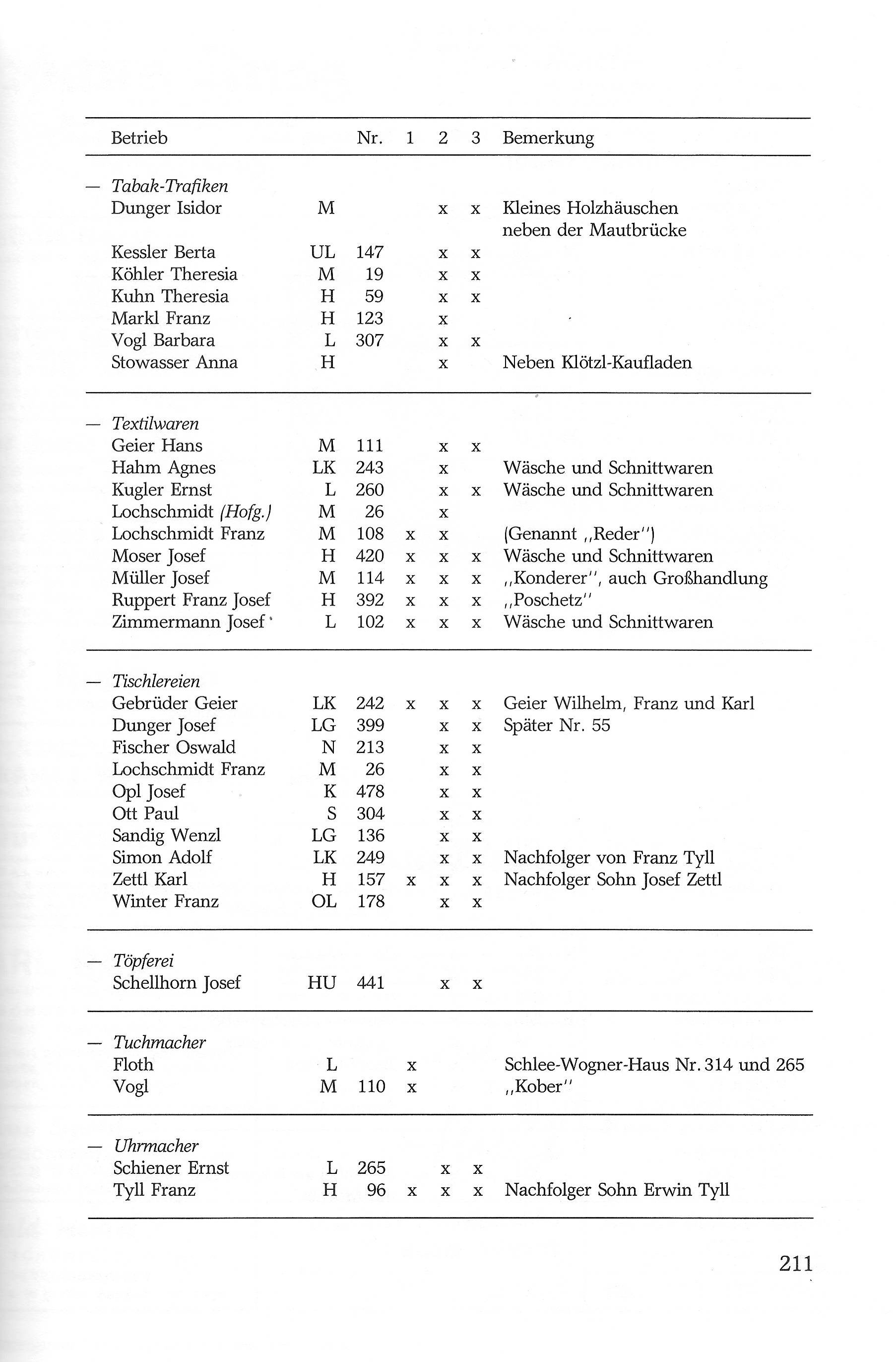 211
211
Page 0211
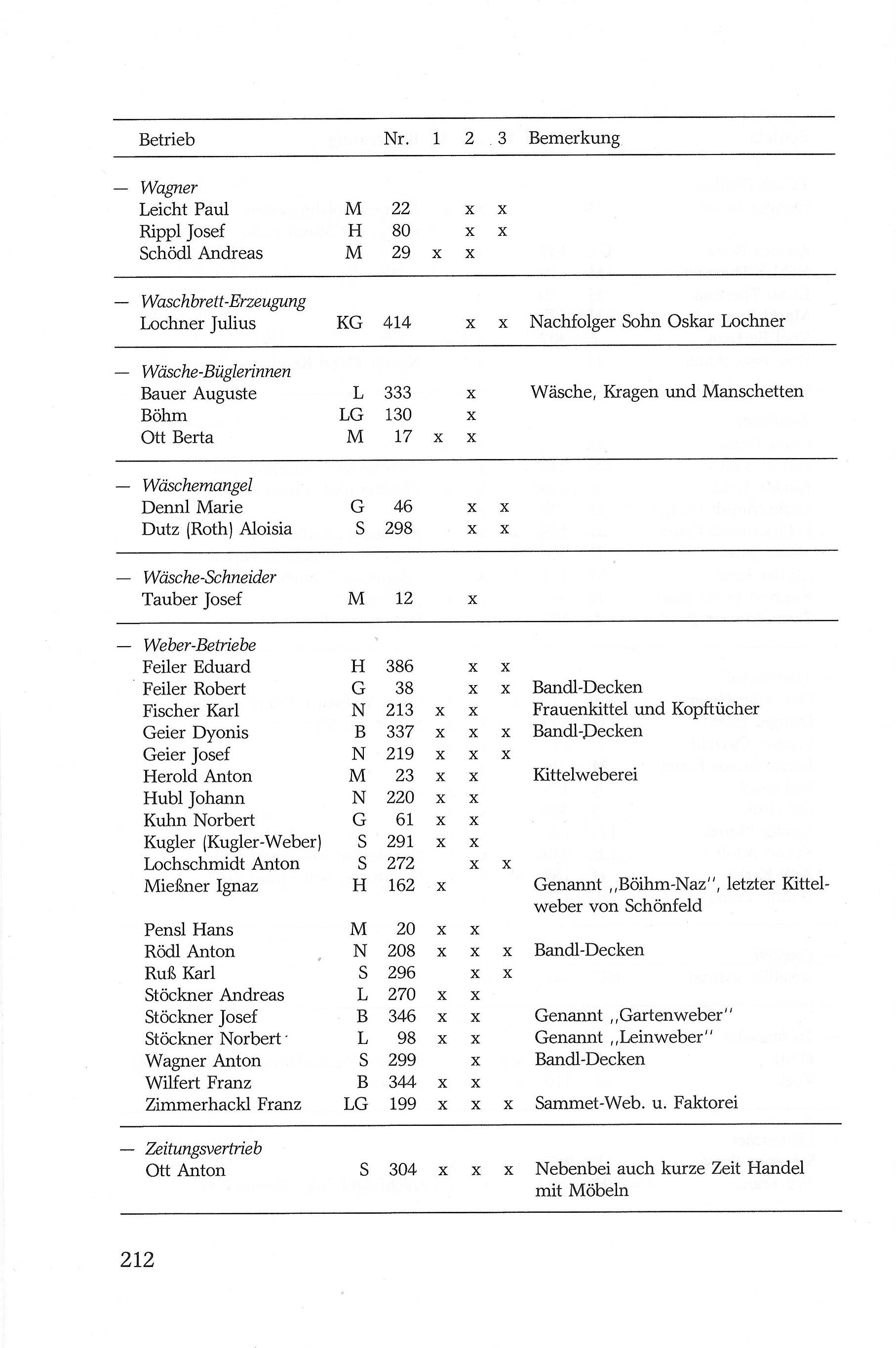 212
212
Page 0212
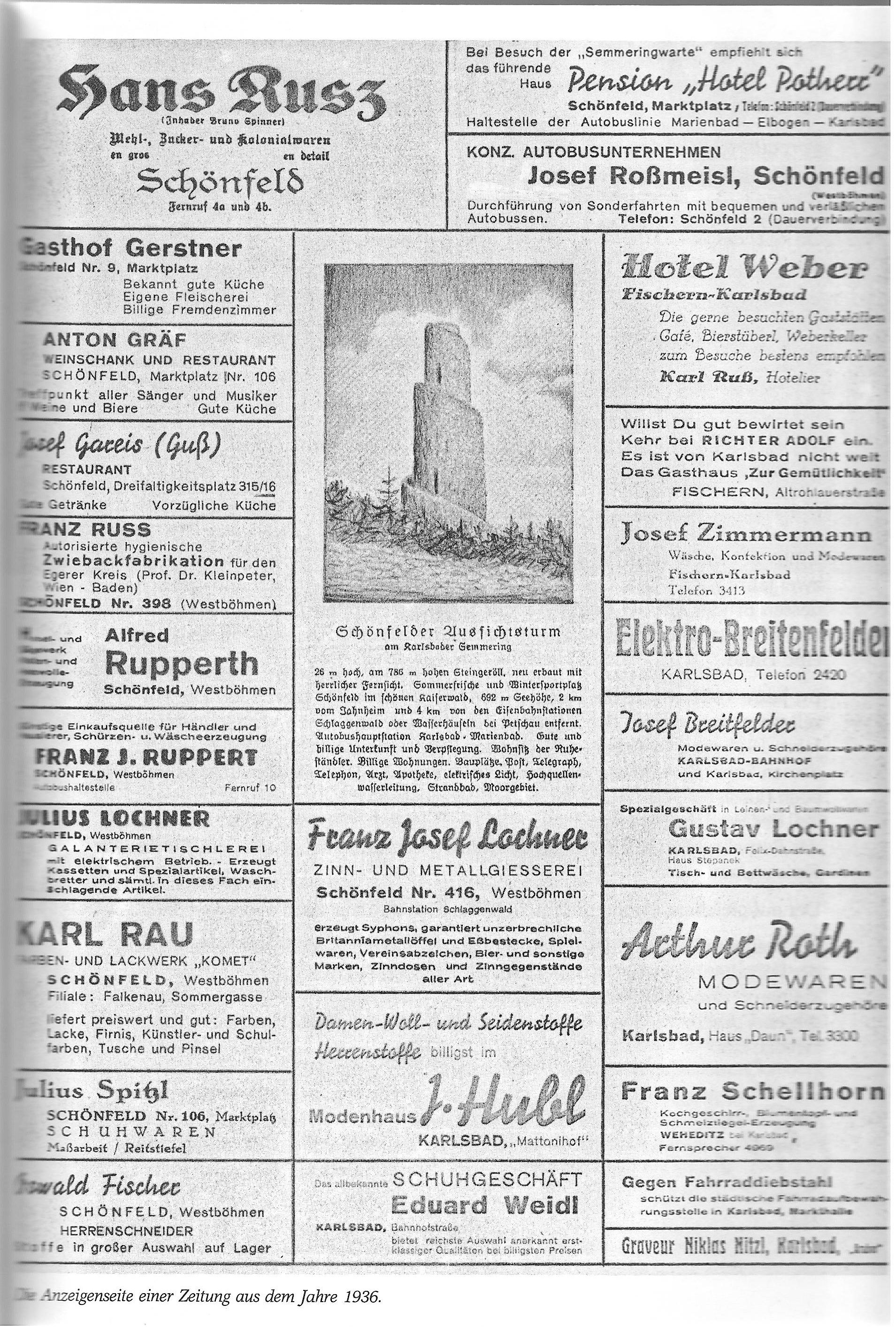 213
Hans Rusz
(Owner Bruno Spinner)
Flour, bakery goods, and groceries
in bulk
When visiting the "Semmeringwarte," we recommend
the leading
guesthouse
Pension, "Hotel Pother"
Schönfeld, Marktplatz, Telephone: Schönfeld 20
Bus stop on the Marienbad - Elbogen line
in detail
KONZ. BUS COMPANY
Schönfeld
Jernruf 4a and 46.
Gasthof Gerstner
Schönfeld No. 9, Market Square
Well-known for its excellent cuisine. Own butcher shop. Affordable guest rooms.
ANTON GRÄF
WINE BAR AND RESTAURANT SCHÖNFELD, Market Square No. 106. A focal point for singers and musicians. Wines and beers.
Good cuisine.
Josef Gareis (Guß)
RESTAURANT
Schönfeld, Dreifaltigkeitsplatz 315/16
Beverages
RANZ RUSS
Excellent cuisine.
Authorized hygienic rusk production for the Cheb district (Prof. Dr. Kleinpeter, Vienna - Baden).
ÖNFELD No. 398 (West Bohemia).
and
works and
wool production.
Alfred
Rupperth
Schönfeld, West Bohemia.
A reliable source for traders and apron and linen production.
FRANZ J. RUPPERT
SCHÖNFELD, West Bohemia
Bus stop
ULIUS LOCHNER
NFELD, West Bohemia
Telephone 10
FURNITURE JOINERY
with electric operation. - Produces cassettes and specialty items, washboards, and all other striking items included in this section.
KARL RAU
PAINT AND LACQUER WORK, "KOMET" SCHÖNFELD, West Bohemia Branch: Falkenau, Sommergasse Delivers affordable and high-quality: paints, varnishes, artist's and school paints, ink, and brushes
lius Spitl
SCHÖNFELD No. 106, Marktplatz SHOES
Custom-made work / Riding boots
Fowald Fischer
SCHÖNFELD, West Bohemia MEN'S TAILORS
Large selection of shoes in stock
Karisbac
Josef Roßmeisl, Schönfeld
Special tours with convenient and affordable buses. Telephone: Schönfeld 2 (permanent connection).
Schönfeld Observation Tower
on the Rarisbaber Gemmering
26 m high, on the 786 m high scree, newly built with magnificent views. Summer resort and winter sports resort Schönfeld in the beautiful Slavkov Forest, 692 m above sea level, 2 km from Sahnheim and 4 km from from the train stations Schlaggenwald or Wajjerhäufeln near Petschau. Main bus station Karlovy Vary. Marienbad. Good and inexpensive accommodations and meals. Peaceful residential area. Locals. Cheap apartments. Building plots. Post office, telegraph, telephone, doctor, pharmacist, electric light, spring water pipeline. Beach, moorland.
Franz Josef Lochner
TIN AND METAL FOUNDRY Schönfeld No. 416, West Bohemia
Train station Schlaggenwald
Produces siphons, guaranteed unbreakable Britannia metal spoons and cutlery, games, club badges, beer and other stamps, tin cans, and tin objects of all kinds.
Ladies' wool and silk fabrics, army fabrics at the cheapest prices at the
Fashion store J. Hubl
KARLSBAD, Mattonihof
SHOE SHOP
Eduard Weidl
KARLSBAD, Bahnhofstraße
Two classifieds page of a newspaper from the 1936.
Offers the widest selection of recognized first-class quality at the lowest prices.
Hotel Weber
Tischern-Karlsbad
The popular guesthouses Gafé, Bierstüberl, and Weberkeller are highly recommended for a visit by Karl Rub, hotelier.
If you want to be well-served, stop by RICHTER ADOLF. It's not far from Karlsbad. The Gasthaus Zur Gemütlichkeit (Guesthouse for Coziness) FISCHERN, Altrohlauerstrasse
Josef Zimmermann
Linen, Ready-to-Wear, and Fashion Shops Fischern-Karlsbad, Phone 3413
Elektro-Breitenfelder
KARLSBAD, Phone 2420
Josef Breitfelder
Fashion Goods and Tailors KARLSBAD-BAHNHOF
and Karlsbad, Kirchenplatz
Specialty Shop for Linen and Cotton Fabrics
Gustav Lochner
KARLSBAD, Felix-Dahns Haus Stepanek
Table and Bed Linen, Gardim
Arthur Roth
FASHION GOODS and Tailoring Accessories, Karlsbad, Haus "Daun", Tel. 3300
Franz Schellhorn
Cookware, Blumentopit
Melting pot production, WEHEDITZ, near Karstad, Telephone 4069
Protection against bicycle theft is provided by the municipal bicycle office in Karlsbad, Markha
Engraver Niklas Mitzl, Karlsbad, he
213
213
Hans Rusz
(Owner Bruno Spinner)
Flour, bakery goods, and groceries
in bulk
When visiting the "Semmeringwarte," we recommend
the leading
guesthouse
Pension, "Hotel Pother"
Schönfeld, Marktplatz, Telephone: Schönfeld 20
Bus stop on the Marienbad - Elbogen line
in detail
KONZ. BUS COMPANY
Schönfeld
Jernruf 4a and 46.
Gasthof Gerstner
Schönfeld No. 9, Market Square
Well-known for its excellent cuisine. Own butcher shop. Affordable guest rooms.
ANTON GRÄF
WINE BAR AND RESTAURANT SCHÖNFELD, Market Square No. 106. A focal point for singers and musicians. Wines and beers.
Good cuisine.
Josef Gareis (Guß)
RESTAURANT
Schönfeld, Dreifaltigkeitsplatz 315/16
Beverages
RANZ RUSS
Excellent cuisine.
Authorized hygienic rusk production for the Cheb district (Prof. Dr. Kleinpeter, Vienna - Baden).
ÖNFELD No. 398 (West Bohemia).
and
works and
wool production.
Alfred
Rupperth
Schönfeld, West Bohemia.
A reliable source for traders and apron and linen production.
FRANZ J. RUPPERT
SCHÖNFELD, West Bohemia
Bus stop
ULIUS LOCHNER
NFELD, West Bohemia
Telephone 10
FURNITURE JOINERY
with electric operation. - Produces cassettes and specialty items, washboards, and all other striking items included in this section.
KARL RAU
PAINT AND LACQUER WORK, "KOMET" SCHÖNFELD, West Bohemia Branch: Falkenau, Sommergasse Delivers affordable and high-quality: paints, varnishes, artist's and school paints, ink, and brushes
lius Spitl
SCHÖNFELD No. 106, Marktplatz SHOES
Custom-made work / Riding boots
Fowald Fischer
SCHÖNFELD, West Bohemia MEN'S TAILORS
Large selection of shoes in stock
Karisbac
Josef Roßmeisl, Schönfeld
Special tours with convenient and affordable buses. Telephone: Schönfeld 2 (permanent connection).
Schönfeld Observation Tower
on the Rarisbaber Gemmering
26 m high, on the 786 m high scree, newly built with magnificent views. Summer resort and winter sports resort Schönfeld in the beautiful Slavkov Forest, 692 m above sea level, 2 km from Sahnheim and 4 km from from the train stations Schlaggenwald or Wajjerhäufeln near Petschau. Main bus station Karlovy Vary. Marienbad. Good and inexpensive accommodations and meals. Peaceful residential area. Locals. Cheap apartments. Building plots. Post office, telegraph, telephone, doctor, pharmacist, electric light, spring water pipeline. Beach, moorland.
Franz Josef Lochner
TIN AND METAL FOUNDRY Schönfeld No. 416, West Bohemia
Train station Schlaggenwald
Produces siphons, guaranteed unbreakable Britannia metal spoons and cutlery, games, club badges, beer and other stamps, tin cans, and tin objects of all kinds.
Ladies' wool and silk fabrics, army fabrics at the cheapest prices at the
Fashion store J. Hubl
KARLSBAD, Mattonihof
SHOE SHOP
Eduard Weidl
KARLSBAD, Bahnhofstraße
Two classifieds page of a newspaper from the 1936.
Offers the widest selection of recognized first-class quality at the lowest prices.
Hotel Weber
Tischern-Karlsbad
The popular guesthouses Gafé, Bierstüberl, and Weberkeller are highly recommended for a visit by Karl Rub, hotelier.
If you want to be well-served, stop by RICHTER ADOLF. It's not far from Karlsbad. The Gasthaus Zur Gemütlichkeit (Guesthouse for Coziness) FISCHERN, Altrohlauerstrasse
Josef Zimmermann
Linen, Ready-to-Wear, and Fashion Shops Fischern-Karlsbad, Phone 3413
Elektro-Breitenfelder
KARLSBAD, Phone 2420
Josef Breitfelder
Fashion Goods and Tailors KARLSBAD-BAHNHOF
and Karlsbad, Kirchenplatz
Specialty Shop for Linen and Cotton Fabrics
Gustav Lochner
KARLSBAD, Felix-Dahns Haus Stepanek
Table and Bed Linen, Gardim
Arthur Roth
FASHION GOODS and Tailoring Accessories, Karlsbad, Haus "Daun", Tel. 3300
Franz Schellhorn
Cookware, Blumentopit
Melting pot production, WEHEDITZ, near Karstad, Telephone 4069
Protection against bicycle theft is provided by the municipal bicycle office in Karlsbad, Markha
Engraver Niklas Mitzl, Karlsbad, he
213
Page 0213
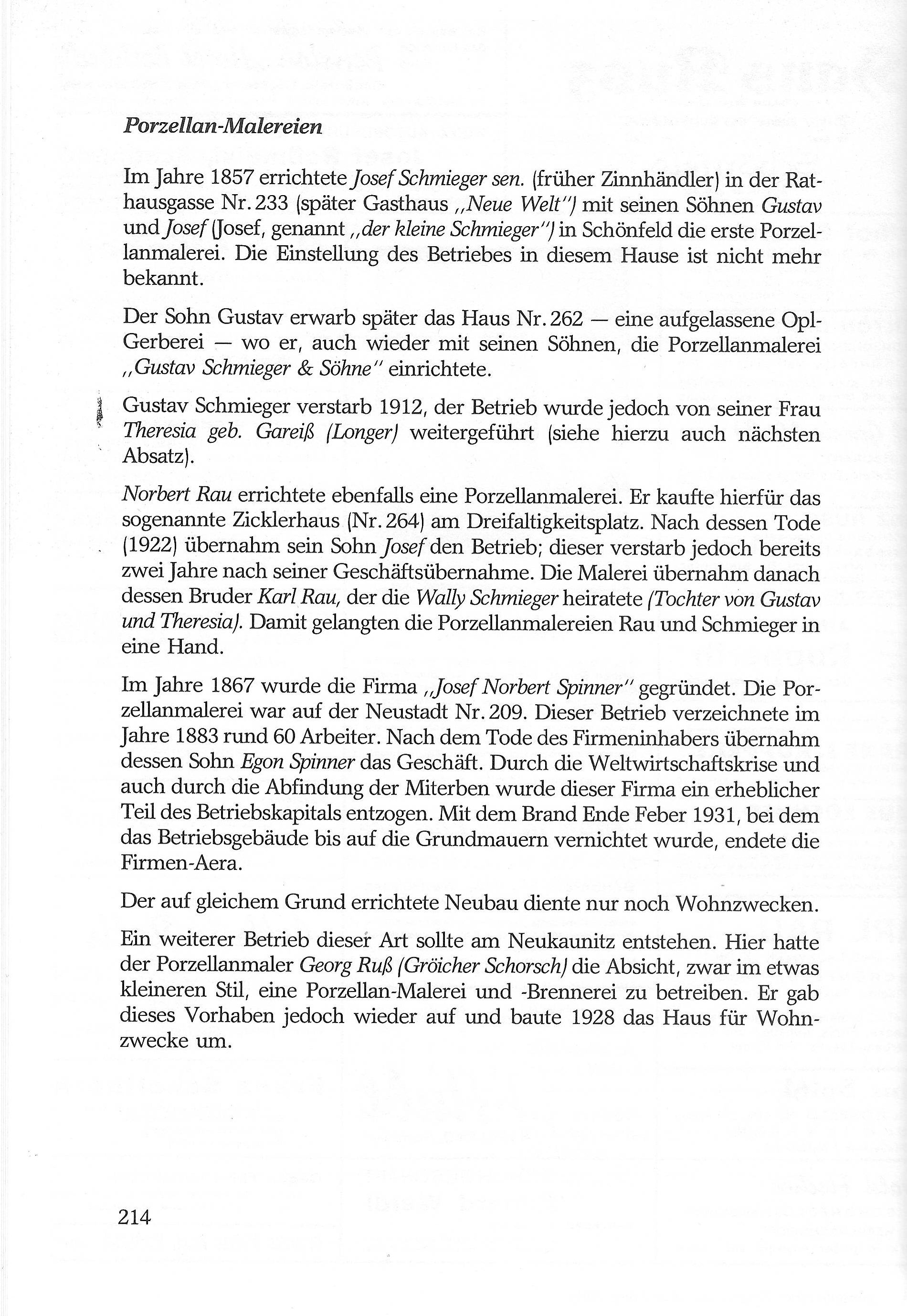 214
Porcelain Paintings
In 1857, Josef Schmieger Sr. (formerly a tin merchant) established the
first porcelain painting shop at Rathausgasse No. 233 (later the "Neue
Welt" inn) in Schönfeld with his sons Gustav and Josef (Josef, known
as "the little Schmieger"). The cessation of operations at this
location is unknown.
His son Gustav later acquired house no. 262 – a disused Opl tannery
– where, again with his sons, he established the porcelain painting
business "Gustav Schmieger & Sons".
Gustav Schmieger died in 1912, but the business was continued by his
wife Theresia, née Gareiß (Longer) (see also the next
paragraph).
Norbert Rau also established a porcelain painting business. He
purchased the so-called Zicklerhaus (No. 264) on Dreifaltigkeitsplatz
for this purpose. After his death (1922), his son Josef took over the
business; however, he died just two years after taking over the
business. The painting business was then taken over by his brother
Karl Rau, who married Wally Schmieger (daughter of Gustav and
Theresia). Thus, the porcelain painting businesses Rau and Schmieger
came under one ownership.
In 1867, the company "Josef Norbert Spinner" was founded. The
porcelain painting shop was located at Neustadt No. 209. This business
employed around 60 people in 1883. After the owner's death, his son,
Egon Spinner, took over the business. Due to the global economic
crisis and the settlement of the co-heirs, the company lost a
significant portion of its operating capital. The fire at the end of
February 1931, which destroyed the factory building down to its
foundations, marked the end of the company's existence.
The new building, erected on the same site, served only residential
purposes. Another business of this type was planned for
Neukaunitz. Here, the porcelain painter Georg Ruß (Gröicher
Schorsch) intended to operate a porcelain painting and firing shop,
albeit on a somewhat smaller scale. However, he abandoned this plan
and converted the building into residential use in 1928.
214
214
Porcelain Paintings
In 1857, Josef Schmieger Sr. (formerly a tin merchant) established the
first porcelain painting shop at Rathausgasse No. 233 (later the "Neue
Welt" inn) in Schönfeld with his sons Gustav and Josef (Josef, known
as "the little Schmieger"). The cessation of operations at this
location is unknown.
His son Gustav later acquired house no. 262 – a disused Opl tannery
– where, again with his sons, he established the porcelain painting
business "Gustav Schmieger & Sons".
Gustav Schmieger died in 1912, but the business was continued by his
wife Theresia, née Gareiß (Longer) (see also the next
paragraph).
Norbert Rau also established a porcelain painting business. He
purchased the so-called Zicklerhaus (No. 264) on Dreifaltigkeitsplatz
for this purpose. After his death (1922), his son Josef took over the
business; however, he died just two years after taking over the
business. The painting business was then taken over by his brother
Karl Rau, who married Wally Schmieger (daughter of Gustav and
Theresia). Thus, the porcelain painting businesses Rau and Schmieger
came under one ownership.
In 1867, the company "Josef Norbert Spinner" was founded. The
porcelain painting shop was located at Neustadt No. 209. This business
employed around 60 people in 1883. After the owner's death, his son,
Egon Spinner, took over the business. Due to the global economic
crisis and the settlement of the co-heirs, the company lost a
significant portion of its operating capital. The fire at the end of
February 1931, which destroyed the factory building down to its
foundations, marked the end of the company's existence.
The new building, erected on the same site, served only residential
purposes. Another business of this type was planned for
Neukaunitz. Here, the porcelain painter Georg Ruß (Gröicher
Schorsch) intended to operate a porcelain painting and firing shop,
albeit on a somewhat smaller scale. However, he abandoned this plan
and converted the building into residential use in 1928.
214
Page 0214
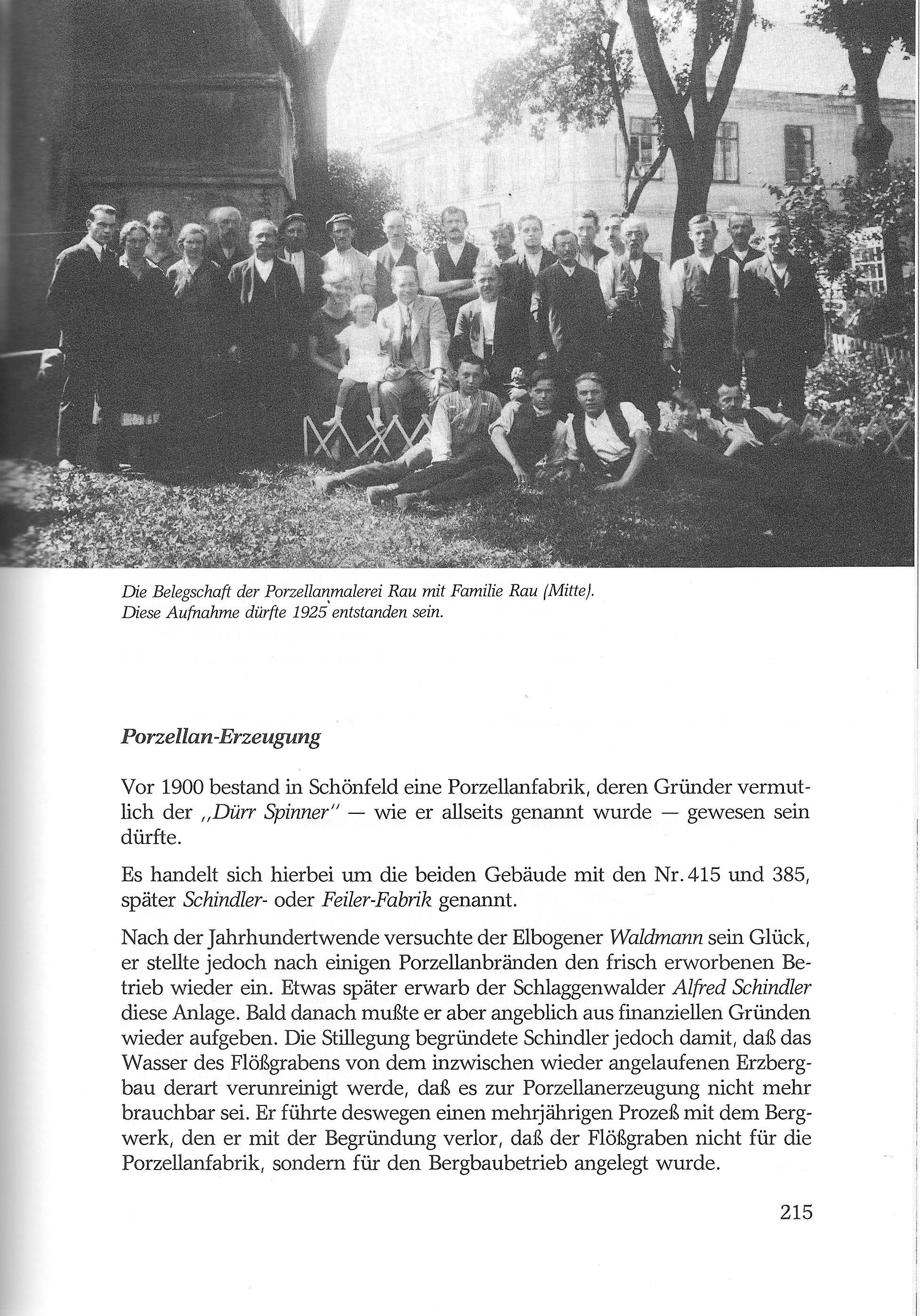 215
The Rau Porcelain Painting staff with the Rau family (center). This
photo was probably taken in 1925.
Porcelain Production
Before 1900, there was a porcelain factory in Schönfeld, whose founder
was presumably the "Dürr Spinner" – as he was commonly called.
—
These are the two buildings with numbers 415 and 385, later called the
Schindler or Feiler Factory.
After the turn of the century, the Elbogen Waldmann tried his luck,
but after firing a few porcelain batches, he closed down the newly
acquired business. A little later, Alfred Schindler from Schlaggenwald
acquired this facility. Soon after, however, he had to abandon it,
allegedly for financial reasons. Schindler justified the closure by
arguing that the water from the Flößgraben was so contaminated by
the ore mining that it was no longer suitable for porcelain
production. He therefore initiated a multi-year legal action with the
mine, which he lost on the grounds that the Flößgraben had been
built for mining operations, not the porcelain factory was.
215
215
The Rau Porcelain Painting staff with the Rau family (center). This
photo was probably taken in 1925.
Porcelain Production
Before 1900, there was a porcelain factory in Schönfeld, whose founder
was presumably the "Dürr Spinner" – as he was commonly called.
—
These are the two buildings with numbers 415 and 385, later called the
Schindler or Feiler Factory.
After the turn of the century, the Elbogen Waldmann tried his luck,
but after firing a few porcelain batches, he closed down the newly
acquired business. A little later, Alfred Schindler from Schlaggenwald
acquired this facility. Soon after, however, he had to abandon it,
allegedly for financial reasons. Schindler justified the closure by
arguing that the water from the Flößgraben was so contaminated by
the ore mining that it was no longer suitable for porcelain
production. He therefore initiated a multi-year legal action with the
mine, which he lost on the grounds that the Flößgraben had been
built for mining operations, not the porcelain factory was.
215
Page 0215
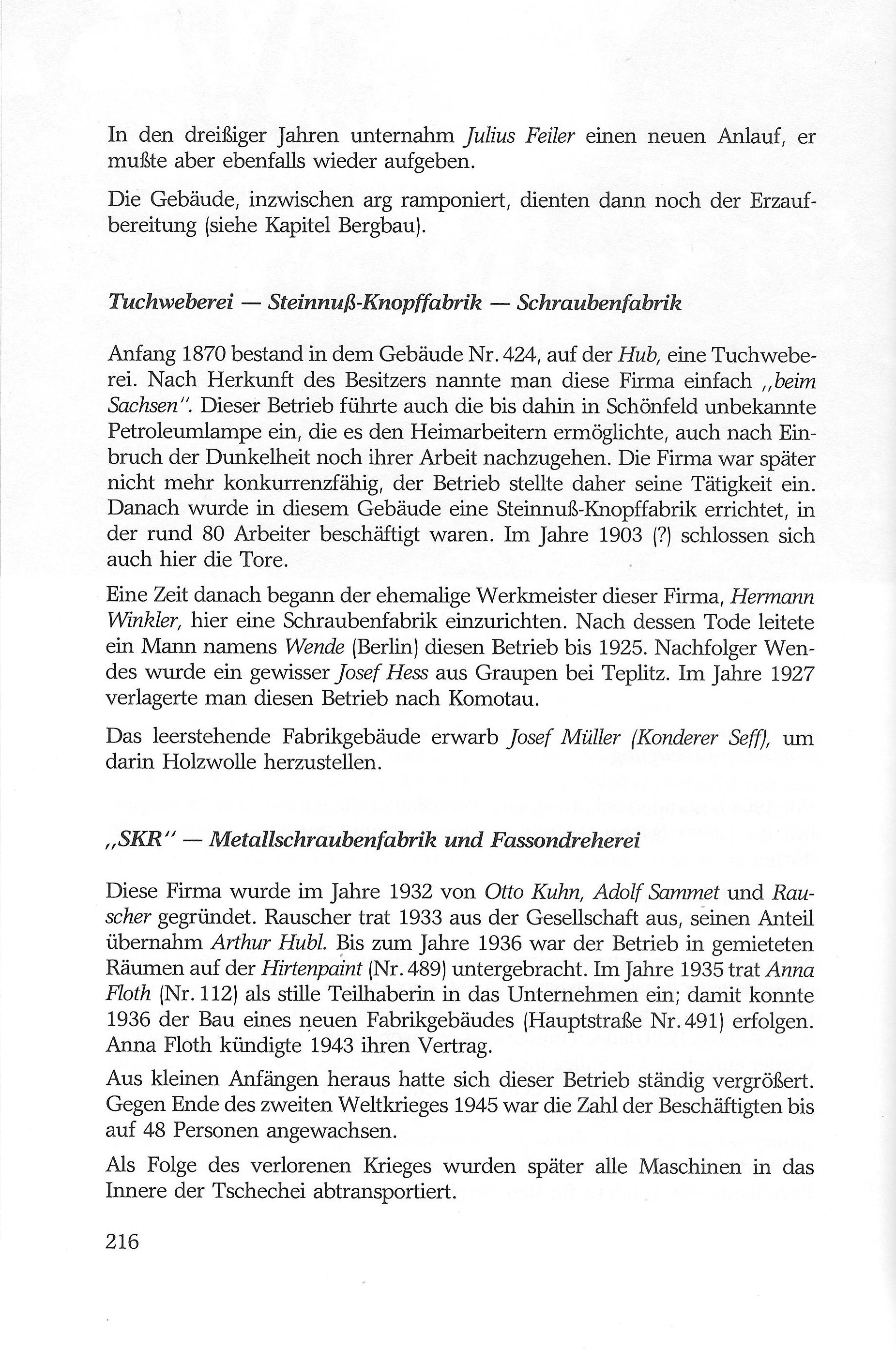 216
In the 1930s, Julius Feiler made a new attempt, but he also had to
give up again.
The buildings, by then badly dilapidated, were then used for ore
processing (see the Mining chapter).
Cloth weaving mill - corozo button factory - screw factory
At the beginning of 1870, a cloth weaving mill existed in building
no. 424 on the Hub. After the owner's origins, this company was simply
called "at the Saxon's." This business also introduced the kerosene
lamp, previously unknown in Schönfeld, which enabled homeworkers to
continue their work even after dark. The company was later no longer
competitive, and the business ceased operations. A corozo button
factory was then built in this building, employing around 80
workers. In 1903 (?), the doors here, too, closed.
Some time later, the company's former foreman, Hermann Winkler, began
setting up a screw factory here. After his death, a man named Wende
(Berlin) managed the business until 1925. Wende's successor was a
certain Josef Hess from Graupen near Teplitz. In 1927, the business
was relocated to Chomutov.
Josef Müller (Konderer Seff) acquired the vacant factory building
to produce wood wool.
SKR - Metal Screw Factory and Turning Shop
This company was founded in 1932 by Otto Kuhn, Adolf Sammet, and
Rauscher. Rauscher left the company in 1933, and Arthur Hubl took over
his share. Until 1936, the business was located in rented premises on
Hirtenpaint (No. 489). In 1935, Anna Floth (No. 112) joined the
company as a silent partner; this enabled the construction of a new
factory building (Hauptstraße No. 491) in 1936. Anna Floth
terminated her contract in 1943.
From small beginnings, this company had steadily expanded. By the end
of World War II in 1945, the number of employees had grown to 48.
As a result of the lost war, all machines were later relocated to the
interior of the Czech Republic. transported away.
216
216
In the 1930s, Julius Feiler made a new attempt, but he also had to
give up again.
The buildings, by then badly dilapidated, were then used for ore
processing (see the Mining chapter).
Cloth weaving mill - corozo button factory - screw factory
At the beginning of 1870, a cloth weaving mill existed in building
no. 424 on the Hub. After the owner's origins, this company was simply
called "at the Saxon's." This business also introduced the kerosene
lamp, previously unknown in Schönfeld, which enabled homeworkers to
continue their work even after dark. The company was later no longer
competitive, and the business ceased operations. A corozo button
factory was then built in this building, employing around 80
workers. In 1903 (?), the doors here, too, closed.
Some time later, the company's former foreman, Hermann Winkler, began
setting up a screw factory here. After his death, a man named Wende
(Berlin) managed the business until 1925. Wende's successor was a
certain Josef Hess from Graupen near Teplitz. In 1927, the business
was relocated to Chomutov.
Josef Müller (Konderer Seff) acquired the vacant factory building
to produce wood wool.
SKR - Metal Screw Factory and Turning Shop
This company was founded in 1932 by Otto Kuhn, Adolf Sammet, and
Rauscher. Rauscher left the company in 1933, and Arthur Hubl took over
his share. Until 1936, the business was located in rented premises on
Hirtenpaint (No. 489). In 1935, Anna Floth (No. 112) joined the
company as a silent partner; this enabled the construction of a new
factory building (Hauptstraße No. 491) in 1936. Anna Floth
terminated her contract in 1943.
From small beginnings, this company had steadily expanded. By the end
of World War II in 1945, the number of employees had grown to 48.
As a result of the lost war, all machines were later relocated to the
interior of the Czech Republic. transported away.
216
Page 0216
 217
Bus Company
The previously sorely felt lack of a railway connection was remedied
by the commissioning of regular bus service on September 1, 1928, by
Josef Roßmeißl.
The first scheduled connection initially operated to the two railway
stations Schlaggenwald and Petschau.
Later, the following lines were opened:
Petschau
Petschau
Buchau
—
-
Sangerberg
Buchau
Tepl
Soon afterward, the network was expanded to include the following routes:
Schönfeld
-
Schlaggenwald - Elbogen - Karlsbald
Schönfeld Lauterbach - Sangerberg
Schönfeld Lauterbach - Falkenau
-
Marienbad
In addition, the bus company organized group trips to Leipzig,
Dresden, Berlin, Munich, and Paris during the summer months.
In 1932, the Petschau routes were discontinued due to
unprofitability. In 1936, Roßmeißl also opened a contract
haulage business.
Under political pressure, the bus company had to be sold to the "KVG"
(Kraftverkehrsgesellschaft in Dresden) in 1939. Regular service
continued until the end of the war in 1945.
During the war years from 1940 to 1945, Roßmeißl was
commissioned to transport milk to and from the central dairy in
Karlovy Vary for the following towns: Elbogen, Nallesgrün,
Poschitzau, Schlaggenwald, and Schönfeld.
In June 1945, the business was taken over by the Czech administrator
Jellinek. Roßmeißl Beb remained an employee at his former
company until his expulsion (January 1946).
217
217
Bus Company
The previously sorely felt lack of a railway connection was remedied
by the commissioning of regular bus service on September 1, 1928, by
Josef Roßmeißl.
The first scheduled connection initially operated to the two railway
stations Schlaggenwald and Petschau.
Later, the following lines were opened:
Petschau
Petschau
Buchau
—
-
Sangerberg
Buchau
Tepl
Soon afterward, the network was expanded to include the following routes:
Schönfeld
-
Schlaggenwald - Elbogen - Karlsbald
Schönfeld Lauterbach - Sangerberg
Schönfeld Lauterbach - Falkenau
-
Marienbad
In addition, the bus company organized group trips to Leipzig,
Dresden, Berlin, Munich, and Paris during the summer months.
In 1932, the Petschau routes were discontinued due to
unprofitability. In 1936, Roßmeißl also opened a contract
haulage business.
Under political pressure, the bus company had to be sold to the "KVG"
(Kraftverkehrsgesellschaft in Dresden) in 1939. Regular service
continued until the end of the war in 1945.
During the war years from 1940 to 1945, Roßmeißl was
commissioned to transport milk to and from the central dairy in
Karlovy Vary for the following towns: Elbogen, Nallesgrün,
Poschitzau, Schlaggenwald, and Schönfeld.
In June 1945, the business was taken over by the Czech administrator
Jellinek. Roßmeißl Beb remained an employee at his former
company until his expulsion (January 1946).
217
Page 0217
 218
At the end of this chapter, for the sake of completeness, the
following two branches should be mentioned. Although both dealt with
"flying creatures," they had nothing in common in terms of their
purpose and practice, as they were concerned with birds and bees.
Schönfeld Beekeepers
The bountiful profits of the local beekeepers were probably largely
intended for their own families or even for close relatives. The
largest beekeeper was Fuhrmann Lois (No. 126), with more than a dozen
beehives or colonies. Adolf Lochner (No. 113), Julius Lochner
(No. 414), Otto Kuhn (Hofgasse), Franz Lochschmidt (Hofgasse), and
Erler (Tischerhof) were also involved in beekeeping. Fowlers and
Bullfinch Breeders (called the "Vuåglgoochårå")
Two "sideline professions" where passion probably preceded The main
focus was on making money. Both activities were forbidden "trades,"
not only in our former homeland.
It remains to be seen which of the two used more humane means in their
procurement: the fowler, who ambushed the small feathered singers with
a glue spindle and a sledgehammer, or the bullfinch breeder, who very
often had his still-fledged victims, including their nests, searched
for and taken care of by forest workers.
Among the most endangered species were primarily the linnet and the
goldfinch, but also many a crossbill (Grüner's), which would
certainly have preferred to nibble its spruce cones on a spruce tree
on the Mühlberg rather than in a cramped wire cage – and lost
its freedom this way, along with many other lively singers. The most
dangerous, however, was the bullfinch, also called the bullfinch,
because breeders considered it the most docile of its
conspecifics. Even today, there are reports of individuals who
developed into true whistling virtuosos. With a sufficiently good
aptitude, some of them often mastered several short songs after their
training – which means the flawless, repeated whistling of a melody
– which also brought their master a correspondingly good price when
sold.
218
218
At the end of this chapter, for the sake of completeness, the
following two branches should be mentioned. Although both dealt with
"flying creatures," they had nothing in common in terms of their
purpose and practice, as they were concerned with birds and bees.
Schönfeld Beekeepers
The bountiful profits of the local beekeepers were probably largely
intended for their own families or even for close relatives. The
largest beekeeper was Fuhrmann Lois (No. 126), with more than a dozen
beehives or colonies. Adolf Lochner (No. 113), Julius Lochner
(No. 414), Otto Kuhn (Hofgasse), Franz Lochschmidt (Hofgasse), and
Erler (Tischerhof) were also involved in beekeeping. Fowlers and
Bullfinch Breeders (called the "Vuåglgoochårå")
Two "sideline professions" where passion probably preceded The main
focus was on making money. Both activities were forbidden "trades,"
not only in our former homeland.
It remains to be seen which of the two used more humane means in their
procurement: the fowler, who ambushed the small feathered singers with
a glue spindle and a sledgehammer, or the bullfinch breeder, who very
often had his still-fledged victims, including their nests, searched
for and taken care of by forest workers.
Among the most endangered species were primarily the linnet and the
goldfinch, but also many a crossbill (Grüner's), which would
certainly have preferred to nibble its spruce cones on a spruce tree
on the Mühlberg rather than in a cramped wire cage – and lost
its freedom this way, along with many other lively singers. The most
dangerous, however, was the bullfinch, also called the bullfinch,
because breeders considered it the most docile of its
conspecifics. Even today, there are reports of individuals who
developed into true whistling virtuosos. With a sufficiently good
aptitude, some of them often mastered several short songs after their
training – which means the flawless, repeated whistling of a melody
– which also brought their master a correspondingly good price when
sold.
218
Page 0218
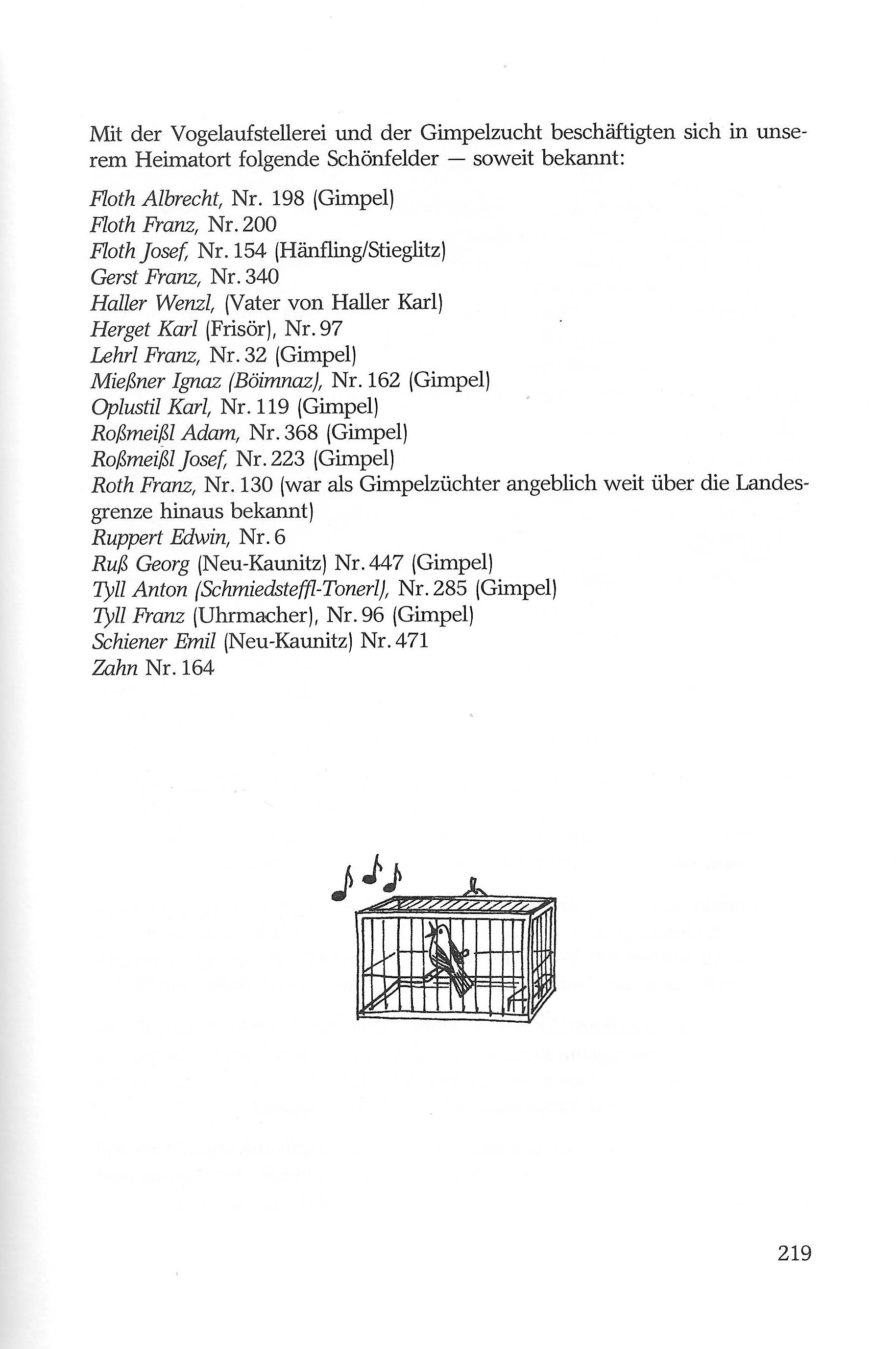 219
he following Schönfelders were involved in bird-watching and bullfinch
breeding in our hometown - as far as is known:
Floth Albrecht, No. 198 (bullfinch)
Floth Franz, No. 200
Floth Josef, No. 154 (linnet/goldfinch)
Gerst Franz, No. 340
Haller Wenzl, (father of Haller Karl)
Herget Karl (hairdresser), No. 97
Lehrl Franz, No. 32 (bullfinch)
Mießner Ignaz (Böimnaz), No. 162 (bullfinch)
Oplustil Karl, No. 119 (bullfinch)
Roßmeißl Adam, No. 368 (bullfinch)
Roßmeißl Josef, No. 223 (bullfinch)
Roth Franz, No. 130 (was allegedly known far beyond the country's
borders as a bullfinch breeder)
Ruppert Edwin, No. 6
Ruß Georg (Neu-Kaunitz) No. 447 (bullfinch)
Tyll Anton (Schmiedsteffl-Tonerl), No. 285 (bullfinch)
Tyll Franz (watchmaker), No. 96 (bullfinch) Schiener Emil (Neu-Kaunitz) No. 471
Zahn No. 164
219
219
he following Schönfelders were involved in bird-watching and bullfinch
breeding in our hometown - as far as is known:
Floth Albrecht, No. 198 (bullfinch)
Floth Franz, No. 200
Floth Josef, No. 154 (linnet/goldfinch)
Gerst Franz, No. 340
Haller Wenzl, (father of Haller Karl)
Herget Karl (hairdresser), No. 97
Lehrl Franz, No. 32 (bullfinch)
Mießner Ignaz (Böimnaz), No. 162 (bullfinch)
Oplustil Karl, No. 119 (bullfinch)
Roßmeißl Adam, No. 368 (bullfinch)
Roßmeißl Josef, No. 223 (bullfinch)
Roth Franz, No. 130 (was allegedly known far beyond the country's
borders as a bullfinch breeder)
Ruppert Edwin, No. 6
Ruß Georg (Neu-Kaunitz) No. 447 (bullfinch)
Tyll Anton (Schmiedsteffl-Tonerl), No. 285 (bullfinch)
Tyll Franz (watchmaker), No. 96 (bullfinch) Schiener Emil (Neu-Kaunitz) No. 471
Zahn No. 164
219
Page 0219
 220
The State Lace School (Sewing School)
Bohemian lace production is very old. It is historically documented as
early as the 16th century. It reached its heyday in the 19th
century. At that time, 40,000 to 60,000 workers in Bohemia earned
their living from lace production. As late as 1936, Czechoslovakia's
lace industry was reported to be exporting 4 million crowns. This does
not include the unregistered exports that resulted from the sale of
these goods in the world-renowned spa towns of Karlovy Vary,
Mariánské Lázn?, and Františkovy Lázn?.
The Czechoslovak authorities recognized the high artistic value of
lace production; they were truly active in promoting this
industry. "Genuine lace" enjoyed special state protection, and its
production was under the patronage of the wife of the then Prime
Minister Beneš.
25 state-run bobbin lace schools and 5 sewing lace schools provided
training for the workers and raised their skills to a level worthy of
the old tradition of Bohemian handicrafts. The products enjoyed
international renown. Compared to the old Belgian and Venetian lace
industries, Bohemian lace had no need to fear competition, as
evidenced by the numerous awards won at prestigious international
exhibitions.
It must be clearly noted, however, that despite this good market
position, the seamstresses received only a very modest wage for their
artistry and painstaking, patient work, which in many cases
contributed to the husband's meager income.
Lace sewing began in Schönfeld in 1856. It was a man from
Gossengrün who, through marriage, moved to Schönfeld, and from his
previous place of residence, where he had already been involved in
lace production, introduced the sewing technique of so-called Venis
lace. Shortly thereafter, the sheep wool manufacturer Johann Floth
brought a teacher, also from Gossengrün, to Schönfeld, who trained
several girls in this subject. This was intended to create both a job
opportunity and a source of income.
In 1905, a traveling course was initiated under the direction of the
Imperial and Royal Central Lace Course in Vienna. This was intended to
perfect the technique and give lacemaking a craft foundation.
220
220
The State Lace School (Sewing School)
Bohemian lace production is very old. It is historically documented as
early as the 16th century. It reached its heyday in the 19th
century. At that time, 40,000 to 60,000 workers in Bohemia earned
their living from lace production. As late as 1936, Czechoslovakia's
lace industry was reported to be exporting 4 million crowns. This does
not include the unregistered exports that resulted from the sale of
these goods in the world-renowned spa towns of Karlovy Vary,
Mariánské Lázn?, and Františkovy Lázn?.
The Czechoslovak authorities recognized the high artistic value of
lace production; they were truly active in promoting this
industry. "Genuine lace" enjoyed special state protection, and its
production was under the patronage of the wife of the then Prime
Minister Beneš.
25 state-run bobbin lace schools and 5 sewing lace schools provided
training for the workers and raised their skills to a level worthy of
the old tradition of Bohemian handicrafts. The products enjoyed
international renown. Compared to the old Belgian and Venetian lace
industries, Bohemian lace had no need to fear competition, as
evidenced by the numerous awards won at prestigious international
exhibitions.
It must be clearly noted, however, that despite this good market
position, the seamstresses received only a very modest wage for their
artistry and painstaking, patient work, which in many cases
contributed to the husband's meager income.
Lace sewing began in Schönfeld in 1856. It was a man from
Gossengrün who, through marriage, moved to Schönfeld, and from his
previous place of residence, where he had already been involved in
lace production, introduced the sewing technique of so-called Venis
lace. Shortly thereafter, the sheep wool manufacturer Johann Floth
brought a teacher, also from Gossengrün, to Schönfeld, who trained
several girls in this subject. This was intended to create both a job
opportunity and a source of income.
In 1905, a traveling course was initiated under the direction of the
Imperial and Royal Central Lace Course in Vienna. This was intended to
perfect the technique and give lacemaking a craft foundation.
220
Page 0220
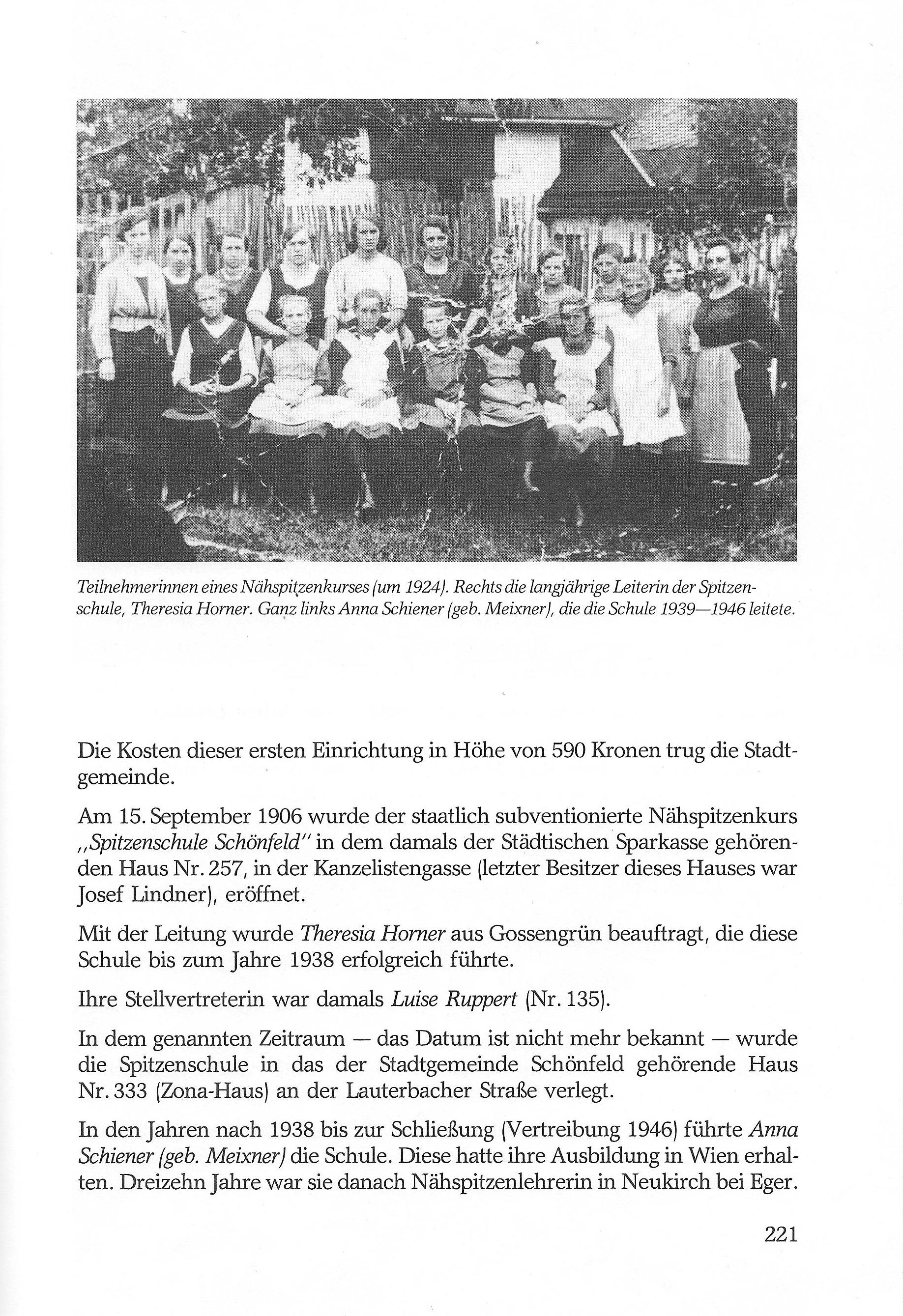 221
Participants in a sewing lace course (around 1924). On the right is
the long-time director of the lace school, Theresia Horner. On the far
left is Anna Schiener (née Meixner), who headed the school from
1939 to 1946.
The city of Vienna covered the costs of this first institution,
amounting to 590 crowns. municipality.
On September 15, 1906, the state-subsidized lace school "Schönfeld
Lace School" opened in house number 257 on Kanzelistengasse, which was
then owned by the Municipal Savings Bank (the last owner of this
building was Josef Lindner).
Theresia Horner from Gossengrün was appointed director and
successfully ran the school until 1938.
Her deputy at the time was Luise Ruppert (number 135).
During this period—the date is no longer known—the lace school
was relocated to house number 333 (Zona House) on Lauterbacher
Straße, owned by the municipality of Schönfeld.
From 1938 until its closure (expulsion in 1946), Anna Schiener (née
Meixner) ran the school. She had received her training in Vienna. She
then worked as a lace teacher in Neukirch near Eger for thirteen
years.
221
221
Participants in a sewing lace course (around 1924). On the right is
the long-time director of the lace school, Theresia Horner. On the far
left is Anna Schiener (née Meixner), who headed the school from
1939 to 1946.
The city of Vienna covered the costs of this first institution,
amounting to 590 crowns. municipality.
On September 15, 1906, the state-subsidized lace school "Schönfeld
Lace School" opened in house number 257 on Kanzelistengasse, which was
then owned by the Municipal Savings Bank (the last owner of this
building was Josef Lindner).
Theresia Horner from Gossengrün was appointed director and
successfully ran the school until 1938.
Her deputy at the time was Luise Ruppert (number 135).
During this period—the date is no longer known—the lace school
was relocated to house number 333 (Zona House) on Lauterbacher
Straße, owned by the municipality of Schönfeld.
From 1938 until its closure (expulsion in 1946), Anna Schiener (née
Meixner) ran the school. She had received her training in Vienna. She
then worked as a lace teacher in Neukirch near Eger for thirteen
years.
221
Page 0221
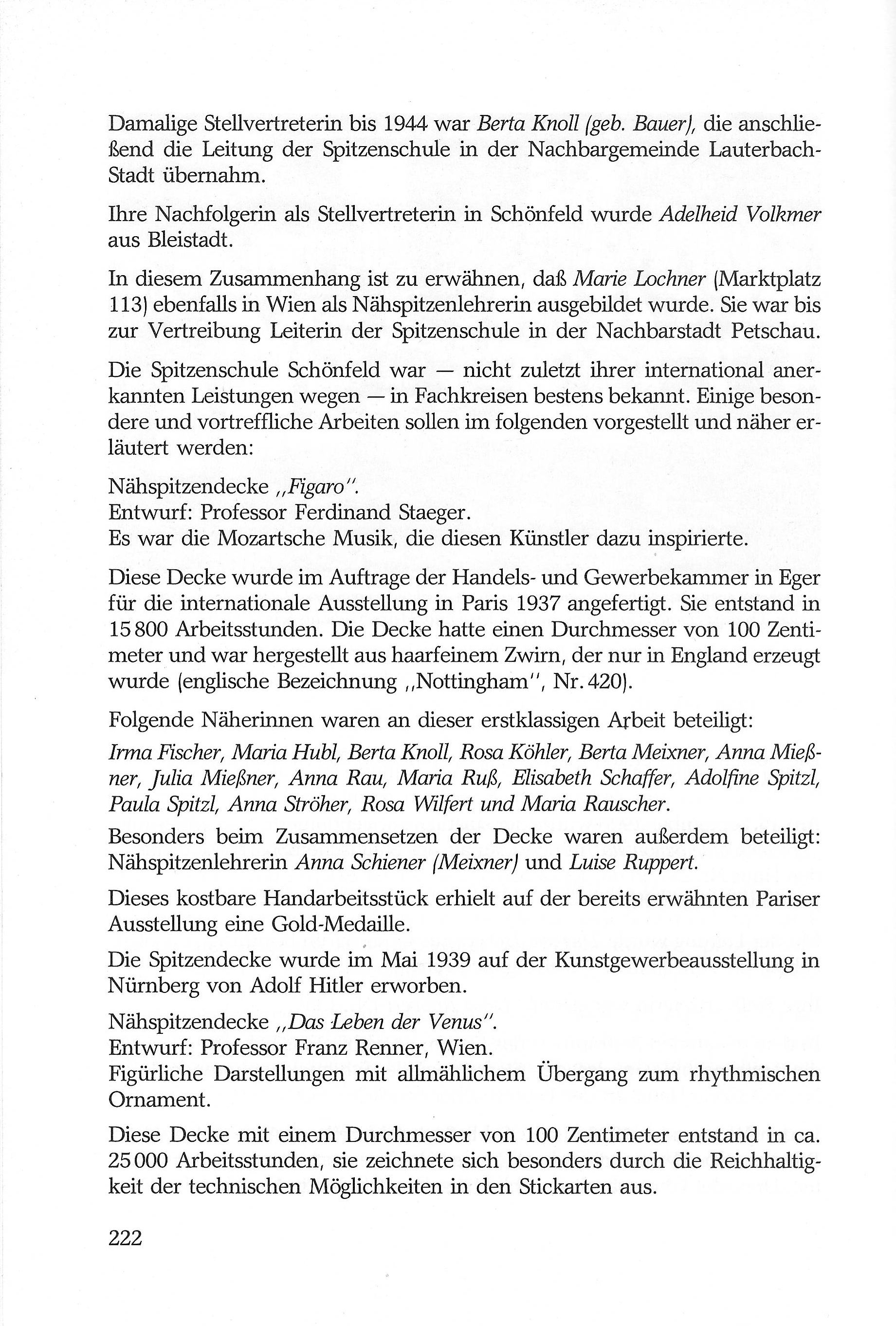 222
The deputy until 1944 was Berta Knoll (née Bauer), who subsequently
took over the management of the lace school in the neighboring
community of Lauterbach-Stadt. Her successor as deputy in Schönfeld
was Adelheid Volkmer from Bleistadt.
In this context, it should be mentioned that Marie Lochner (Marktplatz
113) was also trained as a sewing lace teacher in Vienna. She was the
director of the lace school in the neighboring town of Petschau until
her expulsion. The Schönfeld lace school was well known in
professional circles, not least because of its internationally
recognized achievements. Some special and excellent works will be
presented and explained in more detail below:
Sewing lace tablecloth "Figaro." Design: Professor Ferdinand Staeger.
Mozart's music inspired this artist.
This tablecloth was commissioned by the Chamber of Commerce and
Industry in Eger for the 1937 International Exhibition in Paris. It
took 15,800 hours of work to complete. The tablecloth had a diameter
of 100 centimeters and was made of hair-thin thread produced only in
England (English name "Nottingham," No. 420).
The following seamstresses were involved in this first-class work:
Irma Fischer, Maria Hubl, Berta Knoll, Rosa Köhler, Berta Meixner,
Anna Mießner, Julia Mießner, Anna Rau, Maria Ruß, Elisabeth
Schaffer, Adolfine Spitzl, Paula Spitzl, Anna Ströher, Rosa Wilfert,
and Maria Rauscher.
Also particularly involved in assembling the quilt were: lace teacher
Anna Schiener (Meixner) and Luise Ruppert.
This precious piece of handcraft received a gold medal at the
aforementioned Paris exhibition.
The lace quilt was acquired by Adolf Hitler at the Nuremberg Arts and
Crafts Exhibition in May 1939.
Lace quilt "The Life of Venus."
Design: Professor Franz Renner, Vienna.
Figurative representations with a gradual transition to rhythmic
ornamentation.
This quilt, with a diameter of 100 centimeters, was created in
approximately 25,000 hours of work and was particularly distinguished
by the richness of the technical possibilities in the embroidery
styles.
222
222
The deputy until 1944 was Berta Knoll (née Bauer), who subsequently
took over the management of the lace school in the neighboring
community of Lauterbach-Stadt. Her successor as deputy in Schönfeld
was Adelheid Volkmer from Bleistadt.
In this context, it should be mentioned that Marie Lochner (Marktplatz
113) was also trained as a sewing lace teacher in Vienna. She was the
director of the lace school in the neighboring town of Petschau until
her expulsion. The Schönfeld lace school was well known in
professional circles, not least because of its internationally
recognized achievements. Some special and excellent works will be
presented and explained in more detail below:
Sewing lace tablecloth "Figaro." Design: Professor Ferdinand Staeger.
Mozart's music inspired this artist.
This tablecloth was commissioned by the Chamber of Commerce and
Industry in Eger for the 1937 International Exhibition in Paris. It
took 15,800 hours of work to complete. The tablecloth had a diameter
of 100 centimeters and was made of hair-thin thread produced only in
England (English name "Nottingham," No. 420).
The following seamstresses were involved in this first-class work:
Irma Fischer, Maria Hubl, Berta Knoll, Rosa Köhler, Berta Meixner,
Anna Mießner, Julia Mießner, Anna Rau, Maria Ruß, Elisabeth
Schaffer, Adolfine Spitzl, Paula Spitzl, Anna Ströher, Rosa Wilfert,
and Maria Rauscher.
Also particularly involved in assembling the quilt were: lace teacher
Anna Schiener (Meixner) and Luise Ruppert.
This precious piece of handcraft received a gold medal at the
aforementioned Paris exhibition.
The lace quilt was acquired by Adolf Hitler at the Nuremberg Arts and
Crafts Exhibition in May 1939.
Lace quilt "The Life of Venus."
Design: Professor Franz Renner, Vienna.
Figurative representations with a gradual transition to rhythmic
ornamentation.
This quilt, with a diameter of 100 centimeters, was created in
approximately 25,000 hours of work and was particularly distinguished
by the richness of the technical possibilities in the embroidery
styles.
222
Page 0222
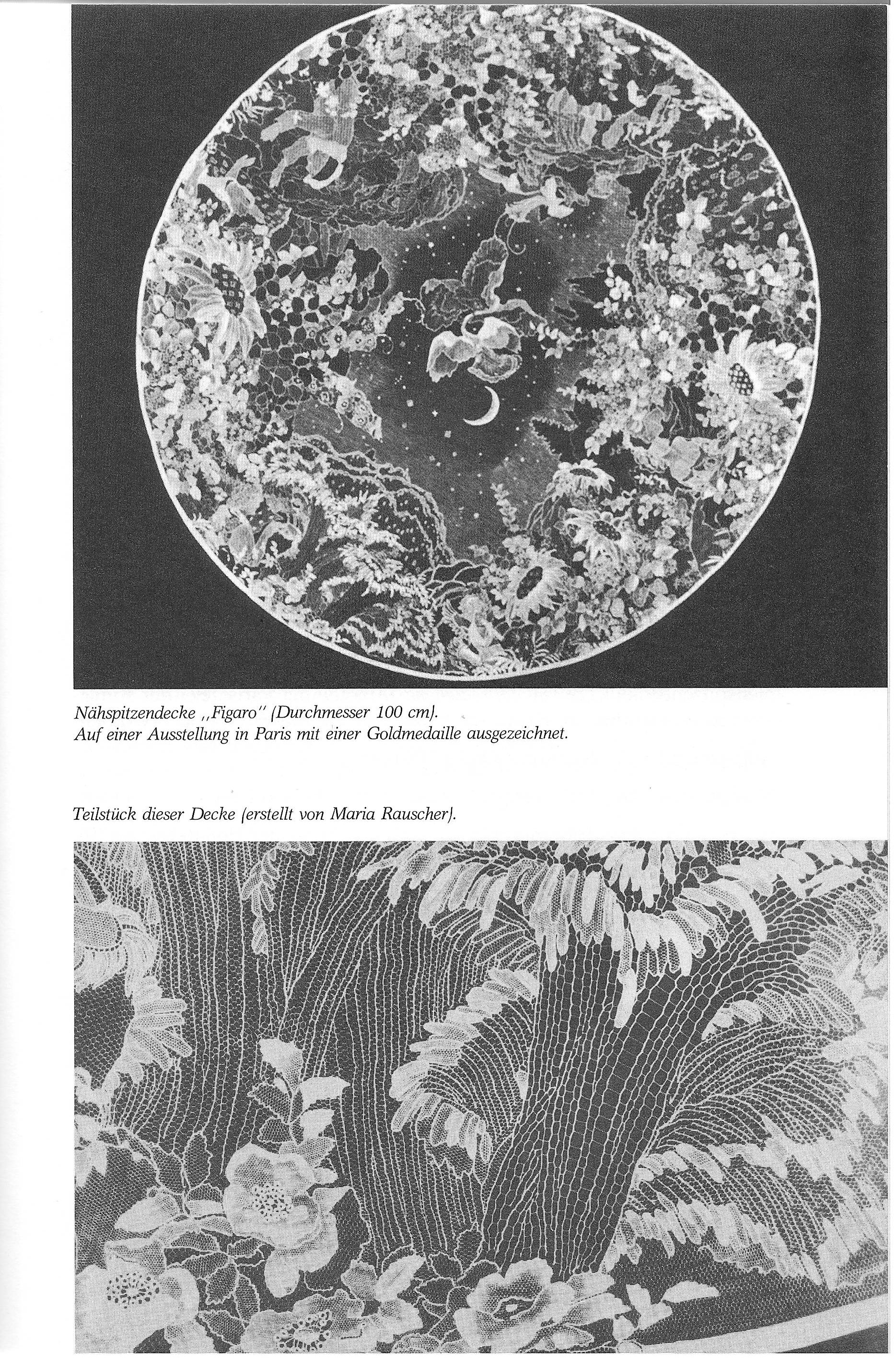 223
Lace quilt "Figaro" (diameter 100 cm).
Awarded a gold medal at an exhibition in Paris.
Part of this quilt (created by Maria Rauscher).
223
223
Lace quilt "Figaro" (diameter 100 cm).
Awarded a gold medal at an exhibition in Paris.
Part of this quilt (created by Maria Rauscher).
223
Page 0223
 224
It was made from the same fine English thread No. 420 as the "Figaro"
blanket.
The following seamstresses participated in the sewing project, which
was supervised by Mrs. Horner:
Rosa Köhler, Berta Meixner, Anna Mießner, Julia Mießner, Anna
Rau, Luise Ruppert, Maria Ruß, Paula Spitzl, and Anna Ströher.
This work was also awarded a gold medal at the Brussels World's Fair.
Sewing lace blanket "Country Life."
Design: Professor E. Pali?kova-Mildeowá.
The motif shows peasants at work in gardens and vineyards.
Square blanket "Reverie."
Design: Professor E. Pali?kova-Mildeowá.
Motif: A woman commemorates various events in her life. The lace is
executed in the Brussels tulle technique with shading. Below are three
other outstanding works produced at the Schönfeld State Lace School,
each awarded a gold medal at international exhibitions:
Sewing lace blanket "The Four Seasons" (Paris exhibition). Acquired by
Hermann Göring at the Nuremberg Arts and Crafts Exhibition in
1939. Sewing lace blanket "Tree Blanket" (Geneva exhibition). Sewing
lace blanket "Lace Collar" (Chicago/USA exhibition).
A christening set—consisting of a gown, bonnet, and blanket—was
also produced at the Schönfeld Lace School on behalf of Queen Juliana
of the Netherlands and intended for the current Queen Beatrix.
A large piece of work, already begun, remained unfinished. It was a
ceiling based on a magnificent design by the Schönfeld sculptor Willy
Russ, entitled "The Song from the Cheb Region." Maria Rauscher had
already completed the sample piece for this ceiling, with the motif
"Dance of the Father with the Mother."
224
224
It was made from the same fine English thread No. 420 as the "Figaro"
blanket.
The following seamstresses participated in the sewing project, which
was supervised by Mrs. Horner:
Rosa Köhler, Berta Meixner, Anna Mießner, Julia Mießner, Anna
Rau, Luise Ruppert, Maria Ruß, Paula Spitzl, and Anna Ströher.
This work was also awarded a gold medal at the Brussels World's Fair.
Sewing lace blanket "Country Life."
Design: Professor E. Pali?kova-Mildeowá.
The motif shows peasants at work in gardens and vineyards.
Square blanket "Reverie."
Design: Professor E. Pali?kova-Mildeowá.
Motif: A woman commemorates various events in her life. The lace is
executed in the Brussels tulle technique with shading. Below are three
other outstanding works produced at the Schönfeld State Lace School,
each awarded a gold medal at international exhibitions:
Sewing lace blanket "The Four Seasons" (Paris exhibition). Acquired by
Hermann Göring at the Nuremberg Arts and Crafts Exhibition in
1939. Sewing lace blanket "Tree Blanket" (Geneva exhibition). Sewing
lace blanket "Lace Collar" (Chicago/USA exhibition).
A christening set—consisting of a gown, bonnet, and blanket—was
also produced at the Schönfeld Lace School on behalf of Queen Juliana
of the Netherlands and intended for the current Queen Beatrix.
A large piece of work, already begun, remained unfinished. It was a
ceiling based on a magnificent design by the Schönfeld sculptor Willy
Russ, entitled "The Song from the Cheb Region." Maria Rauscher had
already completed the sample piece for this ceiling, with the motif
"Dance of the Father with the Mother."
224
Page 0224
 225
Schönfeld Ore Mining
In 1836, Count Kaspar Sternberg published a famous work on mining
history, in which he stated that the tin mines in Schönfeld are among
the oldest in all of Bohemia. The tin mines in our area, especially in
Schönfeld, are said to have been discovered by English miners, who are
said to have come from the English province of Cornwallis. Schlesinger
states in his "History of Bohemia" that a tin mine was already
operating in Schönfeld under King Ottokar II, around the year 1250.
Although the tin mines were not very rich, the tin extracted from them
was of such quality that it was generally considered to be the closest
to English tin. Already 100 years earlier, tin was transported from
Regensburg along the Danube to Vienna and used there as bell fuel; it
is very likely that the Regensburg merchants who traded this tin
obtained it from our region, probably also from our town.
Since this time, and for several centuries thereafter, there was very
lively trade between our region, and thus also between Schönfeld and
Bavaria.
According to consistent reports, the tin mines in Schönfeld are of
earlier origin than those in Schlaggenwald. The oldest mines were the
two Klingen mines. The first settlement in Schönfeld is said to have
been at the Hohen Stein or the Weißer Hügel, where open-pit
mining and The construction was stepped, as the many holes in the
ground and hollows still testify today. Several houses were built
nearby on the Kaunitz River, where underground mining was already
underway.
That Schönfeld was a very old mining settlement is evident from the
historically established fact that in Schönfeld, and in no other
mining town in Bohemia, there existed a mining office, the so-called
Mining Court or Bergschöppenstuhl. This was an authority that had the
jurisdiction to adjudicate in disputed mining matters.
225
225
Schönfeld Ore Mining
In 1836, Count Kaspar Sternberg published a famous work on mining
history, in which he stated that the tin mines in Schönfeld are among
the oldest in all of Bohemia. The tin mines in our area, especially in
Schönfeld, are said to have been discovered by English miners, who are
said to have come from the English province of Cornwallis. Schlesinger
states in his "History of Bohemia" that a tin mine was already
operating in Schönfeld under King Ottokar II, around the year 1250.
Although the tin mines were not very rich, the tin extracted from them
was of such quality that it was generally considered to be the closest
to English tin. Already 100 years earlier, tin was transported from
Regensburg along the Danube to Vienna and used there as bell fuel; it
is very likely that the Regensburg merchants who traded this tin
obtained it from our region, probably also from our town.
Since this time, and for several centuries thereafter, there was very
lively trade between our region, and thus also between Schönfeld and
Bavaria.
According to consistent reports, the tin mines in Schönfeld are of
earlier origin than those in Schlaggenwald. The oldest mines were the
two Klingen mines. The first settlement in Schönfeld is said to have
been at the Hohen Stein or the Weißer Hügel, where open-pit
mining and The construction was stepped, as the many holes in the
ground and hollows still testify today. Several houses were built
nearby on the Kaunitz River, where underground mining was already
underway.
That Schönfeld was a very old mining settlement is evident from the
historically established fact that in Schönfeld, and in no other
mining town in Bohemia, there existed a mining office, the so-called
Mining Court or Bergschöppenstuhl. This was an authority that had the
jurisdiction to adjudicate in disputed mining matters.
225
Page 0225
 226
The Schönfeld Mining Court dates back to a document by the brothers
Borso and Slavko von der Riesenburg from the Margarethentag
(St. Margaret's Day) in 1355, which was expanded by Henry, Burgrave of
Meissen, on February 22, 1456. This was confirmed by Henry the
Younger, Burgrave of Meissen, on July 24, 1472. According to this
document, the Schönfeld courts shall forever judge and administer
justice over all mines located within the Petschau domain, with the
exception of gold and silver.
In 1480, on St. George's Day in Prague, King Wladislav Henry the
Younger, Vogt of Plauen, Burgrave of Meissen, then owner of Be?ov, and
John of Lobkowitz of Hassenstein, granted the right to establish mines
on the lands of the Teplá Abbey, but to obtain and seek mining
rights nowhere other than in Schönfeld, where mining rights have been
administered since ancient times. This seems to suggest that before
the founding of the mining town of St. Joachimsthal, all mines in the
Elbogen District obtained mining rights in Schönfeld, because it was
the only place in this part of Bohemia where a Schöppengericht (court
of judges) existed. (A brief review of the territorial situation at
that time: The ancient fortress town of Elbogen had long been the
central point of the Elbogen District. This district extended up to
the border of the imperial territory of Eger and down to Luditz in the
Saaz District. To the southeast, it bordered the Pilsen region.) The
devastation of the Hussite Wars had dealt a blow to Bohemian mining
from which it was unable to recover until the end of the Middle Ages.
Then came the revival of Bohemian mining from Meissen. Rich silver
ores had been discovered at St. Joachimsthal, and from there also
followed the revival of older mines dating back to the Middle Ages;
these included the tin mines in Schönfeld. On the Wednesday after
Erhardi, January 9, 1510, the mining rights of Schönfeld were
reinstated, and from then on, a mining rights meeting was to be held
every four weeks.
In 1501, Johann Pflug von Rabenstein acquired the Petschau Lordship,
along with the associated mines and mining towns, through a division
of assets. In 1518, he sworn into the Petschau Lordship as a
fief. This included the small town of Schönfeld—where silver and
tin were built, with all its smelters and mills; the mountains,
including the mines and the silver, tin, and all the ores, as the
chronicle states. Kaspar Bruschius, a poet and historian from
Schlaggenwald who lived around this time, reports: "that Schönfeld,
Lauterbach, and the town of Schlaggenwald were always considered a
corpus, belonging to the Petschau Lordship."
226
226
The Schönfeld Mining Court dates back to a document by the brothers
Borso and Slavko von der Riesenburg from the Margarethentag
(St. Margaret's Day) in 1355, which was expanded by Henry, Burgrave of
Meissen, on February 22, 1456. This was confirmed by Henry the
Younger, Burgrave of Meissen, on July 24, 1472. According to this
document, the Schönfeld courts shall forever judge and administer
justice over all mines located within the Petschau domain, with the
exception of gold and silver.
In 1480, on St. George's Day in Prague, King Wladislav Henry the
Younger, Vogt of Plauen, Burgrave of Meissen, then owner of Be?ov, and
John of Lobkowitz of Hassenstein, granted the right to establish mines
on the lands of the Teplá Abbey, but to obtain and seek mining
rights nowhere other than in Schönfeld, where mining rights have been
administered since ancient times. This seems to suggest that before
the founding of the mining town of St. Joachimsthal, all mines in the
Elbogen District obtained mining rights in Schönfeld, because it was
the only place in this part of Bohemia where a Schöppengericht (court
of judges) existed. (A brief review of the territorial situation at
that time: The ancient fortress town of Elbogen had long been the
central point of the Elbogen District. This district extended up to
the border of the imperial territory of Eger and down to Luditz in the
Saaz District. To the southeast, it bordered the Pilsen region.) The
devastation of the Hussite Wars had dealt a blow to Bohemian mining
from which it was unable to recover until the end of the Middle Ages.
Then came the revival of Bohemian mining from Meissen. Rich silver
ores had been discovered at St. Joachimsthal, and from there also
followed the revival of older mines dating back to the Middle Ages;
these included the tin mines in Schönfeld. On the Wednesday after
Erhardi, January 9, 1510, the mining rights of Schönfeld were
reinstated, and from then on, a mining rights meeting was to be held
every four weeks.
In 1501, Johann Pflug von Rabenstein acquired the Petschau Lordship,
along with the associated mines and mining towns, through a division
of assets. In 1518, he sworn into the Petschau Lordship as a
fief. This included the small town of Schönfeld—where silver and
tin were built, with all its smelters and mills; the mountains,
including the mines and the silver, tin, and all the ores, as the
chronicle states. Kaspar Bruschius, a poet and historian from
Schlaggenwald who lived around this time, reports: "that Schönfeld,
Lauterbach, and the town of Schlaggenwald were always considered a
corpus, belonging to the Petschau Lordship."
226
Page 0226
 227
Pflug was a distinguished, wealthy, and enterprising nobleman with a
religious outlook. He strove with great zeal to promote the mining
industry. He granted the miners various freedoms and privileges. Under
his leadership, systematic mining was introduced. He expanded the
mining court established by Slavko and Borso in Schönfeld into a
mining jury with mining judges, mining bailiffs, and mining jurors, a
pound mill and smelter administrator, the latter with special
instructions.
A mining ordinance written by Johann Pflug in 1517 was
republished. Section 3 of the ordinance stipulated: Strict attention
should be paid to ensuring that miners purchase wood, wine, beer,
meat, and bread at the correct price and in the correct amount. In
particular, the council was to ensure that even the poor received a
good piece of meat for their penny, and every four weeks, two men from
the council and two of the oldest members of the miners' association
were to inspect and weigh the bread at the bakers. A mining inspector
with two jurors had to inspect all shafts and tunnels every week,
report defects, check whether everything was being maintained in good
condition, and whether the mine forts were being dug out to damage. A
mine fort had to remain standing at all times between two mines. A
mining law meeting was held every week, at which the accounts were
always audited. The raft master was responsible for accounting for the
smelted tin.
Some of the miners worked from 4 a.m. to 12 noon, others from 12 noon
to 7 p.m. Pay was paid on Saturday at 10 a.m., then the weekly market
began.
If a miner suffered an injury, he received a little more than half a
week's wages, but the mine owners also paid the surgeon.
In order to achieve greater water power, Johann Pflug purchased the
Ebmet stream – then called the Ohmet stream, which led from the
Elbogen Forest to the Hub – in 1514. However, he knew full well
that even this would not allow for large-scale mining. Only with the
construction of the Raft Ditch (see chapter "Raft Ditch") in 1523 did
a sufficient amount of water become available. Vincenz Pröckl writes:
"With this greatly increased water power, the hybrid grinding mills
and stamp mills could be properly put into operation, and mining could
be carried out on a larger scale. The lucky star had risen over the
mining towns. Johann Pflug von Rabenstein, who was highly respected at
the imperial court, rose
227
227
Pflug was a distinguished, wealthy, and enterprising nobleman with a
religious outlook. He strove with great zeal to promote the mining
industry. He granted the miners various freedoms and privileges. Under
his leadership, systematic mining was introduced. He expanded the
mining court established by Slavko and Borso in Schönfeld into a
mining jury with mining judges, mining bailiffs, and mining jurors, a
pound mill and smelter administrator, the latter with special
instructions.
A mining ordinance written by Johann Pflug in 1517 was
republished. Section 3 of the ordinance stipulated: Strict attention
should be paid to ensuring that miners purchase wood, wine, beer,
meat, and bread at the correct price and in the correct amount. In
particular, the council was to ensure that even the poor received a
good piece of meat for their penny, and every four weeks, two men from
the council and two of the oldest members of the miners' association
were to inspect and weigh the bread at the bakers. A mining inspector
with two jurors had to inspect all shafts and tunnels every week,
report defects, check whether everything was being maintained in good
condition, and whether the mine forts were being dug out to damage. A
mine fort had to remain standing at all times between two mines. A
mining law meeting was held every week, at which the accounts were
always audited. The raft master was responsible for accounting for the
smelted tin.
Some of the miners worked from 4 a.m. to 12 noon, others from 12 noon
to 7 p.m. Pay was paid on Saturday at 10 a.m., then the weekly market
began.
If a miner suffered an injury, he received a little more than half a
week's wages, but the mine owners also paid the surgeon.
In order to achieve greater water power, Johann Pflug purchased the
Ebmet stream – then called the Ohmet stream, which led from the
Elbogen Forest to the Hub – in 1514. However, he knew full well
that even this would not allow for large-scale mining. Only with the
construction of the Raft Ditch (see chapter "Raft Ditch") in 1523 did
a sufficient amount of water become available. Vincenz Pröckl writes:
"With this greatly increased water power, the hybrid grinding mills
and stamp mills could be properly put into operation, and mining could
be carried out on a larger scale. The lucky star had risen over the
mining towns. Johann Pflug von Rabenstein, who was highly respected at
the imperial court, rose
227
Page 0227
 228
from honor to honor; became German feudal captain in 1527, court
marshal and mining commissioner at Joachimsthal in 1528, and first
chancellor of the Kingdom of Bohemia from 1533 to 1537. In return for
12,000 fl (Florentine guilders), he received, as collateral, the 18
villages belonging to the Tepl Monastery and the village of Sangerberg
from the Imperial Bohemian Chamber.
Pflug soon became convinced that the colossal ore masses lying at
great depths, including those in the Schöde Tunnel or Stock, near
Schönfeld, could not be extracted, given the circumstances at the
time, because the groundwater problems could only be diverted by a
much deeper tunnel, towards the Huber main mine (today's
Hub-Pinge). The trade unions also recognized this. The landlord Pflug
therefore encouraged them to undertake such a project, assuring them
considerable privileges and freedoms. Wealthy financiers from abroad
also arrived and increased the number of tradesmen, including the
Nuremberg patricians Scheuerle, Hans Schnöd, the Augsburg Welfers, and
others, who supported the construction of a deep tunnel – the Pflug
Tunnel. But before the first blow of this great project had been
struck, Johann Pflug died on August 15, 1537, in Prague, deeply
mourned by the residents of the three mining towns of Schlaggenwald,
Schönfeld, and Lauterbach, as well as the surrounding villages. (Pflug
is buried in Prague in the first chapel of St. Wenceslas Church.)
He was succeeded by his nephew Kaspar Pflug von Rabenstein, a liberal,
talented, and characterful man who pursued his ancestor's plans with
gentleness and prudence and brought mining to its highest
peak. Immediately after his accession, he acquired a privilege from
Emperor Leopold for the construction of the Pflug Tunnel for the Hans
Schnöd mining unions, "for himself and as the ruler of his honorable
union," Christoph Scheuerl the Right Doctor, Jakob Mälsen the
Elder, Siegmund Führer, Sebastian Mälsen, and Kaspar Murzel.
Construction of this tunnel began on the Wednesday after Michaelmas
1539 and continued for a full eleven years. From the Zech, just below
Schlaggenwaid, to the Huber-Stock (Hub), it reached a length of 2,538
fathoms (approximately 5 kilometers). By 1587, the tunnel was
completed in all mines; it is said to have cost 65,000 gold guilders
to complete.
Due to the hereditary ownership of the mines, Pflug got into a dispute
with the imperial government. He lost his property, which the state
took over.
228
228
from honor to honor; became German feudal captain in 1527, court
marshal and mining commissioner at Joachimsthal in 1528, and first
chancellor of the Kingdom of Bohemia from 1533 to 1537. In return for
12,000 fl (Florentine guilders), he received, as collateral, the 18
villages belonging to the Tepl Monastery and the village of Sangerberg
from the Imperial Bohemian Chamber.
Pflug soon became convinced that the colossal ore masses lying at
great depths, including those in the Schöde Tunnel or Stock, near
Schönfeld, could not be extracted, given the circumstances at the
time, because the groundwater problems could only be diverted by a
much deeper tunnel, towards the Huber main mine (today's
Hub-Pinge). The trade unions also recognized this. The landlord Pflug
therefore encouraged them to undertake such a project, assuring them
considerable privileges and freedoms. Wealthy financiers from abroad
also arrived and increased the number of tradesmen, including the
Nuremberg patricians Scheuerle, Hans Schnöd, the Augsburg Welfers, and
others, who supported the construction of a deep tunnel – the Pflug
Tunnel. But before the first blow of this great project had been
struck, Johann Pflug died on August 15, 1537, in Prague, deeply
mourned by the residents of the three mining towns of Schlaggenwald,
Schönfeld, and Lauterbach, as well as the surrounding villages. (Pflug
is buried in Prague in the first chapel of St. Wenceslas Church.)
He was succeeded by his nephew Kaspar Pflug von Rabenstein, a liberal,
talented, and characterful man who pursued his ancestor's plans with
gentleness and prudence and brought mining to its highest
peak. Immediately after his accession, he acquired a privilege from
Emperor Leopold for the construction of the Pflug Tunnel for the Hans
Schnöd mining unions, "for himself and as the ruler of his honorable
union," Christoph Scheuerl the Right Doctor, Jakob Mälsen the
Elder, Siegmund Führer, Sebastian Mälsen, and Kaspar Murzel.
Construction of this tunnel began on the Wednesday after Michaelmas
1539 and continued for a full eleven years. From the Zech, just below
Schlaggenwaid, to the Huber-Stock (Hub), it reached a length of 2,538
fathoms (approximately 5 kilometers). By 1587, the tunnel was
completed in all mines; it is said to have cost 65,000 gold guilders
to complete.
Due to the hereditary ownership of the mines, Pflug got into a dispute
with the imperial government. He lost his property, which the state
took over.
228
Page 0228
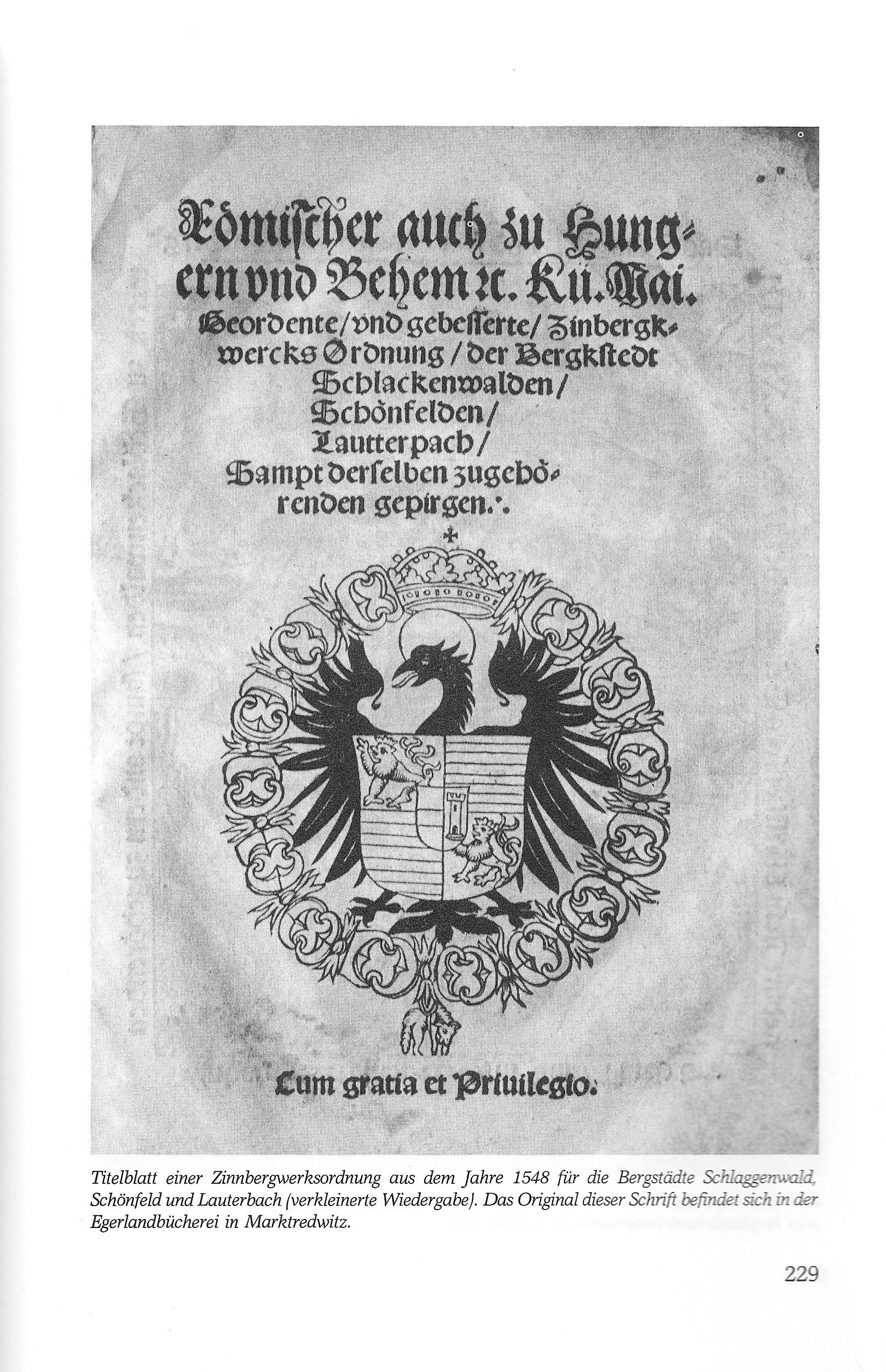 229
Emilian also to Hung ern and Behemic. Kü.mai.
Ordered and provided mining regulations for the mining towns of Schlackenwalden, Schönfelden, and Lauterbach, along with their respective natives.
Cum gratia et Priuilegio.
Title page of a tin mining regulation from 1548 for the mining towns of Schlaggenwald, Schönfeld, and Lauterbach (reduced version). The original of this document is located in the Egerland Library in Marktredwitz.
229
229
Emilian also to Hung ern and Behemic. Kü.mai.
Ordered and provided mining regulations for the mining towns of Schlackenwalden, Schönfelden, and Lauterbach, along with their respective natives.
Cum gratia et Priuilegio.
Title page of a tin mining regulation from 1548 for the mining towns of Schlaggenwald, Schönfeld, and Lauterbach (reduced version). The original of this document is located in the Egerland Library in Marktredwitz.
229
Page 0229
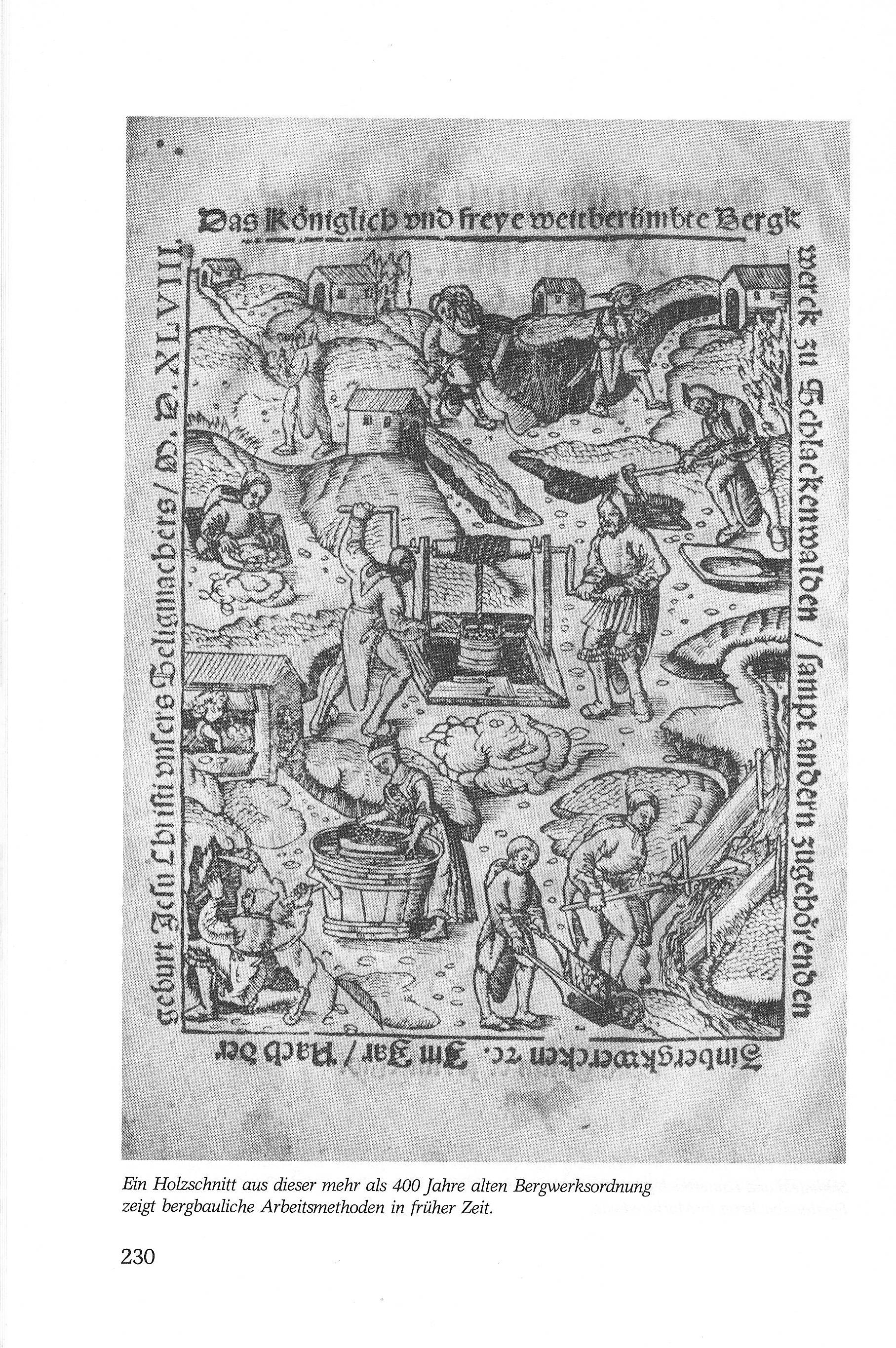 230
Birth of Jefu Lbrifti of our Beligmacb?rs, D. D. XLVIII.
The Royal and Free Widely Recognized Mining
/
A woodcut from this more than 400-year-old mining regulation shows mining methods in earlier times.
230
Schlackenwalden works / along with others belonging
230
Birth of Jefu Lbrifti of our Beligmacb?rs, D. D. XLVIII.
The Royal and Free Widely Recognized Mining
/
A woodcut from this more than 400-year-old mining regulation shows mining methods in earlier times.
230
Schlackenwalden works / along with others belonging
Page 0230
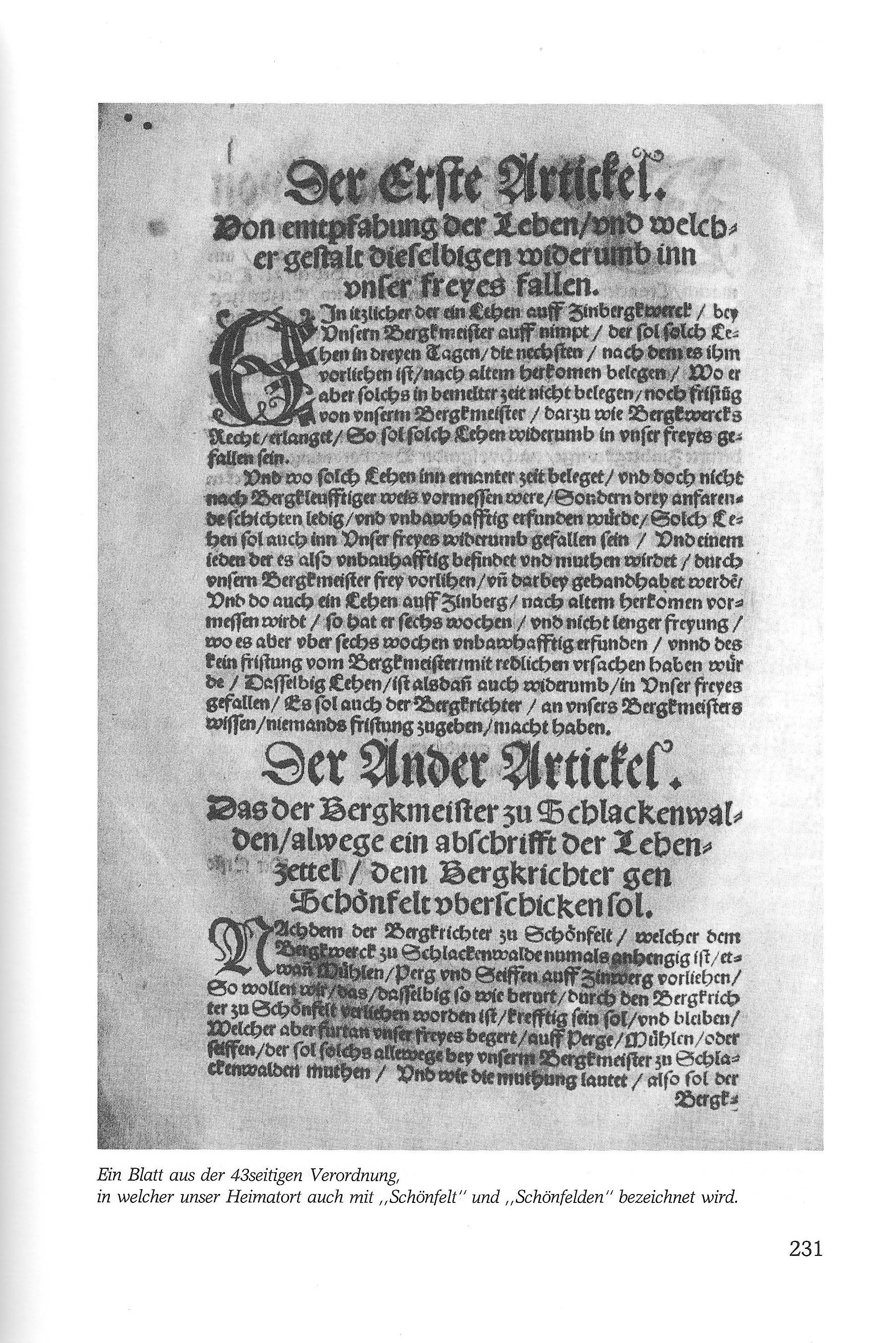 231
The First Article.
The surrender of lives, and in whatever form they shall revert to our
free will.
Whoever takes up a life at the Zinbergktorek from the Dufern Miner
shall reclaim such life in three wagons, the nearest ones, as he sees
fit, according to ancient custom. However, if he does not reclaim it
within the stated time, nor obtains it from our Mining Master within
the stated time, as per the Mining Works Law, then such life shall
revert to our free will.
Even if such life was reclaimed within the stated time, and yet was
not presumed to be according to the Bergkleufftiger, but rather three
wagons. If it were found to be alive and incapacitated, such a thing
would have fallen back into captivity free of charge. And if someone
finds it and believes it to be incapacitated, he would be given free
rein by our mining inspector, and would have been bound by it. Even if
a life sentence on Zinberg was also measured in advance, according to
old custom, he would ask for six weeks and no longer. However, if it
were found to be incapacitated for more than six weeks, and the mining
inspector had granted a reprieve with honest reasons, this life would
have fallen back into captivity free of charge. The mining inspector
also stated that, according to our mining inspector's knowledge, no
one could grant a reprieve.
The other article.
That the mining inspector Schlackenwalde, on the way, is to hand over
the life-saving money to the mining inspector at Schönfelt.
According to the mining inspector at Schönfelt, who is now attached to
the mining works at Schlackenwalde, when Müblen, Perg, and Seiffen
are on the Zinwerg, they will, as ordered, be vigorous and continue to
be so by the mining inspector at Schönfelt. From now on, however,
whoever requests our free will, at Perg, Mühlen, or Seiffen, must
always report to our mining inspector at Schlackenwalden, as the order
calls, also following the
Bargt
A page from the 43-page ordinance, in which our hometown is also
mentioned as "Schönfelt" and "Schönfelden".
231
231
The First Article.
The surrender of lives, and in whatever form they shall revert to our
free will.
Whoever takes up a life at the Zinbergktorek from the Dufern Miner
shall reclaim such life in three wagons, the nearest ones, as he sees
fit, according to ancient custom. However, if he does not reclaim it
within the stated time, nor obtains it from our Mining Master within
the stated time, as per the Mining Works Law, then such life shall
revert to our free will.
Even if such life was reclaimed within the stated time, and yet was
not presumed to be according to the Bergkleufftiger, but rather three
wagons. If it were found to be alive and incapacitated, such a thing
would have fallen back into captivity free of charge. And if someone
finds it and believes it to be incapacitated, he would be given free
rein by our mining inspector, and would have been bound by it. Even if
a life sentence on Zinberg was also measured in advance, according to
old custom, he would ask for six weeks and no longer. However, if it
were found to be incapacitated for more than six weeks, and the mining
inspector had granted a reprieve with honest reasons, this life would
have fallen back into captivity free of charge. The mining inspector
also stated that, according to our mining inspector's knowledge, no
one could grant a reprieve.
The other article.
That the mining inspector Schlackenwalde, on the way, is to hand over
the life-saving money to the mining inspector at Schönfelt.
According to the mining inspector at Schönfelt, who is now attached to
the mining works at Schlackenwalde, when Müblen, Perg, and Seiffen
are on the Zinwerg, they will, as ordered, be vigorous and continue to
be so by the mining inspector at Schönfelt. From now on, however,
whoever requests our free will, at Perg, Mühlen, or Seiffen, must
always report to our mining inspector at Schlackenwalden, as the order
calls, also following the
Bargt
A page from the 43-page ordinance, in which our hometown is also
mentioned as "Schönfelt" and "Schönfelden".
231
Page 0231
 232
On September 26, 1547, King Ferdinand confirmed the articles of mining
law for the town of Schönfeld. As late as 1561, the Schönfeld Mining
Law was still negotiated orally, and everything was "written from the
mouth to the pen." A royal mining office was located in house no. 260
(Ernst Kugler, Naudler), as evidenced by an inserted brick with two
miner's hammers and the year 1567. During this period, in 1568, a
massive landslide occurred at the former main deposit of the
Huberstock. A visible sign of this event is still the pit on the
Hub. According to measurements by mining experts, the excavated ore
stock had a diameter of around 200 meters and a height of 25-30
meters.
Kaspar Bruschius (born 1518 in Schlaggenwald) wrote: "In 1550, the
hybrid stock behind the old Hub in the Kehuts pit was built by the
Stöllner." The mine was opened, and the first excavation took place at
the reported location in 1568, when the weather caused all the shafts
to blow at once. The officials were immediately on the scene at the
time, and the weather threw some of them against the mining
fortifications, causing their sacks to creak. A similar excavation
took place on April 14th on the Schödenstock (presumably today's Fenkl
pit, author's note), when it broke out into the daylight, as the pits
testify to this day.
It is appropriate that, in this chapter, a brief insight into the
mining methods of that time be given. Vincenz Pröckl described them in
1887 as follows: "After using hammer, hammer, and iron, long loci
(lodes) up to 15 or 20 fathoms (= 30-40 meters) in length had been
created and exposed with wood, the wood was lit and the fire made the
ore porous and brittle so that it could be broken and crushed more
easily. This burning created the firing loci. After clearing them,
more logs and fathoms of wood were inserted and burned, thereby
expanding the firing loci in all directions. Through repeated burning
and clearing, large hollow spaces were finally formed, which in mining
slang are called "weiten" (wide spaces). Such expanses (cavities) were
not only constructed side by side, but also four to five stories high,
so that the massive hermaphrodite ore bodies stood only on the
mountain strongholds—the natural, colossal ore pillars excavated
down to the depths. But even these pillars were eventually fired
together to extract the tin content. This firework, as is easily
understandable, could only be carried out at constant risk to life;
many, even the most cautious, miners lost their lives in the
process. During the initial period of operation, the hermaphrodite
rock brought to the surface was crushed with mortars and ground to
powder in hand mills to make it into
232
232
On September 26, 1547, King Ferdinand confirmed the articles of mining
law for the town of Schönfeld. As late as 1561, the Schönfeld Mining
Law was still negotiated orally, and everything was "written from the
mouth to the pen." A royal mining office was located in house no. 260
(Ernst Kugler, Naudler), as evidenced by an inserted brick with two
miner's hammers and the year 1567. During this period, in 1568, a
massive landslide occurred at the former main deposit of the
Huberstock. A visible sign of this event is still the pit on the
Hub. According to measurements by mining experts, the excavated ore
stock had a diameter of around 200 meters and a height of 25-30
meters.
Kaspar Bruschius (born 1518 in Schlaggenwald) wrote: "In 1550, the
hybrid stock behind the old Hub in the Kehuts pit was built by the
Stöllner." The mine was opened, and the first excavation took place at
the reported location in 1568, when the weather caused all the shafts
to blow at once. The officials were immediately on the scene at the
time, and the weather threw some of them against the mining
fortifications, causing their sacks to creak. A similar excavation
took place on April 14th on the Schödenstock (presumably today's Fenkl
pit, author's note), when it broke out into the daylight, as the pits
testify to this day.
It is appropriate that, in this chapter, a brief insight into the
mining methods of that time be given. Vincenz Pröckl described them in
1887 as follows: "After using hammer, hammer, and iron, long loci
(lodes) up to 15 or 20 fathoms (= 30-40 meters) in length had been
created and exposed with wood, the wood was lit and the fire made the
ore porous and brittle so that it could be broken and crushed more
easily. This burning created the firing loci. After clearing them,
more logs and fathoms of wood were inserted and burned, thereby
expanding the firing loci in all directions. Through repeated burning
and clearing, large hollow spaces were finally formed, which in mining
slang are called "weiten" (wide spaces). Such expanses (cavities) were
not only constructed side by side, but also four to five stories high,
so that the massive hermaphrodite ore bodies stood only on the
mountain strongholds—the natural, colossal ore pillars excavated
down to the depths. But even these pillars were eventually fired
together to extract the tin content. This firework, as is easily
understandable, could only be carried out at constant risk to life;
many, even the most cautious, miners lost their lives in the
process. During the initial period of operation, the hermaphrodite
rock brought to the surface was crushed with mortars and ground to
powder in hand mills to make it into
232
Page 0232
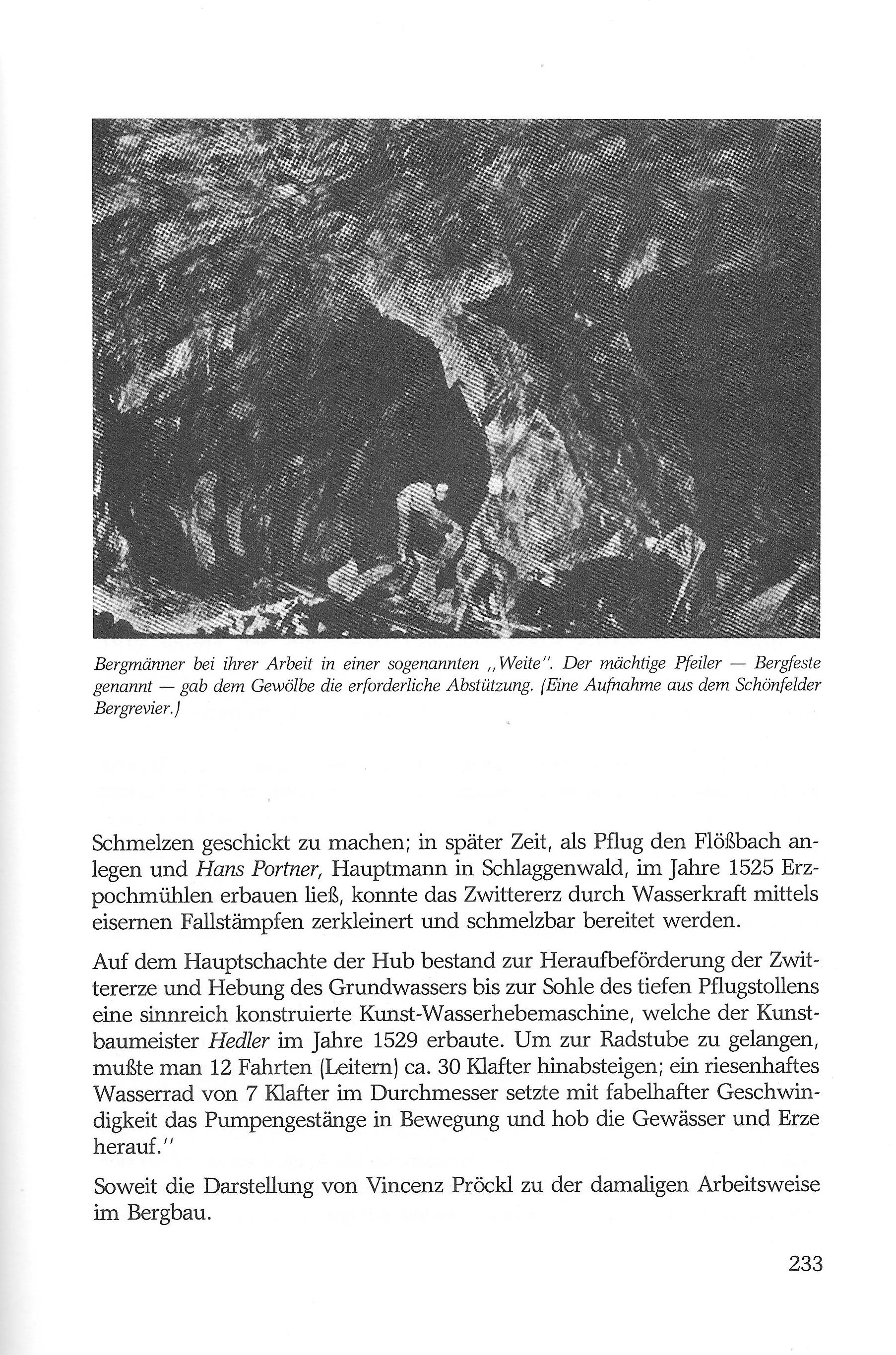 233
Miners at work in a so-called "wide" (wide) tunnel. The mighty pillar,
called the Bergfeste (mountain stronghold), provided the necessary
support for the vault. (A photograph from the Schönfeld mining
district.)
Smelting was a skillful task; in later times, when Pflug had the
rafting stream constructed and Hans Portner, captain of Schlaggenwald,
had ore crushing mills built in 1525, the hermaphrodite ore could be
crushed and melted using water power via iron plungers.
In the main shaft of the Hub, there was an ingeniously constructed
artificial water lifting machine, built by the master builder Hedler
in 1529, to transport the hermaphrodite ore and raise the groundwater
to the bottom of the deep Pflug tunnel. To reach the wheelhouse, one
had to descend 12 ladders, approximately 30 fathoms; a gigantic water
wheel of 7 meters (7 feet) Fathoms in diameter set the pump rods in
motion at incredible speed, lifting the water and ore."
This is Vincenz Pröckl's account of the mining operations of that
time.
233
233
Miners at work in a so-called "wide" (wide) tunnel. The mighty pillar,
called the Bergfeste (mountain stronghold), provided the necessary
support for the vault. (A photograph from the Schönfeld mining
district.)
Smelting was a skillful task; in later times, when Pflug had the
rafting stream constructed and Hans Portner, captain of Schlaggenwald,
had ore crushing mills built in 1525, the hermaphrodite ore could be
crushed and melted using water power via iron plungers.
In the main shaft of the Hub, there was an ingeniously constructed
artificial water lifting machine, built by the master builder Hedler
in 1529, to transport the hermaphrodite ore and raise the groundwater
to the bottom of the deep Pflug tunnel. To reach the wheelhouse, one
had to descend 12 ladders, approximately 30 fathoms; a gigantic water
wheel of 7 meters (7 feet) Fathoms in diameter set the pump rods in
motion at incredible speed, lifting the water and ore."
This is Vincenz Pröckl's account of the mining operations of that
time.
233
Page 0233
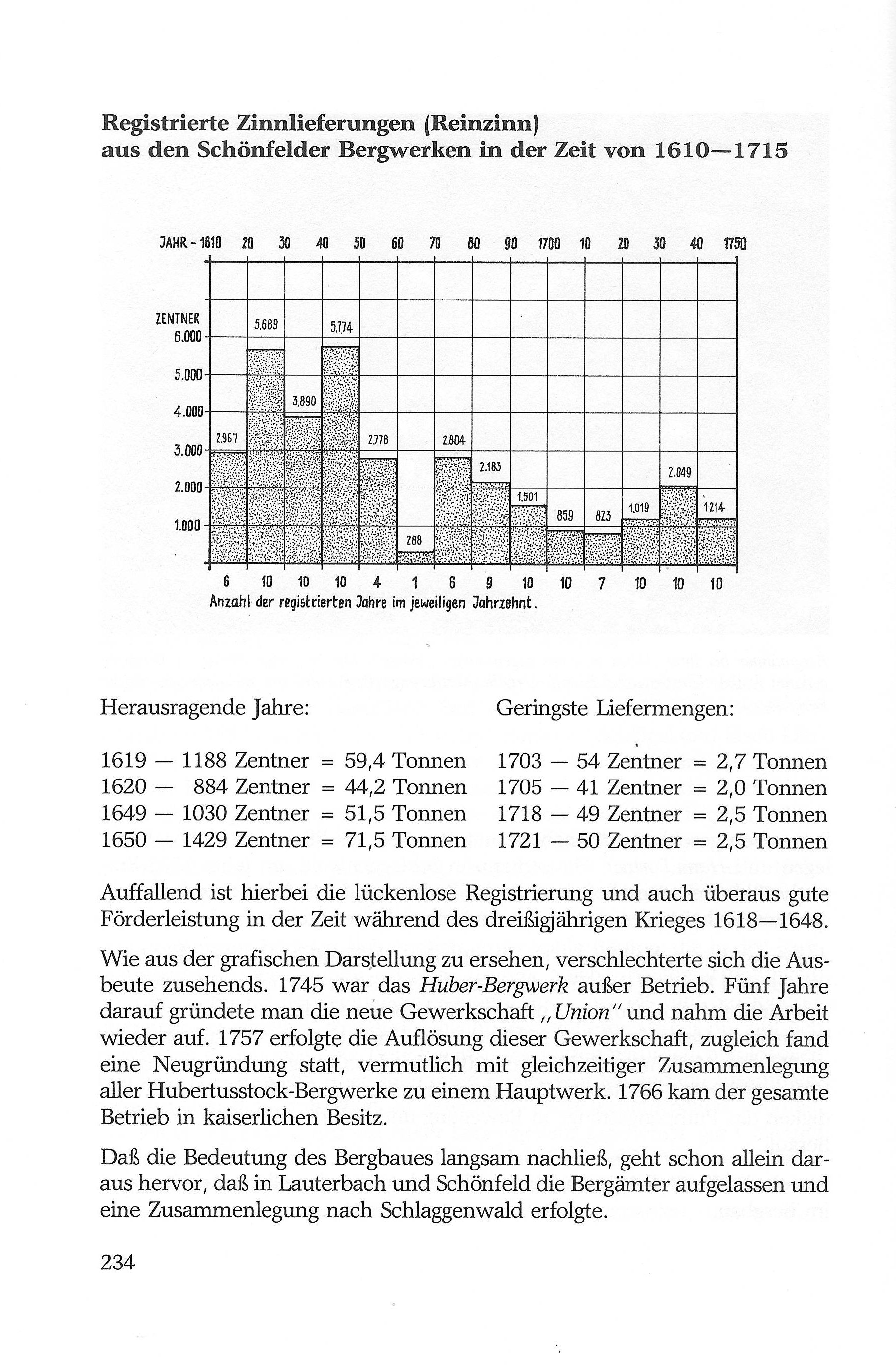 234
Registered tin deliveries (pure tin)
from the Schönfeld mines in the period 1610-1715
YEAR - 1610 20 30 40 50 60 70 80 90 1700 10 20 30 40 1750
CENTNERS
5,689
5,774
6,000
5,000
3,890
4,000
2,967
2,778
2,804
3,000
2,183
2,049
2,000
1,501
1,019
1,214
859 823
1,000
288
9
10
10 7 10 10 10
6 10 10 10 4 1 6 Number of recorded years in the respective decade.
Outstanding years:
-
Lowest delivery quantities:
1619 1188 hundredweights
=
59.4 tons
1703
1620
884 hundredweights
=
44.2 tons
1705
1649 1030 hundredweights
=
51.5 tons
1718
-
1650 1429 hundredweights
=
71.5 tons
1721
-----
-
-
54 hundredweights = 2.7 tons
41 hundredweights = 2.0 tons
49 hundredweights = 2.5 tons 50 hundredweights = 2.5 tons
What is striking here is the complete registration and also the
extremely good production performance during the Thirty Years' War
(1618-1648). As can be seen from the graphic representation, the yield
deteriorated noticeably. By 1745, the Huber mine was out of
operation. Five years later, the new union, "Union," was founded and
operations resumed. In 1757, this union was dissolved, and a new one
was founded at the same time, presumably with the simultaneous
consolidation of all Hubertusstock mines into one main mine. In 1766,
the entire operation came under imperial ownership. The fact that the
importance of mining was slowly declining is evident from the fact
that the mining offices in Lauterbach and Schönfeld were closed and
merged into Schlaggenwald.
234
234
Registered tin deliveries (pure tin)
from the Schönfeld mines in the period 1610-1715
YEAR - 1610 20 30 40 50 60 70 80 90 1700 10 20 30 40 1750
CENTNERS
5,689
5,774
6,000
5,000
3,890
4,000
2,967
2,778
2,804
3,000
2,183
2,049
2,000
1,501
1,019
1,214
859 823
1,000
288
9
10
10 7 10 10 10
6 10 10 10 4 1 6 Number of recorded years in the respective decade.
Outstanding years:
-
Lowest delivery quantities:
1619 1188 hundredweights
=
59.4 tons
1703
1620
884 hundredweights
=
44.2 tons
1705
1649 1030 hundredweights
=
51.5 tons
1718
-
1650 1429 hundredweights
=
71.5 tons
1721
-----
-
-
54 hundredweights = 2.7 tons
41 hundredweights = 2.0 tons
49 hundredweights = 2.5 tons 50 hundredweights = 2.5 tons
What is striking here is the complete registration and also the
extremely good production performance during the Thirty Years' War
(1618-1648). As can be seen from the graphic representation, the yield
deteriorated noticeably. By 1745, the Huber mine was out of
operation. Five years later, the new union, "Union," was founded and
operations resumed. In 1757, this union was dissolved, and a new one
was founded at the same time, presumably with the simultaneous
consolidation of all Hubertusstock mines into one main mine. In 1766,
the entire operation came under imperial ownership. The fact that the
importance of mining was slowly declining is evident from the fact
that the mining offices in Lauterbach and Schönfeld were closed and
merged into Schlaggenwald.
234
Page 0234
 235
In 1761, operations at the Huber main mine were suspended due to low
production and a very high debt burden. Although enormous government
efforts were made and subsidies granted, the high deficit could not be
overcome; every attempt to revive it proved futile. In 1774, the
Austro-Hungarian government closed the Huber main mine. Subsequently,
30 miners from Schlaggenwald and Schönfeld joined forces and purchased
the entire operation for 20,000 guilders. Needless to say, these
miners spared no effort or work to earn some money, but by 1778, they
too had recorded a deficit of 4,000 guilders.
Based on a positive opinion from high-ranking mining officials, the
resumption of Huber mining operations was ordered once again by court
decree of June 15, 1801, and considerable investments were made. At
the same time, the construction of the deep Coloredo Tunnel near
Petschau was proposed. It would be driven into the Huberstock and laid
40 fathoms (= 76 meters) deeper than the floor of the plow
tunnel. This long-term project, supposedly lasting 100 years, was
initiated, but was discontinued after barely four years of work. Even
the energetic work on the Huber main works failed to yield any
profitability. In the famine year of 1817, the abandoned Coloredo
Tunnel was taken up again to provide some relief to the suffering
miners. But it was precisely during this time that the state decided
to permanently cease all mining operations due to persistent
unprofitability.
The great sell-off followed. After a previous valuation, the state
offered the entire mining operations, including the water rights and
forests, for sale. The mine owner Unger (presumably from
Schlaggenwald) was the first to acquire the Huber main works and a
stamp mill for 2,900 florins in 1829 and exploited the mine as best he
could. In addition to Unger, other citizens from Schlaggenwald and
Schönfeld acquired mining property; in 1836, 11 mines were still in
operation, producing approximately 650 hundredweight of tin. However,
yields continued to decline.
In our neighboring town of Lauterbach, the mines had already been idle
since 1825. The following should be noted regarding the mine
ownership structure at that time: The group of owners called
themselves a "union," and the individual shareholder was a
"gewerkschaft." The share in a mining union was called a "Kux." It was
represented by a quota and not, like a share, by a fixed nominal
amount. (According to the Austrian General Mining Law of 1854, the
number of Kux is limited to 128.)
235
235
In 1761, operations at the Huber main mine were suspended due to low
production and a very high debt burden. Although enormous government
efforts were made and subsidies granted, the high deficit could not be
overcome; every attempt to revive it proved futile. In 1774, the
Austro-Hungarian government closed the Huber main mine. Subsequently,
30 miners from Schlaggenwald and Schönfeld joined forces and purchased
the entire operation for 20,000 guilders. Needless to say, these
miners spared no effort or work to earn some money, but by 1778, they
too had recorded a deficit of 4,000 guilders.
Based on a positive opinion from high-ranking mining officials, the
resumption of Huber mining operations was ordered once again by court
decree of June 15, 1801, and considerable investments were made. At
the same time, the construction of the deep Coloredo Tunnel near
Petschau was proposed. It would be driven into the Huberstock and laid
40 fathoms (= 76 meters) deeper than the floor of the plow
tunnel. This long-term project, supposedly lasting 100 years, was
initiated, but was discontinued after barely four years of work. Even
the energetic work on the Huber main works failed to yield any
profitability. In the famine year of 1817, the abandoned Coloredo
Tunnel was taken up again to provide some relief to the suffering
miners. But it was precisely during this time that the state decided
to permanently cease all mining operations due to persistent
unprofitability.
The great sell-off followed. After a previous valuation, the state
offered the entire mining operations, including the water rights and
forests, for sale. The mine owner Unger (presumably from
Schlaggenwald) was the first to acquire the Huber main works and a
stamp mill for 2,900 florins in 1829 and exploited the mine as best he
could. In addition to Unger, other citizens from Schlaggenwald and
Schönfeld acquired mining property; in 1836, 11 mines were still in
operation, producing approximately 650 hundredweight of tin. However,
yields continued to decline.
In our neighboring town of Lauterbach, the mines had already been idle
since 1825. The following should be noted regarding the mine
ownership structure at that time: The group of owners called
themselves a "union," and the individual shareholder was a
"gewerkschaft." The share in a mining union was called a "Kux." It was
represented by a quota and not, like a share, by a fixed nominal
amount. (According to the Austrian General Mining Law of 1854, the
number of Kux is limited to 128.)
235
Page 0235
 236
For example, according to the mining register extract dated October
22, 1868, the municipality of Schönfeld had 32 shares in the Maria
Schönfeld mine, or a 1/4 share. Around 1750, the municipality of
Schlaggenwald had 16 internal and 16 external shares in the Huber main
mine, and 20 internal and 20 external shares in the Kaspar Pflug
tunnel.
Around 1880, the old foreman Josef Schiener – generally known
simply as Schiener-Dick (No. 409, next to the shooting hut) –
acquired the Mariahilf shaft, presumably at the price of its
preservation. He worked in the tunnels with a few miners for several
years. In the 1890s, he too gave up due to the extremely meager yield.
As had happened some time earlier in our neighboring town of
Schlaggenwald, mining operations in Schönfeld also ceased permanently
in 1864. In 1868, all mining operations in Schlaggenwald and Schönfeld
were liquidated. The never-ending period of losses that led to the
major collapse was largely due to cheap tin imports from the Malay
Islands and Indonesia. The tin deposits there were so rich and easy to
mine that every European tin mine was forced to succumb to the
competition.
Meanwhile, however, one mineral had gained importance in the
flourishing heavy industry: tungsten – an ore mined in our mines
but previously worthless. This gave mining, which had until then been
focused solely on tin production, a new appeal. In 1904, Richard
Dübl (origin unknown) acquired the Mariahilf Shaft. He had his
house, the so-called "Bergmannsrast," built in the pinge forest on the
Hub. However, Dübl's financial resources were insufficient to
operate a profitable mine. He had neither steam power nor electricity
at his disposal, so he couldn't use a pump, which meant that mining
had to be limited to the ore-poor run (1st level), which lies at a
depth of only 60 meters, due to the water. Dübl soon ceased
operations. Nevertheless, he was very fortunate, because in 1906,
after brief negotiations, he was able to sell the shaft to an English
company. At the same time, the English acquired the adjacent
properties and the worsted spinning mill, which had burned down in
1903, from Josef Russ for 100,000 Austrian crowns. One of the most
modern processing plants was built in this building at the time. The
steam engine also found its way into the mine. The new owners now
wanted to re-sink the old Kreuzzech shaft. However, it was not
possible to find the exact spot, so the then English mine director
offered a reward of 500 Austrian krone.
236
236
For example, according to the mining register extract dated October
22, 1868, the municipality of Schönfeld had 32 shares in the Maria
Schönfeld mine, or a 1/4 share. Around 1750, the municipality of
Schlaggenwald had 16 internal and 16 external shares in the Huber main
mine, and 20 internal and 20 external shares in the Kaspar Pflug
tunnel.
Around 1880, the old foreman Josef Schiener – generally known
simply as Schiener-Dick (No. 409, next to the shooting hut) –
acquired the Mariahilf shaft, presumably at the price of its
preservation. He worked in the tunnels with a few miners for several
years. In the 1890s, he too gave up due to the extremely meager yield.
As had happened some time earlier in our neighboring town of
Schlaggenwald, mining operations in Schönfeld also ceased permanently
in 1864. In 1868, all mining operations in Schlaggenwald and Schönfeld
were liquidated. The never-ending period of losses that led to the
major collapse was largely due to cheap tin imports from the Malay
Islands and Indonesia. The tin deposits there were so rich and easy to
mine that every European tin mine was forced to succumb to the
competition.
Meanwhile, however, one mineral had gained importance in the
flourishing heavy industry: tungsten – an ore mined in our mines
but previously worthless. This gave mining, which had until then been
focused solely on tin production, a new appeal. In 1904, Richard
Dübl (origin unknown) acquired the Mariahilf Shaft. He had his
house, the so-called "Bergmannsrast," built in the pinge forest on the
Hub. However, Dübl's financial resources were insufficient to
operate a profitable mine. He had neither steam power nor electricity
at his disposal, so he couldn't use a pump, which meant that mining
had to be limited to the ore-poor run (1st level), which lies at a
depth of only 60 meters, due to the water. Dübl soon ceased
operations. Nevertheless, he was very fortunate, because in 1906,
after brief negotiations, he was able to sell the shaft to an English
company. At the same time, the English acquired the adjacent
properties and the worsted spinning mill, which had burned down in
1903, from Josef Russ for 100,000 Austrian crowns. One of the most
modern processing plants was built in this building at the time. The
steam engine also found its way into the mine. The new owners now
wanted to re-sink the old Kreuzzech shaft. However, it was not
possible to find the exact spot, so the then English mine director
offered a reward of 500 Austrian krone.
236
Page 0236
 237
Chinese crowns for the precise naming of the former location. After a
few days, he increased the sum to 1,000 crowns, an amount equivalent
to the annual earnings of a craftsman, but even the oldest Schönfeld
residents were unable to provide any useful information. Therefore, an
approximately 10-meter-deep auxiliary shaft had to be sunk, from which
several test tunnels were driven in a star shape until the old shaft
was finally reached. At that time, there was already a shortage of
suitably trained workers, so the plant management recruited a large
number from the Graßlitz area and from Styria. Thus, the years
1906-1908 were, from a mining perspective, a very good time for our
town, although the work was still quite primitive. Each blast hole was
still drilled by hand. Entry and exit from the shaft were still via
ladders, and in the mine, the miner still had to rely on his
"Rübölfunzl" (candle oil lamp), which provided only dim light. Only
the explosives had been significantly improved; dynamite and dynamon,
along with capsules and modern fuses, were introduced. In previous
years, for example, a straw filled with powder served as an ignition
device.
What no one in Schönfeld had expected at that time—it was around
the end of 1908—happened: completely unexpectedly, the entire
workforce was laid off, and operations ceased. Political events were
probably the trigger for this measure.
This photograph dates from 1906. It shows the winding tower at the
Kreuzzech shaft in the foreground, with the processing area behind
it. At that time, the Mariahilf shaft was located to the left outside
the picture.
Schönfeld, Mine
237
Chinese crowns for the precise naming of the former location. After a
few days, he increased the sum to 1,000 crowns, an amount equivalent
to the annual earnings of a craftsman, but even the oldest Schönfeld
residents were unable to provide any useful information. Therefore, an
approximately 10-meter-deep auxiliary shaft had to be sunk, from which
several test tunnels were driven in a star shape until the old shaft
was finally reached. At that time, there was already a shortage of
suitably trained workers, so the plant management recruited a large
number from the Graßlitz area and from Styria. Thus, the years
1906-1908 were, from a mining perspective, a very good time for our
town, although the work was still quite primitive. Each blast hole was
still drilled by hand. Entry and exit from the shaft were still via
ladders, and in the mine, the miner still had to rely on his
"Rübölfunzl" (candle oil lamp), which provided only dim light. Only
the explosives had been significantly improved; dynamite and dynamon,
along with capsules and modern fuses, were introduced. In previous
years, for example, a straw filled with powder served as an ignition
device.
What no one in Schönfeld had expected at that time—it was around
the end of 1908—happened: completely unexpectedly, the entire
workforce was laid off, and operations ceased. Political events were
probably the trigger for this measure.
This photograph dates from 1906. It shows the winding tower at the
Kreuzzech shaft in the foreground, with the processing area behind
it. At that time, the Mariahilf shaft was located to the left outside
the picture.
Schönfeld, Mine
Page 0237
 238
With the cessation of operations, the The miners who had moved in left
again.
Three years later, at the beginning of June 1911, an English flag
suddenly flew from the processing building, and master painter Emil
Bauer painted the company name "Gewerkschaft Elizabeth" (Elizabeth
Union) in large letters on the facade. A sigh of relief went through
the Schönfeld population, and numerous onlookers gathered in front of
the shaft site with high hopes. With the arrival of workers in the
following days, even the greatest doubters were convinced.
A massive effort was immediately made to combat the enormous volumes
of water in the shaft, with great technical effort; however, it took
some time until the shaft on the third level, at a depth of 87 meters,
was clear of water. Miners from outside were now needed again. Work
was in full swing.
On December 4, 1911, after a high mass in the Gerstner Hall, the
traditional Barbara Festival, financed by the company, was
celebrated. It remained a pleasant memory for all participants for a
long time.
In February of the following year, a prolonged thaw set in; the heavy
snowmelt brought masses of water that the pumps couldn't handle; the
shaft flooded. After more than a month, however, the water was once
again contained.
At that time, the operation employed around 230 workers, including 12
women who worked in processing. The daily yield was between 500 and
800 kilograms of waxy ore, of which around 10% was copper and the
remaining 90% was equal parts tin and tungsten ore.
In 1914, however, another political event struck: the outbreak of
World War I! On August 5, operations ceased.
Only after ten months of war, when raw materials for war production
were already running low, did the Vienna War Ministry remember the
long-suffering mine.
Thus, in mid-June 1915, a lieutenant named Schmidt was assigned to
Schönfeld. Together with the former operations manager, Richard
Freudenberg, he made all the necessary arrangements for the rapid
mining of ore. This included the release of the miners from our
hometown who had since been drafted into military service.
At the same time, an overhead power line was laid from the mining
power plant in Unterreichenau to the shaft. This provided
238
238
With the cessation of operations, the The miners who had moved in left
again.
Three years later, at the beginning of June 1911, an English flag
suddenly flew from the processing building, and master painter Emil
Bauer painted the company name "Gewerkschaft Elizabeth" (Elizabeth
Union) in large letters on the facade. A sigh of relief went through
the Schönfeld population, and numerous onlookers gathered in front of
the shaft site with high hopes. With the arrival of workers in the
following days, even the greatest doubters were convinced.
A massive effort was immediately made to combat the enormous volumes
of water in the shaft, with great technical effort; however, it took
some time until the shaft on the third level, at a depth of 87 meters,
was clear of water. Miners from outside were now needed again. Work
was in full swing.
On December 4, 1911, after a high mass in the Gerstner Hall, the
traditional Barbara Festival, financed by the company, was
celebrated. It remained a pleasant memory for all participants for a
long time.
In February of the following year, a prolonged thaw set in; the heavy
snowmelt brought masses of water that the pumps couldn't handle; the
shaft flooded. After more than a month, however, the water was once
again contained.
At that time, the operation employed around 230 workers, including 12
women who worked in processing. The daily yield was between 500 and
800 kilograms of waxy ore, of which around 10% was copper and the
remaining 90% was equal parts tin and tungsten ore.
In 1914, however, another political event struck: the outbreak of
World War I! On August 5, operations ceased.
Only after ten months of war, when raw materials for war production
were already running low, did the Vienna War Ministry remember the
long-suffering mine.
Thus, in mid-June 1915, a lieutenant named Schmidt was assigned to
Schönfeld. Together with the former operations manager, Richard
Freudenberg, he made all the necessary arrangements for the rapid
mining of ore. This included the release of the miners from our
hometown who had since been drafted into military service.
At the same time, an overhead power line was laid from the mining
power plant in Unterreichenau to the shaft. This provided
238
Page 0238
 239
Schönfeld also finally received its electricity supply, under the most
favorable conditions possible.
The pumps ran until the autumn to clear the shaft of water. In the
meantime, material was brought from Zinnwald near Teplitz, from which
ore was extracted in the efficient processing plant. During this
interim period, the mining of the dumps began, from which the
previously worthless tungsten could still be extracted.
Soon, the Schönfeld miners, released from military service,
arrived. The War Ministry also assembled so-called mining cadres,
groups of miners from other areas who were assigned to Schönfeld. A
large number of prisoners of war also arrived later.
Subject to constant military control and co-determination, the
Austrian War Ministry decided to sell the now productive Schönfeld ore
mine to private individuals by auction. For this purpose, an auction
was scheduled for December 12 or 14, 1915, at the court-martial in
Eger. This was announced by the Austrian Commercial Court and in the
Austrian and German press, which was closely associated with heavy
industry. Interested parties included the "Steirischen Boehler
Stahlwerke" and the Berlin banking house "Laupenmühlen und Co.",
both of which sent experts to Schönfeld almost simultaneously to
inspect the mining operation in detail and examine its potential for
further development. Since the experts and representatives of the
Boehler Steelworks had already agreed during their mine visit with the
mining operations manager, Richard Freudenberg, who was a German
citizen, that he, Freudenberg, would travel to the auction in Eger as
the representative and agent of the Boehler Works in order to acquire
the mine for them, Freudenberg was granted all the necessary powers of
attorney by the "Boehler Steelworks" a few days before the auction
date to acquire the mining operation at any price. Obviously striving
to serve his client to the best of his ability and in good conscience,
Freudenberg, at the height of his adulthood, traveled to Eger, but was
intercepted in Eger by the 27-year-old mining assessor Maier, a
Berliner who had been sent to the auction as the authorized
representative of the Berlin bank. He persuaded Maier to decline the
auction in exchange for a large bribe. By agreeing to this dirty deal,
Assessor Maier was the only person at the auction to Auction,
interested parties present, the entire Schönfeld ore mining operation
for a
239
239
Schönfeld also finally received its electricity supply, under the most
favorable conditions possible.
The pumps ran until the autumn to clear the shaft of water. In the
meantime, material was brought from Zinnwald near Teplitz, from which
ore was extracted in the efficient processing plant. During this
interim period, the mining of the dumps began, from which the
previously worthless tungsten could still be extracted.
Soon, the Schönfeld miners, released from military service,
arrived. The War Ministry also assembled so-called mining cadres,
groups of miners from other areas who were assigned to Schönfeld. A
large number of prisoners of war also arrived later.
Subject to constant military control and co-determination, the
Austrian War Ministry decided to sell the now productive Schönfeld ore
mine to private individuals by auction. For this purpose, an auction
was scheduled for December 12 or 14, 1915, at the court-martial in
Eger. This was announced by the Austrian Commercial Court and in the
Austrian and German press, which was closely associated with heavy
industry. Interested parties included the "Steirischen Boehler
Stahlwerke" and the Berlin banking house "Laupenmühlen und Co.",
both of which sent experts to Schönfeld almost simultaneously to
inspect the mining operation in detail and examine its potential for
further development. Since the experts and representatives of the
Boehler Steelworks had already agreed during their mine visit with the
mining operations manager, Richard Freudenberg, who was a German
citizen, that he, Freudenberg, would travel to the auction in Eger as
the representative and agent of the Boehler Works in order to acquire
the mine for them, Freudenberg was granted all the necessary powers of
attorney by the "Boehler Steelworks" a few days before the auction
date to acquire the mining operation at any price. Obviously striving
to serve his client to the best of his ability and in good conscience,
Freudenberg, at the height of his adulthood, traveled to Eger, but was
intercepted in Eger by the 27-year-old mining assessor Maier, a
Berliner who had been sent to the auction as the authorized
representative of the Berlin bank. He persuaded Maier to decline the
auction in exchange for a large bribe. By agreeing to this dirty deal,
Assessor Maier was the only person at the auction to Auction,
interested parties present, the entire Schönfeld ore mining operation
for a
239
Page 0239
 240
to play a virtually ridiculous purchase price into the hands of the
Berlin bank Laupenmühlen and Co. Freudenberg justified his
non-participation in the auction to the Boehler steelworks and the
Schönfeld population by claiming that he was late, but this seemed
implausible, as the entire fraud was soon discovered and made
public. Although Schönfeld could have been indifferent to who owned
the ore mine—as long as it was in operation—the disappointment
of the population and the factory workforce over the auction outcome
was unmistakable.
1 This misdeed committed by Freudenberg took its revenge on him within
just a few days and weeks. As a thank you for his services to Assessor
Maier, Freudenberg's powers as operations manager were shortly
thereafter restricted solely to mine operations, meaning he, like any
other foreman, had to drive in at the start of his shift and drive out
at the end. As early as March 1, 1916, he received his notice from the
assessor, who stated that he could not afford officials who could
accept bribes.
In the winter of 1915/16, a thaw struck again, bringing with it large
amounts of water. The flooded shaft remained idle for about a month,
so that in the meantime, mining had to resort to the dump material to
extract several hundredweight of tungsten.
At the beginning of 1916, the Wilhelm Shaft, which was in every
respect modern, was sunk. The circular shaft, 160 meters deep, had a
diameter of 5 meters; the concrete walls were 1 meter thick
throughout. The new shaft system, crowned by a 26-meter-high iron
winding tower, also included various supply buildings, crew quarters,
and offices.
During the construction phase of the Wilhelm Shaft, which was being
built on the opposite side of the processing plant (below the screw
factory built later), an event occurred that completely shut down the
new mine and also claimed a human life.
Karl Haller, who worked as a pump operator at this shaft at the time,
wrote a gripping and dramatic account of this event as an eyewitness,
clearly demonstrating the dangers of working underground. Here is his
stirring account in full:
"It was Tuesday, June 13, 1916, when, during the early shift on the
fourth run on the so-called Kreuzzech line, the railway construction
company in Schlaggen-
240
240
to play a virtually ridiculous purchase price into the hands of the
Berlin bank Laupenmühlen and Co. Freudenberg justified his
non-participation in the auction to the Boehler steelworks and the
Schönfeld population by claiming that he was late, but this seemed
implausible, as the entire fraud was soon discovered and made
public. Although Schönfeld could have been indifferent to who owned
the ore mine—as long as it was in operation—the disappointment
of the population and the factory workforce over the auction outcome
was unmistakable.
1 This misdeed committed by Freudenberg took its revenge on him within
just a few days and weeks. As a thank you for his services to Assessor
Maier, Freudenberg's powers as operations manager were shortly
thereafter restricted solely to mine operations, meaning he, like any
other foreman, had to drive in at the start of his shift and drive out
at the end. As early as March 1, 1916, he received his notice from the
assessor, who stated that he could not afford officials who could
accept bribes.
In the winter of 1915/16, a thaw struck again, bringing with it large
amounts of water. The flooded shaft remained idle for about a month,
so that in the meantime, mining had to resort to the dump material to
extract several hundredweight of tungsten.
At the beginning of 1916, the Wilhelm Shaft, which was in every
respect modern, was sunk. The circular shaft, 160 meters deep, had a
diameter of 5 meters; the concrete walls were 1 meter thick
throughout. The new shaft system, crowned by a 26-meter-high iron
winding tower, also included various supply buildings, crew quarters,
and offices.
During the construction phase of the Wilhelm Shaft, which was being
built on the opposite side of the processing plant (below the screw
factory built later), an event occurred that completely shut down the
new mine and also claimed a human life.
Karl Haller, who worked as a pump operator at this shaft at the time,
wrote a gripping and dramatic account of this event as an eyewitness,
clearly demonstrating the dangers of working underground. Here is his
stirring account in full:
"It was Tuesday, June 13, 1916, when, during the early shift on the
fourth run on the so-called Kreuzzech line, the railway construction
company in Schlaggen-
240
Page 0240
 241
The Italian D'Orazio, known in the shaft only as "Tonerl," who had
remained in the forest, and his friend, after clearing away the
material thrown down by the night shift, set about extending the track
by one more rail. In doing so, they encountered an obstacle: on the
left side of the floor, there was a rock bulge the size and height of
a washbasin, which had remained standing during blasting in previous
shifts and now proved to be a hindrance to track laying. Since this
hard and seemingly compact boulder was difficult to tackle with other
tools, D'Orazio simply took the drill and drilled a hole barely 20
centimeters deep to remove the obstacle with a very weak blast. Tonerl
then took half a cartridge from the explosives chamber, which seemed
more than sufficient to remove this lump of rock. Upon returning with
the cartridge, he found that, despite the dry conditions there, there
was some water in the borehole, which could only come from
below. Since the mine management had long expected that, while driving
this section, they would one day encounter the old workings of the
former Kreuzzech shaft, which could likely contain unpredictable
amounts of water, two 3-meter-deep holes were drilled in this section,
in addition to the necessary approximately 1.20-meter-deep blast
holes, to test the area for the presence of water. Furthermore, as a
precautionary measure, a two-meter-thick concrete door frame with a
self-closing water gate that seemed capable of withstanding any water
pressure was installed approximately 120 meters from the site in case
of an unexpected incident. D'Orazio, already suspicious, experienced,
and always cautious, therefore came to me in the pump room, where the
foremen sometimes hung out, to alert the foremen or senior foremen to
this, admittedly meaningless, yet nevertheless suspicious, water in
the borehole and to ask whether he should take the shot. I could only
tell him that the senior foremen had probably left and the foremen was
probably in the Schönfeld section, whereupon Tonerl left again. Since
I was overcome by a faint premonition of what was to come, I quickly
glanced into the pump sump to make sure I had precisely adjusted the
two running pumps to the water flow, and then went with him. Arriving
at Tonerl's location, I examined the lump of stone with the borehole
and told him that, in my opinion, it wasn't necessary to clear the
small lump of stone out of the way by shooting; it should be possible
to remove it without shooting. I then left the still-hesitant Tonerl,
and when I returned to the pump room, a shot rang out about five
minutes later.
241
241
The Italian D'Orazio, known in the shaft only as "Tonerl," who had
remained in the forest, and his friend, after clearing away the
material thrown down by the night shift, set about extending the track
by one more rail. In doing so, they encountered an obstacle: on the
left side of the floor, there was a rock bulge the size and height of
a washbasin, which had remained standing during blasting in previous
shifts and now proved to be a hindrance to track laying. Since this
hard and seemingly compact boulder was difficult to tackle with other
tools, D'Orazio simply took the drill and drilled a hole barely 20
centimeters deep to remove the obstacle with a very weak blast. Tonerl
then took half a cartridge from the explosives chamber, which seemed
more than sufficient to remove this lump of rock. Upon returning with
the cartridge, he found that, despite the dry conditions there, there
was some water in the borehole, which could only come from
below. Since the mine management had long expected that, while driving
this section, they would one day encounter the old workings of the
former Kreuzzech shaft, which could likely contain unpredictable
amounts of water, two 3-meter-deep holes were drilled in this section,
in addition to the necessary approximately 1.20-meter-deep blast
holes, to test the area for the presence of water. Furthermore, as a
precautionary measure, a two-meter-thick concrete door frame with a
self-closing water gate that seemed capable of withstanding any water
pressure was installed approximately 120 meters from the site in case
of an unexpected incident. D'Orazio, already suspicious, experienced,
and always cautious, therefore came to me in the pump room, where the
foremen sometimes hung out, to alert the foremen or senior foremen to
this, admittedly meaningless, yet nevertheless suspicious, water in
the borehole and to ask whether he should take the shot. I could only
tell him that the senior foremen had probably left and the foremen was
probably in the Schönfeld section, whereupon Tonerl left again. Since
I was overcome by a faint premonition of what was to come, I quickly
glanced into the pump sump to make sure I had precisely adjusted the
two running pumps to the water flow, and then went with him. Arriving
at Tonerl's location, I examined the lump of stone with the borehole
and told him that, in my opinion, it wasn't necessary to clear the
small lump of stone out of the way by shooting; it should be possible
to remove it without shooting. I then left the still-hesitant Tonerl,
and when I returned to the pump room, a shot rang out about five
minutes later.
241
Page 0241
 242
I took off my military blouse, rolled up my shirt sleeves as far as
possible, and wanted to clean the sucked-in wood shavings from the
pumps' iron suction baskets, just in case. To do this, I had to climb
two meters down from the pump chamber to the track and from there into
the four-meter-deep pump sump, but I couldn't get onto the track or
into the sump, because as I took the first two steps out of the pump
chamber, a wave of water about 1.20 meters high rolled through the
Kreuzzech track, carrying Tonerl, his buddy, and Rau Rudolf, who was
just on the track. They were all lucky that there were three or four
full boats on the Schönfeld side of the shaft, which significantly
slowed the speed of the flood, thus giving the three men the
opportunity to climb out of the raging flood, already half-dead, with
my help and that of the pusher, Kugler Franz (Katzengrün). I then
started the third pump faster than ever before, so that all three were
running at a total capacity of approximately 4,800 liters per
minute. Since I couldn't move far from the pumps even in this
situation, but was aware of the danger facing the people on the shafts
and the workings, which were up to 15 meters above the fourth shaft, I
could do nothing better than send Franz Kugler, barely 17 years old
and not long in the shaft, into the water in the Kreuzzech drift to
alert the men on the workings. But when I saw that Franz Kugler
couldn't possibly reach all the workings under these difficulties, I
thought better of it and, like Kugler, climbed chest-deep into the
water to reach the main valve of the main air line, shut off the air
supply to all the workings and workings, and sounded the alarm on the
pipe for several minutes with a hammer. At this alarm, Kugler turned
back, and unsuspecting foreman Schmidt (a platoon leader assigned to
the mine) also came down from the third shaft, to whom I quickly had
to explain what had happened. He then inquired about the functioning
of the pumps and, despite the rising water, entered the Kreuzzech
shaft. After a man from each pit wanted to investigate the meaning of
the air lock and the alarm, and they saw the entire shaft almost full
of water, they quickly called their mates down and, already up to
their necks in water, came forward to exit. Meanwhile, the operations
manager, senior foreman, foreman, first lieutenant, and everyone who
thought they could save something also learned of the incident and
entered the shaft.
At the third shaft, at the filling point, the senior foreman took a
crew count to make sure everything was saved, but to everyone's
dismay, he discovered that five men were missing: foreman Schmidt and
242
242
I took off my military blouse, rolled up my shirt sleeves as far as
possible, and wanted to clean the sucked-in wood shavings from the
pumps' iron suction baskets, just in case. To do this, I had to climb
two meters down from the pump chamber to the track and from there into
the four-meter-deep pump sump, but I couldn't get onto the track or
into the sump, because as I took the first two steps out of the pump
chamber, a wave of water about 1.20 meters high rolled through the
Kreuzzech track, carrying Tonerl, his buddy, and Rau Rudolf, who was
just on the track. They were all lucky that there were three or four
full boats on the Schönfeld side of the shaft, which significantly
slowed the speed of the flood, thus giving the three men the
opportunity to climb out of the raging flood, already half-dead, with
my help and that of the pusher, Kugler Franz (Katzengrün). I then
started the third pump faster than ever before, so that all three were
running at a total capacity of approximately 4,800 liters per
minute. Since I couldn't move far from the pumps even in this
situation, but was aware of the danger facing the people on the shafts
and the workings, which were up to 15 meters above the fourth shaft, I
could do nothing better than send Franz Kugler, barely 17 years old
and not long in the shaft, into the water in the Kreuzzech drift to
alert the men on the workings. But when I saw that Franz Kugler
couldn't possibly reach all the workings under these difficulties, I
thought better of it and, like Kugler, climbed chest-deep into the
water to reach the main valve of the main air line, shut off the air
supply to all the workings and workings, and sounded the alarm on the
pipe for several minutes with a hammer. At this alarm, Kugler turned
back, and unsuspecting foreman Schmidt (a platoon leader assigned to
the mine) also came down from the third shaft, to whom I quickly had
to explain what had happened. He then inquired about the functioning
of the pumps and, despite the rising water, entered the Kreuzzech
shaft. After a man from each pit wanted to investigate the meaning of
the air lock and the alarm, and they saw the entire shaft almost full
of water, they quickly called their mates down and, already up to
their necks in water, came forward to exit. Meanwhile, the operations
manager, senior foreman, foreman, first lieutenant, and everyone who
thought they could save something also learned of the incident and
entered the shaft.
At the third shaft, at the filling point, the senior foreman took a
crew count to make sure everything was saved, but to everyone's
dismay, he discovered that five men were missing: foreman Schmidt and
242
Page 0242
 243
Four miners from Joachimsthal, who were working in the two pits
closest to the pump room in the Schönfeld drift. When I shut off the
air supply, they hadn't yet drilled and therefore didn't notice the
closure, and they ignored the alarm. Only later, when they were about
to start drilling and there was no air supply, did one of them want to
inspect and find that the drift was full of water and that they were
trapped by the water at the pit. They were lucky, however, because
their pits were almost at the height of the third drift, from which
they were separated not by a solid stone wall, but only by a wall of
displaced, i.e., loose, stones about 4 to 5 meters thick. They were
able to work their way through them, not entirely without danger, but
at least easily, especially since feverish efforts were being made to
free them from the third drift by unpacking the stones. Foreman
Schmidt, however, remained missing.
Now, it should also be mentioned that the water gate, already
mentioned as a precautionary measure and designed to close
automatically in the event of a heavy water outburst, actually
fulfilled its intended purpose completely, if not for a most strange
coincidence that prevented it from fully fulfilling its task. It was
the case that in the tunnels (addresses) almost every time a working
was opened, there was a toolbox approximately 1.50 meters long, 60
centimeters high, and just as wide. Such a solidly built, rather heavy
toolbox carried away the erupted water, and just at the moment the
water gate was about to close, the box floated through the door
opening and was wedged by the closing door, so that the door had to
remain open across the width of the box. The strong strips attached to
both sides of the box and the water pressure at the door ensured that
the box could not escape at all, and that was a good thing. This
strange coincidence, despite causing the shaft to flood and the
foreman Schmidt's death, had to be described as extremely fortunate,
because without this toolbox being wedged in, the water door would
undoubtedly have closed completely, making escape from certain death
completely impossible for all the men working behind the water door in
the workings, 12 or 14 in number. As it was, all the men working
between the water door and the end of the tunnel were able to climb
over the box and through the gap to safety, despite the water buildup
reaching up to their necks caused by the half-closed door and the box
wedged between it. I and some fitters and mechanics who were available
for any pump dismantling, as well as plant manager Fekler, foreman
Haber and foreman-
243
243
Four miners from Joachimsthal, who were working in the two pits
closest to the pump room in the Schönfeld drift. When I shut off the
air supply, they hadn't yet drilled and therefore didn't notice the
closure, and they ignored the alarm. Only later, when they were about
to start drilling and there was no air supply, did one of them want to
inspect and find that the drift was full of water and that they were
trapped by the water at the pit. They were lucky, however, because
their pits were almost at the height of the third drift, from which
they were separated not by a solid stone wall, but only by a wall of
displaced, i.e., loose, stones about 4 to 5 meters thick. They were
able to work their way through them, not entirely without danger, but
at least easily, especially since feverish efforts were being made to
free them from the third drift by unpacking the stones. Foreman
Schmidt, however, remained missing.
Now, it should also be mentioned that the water gate, already
mentioned as a precautionary measure and designed to close
automatically in the event of a heavy water outburst, actually
fulfilled its intended purpose completely, if not for a most strange
coincidence that prevented it from fully fulfilling its task. It was
the case that in the tunnels (addresses) almost every time a working
was opened, there was a toolbox approximately 1.50 meters long, 60
centimeters high, and just as wide. Such a solidly built, rather heavy
toolbox carried away the erupted water, and just at the moment the
water gate was about to close, the box floated through the door
opening and was wedged by the closing door, so that the door had to
remain open across the width of the box. The strong strips attached to
both sides of the box and the water pressure at the door ensured that
the box could not escape at all, and that was a good thing. This
strange coincidence, despite causing the shaft to flood and the
foreman Schmidt's death, had to be described as extremely fortunate,
because without this toolbox being wedged in, the water door would
undoubtedly have closed completely, making escape from certain death
completely impossible for all the men working behind the water door in
the workings, 12 or 14 in number. As it was, all the men working
between the water door and the end of the tunnel were able to climb
over the box and through the gap to safety, despite the water buildup
reaching up to their necks caused by the half-closed door and the box
wedged between it. I and some fitters and mechanics who were available
for any pump dismantling, as well as plant manager Fekler, foreman
Haber and foreman-
243
Page 0243
 244
Lieutenant Schurk crouched in front of the pump room and, with a watch
in his hand and repeatedly placing pebbles and drawing lines in the
sloping depression in front of the water, observed the incessant rise
of the water. The time-consuming removal of the pumps was out of the
question with the water rising so rapidly. Incidentally, the
lieutenant had also ordered the pumps to be kept running until the
last moment, as it might be possible that the water would subside in
the meantime and the pumps could cope with the inflow. But these hopes
were not fulfilled; on the contrary, the water rose noticeably faster,
since at this height it had not yet reached any relief and had no
possibility of spreading sideways. Thus, within a short time, the
water also penetrated the pump chamber, slowly rising up the
foundations and the electric motors and pumps standing on them. The
time seemed to have come to switch off the high-voltage current, at
the external signal agreed upon by the foreman during the day, since
entering the pump chamber no longer seemed advisable due to the risk
of earth faults. This happened almost exactly one hour after the
explosive shot fired by the Italian Tonerl, which opened the door to
this fateful water.
It was an incredibly oppressive feeling when the usual, uninterrupted
singing of the pumps was suddenly replaced by a deathly silence and
the electric lamps went out, for only now, when all resistance to the
water had been abandoned, could the magnitude of the event be
assessed. The mere thought that a person had lost their life to this
water made me shudder, especially since I was extremely lucky myself,
because if the water had entered just half a minute later, I would
have been in the sump cleaning the suction baskets. But there wasn't
much time for such thoughts, because the shutdown of the pumps caused
the water to rise even faster into the space, now almost confined to
the shaft, about three meters wide, so that nothing remained but to
get to safety. By the next day, despite the enormous potential for
expansion on and above the third channel, the water had reached a
height of 38 meters and the second channel.
Now, above all, new pumps, along with the necessary electric motors
and cables, had to be purchased. Due to their importance to the war
effort, this was only possible through the War Ministry. However, it
was accomplished unexpectedly quickly, so that after just a few days,
the attack on the water could begin with powerful pumps never before
used. In order to cope with these larger and more powerful pumps,
whose
244
244
Lieutenant Schurk crouched in front of the pump room and, with a watch
in his hand and repeatedly placing pebbles and drawing lines in the
sloping depression in front of the water, observed the incessant rise
of the water. The time-consuming removal of the pumps was out of the
question with the water rising so rapidly. Incidentally, the
lieutenant had also ordered the pumps to be kept running until the
last moment, as it might be possible that the water would subside in
the meantime and the pumps could cope with the inflow. But these hopes
were not fulfilled; on the contrary, the water rose noticeably faster,
since at this height it had not yet reached any relief and had no
possibility of spreading sideways. Thus, within a short time, the
water also penetrated the pump chamber, slowly rising up the
foundations and the electric motors and pumps standing on them. The
time seemed to have come to switch off the high-voltage current, at
the external signal agreed upon by the foreman during the day, since
entering the pump chamber no longer seemed advisable due to the risk
of earth faults. This happened almost exactly one hour after the
explosive shot fired by the Italian Tonerl, which opened the door to
this fateful water.
It was an incredibly oppressive feeling when the usual, uninterrupted
singing of the pumps was suddenly replaced by a deathly silence and
the electric lamps went out, for only now, when all resistance to the
water had been abandoned, could the magnitude of the event be
assessed. The mere thought that a person had lost their life to this
water made me shudder, especially since I was extremely lucky myself,
because if the water had entered just half a minute later, I would
have been in the sump cleaning the suction baskets. But there wasn't
much time for such thoughts, because the shutdown of the pumps caused
the water to rise even faster into the space, now almost confined to
the shaft, about three meters wide, so that nothing remained but to
get to safety. By the next day, despite the enormous potential for
expansion on and above the third channel, the water had reached a
height of 38 meters and the second channel.
Now, above all, new pumps, along with the necessary electric motors
and cables, had to be purchased. Due to their importance to the war
effort, this was only possible through the War Ministry. However, it
was accomplished unexpectedly quickly, so that after just a few days,
the attack on the water could begin with powerful pumps never before
used. In order to cope with these larger and more powerful pumps,
whose
244
Page 0244
 245
In order to be able to follow the falling water, a long-filled shaft
dating from earlier times and extending diagonally from the 1st to the
3rd channel had to be opened up. This delayed the advance into the
depths somewhat, but allowed for unhindered progress.
Almost exactly six weeks after the drowning, the 4th channel could be
accessed again, and the first order of business was, of course, to
search for the missing foreman Schmidt. At the same time, there was
also great curiosity about where and how the fateful water erupted,
which is why the Kreuzzech section was the first to be explored, where
foreman Schmidt was found very close to the water gate, covered in mud
beyond recognition. He probably overstepped the bounds of his duty and
struggled for a long time with his head underwater to retrieve the
toolbox wedged between the water gate. He probably fell due to
exhaustion or some other circumstance and, deprived of light, was
unable to get up, thus drowning. Furthermore, the half-closed water
gate, with the toolbox wedged in, preventing it from closing
completely, was found just as the last miners to slip through had
described it. Finally, at the spot where the Italian clay had dumped
the small bowl, which, given its load, could be considered harmless, a
hole about three-quarters of a meter in diameter was found, from which
a quantity of water was still gushing, which a pump had to deal
with. This hole ran diagonally downwards, following the location of
the ore vein, and despite repeated attempts to measure it, no
conclusions could be drawn as to its depth. All that was certain was
that this hole was the uppermost end of a possibly three- to
four-hundred-year-old eruption, which originated at a previously
unknown depth. It was also certain that this ancient eruption must
have been connected to an enormous volume of water, the lateral extent
of which could not be estimated and which rose approximately 15 meters
above the fourth channel. This could be assumed with certainty because
barely 15 minutes after the water eruption at the fourth channel, a
spring that had been present for years in the Schönfeld section at the
third channel and from which water normally flowed for a pump
diminished significantly and dried up completely after another 10
minutes. The hole at the 4th run, which widened just below its
surface, was pumped out, following the water's advance, and led
through old workings and old backfill in Kaspar Pflug's footsteps,
namely to the Kaspar Pflug Tunnel, built in the 16th century and
beginning in the Marienschacht (Hirtenpaint) at a depth of 120 meters,
which had never been encountered from the Mariahilf Shaft until then.
245
245
In order to be able to follow the falling water, a long-filled shaft
dating from earlier times and extending diagonally from the 1st to the
3rd channel had to be opened up. This delayed the advance into the
depths somewhat, but allowed for unhindered progress.
Almost exactly six weeks after the drowning, the 4th channel could be
accessed again, and the first order of business was, of course, to
search for the missing foreman Schmidt. At the same time, there was
also great curiosity about where and how the fateful water erupted,
which is why the Kreuzzech section was the first to be explored, where
foreman Schmidt was found very close to the water gate, covered in mud
beyond recognition. He probably overstepped the bounds of his duty and
struggled for a long time with his head underwater to retrieve the
toolbox wedged between the water gate. He probably fell due to
exhaustion or some other circumstance and, deprived of light, was
unable to get up, thus drowning. Furthermore, the half-closed water
gate, with the toolbox wedged in, preventing it from closing
completely, was found just as the last miners to slip through had
described it. Finally, at the spot where the Italian clay had dumped
the small bowl, which, given its load, could be considered harmless, a
hole about three-quarters of a meter in diameter was found, from which
a quantity of water was still gushing, which a pump had to deal
with. This hole ran diagonally downwards, following the location of
the ore vein, and despite repeated attempts to measure it, no
conclusions could be drawn as to its depth. All that was certain was
that this hole was the uppermost end of a possibly three- to
four-hundred-year-old eruption, which originated at a previously
unknown depth. It was also certain that this ancient eruption must
have been connected to an enormous volume of water, the lateral extent
of which could not be estimated and which rose approximately 15 meters
above the fourth channel. This could be assumed with certainty because
barely 15 minutes after the water eruption at the fourth channel, a
spring that had been present for years in the Schönfeld section at the
third channel and from which water normally flowed for a pump
diminished significantly and dried up completely after another 10
minutes. The hole at the 4th run, which widened just below its
surface, was pumped out, following the water's advance, and led
through old workings and old backfill in Kaspar Pflug's footsteps,
namely to the Kaspar Pflug Tunnel, built in the 16th century and
beginning in the Marienschacht (Hirtenpaint) at a depth of 120 meters,
which had never been encountered from the Mariahilf Shaft until then.
245
Page 0245
 246
Now, this unexpectedly disastrous flood on June 13, 1916, was also the
last of the frequent and always extremely damaging water invasions,
which had previously constantly threatened the Schönfeld ore mine, and
especially the Mariahilf shaft, due to technical deficiencies. The
following months brought no abnormally strong water inflows caused by
weather or other reasons, which could have caused the shaft to flood
again. When, about a year after the new shaft was started, it reached
a depth of 110 meters, forming the first level, the new shaft's width
allowed for the installation of appropriately large pumps capable of
handling any expected water inflow."
This is Karl Haller's report, which represents a very valuable
contribution to this local history book and especially to this
chapter.
From the new Wilhelm Shaft, old, completely collapsed drifts were also
repaired, which not only established connections to the Mariahilf
Shaft but also opened up new mining areas. All material transport from
all locations was also shifted to the new shaft. The same applied to
the entry and exit of the mine crew. Until then, the only way in and
out was via ladders. In 1917, the Processing, so that the capacity of
this plant could be doubled. It was thus adapted to the increased
production capacity.
Meanwhile, the shortage of food and work clothing became almost
unbearable, so that the exceptionally heavy wear and tear on footwear
in the mine forced the workers to shoe their wooden shoes with strong
irons, hardly inferior to horse shoes. With the end of World War I,
the War Service Act also came to an end, meaning the miners were no
longer tied to the company. Many terminated their employment contracts
and returned home. The workforce subsequently fell from 800 to barely
more than 300 employees. The three-shift operation was reduced to two
shifts. The year 1919 saw no structural changes in the mine, but
instead saw all the more revolutionary socio-political demands from
the workforce. In addition to all this dissatisfaction, this year also
brought a series of serious accidents, which mainly occurred during
blasting and were mostly due to faulty fuses. were.
It wasn't until the following year that conditions became somewhat
stable again. Although the food supply still left much to be desired,
246
246
Now, this unexpectedly disastrous flood on June 13, 1916, was also the
last of the frequent and always extremely damaging water invasions,
which had previously constantly threatened the Schönfeld ore mine, and
especially the Mariahilf shaft, due to technical deficiencies. The
following months brought no abnormally strong water inflows caused by
weather or other reasons, which could have caused the shaft to flood
again. When, about a year after the new shaft was started, it reached
a depth of 110 meters, forming the first level, the new shaft's width
allowed for the installation of appropriately large pumps capable of
handling any expected water inflow."
This is Karl Haller's report, which represents a very valuable
contribution to this local history book and especially to this
chapter.
From the new Wilhelm Shaft, old, completely collapsed drifts were also
repaired, which not only established connections to the Mariahilf
Shaft but also opened up new mining areas. All material transport from
all locations was also shifted to the new shaft. The same applied to
the entry and exit of the mine crew. Until then, the only way in and
out was via ladders. In 1917, the Processing, so that the capacity of
this plant could be doubled. It was thus adapted to the increased
production capacity.
Meanwhile, the shortage of food and work clothing became almost
unbearable, so that the exceptionally heavy wear and tear on footwear
in the mine forced the workers to shoe their wooden shoes with strong
irons, hardly inferior to horse shoes. With the end of World War I,
the War Service Act also came to an end, meaning the miners were no
longer tied to the company. Many terminated their employment contracts
and returned home. The workforce subsequently fell from 800 to barely
more than 300 employees. The three-shift operation was reduced to two
shifts. The year 1919 saw no structural changes in the mine, but
instead saw all the more revolutionary socio-political demands from
the workforce. In addition to all this dissatisfaction, this year also
brought a series of serious accidents, which mainly occurred during
blasting and were mostly due to faulty fuses. were.
It wasn't until the following year that conditions became somewhat
stable again. Although the food supply still left much to be desired,
246
Page 0246
 247
remained, but the miners received preferential treatment with higher
rations than the rest of the population. In addition, the relatively
high wages—which is why the miners were also called the
"stockbrokers" of labor—allowed them to purchase additional food
through the black market.
The miners' good earnings were not only due to the shift and piecework
wages increased by the mill management, but to a far greater extent to
an almost unbelievable increase in output compared to the mining
results during the war years. While at that time, the tunnel advance
in three-shift operation amounted to 4-5 meters per week, in 1920,
with the same effort, five times that amount was achieved.
The following data on ore production are still recorded for the period
1917-1920: 3,768 hundredweight of tin, 2,890 hundredweight of
wolframite, and 946 hundredweight of alluvial copper. In November
1920, after several previous unsuccessful attempts, the reopening of
the almost completely collapsed 400-year-old mine was finally achieved
under the most difficult conditions. Kaspar Pflug Tunnel, over a
continuous length of approximately 4 kilometers. Only the
Jahnheim-Schindlerfabrik section still had to be exposed; the labor
required for this was estimated at 4 months. This would have finally
reopened the drainage tunnel, so important for mining and the soul of
the Schlaggenwald and Schönfeld ore mines for centuries, after
disappointing attempts, along its entire length – from the
Hirtenpaint to the Zech, below Schlaggenwald.
Unfortunately, it never came to that, because in the first days of
1921, the Czech government in Prague banned the export of tin and
tungsten. Attempts by the Schönfeld municipality and workforce to
revoke this order were unsuccessful. Since at that time there was only
one plant in Czechoslovakia (Poldi-Hütte) equipped to smelt these
ores, but this only produced 40% of the ore produced in Germany
Because the mining directorate was forced to close the plant due to
the expected unprofitability, the time had come again: February 21,
1921.
Over the next five years, all equipment, inventories, and other assets
were sold. They began dismantling all machinery and power plants, and
the factory buildings were stripped down. Franz Russ acquired the
majority of the facilities at that time, including the processing
building, a former warehouse, which was expanded in 1913,
247
247
remained, but the miners received preferential treatment with higher
rations than the rest of the population. In addition, the relatively
high wages—which is why the miners were also called the
"stockbrokers" of labor—allowed them to purchase additional food
through the black market.
The miners' good earnings were not only due to the shift and piecework
wages increased by the mill management, but to a far greater extent to
an almost unbelievable increase in output compared to the mining
results during the war years. While at that time, the tunnel advance
in three-shift operation amounted to 4-5 meters per week, in 1920,
with the same effort, five times that amount was achieved.
The following data on ore production are still recorded for the period
1917-1920: 3,768 hundredweight of tin, 2,890 hundredweight of
wolframite, and 946 hundredweight of alluvial copper. In November
1920, after several previous unsuccessful attempts, the reopening of
the almost completely collapsed 400-year-old mine was finally achieved
under the most difficult conditions. Kaspar Pflug Tunnel, over a
continuous length of approximately 4 kilometers. Only the
Jahnheim-Schindlerfabrik section still had to be exposed; the labor
required for this was estimated at 4 months. This would have finally
reopened the drainage tunnel, so important for mining and the soul of
the Schlaggenwald and Schönfeld ore mines for centuries, after
disappointing attempts, along its entire length – from the
Hirtenpaint to the Zech, below Schlaggenwald.
Unfortunately, it never came to that, because in the first days of
1921, the Czech government in Prague banned the export of tin and
tungsten. Attempts by the Schönfeld municipality and workforce to
revoke this order were unsuccessful. Since at that time there was only
one plant in Czechoslovakia (Poldi-Hütte) equipped to smelt these
ores, but this only produced 40% of the ore produced in Germany
Because the mining directorate was forced to close the plant due to
the expected unprofitability, the time had come again: February 21,
1921.
Over the next five years, all equipment, inventories, and other assets
were sold. They began dismantling all machinery and power plants, and
the factory buildings were stripped down. Franz Russ acquired the
majority of the facilities at that time, including the processing
building, a former warehouse, which was expanded in 1913,
247
Page 0247
 248
to gain office space, the empty engine house, and a fairly extensive
property with a massive pile of sand thrown up by the processing plant
over the previous six years.
Only in the fall of 1934 did a small glimmer of hope emerge for a
resumption of mining operations. At that time, the Anglo-Belgian
ownership group resumed exploration work at the Wilhelm Shaft and
built modest new facilities. Despite promising discoveries, work was
halted again in the summer of 1935, and the workforce was laid off.
At the beginning of 1936, the Schlaggenwald engineer Karl Prosch
decided to make a fresh start. He also received permission to mine for
ore at the "Steinbacher Lehen- und Stockschacht Zinnzeche" (according
to Haller, located on the edge of the Rauhschacht pit and also called
the "Schnödenstock Shaft"), which had been abandoned for 80 years and
had since fallen into disrepair. For several weeks, Prosch tried
alone, through painstaking digging, to determine the location of the
shaft. On March 2nd, the time had finally come for him to begin
sinking the shaft. He was subsequently assisted by around half a dozen
experienced unemployed miners, whose meager unemployment benefits at
the time amounted to 20 crowns a week. After almost half a year of
hard work, the men came across the completely preserved lower section
of the former shaft at a depth of approximately 65 meters, which
continued a further 15 meters down. Here, Prosch encountered large old
excavations where ore had previously been mined by stick
mining. According to his information, the reserve of mineable raw ore
in this deposit amounted to over 7 million tons. In addition to the
exploration work, a processing plant was built in the nearby old
Schindler factory. This allowed the ore to be processed into a
saleable form. After a long wait, in the summer of 1938, Prosch
received permission from the Czechoslovak General Staff to export the
ore concentrates. Until then—22 years had passed—this small
group of miners had worked without pay. When the war broke out in
1939, Prosch was forced to surrender his mining rights.
still Anglo-Belgian property at that time
The Wilhelm Shaft was confiscated. The war industry was in full swing,
and, as could be expected, it brought in Friedrich Krupp AG as the new
mine management. The importance of the Schönfeld ore deposits for this
company can be deduced from the construction of the massive ore
processing plant at the Hubhof alone. It took 2.5 years to build, at a
cost of 70 million Reichsmarks. In the fall of 1943, it successfully
completed its
248
248
to gain office space, the empty engine house, and a fairly extensive
property with a massive pile of sand thrown up by the processing plant
over the previous six years.
Only in the fall of 1934 did a small glimmer of hope emerge for a
resumption of mining operations. At that time, the Anglo-Belgian
ownership group resumed exploration work at the Wilhelm Shaft and
built modest new facilities. Despite promising discoveries, work was
halted again in the summer of 1935, and the workforce was laid off.
At the beginning of 1936, the Schlaggenwald engineer Karl Prosch
decided to make a fresh start. He also received permission to mine for
ore at the "Steinbacher Lehen- und Stockschacht Zinnzeche" (according
to Haller, located on the edge of the Rauhschacht pit and also called
the "Schnödenstock Shaft"), which had been abandoned for 80 years and
had since fallen into disrepair. For several weeks, Prosch tried
alone, through painstaking digging, to determine the location of the
shaft. On March 2nd, the time had finally come for him to begin
sinking the shaft. He was subsequently assisted by around half a dozen
experienced unemployed miners, whose meager unemployment benefits at
the time amounted to 20 crowns a week. After almost half a year of
hard work, the men came across the completely preserved lower section
of the former shaft at a depth of approximately 65 meters, which
continued a further 15 meters down. Here, Prosch encountered large old
excavations where ore had previously been mined by stick
mining. According to his information, the reserve of mineable raw ore
in this deposit amounted to over 7 million tons. In addition to the
exploration work, a processing plant was built in the nearby old
Schindler factory. This allowed the ore to be processed into a
saleable form. After a long wait, in the summer of 1938, Prosch
received permission from the Czechoslovak General Staff to export the
ore concentrates. Until then—22 years had passed—this small
group of miners had worked without pay. When the war broke out in
1939, Prosch was forced to surrender his mining rights.
still Anglo-Belgian property at that time
The Wilhelm Shaft was confiscated. The war industry was in full swing,
and, as could be expected, it brought in Friedrich Krupp AG as the new
mine management. The importance of the Schönfeld ore deposits for this
company can be deduced from the construction of the massive ore
processing plant at the Hubhof alone. It took 2.5 years to build, at a
cost of 70 million Reichsmarks. In the fall of 1943, it successfully
completed its
248
Page 0248
 249
operations began. The location of this facility, equipped with
state-of-the-art machinery, was not the most favorable in terms of
material supply from the Wilhelm Shaft, but the nearby so-called
Wiesental valley made it possible to accommodate the enormous
quantities of sludge and sand generated during ore processing in the
long term. A 900-meter-long cable car between the Wilhelm Shaft and
the processing plant, which crossed the road to Schlaggenwald at the
Kreuzzeche mine, provided the necessary transport connection. The
mine administration was then headquartered in Jahnheim.
In 1941, the Fuller Mill (No. 398) was purchased to create new housing
for officials.
Under the management of the Krupp company, the company was renamed
"Egerländer Erzbergbau GmbH Schlaggenwald" in 1942. That the
gentlemen from Krupp responsible for this naming were not uninfluenced
at the time is probably beyond doubt. For Schönfeld, it was a bitter
realization of how far local patriotism can go, because in this case,
a group of people no longer known today had blatantly disregarded more
than 700 years of local history, and even geographical boundaries, in
making this decision.
It is incomprehensible that Schönfeld did not vigorously oppose this
measure. (See also the chapter on Town Hall/Mayor.)
An essay on Schönfeld's ore mining would be incomplete without
mentioning the repeatedly occurring fatal accidents. While in earlier
years the stock mining method, with the constant danger of falling
rock, was predominantly the cause, in recent years it seems that many
deaths were caused by the higher Technology (explosives, electricity)
played a significant role in this. The first recorded reference to a
fatal mining accident, which was certainly not the first victim in
Schönfeld's mining history, dates back to 1577.
Although subsequent information is very sketchy, it can be assumed
that in the following years, one or two miners died annually.
As far as is known, the highest number of fatal accidents occurred in
1917. Eleven miners, including several prisoners of war, lost their
lives that year.
249
249
operations began. The location of this facility, equipped with
state-of-the-art machinery, was not the most favorable in terms of
material supply from the Wilhelm Shaft, but the nearby so-called
Wiesental valley made it possible to accommodate the enormous
quantities of sludge and sand generated during ore processing in the
long term. A 900-meter-long cable car between the Wilhelm Shaft and
the processing plant, which crossed the road to Schlaggenwald at the
Kreuzzeche mine, provided the necessary transport connection. The
mine administration was then headquartered in Jahnheim.
In 1941, the Fuller Mill (No. 398) was purchased to create new housing
for officials.
Under the management of the Krupp company, the company was renamed
"Egerländer Erzbergbau GmbH Schlaggenwald" in 1942. That the
gentlemen from Krupp responsible for this naming were not uninfluenced
at the time is probably beyond doubt. For Schönfeld, it was a bitter
realization of how far local patriotism can go, because in this case,
a group of people no longer known today had blatantly disregarded more
than 700 years of local history, and even geographical boundaries, in
making this decision.
It is incomprehensible that Schönfeld did not vigorously oppose this
measure. (See also the chapter on Town Hall/Mayor.)
An essay on Schönfeld's ore mining would be incomplete without
mentioning the repeatedly occurring fatal accidents. While in earlier
years the stock mining method, with the constant danger of falling
rock, was predominantly the cause, in recent years it seems that many
deaths were caused by the higher Technology (explosives, electricity)
played a significant role in this. The first recorded reference to a
fatal mining accident, which was certainly not the first victim in
Schönfeld's mining history, dates back to 1577.
Although subsequent information is very sketchy, it can be assumed
that in the following years, one or two miners died annually.
As far as is known, the highest number of fatal accidents occurred in
1917. Eleven miners, including several prisoners of war, lost their
lives that year.
249
Page 0249
 250
The Tin Mines
All Saints Mine
Anselm Mine
Trinity Mine
Three Kings Mine
Evangelist Mine
Guide Shaft Huberstock Shaft Johannis Mine
Karl Hirschen Tunnel
Knapphahn Shaft Königs Mine
Kreuz Mine Shaft Mariahilf Mine
Mariahilf Mine
Maria Schönfeld Mine
· Paul Mine
Pingen Shaft
Rauch Shaft
Near House No. 422 (Wagner-Häusl) Unterh. Jahnheim,
Geb. Schlaggenwald Between Kreuzzeche and Schellhorn
Schlaggenwald/Schönfeld mine pit
Near Tischer/Erler-Hof
Approx. 60 m behind the Kreuzzeche Below Ruppert tannery
At the shooting hut
Hirtenpaint
19 Steinbacher Lehenzeche x
20 Wilhelm Shaft
Pinge near Fenkl
On the edge of the aforementioned pinge, the new shaft below the screw
factory
1) x = 1836 still recorded as "in operation."
Notes on some mines:
9- Karl-Hirschen-Stollen: This tunnel supplied part of Schlaggenwald
with drinking water.
13 Mariahilf Shaft:
Silver was allegedly mined here in the past.
After the Wilhelm Shaft was sunk, it was connected to it. Around 1920,
two ore veins, the "Gelnauer" and the "Mariengang," with a
thickness of approximately 80 cm,
250
250
The Tin Mines
All Saints Mine
Anselm Mine
Trinity Mine
Three Kings Mine
Evangelist Mine
Guide Shaft Huberstock Shaft Johannis Mine
Karl Hirschen Tunnel
Knapphahn Shaft Königs Mine
Kreuz Mine Shaft Mariahilf Mine
Mariahilf Mine
Maria Schönfeld Mine
· Paul Mine
Pingen Shaft
Rauch Shaft
Near House No. 422 (Wagner-Häusl) Unterh. Jahnheim,
Geb. Schlaggenwald Between Kreuzzeche and Schellhorn
Schlaggenwald/Schönfeld mine pit
Near Tischer/Erler-Hof
Approx. 60 m behind the Kreuzzeche Below Ruppert tannery
At the shooting hut
Hirtenpaint
19 Steinbacher Lehenzeche x
20 Wilhelm Shaft
Pinge near Fenkl
On the edge of the aforementioned pinge, the new shaft below the screw
factory
1) x = 1836 still recorded as "in operation."
Notes on some mines:
9- Karl-Hirschen-Stollen: This tunnel supplied part of Schlaggenwald
with drinking water.
13 Mariahilf Shaft:
Silver was allegedly mined here in the past.
After the Wilhelm Shaft was sunk, it was connected to it. Around 1920,
two ore veins, the "Gelnauer" and the "Mariengang," with a
thickness of approximately 80 cm,
250
Page 0250
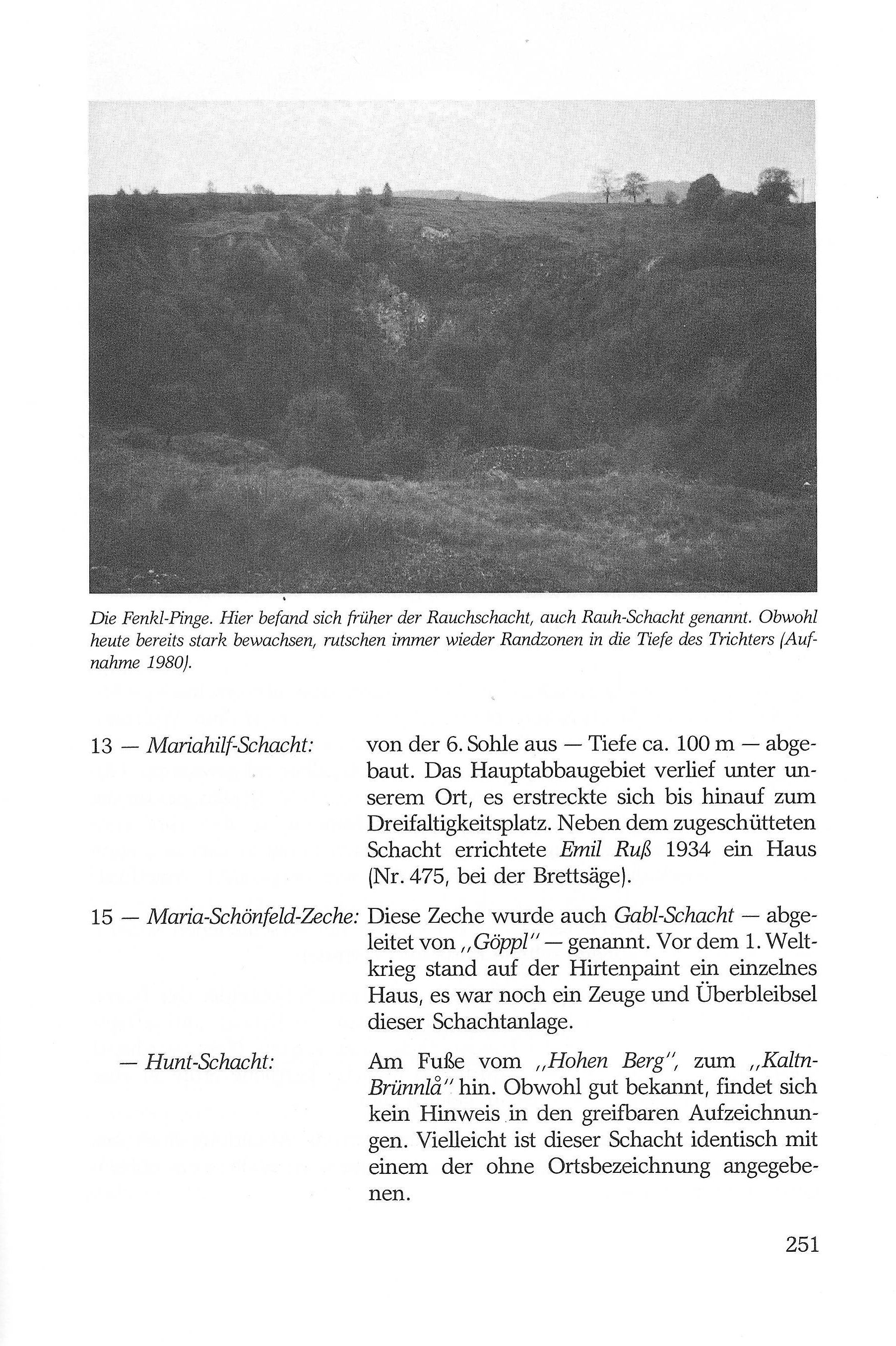 251
The Fenkl Pit. This was once the site of the Rauchschacht (smoke
shaft), also known as the Rauh Shaft. Although now heavily overgrown,
marginal zones continue to slide into the depths of the crater (photo
taken in 1980).
13 Mariahilf Shaft:
from the 6th level, from a depth of approximately 100 m. The main
mining area ran beneath our village, extending up to
Dreifaltigkeitsplatz (Trinity Square). Emil Ruß built a house next
to the filled-in shaft in 1934 (No. 475, near the sawmill).
15 - Maria Schönfeld Mine: This mine was also called the Gabl Shaft -
derived from "Göppl" - Hunt Shaft: Before the First World War, a
single house stood on the Hirtenpaint, a witness and remnant of this
mine.
At the foot of the "Hoher Berg" towards the "Kaltn-Brünnlå"
(Kaltn-Brünnlå). Although well known, there is no reference in
the available records. Perhaps this shaft is identical to one of the
ones listed without a place name.
251
251
The Fenkl Pit. This was once the site of the Rauchschacht (smoke
shaft), also known as the Rauh Shaft. Although now heavily overgrown,
marginal zones continue to slide into the depths of the crater (photo
taken in 1980).
13 Mariahilf Shaft:
from the 6th level, from a depth of approximately 100 m. The main
mining area ran beneath our village, extending up to
Dreifaltigkeitsplatz (Trinity Square). Emil Ruß built a house next
to the filled-in shaft in 1934 (No. 475, near the sawmill).
15 - Maria Schönfeld Mine: This mine was also called the Gabl Shaft -
derived from "Göppl" - Hunt Shaft: Before the First World War, a
single house stood on the Hirtenpaint, a witness and remnant of this
mine.
At the foot of the "Hoher Berg" towards the "Kaltn-Brünnlå"
(Kaltn-Brünnlå). Although well known, there is no reference in
the available records. Perhaps this shaft is identical to one of the
ones listed without a place name.
251
Page 0251
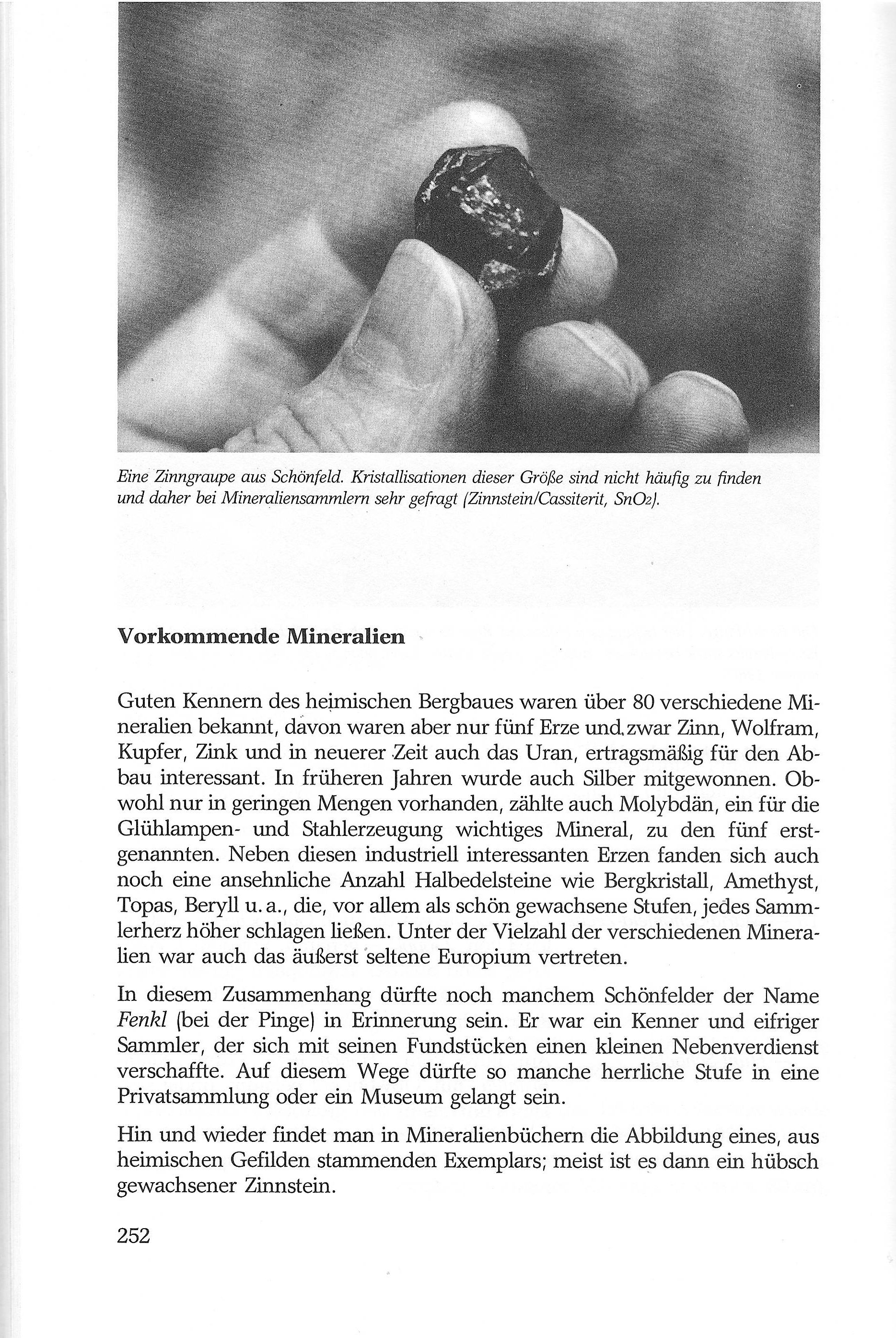 252
A tin barley from Schönfeld. Crystallizations of this size are rare
and therefore highly sought after by mineral collectors (tin
ore/cassiterite, SnO2).
Minerals Found
Experts in local mining knew of over 80 different minerals, but only
five of these—tin, tungsten, copper, zinc, and, more recently,
uranium—were of interest in terms of profitability. In earlier
years, silver was also mined. Although present only in small
quantities, molybdenum, an important mineral for light bulb and steel
production, was among the first five. In addition to these
industrially interesting ores, a considerable number of semiprecious
stones such as rock crystal, amethyst, topaz, beryl, and others were
also found, which, especially in beautifully grown specimens, made
every collector's heart beat faster. Among the multitude of different
minerals, the extremely rare europium was also present.
In this context, many Schönfeld residents may still remember the name
Fenkl (near the Pinge). He was a connoisseur and avid collector who
earned a little extra income from his finds. In this way, many a
magnificent specimen may have found its way into a private collection
or museum.
Every now and then, one finds an illustration of a specimen from his
home region in mineral books; usually, it is a beautifully grown
tinstone.
252
252
A tin barley from Schönfeld. Crystallizations of this size are rare
and therefore highly sought after by mineral collectors (tin
ore/cassiterite, SnO2).
Minerals Found
Experts in local mining knew of over 80 different minerals, but only
five of these—tin, tungsten, copper, zinc, and, more recently,
uranium—were of interest in terms of profitability. In earlier
years, silver was also mined. Although present only in small
quantities, molybdenum, an important mineral for light bulb and steel
production, was among the first five. In addition to these
industrially interesting ores, a considerable number of semiprecious
stones such as rock crystal, amethyst, topaz, beryl, and others were
also found, which, especially in beautifully grown specimens, made
every collector's heart beat faster. Among the multitude of different
minerals, the extremely rare europium was also present.
In this context, many Schönfeld residents may still remember the name
Fenkl (near the Pinge). He was a connoisseur and avid collector who
earned a little extra income from his finds. In this way, many a
magnificent specimen may have found its way into a private collection
or museum.
Every now and then, one finds an illustration of a specimen from his
home region in mineral books; usually, it is a beautifully grown
tinstone.
252
Page 0252
 253
The Flößgraben
History of the Flößgraben
A large part of the townscape, especially the market square, but also
part of the beautiful surroundings of Schönfeld were characterized by
this lively stream, teeming with trout.
Its origins date back to 1523. At that time, the Schlaggenwald and
Schönfeld mines needed larger quantities of water to convert from dry
to wet stamp mills, which were stamp mills used to crush the
ore-bearing rock. In addition, the ore washhouses and, above all, the
waterworks at the Huber main works (Huberstock shaft near the large
pit) also needed to be supplied with water. The waterworks was a huge
pumping station that raised the mine water. This made ore mining at
greater depths possible.
It was Johann Pflug von Rabenstein, the then owner of the Petschau
estate and the associated mines and mining towns, who wanted to remedy
the water shortage at the time. He therefore commissioned a man
experienced in hydraulic engineering named Roßmeißl to locate
suitable sources and plan the supply of these waters.
On Roßmeißl's recommendation, the water flowing from the raised
bog between Lauterbach and Schönfeld Filz was initially collected in
two large ponds (Alter- and Neuer Muckengrund-Teich), which were
created specifically for this purpose. The excess water from the Neuer
Teich fed the Ebmetgraben. This ditch wound through dense spruce
forest, past mighty boulders – popularly known as the
Zwergenhaislå – to its collecting basin, the Ebmetteich. From
there, the water flowed into the Sackdamm and then on to the Hub,
where it presumably flowed into a watercourse that was a precursor to
the later Flößgraben.
253
253
The Flößgraben
History of the Flößgraben
A large part of the townscape, especially the market square, but also
part of the beautiful surroundings of Schönfeld were characterized by
this lively stream, teeming with trout.
Its origins date back to 1523. At that time, the Schlaggenwald and
Schönfeld mines needed larger quantities of water to convert from dry
to wet stamp mills, which were stamp mills used to crush the
ore-bearing rock. In addition, the ore washhouses and, above all, the
waterworks at the Huber main works (Huberstock shaft near the large
pit) also needed to be supplied with water. The waterworks was a huge
pumping station that raised the mine water. This made ore mining at
greater depths possible.
It was Johann Pflug von Rabenstein, the then owner of the Petschau
estate and the associated mines and mining towns, who wanted to remedy
the water shortage at the time. He therefore commissioned a man
experienced in hydraulic engineering named Roßmeißl to locate
suitable sources and plan the supply of these waters.
On Roßmeißl's recommendation, the water flowing from the raised
bog between Lauterbach and Schönfeld Filz was initially collected in
two large ponds (Alter- and Neuer Muckengrund-Teich), which were
created specifically for this purpose. The excess water from the Neuer
Teich fed the Ebmetgraben. This ditch wound through dense spruce
forest, past mighty boulders – popularly known as the
Zwergenhaislå – to its collecting basin, the Ebmetteich. From
there, the water flowed into the Sackdamm and then on to the Hub,
where it presumably flowed into a watercourse that was a precursor to
the later Flößgraben.
253
Page 0253
 254
This amount of water probably fell far short of the demand. It also
didn't reach the mines in Seifertsgrün in the Schlaggenwald
area. Roßmeißl therefore turned to the springs on the Glatzen,
located between Königswart and Sangerberg. He also found a route along
which the water could be brought.
According to a mining registrar's book, as reported in the Enzmann
Chronicle, it was a shepherd who is said to have set out, or rather,
strode out, the direction of the rafting ditch.
In negotiations with the abbot of Tepl Abbey, Andreas Urban, Johann
Pflug von Rabenstein acquired the right to use the water and the land
for the construction of the ditch. This contract was signed on
St. Vitus Day in 1523 (Enzmann Chronicle, p. 6).
There are widely varying accounts of both the start and the
construction period. Regarding the latter, reports of 5 and even 24
years have been made. There's no doubt that the first estimate can be
considered too short for such a large project, considering the simple
working methods of the time, especially since the notoriously long
winters in our homeland regularly required a forced break. The fact
that the mining unions strongly supported this project by providing
labor and financial resources probably didn't change this. The
chronicle reports: "From 1547 onwards, timber was floated from
Königswarth to Schönfeld and Schlaggenwald."
Here, it can be assumed that a subsequent widening or expansion of the
existing ditch for rafting purposes took place. This could be the
reason for the different construction dates.
The following excerpt from Count Kaspar Sternberg's book, "Outlines of
a History of Bohemian Mines" from 1836 (p. 283) is also interesting in
this context: "No less documented is that on the day of Jubilate 1535,
a contract and regulation concerning the rafting ditch was published
by the mining captain, Georg Albin von der Niederhaid."
Sternberg further reports that with this regulation (contract), an
older one from 1499 was repealed. It states: "This concerned, as the
contract reads, the previous watercourse—called "Rotta"—which
the mill and smelting works had used. near Schönfeld and
Seifertsgrün, they dug a ditch from Sangerberg behind Neudorf and
built it over the watercourse through a cinder forest.
254
254
This amount of water probably fell far short of the demand. It also
didn't reach the mines in Seifertsgrün in the Schlaggenwald
area. Roßmeißl therefore turned to the springs on the Glatzen,
located between Königswart and Sangerberg. He also found a route along
which the water could be brought.
According to a mining registrar's book, as reported in the Enzmann
Chronicle, it was a shepherd who is said to have set out, or rather,
strode out, the direction of the rafting ditch.
In negotiations with the abbot of Tepl Abbey, Andreas Urban, Johann
Pflug von Rabenstein acquired the right to use the water and the land
for the construction of the ditch. This contract was signed on
St. Vitus Day in 1523 (Enzmann Chronicle, p. 6).
There are widely varying accounts of both the start and the
construction period. Regarding the latter, reports of 5 and even 24
years have been made. There's no doubt that the first estimate can be
considered too short for such a large project, considering the simple
working methods of the time, especially since the notoriously long
winters in our homeland regularly required a forced break. The fact
that the mining unions strongly supported this project by providing
labor and financial resources probably didn't change this. The
chronicle reports: "From 1547 onwards, timber was floated from
Königswarth to Schönfeld and Schlaggenwald."
Here, it can be assumed that a subsequent widening or expansion of the
existing ditch for rafting purposes took place. This could be the
reason for the different construction dates.
The following excerpt from Count Kaspar Sternberg's book, "Outlines of
a History of Bohemian Mines" from 1836 (p. 283) is also interesting in
this context: "No less documented is that on the day of Jubilate 1535,
a contract and regulation concerning the rafting ditch was published
by the mining captain, Georg Albin von der Niederhaid."
Sternberg further reports that with this regulation (contract), an
older one from 1499 was repealed. It states: "This concerned, as the
contract reads, the previous watercourse—called "Rotta"—which
the mill and smelting works had used. near Schönfeld and
Seifertsgrün, they dug a ditch from Sangerberg behind Neudorf and
built it over the watercourse through a cinder forest.
254
Page 0254
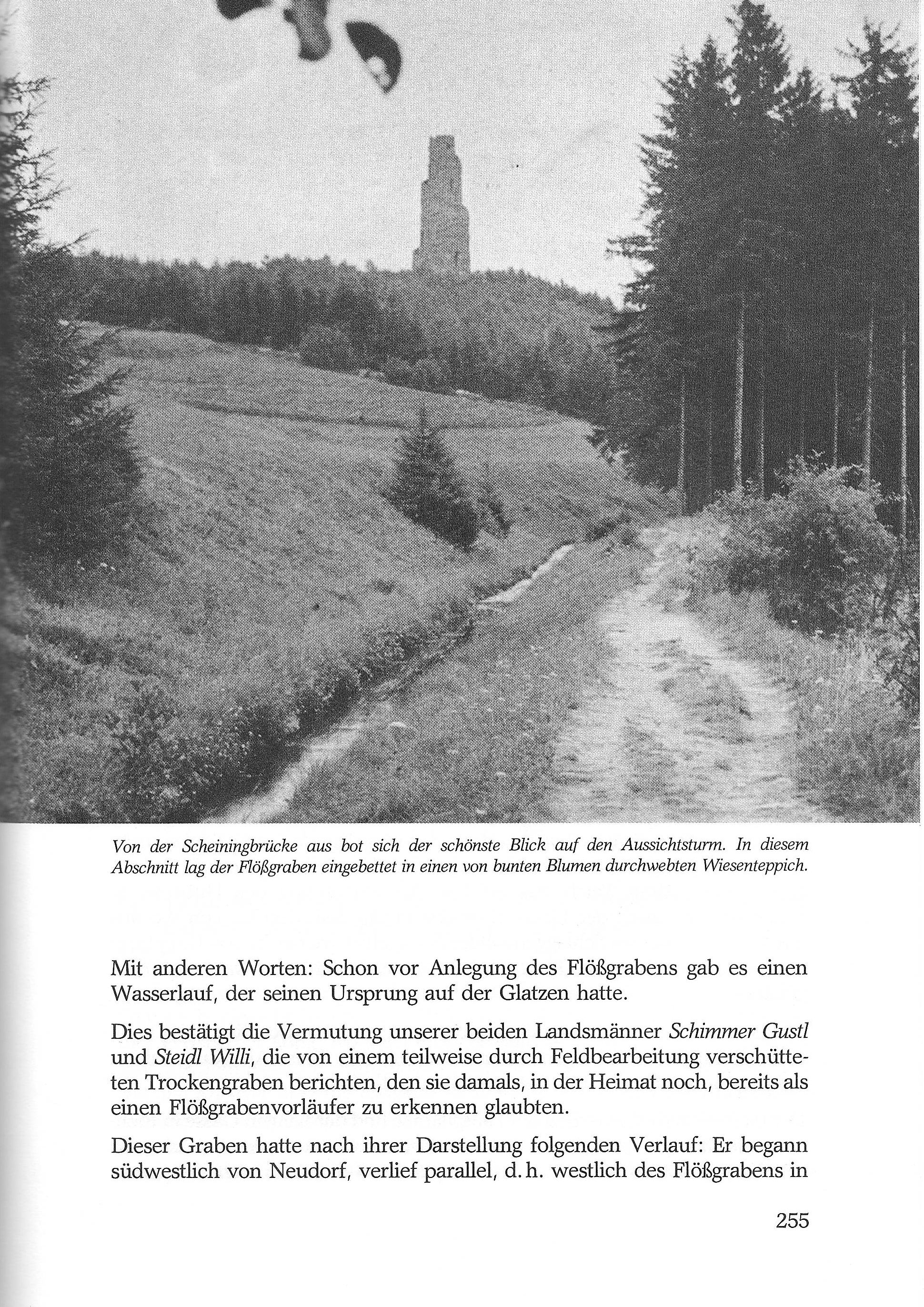 255
The Scheining Bridge offered the most beautiful view of the
observation tower. In this section, the rafting ditch lay embedded in
a meadow carpet woven with colorful flowers. In other words: Even
before the rafting ditch was created, there was a watercourse that
originated on the Glatzen. This confirms the assumption of our two
compatriots, Schimmer Gustl and Steidl Willi, who reported a dry ditch
partially buried by field cultivation, which they believed, back then,
to be a precursor to the rafting ditch.
According to their account, this ditch had the following course: It
began southwest of Neudorf, ran parallel, i.e., west of the rafting
ditch in
255
255
The Scheining Bridge offered the most beautiful view of the
observation tower. In this section, the rafting ditch lay embedded in
a meadow carpet woven with colorful flowers. In other words: Even
before the rafting ditch was created, there was a watercourse that
originated on the Glatzen. This confirms the assumption of our two
compatriots, Schimmer Gustl and Steidl Willi, who reported a dry ditch
partially buried by field cultivation, which they believed, back then,
to be a precursor to the rafting ditch.
According to their account, this ditch had the following course: It
began southwest of Neudorf, ran parallel, i.e., west of the rafting
ditch in
255
Page 0255
 256
Towards Filz, past Filz, past Himmelteich. Between Filz and
Lauterbacher Street, the ditch then led through the Herrnholz towards
Scheining, from where it continued – past the Opl Cross – to the
Seifen and the Beckenteich ponds.
In the Seifen, where in very early years, before mining operations
were known, tin ore was still extracted from deposited rock, the
so-called Seifen, by leaching, no operation would have been possible
without a constant water supply.
Regarding the – according to this information, it must be said –
modified rafting ditch and its pioneer, the Roßmeißl, the
following version could be correct: At that time, it was not about
supplying a new source of water, but about raising a much larger
quantity than previously. Furthermore, the water had long since ceased
to be needed in the Seifen, because at that time, mining operations
were only carried out underground. However, it was urgently needed at
the Huberstock Shaft and in the Schlaggenwald mining operations in
Seifertsgrün. For this, however, a new stream course was required,
which Roßmeißl was tasked with finding, and which he did find:
the path we know today, which took its unusual course from Neudorf,
along the mountain slope, to Schönfeld. This alone must have been
Roßmeißl's magnificent and masterly deed, repeatedly mentioned
in the records.
At the Teilhäusl, at the exit of Streichergasse, he divided this
watercourse. He diverted one of the two ditches along the slope to the
Damml, because Schönfeld and the Hub still needed to be supplied with
water. The second branch of the ditch led from Teilhäusl toward
Schönfelder Hochgericht/Rabensgrün. At that time, the Old Pond
probably served as the sole reservoir, as the Long Pond, located in
front of it, was supposedly only created in 1551 by the miners from
Seifertsgrün. The Old Pond supplied the Huberstock Shaft and also
the mine workings in Seifertsgrün, from where the water later
flowed back into the main branch of the Flößgraben, or the Flout
(flood)—as it was commonly called in Schlaggenwald—in the
Schlaggenwald town area.
The ditch line, which led through Schönfeld, received another branch
through Ro?meißl, the so-called Heinzengraben. This branch was
located in the immediate vicinity of the later pharmacy. The ditch
ran between the main street and the Long Lane in the direction of Ecce
homo - Schießhütte (shooting hut) and from there further into
the Heinzen and Kasnap ponds. This water then flowed into the dead-end
dam,
256
256
Towards Filz, past Filz, past Himmelteich. Between Filz and
Lauterbacher Street, the ditch then led through the Herrnholz towards
Scheining, from where it continued – past the Opl Cross – to the
Seifen and the Beckenteich ponds.
In the Seifen, where in very early years, before mining operations
were known, tin ore was still extracted from deposited rock, the
so-called Seifen, by leaching, no operation would have been possible
without a constant water supply.
Regarding the – according to this information, it must be said –
modified rafting ditch and its pioneer, the Roßmeißl, the
following version could be correct: At that time, it was not about
supplying a new source of water, but about raising a much larger
quantity than previously. Furthermore, the water had long since ceased
to be needed in the Seifen, because at that time, mining operations
were only carried out underground. However, it was urgently needed at
the Huberstock Shaft and in the Schlaggenwald mining operations in
Seifertsgrün. For this, however, a new stream course was required,
which Roßmeißl was tasked with finding, and which he did find:
the path we know today, which took its unusual course from Neudorf,
along the mountain slope, to Schönfeld. This alone must have been
Roßmeißl's magnificent and masterly deed, repeatedly mentioned
in the records.
At the Teilhäusl, at the exit of Streichergasse, he divided this
watercourse. He diverted one of the two ditches along the slope to the
Damml, because Schönfeld and the Hub still needed to be supplied with
water. The second branch of the ditch led from Teilhäusl toward
Schönfelder Hochgericht/Rabensgrün. At that time, the Old Pond
probably served as the sole reservoir, as the Long Pond, located in
front of it, was supposedly only created in 1551 by the miners from
Seifertsgrün. The Old Pond supplied the Huberstock Shaft and also
the mine workings in Seifertsgrün, from where the water later
flowed back into the main branch of the Flößgraben, or the Flout
(flood)—as it was commonly called in Schlaggenwald—in the
Schlaggenwald town area.
The ditch line, which led through Schönfeld, received another branch
through Ro?meißl, the so-called Heinzengraben. This branch was
located in the immediate vicinity of the later pharmacy. The ditch
ran between the main street and the Long Lane in the direction of Ecce
homo - Schießhütte (shooting hut) and from there further into
the Heinzen and Kasnap ponds. This water then flowed into the dead-end
dam,
256
Page 0256
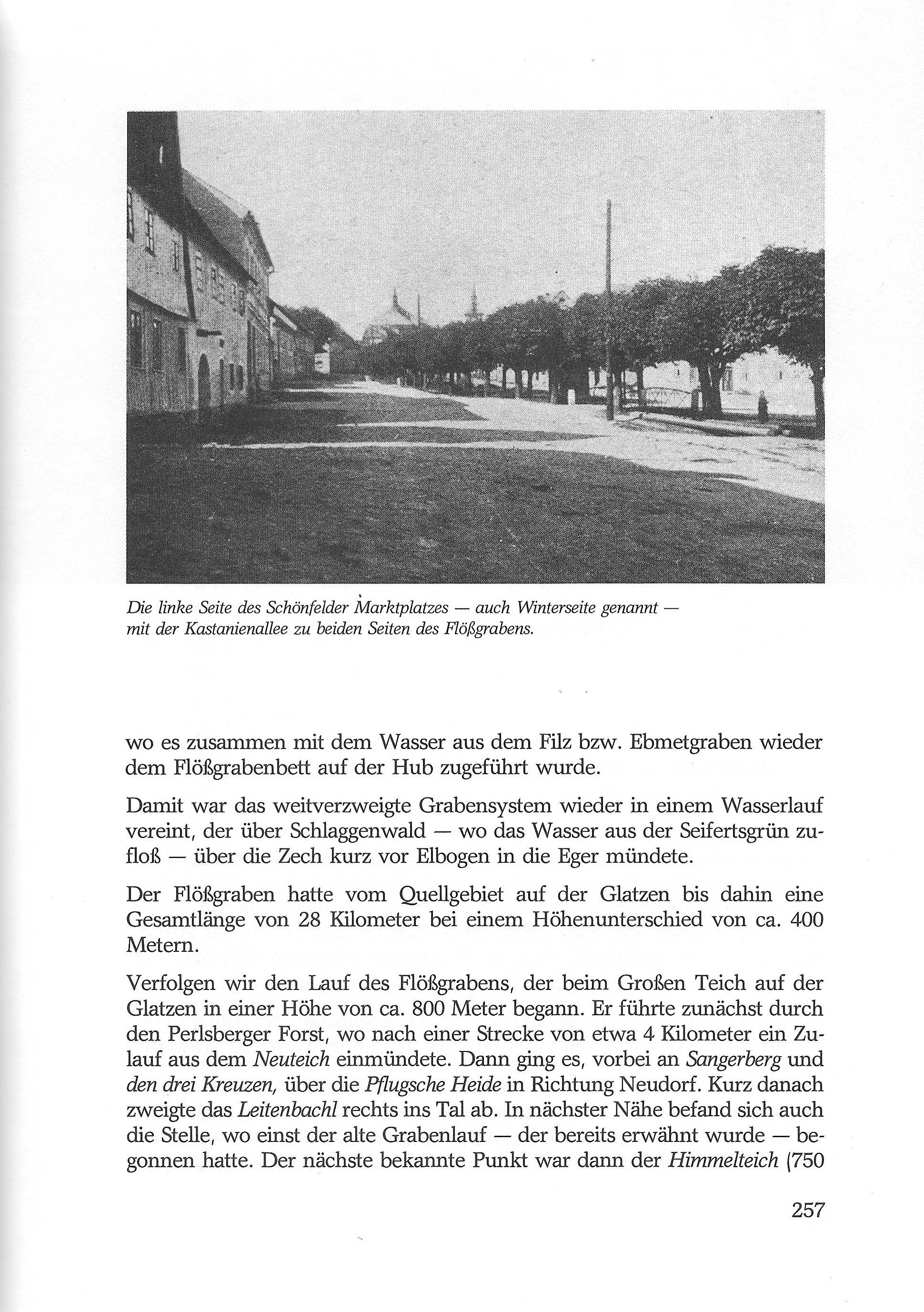 257
The left side of Sch̦nfeld's market square Рalso called the winter
side – with the chestnut avenue on both sides of the Flößgraben
where it was fed back into the Flößgraben bed on the Hub, together
with the water from the Filz and Ebmetgraben.
Thus, the extensive ditch system was reunited into a single
watercourse, which flowed via Schlaggenwald – where the water from
the Seifertsgrün flowed in – via the Zech River, shortly before
Elbogen, into the Eger.
From its source on the Glatzen, the Flößgraben had a total length
of 28 kilometers, with an elevation difference of approximately 400
meters.
Let's follow the course of the Flößgraben, which began at the
Großer Teich on the Glatzen at an elevation of approximately 800
meters. It first led through the Perlsberger Forest, where, after a
distance of approximately 4 kilometers, a tributary from the Neuteich
pond flowed into it. Then we continued past Sangerberg and the Three
Crosses, across the Pflugsche Heide toward Neudorf. Shortly afterward,
the Leitenbachl stream branched off to the right into the
valley. Nearby was the spot where the old ditch—mentioned
above—had once begun. The next known point was the Himmelteich (750
257
257
The left side of Sch̦nfeld's market square Рalso called the winter
side – with the chestnut avenue on both sides of the Flößgraben
where it was fed back into the Flößgraben bed on the Hub, together
with the water from the Filz and Ebmetgraben.
Thus, the extensive ditch system was reunited into a single
watercourse, which flowed via Schlaggenwald – where the water from
the Seifertsgrün flowed in – via the Zech River, shortly before
Elbogen, into the Eger.
From its source on the Glatzen, the Flößgraben had a total length
of 28 kilometers, with an elevation difference of approximately 400
meters.
Let's follow the course of the Flößgraben, which began at the
Großer Teich on the Glatzen at an elevation of approximately 800
meters. It first led through the Perlsberger Forest, where, after a
distance of approximately 4 kilometers, a tributary from the Neuteich
pond flowed into it. Then we continued past Sangerberg and the Three
Crosses, across the Pflugsche Heide toward Neudorf. Shortly afterward,
the Leitenbachl stream branched off to the right into the
valley. Nearby was the spot where the old ditch—mentioned
above—had once begun. The next known point was the Himmelteich (750
257
Page 0257
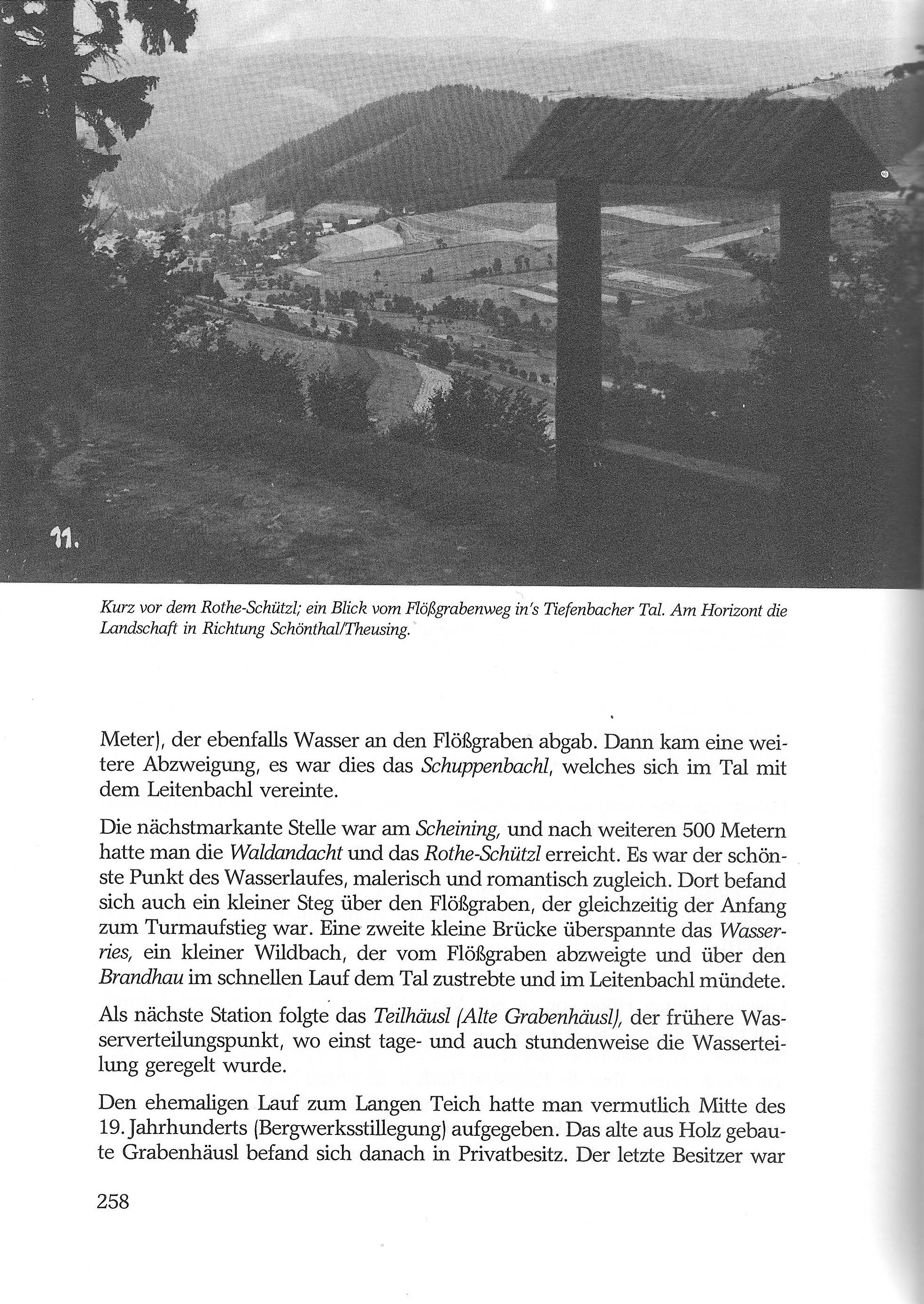 258
Shortly before the Rothe-Schützl stream; a view from the
Flößgrabenweg into the Tiefenbach valley. On the horizon, the
landscape towards Schönthal/Theusing.
meters), which also fed water into the Flößgraben. Then came
another junction: the Schuppenbachl stream, which joined the
Leitenbachl stream in the valley.
The next striking point was at Scheining, and after another 500
meters, one reached the Waldandacht stream and the Rothe-Schützl
stream. It was the most beautiful point of the watercourse, both
picturesque and romantic. There was also a small footbridge over the
Flößgraben, which also marked the beginning of the climb to the
tower. A second small bridge spanned the Wasserries stream, a small
torrent that branched off from the Flößgraben and flowed rapidly
into the valley via the Brandhau stream, flowing into the Leitenbachl
stream. The next stop was the Teilhäusl (Old Grabenhäusl), the
former water distribution point, where water distribution was once
regulated on a daily and hourly basis.
The former course to the Long Pond was probably abandoned in the
mid-19th century (due to the closure of the mine). The old wooden
Grabenhäusl was then privately owned. The last owner was
258
258
Shortly before the Rothe-Schützl stream; a view from the
Flößgrabenweg into the Tiefenbach valley. On the horizon, the
landscape towards Schönthal/Theusing.
meters), which also fed water into the Flößgraben. Then came
another junction: the Schuppenbachl stream, which joined the
Leitenbachl stream in the valley.
The next striking point was at Scheining, and after another 500
meters, one reached the Waldandacht stream and the Rothe-Schützl
stream. It was the most beautiful point of the watercourse, both
picturesque and romantic. There was also a small footbridge over the
Flößgraben, which also marked the beginning of the climb to the
tower. A second small bridge spanned the Wasserries stream, a small
torrent that branched off from the Flößgraben and flowed rapidly
into the valley via the Brandhau stream, flowing into the Leitenbachl
stream. The next stop was the Teilhäusl (Old Grabenhäusl), the
former water distribution point, where water distribution was once
regulated on a daily and hourly basis.
The former course to the Long Pond was probably abandoned in the
mid-19th century (due to the closure of the mine). The old wooden
Grabenhäusl was then privately owned. The last owner was
258
Page 0258
 259
Fleißner Karl, who ran a beer tavern there. In 1892, a fire
destroyed this building. It was never rebuilt.
From the Teilhäusl, the main artery of the Flößgraben then
continued to the elevated part of Schönfeld, called Damml, where there
used to be a small bathing area. Along the route there, the second
half of which ran parallel to the village at a distance of about
200-300 meters, the ditch, in addition to its unusual
3.5-kilometer-long course along the mountain slope, had a second
peculiarity. This section lay at an acute angle to the continuing
ditch that ran through the village, and the distance from stream bed
to stream bed was only about 200 meters. What was special about it,
however, was the difference in altitude between the two, as it was far
greater than the height of the church tower that lay between them.
The further course of the rafting ditch, whose water power was
harnessed by numerous businesses – in 1766, no fewer than 27 mills
and stamp mills are mentioned – has already been briefly described
in this chapter.
The rafting ditch not only brought benefits, but also often caused
problems in the winter. The stream frequently froze over, resulting in
flooding; for example, in 1907, costs of 1,500 crowns are known to
have been incurred by the water cooperative to repair the damage. To
avert further damage, a rafting ditch regulation was carried out
between 1910 and 1912 (the first one had already been carried out in
1856). The project was subsidized by the state. This financial support
was primarily due to the activities of the then mayor Norbert Rau and
city councilor Josef Ruß (Walker Beb) and their relationships with
relevant government agencies in Vienna.
The application was preemptively focused on job creation, particularly
for the unemployed in Schönfeld, Lauterbach, Neudorf, and Sangerberg.
The responsible ministry in Vienna awarded the construction contract
to the Kapsa company in Pilsen. Several hundred workers from the
aforementioned towns – some of whom were even men aged 70-75 –
were employed during the three-year construction period.
The rafting ditch was also constantly supervised and monitored. It is
known that with the introduction of the ditch tax in 1555, a person
was also appointed to oversee the ditch. This person was the ditch
foreman, called the Groomsteichå. He held the rank of a (mine)
foreman, i.e., a mine supervisor.
259
259
Fleißner Karl, who ran a beer tavern there. In 1892, a fire
destroyed this building. It was never rebuilt.
From the Teilhäusl, the main artery of the Flößgraben then
continued to the elevated part of Schönfeld, called Damml, where there
used to be a small bathing area. Along the route there, the second
half of which ran parallel to the village at a distance of about
200-300 meters, the ditch, in addition to its unusual
3.5-kilometer-long course along the mountain slope, had a second
peculiarity. This section lay at an acute angle to the continuing
ditch that ran through the village, and the distance from stream bed
to stream bed was only about 200 meters. What was special about it,
however, was the difference in altitude between the two, as it was far
greater than the height of the church tower that lay between them.
The further course of the rafting ditch, whose water power was
harnessed by numerous businesses – in 1766, no fewer than 27 mills
and stamp mills are mentioned – has already been briefly described
in this chapter.
The rafting ditch not only brought benefits, but also often caused
problems in the winter. The stream frequently froze over, resulting in
flooding; for example, in 1907, costs of 1,500 crowns are known to
have been incurred by the water cooperative to repair the damage. To
avert further damage, a rafting ditch regulation was carried out
between 1910 and 1912 (the first one had already been carried out in
1856). The project was subsidized by the state. This financial support
was primarily due to the activities of the then mayor Norbert Rau and
city councilor Josef Ruß (Walker Beb) and their relationships with
relevant government agencies in Vienna.
The application was preemptively focused on job creation, particularly
for the unemployed in Schönfeld, Lauterbach, Neudorf, and Sangerberg.
The responsible ministry in Vienna awarded the construction contract
to the Kapsa company in Pilsen. Several hundred workers from the
aforementioned towns – some of whom were even men aged 70-75 –
were employed during the three-year construction period.
The rafting ditch was also constantly supervised and monitored. It is
known that with the introduction of the ditch tax in 1555, a person
was also appointed to oversee the ditch. This person was the ditch
foreman, called the Groomsteichå. He held the rank of a (mine)
foreman, i.e., a mine supervisor.
259
Page 0259
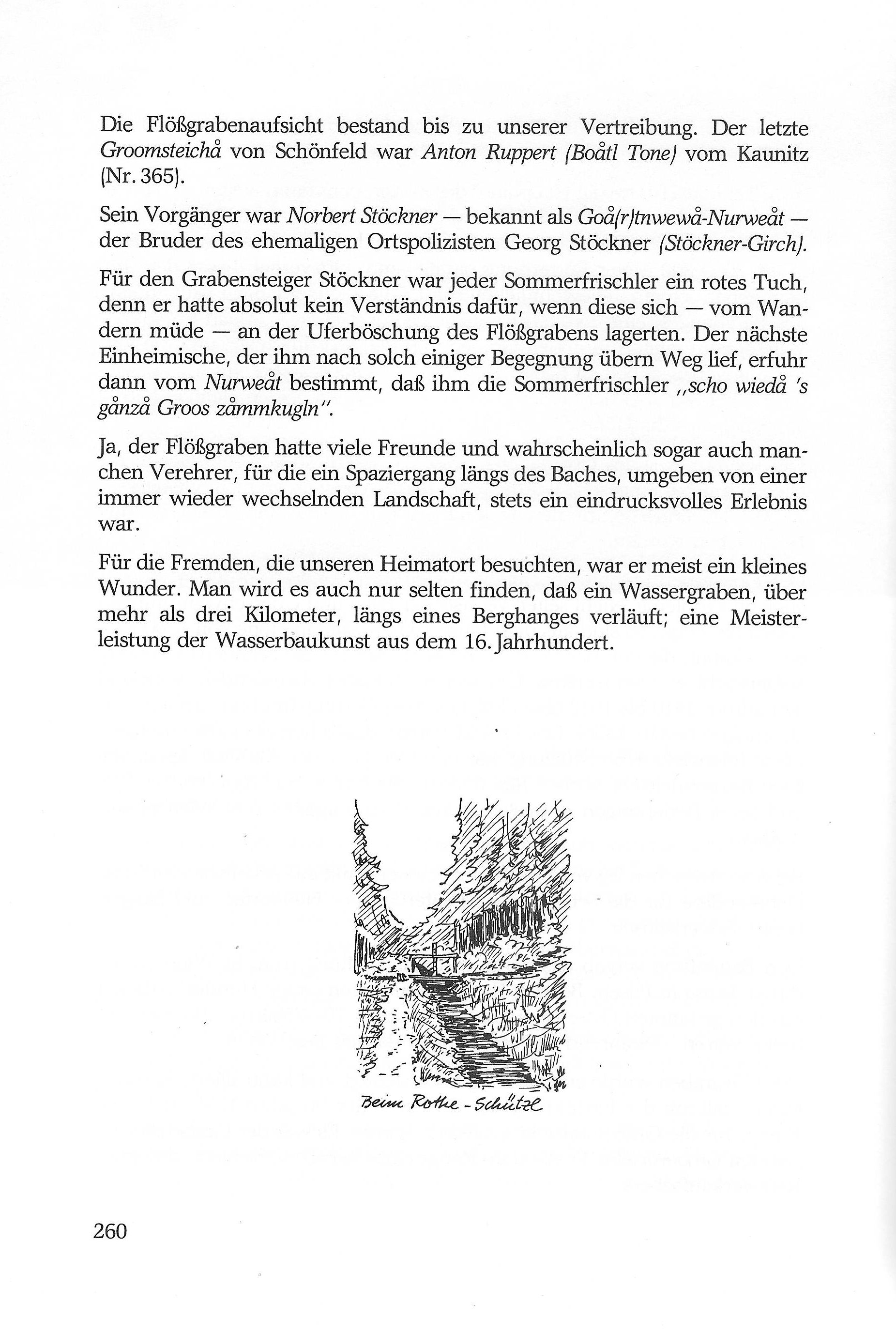 260
The Flößgraben supervision continued until our expulsion. The last
groomsteichå of Schönfeld was Anton Ruppert (Boåtl Tone) from
Kaunitz (No. 365).
His predecessor was Norbert Sțckner Рknown as
Goå/r/tnwewå-Nurweåt, the brother of the former local
policeman Georg Stöckner (Stöckner-Girch). For the ditch inspector
Stöckner, every summer visitor was a red rag, because he had
absolutely no understanding of them camping on the banks of the
Flößgraben, tired from hiking. The next local who crossed his path
after such a few encounters would certainly have heard from Nurweåt
that the summer visitors were "all over the place again."
Yes, the Flößgraben had many friends and probably even a few
admirers, for whom a walk along the stream, surrounded by an
ever-changing landscape, was always an impressive experience. For the
strangers who visited our hometown, it was usually a small miracle. It
is also rare to find a moat running more than three kilometers along a
mountain slope; a masterpiece of hydraulic engineering from the 16th
century.
At the Rothe-Schütze
260
260
The Flößgraben supervision continued until our expulsion. The last
groomsteichå of Schönfeld was Anton Ruppert (Boåtl Tone) from
Kaunitz (No. 365).
His predecessor was Norbert Sțckner Рknown as
Goå/r/tnwewå-Nurweåt, the brother of the former local
policeman Georg Stöckner (Stöckner-Girch). For the ditch inspector
Stöckner, every summer visitor was a red rag, because he had
absolutely no understanding of them camping on the banks of the
Flößgraben, tired from hiking. The next local who crossed his path
after such a few encounters would certainly have heard from Nurweåt
that the summer visitors were "all over the place again."
Yes, the Flößgraben had many friends and probably even a few
admirers, for whom a walk along the stream, surrounded by an
ever-changing landscape, was always an impressive experience. For the
strangers who visited our hometown, it was usually a small miracle. It
is also rare to find a moat running more than three kilometers along a
mountain slope; a masterpiece of hydraulic engineering from the 16th
century.
At the Rothe-Schütze
260
Page 0260
 261
The Flöß- and Ebmetgraben Water Cooperative
(With excerpts from the local history book, "Das Tepler Land,"
pp. 615-617, by Emil Riedl, Neudorf.)
In 1873, Josef Ruß Sr. sold all water rights and facilities
associated with the Flößgraben to the water cooperative founded in
the same year. Ruß received 6,000 florins as the purchase price and
membership in the cooperative, which was headquartered in
Schlaggenwald.
This was a legal, i.e., real cooperative, i.e., an association of
persons whose interest lay in the generation and maintenance of
hydropower from a common facility. The 28 members of this cooperative
were Schlaggenwald and Schönfeld manufacturers and tradesmen who
operated their machines or facilities entirely or partially with
hydropower. Two waterways supplied the necessary water volumes. These
were the Flößgraben and the Ebmettengraben.
The former was fed by the Great or Black Pond on the Glatzen and by
the Weiden Pond, also called the Neuteich, both belonging to the
Marienbad district. In the Schönfeld cadastre, it also had an inflow
from the Himmelteich.
The Ebmetgraben, also an artificially created stream, with a length of
approximately 10 kilometers, also included ponds that could keep the
water level constant in dry periods. These were the Old and New Ponds
in Muckengrund, as well as the Ebmetteich and the Sackdamm.
The water management of these two streams used to serve primarily the
mining industry, but in the last years before our expulsion, it served
almost exclusively the industry in the Zechtal. The cooperative
members' contributions were based on the used water head. The total
water head was approximately 350 meters, and the usable head was
approximately 165 meters.
The facility owners had to pay their contributions quarterly to the
cooperative and annually to the state – even if the facility was
not in use.
261
261
The Flöß- and Ebmetgraben Water Cooperative
(With excerpts from the local history book, "Das Tepler Land,"
pp. 615-617, by Emil Riedl, Neudorf.)
In 1873, Josef Ruß Sr. sold all water rights and facilities
associated with the Flößgraben to the water cooperative founded in
the same year. Ruß received 6,000 florins as the purchase price and
membership in the cooperative, which was headquartered in
Schlaggenwald.
This was a legal, i.e., real cooperative, i.e., an association of
persons whose interest lay in the generation and maintenance of
hydropower from a common facility. The 28 members of this cooperative
were Schlaggenwald and Schönfeld manufacturers and tradesmen who
operated their machines or facilities entirely or partially with
hydropower. Two waterways supplied the necessary water volumes. These
were the Flößgraben and the Ebmettengraben.
The former was fed by the Great or Black Pond on the Glatzen and by
the Weiden Pond, also called the Neuteich, both belonging to the
Marienbad district. In the Schönfeld cadastre, it also had an inflow
from the Himmelteich.
The Ebmetgraben, also an artificially created stream, with a length of
approximately 10 kilometers, also included ponds that could keep the
water level constant in dry periods. These were the Old and New Ponds
in Muckengrund, as well as the Ebmetteich and the Sackdamm.
The water management of these two streams used to serve primarily the
mining industry, but in the last years before our expulsion, it served
almost exclusively the industry in the Zechtal. The cooperative
members' contributions were based on the used water head. The total
water head was approximately 350 meters, and the usable head was
approximately 165 meters.
The facility owners had to pay their contributions quarterly to the
cooperative and annually to the state – even if the facility was
not in use.
261
Page 0261
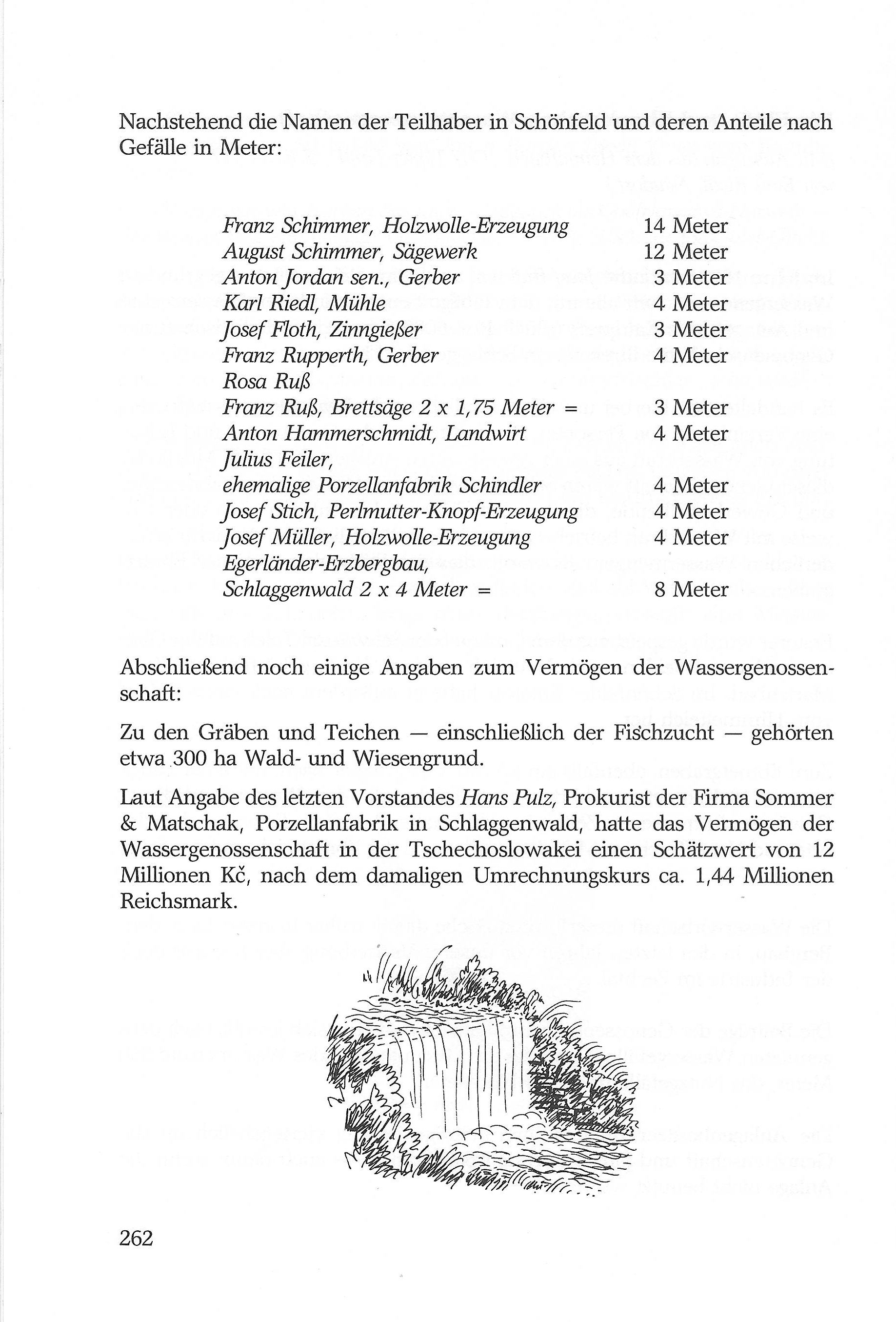 262
Below are the names of the partners in Schönfeld and their shares
according to slope in meters:
Franz Schimmer, wood wool production 14 meters
August Schimmer, sawmill 12 meters
Anton Jordan Sr., tanner 3 meters
Karl Riedl, mill 4 meters
Josef Floth, tinsmith 3 meters
Franz Rupperth, tanner 4 meters
Rosa Ruß
Franz Ruß, board saw 2 x 1.75 meters = 3 meters
Anton Hammerschmidt, farmer 4 meters
Julius Feiler,
former Schindler porcelain factory 4 meters
Josef Stich, mother-of-pearl button production 4 meters
Josef Müller, wood wool production Egerländer ore mining, 4 meters
Schlaggenwald 2 x 4 meters = 8 meters
Finally, some information about the assets of the water cooperative:
Regarding the ditches and Ponds – including fish farming,
approximately 300 hectares of forest and meadow land.
According to the last board member, Hans Pulz, authorized signatory of
the Sommer & Matschak porcelain factory in Schlaggenwald, the assets
of the water cooperative in Czechoslovakia had an estimated value of
12 million CZK, approximately 1.44 million Reichsmarks at the exchange
rate at the time.
262
262
Below are the names of the partners in Schönfeld and their shares
according to slope in meters:
Franz Schimmer, wood wool production 14 meters
August Schimmer, sawmill 12 meters
Anton Jordan Sr., tanner 3 meters
Karl Riedl, mill 4 meters
Josef Floth, tinsmith 3 meters
Franz Rupperth, tanner 4 meters
Rosa Ruß
Franz Ruß, board saw 2 x 1.75 meters = 3 meters
Anton Hammerschmidt, farmer 4 meters
Julius Feiler,
former Schindler porcelain factory 4 meters
Josef Stich, mother-of-pearl button production 4 meters
Josef Müller, wood wool production Egerländer ore mining, 4 meters
Schlaggenwald 2 x 4 meters = 8 meters
Finally, some information about the assets of the water cooperative:
Regarding the ditches and Ponds – including fish farming,
approximately 300 hectares of forest and meadow land.
According to the last board member, Hans Pulz, authorized signatory of
the Sommer & Matschak porcelain factory in Schlaggenwald, the assets
of the water cooperative in Czechoslovakia had an estimated value of
12 million CZK, approximately 1.44 million Reichsmarks at the exchange
rate at the time.
262
Page 0262
 263
Clubs
Introduction
This chapter lists all of Schönfeld's clubs, as far as they are
known. In addition, some cooperative organizations, as well as clubs
and interest groups, are also affiliated. With a few exceptions, all
clubs and cooperatives were dissolved in the spring of 1939, and their
assets were confiscated by the so-called "Standstill Commission." The
following organizations were exceptions:
-
-
-
German Gymnastics Club Changed to Reich Association for Physical Education
Singing Club Changed to Schönfeld Folk Choir
Association of Veteran Soldiers Changed to Reich Veterans Association
Volunteer Fire Department Without name change
Church Preservation Association Without name change
Introductory remarks, I would like to express my gratitude to all
those idealists—from club leaders and chairmen to ordinary active
club members—for their valuable contributions, often through their
selfless commitment to cultural or charitable causes, to the
reputation of the town and to the well-being and enjoyment of its
people, in good times and bad.
Volunteer Fire Department
The founding day of this club, which had 206 members, was August 9,
1869. Since it also consisted, among other things, of a Gymnastics
club, it was then still called the "Gymnastics Fire Brigade
Association." In 1886, the gymnasts separated and founded their own
club.
263
263
Clubs
Introduction
This chapter lists all of Schönfeld's clubs, as far as they are
known. In addition, some cooperative organizations, as well as clubs
and interest groups, are also affiliated. With a few exceptions, all
clubs and cooperatives were dissolved in the spring of 1939, and their
assets were confiscated by the so-called "Standstill Commission." The
following organizations were exceptions:
-
-
-
German Gymnastics Club Changed to Reich Association for Physical Education
Singing Club Changed to Schönfeld Folk Choir
Association of Veteran Soldiers Changed to Reich Veterans Association
Volunteer Fire Department Without name change
Church Preservation Association Without name change
Introductory remarks, I would like to express my gratitude to all
those idealists—from club leaders and chairmen to ordinary active
club members—for their valuable contributions, often through their
selfless commitment to cultural or charitable causes, to the
reputation of the town and to the well-being and enjoyment of its
people, in good times and bad.
Volunteer Fire Department
The founding day of this club, which had 206 members, was August 9,
1869. Since it also consisted, among other things, of a Gymnastics
club, it was then still called the "Gymnastics Fire Brigade
Association." In 1886, the gymnasts separated and founded their own
club.
263
Page 0263
 264
The fire department also had its own band until 1880, whose members
then founded the Schönfeld Music Corporation.
The first chairman and commander was Gustav Schmieger (porcelain
painter). He held this position for almost 30 years.
He was followed by: Ferdinand Heidelberger, Karl Opl (tinsmith),
Joh. Kugler (Gabl), Joh. Lorenz, Josef Lochschmidt (butcher and
innkeeper), Hermann Lochner (innkeeper), Roman Kempf (butcher), Josef
Müller (tailor), Adolf Schimmer (sawmill owner), Hans Müller
(haulage contractor), and, as the last commander until our expulsion,
Franz Lochschmidt, a carpenter from Hofgasse, who, it can be said
without exaggeration, dedicated himself "body and soul" to the fire
department.
The fire department association, especially in the first years after
its founding, was occasionally supported financially by the Theater
Amateurs Association to purchase the necessary equipment. In this
context, the members often dipped into their own pockets to avoid
burdening the already rather limited municipal coffers. In 1866, a new
two-hose fire engine was purchased; it came from the Cermak company in
Teplitz. In 1890, the club purchased the "Liesl" (Liesl), a
one-man-pushed cart fire engine. In 1893, the new club flag was
consecrated. The old flag, still belonging to the riflemen, was
presented to the church. Around 1900, the club received a crew car as
a gift from the wholesale merchant Hans Ruß (Schan).
In 1919, the volunteer fire department celebrated its 50th
anniversary. Diplomas were presented to five members still in the club
on this occasion.
Despite the club's empty coffers, a general meeting in 1924, under the
then chairman Lochner Hermann, unanimously approved the purchase of a
motorized fire engine. Following a request supported by the state
inspector, the club received a subsidy of 6,000 CZK. Letters of
request to Schönfeld residents living outside the district raised the
same amount. The same amount was raised by local collections. This
made 18,000 CZK available. In August 1924, the Schönfelders acquired a
motorized fire engine from the Karlovy Vary Fire Department for 30,000
CZK. At the same time, with the consent of Hans Ruß, the crew
vehicle he had donated was exchanged for a 16-meter-high mechanical
extension ladder. In the same year, the Schönfelder Erzberg mining
company was in liquidation, and among other things, a fire engine was
up for sale.
264
264
The fire department also had its own band until 1880, whose members
then founded the Schönfeld Music Corporation.
The first chairman and commander was Gustav Schmieger (porcelain
painter). He held this position for almost 30 years.
He was followed by: Ferdinand Heidelberger, Karl Opl (tinsmith),
Joh. Kugler (Gabl), Joh. Lorenz, Josef Lochschmidt (butcher and
innkeeper), Hermann Lochner (innkeeper), Roman Kempf (butcher), Josef
Müller (tailor), Adolf Schimmer (sawmill owner), Hans Müller
(haulage contractor), and, as the last commander until our expulsion,
Franz Lochschmidt, a carpenter from Hofgasse, who, it can be said
without exaggeration, dedicated himself "body and soul" to the fire
department.
The fire department association, especially in the first years after
its founding, was occasionally supported financially by the Theater
Amateurs Association to purchase the necessary equipment. In this
context, the members often dipped into their own pockets to avoid
burdening the already rather limited municipal coffers. In 1866, a new
two-hose fire engine was purchased; it came from the Cermak company in
Teplitz. In 1890, the club purchased the "Liesl" (Liesl), a
one-man-pushed cart fire engine. In 1893, the new club flag was
consecrated. The old flag, still belonging to the riflemen, was
presented to the church. Around 1900, the club received a crew car as
a gift from the wholesale merchant Hans Ruß (Schan).
In 1919, the volunteer fire department celebrated its 50th
anniversary. Diplomas were presented to five members still in the club
on this occasion.
Despite the club's empty coffers, a general meeting in 1924, under the
then chairman Lochner Hermann, unanimously approved the purchase of a
motorized fire engine. Following a request supported by the state
inspector, the club received a subsidy of 6,000 CZK. Letters of
request to Schönfeld residents living outside the district raised the
same amount. The same amount was raised by local collections. This
made 18,000 CZK available. In August 1924, the Schönfelders acquired a
motorized fire engine from the Karlovy Vary Fire Department for 30,000
CZK. At the same time, with the consent of Hans Ruß, the crew
vehicle he had donated was exchanged for a 16-meter-high mechanical
extension ladder. In the same year, the Schönfelder Erzberg mining
company was in liquidation, and among other things, a fire engine was
up for sale.
264
Page 0264
 265
Since the purchase of this fire engine could not be postponed due to
other interested parties, Lochner quickly decided to purchase the
device "on his own" by phone for 3,700 CZK. To his great joy, Lochner
only learned later that this item also included 400 meters of hose,
two hose carts, a distributor, and several ladders.
The subsequently convened association committee approved his
unilateral action and commended him for this well-executed
transaction.
This fire engine was resold shortly thereafter, along with 200 meters
of hose and a hose cart, to a fire department near Teplá for 7,700
CZK. This, along with some equipment, enabled the association to
record a profit of 4,000 CZK.
The following year, 1925, a fire department festival was held at
Whitsun, which generated a net profit of 9,000 CZK; this made it
possible to pay off the remaining debt.
In the mid-1930s, under chairman Adolf Schimmer also purchased a
second modern motorized pump.
The Schönfeld Fire Department was deployed in numerous firefighting
operations in and outside of Schönfeld, including the great fire in
Falkenau in 1870 (?).
Our town was also the headquarters of the Elbogen District Fire
Brigade Association No. 40, to which the fire departments of
Schlaggenwald, Rabensgrün, Lessnitz, Gfell, and Poschetzau, in
addition to Schönfeld, belonged.
The founder of this association was Gustav Schmieger, who also served
as the district association chairman for many years.
His successors were: Hubert Knaut (senior teacher), Josef Lochschmidt,
Roman Kempf, Josef Floth Sr. (pewter caster), and Karl Rau (porcelain
painter).
Theater Amateurs' Association
When master pewter caster Franz Anton Lochner (No. 317) founded the
Schönfeld Theater Amateurs' Association in 1834 When he founded the
school, he certainly had no idea that this would lay the foundation
for a cultural institution that would steadily gain in prestige and
importance in the years to come.
265
265
Since the purchase of this fire engine could not be postponed due to
other interested parties, Lochner quickly decided to purchase the
device "on his own" by phone for 3,700 CZK. To his great joy, Lochner
only learned later that this item also included 400 meters of hose,
two hose carts, a distributor, and several ladders.
The subsequently convened association committee approved his
unilateral action and commended him for this well-executed
transaction.
This fire engine was resold shortly thereafter, along with 200 meters
of hose and a hose cart, to a fire department near Teplá for 7,700
CZK. This, along with some equipment, enabled the association to
record a profit of 4,000 CZK.
The following year, 1925, a fire department festival was held at
Whitsun, which generated a net profit of 9,000 CZK; this made it
possible to pay off the remaining debt.
In the mid-1930s, under chairman Adolf Schimmer also purchased a
second modern motorized pump.
The Schönfeld Fire Department was deployed in numerous firefighting
operations in and outside of Schönfeld, including the great fire in
Falkenau in 1870 (?).
Our town was also the headquarters of the Elbogen District Fire
Brigade Association No. 40, to which the fire departments of
Schlaggenwald, Rabensgrün, Lessnitz, Gfell, and Poschetzau, in
addition to Schönfeld, belonged.
The founder of this association was Gustav Schmieger, who also served
as the district association chairman for many years.
His successors were: Hubert Knaut (senior teacher), Josef Lochschmidt,
Roman Kempf, Josef Floth Sr. (pewter caster), and Karl Rau (porcelain
painter).
Theater Amateurs' Association
When master pewter caster Franz Anton Lochner (No. 317) founded the
Schönfeld Theater Amateurs' Association in 1834 When he founded the
school, he certainly had no idea that this would lay the foundation
for a cultural institution that would steadily gain in prestige and
importance in the years to come.
265
Page 0265
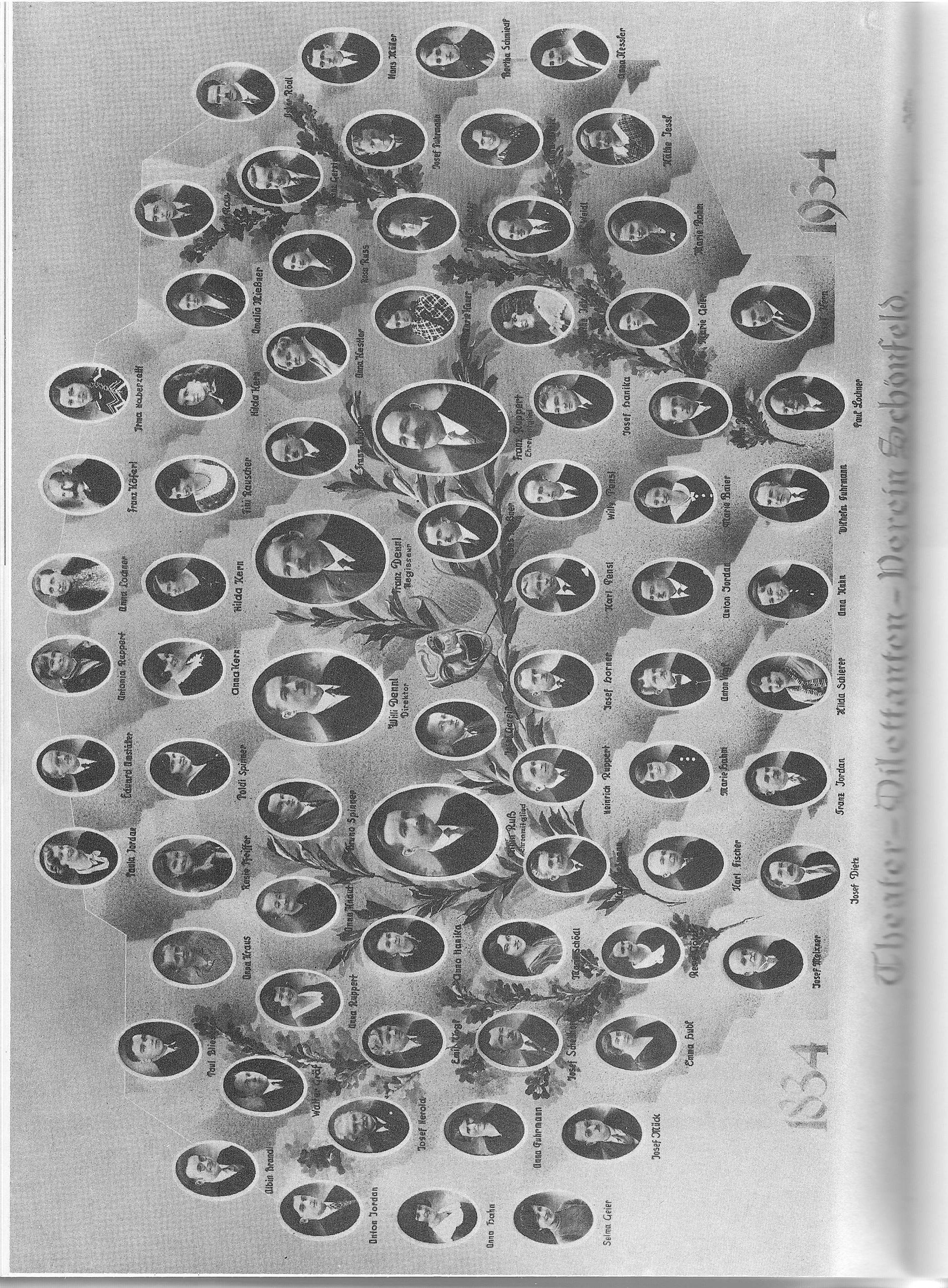 266
Albin Brand
Onion Jordan
Onno Bahn
Selma Geier
Toul Blies
Walter Graf
Antonia Ruppert
Aula Jordan
Eduard Bnstüfer
Illya Cocaner
Franz Köfer!
ma Naberzall
Anna Kern
Hilda Kern
Unna Traus
Rosie Feiffer
Toldi Spinner
in Rauscher
Amalia LieBaer
Die Rödl
Anna Ruppert
Bruno Spinner
Cena Wester
Willi Dennl Director
ranz Dennl Director
Josef Nerola
Emilogl
Anna Hanika
Unga Guhrmann
Josef Mick
RUB Academic Member
Ser
Franz Ruppert Chrer
Josef Schelhor
on School
Heinrich Ruppert
Josef Borner
Karl Tens!
Willy Const
Josef Banika
Emma Bubl
1834
Josef Meixner
Marie Ham
Anton
Anton Jorda
quarie Bajer
Karl Fischer
000
Mans 2 süller
Käthe Jess?
Franz Jordan
Kilda Schierer
Ama Kahn
Wilhelm Suhrmann
Josef Dietz
Paul Lochner
Theater-Amateur-Derein Schönfeld.
1954
Martha Schmiedl
Anna Jessler
266
Albin Brand
Onion Jordan
Onno Bahn
Selma Geier
Toul Blies
Walter Graf
Antonia Ruppert
Aula Jordan
Eduard Bnstüfer
Illya Cocaner
Franz Köfer!
ma Naberzall
Anna Kern
Hilda Kern
Unna Traus
Rosie Feiffer
Toldi Spinner
in Rauscher
Amalia LieBaer
Die Rödl
Anna Ruppert
Bruno Spinner
Cena Wester
Willi Dennl Director
ranz Dennl Director
Josef Nerola
Emilogl
Anna Hanika
Unga Guhrmann
Josef Mick
RUB Academic Member
Ser
Franz Ruppert Chrer
Josef Schelhor
on School
Heinrich Ruppert
Josef Borner
Karl Tens!
Willy Const
Josef Banika
Emma Bubl
1834
Josef Meixner
Marie Ham
Anton
Anton Jorda
quarie Bajer
Karl Fischer
000
Mans 2 süller
Käthe Jess?
Franz Jordan
Kilda Schierer
Ama Kahn
Wilhelm Suhrmann
Josef Dietz
Paul Lochner
Theater-Amateur-Derein Schönfeld.
1954
Martha Schmiedl
Anna Jessler
Page 0266
 267
There are probably only a few small towns the size of Schönfeld where
a club of this type and stature can be found.
Thanks to Lochner's idealism and efficiency, the initial difficulties
that clubs of this category generally struggle with were soon
overcome. He found well-suited actors and also theater enthusiasts who
occasionally made financial contributions to the development.
Lochner served as director, technical director, and commercial
director. His performances were met with great acclaim and enthusiasm
among the Schönfeld residents. The club soon found itself on a solid
footing, not least due to his prudent leadership; it even became a
benefactor of the town. Old minutes recorded donations to fire
victims. In 1866, the club donated the 14 Stations of the Cross for
the church.
Another commendable achievement was the procurement of the first fire
engine for the fire department.
This positive development, however, was brought to an abrupt end by a
fire in house number 104 (Fuhrmann/Schöberl), which housed the club's
entire property.
Valuable wardrobe and many precious props, such as sabers, rifles, and
other utensils, as well as the club's entire library containing 280
plays, were destroyed by the flames.
Through its own initiative and numerous donations from the public, the
association was able to slowly recover, but for a long time it didn't
achieve a significant financial balance.
A brief look at the theater program at that time is interesting. It
primarily features knightly plays such as "The Stone Burggraf von
Elbogen," "The Robbers at Maria Kulm," "The Graveyard at Königswerth,"
and Schiller's "The Robbers."
After Anton Lochner, who led the association for many years, handed
over his position to his two sons Franz and Wilhelm, the character of
the performances also changed, with plays including "Intrigue and
Love," "The Miller and His Child," and light folk plays. Later, when
the spinning mill owner Josef Ruß (Walker Beb) served as the newly
elected director, the association successfully entered the operetta
scene. Worth mentioning here is "The Spendthrift," in which Wilhelm
Lochner and Josef Ruß played the leading roles. "Lumpazi
Vagabundus," "The Pastor of Kirchfeld," and several Upper Bavarian
plays were also performed.
267
267
There are probably only a few small towns the size of Schönfeld where
a club of this type and stature can be found.
Thanks to Lochner's idealism and efficiency, the initial difficulties
that clubs of this category generally struggle with were soon
overcome. He found well-suited actors and also theater enthusiasts who
occasionally made financial contributions to the development.
Lochner served as director, technical director, and commercial
director. His performances were met with great acclaim and enthusiasm
among the Schönfeld residents. The club soon found itself on a solid
footing, not least due to his prudent leadership; it even became a
benefactor of the town. Old minutes recorded donations to fire
victims. In 1866, the club donated the 14 Stations of the Cross for
the church.
Another commendable achievement was the procurement of the first fire
engine for the fire department.
This positive development, however, was brought to an abrupt end by a
fire in house number 104 (Fuhrmann/Schöberl), which housed the club's
entire property.
Valuable wardrobe and many precious props, such as sabers, rifles, and
other utensils, as well as the club's entire library containing 280
plays, were destroyed by the flames.
Through its own initiative and numerous donations from the public, the
association was able to slowly recover, but for a long time it didn't
achieve a significant financial balance.
A brief look at the theater program at that time is interesting. It
primarily features knightly plays such as "The Stone Burggraf von
Elbogen," "The Robbers at Maria Kulm," "The Graveyard at Königswerth,"
and Schiller's "The Robbers."
After Anton Lochner, who led the association for many years, handed
over his position to his two sons Franz and Wilhelm, the character of
the performances also changed, with plays including "Intrigue and
Love," "The Miller and His Child," and light folk plays. Later, when
the spinning mill owner Josef Ruß (Walker Beb) served as the newly
elected director, the association successfully entered the operetta
scene. Worth mentioning here is "The Spendthrift," in which Wilhelm
Lochner and Josef Ruß played the leading roles. "Lumpazi
Vagabundus," "The Pastor of Kirchfeld," and several Upper Bavarian
plays were also performed.
267
Page 0267
 268
Numerous good new additions brought a breath of fresh air to the club,
especially shortly before the turn of the century.
Strong supporters at the club's leadership during those years were
Gustav Schmieger (owner of the porcelain painting studio), Wilhelm
Schmidt (postmaster), and Hans Ruß (wholesale merchant). Anton
Jordan was presumably appointed director after Ruß.
Around 1910, due to its earlier success, "The Spendthrift" was
performed again, with Bellmann Karl as the Spendthrift and Pensl Karl
as Valentin. "Lumpazi Vagabundus" also experienced several more
performances. The dissolute cloverleaf in this play was played by
Kempf Roman as Knieriem, Pensl Karl as Zwirn, and Hanika Beb as
Leim. The performances always received great acclaim. With the
outbreak of World War I, the club's activities dwindled. The fighting
on the front lines also claimed its victims from the ranks of this
club. The end of the war was followed by a nationally and politically
turbulent time in which a theater amateur association had no prospect
of success alongside the great "world theater." However, as the
following years showed, this was only the calm before the great storm,
for young, new talents of both sexes stepped into the breach and, so
to speak, proved equal to any task overnight, thus leading to an
increase in performance that must be described as admirable for a
small-town amateur association. This increase had good reasons: first,
most of the young talents already possessed a talent that could be
described as innate or hereditary, since most of them had already had
their parents, and some even their grandparents, successfully perform
on stage.
Second, the older, experienced men at the top gave the young talents
sufficient opportunity and encouragement to develop their talents, and
third, the musical director, Anton Gräf, spared no effort to
support the association. to give the operetta the polish it
needed. Through this fruitful collaboration, the society was able to
not only put operettas on the program in Schönfeld, but also to dare
to perform operettas in Karlsbad before a discerning audience, which
expressed high appreciation for the amateur society's dramatic and
musical achievements. Thus, the following operettas were performed at
that time, among others: "The Enchanted Castle" by Millöcker, "Where
the Lark Sings" by Lehar, "The Golden Master" by Eysler, and not to
forget the multiple performances of the opera-
268
268
Numerous good new additions brought a breath of fresh air to the club,
especially shortly before the turn of the century.
Strong supporters at the club's leadership during those years were
Gustav Schmieger (owner of the porcelain painting studio), Wilhelm
Schmidt (postmaster), and Hans Ruß (wholesale merchant). Anton
Jordan was presumably appointed director after Ruß.
Around 1910, due to its earlier success, "The Spendthrift" was
performed again, with Bellmann Karl as the Spendthrift and Pensl Karl
as Valentin. "Lumpazi Vagabundus" also experienced several more
performances. The dissolute cloverleaf in this play was played by
Kempf Roman as Knieriem, Pensl Karl as Zwirn, and Hanika Beb as
Leim. The performances always received great acclaim. With the
outbreak of World War I, the club's activities dwindled. The fighting
on the front lines also claimed its victims from the ranks of this
club. The end of the war was followed by a nationally and politically
turbulent time in which a theater amateur association had no prospect
of success alongside the great "world theater." However, as the
following years showed, this was only the calm before the great storm,
for young, new talents of both sexes stepped into the breach and, so
to speak, proved equal to any task overnight, thus leading to an
increase in performance that must be described as admirable for a
small-town amateur association. This increase had good reasons: first,
most of the young talents already possessed a talent that could be
described as innate or hereditary, since most of them had already had
their parents, and some even their grandparents, successfully perform
on stage.
Second, the older, experienced men at the top gave the young talents
sufficient opportunity and encouragement to develop their talents, and
third, the musical director, Anton Gräf, spared no effort to
support the association. to give the operetta the polish it
needed. Through this fruitful collaboration, the society was able to
not only put operettas on the program in Schönfeld, but also to dare
to perform operettas in Karlsbad before a discerning audience, which
expressed high appreciation for the amateur society's dramatic and
musical achievements. Thus, the following operettas were performed at
that time, among others: "The Enchanted Castle" by Millöcker, "Where
the Lark Sings" by Lehar, "The Golden Master" by Eysler, and not to
forget the multiple performances of the opera-
268
Page 0268
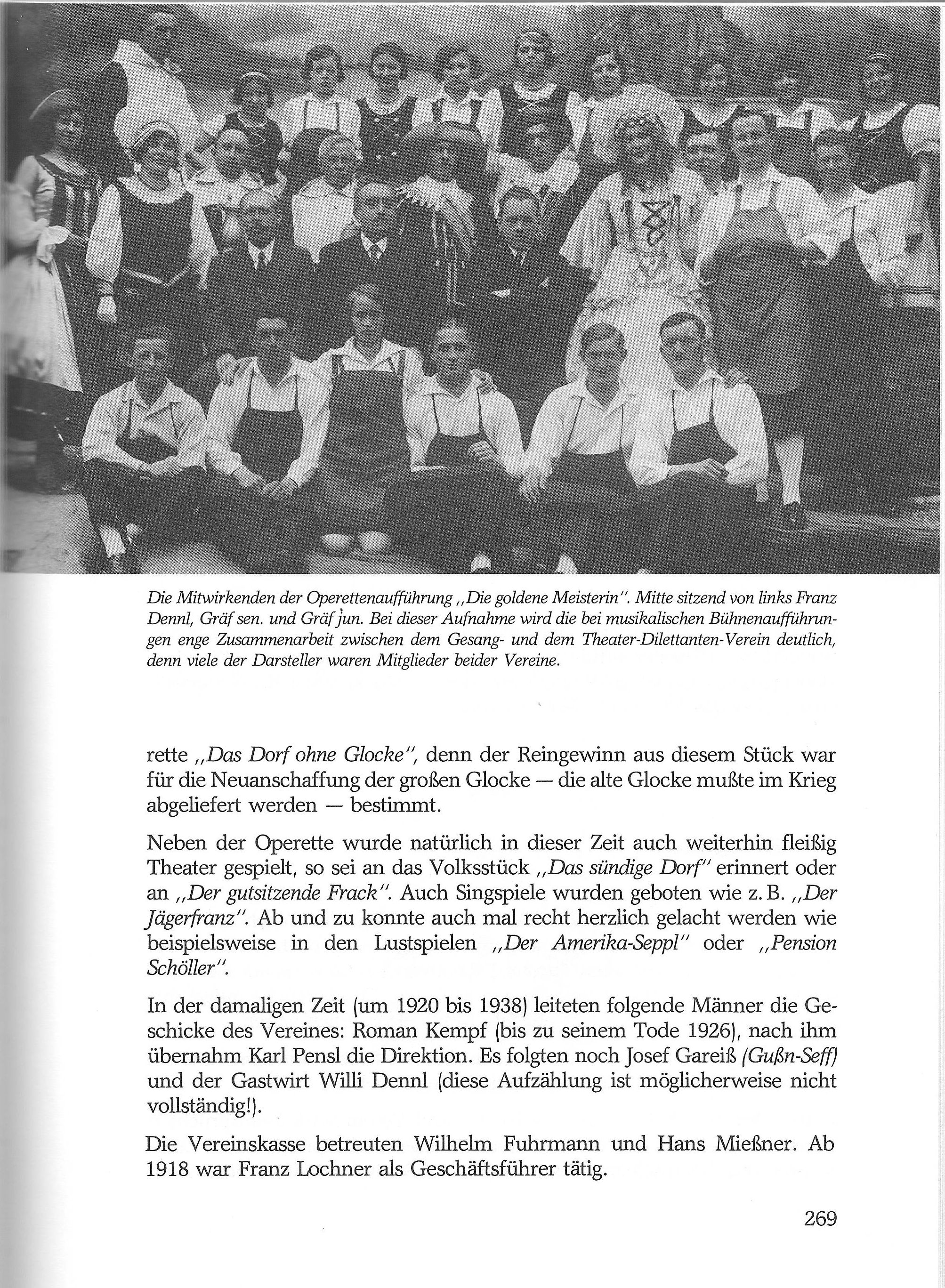 269
The participants in the operetta performance "The Golden Mistress."
Seated in the middle, from left, are Franz Dennl, Gräf Sr., and
Gräf Jr. This photo clearly demonstrates the close collaboration
between the Singing and Theater Amateurs' Associations in musical
stage performances, as many of the performers were members of both
associations.
Save "The Village Without a Bell," because the net profits from this
piece were intended for the purchase of a new large bell—the old
one had to be handed over during the war.
In addition to the operetta, theater continued to be performed
diligently during this period, for example, the folk play "The Sinful
Village" and "The Well-Fitting Tailcoat." Singspiels were also
offered, such as "The Village Without a Bell." B. "Der Jägerfranz."
Occasionally, there was even some hearty laughter, such as in the
comedies "Der Amerika-Seppl" or "Pension Schöller."
During that time (around 1920 to 1938), the following men led the
club's fortunes: Roman Kempf (until his death in 1926), followed by
Karl Pensl as director. Josef Gareiß (Gußn-Seff) and the
innkeeper Willi Dennl followed (this list may not be complete!).
Wilhelm Fuhrmann and Hans Mießner managed the club's finances. From
1918, Franz Lochner served as managing director.
269
269
The participants in the operetta performance "The Golden Mistress."
Seated in the middle, from left, are Franz Dennl, Gräf Sr., and
Gräf Jr. This photo clearly demonstrates the close collaboration
between the Singing and Theater Amateurs' Associations in musical
stage performances, as many of the performers were members of both
associations.
Save "The Village Without a Bell," because the net profits from this
piece were intended for the purchase of a new large bell—the old
one had to be handed over during the war.
In addition to the operetta, theater continued to be performed
diligently during this period, for example, the folk play "The Sinful
Village" and "The Well-Fitting Tailcoat." Singspiels were also
offered, such as "The Village Without a Bell." B. "Der Jägerfranz."
Occasionally, there was even some hearty laughter, such as in the
comedies "Der Amerika-Seppl" or "Pension Schöller."
During that time (around 1920 to 1938), the following men led the
club's fortunes: Roman Kempf (until his death in 1926), followed by
Karl Pensl as director. Josef Gareiß (Gußn-Seff) and the
innkeeper Willi Dennl followed (this list may not be complete!).
Wilhelm Fuhrmann and Hans Mießner managed the club's finances. From
1918, Franz Lochner served as managing director.
269
Page 0269
 270
The events usually took place in the hall of the Geier Inn (Marktplatz
No. 13), which had a larger capacity than that of the neighboring
Gerstner Inn (No. 9), where some performances were also given.
In August In 1934, the Schönfeld Theater Amateurs' Association
celebrated its 100th anniversary. Numerous delegations from the
surrounding area and further afield attended the celebration. The
board of the Gauverbandsleitung (regional association) from Königsberg
an der Eger was also present. At the celebratory service in the
morning, the Elbogen Liedertafel, under the direction of Professor
Josef Sykora, sang Schubert's Deutsche Messe. In the afternoon, a
celebratory banquet was held in the Geier Hall. The ceremonial
performance that evening, to a packed house, was the operetta "Die
Goldene Meisterin" by Edmund Eysler. With this performance, the
Schönfeld Amateurs' Association demonstrated its great talent and, as
the storms of applause demonstrated, achieved a first-rate success.
Four years later, the region was annexed to the German Reich. Shortly
thereafter, the theater was placed under the control of the "German
Labor Front." With it, its former glory faded, along with its
familiar, cozy atmosphere.
It should also be added that numerous theater performances with young
actors were staged under the direction of experienced, active
members. These were mostly fairy tales such as "Snow White," "Sleeping
Beauty," or "Hans in Luck."
The Choral Society This society, which had 118 members, was founded in
1885. The founders were likely some prominent figures in the then
51-year-old Theater-Amateurs-Verein (Theater Amateurs' Association),
since at that time, plays accompanied by singing were performed more
frequently than before, requiring vocally trained performers.
Therefore, in addition to folk songs and church singing, the choral
society also cultivated operetta, especially after the turn of the
century. Anton Gräf served as a capable and representative
choirmaster for more than three decades in this choir, which was
heavily used by the church and the association. After his death, his
son, Walter Gräf, took over this position.
270
270
The events usually took place in the hall of the Geier Inn (Marktplatz
No. 13), which had a larger capacity than that of the neighboring
Gerstner Inn (No. 9), where some performances were also given.
In August In 1934, the Schönfeld Theater Amateurs' Association
celebrated its 100th anniversary. Numerous delegations from the
surrounding area and further afield attended the celebration. The
board of the Gauverbandsleitung (regional association) from Königsberg
an der Eger was also present. At the celebratory service in the
morning, the Elbogen Liedertafel, under the direction of Professor
Josef Sykora, sang Schubert's Deutsche Messe. In the afternoon, a
celebratory banquet was held in the Geier Hall. The ceremonial
performance that evening, to a packed house, was the operetta "Die
Goldene Meisterin" by Edmund Eysler. With this performance, the
Schönfeld Amateurs' Association demonstrated its great talent and, as
the storms of applause demonstrated, achieved a first-rate success.
Four years later, the region was annexed to the German Reich. Shortly
thereafter, the theater was placed under the control of the "German
Labor Front." With it, its former glory faded, along with its
familiar, cozy atmosphere.
It should also be added that numerous theater performances with young
actors were staged under the direction of experienced, active
members. These were mostly fairy tales such as "Snow White," "Sleeping
Beauty," or "Hans in Luck."
The Choral Society This society, which had 118 members, was founded in
1885. The founders were likely some prominent figures in the then
51-year-old Theater-Amateurs-Verein (Theater Amateurs' Association),
since at that time, plays accompanied by singing were performed more
frequently than before, requiring vocally trained performers.
Therefore, in addition to folk songs and church singing, the choral
society also cultivated operetta, especially after the turn of the
century. Anton Gräf served as a capable and representative
choirmaster for more than three decades in this choir, which was
heavily used by the church and the association. After his death, his
son, Walter Gräf, took over this position.
270
Page 0270
 271
Under his leadership, a celebration of the association's 50th
anniversary took place on September 22 and 23, 1935. It began Saturday
evening with a celebratory banquet in the Gerstner Hall. On Sunday,
approximately 400 members marched through Schönfeld to the Turngarten,
which served as the festival grounds. There, a community singing event
with other choirs from the surrounding area took place.
An outstanding event in the association's history was the performance
of a large oratorio in the church (Easter 1937). Also worth mentioning
is the request concert held in June 1942, which marked the culmination
of the culturally valuable work of this non-profit
association. Finally, a few well-known chairmen who guided the
association's fortunes in the period after World War I: Anton Pompl
(senior teacher), Martin Fenderl (teacher), Josef Horner
(electrician), Dr. med. Gottlieb Pollak, Paul Bliesener, and from 1935
Oskar Hubl (teacher).
In addition to these men, Franz Lochner (savings bank director) should
also be mentioned, who managed the financial side with great prudence
and conscientiousness for over 30 years.
271
271
Under his leadership, a celebration of the association's 50th
anniversary took place on September 22 and 23, 1935. It began Saturday
evening with a celebratory banquet in the Gerstner Hall. On Sunday,
approximately 400 members marched through Schönfeld to the Turngarten,
which served as the festival grounds. There, a community singing event
with other choirs from the surrounding area took place.
An outstanding event in the association's history was the performance
of a large oratorio in the church (Easter 1937). Also worth mentioning
is the request concert held in June 1942, which marked the culmination
of the culturally valuable work of this non-profit
association. Finally, a few well-known chairmen who guided the
association's fortunes in the period after World War I: Anton Pompl
(senior teacher), Martin Fenderl (teacher), Josef Horner
(electrician), Dr. med. Gottlieb Pollak, Paul Bliesener, and from 1935
Oskar Hubl (teacher).
In addition to these men, Franz Lochner (savings bank director) should
also be mentioned, who managed the financial side with great prudence
and conscientiousness for over 30 years.
271
Page 0271
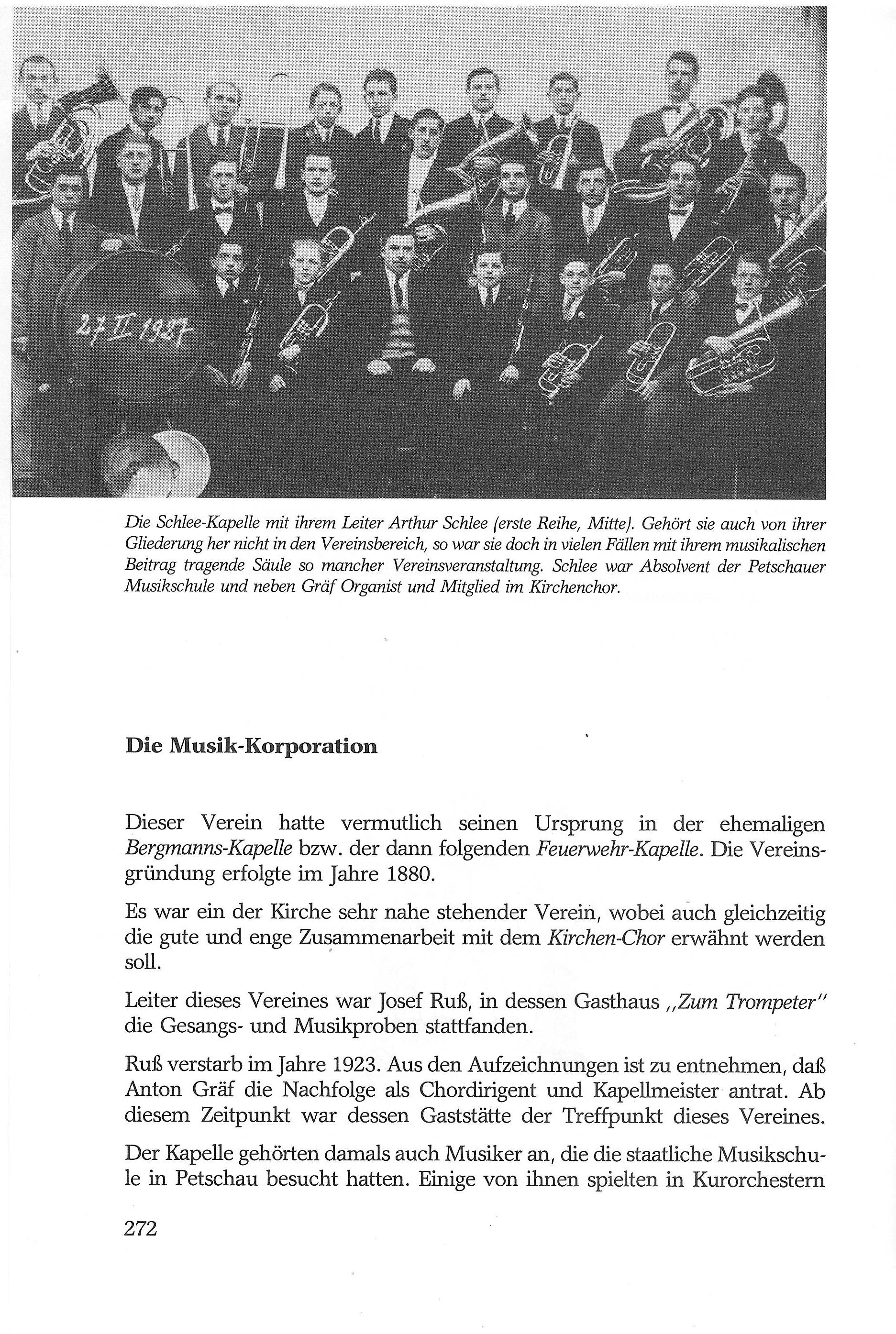 272
27 II 1937
The Schlee Band with its conductor Arthur Schlee (front row,
center). Although its structure does not place it within the club
context, its musical contribution was nevertheless a mainstay of many
club events. Schlee was a graduate of the Petschau Music School and,
alongside Gräf, was an organist and member of the church choir.
The Music Corporation
This club probably had its origins in the former miners' band or the
subsequent fire brigade band. The association was founded in 1880.
It was a club with close ties to the church, and the good and close
cooperation with the church choir should also be mentioned.
The leader of this club was Josef Ruß, in whose inn, "Zum
Trompeter," the singing and music rehearsals took place.
Ruß died in 1923. Records show that Anton Gräf succeeded him as
choir conductor and bandmaster. From that point on, his inn became the
meeting place of this club. At that time, the band also included
musicians who had attended the state music school in Petschau. Some of
them played in spa orchestras.
272
272
27 II 1937
The Schlee Band with its conductor Arthur Schlee (front row,
center). Although its structure does not place it within the club
context, its musical contribution was nevertheless a mainstay of many
club events. Schlee was a graduate of the Petschau Music School and,
alongside Gräf, was an organist and member of the church choir.
The Music Corporation
This club probably had its origins in the former miners' band or the
subsequent fire brigade band. The association was founded in 1880.
It was a club with close ties to the church, and the good and close
cooperation with the church choir should also be mentioned.
The leader of this club was Josef Ruß, in whose inn, "Zum
Trompeter," the singing and music rehearsals took place.
Ruß died in 1923. Records show that Anton Gräf succeeded him as
choir conductor and bandmaster. From that point on, his inn became the
meeting place of this club. At that time, the band also included
musicians who had attended the state music school in Petschau. Some of
them played in spa orchestras.
272
Page 0272
 273
of the neighboring spa towns of Karlovy Vary, Mariánské
Lázn?, and Franzensbad. But even outside the country's borders,
many found employment in good orchestras thanks to this training. The
music corporation provided church music and played at festive church
services. It performed at weddings and public events of all kinds, as
well as at funerals. Furthermore, during Gräf's leadership – as
bandmaster in Teplitz, Zell am See, and St. Joachimsthal, as well as a
music teacher at the State Music School in Petschau – a very close
connection existed between the choral society, which he led as
choirmaster, the Theater-Amateurs-Verein, and the music
corporation. The numerous operetta performances during that time were
the most visible proof of this.
The annual highlight for the members of this society was the
St. Cecilia Celebration held on November 22nd in honor of the patron
saint of music. This event, which only concerned the musicians, was
known in Schönfeld as the "Konfünferl." It began in the morning
with a celebratory church service. Afterwards, the group returned to
the club premises accompanied by marching music. Lunch, afternoon
coffee—at which the ladies from the "Mixed Choir" were already
present—and dinner were always an integral part of the
festivities. The pleasant get-together, which naturally included
singing and music, usually lasted until late in the evening.
In 1933 (?) Anton Gräf died; his son Walter Gräf took over the
leadership of the club.
273
273
of the neighboring spa towns of Karlovy Vary, Mariánské
Lázn?, and Franzensbad. But even outside the country's borders,
many found employment in good orchestras thanks to this training. The
music corporation provided church music and played at festive church
services. It performed at weddings and public events of all kinds, as
well as at funerals. Furthermore, during Gräf's leadership – as
bandmaster in Teplitz, Zell am See, and St. Joachimsthal, as well as a
music teacher at the State Music School in Petschau – a very close
connection existed between the choral society, which he led as
choirmaster, the Theater-Amateurs-Verein, and the music
corporation. The numerous operetta performances during that time were
the most visible proof of this.
The annual highlight for the members of this society was the
St. Cecilia Celebration held on November 22nd in honor of the patron
saint of music. This event, which only concerned the musicians, was
known in Schönfeld as the "Konfünferl." It began in the morning
with a celebratory church service. Afterwards, the group returned to
the club premises accompanied by marching music. Lunch, afternoon
coffee—at which the ladies from the "Mixed Choir" were already
present—and dinner were always an integral part of the
festivities. The pleasant get-together, which naturally included
singing and music, usually lasted until late in the evening.
In 1933 (?) Anton Gräf died; his son Walter Gräf took over the
leadership of the club.
273
Page 0273
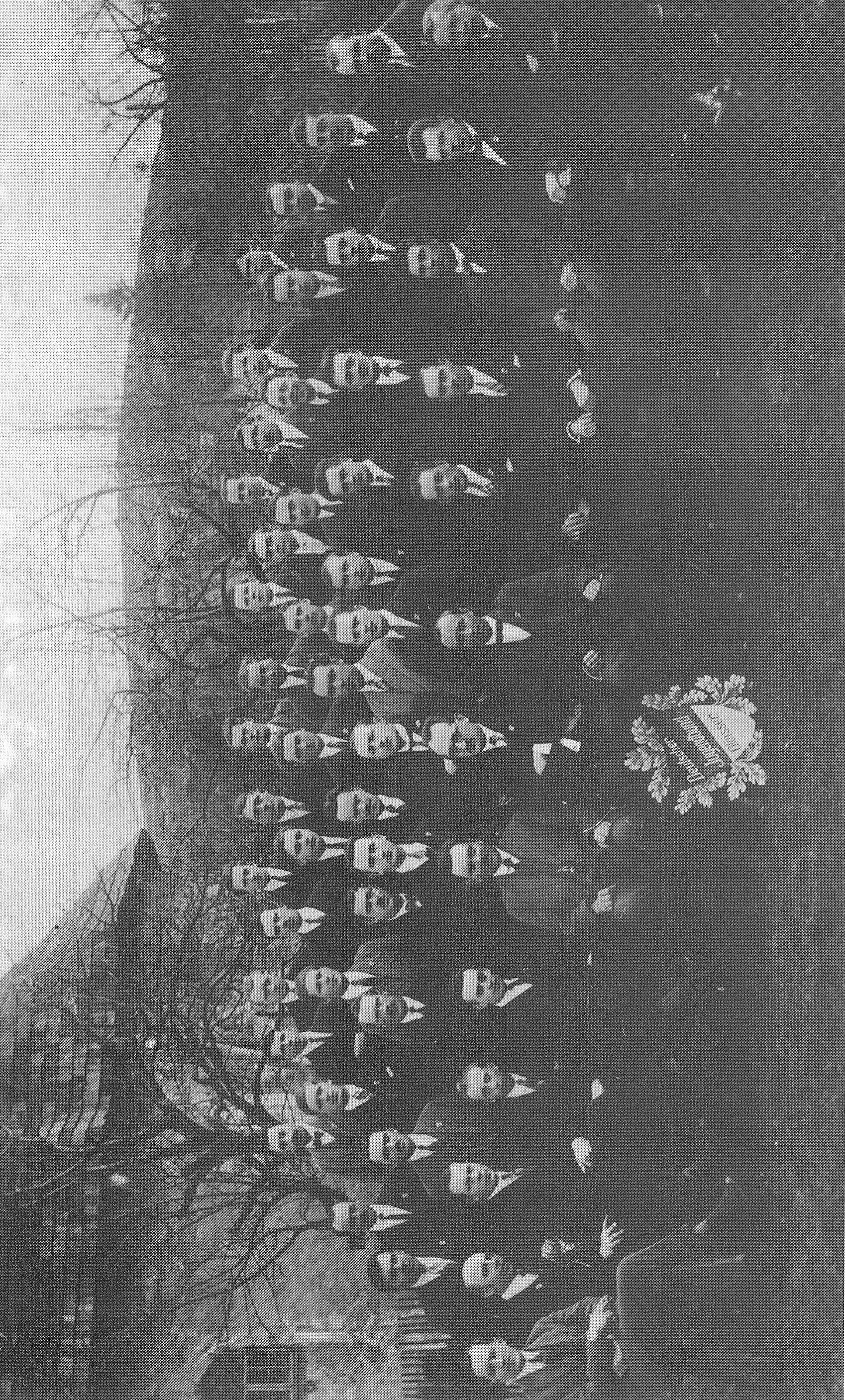 274
274
P
B
German
Youth Association
Glisser
274
274
274
P
B
German
Youth Association
Glisser
274
Page 0274
 275
German Youth Association Glöisser
German, apolitical, focused on cultural concerns and sociability –
these were the Glöisser, who founded their association in 1912. The
first club premises were the Longer Inn on the market square. Later,
due to space constraints, they moved to the Guß Inn, which also had
a small hall.
The association had approximately 130 members.
Josef Fuhrmann was the club's chairman. Founding member J. Ruppert
(Poschetz) was the long-time chairman and later honorary
chairman. Josef Gareiß (Gußn Seffl) also served as chairman.
among others
In addition to the club director and chairman, the committee included
the following members: Julius Spitzl, Rude Weidl (secretary), Adolf
Lochner (finance), and Albin Brandl (entertainment chairman and
responsible for the carnival parade, theater, and hall decorations at
balls).
The general meetings always took place on Epiphany. They always ran
smoothly, and re-elections were practically a custom.
The main highlights of this club's annual program included the
carnival parade, excursions, theater performances, as well as the
annual Yule celebration and the Glöisser Ball. The latter always had
a specific motto (see also "Schönfeld in the Year"). In 1921, the
motto was "Hello, this is the bell fairy." A small masked procession
preceded by marching music advertised this event in the village on
Shrove Tuesday. The procession ended at Gerstner's Inn, where the
bell-ringing fairy (Fuhrmann Beb), from the hall window on the upper
floor, invited the residents who had flocked there to her wedding on
the evening of the ball.
This small procession was so well received by the population that the
Glöissers decided to organize a larger carnival procession, or rather,
a Maschkårå-Zuch, the following year, followed by a dozen more.
A group photo of the "Glöissers" in the Zona Garden; in the background
on the left, part of the church. In the front row, behind the sign, is
founding member, long-time chairman, and later honorary chairman Franz
J. Ruppert (Poschetz). Behind him, club chairman J. Gareiß
(Gußn-Seffl). First row, second from right, club leader J. Fuhrmann
(photo 1925).
275
275
German Youth Association Glöisser
German, apolitical, focused on cultural concerns and sociability –
these were the Glöisser, who founded their association in 1912. The
first club premises were the Longer Inn on the market square. Later,
due to space constraints, they moved to the Guß Inn, which also had
a small hall.
The association had approximately 130 members.
Josef Fuhrmann was the club's chairman. Founding member J. Ruppert
(Poschetz) was the long-time chairman and later honorary
chairman. Josef Gareiß (Gußn Seffl) also served as chairman.
among others
In addition to the club director and chairman, the committee included
the following members: Julius Spitzl, Rude Weidl (secretary), Adolf
Lochner (finance), and Albin Brandl (entertainment chairman and
responsible for the carnival parade, theater, and hall decorations at
balls).
The general meetings always took place on Epiphany. They always ran
smoothly, and re-elections were practically a custom.
The main highlights of this club's annual program included the
carnival parade, excursions, theater performances, as well as the
annual Yule celebration and the Glöisser Ball. The latter always had
a specific motto (see also "Schönfeld in the Year"). In 1921, the
motto was "Hello, this is the bell fairy." A small masked procession
preceded by marching music advertised this event in the village on
Shrove Tuesday. The procession ended at Gerstner's Inn, where the
bell-ringing fairy (Fuhrmann Beb), from the hall window on the upper
floor, invited the residents who had flocked there to her wedding on
the evening of the ball.
This small procession was so well received by the population that the
Glöissers decided to organize a larger carnival procession, or rather,
a Maschkårå-Zuch, the following year, followed by a dozen more.
A group photo of the "Glöissers" in the Zona Garden; in the background
on the left, part of the church. In the front row, behind the sign, is
founding member, long-time chairman, and later honorary chairman Franz
J. Ruppert (Poschetz). Behind him, club chairman J. Gareiß
(Gußn-Seffl). First row, second from right, club leader J. Fuhrmann
(photo 1925).
275
Page 0275
 276
These parades, which grew in size and format from year to year, soon
became known and popular beyond Schönfeld's borders, and thus numerous
spectators from outside the area always came to admire the carnival
parades along with the rest of the local population.
Considering Schönfeld's size, there was also quite a lot on
offer. From a traveling circus, one could see maharajahs, gypsies,
people from Mars, and exotic folk of all stripes, or even a wedding of
animals. Even a zeppelin, a pirate ship, and a mulled wine were
represented.
Of course, the Glöissers couldn't put together this parade alone; they
were therefore actively and enthusiastically supported by all the
clubs, even by the dining parties. This also included the truck and
horse-drawn carriage owners, who put their wagons and carriages at the
service of this foolish cause and contributed to its success. During
the parade, eager young ladies asked spectators for donations, as the
expenses for the parade were often considerable. For example, costumes
were frequently rented from the Kraus mask rental shop in Gablonz, for
which a four-figure sum of krone was often charged. Furthermore, the
Glöissers were constantly striving to replenish their donation account
in order to support local cultural projects and aid organizations in
the town. The following two incidents demonstrate that the Glöissers
often had to cope with a variety of difficulties during these parades:
In 1925, the snow was so heavy that, on the eve of the masked parade,
200 men set out to clear the route, including the market square, of
snow. This operation lasted until midnight. Another time, a large
funeral in Schlaggenwald was brought forward by an hour at the request
of the organizers, as several carriages needed for the carnival parade
were reserved for the funeral.
In 1934, the last carnival parade passed through our hometown. The
strained financial situation of the population was probably the
primary reason for the discontinuation of these events, which had
already become a tradition.
Theater was also on the agenda for the Glöissers. Usually, at the Yule
celebration, which regularly took place on the Sunday before
Christmas, two or three Egerländer one-act plays, such as
"Stoodföiwåh" or "Då Viezenz wiåd å Muå(n)," were
performed on the small stage during the opening ceremony.
276
276
These parades, which grew in size and format from year to year, soon
became known and popular beyond Schönfeld's borders, and thus numerous
spectators from outside the area always came to admire the carnival
parades along with the rest of the local population.
Considering Schönfeld's size, there was also quite a lot on
offer. From a traveling circus, one could see maharajahs, gypsies,
people from Mars, and exotic folk of all stripes, or even a wedding of
animals. Even a zeppelin, a pirate ship, and a mulled wine were
represented.
Of course, the Glöissers couldn't put together this parade alone; they
were therefore actively and enthusiastically supported by all the
clubs, even by the dining parties. This also included the truck and
horse-drawn carriage owners, who put their wagons and carriages at the
service of this foolish cause and contributed to its success. During
the parade, eager young ladies asked spectators for donations, as the
expenses for the parade were often considerable. For example, costumes
were frequently rented from the Kraus mask rental shop in Gablonz, for
which a four-figure sum of krone was often charged. Furthermore, the
Glöissers were constantly striving to replenish their donation account
in order to support local cultural projects and aid organizations in
the town. The following two incidents demonstrate that the Glöissers
often had to cope with a variety of difficulties during these parades:
In 1925, the snow was so heavy that, on the eve of the masked parade,
200 men set out to clear the route, including the market square, of
snow. This operation lasted until midnight. Another time, a large
funeral in Schlaggenwald was brought forward by an hour at the request
of the organizers, as several carriages needed for the carnival parade
were reserved for the funeral.
In 1934, the last carnival parade passed through our hometown. The
strained financial situation of the population was probably the
primary reason for the discontinuation of these events, which had
already become a tradition.
Theater was also on the agenda for the Glöissers. Usually, at the Yule
celebration, which regularly took place on the Sunday before
Christmas, two or three Egerländer one-act plays, such as
"Stoodföiwåh" or "Då Viezenz wiåd å Muå(n)," were
performed on the small stage during the opening ceremony.
276
Page 0276
 277
It was before World War I that the Karlovy Vary local poet Josef
Hofmann once attended a Christmas celebration because of this
play. That evening, the small hall was, as usual, packed with
spectators, and the plays ran "like clockwork." Hofmann was so
enthusiastic about the performance that—since there was no way to
get to the stage by normal means—he hurried onto the stage,
climbing over tables, and lavishing praise on the actors.
At the Christmas celebration, too, several crowns always flowed into
the donation account, and in this context, it should be mentioned that
our "Elfer-Glöckl" (Eleven Bell) was purchased at the suggestion and
expense of the Glöisser. The Enzmann Chronicle, to which we owe so
much valuable information in this book, was also made possible with
the support of this association. Schönfeld Local Tourist Association
(near Karlovy Vary)
277
277
It was before World War I that the Karlovy Vary local poet Josef
Hofmann once attended a Christmas celebration because of this
play. That evening, the small hall was, as usual, packed with
spectators, and the plays ran "like clockwork." Hofmann was so
enthusiastic about the performance that—since there was no way to
get to the stage by normal means—he hurried onto the stage,
climbing over tables, and lavishing praise on the actors.
At the Christmas celebration, too, several crowns always flowed into
the donation account, and in this context, it should be mentioned that
our "Elfer-Glöckl" (Eleven Bell) was purchased at the suggestion and
expense of the Glöisser. The Enzmann Chronicle, to which we owe so
much valuable information in this book, was also made possible with
the support of this association. Schönfeld Local Tourist Association
(near Karlovy Vary)
277
Page 0277
 278
Tourist Association
(also called the Tourist Commission)
An association that arose from the critical economic situation of our
town at the time.
This association was founded with the goal of developing Schönfeld
into a summer resort to promote tourism, especially from nearby
Karlovy Vary.
It was founded on October 15, 1928. Alfred Rupperth (sawmill owner)
served as chairman.
He was also the one who initiated the transformation of the Old
Cemetery into a park.
The greatest achievement of this association—and especially of its
chairman, Rupperth—was the instigation for the construction of the
observation tower, for which he was also responsible. This mighty
structure, which demanded all of this association's strength during
its construction, still stands today as a memorial in our
unforgettable homeland.
Military Veterans Association
This association, which later called itself the "Association of
Serving Soldiers," was founded in 1871. It had 162 members.
Josef Jordan (a glue maker) was its long-time chairman. The
association's premises were formerly at the "Guß" (cast iron),
later at the Russ Restaurant on Dreifaltigkeitsplatz.
Norbert Ruß, known as "Schneider-Wärtl," was the horn player in
this club for many years.
On May 19, 1911, a new club flag was ceremoniously consecrated. The
flag's sponsor was the wife of Reichstag member Bachmann. Even younger
Schönfeld residents may still remember that this club was responsible
for firing cannon shots from the large
278
278
Tourist Association
(also called the Tourist Commission)
An association that arose from the critical economic situation of our
town at the time.
This association was founded with the goal of developing Schönfeld
into a summer resort to promote tourism, especially from nearby
Karlovy Vary.
It was founded on October 15, 1928. Alfred Rupperth (sawmill owner)
served as chairman.
He was also the one who initiated the transformation of the Old
Cemetery into a park.
The greatest achievement of this association—and especially of its
chairman, Rupperth—was the instigation for the construction of the
observation tower, for which he was also responsible. This mighty
structure, which demanded all of this association's strength during
its construction, still stands today as a memorial in our
unforgettable homeland.
Military Veterans Association
This association, which later called itself the "Association of
Serving Soldiers," was founded in 1871. It had 162 members.
Josef Jordan (a glue maker) was its long-time chairman. The
association's premises were formerly at the "Guß" (cast iron),
later at the Russ Restaurant on Dreifaltigkeitsplatz.
Norbert Ruß, known as "Schneider-Wärtl," was the horn player in
this club for many years.
On May 19, 1911, a new club flag was ceremoniously consecrated. The
flag's sponsor was the wife of Reichstag member Bachmann. Even younger
Schönfeld residents may still remember that this club was responsible
for firing cannon shots from the large
278
Page 0278
 279
Ben Cannon, which was usually positioned between the church and the
school building, was responsible.
Dressed discreetly in green and black, with white gloves and the
distinctive uniform piece, the so-called "Birkhånnå-Stauß"
(curved tail feathers of the black grouse with white down) on their
hats, the detachment of veterans, most of whom wore mustaches, gave
every parade a truly majestic character.
The Rifle Corps
The first references to the Rifle Corps date back to 1547, the year
Schönfeld was declared a town. The Enzmann Chronicle reports that on
October 8, the riflemen and riflemen were granted permission to shoot
on holidays, from Easter to Michaelmas. In 1612, a rifle house on the
White Hill is mentioned (referring to Fenkl House No. 402 on the
Kaunitz). On May 18, 1752, the rifle captains and target riflemen of
Schönfeld invited the Eger riflemen to a rifle competition on June
11. A free shooting competition was held, to which the Eger council
granted 16 shooters a travel allowance of 25 guilders. After the great
fire of 1848, the shooting corps disbanded. In 1870, the club's flag
was handed over to the volunteer fire department. The remaining club
assets were also handed over. This donation was conditional on the
fire department's corporate participation in the funerals of former
members of the shooting club.
279
279
Ben Cannon, which was usually positioned between the church and the
school building, was responsible.
Dressed discreetly in green and black, with white gloves and the
distinctive uniform piece, the so-called "Birkhånnå-Stauß"
(curved tail feathers of the black grouse with white down) on their
hats, the detachment of veterans, most of whom wore mustaches, gave
every parade a truly majestic character.
The Rifle Corps
The first references to the Rifle Corps date back to 1547, the year
Schönfeld was declared a town. The Enzmann Chronicle reports that on
October 8, the riflemen and riflemen were granted permission to shoot
on holidays, from Easter to Michaelmas. In 1612, a rifle house on the
White Hill is mentioned (referring to Fenkl House No. 402 on the
Kaunitz). On May 18, 1752, the rifle captains and target riflemen of
Schönfeld invited the Eger riflemen to a rifle competition on June
11. A free shooting competition was held, to which the Eger council
granted 16 shooters a travel allowance of 25 guilders. After the great
fire of 1848, the shooting corps disbanded. In 1870, the club's flag
was handed over to the volunteer fire department. The remaining club
assets were also handed over. This donation was conditional on the
fire department's corporate participation in the funerals of former
members of the shooting club.
279
Page 0279
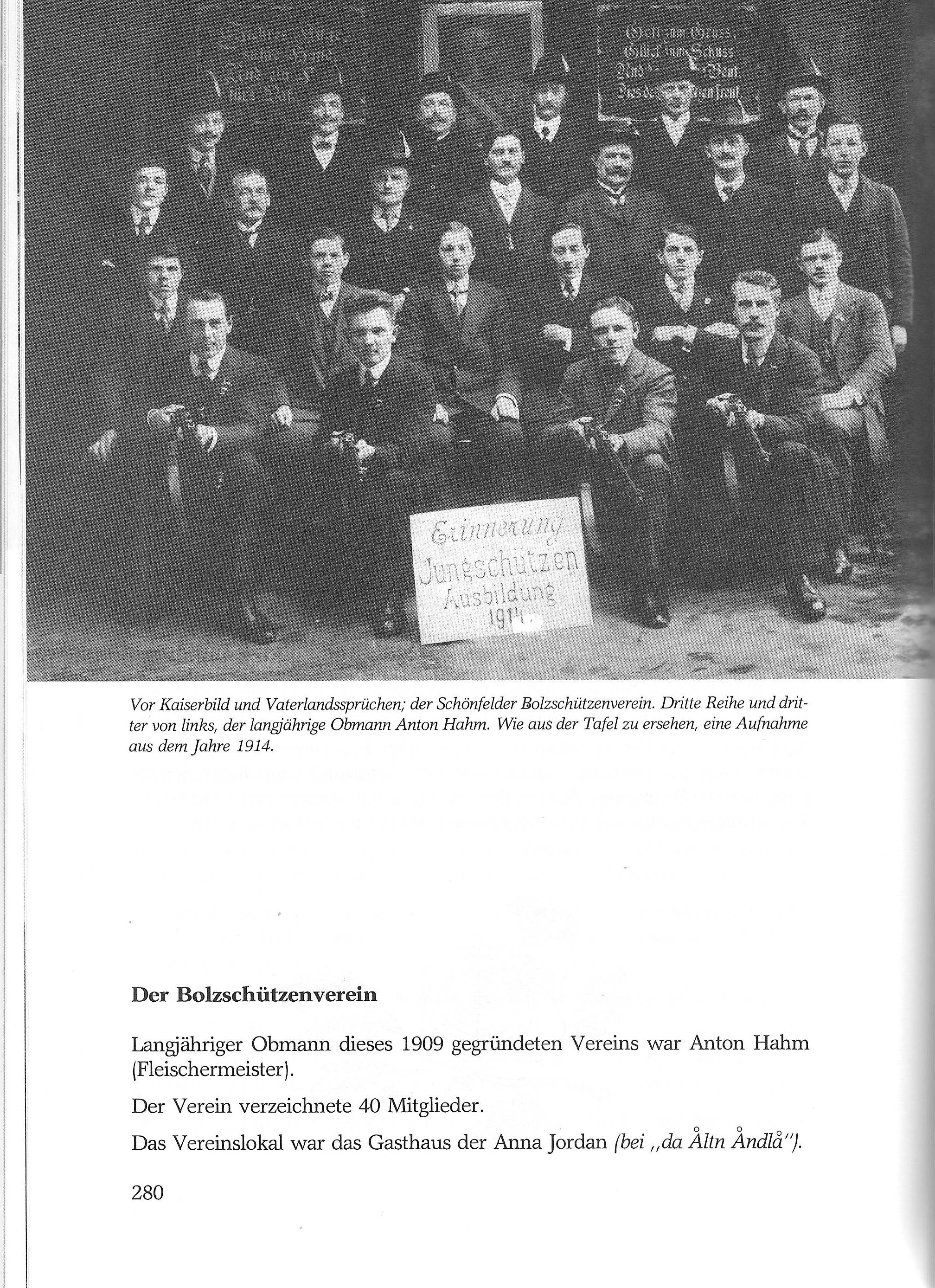 280
Sichre Spand Rud a S Sift in greeting, (Sluefnm Schuss Nud Bent. This
pleases them.
Remembrance of the young shooters' training in 1914.
In front of a picture of the emperor and patriotic slogans: the
Schönfeld Bolzschützenverein. Third row and third from the left,
the long-time chairman Anton Hahm. As can be seen from the plaque, a
photo from 1914.
The Bolzschützenverein
The long-time chairman of this club, founded in 1909, was Anton Hahm
(master butcher). The club had 40 members. The clubhouse was Anna
Jordan's inn (near "da Åltn Åndlå").
280
280
Sichre Spand Rud a S Sift in greeting, (Sluefnm Schuss Nud Bent. This
pleases them.
Remembrance of the young shooters' training in 1914.
In front of a picture of the emperor and patriotic slogans: the
Schönfeld Bolzschützenverein. Third row and third from the left,
the long-time chairman Anton Hahm. As can be seen from the plaque, a
photo from 1914.
The Bolzschützenverein
The long-time chairman of this club, founded in 1909, was Anton Hahm
(master butcher). The club had 40 members. The clubhouse was Anna
Jordan's inn (near "da Åltn Åndlå").
280
Page 0280
 281
German Gymnastics Club
The predecessor of the German Gymnastics Club was the Gymnastics and
Fire Brigade Club, which had existed since 1869. In 1886, the gymnasts
separated from the fire brigade and founded their own club with a
nationalist orientation, which at that time had 140 members.
Although this club – due to its grassroots work alone – was one
of the leading organizations in our hometown, very little is known
about it from earlier times.
For example, we know that numerous certificates adorned the walls of
the Gerstner clubhouse, testifying to many hard-fought victories, but
neither the names of the gymnasts in question nor the disciplines in
which these top places were achieved are known to us today. We even
lack the dates of the construction of the gymnastics garden, although
this sand court could only be built at the beginning of the 20th
century. Until 1904, a residential building stood on this site, which
fell victim to a fire and was never rebuilt.
The equipment shed and the wall fortifications were built later.
The gymnastics garden could only be used from spring to fall. In
winter, gymnastics evenings—as they were commonly called—took
place in the gymnasium of the upper school building.
The club had access to the well-known exercise equipment such as
parallel bars, boxes, high bars, horse, rings, as well as dumbbells,
shot puts, and clubs.
The highlights of club life were always the gymnastics festivals, such
as the Association Gymnastics Festival in 1925 in Komotau or the
gymnastics festivals in Bleistadt (1930) or Kaaden (1931). There were
not only sporting highlights, but also social ones. These included the
gymnasts' balls, which usually took place in the Gerstner Hall; only
two of these dance events had taken place at Geier. The gymnastics
club also frequently hosted forest festivals. It also often played a
significant role in solstice celebrations.
Numerous names of gymnasts who held leading positions are still known
from the period after the First World War. However, the following list
is by no means exhaustive.
281
281
German Gymnastics Club
The predecessor of the German Gymnastics Club was the Gymnastics and
Fire Brigade Club, which had existed since 1869. In 1886, the gymnasts
separated from the fire brigade and founded their own club with a
nationalist orientation, which at that time had 140 members.
Although this club – due to its grassroots work alone – was one
of the leading organizations in our hometown, very little is known
about it from earlier times.
For example, we know that numerous certificates adorned the walls of
the Gerstner clubhouse, testifying to many hard-fought victories, but
neither the names of the gymnasts in question nor the disciplines in
which these top places were achieved are known to us today. We even
lack the dates of the construction of the gymnastics garden, although
this sand court could only be built at the beginning of the 20th
century. Until 1904, a residential building stood on this site, which
fell victim to a fire and was never rebuilt.
The equipment shed and the wall fortifications were built later.
The gymnastics garden could only be used from spring to fall. In
winter, gymnastics evenings—as they were commonly called—took
place in the gymnasium of the upper school building.
The club had access to the well-known exercise equipment such as
parallel bars, boxes, high bars, horse, rings, as well as dumbbells,
shot puts, and clubs.
The highlights of club life were always the gymnastics festivals, such
as the Association Gymnastics Festival in 1925 in Komotau or the
gymnastics festivals in Bleistadt (1930) or Kaaden (1931). There were
not only sporting highlights, but also social ones. These included the
gymnasts' balls, which usually took place in the Gerstner Hall; only
two of these dance events had taken place at Geier. The gymnastics
club also frequently hosted forest festivals. It also often played a
significant role in solstice celebrations.
Numerous names of gymnasts who held leading positions are still known
from the period after the First World War. However, the following list
is by no means exhaustive.
281
Page 0281
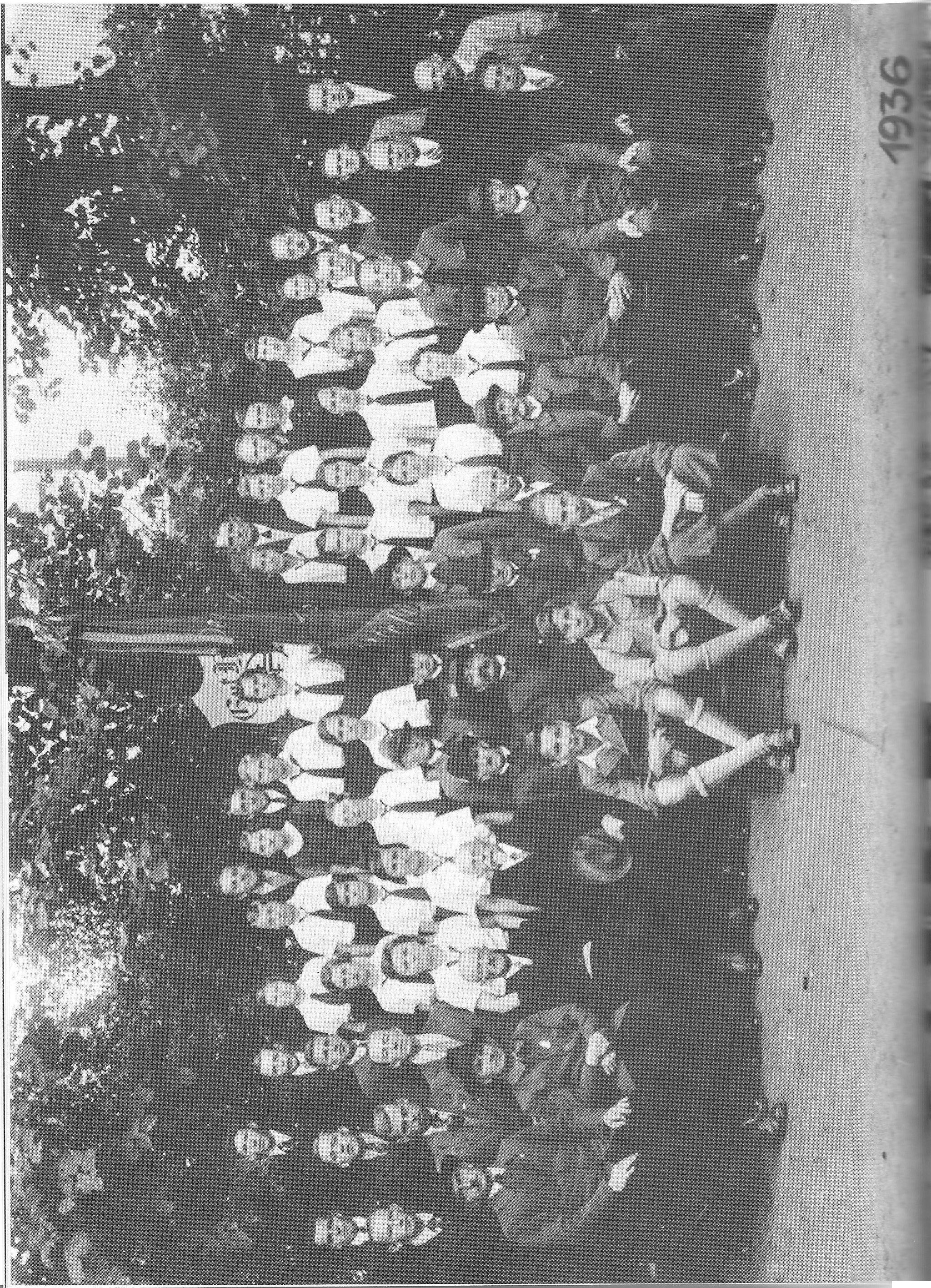 282
1936
282
1936
Page 0282
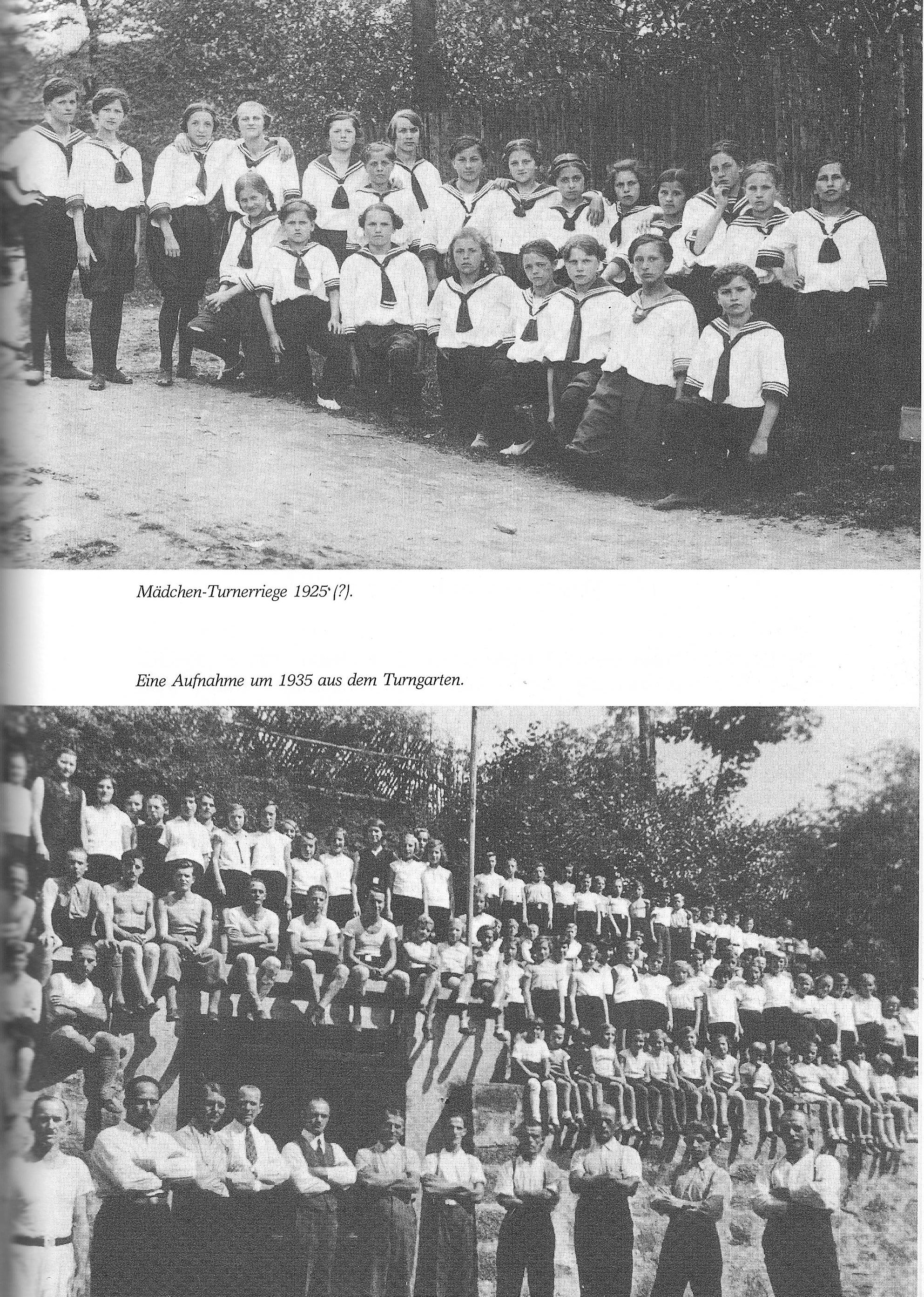 283
Girls' gymnastics team 1925 (?).
A photo taken around 1935 from the gymnastics garden.
283
283
Girls' gymnastics team 1925 (?).
A photo taken around 1935 from the gymnastics garden.
283
Page 0283
 284
Speaker Officers: The long-standing speaker officer was Franz Rupperth
Sr. He was later appointed honorary speaker officer. He was followed
by Josef Schöberl, Emil Vogl, and Hans Mießner.
Gymnastics Officers: Heinrich Lindner, Julius Stöckner, Josef Lochner,
Josef Zettl, Franz Hahm, Hans Mießner, Hans Herold, Anton Eibl,
Franz Schellhorn, Adolf Feiler, and Franz Rupperth Jr.
Dietary Officers: Josef Horner, Franz Ruppert, and Josef Gareiß
(Guß).
Youth Officers: Adolf Feiler, Willi Dennl, and Josef Maronek.
Girls' Counselors: Marie Ruß, Marie Bayer, Luise Klement, Maria
Kugler, Marie Schmidt, and Ilse Habermann.
Marching Band Leaders: Albin Hopf
Equipment Managers: Josef Seidl, Franz Erler, and Edwin Brandl.
Secretaries: Willi Pensl, Karl Ulrich (formerly Erhard Wilfert, a
member for 50 years and most recently an honorary member).
The German Gymnastics Club Schönfeld was renamed the "Reich
Association for Physical Education" in the spring of 1939. Hans
Mießner was elected chairman and held this position until 1945.
With the emergence of the Nazi organizations SA, HJ, and others, and
the conscription into the Wehrmacht shortly thereafter, this
well-known club came to a complete standstill.
Workers' Cyclists' Club "Falke"
As far as is known, this club was founded in 1923. It consisted of
only seven members.
The club's premises were Berta Keßler's inn.
After initial enthusiasm, the club's activities soon waned.
284
284
Speaker Officers: The long-standing speaker officer was Franz Rupperth
Sr. He was later appointed honorary speaker officer. He was followed
by Josef Schöberl, Emil Vogl, and Hans Mießner.
Gymnastics Officers: Heinrich Lindner, Julius Stöckner, Josef Lochner,
Josef Zettl, Franz Hahm, Hans Mießner, Hans Herold, Anton Eibl,
Franz Schellhorn, Adolf Feiler, and Franz Rupperth Jr.
Dietary Officers: Josef Horner, Franz Ruppert, and Josef Gareiß
(Guß).
Youth Officers: Adolf Feiler, Willi Dennl, and Josef Maronek.
Girls' Counselors: Marie Ruß, Marie Bayer, Luise Klement, Maria
Kugler, Marie Schmidt, and Ilse Habermann.
Marching Band Leaders: Albin Hopf
Equipment Managers: Josef Seidl, Franz Erler, and Edwin Brandl.
Secretaries: Willi Pensl, Karl Ulrich (formerly Erhard Wilfert, a
member for 50 years and most recently an honorary member).
The German Gymnastics Club Schönfeld was renamed the "Reich
Association for Physical Education" in the spring of 1939. Hans
Mießner was elected chairman and held this position until 1945.
With the emergence of the Nazi organizations SA, HJ, and others, and
the conscription into the Wehrmacht shortly thereafter, this
well-known club came to a complete standstill.
Workers' Cyclists' Club "Falke"
As far as is known, this club was founded in 1923. It consisted of
only seven members.
The club's premises were Berta Keßler's inn.
After initial enthusiasm, the club's activities soon waned.
284
Page 0284
 285
Football Club
Since this club played its first game in 1921 against a team from our
neighboring town of Schlaggenwald, it can be assumed that it was
founded in the same year.
The club's chairman was the later mayor, Josef Tauber.
The "opening game" mentioned above was played on the Breite Wiese
(Bread Meadow). The Schönfeld residents even signed a player from the
"K.F.K." (Karlsbad Football Club) for this match—amazingly. -
Later, games followed against Elbogen, Neusattl, Tepl, and other
surrounding towns, during which it was probably said that the heath on
the White Hill was shaking.
Later, they played in the large pinge on the Hub.
The club, which most likely wasn't affiliated with any league or other
association, included – as far as is known – the following
players:
Ott Paul (buck), Rahm Turl, Müller Seffl, Ott Franz, Wende (from
Berlin), Hoffmann Tone, Kuhn Anton, Kuhn Paul (baker), Ruppert Franz,
Klieber Oswald, Fuhrmann Lois, and Långer-Rudl, who is still said
to have always inspired the greatest respect from the opposing team,
for he kicked – as they said at home – "out into the cold ice"!
Swimming and Ice Skating Club
This club was founded in 1897 on the initiative of then elementary
school teacher Max Morawetz and boasted 45 members.
The swimming area was the dammed raft ditch above the Damml. For the
club's second division, the pool was kept free of snow in winter.
The accompanying music for ice skating was provided by the old "Flohl"
with his barrel organ.
285
285
Football Club
Since this club played its first game in 1921 against a team from our
neighboring town of Schlaggenwald, it can be assumed that it was
founded in the same year.
The club's chairman was the later mayor, Josef Tauber.
The "opening game" mentioned above was played on the Breite Wiese
(Bread Meadow). The Schönfeld residents even signed a player from the
"K.F.K." (Karlsbad Football Club) for this match—amazingly. -
Later, games followed against Elbogen, Neusattl, Tepl, and other
surrounding towns, during which it was probably said that the heath on
the White Hill was shaking.
Later, they played in the large pinge on the Hub.
The club, which most likely wasn't affiliated with any league or other
association, included – as far as is known – the following
players:
Ott Paul (buck), Rahm Turl, Müller Seffl, Ott Franz, Wende (from
Berlin), Hoffmann Tone, Kuhn Anton, Kuhn Paul (baker), Ruppert Franz,
Klieber Oswald, Fuhrmann Lois, and Långer-Rudl, who is still said
to have always inspired the greatest respect from the opposing team,
for he kicked – as they said at home – "out into the cold ice"!
Swimming and Ice Skating Club
This club was founded in 1897 on the initiative of then elementary
school teacher Max Morawetz and boasted 45 members.
The swimming area was the dammed raft ditch above the Damml. For the
club's second division, the pool was kept free of snow in winter.
The accompanying music for ice skating was provided by the old "Flohl"
with his barrel organ.
285
Page 0285
 286
Pipe Club
This club was more of a social gathering of gentlemen than a club in
the traditional sense. It was founded around 1920 by Lochschmidt
Matthes, who at the time leased the Manahell Inn (later Herold) in
Neustadt. When Matthes gave up the lease, the club moved with its few
possessions, which consisted of pipes, tobacco tins, and, of
necessity, a few spittoons, to Anton Gräf's inn.
Every Monday evening, thick tobacco smoke was "manufactured" there. It
was a top priority that no cigars or cigarettes were allowed to be
smoked during official club hours.
The club's chairman was Anton Hahm, and Julius Spitzl was responsible
for finances. Tobacco needs were covered by dues and fines.
Once a year, usually at the beginning of winter, there was a
celebratory dinner.
Bowling Club
Nothing is known about its founding or membership. Perhaps this group
was just a casual, non-club-affiliated men's group.
Bowling took place at Josef Geier's, in the "Zur Krone" inn.
In earlier years, a large prize bowling competition took place
annually at the so-called "Kaalschub," as the lane was commonly
called.
"Faulenzia"
While this name doesn't refer to a club, it does refer to a rather
original group of men who met at the Jordan Inn—at the
"Altn"—and who should not go unmentioned in this section.
286
286
Pipe Club
This club was more of a social gathering of gentlemen than a club in
the traditional sense. It was founded around 1920 by Lochschmidt
Matthes, who at the time leased the Manahell Inn (later Herold) in
Neustadt. When Matthes gave up the lease, the club moved with its few
possessions, which consisted of pipes, tobacco tins, and, of
necessity, a few spittoons, to Anton Gräf's inn.
Every Monday evening, thick tobacco smoke was "manufactured" there. It
was a top priority that no cigars or cigarettes were allowed to be
smoked during official club hours.
The club's chairman was Anton Hahm, and Julius Spitzl was responsible
for finances. Tobacco needs were covered by dues and fines.
Once a year, usually at the beginning of winter, there was a
celebratory dinner.
Bowling Club
Nothing is known about its founding or membership. Perhaps this group
was just a casual, non-club-affiliated men's group.
Bowling took place at Josef Geier's, in the "Zur Krone" inn.
In earlier years, a large prize bowling competition took place
annually at the so-called "Kaalschub," as the lane was commonly
called.
"Faulenzia"
While this name doesn't refer to a club, it does refer to a rather
original group of men who met at the Jordan Inn—at the
"Altn"—and who should not go unmentioned in this section.
286
Page 0286
 287
Although the founding and dissolution dates of this group are unknown
to us, we do know from brewer Hans (Kern), who once belonged to the
Faulenzia and now lives in Koblenz as an "88er" (member of the
"88er"), that this circle, which saw its main purpose in joking, was
very active in this area shortly before World War I.
The chairman was Hans Ruß (Schan), who was then appointed "Knight
of the Vatz" by the "Oberlaulenzer" (chief lazybones) Muchow Tschulle.
The tannery owner Anton Jordan Sr. bore the dignified name and title
"Tone von der Juchten."
The group also had its own magazine, the "Lazybones Newspaper." The
editor and author of this caricature series was Franz Hubl (master
bricklayer), who "took aim" of humorous current Schönfeld events in a
suitable manner. His artistic touch also designed the club's flag,
which depicted a tramp sitting on a bench with a club in his
hand. Below it were the words: "If only I could catch the guy who
invented work."
The man responsible for carrying this flag—which was probably only
occasionally carried around the pub—was Franz Knaut. Finally, a
small sample of the club's activities: Teacher Lumpe was a guest at
the "Åltn" when Tschulle informed him that the club would be
traveling to America by boat via Schönwehr the following Sunday
afternoon. Lumpe spontaneously left the pub, saying, "What nonsense,"
presumably to avoid further verbal sparring.
Workers' Reading Club
This club was founded in 1885. It had 78 members.
The unanimously elected chairman was Josef Kugler, also known as
"Tscheischich," from the Katzengrün district (No. 188).
The clubhouse was located at the "Guß" (castle).
287
287
Although the founding and dissolution dates of this group are unknown
to us, we do know from brewer Hans (Kern), who once belonged to the
Faulenzia and now lives in Koblenz as an "88er" (member of the
"88er"), that this circle, which saw its main purpose in joking, was
very active in this area shortly before World War I.
The chairman was Hans Ruß (Schan), who was then appointed "Knight
of the Vatz" by the "Oberlaulenzer" (chief lazybones) Muchow Tschulle.
The tannery owner Anton Jordan Sr. bore the dignified name and title
"Tone von der Juchten."
The group also had its own magazine, the "Lazybones Newspaper." The
editor and author of this caricature series was Franz Hubl (master
bricklayer), who "took aim" of humorous current Schönfeld events in a
suitable manner. His artistic touch also designed the club's flag,
which depicted a tramp sitting on a bench with a club in his
hand. Below it were the words: "If only I could catch the guy who
invented work."
The man responsible for carrying this flag—which was probably only
occasionally carried around the pub—was Franz Knaut. Finally, a
small sample of the club's activities: Teacher Lumpe was a guest at
the "Åltn" when Tschulle informed him that the club would be
traveling to America by boat via Schönwehr the following Sunday
afternoon. Lumpe spontaneously left the pub, saying, "What nonsense,"
presumably to avoid further verbal sparring.
Workers' Reading Club
This club was founded in 1885. It had 78 members.
The unanimously elected chairman was Josef Kugler, also known as
"Tscheischich," from the Katzengrün district (No. 188).
The clubhouse was located at the "Guß" (castle).
287
Page 0287
 288
Due to its political and social stance, the activities of this
association represented the first introduction of socialism in
Schönfeld. The association's statutes stipulated a reading hour in the
association's premises every Sunday afternoon. During this time,
socialist magazines and books were primarily read, and articles were
presented. In addition, long debates about the advantages and
disadvantages of socialism were held, which were indispensable.
From time to time, entertaining events were also held, which were
useful for recruiting new members. This association was dissolved in
1904.
Caritas Local Group
An association that sought to alleviate the suffering of the poor and
provided helpful support to the sick in their difficult circumstances.
Sister Marie Horn was at the forefront of this effort.
Although no information is available regarding its founding and
membership status, a 1936 edition of the "House Paper for the Elbogen
District" provides us with a brief insight into its finances and the
assistance provided.
This association recorded an income of approximately 2,500 CZK. Of
this, 1,900 CZK came from collections and donations, and the remaining
600 CZK came from membership fees. 60 families and 20 individuals
were provided with food worth 1,475 CZK.
The Caritas sister received 1,480 CZK for her work.
Sister Marie Horn's deployment time: 90 half-days and 201 days. She
made 297 home visits, 21 care visits, and performed 128 night vigils.
In total, she cared for 96 people.
Sister Horn is fervently honored in the above-mentioned church paper
for her great, selfless efforts. Thanks are expressed. Special thanks
also go to treasurer Franz Lochner.
288
288
Due to its political and social stance, the activities of this
association represented the first introduction of socialism in
Schönfeld. The association's statutes stipulated a reading hour in the
association's premises every Sunday afternoon. During this time,
socialist magazines and books were primarily read, and articles were
presented. In addition, long debates about the advantages and
disadvantages of socialism were held, which were indispensable.
From time to time, entertaining events were also held, which were
useful for recruiting new members. This association was dissolved in
1904.
Caritas Local Group
An association that sought to alleviate the suffering of the poor and
provided helpful support to the sick in their difficult circumstances.
Sister Marie Horn was at the forefront of this effort.
Although no information is available regarding its founding and
membership status, a 1936 edition of the "House Paper for the Elbogen
District" provides us with a brief insight into its finances and the
assistance provided.
This association recorded an income of approximately 2,500 CZK. Of
this, 1,900 CZK came from collections and donations, and the remaining
600 CZK came from membership fees. 60 families and 20 individuals
were provided with food worth 1,475 CZK.
The Caritas sister received 1,480 CZK for her work.
Sister Marie Horn's deployment time: 90 half-days and 201 days. She
made 297 home visits, 21 care visits, and performed 128 night vigils.
In total, she cared for 96 people.
Sister Horn is fervently honored in the above-mentioned church paper
for her great, selfless efforts. Thanks are expressed. Special thanks
also go to treasurer Franz Lochner.
288
Page 0288
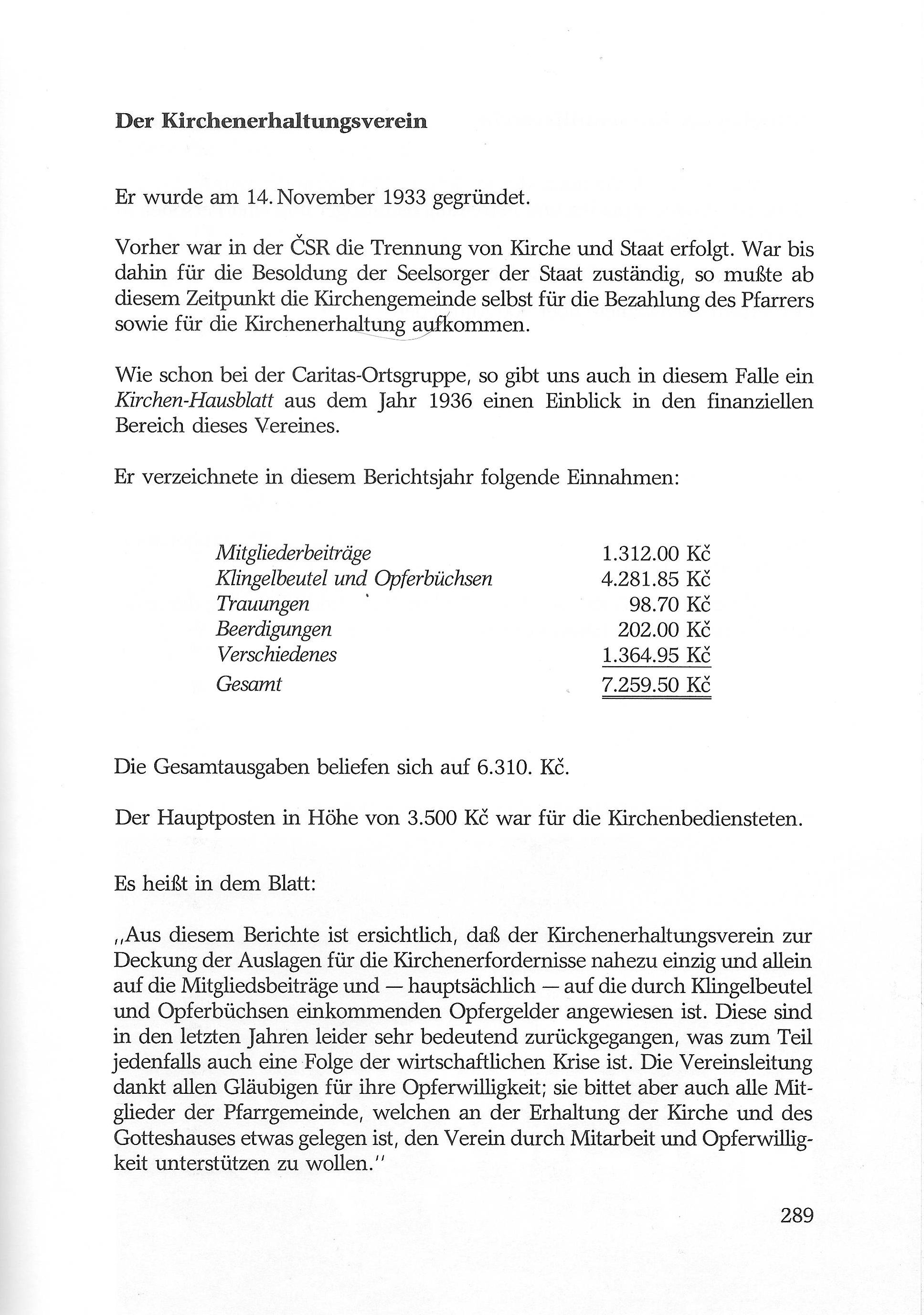 289
The Church Preservation Society
It was founded on November 14, 1933.
Prior to this, the separation of church and state had taken place in
Czechoslovakia. Until then, the state had been responsible for the
salaries of pastors, but from this point on, the parish itself had to
pay the pastor and the church's maintenance.
As with the local Caritas group, a church newsletter from 1936
provides us with an insight into the financial side of this society.
It recorded the following income for this reporting year:
Membership fees
Collection plates and offering boxes
Weddings
Funerals
Miscellaneous
1,312.00 CZK
4,281.85 CZK
98.70 CZK
202.00 CZK
1,364.95 CZK
Total
7,259.50 CZK
Total expenses amounted to 6,310 CZK.
The main item, 3,500 CZK, was for church employees.
The paper states:
"From this report, it is clear that the Church Preservation Society
relies almost exclusively on membership fees and – primarily –
on the offerings received from collection plates and offering boxes to
cover the expenses of the church. These have unfortunately declined
significantly in recent years, which is at least partly a result of
the economic crisis. The association's leadership thanks all believers
for their willingness to make sacrifices; however, it also asks all
members of the parish who are concerned about the preservation of the
church and the place of worship to support the association through
cooperation and willingness to make sacrifices.
289
289
The Church Preservation Society
It was founded on November 14, 1933.
Prior to this, the separation of church and state had taken place in
Czechoslovakia. Until then, the state had been responsible for the
salaries of pastors, but from this point on, the parish itself had to
pay the pastor and the church's maintenance.
As with the local Caritas group, a church newsletter from 1936
provides us with an insight into the financial side of this society.
It recorded the following income for this reporting year:
Membership fees
Collection plates and offering boxes
Weddings
Funerals
Miscellaneous
1,312.00 CZK
4,281.85 CZK
98.70 CZK
202.00 CZK
1,364.95 CZK
Total
7,259.50 CZK
Total expenses amounted to 6,310 CZK.
The main item, 3,500 CZK, was for church employees.
The paper states:
"From this report, it is clear that the Church Preservation Society
relies almost exclusively on membership fees and – primarily –
on the offerings received from collection plates and offering boxes to
cover the expenses of the church. These have unfortunately declined
significantly in recent years, which is at least partly a result of
the economic crisis. The association's leadership thanks all believers
for their willingness to make sacrifices; however, it also asks all
members of the parish who are concerned about the preservation of the
church and the place of worship to support the association through
cooperation and willingness to make sacrifices.
289
Page 0289
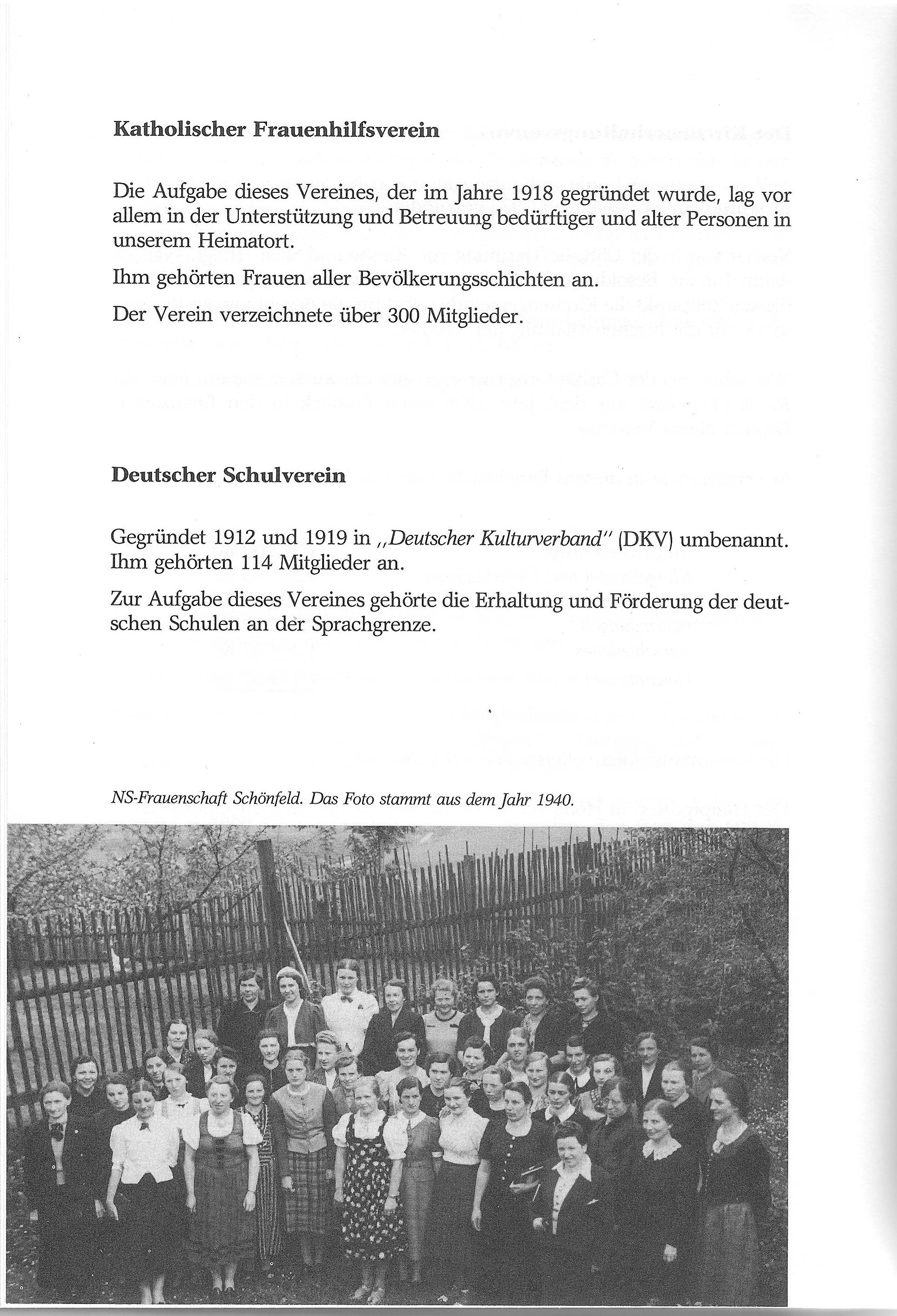 290
Catholic Women's Relief Society
The mission of this society, founded in 1918, was primarily to support
and care for the needy and elderly in our hometown.
Women from all walks of life were members.
The society had over 300 members.
German School Association
Founded in 1912 and renamed the "German Cultural Association" (DKV) in
1919. It had 114 members. The mission of this association was to
maintain and promote German schools along the language border. NS
Women's League Schönfeld. The photo is from 1940.
290
Catholic Women's Relief Society
The mission of this society, founded in 1918, was primarily to support
and care for the needy and elderly in our hometown.
Women from all walks of life were members.
The society had over 300 members.
German School Association
Founded in 1912 and renamed the "German Cultural Association" (DKV) in
1919. It had 114 members. The mission of this association was to
maintain and promote German schools along the language border. NS
Women's League Schönfeld. The photo is from 1940.
Page 0290
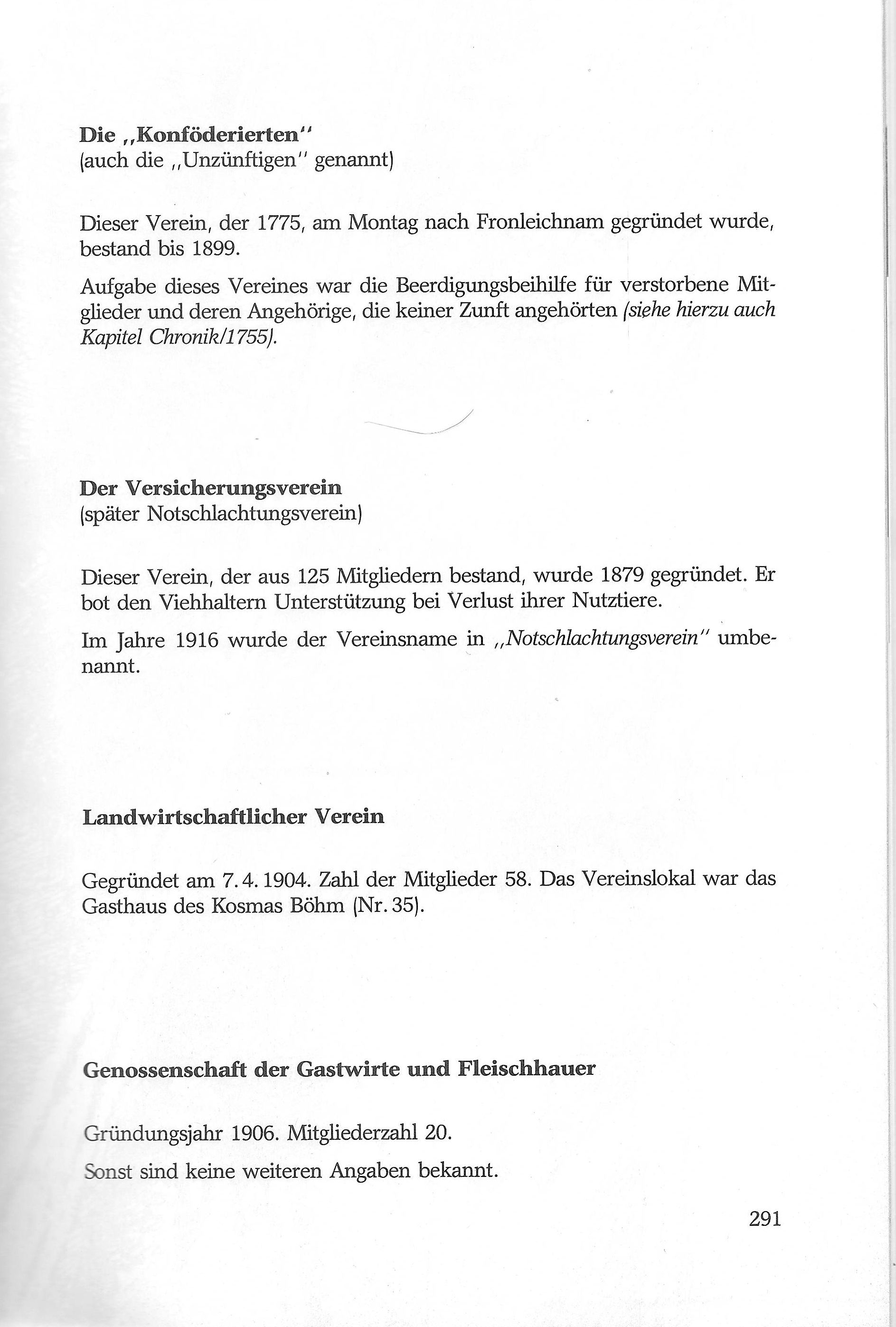 291
The "Confederates"
(also called the "Unzünftigen")
This association, founded in 1775, on the Monday after Corpus Christi,
existed until 1899.
The association's mission was to provide funeral assistance for
deceased members and their relatives who did not belong to a guild
(see also the Chronicle/1755 chapter). The Insurance Association
(later the Emergency Slaughter Association)
This association, which consisted of 125 members, was founded in
1879. It offered Support for livestock farmers in the event of the
loss of their livestock. In 1916, the association's name was changed
to "Emergency Slaughtering Association."
Agricultural Association
Founded on April 7, 1904. Number of members: 58. The association's
premises were Kosmas Böhm's inn (No. 35).
Cooperative of Innkeepers and Butchers
Founded in 1906. Number of members: 20.
No other information is known.
291
291
The "Confederates"
(also called the "Unzünftigen")
This association, founded in 1775, on the Monday after Corpus Christi,
existed until 1899.
The association's mission was to provide funeral assistance for
deceased members and their relatives who did not belong to a guild
(see also the Chronicle/1755 chapter). The Insurance Association
(later the Emergency Slaughter Association)
This association, which consisted of 125 members, was founded in
1879. It offered Support for livestock farmers in the event of the
loss of their livestock. In 1916, the association's name was changed
to "Emergency Slaughtering Association."
Agricultural Association
Founded on April 7, 1904. Number of members: 58. The association's
premises were Kosmas Böhm's inn (No. 35).
Cooperative of Innkeepers and Butchers
Founded in 1906. Number of members: 20.
No other information is known.
291
Page 0291
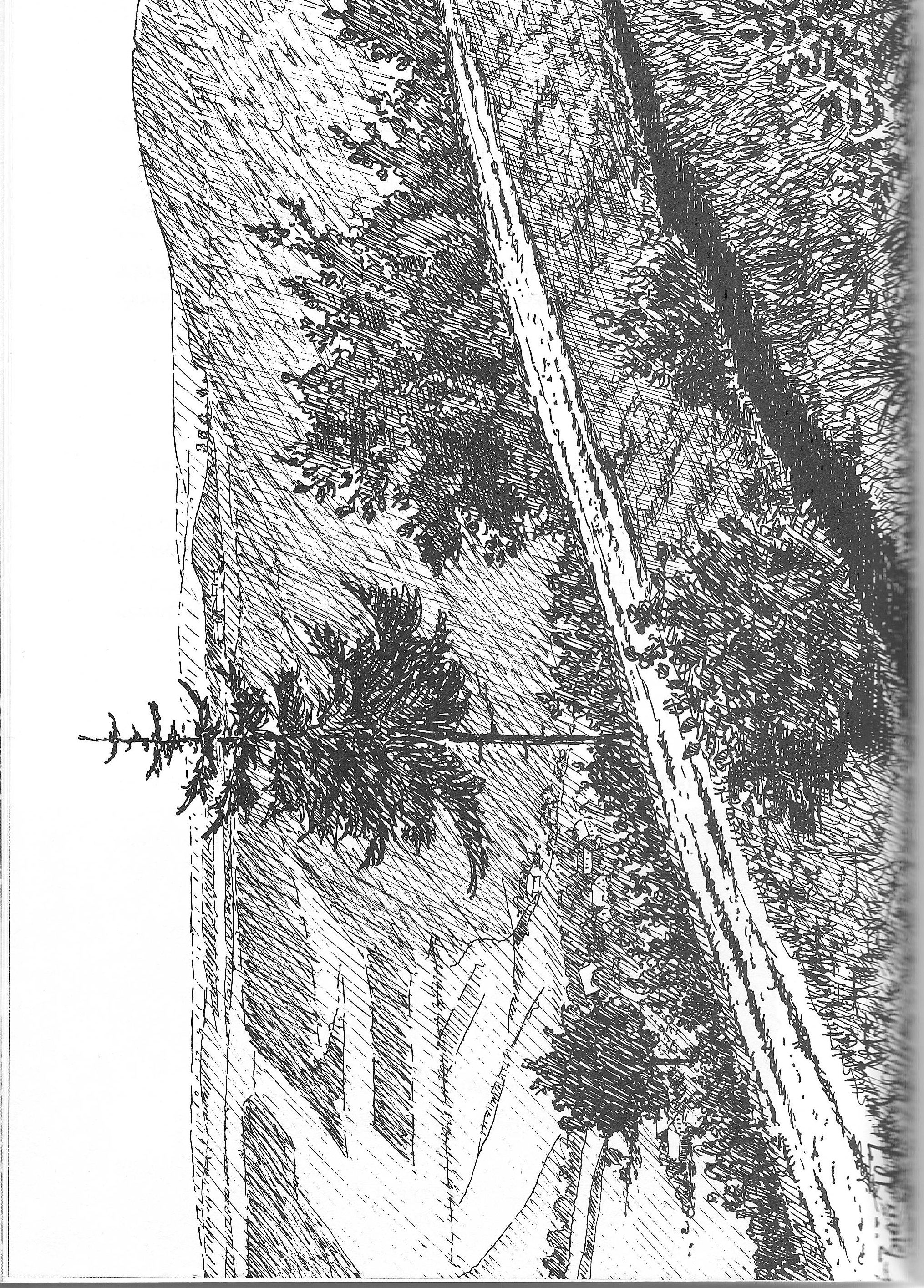 292
------
292
------
Page 0292
 293
Mixed Cooperative
Founded in 1880. Number of members: 98. Wilhelm Eckl (No. 11) was the
long-time chairman. No further information is available here either.
Schönfeld Consumer Association
At the suggestion and instigation of the then chairman of Schönfeld's
Social Democratic Party, Karl Reinhold (No. 67), a Konsum branch was
opened in 1912 in house No. 6 (Ruppert Edwin). The Konsum headquarters
was located in Schlaggenwald at that time.
Later, the branch moved to house No. 110 on the market square.
The branch managers are still known to be Zimmerhackl, Hahn,
Schloßbauer, and Doischer.
The bread supplier for the Konsum at that time was baker Klement.
After World War I, the Konsum stores in Schlaggenwald, Lauterbach, and
Schönfeld were connected to the main branch in Chodau, and all
deliveries were made exclusively from there. However, the branch
manager could still purchase eggs, butter, potatoes, and similar items
from the farmer.
Between 1926 and 1928, the Konsum branch in Schönfeld recorded an
average annual turnover of approximately 300,000 CZK with a membership
of 216.
In the spring of 1939, the cooperative was dissolved, and its assets
were confiscated by the so-called Standstill Commission.
Area at the Flößgraben with a view of the Tiefenbach Valley.
293
293
Mixed Cooperative
Founded in 1880. Number of members: 98. Wilhelm Eckl (No. 11) was the
long-time chairman. No further information is available here either.
Schönfeld Consumer Association
At the suggestion and instigation of the then chairman of Schönfeld's
Social Democratic Party, Karl Reinhold (No. 67), a Konsum branch was
opened in 1912 in house No. 6 (Ruppert Edwin). The Konsum headquarters
was located in Schlaggenwald at that time.
Later, the branch moved to house No. 110 on the market square.
The branch managers are still known to be Zimmerhackl, Hahn,
Schloßbauer, and Doischer.
The bread supplier for the Konsum at that time was baker Klement.
After World War I, the Konsum stores in Schlaggenwald, Lauterbach, and
Schönfeld were connected to the main branch in Chodau, and all
deliveries were made exclusively from there. However, the branch
manager could still purchase eggs, butter, potatoes, and similar items
from the farmer.
Between 1926 and 1928, the Konsum branch in Schönfeld recorded an
average annual turnover of approximately 300,000 CZK with a membership
of 216.
In the spring of 1939, the cooperative was dissolved, and its assets
were confiscated by the so-called Standstill Commission.
Area at the Flößgraben with a view of the Tiefenbach Valley.
293
Page 0293
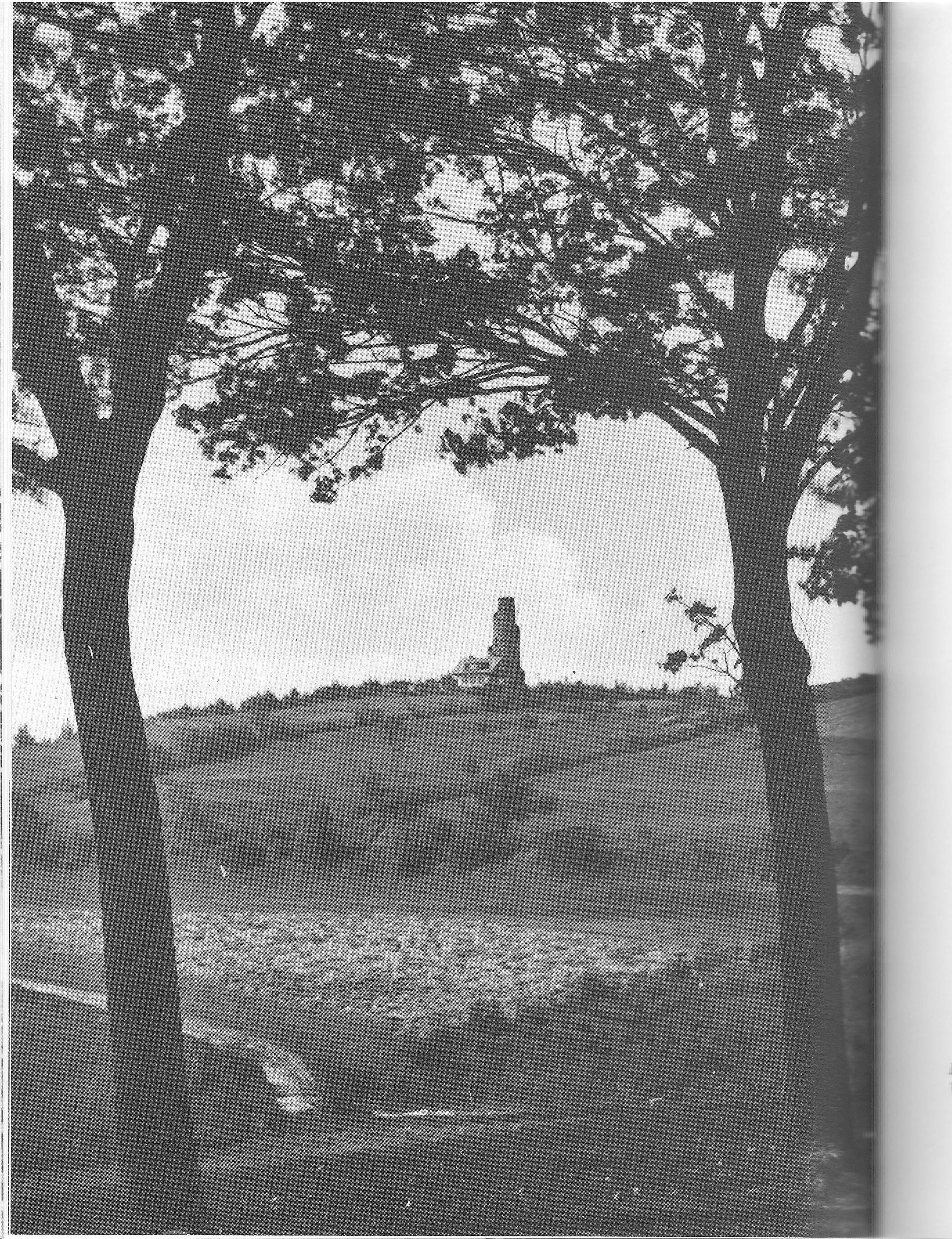 294
294
Page 0294
 295
The Observation Tower
Rarely is a town's landmark as closely connected to its residents as
was the case with the Schönfeld Observation Tower. This was
undoubtedly due to the laborious construction of this observation
tower, in which all levels of our hometown's population
contributed. This tower was built at a time when our town, which at
the time had a population of around 2,100, had over 400 unemployed
people. However, it was this economic hardship that primarily provided
the strongest impetus for its realization, as it was believed that the
construction of an observation tower would create a tourist
attraction. Schönfeld's location was ideal in this respect, as one of
the most beautiful bus trips taken by spa guests in the summer months
was the Karlovy Vary-Semmering tour, with the route:
Karlsbad-Petschau-Schönfeld-Schlaggenwald-Elbogen-Karlsbad, with
Schönfeld offering the highest geographical location on this tour, at
around 700 meters above sea level. What could be more natural than
creating a vantage point here that would provide a view of the
magnificent landscape surrounding our hometown?
It was primarily the Tourist Association, under its then chairman
Alfred Rupperth, that pursued such a project. The final impetus came
in 1932 with the construction of the Dr. Kempf Lookout Tower on the
Krudum.
Only now did people seriously begin to realize this long-held dream. A
truly bold undertaking in the economically disastrous times of the
time. Only those possessed of idealism could undertake such a project
in those days.
View from the Old Grabenhäusl of the Steingröll with its
observation tower. In the foreground left is the Lange road, and above
it the Flößgraben dam.
295
295
The Observation Tower
Rarely is a town's landmark as closely connected to its residents as
was the case with the Schönfeld Observation Tower. This was
undoubtedly due to the laborious construction of this observation
tower, in which all levels of our hometown's population
contributed. This tower was built at a time when our town, which at
the time had a population of around 2,100, had over 400 unemployed
people. However, it was this economic hardship that primarily provided
the strongest impetus for its realization, as it was believed that the
construction of an observation tower would create a tourist
attraction. Schönfeld's location was ideal in this respect, as one of
the most beautiful bus trips taken by spa guests in the summer months
was the Karlovy Vary-Semmering tour, with the route:
Karlsbad-Petschau-Schönfeld-Schlaggenwald-Elbogen-Karlsbad, with
Schönfeld offering the highest geographical location on this tour, at
around 700 meters above sea level. What could be more natural than
creating a vantage point here that would provide a view of the
magnificent landscape surrounding our hometown?
It was primarily the Tourist Association, under its then chairman
Alfred Rupperth, that pursued such a project. The final impetus came
in 1932 with the construction of the Dr. Kempf Lookout Tower on the
Krudum.
Only now did people seriously begin to realize this long-held dream. A
truly bold undertaking in the economically disastrous times of the
time. Only those possessed of idealism could undertake such a project
in those days.
View from the Old Grabenhäusl of the Steingröll with its
observation tower. In the foreground left is the Lange road, and above
it the Flößgraben dam.
295
Page 0295
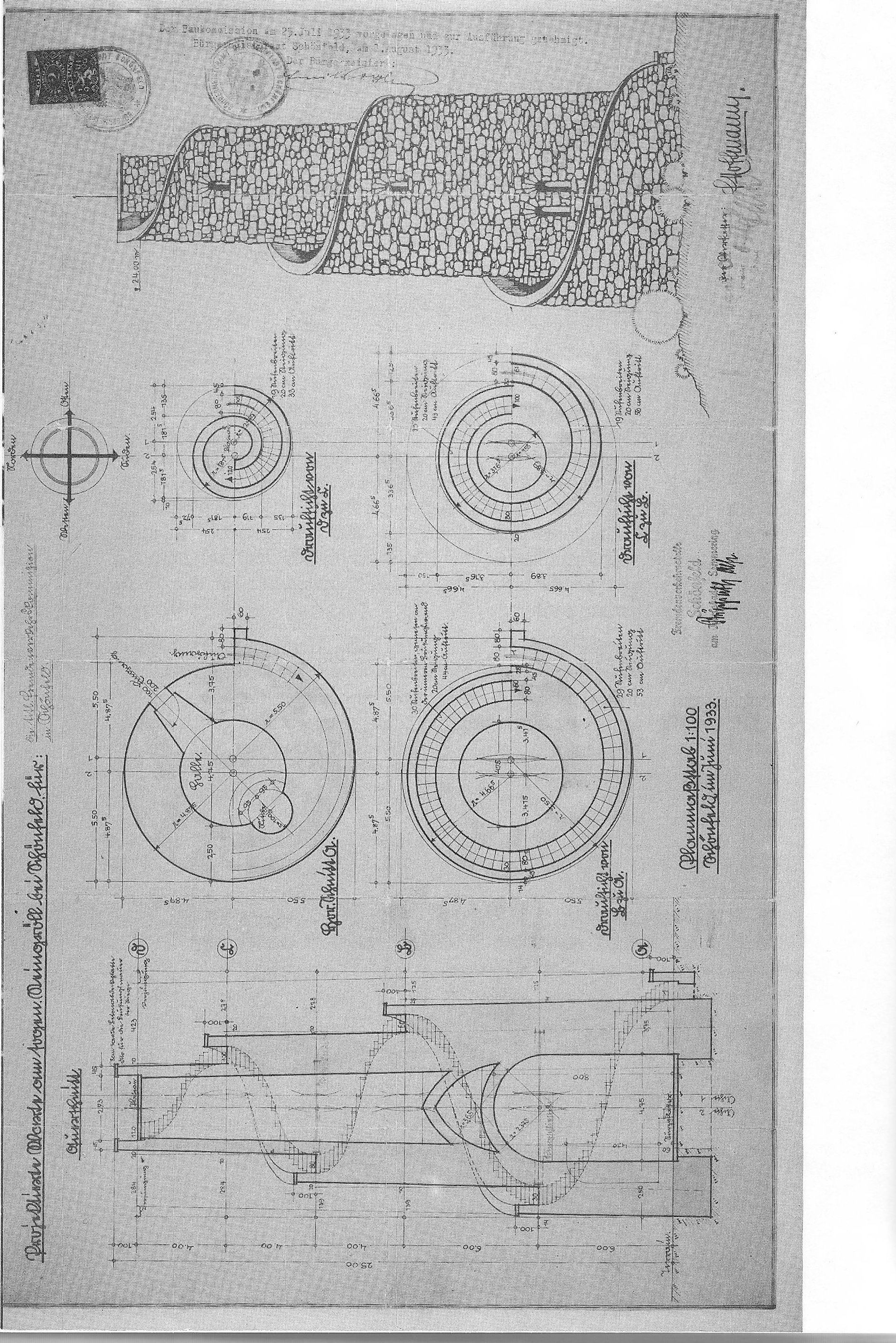 296
Propellate Words ontogenous. Ringroll at Schönfeld for:
Yow Yese Betenilde Agtató
all for the dengung maue*
228
L
4.35
OL
4.805
-5.50
+.87
250
Sally.
475
Bor. Asuista.
14
5.50
4.87
-5.50
200
4.87
4.875
5.50
4.665
ku
30 Ausendenten, further on Grunten dentibuokoauð
20am Thuy
#Has Appearance.
806806-
3,475
3.41
80
-7815
Borov
120
19 Nisen widths
20cm
deseruny
33 to me
4,655
3365
1376-
43mm Ankle l
100
Franticht by LOV
29 widths 20 cur throug 53 cm appearance
Gray spruce vow LZWL.
19 inchinbreidem 20 in Bengung
56 at Anfrill
(Plau scale 1:100
Ochonfel and June 1933.
ver Cherfather:
Hofmanny.
296
296
Propellate Words ontogenous. Ringroll at Schönfeld for:
Yow Yese Betenilde Agtató
all for the dengung maue*
228
L
4.35
OL
4.805
-5.50
+.87
250
Sally.
475
Bor. Asuista.
14
5.50
4.87
-5.50
200
4.87
4.875
5.50
4.665
ku
30 Ausendenten, further on Grunten dentibuokoauð
20am Thuy
#Has Appearance.
806806-
3,475
3.41
80
-7815
Borov
120
19 Nisen widths
20cm
deseruny
33 to me
4,655
3365
1376-
43mm Ankle l
100
Franticht by LOV
29 widths 20 cur throug 53 cm appearance
Gray spruce vow LZWL.
19 inchinbreidem 20 in Bengung
56 at Anfrill
(Plau scale 1:100
Ochonfel and June 1933.
ver Cherfather:
Hofmanny.
296
Page 0296
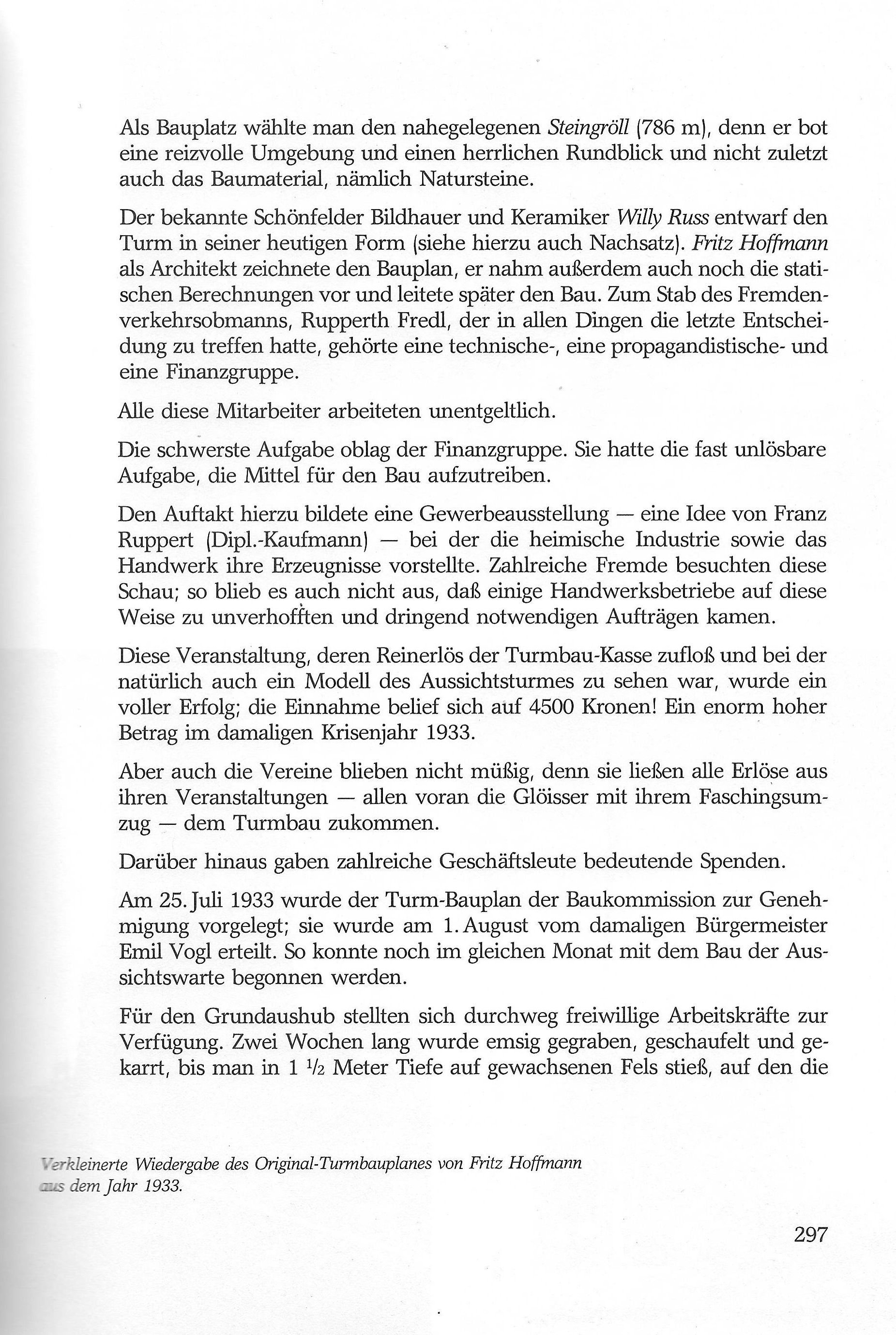 297
The nearby Steingröll (786 m) was chosen as the construction site
because it offered charming surroundings and a magnificent panoramic
view, as well as the building material, namely natural stone.
The well-known Schönfeld sculptor and ceramicist Willy Russ designed
the tower in its current form (see also the postscript). Fritz
Hoffmann, the architect, drew the construction plan, also carried out
the structural calculations, and later supervised the
construction. The staff of the tourism director, Rupperth Fredl, who
had the final decision in all matters, included a technical, a
propaganda, and a financial group.
All of these employees worked for free.
The most difficult task fell to the financial group. They had the
almost impossible task of raising the funds for the construction. The
event kicked off with a trade exhibition, an idea by Franz Ruppert
(Dipl.-Kaufmann), where local industry and crafts presented their
products. Numerous visitors visited this show; thus, it was inevitable
that some craft businesses received unexpected and urgently needed
orders.
This event, whose net proceeds went to the tower construction fund and
at which, of course, a model of the observation tower was also on
display, was a complete success; the proceeds amounted to 4,500
crowns! An enormous amount in the crisis year of 1933. But the clubs
didn't sit idle either, as they donated all the proceeds from their
events—especially the Glöisser with their carnival parade—to the
tower construction.
In addition, numerous businesspeople made significant donations. On
July 25, 1933, the tower construction plan was submitted to the
building commission for approval; It was granted on August 1st by the
then mayor, Emil Vogl. Construction of the observation tower could
begin that same month.
Volunteers were provided for the basic excavation. Digging, shoveling,
and carting took two weeks of diligent work until they encountered
natural rock at a depth of 1.5 meters, onto which the
Reduced-scale reproduction of the original tower construction plan by
Fritz Hoffmann from 1933.
297
297
The nearby Steingröll (786 m) was chosen as the construction site
because it offered charming surroundings and a magnificent panoramic
view, as well as the building material, namely natural stone.
The well-known Schönfeld sculptor and ceramicist Willy Russ designed
the tower in its current form (see also the postscript). Fritz
Hoffmann, the architect, drew the construction plan, also carried out
the structural calculations, and later supervised the
construction. The staff of the tourism director, Rupperth Fredl, who
had the final decision in all matters, included a technical, a
propaganda, and a financial group.
All of these employees worked for free.
The most difficult task fell to the financial group. They had the
almost impossible task of raising the funds for the construction. The
event kicked off with a trade exhibition, an idea by Franz Ruppert
(Dipl.-Kaufmann), where local industry and crafts presented their
products. Numerous visitors visited this show; thus, it was inevitable
that some craft businesses received unexpected and urgently needed
orders.
This event, whose net proceeds went to the tower construction fund and
at which, of course, a model of the observation tower was also on
display, was a complete success; the proceeds amounted to 4,500
crowns! An enormous amount in the crisis year of 1933. But the clubs
didn't sit idle either, as they donated all the proceeds from their
events—especially the Glöisser with their carnival parade—to the
tower construction.
In addition, numerous businesspeople made significant donations. On
July 25, 1933, the tower construction plan was submitted to the
building commission for approval; It was granted on August 1st by the
then mayor, Emil Vogl. Construction of the observation tower could
begin that same month.
Volunteers were provided for the basic excavation. Digging, shoveling,
and carting took two weeks of diligent work until they encountered
natural rock at a depth of 1.5 meters, onto which the
Reduced-scale reproduction of the original tower construction plan by
Fritz Hoffmann from 1933.
297
Page 0297
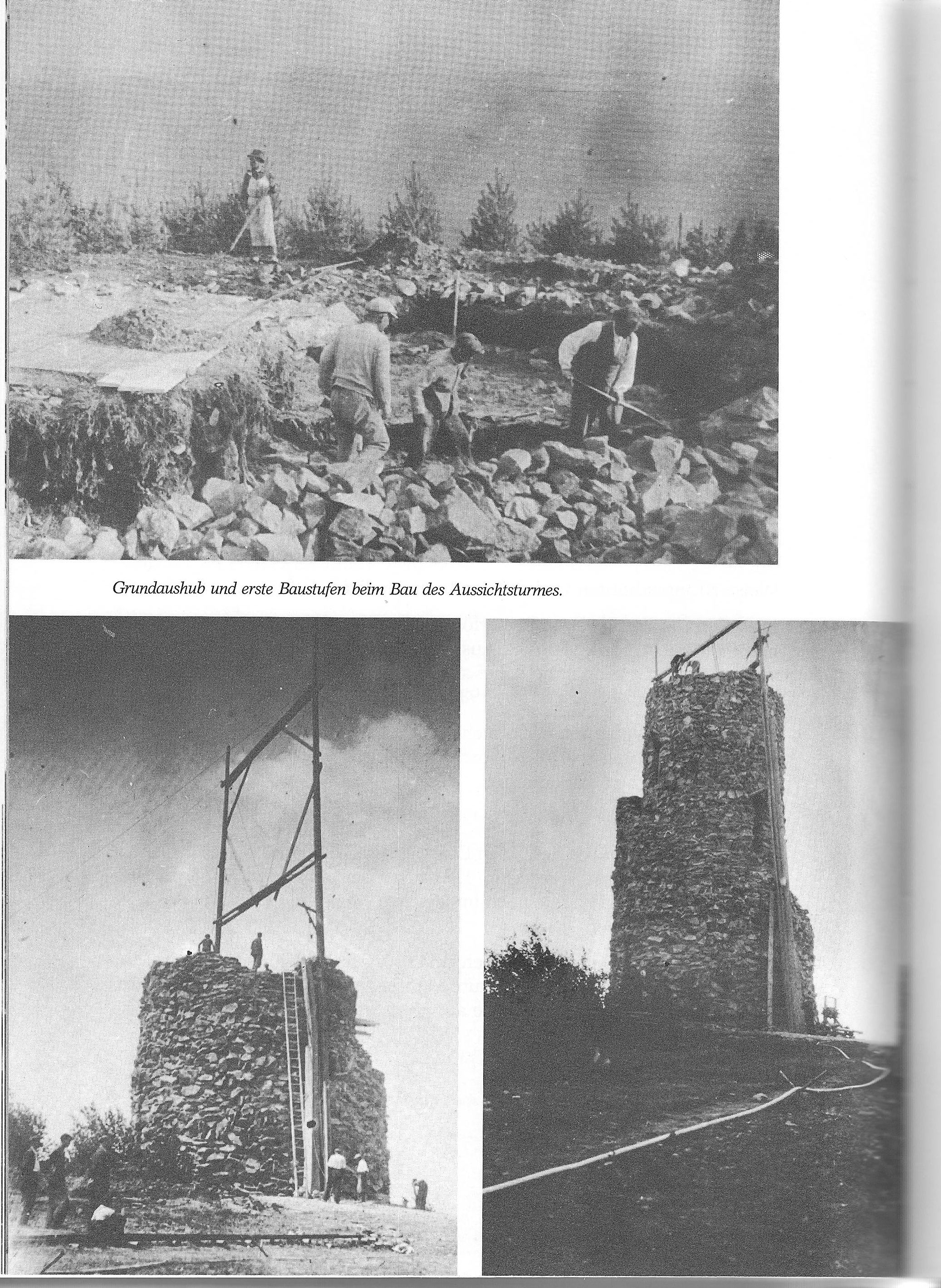 298
Basic excavation and first construction phases of the observation tower.
298
Basic excavation and first construction phases of the observation tower.
Page 0298
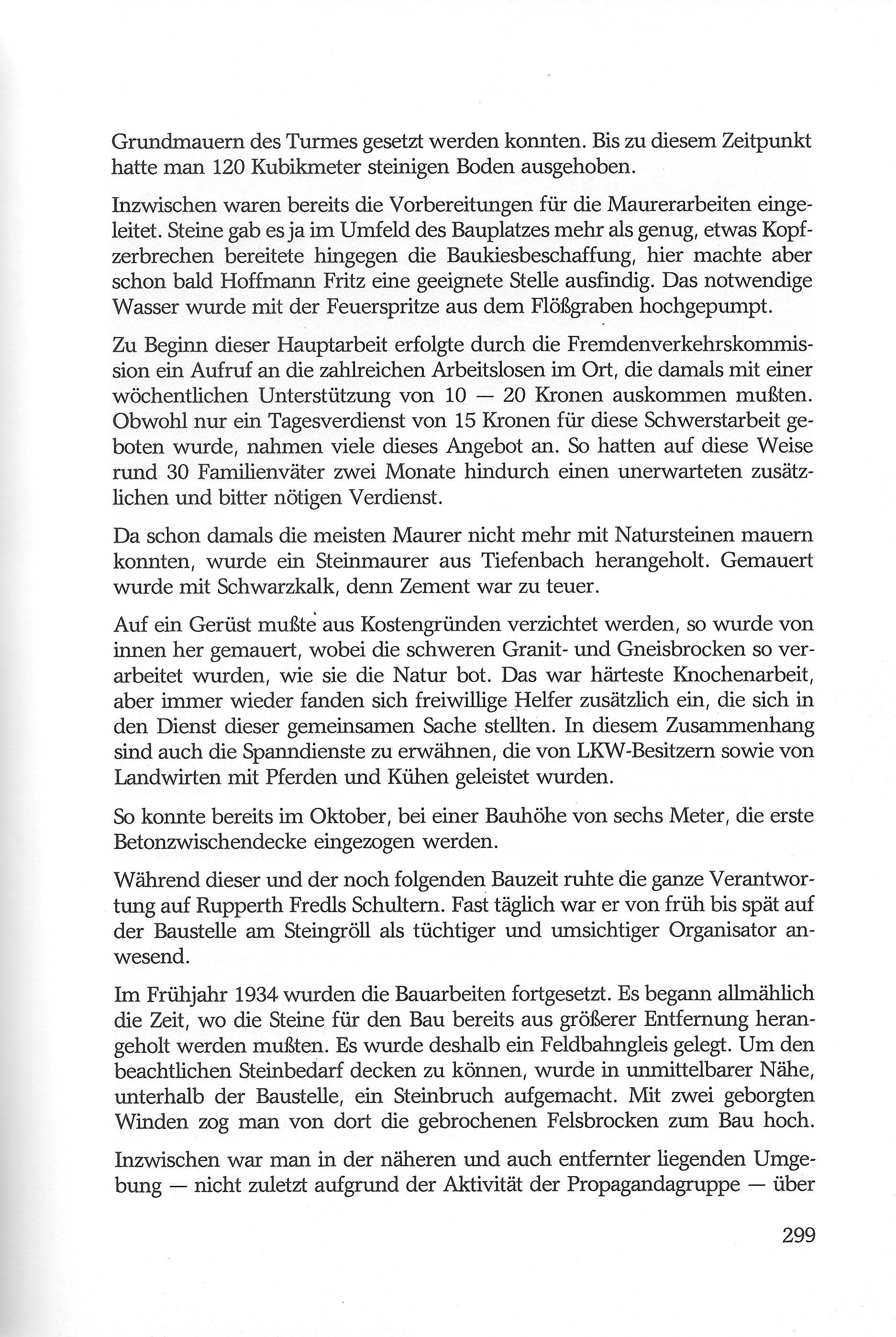 299
The foundation walls of the tower could be laid. By this time, 120
cubic meters of stony soil had been excavated.
Meanwhile, preparations for the masonry work had already begun. There
was more than enough stone in the area around the construction site,
but obtaining construction gravel was a bit of a headache, but
Hoffmann Fritz soon found a suitable location. The necessary water was
pumped up from the rafting ditch with a fire engine.
At the beginning of this major work, the Tourist Commission issued an
appeal to the numerous unemployed in the town, who at that time had to
get by on a weekly allowance of 10-20 crowns. Although only 15 crowns
a day was offered for this hard work, many accepted the offer. In this
way, around 30 fathers of families had unexpected additional and
desperately needed income for two months.
Since even at that time most of the bricklayers were no longer able to
work with natural stone, a stonemason from Tiefenbach was brought
in. The brickwork was done with black lime, as cement was too
expensive.
Scaffolding had to be dispensed with for cost reasons, so the
brickwork was carried out from the inside, with the heavy granite and
gneiss boulders being worked as they naturally provided. It was
extremely backbreaking work, but volunteers continually stepped up to
help this common cause. In this context, the tensioning services
provided by truck owners and farmers with horses and cows are also
worth mentioning.
Thus, the first concrete intermediate floor was installed as early as
October, at a construction height of six meters.
During this and the subsequent construction period, the entire
responsibility rested on Rupperth Fredl's shoulders. Almost every day,
from morning to night, he was present at the Steingröll construction
site as a capable and prudent organizer.
In the spring of 1934, construction work continued. The time gradually
began when the stones for the construction had to be brought from
greater distances. A narrow-gauge railway was therefore laid. To meet
the considerable demand for stone, a quarry was opened in the
immediate vicinity, below the construction site. Two borrowed winches
were used to pull the broken boulders up to the construction
site. Meanwhile, in the immediate and distant surroundings—not
least due to the activities of the propaganda group— over
2
299
299
The foundation walls of the tower could be laid. By this time, 120
cubic meters of stony soil had been excavated.
Meanwhile, preparations for the masonry work had already begun. There
was more than enough stone in the area around the construction site,
but obtaining construction gravel was a bit of a headache, but
Hoffmann Fritz soon found a suitable location. The necessary water was
pumped up from the rafting ditch with a fire engine.
At the beginning of this major work, the Tourist Commission issued an
appeal to the numerous unemployed in the town, who at that time had to
get by on a weekly allowance of 10-20 crowns. Although only 15 crowns
a day was offered for this hard work, many accepted the offer. In this
way, around 30 fathers of families had unexpected additional and
desperately needed income for two months.
Since even at that time most of the bricklayers were no longer able to
work with natural stone, a stonemason from Tiefenbach was brought
in. The brickwork was done with black lime, as cement was too
expensive.
Scaffolding had to be dispensed with for cost reasons, so the
brickwork was carried out from the inside, with the heavy granite and
gneiss boulders being worked as they naturally provided. It was
extremely backbreaking work, but volunteers continually stepped up to
help this common cause. In this context, the tensioning services
provided by truck owners and farmers with horses and cows are also
worth mentioning.
Thus, the first concrete intermediate floor was installed as early as
October, at a construction height of six meters.
During this and the subsequent construction period, the entire
responsibility rested on Rupperth Fredl's shoulders. Almost every day,
from morning to night, he was present at the Steingröll construction
site as a capable and prudent organizer.
In the spring of 1934, construction work continued. The time gradually
began when the stones for the construction had to be brought from
greater distances. A narrow-gauge railway was therefore laid. To meet
the considerable demand for stone, a quarry was opened in the
immediate vicinity, below the construction site. Two borrowed winches
were used to pull the broken boulders up to the construction
site. Meanwhile, in the immediate and distant surroundings—not
least due to the activities of the propaganda group— over
2
299
Page 0299
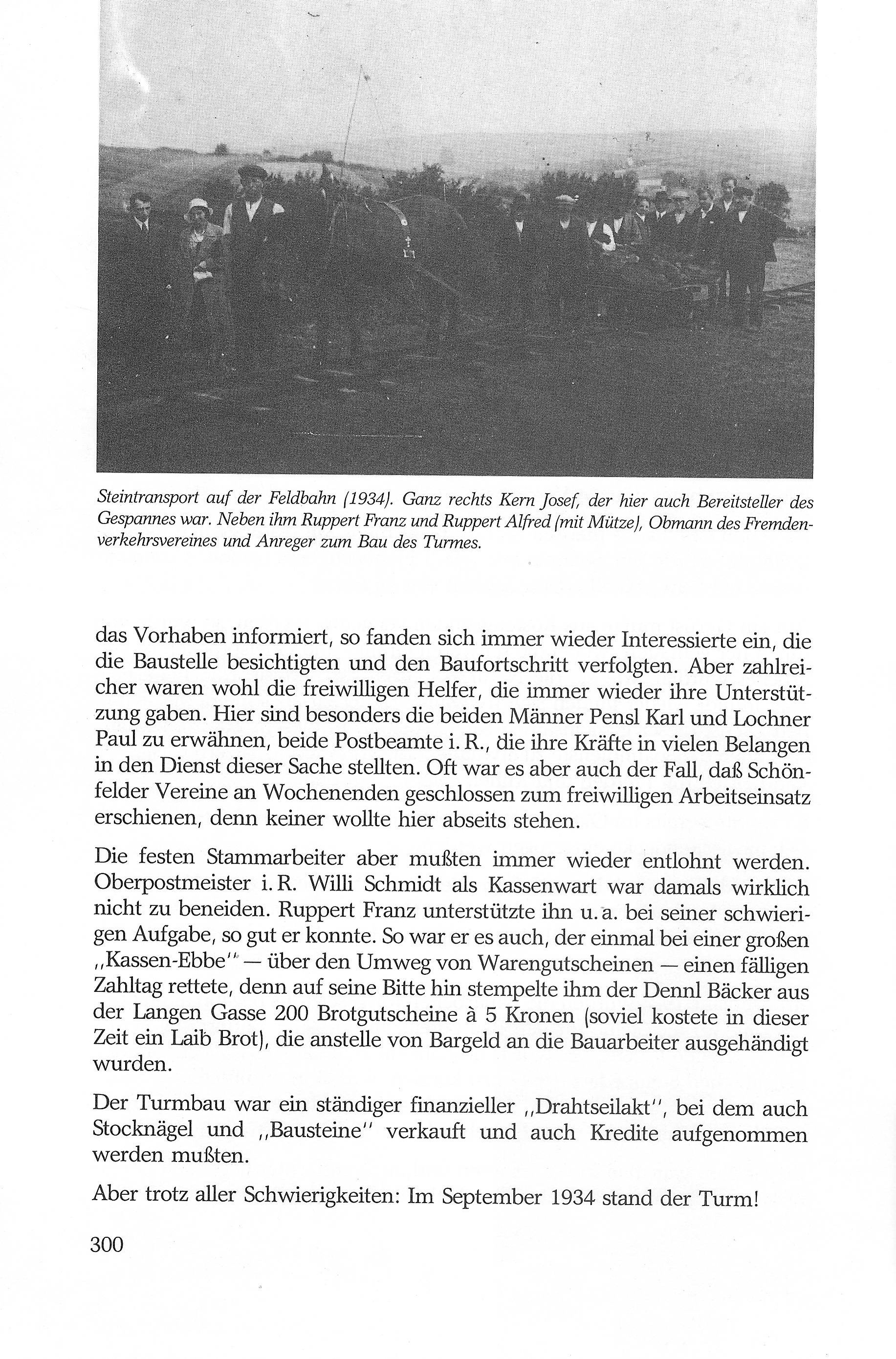 300
Stone transport on the field railway (1934). On the far right is Kern
Josef, who also provided the team. Next to him are Ruppert Franz and
Ruppert Alfred (with cap), chairman of the tourist association and
initiator of the tower's construction.
... Ruppert Franz, among others, supported him in his difficult task
as best he could. It was he who once saved a due payment day during a
major cash crunch – by way of gift vouchers – because, at his
request, the Dennl baker from Lange Gasse stamped 200 bread vouchers
worth 5 crowns each (the cost of a loaf of bread at that time), which
were handed out to the construction workers instead of cash.
The construction of the tower was a constant financial balancing act,
in which nails and building blocks had to be sold and loans had to be
taken out. But despite all the difficulties: In September 1934, the
tower was standing!
300
300
Stone transport on the field railway (1934). On the far right is Kern
Josef, who also provided the team. Next to him are Ruppert Franz and
Ruppert Alfred (with cap), chairman of the tourist association and
initiator of the tower's construction.
... Ruppert Franz, among others, supported him in his difficult task
as best he could. It was he who once saved a due payment day during a
major cash crunch – by way of gift vouchers – because, at his
request, the Dennl baker from Lange Gasse stamped 200 bread vouchers
worth 5 crowns each (the cost of a loaf of bread at that time), which
were handed out to the construction workers instead of cash.
The construction of the tower was a constant financial balancing act,
in which nails and building blocks had to be sold and loans had to be
taken out. But despite all the difficulties: In September 1934, the
tower was standing!
300
Page 0300
 301
The stone colossus, built over a year and under the most difficult
conditions, became the landmark of our hometown from that moment
on. This tower was also a symbol of the strength and power that a
determined community is capable of mustering.
The following technical data and information about this structure
support the assessment of this achievement:
Tower height:
Base diameter:
Wall thickness at the base:
Material used:
25.00 meters
11.00 meters
2.50 meters
1100 cubic meters
The platform, with a diameter of 234 meters, is reached via a 22-turn
external staircase with 120 steps. The 80-centimeter-wide staircase,
including the platform, was provided with a one-meter-high parapet
wall with a wall thickness of approximately 45 centimeters. Four
concrete intermediate floors were installed inside the tower. They had
a square recess for a possible future passenger elevator. The cost
side is also very interesting:
The structure cost approximately 55,000 crowns. This amount was raised
directly or indirectly by Schönfeld's citizens of all classes, without
any subsidy from any official or government agency.
Around 70% (39,000 crowns) went towards wages.
Building materials such as lime, cement, and iron required around
9,000 crowns. The remainder came from social security contributions.
Considering the numerous voluntary services that were contributed in
various ways, the value of the property is over 100,000 crowns. The
ceremonial inauguration of the observation tower was scheduled for
Sunday, October 6, 1934. All preparations had been made, and the
observation deck was decorated with garlands. On Saturday evening,
after dark, it shone with festive illumination. There was a fireworks
display, and everyone looked forward to the coming day. However, on
Sunday night, torrential rain began, which continued unabated
throughout the entire Sunday. The inauguration had to be canceled and
postponed to an unspecified date.
301
301
The stone colossus, built over a year and under the most difficult
conditions, became the landmark of our hometown from that moment
on. This tower was also a symbol of the strength and power that a
determined community is capable of mustering.
The following technical data and information about this structure
support the assessment of this achievement:
Tower height:
Base diameter:
Wall thickness at the base:
Material used:
25.00 meters
11.00 meters
2.50 meters
1100 cubic meters
The platform, with a diameter of 234 meters, is reached via a 22-turn
external staircase with 120 steps. The 80-centimeter-wide staircase,
including the platform, was provided with a one-meter-high parapet
wall with a wall thickness of approximately 45 centimeters. Four
concrete intermediate floors were installed inside the tower. They had
a square recess for a possible future passenger elevator. The cost
side is also very interesting:
The structure cost approximately 55,000 crowns. This amount was raised
directly or indirectly by Schönfeld's citizens of all classes, without
any subsidy from any official or government agency.
Around 70% (39,000 crowns) went towards wages.
Building materials such as lime, cement, and iron required around
9,000 crowns. The remainder came from social security contributions.
Considering the numerous voluntary services that were contributed in
various ways, the value of the property is over 100,000 crowns. The
ceremonial inauguration of the observation tower was scheduled for
Sunday, October 6, 1934. All preparations had been made, and the
observation deck was decorated with garlands. On Saturday evening,
after dark, it shone with festive illumination. There was a fireworks
display, and everyone looked forward to the coming day. However, on
Sunday night, torrential rain began, which continued unabated
throughout the entire Sunday. The inauguration had to be canceled and
postponed to an unspecified date.
301
Page 0301
 302
Numerous guests from outside the area had already arrived in Schönfeld
for this celebration, having traveled there in vain. Rupperth Fredl
remarked resignedly: "We managed everything so well, but we couldn't
control the weather."
The official inauguration of the observation tower took place the
following year, on Sunday, June 23, 1935, in a ceremonial
ceremony. The weather was at its best that day. All local clubs were
invited. Numerous visitors and especially many Schönfelders living
abroad also attended this festive occasion.
The welcoming address was given by Alfred Rupperth, chairman of the
Tourist Association. This was followed by the ceremonial inauguration,
which was conducted by our pastor Karl Enzmann.
Afterward, Professor Dr. Kapel from Karlsbad, representing the State
Association of Tourist Associations, gave the keynote speech. The
celebration was accompanied by performances by the Schönfelder Choral
Society.
The evening concluded with a fireworks display.
The new landmark of our hometown was given the name: "Schönfelder
Observation Tower at the Karlsbad Semmering."
After the annexation to the German Reich, in the spring of 1939,
Rupperth requested the then mayor, Tauber, to rename this name to
"Adolf Hitler Lookout." The name change was requested from the Reich
Chancellery in Berlin; in May (?) 1939, this request was approved. The
history of the Schönfeld Lookout, which, from today's perspective,
probably did not bring the boost to Schönfeld that its initiators and
builders had hoped for in that economically desolate time, would be
incomplete without mentioning the tower restoration, or rather the
"Einkehr-Haus," as the front of this building reads.
This accommodation building with an inn and guest rooms was built and
managed by Franz Herget. This also resolved a concern of the tourist
association.
This restaurant was later acquired by Franz Fliegl, who continued to
run it with his wife (Erna Schimmer) until the expulsion. Fliegl was
also responsible for connecting it to the electricity grid, building
the terrace, and constructing the veranda.
302
302
Numerous guests from outside the area had already arrived in Schönfeld
for this celebration, having traveled there in vain. Rupperth Fredl
remarked resignedly: "We managed everything so well, but we couldn't
control the weather."
The official inauguration of the observation tower took place the
following year, on Sunday, June 23, 1935, in a ceremonial
ceremony. The weather was at its best that day. All local clubs were
invited. Numerous visitors and especially many Schönfelders living
abroad also attended this festive occasion.
The welcoming address was given by Alfred Rupperth, chairman of the
Tourist Association. This was followed by the ceremonial inauguration,
which was conducted by our pastor Karl Enzmann.
Afterward, Professor Dr. Kapel from Karlsbad, representing the State
Association of Tourist Associations, gave the keynote speech. The
celebration was accompanied by performances by the Schönfelder Choral
Society.
The evening concluded with a fireworks display.
The new landmark of our hometown was given the name: "Schönfelder
Observation Tower at the Karlsbad Semmering."
After the annexation to the German Reich, in the spring of 1939,
Rupperth requested the then mayor, Tauber, to rename this name to
"Adolf Hitler Lookout." The name change was requested from the Reich
Chancellery in Berlin; in May (?) 1939, this request was approved. The
history of the Schönfeld Lookout, which, from today's perspective,
probably did not bring the boost to Schönfeld that its initiators and
builders had hoped for in that economically desolate time, would be
incomplete without mentioning the tower restoration, or rather the
"Einkehr-Haus," as the front of this building reads.
This accommodation building with an inn and guest rooms was built and
managed by Franz Herget. This also resolved a concern of the tourist
association.
This restaurant was later acquired by Franz Fliegl, who continued to
run it with his wife (Erna Schimmer) until the expulsion. Fliegl was
also responsible for connecting it to the electricity grid, building
the terrace, and constructing the veranda.
302
Page 0302
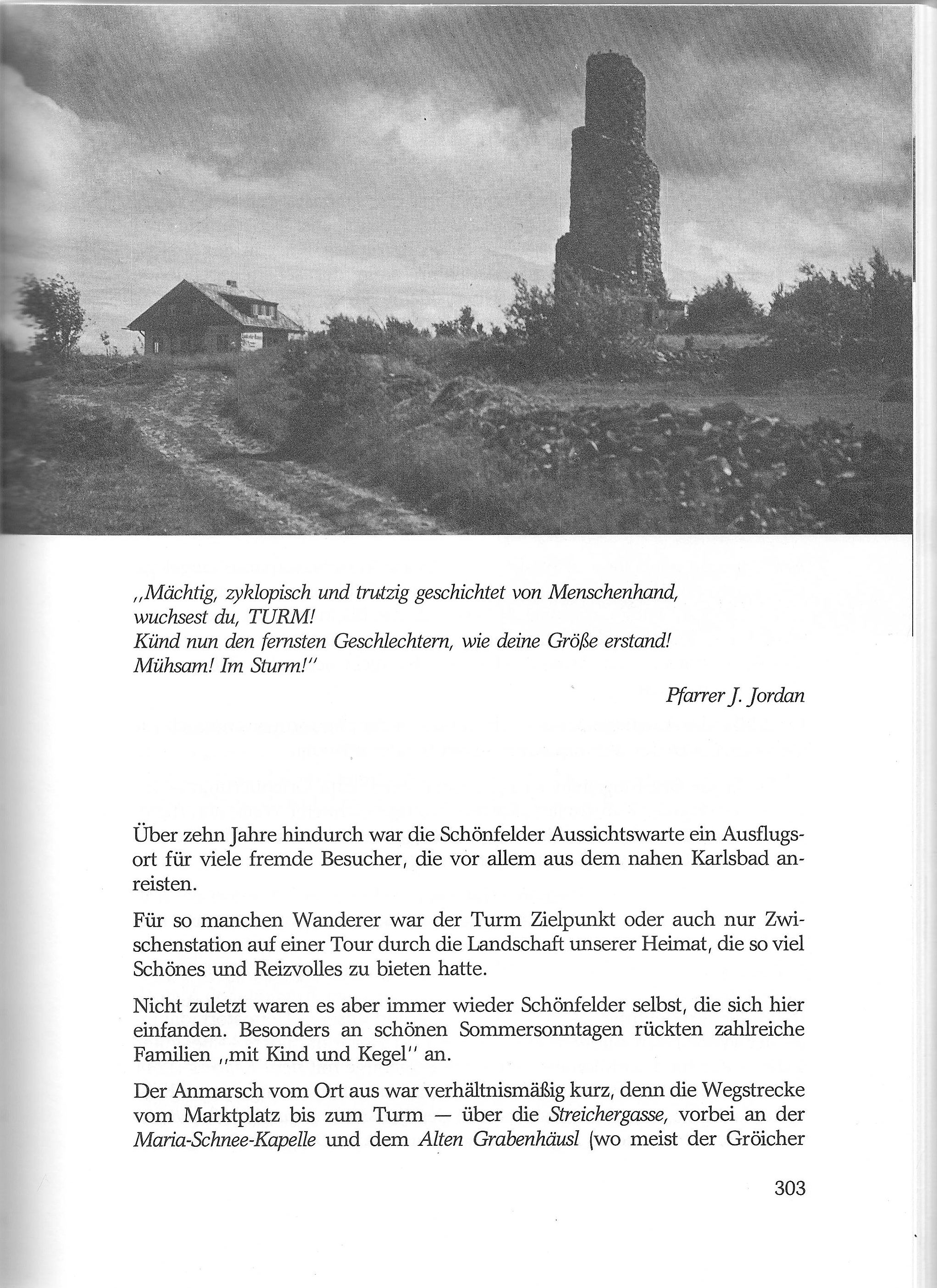 303
"Mighty, cyclopean, and defiantly layered by human hands, you grew,
TOWER!
Now tell the most distant generations how your greatness arose! With
difficulty! In the storm!"
Pastor J. Jordan
For over ten years, the Schönfeld lookout tower was a destination for
many foreign visitors, who traveled primarily from nearby Karlovy
Vary.
For many a hiker, the tower was a destination or even just a stopover
on a tour through the landscape of our homeland, which had so much
beauty and charm to offer.
Last but not least, it was always Schönfeld residents themselves who
came here. Especially on beautiful summer Sundays, numerous families
"with children and grandchildren" would gather here.
The walk from the village was relatively short, as the route from the
market square to the tower – via Streichergasse, past the Maria
Schnee Chapel and the Alte Grabenhäusl (where the Gröicher usually
303
303
"Mighty, cyclopean, and defiantly layered by human hands, you grew,
TOWER!
Now tell the most distant generations how your greatness arose! With
difficulty! In the storm!"
Pastor J. Jordan
For over ten years, the Schönfeld lookout tower was a destination for
many foreign visitors, who traveled primarily from nearby Karlovy
Vary.
For many a hiker, the tower was a destination or even just a stopover
on a tour through the landscape of our homeland, which had so much
beauty and charm to offer.
Last but not least, it was always Schönfeld residents themselves who
came here. Especially on beautiful summer Sundays, numerous families
"with children and grandchildren" would gather here.
The walk from the village was relatively short, as the route from the
market square to the tower – via Streichergasse, past the Maria
Schnee Chapel and the Alte Grabenhäusl (where the Gröicher usually
303
Page 0303
 304
Hans sat and offered the walkers snacks from his parked basket) –
was just over a kilometer.
After the Alte Grabenhäusl, the most beautiful part of the trail
began, as from here, the path followed the course of the
Flößgraben. The narrow path beside the whispering water offered a
magnificent view of the Tiefenbach Valley. At Rau(d)n-Schützlå,
the shady spruce forest welcomed the hikers. Over the small
Flößgraben bridge, they then turned right, past the Waldandacht
(forest prayer), up the stone scree over unhewn natural stone
steps. Soon they reached the cross path, which they walked in a
westerly direction. After a few meters, they continued steeply up the
mountain again, over more steps.
One was always quite pleased when, just before reaching the
destination, the rough gray-brown stone wall of the tower appeared
through the coniferous woodland. After a few steps, one suddenly and
surprisingly stood close to this massive structure, whose height was
only fully apparent at that moment.
Usually, a short break was taken after this climb before tackling the
120 steps leading up to the platform. With each step, the field of
view changed and expanded. Every now and then, the climber had to
press himself against the wall of the tower or use a window niche to
Clear the way for those descending on the rather narrow stairs.
The effort of the climb was worthwhile, for from the platform, a
panorama offered visitors a never-ending delight.
Six enameled orientation panels, embedded in the parapet wall,
superbly executed by the Carlsbad painter Hamann, helped the viewer
identify the numerous towns, villages, mountains, and ridges within
view.
Thus, in the immediate vicinity, from southwest to northeast,
stretched the Kaiserwald, with its highest elevation, the Judenhau
(987 meters) near Bad Königswart. To the west, close to our
neighboring town of Lauterbach, one could see the Knock (856 meters),
with the Muckenberg (790 meters) and the Spitzberg (825 meters) to the
side. Behind it lay the Krudum (835 meters). To the north, one could
see our hometown in the foreground, behind it the White Hill with the
Hohen Stein. The horizon formed – on a clear day – the The Ore
Mountains, some 35 kilometers away, with the Keilberg (1,244 meters)
as its highest point, were visible. Further east, at a distance of 15
kilometers as the crow flies, was the observation tower of the
Karlsbader Freundschaftshöhe. Further to the right was Engelhaus, and
beyond it, the Duppauer Mountains.
304
304
Hans sat and offered the walkers snacks from his parked basket) –
was just over a kilometer.
After the Alte Grabenhäusl, the most beautiful part of the trail
began, as from here, the path followed the course of the
Flößgraben. The narrow path beside the whispering water offered a
magnificent view of the Tiefenbach Valley. At Rau(d)n-Schützlå,
the shady spruce forest welcomed the hikers. Over the small
Flößgraben bridge, they then turned right, past the Waldandacht
(forest prayer), up the stone scree over unhewn natural stone
steps. Soon they reached the cross path, which they walked in a
westerly direction. After a few meters, they continued steeply up the
mountain again, over more steps.
One was always quite pleased when, just before reaching the
destination, the rough gray-brown stone wall of the tower appeared
through the coniferous woodland. After a few steps, one suddenly and
surprisingly stood close to this massive structure, whose height was
only fully apparent at that moment.
Usually, a short break was taken after this climb before tackling the
120 steps leading up to the platform. With each step, the field of
view changed and expanded. Every now and then, the climber had to
press himself against the wall of the tower or use a window niche to
Clear the way for those descending on the rather narrow stairs.
The effort of the climb was worthwhile, for from the platform, a
panorama offered visitors a never-ending delight.
Six enameled orientation panels, embedded in the parapet wall,
superbly executed by the Carlsbad painter Hamann, helped the viewer
identify the numerous towns, villages, mountains, and ridges within
view.
Thus, in the immediate vicinity, from southwest to northeast,
stretched the Kaiserwald, with its highest elevation, the Judenhau
(987 meters) near Bad Königswart. To the west, close to our
neighboring town of Lauterbach, one could see the Knock (856 meters),
with the Muckenberg (790 meters) and the Spitzberg (825 meters) to the
side. Behind it lay the Krudum (835 meters). To the north, one could
see our hometown in the foreground, behind it the White Hill with the
Hohen Stein. The horizon formed – on a clear day – the The Ore
Mountains, some 35 kilometers away, with the Keilberg (1,244 meters)
as its highest point, were visible. Further east, at a distance of 15
kilometers as the crow flies, was the observation tower of the
Karlsbader Freundschaftshöhe. Further to the right was Engelhaus, and
beyond it, the Duppauer Mountains.
304
Page 0304
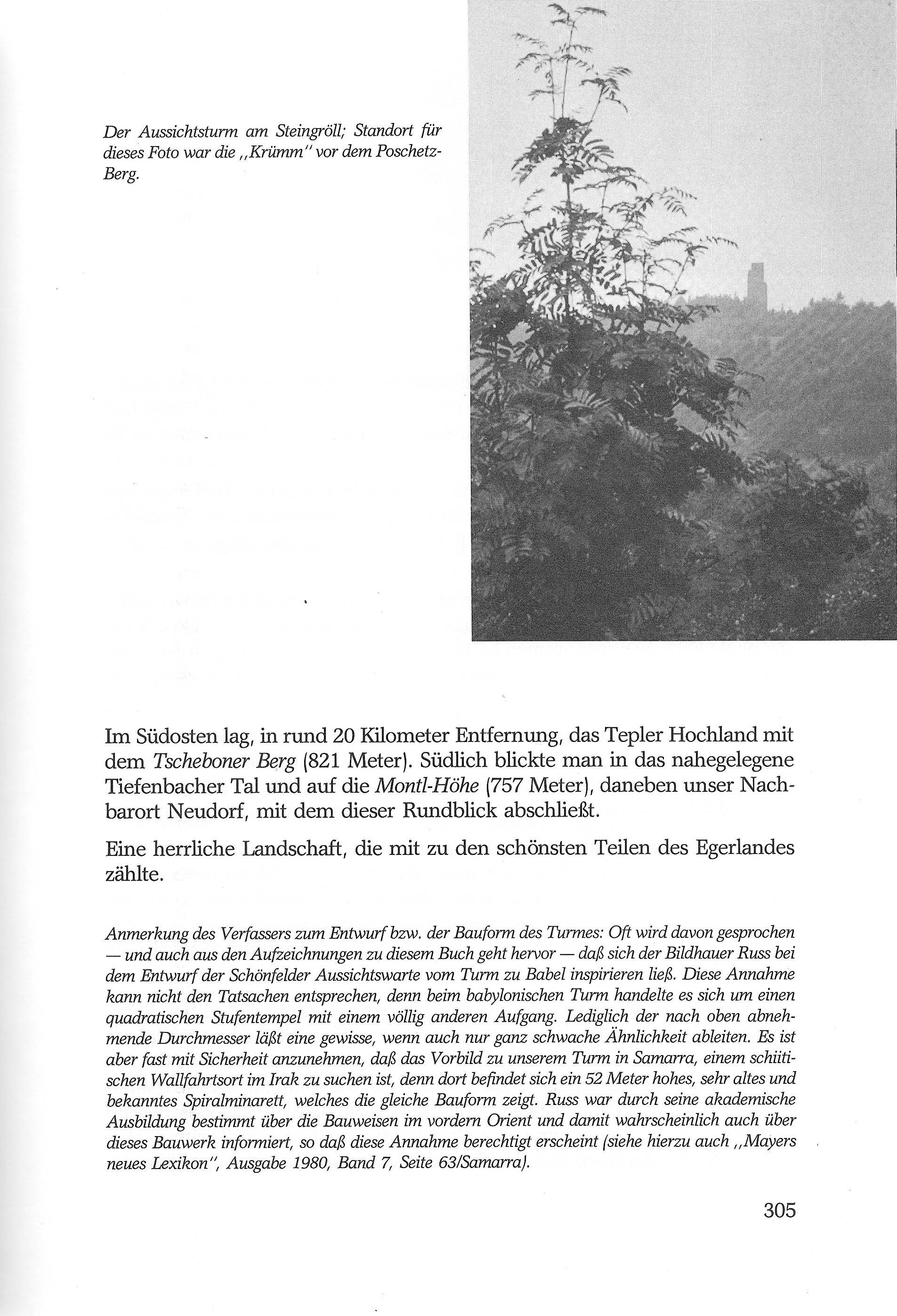 305
The observation tower at Steingröll; The location for this photo was
the "Krümm" in front of the Poschetz Mountain.
To the southeast, about 20 kilometers away, lay the Tepler Highlands
with the Tscheboner Mountain (821 meters). To the south, one could see
the nearby Tiefenbach Valley and the Montl Heights (757 meters), next
to our neighboring town of Neudorf, which completes this panoramic
view.
A magnificent landscape that was one of the most beautiful parts of
the Egerland region.
Author's note on the design and structural form of the tower: It is
often said—and the notes for this book also reveal this—that the
sculptor Russ was inspired by the Tower of Babel when designing the
Schönfeld Observation Tower. This assumption cannot be true, because
the Tower of Babel was a square stepped temple with a completely
different entrance. Only the diameter, which decreases towards the
top, suggests a certain, albeit very faint, similarity. It is However,
it can almost certainly be assumed that the model for our tower can be
found in Samarra, a Shiite pilgrimage site in Iraq, because there is a
52-meter-high, very old, and well-known spiral minaret there, which
has the same design. Russ was certainly familiar with the construction
methods of the Near East through his academic training and thus
probably also with this building, so this assumption seems justified
(see also "Mayer's New Encyclopedia," 1980 edition, Volume 7, page
63/Samarra).
305
305
The observation tower at Steingröll; The location for this photo was
the "Krümm" in front of the Poschetz Mountain.
To the southeast, about 20 kilometers away, lay the Tepler Highlands
with the Tscheboner Mountain (821 meters). To the south, one could see
the nearby Tiefenbach Valley and the Montl Heights (757 meters), next
to our neighboring town of Neudorf, which completes this panoramic
view.
A magnificent landscape that was one of the most beautiful parts of
the Egerland region.
Author's note on the design and structural form of the tower: It is
often said—and the notes for this book also reveal this—that the
sculptor Russ was inspired by the Tower of Babel when designing the
Schönfeld Observation Tower. This assumption cannot be true, because
the Tower of Babel was a square stepped temple with a completely
different entrance. Only the diameter, which decreases towards the
top, suggests a certain, albeit very faint, similarity. It is However,
it can almost certainly be assumed that the model for our tower can be
found in Samarra, a Shiite pilgrimage site in Iraq, because there is a
52-meter-high, very old, and well-known spiral minaret there, which
has the same design. Russ was certainly familiar with the construction
methods of the Near East through his academic training and thus
probably also with this building, so this assumption seems justified
(see also "Mayer's New Encyclopedia," 1980 edition, Volume 7, page
63/Samarra).
305
Page 0305
 306
The Filz
(See also the Topography chapter.)
This approximately one-square-kilometer moorland, located at the foot
of the Muckenberg and Spitzberg mountains, belonged to the Petschau
domain in earlier centuries. As it was deemed unusable for
agricultural purposes, it was donated to the municipality of
Schönfeld.
Due to the abundance of timber at the time, however, hardly any peat
was mined, so the municipality, just to save a few tax pennies, gave
this area to the town of Elbogen free of charge, albeit with the
reservation of the right of use.
How invaluable this agreement was became apparent in the later years
after World War I, when general unemployment had reached catastrophic
levels. At that time, men, women, and schoolboys often flocked to the
Filz to cut peat bricks.
It was a distinctly summer job, providing the best conditions for
drying the wet-stacked pieces of peat. As difficult and primitive as
cutting peat may have been, for many of the less well-off, the felt
was a free source of clean fuel. Unfortunately, the extraction was
carried out completely haphazardly, with the result that this area
later became life-threatening. The up to two-meter-deep cuts filled
with water, and not only that, but many small pools disappeared
beneath a layer of vegetation, forming what was known as a "cow
belly." Woe betide anyone who unknowingly entered such an overgrown
area.
At the beginning of 1921, Erich Korndörfer, a native of Asch who, as a
captain, had been in charge of the military ore mining industry during
the war, attempted to exploit the peat deposit for industrial
purposes. He intended to spin the relatively loose peat fiber, but
this later proved to be unfeasible. The company thus focused solely on
the extraction of fuel, compressed peat, and peat moss. Korndörfer
purchased part of the peat area, including some felt meadows.
306
306
The Filz
(See also the Topography chapter.)
This approximately one-square-kilometer moorland, located at the foot
of the Muckenberg and Spitzberg mountains, belonged to the Petschau
domain in earlier centuries. As it was deemed unusable for
agricultural purposes, it was donated to the municipality of
Schönfeld.
Due to the abundance of timber at the time, however, hardly any peat
was mined, so the municipality, just to save a few tax pennies, gave
this area to the town of Elbogen free of charge, albeit with the
reservation of the right of use.
How invaluable this agreement was became apparent in the later years
after World War I, when general unemployment had reached catastrophic
levels. At that time, men, women, and schoolboys often flocked to the
Filz to cut peat bricks.
It was a distinctly summer job, providing the best conditions for
drying the wet-stacked pieces of peat. As difficult and primitive as
cutting peat may have been, for many of the less well-off, the felt
was a free source of clean fuel. Unfortunately, the extraction was
carried out completely haphazardly, with the result that this area
later became life-threatening. The up to two-meter-deep cuts filled
with water, and not only that, but many small pools disappeared
beneath a layer of vegetation, forming what was known as a "cow
belly." Woe betide anyone who unknowingly entered such an overgrown
area.
At the beginning of 1921, Erich Korndörfer, a native of Asch who, as a
captain, had been in charge of the military ore mining industry during
the war, attempted to exploit the peat deposit for industrial
purposes. He intended to spin the relatively loose peat fiber, but
this later proved to be unfeasible. The company thus focused solely on
the extraction of fuel, compressed peat, and peat moss. Korndörfer
purchased part of the peat area, including some felt meadows.
306
Page 0306
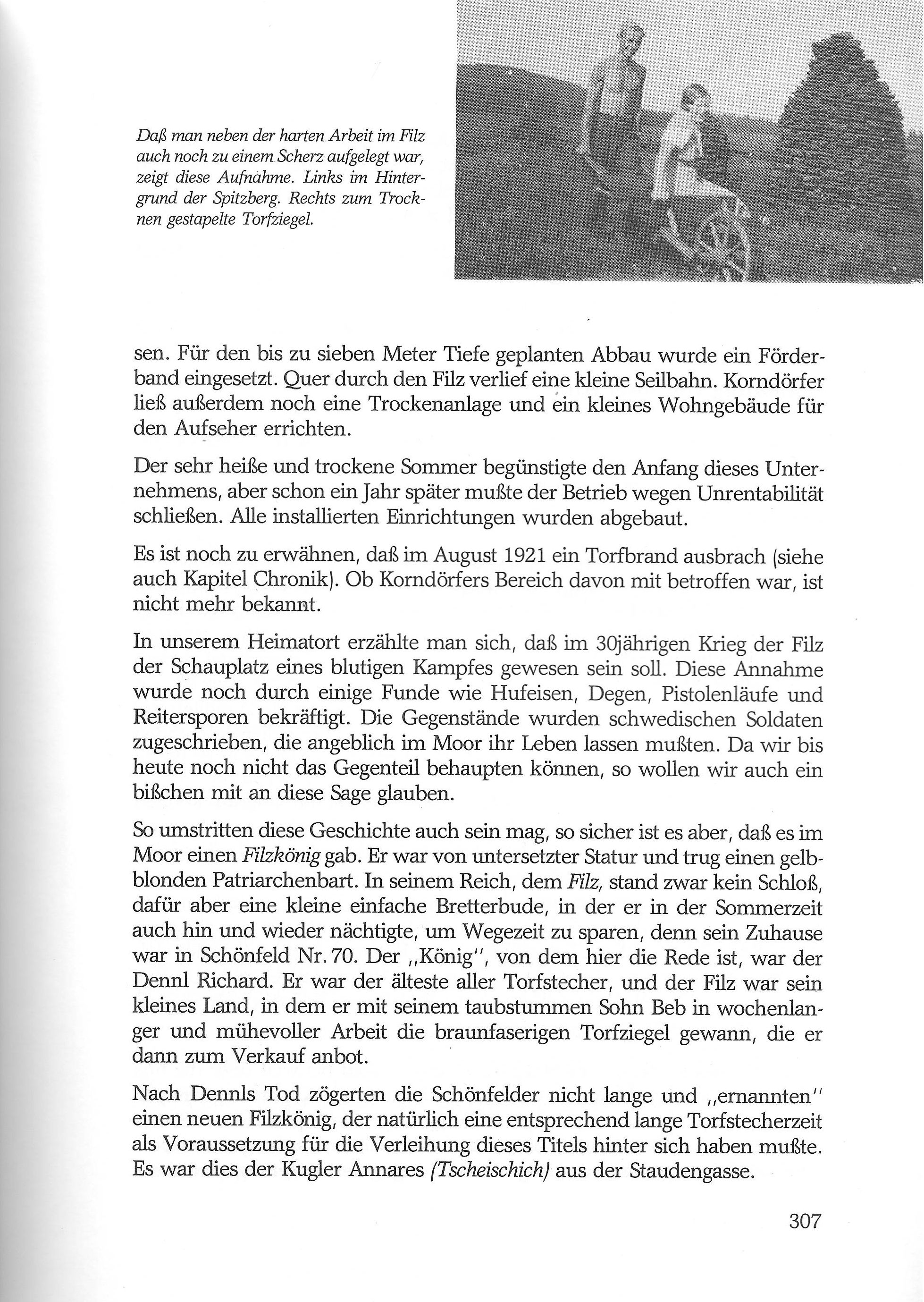 307
This photo shows that, in addition to the hard work, the people in the
Filz were also in the mood for a joke. On the left in the background
is the Spitzberg. On the right, peat bricks stacked for drying.
A conveyor belt was used for the planned mining operations, which were
planned to reach depths of up to seven meters. A small cable car ran
across the Filz. Korndörfer also had a drying facility and a small
residential building built for the supervisor.
The very hot and dry summer favored the start of this venture, but
just a year later, the operation had to close due to
unprofitability. All installed facilities were dismantled.
It should also be mentioned that a peat fire broke out in August 1921
(see also the Chronicle chapter). Whether Korndörfer's area was
affected is not known.
In our hometown, it was said that the Filz was the scene of a bloody
battle during the Thirty Years' War. This assumption was further
reinforced by several finds, such as horseshoes, swords, pistol
barrels, and riding spurs. The objects were attributed to Swedish
soldiers who supposedly lost their lives in the moor. Since we still
can't prove the opposite, we'll give this legend a little credence.
As controversial as this story may be, it is certain that there was a
felt king in the moor. He was of stocky build and wore a yellow-blond
patriarchal beard. In his kingdom, the Filz, there was no castle, but
instead a small, simple wooden hut, in which he occasionally spent the
night during the summer to save travel time, as his home was at
Schönfeld No. 70. The "king" referred to here was Dennl Richard. He
was the oldest of all peat cutters, and the Filz was his small land,
where he and his deaf-mute son Beb spent weeks of laborious work
extracting the brown-fibered peat bricks, which he then offered for
sale. After Dennl's death, the Schönfeld residents didn't hesitate
for long and appointed a new Filz king, who, of course, had to have
completed a correspondingly long peat-cutting career as a prerequisite
for being awarded this title. This was the Kugler Annares
(Tscheischich) from Staudengasse.
307
307
This photo shows that, in addition to the hard work, the people in the
Filz were also in the mood for a joke. On the left in the background
is the Spitzberg. On the right, peat bricks stacked for drying.
A conveyor belt was used for the planned mining operations, which were
planned to reach depths of up to seven meters. A small cable car ran
across the Filz. Korndörfer also had a drying facility and a small
residential building built for the supervisor.
The very hot and dry summer favored the start of this venture, but
just a year later, the operation had to close due to
unprofitability. All installed facilities were dismantled.
It should also be mentioned that a peat fire broke out in August 1921
(see also the Chronicle chapter). Whether Korndörfer's area was
affected is not known.
In our hometown, it was said that the Filz was the scene of a bloody
battle during the Thirty Years' War. This assumption was further
reinforced by several finds, such as horseshoes, swords, pistol
barrels, and riding spurs. The objects were attributed to Swedish
soldiers who supposedly lost their lives in the moor. Since we still
can't prove the opposite, we'll give this legend a little credence.
As controversial as this story may be, it is certain that there was a
felt king in the moor. He was of stocky build and wore a yellow-blond
patriarchal beard. In his kingdom, the Filz, there was no castle, but
instead a small, simple wooden hut, in which he occasionally spent the
night during the summer to save travel time, as his home was at
Schönfeld No. 70. The "king" referred to here was Dennl Richard. He
was the oldest of all peat cutters, and the Filz was his small land,
where he and his deaf-mute son Beb spent weeks of laborious work
extracting the brown-fibered peat bricks, which he then offered for
sale. After Dennl's death, the Schönfeld residents didn't hesitate
for long and appointed a new Filz king, who, of course, had to have
completed a correspondingly long peat-cutting career as a prerequisite
for being awarded this title. This was the Kugler Annares
(Tscheischich) from Staudengasse.
307
Page 0307
 308
Legends of the Homeland
Introduction by Josef Hubl
Among the little-noticed and little-climbed heights of northwestern
Bohemia is Mount Krudum, which rises from the Teplá Plateau as the
highest peak of a special mountain range.
Its primary rock masses rise majestically above the evergreen forests
surrounding its base and slopes, forming a ridge extending from east
to west, whose western end, higher than the opposite one, is called
the anterior Krudum. The division of the ridge is more noticeable by a
depression on the southern slope of the mountain range than on the
ridge, which extends into a partially cleared platform. To this point
we will take our somewhat arduous, yet highly rewarding route from the
village of Dreihäuser.
Soon the refreshing coolness of the forest envelops us; We can only
slowly follow the steeply ascending path, and we aren't even forced to
make a short stop, during which, admiring all the many splendors, we
gladly forget the difficulties of mountaineering. Finally, we prepare
to climb the steepest section. After passing through a small grove,
our feet involuntarily stumble. A cry of surprise and admiration
escapes our hearts, as the highest part of the Bohemian Ore Mountains,
towering before us up to the blue sky and separated by a vast valley
basin, lies a rare feast for the eyes. From the foothills of the
Fichtel Mountains, far beyond the Kupferberg Chapel, shimmering
brightly through the sunny ether, across the massive Duppauer Mountain
Range, the Tepler Plateau, and even down to the foothills of the
Bohemian Forest, blurred in the indefinite blue, our eyes can, in
reasonably good weather, wander.
308
308
Legends of the Homeland
Introduction by Josef Hubl
Among the little-noticed and little-climbed heights of northwestern
Bohemia is Mount Krudum, which rises from the Teplá Plateau as the
highest peak of a special mountain range.
Its primary rock masses rise majestically above the evergreen forests
surrounding its base and slopes, forming a ridge extending from east
to west, whose western end, higher than the opposite one, is called
the anterior Krudum. The division of the ridge is more noticeable by a
depression on the southern slope of the mountain range than on the
ridge, which extends into a partially cleared platform. To this point
we will take our somewhat arduous, yet highly rewarding route from the
village of Dreihäuser.
Soon the refreshing coolness of the forest envelops us; We can only
slowly follow the steeply ascending path, and we aren't even forced to
make a short stop, during which, admiring all the many splendors, we
gladly forget the difficulties of mountaineering. Finally, we prepare
to climb the steepest section. After passing through a small grove,
our feet involuntarily stumble. A cry of surprise and admiration
escapes our hearts, as the highest part of the Bohemian Ore Mountains,
towering before us up to the blue sky and separated by a vast valley
basin, lies a rare feast for the eyes. From the foothills of the
Fichtel Mountains, far beyond the Kupferberg Chapel, shimmering
brightly through the sunny ether, across the massive Duppauer Mountain
Range, the Tepler Plateau, and even down to the foothills of the
Bohemian Forest, blurred in the indefinite blue, our eyes can, in
reasonably good weather, wander.
308
Page 0308
 309
Closer to us are the bare Spitzberg, the elongated Mückenberg, the
Bretenberg, the Hohe Ruh, and other less significant heights, and,
either completely or partially enclosed by the forests that extend far
and wide around their base, the nearby villages of Kohling, Birndorf,
and Dreihäuser. Actually, the entire extensive forest area
belonging to the municipality of Elbogen, located not far from the
villages of Schlaggenwald, Schönfeld, Lauterbach/Stadt, Dreihäuser,
Kohling, Lobs, and Birndorf, was referred to as the "Krudum District."
However, the core of this forest area, which contained exclusively
coniferous trees, was the double-peaked, 835-meter-high Krudum
Mountain, surrounded by legends and fairy tales, located about five
kilometers north of Schönfeld.
No matter what the word, or rather the Krudum Mountain, was associated
with, most people could not prevent a period of dim prehistory from
flashing before their eyes, which even triggered a slight shudder or
goosebumps in anxious people. This may also have been the reason why,
regardless of the speaker's background, the possessive pronoun "our"
was never used when mentioning Krudum. It came into use, although it
was used more often than appropriate for other municipal properties.
Most residents of the villages mentioned above doubled their pace to
escape its spell as quickly as possible when passing Krudum, and even
otherwise robust men insisted on seeing and hearing things as they
passed that could only occur in the spirit world. Some swore that they
saw Krudum-Barberl hanging out laundry on Good Friday; others claimed
to have seen her as a white woman or in some other form, and still
others claimed to have seen an apple tree laden with rosy-cheeked
apples on Krudum that disappeared before their eyes on Good Friday.
But not only on Krudum Mountain itself, but also in the surrounding
forests, it was said to be the "white woman," "the Höimuå," and
other apparitions that spread fear and anxiety.
As widespread as such claims about such occurrences were in earlier
years, they increasingly lost credibility with the decline of
superstition and the progressive education and modernization of rural
residents.
Over time, people lost their fear of the Krudum, and after the turn of
the century, it became an increasingly popular attraction and
destination.
309
309
Closer to us are the bare Spitzberg, the elongated Mückenberg, the
Bretenberg, the Hohe Ruh, and other less significant heights, and,
either completely or partially enclosed by the forests that extend far
and wide around their base, the nearby villages of Kohling, Birndorf,
and Dreihäuser. Actually, the entire extensive forest area
belonging to the municipality of Elbogen, located not far from the
villages of Schlaggenwald, Schönfeld, Lauterbach/Stadt, Dreihäuser,
Kohling, Lobs, and Birndorf, was referred to as the "Krudum District."
However, the core of this forest area, which contained exclusively
coniferous trees, was the double-peaked, 835-meter-high Krudum
Mountain, surrounded by legends and fairy tales, located about five
kilometers north of Schönfeld.
No matter what the word, or rather the Krudum Mountain, was associated
with, most people could not prevent a period of dim prehistory from
flashing before their eyes, which even triggered a slight shudder or
goosebumps in anxious people. This may also have been the reason why,
regardless of the speaker's background, the possessive pronoun "our"
was never used when mentioning Krudum. It came into use, although it
was used more often than appropriate for other municipal properties.
Most residents of the villages mentioned above doubled their pace to
escape its spell as quickly as possible when passing Krudum, and even
otherwise robust men insisted on seeing and hearing things as they
passed that could only occur in the spirit world. Some swore that they
saw Krudum-Barberl hanging out laundry on Good Friday; others claimed
to have seen her as a white woman or in some other form, and still
others claimed to have seen an apple tree laden with rosy-cheeked
apples on Krudum that disappeared before their eyes on Good Friday.
But not only on Krudum Mountain itself, but also in the surrounding
forests, it was said to be the "white woman," "the Höimuå," and
other apparitions that spread fear and anxiety.
As widespread as such claims about such occurrences were in earlier
years, they increasingly lost credibility with the decline of
superstition and the progressive education and modernization of rural
residents.
Over time, people lost their fear of the Krudum, and after the turn of
the century, it became an increasingly popular attraction and
destination.
309
Page 0309
 310
for day-trippers, and not a year went by without many school classes
and their teachers paying a visit to Krudum during the spring and
summer. Of course, it was indispensable for the teacher to tell the
schoolchildren various legends about Krudum during their rest at the
summit, and to have them tell them. Alongside this, when visibility
was good, a little geography was also practiced, for the mountain's
height allowed for the Ore Mountains with their highest point, the
Keilberg, as well as the Duppauer and other mountains. But the
immediate surroundings were also worth seeing, for, seen from Krudum,
they always presented a picture of rare beauty. Furthermore, Krudum
also provided an opportunity to touch on natural history, for during
the long period when few people set foot on the mountain, various
animals made their home there, of which the stag beetle is
particularly noteworthy. This beetle, the male of which can reach up
to eight centimeters in length and has a horn-like pincer of the same
length on the side of its head, was said to be found in no other
forests in our region except on Krudum Mountain.
Besides all this, a teacher at Krudum also had material to discuss
geology with his students, for while the Prague company C. T. Petzold
& Co. (co-owner of the Neudecker Ironworks and owner of the Grafen
Shaft in Grasseth) exercised its mining rights for red iron ore at the
foot of the eastern side of the mountain for many years, according to
ancient traditions, the mountain is also crisscrossed by silver and
tin veins, alongside which, based on current knowledge, uranium and
tungsten might also be found.
But another sight that had already become a rarity almost everywhere,
even in our region, in the years before World War I could be
encountered at the foot of the southern side of the mountain: the
charcoal burner and his charcoal kilns. The abundance of wood there,
coupled with the likely laborious and difficult removal of the same in
earlier years, presumably made it seem advisable and more economical
to convert the wood on site into a more refined and lighter
product. And what could that be other than charcoal, which was widely
used in earlier years and not exactly cheap? Thus, in the years
mentioned, near the village of Kohling, one found not only several
black, round charcoal kilns, approximately six to seven meters in
diameter, but also freshly built, smoldering charcoal kilns. At
Krudum, the last charcoal kilns were probably burned in 1913 by the
already quite elderly Lauterbach master blacksmith Köferl, who not
only used them to meet the needs of his own blacksmith shop, 310
310
for day-trippers, and not a year went by without many school classes
and their teachers paying a visit to Krudum during the spring and
summer. Of course, it was indispensable for the teacher to tell the
schoolchildren various legends about Krudum during their rest at the
summit, and to have them tell them. Alongside this, when visibility
was good, a little geography was also practiced, for the mountain's
height allowed for the Ore Mountains with their highest point, the
Keilberg, as well as the Duppauer and other mountains. But the
immediate surroundings were also worth seeing, for, seen from Krudum,
they always presented a picture of rare beauty. Furthermore, Krudum
also provided an opportunity to touch on natural history, for during
the long period when few people set foot on the mountain, various
animals made their home there, of which the stag beetle is
particularly noteworthy. This beetle, the male of which can reach up
to eight centimeters in length and has a horn-like pincer of the same
length on the side of its head, was said to be found in no other
forests in our region except on Krudum Mountain.
Besides all this, a teacher at Krudum also had material to discuss
geology with his students, for while the Prague company C. T. Petzold
& Co. (co-owner of the Neudecker Ironworks and owner of the Grafen
Shaft in Grasseth) exercised its mining rights for red iron ore at the
foot of the eastern side of the mountain for many years, according to
ancient traditions, the mountain is also crisscrossed by silver and
tin veins, alongside which, based on current knowledge, uranium and
tungsten might also be found.
But another sight that had already become a rarity almost everywhere,
even in our region, in the years before World War I could be
encountered at the foot of the southern side of the mountain: the
charcoal burner and his charcoal kilns. The abundance of wood there,
coupled with the likely laborious and difficult removal of the same in
earlier years, presumably made it seem advisable and more economical
to convert the wood on site into a more refined and lighter
product. And what could that be other than charcoal, which was widely
used in earlier years and not exactly cheap? Thus, in the years
mentioned, near the village of Kohling, one found not only several
black, round charcoal kilns, approximately six to seven meters in
diameter, but also freshly built, smoldering charcoal kilns. At
Krudum, the last charcoal kilns were probably burned in 1913 by the
already quite elderly Lauterbach master blacksmith Köferl, who not
only used them to meet the needs of his own blacksmith shop, 310
Page 0310
 311
but also supplied other blacksmiths and factory workshops with
charcoal, which was still in widespread use at the time.
However, excursion traffic to Krudum in the 1920s developed much more
strongly than in the last years before the First World War. This
prompted Cawranoch, a postal official from Elbow, who was a friend and
frequent visitor to Krudum, to suggest building an observation tower
on the Krudum summit. Although this project encountered financial
difficulties, it was nevertheless realized with the help of
collections and donations. Thus, in 1932, the "Dr. Kempf-Warte" was
built.
Just as shy and fearful as people rushed past the Krudum or even
avoided it barely 100 years ago, in the last years of our stay,
day-trippers from near and far have chosen it as their Sunday
destination.
In addition to this popularity, the Krudum has proven itself annually
to be a bountiful source of all kinds of mushrooms and wild berries,
making the trip there well worth the effort for all mushroom and berry
hunters.
The Krudum Legends
Taken from the booklet "Sagen-Buch der Heimat" (Book of Legends of the
Homeland) by Johann Hahn, Schlaggenwald (1911). This work was an
expanded new version of the 1864 booklet "Legends, Fairy Tales, and
Stories of Elbogen and its Surroundings," written by high school
teacher Anton Prokop Schmitt in Elbogen. He, in turn, had based his
work on the Eger chronicler Georg Thomas Funk, whose father, Johann
Funk, was once a forester in Elbogen.
The Castle on the Krudum
Although not the highest, the Krudum is one of the most important
mountains in the Kaiserwald, rising in three mighty peaks to a height
of 835 meters. It forms an elongated ridge dominating the surrounding
area, making it plausible that it once supported a mighty
fortification. Its slopes...
311
311
but also supplied other blacksmiths and factory workshops with
charcoal, which was still in widespread use at the time.
However, excursion traffic to Krudum in the 1920s developed much more
strongly than in the last years before the First World War. This
prompted Cawranoch, a postal official from Elbow, who was a friend and
frequent visitor to Krudum, to suggest building an observation tower
on the Krudum summit. Although this project encountered financial
difficulties, it was nevertheless realized with the help of
collections and donations. Thus, in 1932, the "Dr. Kempf-Warte" was
built.
Just as shy and fearful as people rushed past the Krudum or even
avoided it barely 100 years ago, in the last years of our stay,
day-trippers from near and far have chosen it as their Sunday
destination.
In addition to this popularity, the Krudum has proven itself annually
to be a bountiful source of all kinds of mushrooms and wild berries,
making the trip there well worth the effort for all mushroom and berry
hunters.
The Krudum Legends
Taken from the booklet "Sagen-Buch der Heimat" (Book of Legends of the
Homeland) by Johann Hahn, Schlaggenwald (1911). This work was an
expanded new version of the 1864 booklet "Legends, Fairy Tales, and
Stories of Elbogen and its Surroundings," written by high school
teacher Anton Prokop Schmitt in Elbogen. He, in turn, had based his
work on the Eger chronicler Georg Thomas Funk, whose father, Johann
Funk, was once a forester in Elbogen.
The Castle on the Krudum
Although not the highest, the Krudum is one of the most important
mountains in the Kaiserwald, rising in three mighty peaks to a height
of 835 meters. It forms an elongated ridge dominating the surrounding
area, making it plausible that it once supported a mighty
fortification. Its slopes...
311
Page 0311
 312
are covered by gloomy, mysteriously rustling forests, and in ancient
times, miners mined within them. It's no wonder, then, that Frau Sage
has devoted herself lovingly to this mountain, drawing it into the
sphere of her quiet and tireless activity.
On the ridge of Krudum, where the noise pole had been erected just a
few years ago, there stood in ancient times a mighty castle, which had
been given by the king to a brave count. The count had an only son, to
whom he intended to leave money and property. But heaven had decreed
otherwise. For the young count came into conflict with the son of the
Count of Falkenau, in which the latter was slain by the young Count of
Krudum.
To atone for his deed, the murderer went to Rome as a pilgrim and
there, at a holy place, relieved his soul of the great guilt. With a
lighter heart than when he had arrived, he left the Eternal City and,
on his way back, reached Plan without any particular
adventures. However, as he passed through a large forest, he
encountered a band of robbers dragging a loudly wailing girl with
them. The young count didn't hesitate for long and, with his squires,
hacked at the thugs so bravely that some escaped, while others
littered the battlefield dead or wounded. Then, after freeing the
prisoner from her bonds, he asked: "Who are you that I can bring you
to your homeland?" "I am the daughter of the Count of Falkenau,"
replied the maiden.
It was a strange twist of fate that the young knight had rescued the
daughter of the man he had caused so much suffering from the hands of
robbers. And since he thought he noticed that she recognized him, he
spoke to conceal his emotion: "I have been away from home for some
time, and many things may have happened. Tell me, if you have any
news, how my father is doing!"
"Bad news awaits you," replied the maiden. And although the count
pressed her with questions, she gave no further information. The
knight accompanied the young lady to Falkenau, where he took a hasty
leave and hurried to his native mountain. "Where is my father?" was
the first question he asked his servants, full of gloomy
foreboding. But they stood there with bowed heads and remained
silent. Finally, the aged castellan stepped forward and said: "Sir,
the sun has already risen above the mountains eight times since we
buried your father in the church crypt." Deeply shaken, the young
count could not speak for a long time. His next question was what had
taken his sprightly father so quickly. But neither the castle steward
nor the servants gave him a satisfactory answer, and he demanded to be
led into the crypt.
312
312
are covered by gloomy, mysteriously rustling forests, and in ancient
times, miners mined within them. It's no wonder, then, that Frau Sage
has devoted herself lovingly to this mountain, drawing it into the
sphere of her quiet and tireless activity.
On the ridge of Krudum, where the noise pole had been erected just a
few years ago, there stood in ancient times a mighty castle, which had
been given by the king to a brave count. The count had an only son, to
whom he intended to leave money and property. But heaven had decreed
otherwise. For the young count came into conflict with the son of the
Count of Falkenau, in which the latter was slain by the young Count of
Krudum.
To atone for his deed, the murderer went to Rome as a pilgrim and
there, at a holy place, relieved his soul of the great guilt. With a
lighter heart than when he had arrived, he left the Eternal City and,
on his way back, reached Plan without any particular
adventures. However, as he passed through a large forest, he
encountered a band of robbers dragging a loudly wailing girl with
them. The young count didn't hesitate for long and, with his squires,
hacked at the thugs so bravely that some escaped, while others
littered the battlefield dead or wounded. Then, after freeing the
prisoner from her bonds, he asked: "Who are you that I can bring you
to your homeland?" "I am the daughter of the Count of Falkenau,"
replied the maiden.
It was a strange twist of fate that the young knight had rescued the
daughter of the man he had caused so much suffering from the hands of
robbers. And since he thought he noticed that she recognized him, he
spoke to conceal his emotion: "I have been away from home for some
time, and many things may have happened. Tell me, if you have any
news, how my father is doing!"
"Bad news awaits you," replied the maiden. And although the count
pressed her with questions, she gave no further information. The
knight accompanied the young lady to Falkenau, where he took a hasty
leave and hurried to his native mountain. "Where is my father?" was
the first question he asked his servants, full of gloomy
foreboding. But they stood there with bowed heads and remained
silent. Finally, the aged castellan stepped forward and said: "Sir,
the sun has already risen above the mountains eight times since we
buried your father in the church crypt." Deeply shaken, the young
count could not speak for a long time. His next question was what had
taken his sprightly father so quickly. But neither the castle steward
nor the servants gave him a satisfactory answer, and he demanded to be
led into the crypt.
312
Page 0312
 313
did not want to let him enter the church, and when the lid of the
silver coffin was lifted, the corpse was black all over, for the count
had neither fallen in a feud nor been slain by an illness, but had
been put to an end by poison. Then the young count's vitality
collapsed. He no longer wanted to remain in a place where he had
experienced so much suffering. He had all the gold, silver, and
jewelry stored in the castle's spacious cellar, then he had a banquet
prepared, and when everyone was drunk on wine, the count locked the
gates and set fire to the castle. But not only the castle, but also
the surrounding forests and the neighboring village fell victim to the
flames. The latter had become a desert and, even after it was rebuilt,
still bore the name "Wüstung." The count, however, was gone
forever.
The castle servants wandered around without a master and resorted to
thieving, and during this time the path through the Krudum Forest may
have acquired the name "Thieves' Path," which it still bears today.
The Treasures in the Krudum
Among the treasure hunters and metal prospectors who rummaged through
the mountain, the Venetians seem to have been the luckiest. They knew
how to search for the hidden deposits of metals and ores by certain
characteristics, as is evident from the book by Josef Adagoni
Pachamini of Venice:
"When you come to Dreihäuser, you will see a large mountain. It is
called Krudum. In this mountain is a silver vein, an arm thick. On the
mountain you will find several gesähe (marshy places), all of which
contain good grains of gold. I once carried away ten pounds of gold
from this mountain. In Lauterbach, ask for Miltau (a small village
located between the aforementioned town and Kohling); there's a farm
next to the bush. Take the path there toward midnight, and you'll see
Krudum again. This mountain should be called the Silver Mountain
because of the silver. The small village belongs to the Count of
Falkenau and is worth so much (because of the ore in the soil) that
every house could be roofed with silver.
The Tichtelhof
Once upon a time, highwaymen discovered that the lord of Tichtelhof, a
knight's estate near Schlaggenwald, had gone to a feast.
313
313
did not want to let him enter the church, and when the lid of the
silver coffin was lifted, the corpse was black all over, for the count
had neither fallen in a feud nor been slain by an illness, but had
been put to an end by poison. Then the young count's vitality
collapsed. He no longer wanted to remain in a place where he had
experienced so much suffering. He had all the gold, silver, and
jewelry stored in the castle's spacious cellar, then he had a banquet
prepared, and when everyone was drunk on wine, the count locked the
gates and set fire to the castle. But not only the castle, but also
the surrounding forests and the neighboring village fell victim to the
flames. The latter had become a desert and, even after it was rebuilt,
still bore the name "Wüstung." The count, however, was gone
forever.
The castle servants wandered around without a master and resorted to
thieving, and during this time the path through the Krudum Forest may
have acquired the name "Thieves' Path," which it still bears today.
The Treasures in the Krudum
Among the treasure hunters and metal prospectors who rummaged through
the mountain, the Venetians seem to have been the luckiest. They knew
how to search for the hidden deposits of metals and ores by certain
characteristics, as is evident from the book by Josef Adagoni
Pachamini of Venice:
"When you come to Dreihäuser, you will see a large mountain. It is
called Krudum. In this mountain is a silver vein, an arm thick. On the
mountain you will find several gesähe (marshy places), all of which
contain good grains of gold. I once carried away ten pounds of gold
from this mountain. In Lauterbach, ask for Miltau (a small village
located between the aforementioned town and Kohling); there's a farm
next to the bush. Take the path there toward midnight, and you'll see
Krudum again. This mountain should be called the Silver Mountain
because of the silver. The small village belongs to the Count of
Falkenau and is worth so much (because of the ore in the soil) that
every house could be roofed with silver.
The Tichtelhof
Once upon a time, highwaymen discovered that the lord of Tichtelhof, a
knight's estate near Schlaggenwald, had gone to a feast.
313
Page 0313
 314
They entered the courtyard, plundered it, killed the knight's only
child, the daughter who had stayed at home, and threw her body into a
shaft. Then the robbers proceeded to divide their loot, getting into a
fight and a scuffle, leaving only one survivor. The owner of the
Tichtelhof disappeared, and his property fell into disrepair. The body
of the murdered woman was later found and buried, but her spirit still
haunts the scene. Since she was the last of her line, she must wander
as a white woman at the site of her ancestors' seat until her hour of
redemption. She harms no one but misleads those who wish to unearth
the treasures buried in the earth. Only one woman managed to enter the
exposed mountain on Good Friday and carry out a quantity of
gold. However, since she had forgotten to place a sacred object on it,
she had wood shavings instead of gold in her chest the next
morning. On a stormy winter night, the last remnants of the castle and
its treasures sank, and from that time on, the Krudum became unsafe.
The White Woman
Once upon a time, there was a poor woman who went to the Krudum on
Good Friday to gather wood. She had taken her small child with her so
that it wouldn't come to harm at home. As she approached a thicket, a
white, three-legged bunny jumped out.
The woman watched the strange creature in amazement, but was
astonished beyond measure when she spotted a magnificent house among
the trees, into whose open door the bunny fled. She approached and saw
that in the entrance doorway stood barrels and chests full of gold and
silver. Remembering her bitter need, she placed her child on one of
the chests and carried out as much gold and silver as her apron could
hold at a time.
She went one more time to fill the basket to the brim. But when she
returned, the house and the child had disappeared. Lamenting, she ran
through the forest, forcing her way through trees and hedges in
search, but the child was gone and remained so. She cursed gold and
silver and would have given everything if she could have had her child
back.
A year passed, and the sorely tried woman went to the Krudum once
more. Then the three-legged hare appeared in the same place, and there
stood the magnificent house again. With a pounding heart, the woman
entered the gate, and to her unspeakable joy, her beloved child sat in
the same place where she had placed it a year ago. The child she had
brought with her...
314
314
They entered the courtyard, plundered it, killed the knight's only
child, the daughter who had stayed at home, and threw her body into a
shaft. Then the robbers proceeded to divide their loot, getting into a
fight and a scuffle, leaving only one survivor. The owner of the
Tichtelhof disappeared, and his property fell into disrepair. The body
of the murdered woman was later found and buried, but her spirit still
haunts the scene. Since she was the last of her line, she must wander
as a white woman at the site of her ancestors' seat until her hour of
redemption. She harms no one but misleads those who wish to unearth
the treasures buried in the earth. Only one woman managed to enter the
exposed mountain on Good Friday and carry out a quantity of
gold. However, since she had forgotten to place a sacred object on it,
she had wood shavings instead of gold in her chest the next
morning. On a stormy winter night, the last remnants of the castle and
its treasures sank, and from that time on, the Krudum became unsafe.
The White Woman
Once upon a time, there was a poor woman who went to the Krudum on
Good Friday to gather wood. She had taken her small child with her so
that it wouldn't come to harm at home. As she approached a thicket, a
white, three-legged bunny jumped out.
The woman watched the strange creature in amazement, but was
astonished beyond measure when she spotted a magnificent house among
the trees, into whose open door the bunny fled. She approached and saw
that in the entrance doorway stood barrels and chests full of gold and
silver. Remembering her bitter need, she placed her child on one of
the chests and carried out as much gold and silver as her apron could
hold at a time.
She went one more time to fill the basket to the brim. But when she
returned, the house and the child had disappeared. Lamenting, she ran
through the forest, forcing her way through trees and hedges in
search, but the child was gone and remained so. She cursed gold and
silver and would have given everything if she could have had her child
back.
A year passed, and the sorely tried woman went to the Krudum once
more. Then the three-legged hare appeared in the same place, and there
stood the magnificent house again. With a pounding heart, the woman
entered the gate, and to her unspeakable joy, her beloved child sat in
the same place where she had placed it a year ago. The child she had
brought with her...
314
Page 0314
 315
She quickly poured the gold she had brought into the barrels and
hurried away with her child. When she came out of the forest, she
asked, "My dear child, who fed and cared for you?" "Ah, Mother," said
the child, "a beautiful white woman fed and cared for me."
The Krudum-Barberl
Many years after the disappearance of the Krudum Count, a farm was
built on the deserted land. It belonged to a rich man, the farmer. He
had a single child named Barberl. Barberl once went to the Krudum to
look for beech nuts. After she had gathered a large quantity, she lay
down in the soft moss, feeling very tired, and fell asleep. Suddenly,
she felt herself touched by a delicate hand, and when she awoke and
looked around, she saw a beautiful woman dressed in white and, all
around, a magnificent garden full of the most magnificent flowers and
fruits. In the center of the garden rose a trickling fountain, and
colorful birds and butterflies fluttered through the air. Barberl was
so astonished that she couldn't contain herself. But the white woman
spoke to her in a gentle voice and commanded her to follow. Barberl
walked and looked at all the splendors of the garden, then they came
to a leafy walkway at the end of which stood a magnificent castle. It
was made of white marble, the gates were made of ivory and had golden
locks, the roof was covered with glittering coins, and behind the
windows hung heavy silk curtains.
The woman led Barberl into the castle and went with the child from
floor to floor. She had lost all fear and even begged her companion to
let her see the underground rooms as well. She refused at first, then
gave in, but Barberl had to solemnly promise that she would neither
talk, nor laugh, nor cry. Then they left. On the way, the woman put
something in the child's pocket. Full of anticipation, Barberl
entered the first vault. How did she feel? Disappointed! The walls and
ceiling were covered with black cloth, on which silver stars
shimmered. In the middle of the room, however, stood a large, black
coffin, and around it were placed four silver candlesticks with
burning wax candles. The white woman approached the coffin, knelt
down, covered her face, and began to sob heartbreakingly. Barberl
didn't know what was happening to her, but then she was overcome with
compassion, forgot her promise, and burst into loud tears. Then there
was a tremendous bang, so that the entire house trembled. Barberl fell
to the floor, and when she awoke from her stupor, she was alone.
315
315
She quickly poured the gold she had brought into the barrels and
hurried away with her child. When she came out of the forest, she
asked, "My dear child, who fed and cared for you?" "Ah, Mother," said
the child, "a beautiful white woman fed and cared for me."
The Krudum-Barberl
Many years after the disappearance of the Krudum Count, a farm was
built on the deserted land. It belonged to a rich man, the farmer. He
had a single child named Barberl. Barberl once went to the Krudum to
look for beech nuts. After she had gathered a large quantity, she lay
down in the soft moss, feeling very tired, and fell asleep. Suddenly,
she felt herself touched by a delicate hand, and when she awoke and
looked around, she saw a beautiful woman dressed in white and, all
around, a magnificent garden full of the most magnificent flowers and
fruits. In the center of the garden rose a trickling fountain, and
colorful birds and butterflies fluttered through the air. Barberl was
so astonished that she couldn't contain herself. But the white woman
spoke to her in a gentle voice and commanded her to follow. Barberl
walked and looked at all the splendors of the garden, then they came
to a leafy walkway at the end of which stood a magnificent castle. It
was made of white marble, the gates were made of ivory and had golden
locks, the roof was covered with glittering coins, and behind the
windows hung heavy silk curtains.
The woman led Barberl into the castle and went with the child from
floor to floor. She had lost all fear and even begged her companion to
let her see the underground rooms as well. She refused at first, then
gave in, but Barberl had to solemnly promise that she would neither
talk, nor laugh, nor cry. Then they left. On the way, the woman put
something in the child's pocket. Full of anticipation, Barberl
entered the first vault. How did she feel? Disappointed! The walls and
ceiling were covered with black cloth, on which silver stars
shimmered. In the middle of the room, however, stood a large, black
coffin, and around it were placed four silver candlesticks with
burning wax candles. The white woman approached the coffin, knelt
down, covered her face, and began to sob heartbreakingly. Barberl
didn't know what was happening to her, but then she was overcome with
compassion, forgot her promise, and burst into loud tears. Then there
was a tremendous bang, so that the entire house trembled. Barberl fell
to the floor, and when she awoke from her stupor, she was alone.
315
Page 0315
 316
in the middle of the forest. She thought she had dreamed it all, but
when she reached into her pocket and pulled out a large, shiny coin
that the white woman had secretly slipped her, she was overcome by
unspeakable fear, and she ran with all her might to her father's
house. But new terror filled her. The two linden trees that stood on
either side of the farm gate had disappeared; strange children were
playing under the front door; unknown people were bustling around in
the living room. When she called out, "I'm Barberl the hop farmer,
don't you know me?" the people laughed, and one said, "Well, where do
you come from? Your father has been dead for 15 years, and 15 years
ago I bought the farm from him. Tell me, where have you been all this
time? You've changed a lot!" Then Barberl looked in the mirror and saw
an old, wrinkled face. Fear and terror seized her, she fled into the
forest, built herself a hut there, lived on roots and mushrooms, and
never set foot on her homestead again.
St. Nicholas Church
About a generation ago, the ruins of the so-called St. Nicholas Church
were still visible at the foot of Krudum, on its north side. The area
is therefore still called "am Niklas" today.
If one walked uphill from the wine fountain, a spring with excellent
drinking water, one reached an elongated wall, rounded towards the
sunrise, and from there to the foundations of two square towers and
one round tower. Between these, and below the latter, ran
well-preserved ramparts. The space within these ramparts was
diligently searched by treasure hunters. About 100 years ago, a
comprehensive excavation was carried out, which actually yielded
results. In a cellar, a round oak table was found with a marble slab
in the center. On it stood a crucifix with two candlesticks, in front
of which lay a dagger. A human skeleton crouched against the wall.
Mrs. Sage has not been idle regarding this place either and tells us
all sorts of things about it. Treasure hunters who were busy there
were found in the Moments later, they were surprised by a terrible
rain of stones as they tried to lift a large chest from the
ground. They had to flee, and when they returned to the site the next
morning, the pit was completely buried.
316
316
in the middle of the forest. She thought she had dreamed it all, but
when she reached into her pocket and pulled out a large, shiny coin
that the white woman had secretly slipped her, she was overcome by
unspeakable fear, and she ran with all her might to her father's
house. But new terror filled her. The two linden trees that stood on
either side of the farm gate had disappeared; strange children were
playing under the front door; unknown people were bustling around in
the living room. When she called out, "I'm Barberl the hop farmer,
don't you know me?" the people laughed, and one said, "Well, where do
you come from? Your father has been dead for 15 years, and 15 years
ago I bought the farm from him. Tell me, where have you been all this
time? You've changed a lot!" Then Barberl looked in the mirror and saw
an old, wrinkled face. Fear and terror seized her, she fled into the
forest, built herself a hut there, lived on roots and mushrooms, and
never set foot on her homestead again.
St. Nicholas Church
About a generation ago, the ruins of the so-called St. Nicholas Church
were still visible at the foot of Krudum, on its north side. The area
is therefore still called "am Niklas" today.
If one walked uphill from the wine fountain, a spring with excellent
drinking water, one reached an elongated wall, rounded towards the
sunrise, and from there to the foundations of two square towers and
one round tower. Between these, and below the latter, ran
well-preserved ramparts. The space within these ramparts was
diligently searched by treasure hunters. About 100 years ago, a
comprehensive excavation was carried out, which actually yielded
results. In a cellar, a round oak table was found with a marble slab
in the center. On it stood a crucifix with two candlesticks, in front
of which lay a dagger. A human skeleton crouched against the wall.
Mrs. Sage has not been idle regarding this place either and tells us
all sorts of things about it. Treasure hunters who were busy there
were found in the Moments later, they were surprised by a terrible
rain of stones as they tried to lift a large chest from the
ground. They had to flee, and when they returned to the site the next
morning, the pit was completely buried.
316
Page 0316
 317
In the former monastery cellar, as in the Krudum, a quantity of the
finest wine is said to lie, guarded by a hooded man who sometimes
appears at midday. Woodcutters and field workers often encountered a
woman here in white clothes and a white headscarf, carrying a bunch of
keys on a strap, as well as a new, empty pot and a new spoon. Although
people spoke to her several times, they never received a clear answer,
and she suddenly disappeared from their sight.
What treasure hunters couldn't find at Niklas despite all their
efforts was easily obtained by others. A little farmer carried a pot
full of cheese to market in Falkenau, sold it well, and, having grown
tired and hungry on the way back, sat down on a tree stump, just as
Niklas was at the church. "I have to go and see if there are any
cheeses left," the man said to himself, "to see if there are any." And
lo and behold, three of them were still lying at the bottom of the
pot. But the knife blade wouldn't go through them. Quite astonished,
he scraped them: they were three gold pieces, which he joyfully
carried home to his family.
Another man, a butcher from Birndorf, also carried cheese to market
and also sat down on a stone near St. Nicholas. A stranger came along
the path and offered him one kreuzer for four cheeses. The butcher
gladly accepted the deal. As he continued on his way and stopped in
Dreihäuser, he found three shiny thalers in his vest pocket instead
of the three kreuzers. He hurried back and looked for the stranger,
but he was no longer there.
Dwarves and Bushmen
In ancient times, many dwarves and bushwomen lived from St. Nicholas
Church to Spitzberg, and from there across the Krudum to
Lobsbach. They frequently came into contact with humans, and one bush
woman even became a resident of Birndorf. She would sometimes go from
the house into the forest and then be late. When confronted about her
long absence, she would excuse herself by saying that she had to wait
in the forest until 77 streams had flowed.
A woman from Altsattl once went into the Birndorf forest and found a
small child there. Since she didn't have one herself, she took it
home. That same evening, a bush woman, who was the child's mother,
came and demanded it back. The woman, however, did not agree, and
since the stranger had to leave without accomplishing anything, she
said to the child: "You must,
317
317
In the former monastery cellar, as in the Krudum, a quantity of the
finest wine is said to lie, guarded by a hooded man who sometimes
appears at midday. Woodcutters and field workers often encountered a
woman here in white clothes and a white headscarf, carrying a bunch of
keys on a strap, as well as a new, empty pot and a new spoon. Although
people spoke to her several times, they never received a clear answer,
and she suddenly disappeared from their sight.
What treasure hunters couldn't find at Niklas despite all their
efforts was easily obtained by others. A little farmer carried a pot
full of cheese to market in Falkenau, sold it well, and, having grown
tired and hungry on the way back, sat down on a tree stump, just as
Niklas was at the church. "I have to go and see if there are any
cheeses left," the man said to himself, "to see if there are any." And
lo and behold, three of them were still lying at the bottom of the
pot. But the knife blade wouldn't go through them. Quite astonished,
he scraped them: they were three gold pieces, which he joyfully
carried home to his family.
Another man, a butcher from Birndorf, also carried cheese to market
and also sat down on a stone near St. Nicholas. A stranger came along
the path and offered him one kreuzer for four cheeses. The butcher
gladly accepted the deal. As he continued on his way and stopped in
Dreihäuser, he found three shiny thalers in his vest pocket instead
of the three kreuzers. He hurried back and looked for the stranger,
but he was no longer there.
Dwarves and Bushmen
In ancient times, many dwarves and bushwomen lived from St. Nicholas
Church to Spitzberg, and from there across the Krudum to
Lobsbach. They frequently came into contact with humans, and one bush
woman even became a resident of Birndorf. She would sometimes go from
the house into the forest and then be late. When confronted about her
long absence, she would excuse herself by saying that she had to wait
in the forest until 77 streams had flowed.
A woman from Altsattl once went into the Birndorf forest and found a
small child there. Since she didn't have one herself, she took it
home. That same evening, a bush woman, who was the child's mother,
came and demanded it back. The woman, however, did not agree, and
since the stranger had to leave without accomplishing anything, she
said to the child: "You must,
317
Page 0317
 318
As you can see, stay here, but never tell me what the big hair on the
big toe is for." Then she went on her way. When the woman checked on
the child in the morning, it was lying dead in its bed.
The dwarves usually stayed at midday on the Hohe Ruh, a mountain
located between the Krudum and the Lobstal, which takes its name from
this very mountain. Once, the old martyr from Birndorf was plowing
right near the Hohe Ruh and saw smoke rising from it through the
forest. Then he called to the cooking dwarves: "Cook for me too!" When
he returned to his plow after his midday rest, there was a magnificent
cake on it, which he immediately opened and ate. But a dwarf called
out to him: "That was your luck; For if you hadn't touched the cake,
it would have been your downfall." The same man then repeatedly saw
yarn spun from moss hanging from the forest trees in the Krudum
forests, which certainly belonged to the forest and moss people.
The dwarves and bushmen lived for many years in perfect harmony with
the inhabitants of the surrounding villages. But when people began to
count the dumplings in the pot and the bread in the oven, their stay
was no longer acceptable, and they decided to emigrate to the Ore
Mountains. Their king went to a ferryman named Schreiner in Königswert
to negotiate with him about the crossing of the Eger. He gave him the
option of demanding a hatful of thalers or a heller from each
dwarf. The ferryman chose the former and sailed back and forth
continuously from early morning until evening, strangely enough,
without seeing anyone. But he noticed that his boat was getting The
return trip was noticeably easier.
Finally, the king appeared and said to him: "Thank you, you have
faithfully kept your word. Do you want to see how many of my people
you have brought across?" And when the ferryman answered in the
affirmative, the king called out in a loud voice: "Hats off!" Then the
large meadow across the river was seen covered all over with teeming
dwarves, and the ferryman now realized that he would have done better
to take a farthing from each dwarf. From that time on, no dwarf was
ever seen on the Krudum or in its surroundings.
318
318
As you can see, stay here, but never tell me what the big hair on the
big toe is for." Then she went on her way. When the woman checked on
the child in the morning, it was lying dead in its bed.
The dwarves usually stayed at midday on the Hohe Ruh, a mountain
located between the Krudum and the Lobstal, which takes its name from
this very mountain. Once, the old martyr from Birndorf was plowing
right near the Hohe Ruh and saw smoke rising from it through the
forest. Then he called to the cooking dwarves: "Cook for me too!" When
he returned to his plow after his midday rest, there was a magnificent
cake on it, which he immediately opened and ate. But a dwarf called
out to him: "That was your luck; For if you hadn't touched the cake,
it would have been your downfall." The same man then repeatedly saw
yarn spun from moss hanging from the forest trees in the Krudum
forests, which certainly belonged to the forest and moss people.
The dwarves and bushmen lived for many years in perfect harmony with
the inhabitants of the surrounding villages. But when people began to
count the dumplings in the pot and the bread in the oven, their stay
was no longer acceptable, and they decided to emigrate to the Ore
Mountains. Their king went to a ferryman named Schreiner in Königswert
to negotiate with him about the crossing of the Eger. He gave him the
option of demanding a hatful of thalers or a heller from each
dwarf. The ferryman chose the former and sailed back and forth
continuously from early morning until evening, strangely enough,
without seeing anyone. But he noticed that his boat was getting The
return trip was noticeably easier.
Finally, the king appeared and said to him: "Thank you, you have
faithfully kept your word. Do you want to see how many of my people
you have brought across?" And when the ferryman answered in the
affirmative, the king called out in a loud voice: "Hats off!" Then the
large meadow across the river was seen covered all over with teeming
dwarves, and the ferryman now realized that he would have done better
to take a farthing from each dwarf. From that time on, no dwarf was
ever seen on the Krudum or in its surroundings.
318
Page 0318
 319
On the Filz
Between Schönfeld and Lauterbach, at the foot of the Spitzberg and the
Muckenberg, a desolate heathland stretches out. It is called "on the
Filz" because of a massive peat deposit. Legend tells that a murderous
battle once took place here, and the blood of the slain flowed in
streams. And not even the dead were granted peace. For whole groups of
headless horsemen roamed here at midnight. But a precious treasure is
also said to lie in the earth. A peat cutter stumbled upon it and
could have easily lifted it. But he failed to seize the opportunity,
and when he returned, the treasure was gone.
The Wandelhof Legend by R. K. Schönfeld
The following story appeared around 1925 in the "Elbogener Zeitung."
The author, R. K." is presumably Roman Kempf, the then mayor of
Schönfeld.
If you walk along the district road from Schönfeld towards Lauterbach
and climb the hill near the old church, which is now the Schönfeld
almshouse, you will reach a plateau. To the right of the road lies a
peat bog, called the Filz; to the left of the road are the so-called
Wandelwiesen (Walking Meadows). Some of these are planted with forest,
others produce low-value hay. At the Stone Martyrdom of a statue from
ancient times, a path branches off to the left of the road, leading
into the woods belonging to the town of Schönfeld and to the so-called
Himmelteich (Sky Pond). About 400 meters from the so-called statue, to
the right of the path, a farm, called the Wandelhof (Walking Farm) or
Teufelshof (Devil's Farm), is said to have stood many years ago. Based
on the holes in the ground that were once there, which are no longer
visible, it was concluded that the cellars of the aforementioned farm
were there, and old people claimed that these holes in the ground were
the cellar entrances. According to ancient oral tradition, the
following is said to have happened on this property. I cannot,
however, provide historically established dates, but I will continue
the old story I have heard.
319
319
On the Filz
Between Schönfeld and Lauterbach, at the foot of the Spitzberg and the
Muckenberg, a desolate heathland stretches out. It is called "on the
Filz" because of a massive peat deposit. Legend tells that a murderous
battle once took place here, and the blood of the slain flowed in
streams. And not even the dead were granted peace. For whole groups of
headless horsemen roamed here at midnight. But a precious treasure is
also said to lie in the earth. A peat cutter stumbled upon it and
could have easily lifted it. But he failed to seize the opportunity,
and when he returned, the treasure was gone.
The Wandelhof Legend by R. K. Schönfeld
The following story appeared around 1925 in the "Elbogener Zeitung."
The author, R. K." is presumably Roman Kempf, the then mayor of
Schönfeld.
If you walk along the district road from Schönfeld towards Lauterbach
and climb the hill near the old church, which is now the Schönfeld
almshouse, you will reach a plateau. To the right of the road lies a
peat bog, called the Filz; to the left of the road are the so-called
Wandelwiesen (Walking Meadows). Some of these are planted with forest,
others produce low-value hay. At the Stone Martyrdom of a statue from
ancient times, a path branches off to the left of the road, leading
into the woods belonging to the town of Schönfeld and to the so-called
Himmelteich (Sky Pond). About 400 meters from the so-called statue, to
the right of the path, a farm, called the Wandelhof (Walking Farm) or
Teufelshof (Devil's Farm), is said to have stood many years ago. Based
on the holes in the ground that were once there, which are no longer
visible, it was concluded that the cellars of the aforementioned farm
were there, and old people claimed that these holes in the ground were
the cellar entrances. According to ancient oral tradition, the
following is said to have happened on this property. I cannot,
however, provide historically established dates, but I will continue
the old story I have heard.
319
Page 0319
 320
Let's tell a story. Perhaps some readers will be interested in stories
from our hometown from times gone by. It was in the period after the
Thirty Years' War. People breathed a sigh of relief when the Peace of
Osnabrück was signed and peace and order were expected to return
after the long period of war. Protestantism had spread to our region
during these war years. However, now that the Swedes had been defeated
by the imperial troops, the Catholic faith regained the upper hand.
Times were hard for those who did not want to submit to
religion. Among many others, the Wandelhof farmer was a Protestant. He
had immigrated here from Franconia, like so many other residents of
our town. The flourishing tin mining industry at the time was likely
the attraction for these people. The Wandelhof farmer was an
energetic, upright man and maintained discipline and order on his
farm; As a result, his estate flourished, providing him and his family
with a decent living. He went to work early, and after the evening
bell rang, the house was quiet. He was also very fair and made no
exceptions, whether to his children or his servants, if they were
guilty of something wrong. Wandler lived happily with his family, only
his eldest son worried him, and this was the following:
At that time, there lived in Lauterbach a landowner who had a
beautiful daughter. (There is still an inn in Lauterbach today called
"Am Hofe" (Am Huaf, da Huåfårå). This farm may have
originated from the former noble estate Ja/d/lhuåf.
Personally, Wandelhofer and Lauterbach's Edelhofer got along quite
well, but since circumstances had changed significantly after the war,
their friendship became increasingly cooler. Wandelhofer remained a
Protestant and Edelhofer was a Catholic, hence, in the opinion of the
two old men, the great rift between the lovers. Wandler often
admonished his son to abandon this hopeless love. But it was all in
vain; it was too deeply rooted in the boy's heart. "Father, I cannot
live without Theres"—that was the girl's name—"I cannot leave
her, no matter how much it grieves you."
Theres, too, had to endure many bitter hours, but it was all to no
avail; she remained with her lover. faithful. One day, both the
Wanderer's son and the Hofer's daughter disappeared. They searched
everywhere for them, but no one could provide any information about
the young people's whereabouts. This, of course, tore the two old
men's hearts. Theresa's
320
320
Let's tell a story. Perhaps some readers will be interested in stories
from our hometown from times gone by. It was in the period after the
Thirty Years' War. People breathed a sigh of relief when the Peace of
Osnabrück was signed and peace and order were expected to return
after the long period of war. Protestantism had spread to our region
during these war years. However, now that the Swedes had been defeated
by the imperial troops, the Catholic faith regained the upper hand.
Times were hard for those who did not want to submit to
religion. Among many others, the Wandelhof farmer was a Protestant. He
had immigrated here from Franconia, like so many other residents of
our town. The flourishing tin mining industry at the time was likely
the attraction for these people. The Wandelhof farmer was an
energetic, upright man and maintained discipline and order on his
farm; As a result, his estate flourished, providing him and his family
with a decent living. He went to work early, and after the evening
bell rang, the house was quiet. He was also very fair and made no
exceptions, whether to his children or his servants, if they were
guilty of something wrong. Wandler lived happily with his family, only
his eldest son worried him, and this was the following:
At that time, there lived in Lauterbach a landowner who had a
beautiful daughter. (There is still an inn in Lauterbach today called
"Am Hofe" (Am Huaf, da Huåfårå). This farm may have
originated from the former noble estate Ja/d/lhuåf.
Personally, Wandelhofer and Lauterbach's Edelhofer got along quite
well, but since circumstances had changed significantly after the war,
their friendship became increasingly cooler. Wandelhofer remained a
Protestant and Edelhofer was a Catholic, hence, in the opinion of the
two old men, the great rift between the lovers. Wandler often
admonished his son to abandon this hopeless love. But it was all in
vain; it was too deeply rooted in the boy's heart. "Father, I cannot
live without Theres"—that was the girl's name—"I cannot leave
her, no matter how much it grieves you."
Theres, too, had to endure many bitter hours, but it was all to no
avail; she remained with her lover. faithful. One day, both the
Wanderer's son and the Hofer's daughter disappeared. They searched
everywhere for them, but no one could provide any information about
the young people's whereabouts. This, of course, tore the two old
men's hearts. Theresa's
320
Page 0320
 321
Father died of grief and, as a good Catholic, left all his
possessions, partly to the Church and partly to the poor. Wandler,
too, was no longer what he had been before; he became taciturn and
gloomy, resulting in him increasingly giving up contact with people,
and soon the people began to say that he had no clear
conscience. Despite frequent warnings to convert to Protestantism, he
remained true to his faith, which is why he was considered a heretic
in league with the devil, so that his farm was given the name Devil's
Farm. Wandler heard of this foolish chatter, and it annoyed him more
and more that he was so misunderstood. One July Sunday morning, it was
the Egerischen festival in Schönfeld, and Wandler got up early to
check the weather, for the hay harvest was in full swing. The
blood-red sun rose over the Duppauer Mountains, and Wandler was
completely absorbed in the magic of the magnificently beautiful
morning. Engelhaus and the entire surrounding area became increasingly
visible in the dawn. The sun rose higher, the dawn faded, and
according to the old farmer's rule, there would be thunderstorms on
that day. Wandler went inside the house, woke his men, and soon they
got to work quickly, even though it was Sunday. Load after load was
brought under cover. Over by the farmyard, on the road to Schönfeld,
the first procession with flags was already passing by, singing and
praying, for it was time to pay a visit to the gracious Mother of God
of Schönfeld, and surely every pilgrim had a wish or a request that he
wanted to present at the place of grace, hoping for help from the
Mother of God. Wandler didn't care about this matter, as he was a
Protestant. Around eleven o'clock in the morning, the first storm
clouds were already rising over Knockberg in the west, thunder was
already rumbling in the distance, and the sky darkened more and more
until a terrible storm broke out around midday. Many pilgrims sought
and found shelter from the storm in the Wandelhof. Among those seeking
shelter was a monk from the Waldsassen monastery. When the storm
passed, the pilgrims set off again, but the monk stayed behind for a
while, and there must have been a bitter argument between Wandler and
him. Why or over what, no one knows. Times became increasingly
difficult for non-Catholics, including the Wandelhof farmer.
321
321
Father died of grief and, as a good Catholic, left all his
possessions, partly to the Church and partly to the poor. Wandler,
too, was no longer what he had been before; he became taciturn and
gloomy, resulting in him increasingly giving up contact with people,
and soon the people began to say that he had no clear
conscience. Despite frequent warnings to convert to Protestantism, he
remained true to his faith, which is why he was considered a heretic
in league with the devil, so that his farm was given the name Devil's
Farm. Wandler heard of this foolish chatter, and it annoyed him more
and more that he was so misunderstood. One July Sunday morning, it was
the Egerischen festival in Schönfeld, and Wandler got up early to
check the weather, for the hay harvest was in full swing. The
blood-red sun rose over the Duppauer Mountains, and Wandler was
completely absorbed in the magic of the magnificently beautiful
morning. Engelhaus and the entire surrounding area became increasingly
visible in the dawn. The sun rose higher, the dawn faded, and
according to the old farmer's rule, there would be thunderstorms on
that day. Wandler went inside the house, woke his men, and soon they
got to work quickly, even though it was Sunday. Load after load was
brought under cover. Over by the farmyard, on the road to Schönfeld,
the first procession with flags was already passing by, singing and
praying, for it was time to pay a visit to the gracious Mother of God
of Schönfeld, and surely every pilgrim had a wish or a request that he
wanted to present at the place of grace, hoping for help from the
Mother of God. Wandler didn't care about this matter, as he was a
Protestant. Around eleven o'clock in the morning, the first storm
clouds were already rising over Knockberg in the west, thunder was
already rumbling in the distance, and the sky darkened more and more
until a terrible storm broke out around midday. Many pilgrims sought
and found shelter from the storm in the Wandelhof. Among those seeking
shelter was a monk from the Waldsassen monastery. When the storm
passed, the pilgrims set off again, but the monk stayed behind for a
while, and there must have been a bitter argument between Wandler and
him. Why or over what, no one knows. Times became increasingly
difficult for non-Catholics, including the Wandelhof farmer.
321
Page 0321
 322
He remained who he was, despite all the hostility he faced, only his
impoverished nature turned into hatred and anger. He no longer had any
joy; he wanted to leave, far away from this region where he had to
live as an outlaw. Better to leave his homeland, his estate,
voluntarily, even if with a bleeding heart, than to be chased away
like a scoundrel later. This thought matured within him. His heart
raged and rumbled, and he thought, If I have to leave my father's
house, not a single soul should live there anymore. The decision was
made and carried out.
One evening, he ordered his men to fetch the wagons from the
shed. Everything that could be transported was loaded, the animals
were taken from the stable and harnessed. The head farmhand was
ordered to drive away in the direction of Lauterbach. Wandler was the
last to stay; he wept like a child; saying goodbye to his farm was so
difficult. A few minutes and it was over. A bloody red covered the
night sky, the flames consumed the once stately property. Wandler
wandered away, far away, and no one ever heard of him.
Many years have disappeared into the stream of time. There is no trace
of the Wandelhof anymore, and only those who knew the story of the
Wandelhof might have involuntarily remembered the Wandelhof when
talking about the Wandelwiesen.
On the plot of land where a German farming family once made a good
living, young spruce trees and heather flowers now grow, and when the
St. John's wort blooms in July and sways their yellow flower heads in
the breeze, they probably tell mysterious tales of times gone by and
of the Wandelhof, which stood where they now bloom, many, many years
ago.
322
322
He remained who he was, despite all the hostility he faced, only his
impoverished nature turned into hatred and anger. He no longer had any
joy; he wanted to leave, far away from this region where he had to
live as an outlaw. Better to leave his homeland, his estate,
voluntarily, even if with a bleeding heart, than to be chased away
like a scoundrel later. This thought matured within him. His heart
raged and rumbled, and he thought, If I have to leave my father's
house, not a single soul should live there anymore. The decision was
made and carried out.
One evening, he ordered his men to fetch the wagons from the
shed. Everything that could be transported was loaded, the animals
were taken from the stable and harnessed. The head farmhand was
ordered to drive away in the direction of Lauterbach. Wandler was the
last to stay; he wept like a child; saying goodbye to his farm was so
difficult. A few minutes and it was over. A bloody red covered the
night sky, the flames consumed the once stately property. Wandler
wandered away, far away, and no one ever heard of him.
Many years have disappeared into the stream of time. There is no trace
of the Wandelhof anymore, and only those who knew the story of the
Wandelhof might have involuntarily remembered the Wandelhof when
talking about the Wandelwiesen.
On the plot of land where a German farming family once made a good
living, young spruce trees and heather flowers now grow, and when the
St. John's wort blooms in July and sways their yellow flower heads in
the breeze, they probably tell mysterious tales of times gone by and
of the Wandelhof, which stood where they now bloom, many, many years
ago.
322
Page 0322
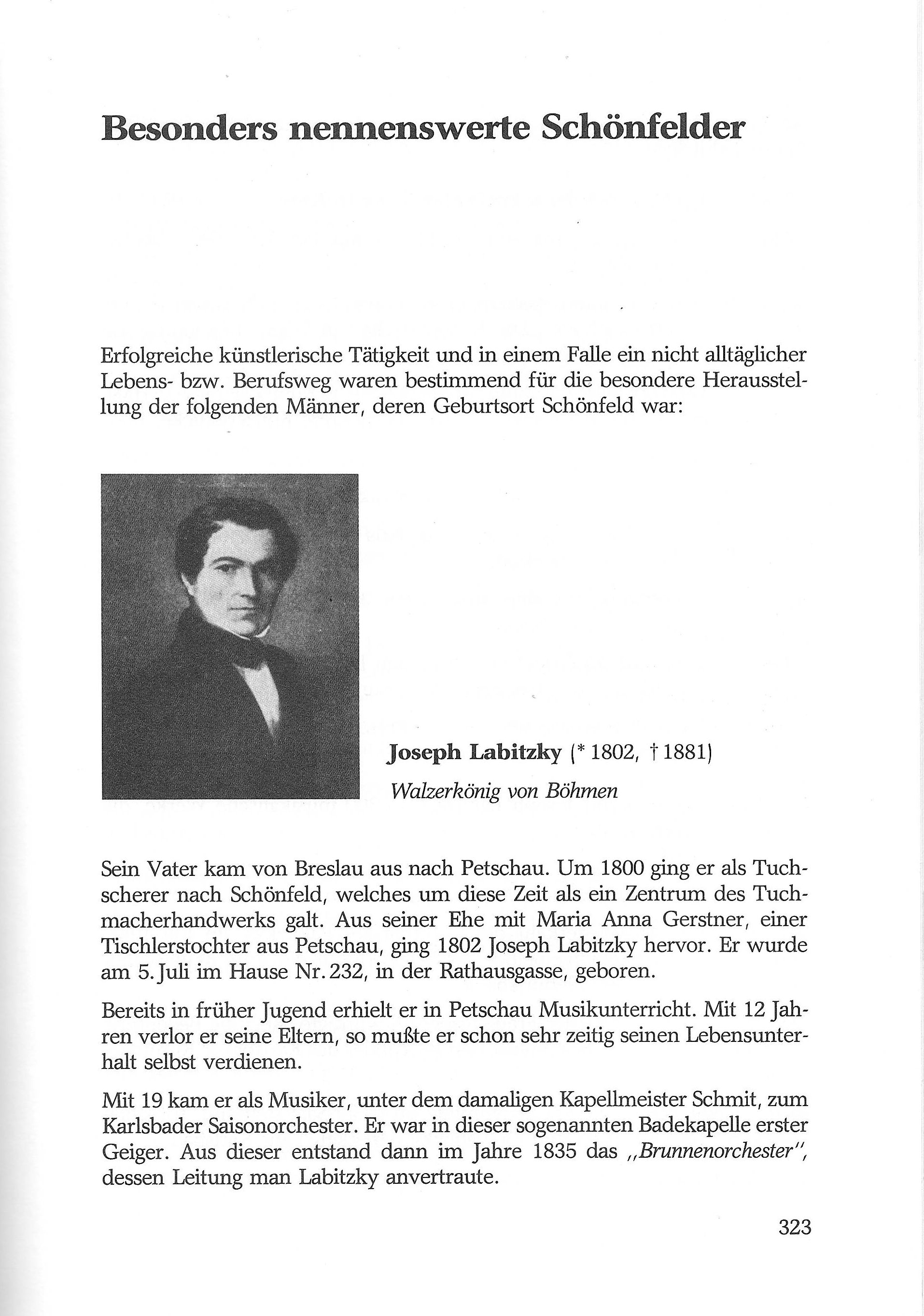 323
Particularly Notable Schönfeld Residents
Successful artistic activity and, in one case, an unusual life and
career path were decisive for the special distinction of the following
men, whose birthplace was Schönfeld:
Joseph Labitzky (* 1802, † 1881) Waltz King of Bohemia
His father came to Petschau from Breslau. Around 1800, he went to
Schönfeld as a cloth shearer, which at that time was considered a
center of the cloth-making trade. Joseph Labitzky was born in 1802
from his marriage to Maria Anna Gerstner, a carpenter's daughter from
Petschau. He was born on July 5th in house number 232, Rathausgasse.
He received music lessons in Petschau from an early age. He lost his
parents at the age of 12, so he had to earn his own living at a very
early age.
At 19, he joined the Carlsbad Seasonal Orchestra as a musician, under
the then conductor Schmit. He was first violin in this so-called spa
orchestra. From this, the "Brunnenorchester" emerged in 1835, under
the direction of Labitzky.
323
323
Particularly Notable Schönfeld Residents
Successful artistic activity and, in one case, an unusual life and
career path were decisive for the special distinction of the following
men, whose birthplace was Schönfeld:
Joseph Labitzky (* 1802, † 1881) Waltz King of Bohemia
His father came to Petschau from Breslau. Around 1800, he went to
Schönfeld as a cloth shearer, which at that time was considered a
center of the cloth-making trade. Joseph Labitzky was born in 1802
from his marriage to Maria Anna Gerstner, a carpenter's daughter from
Petschau. He was born on July 5th in house number 232, Rathausgasse.
He received music lessons in Petschau from an early age. He lost his
parents at the age of 12, so he had to earn his own living at a very
early age.
At 19, he joined the Carlsbad Seasonal Orchestra as a musician, under
the then conductor Schmit. He was first violin in this so-called spa
orchestra. From this, the "Brunnenorchester" emerged in 1835, under
the direction of Labitzky.
323
Page 0323
 0324
Further milestones and interesting dates from Labitzky's life are
listed below:
In 1821/22 he played at the French Opera in Bern.
1824 Married Antonia Herget from Petschau. She bore him 16 children.
1825-27 During these years, he performed with a small orchestra at the
new "Zur Kettenbrücke" inn in Vienna. He met Johann Strauss V and
Lanner.
Labitzky had already composed numerous works,
mostly dances and several concert pieces.
1829/30 Guest performance with his musicians in Warsaw.
1834 Great success in Prague for his waltz series "Gypsy Dances."
1838 At the invitation of Tsar Nicholas I, he performed with the spa
orchestra in St. Petersburg.
1849 Concert tour with the orchestra, now 35 members strong, to
northern Germany.
1868 After almost 50 years of service, Labitzky relinquished his
leadership of the orchestra this year for health reasons. He was
succeeded by his son, August Labitzky, born in Petschau in 1832.
Over the years, Joseph Labitzky created approximately 300 musical
works, ranging from waltzes to mazurkas and galopps to simple drinking
songs.
He was a recognized master of light music.
On the occasion of the 125th anniversary of Labitzky's birth in July
1927, the town of Schönfeld honored him by placing a commemorative
plaque on his birthplace.
The then mayor, Franz Rupperth, acknowledged Labitzky's importance as
a musician, composer, and founder of the Karlovy Vary Spa Orchestra.
District Judge Dr. Grund and Dr. Labitzky (great-grandson?) from
Karlovy Vary spoke at the memorial ceremony, which took place in the
Geier Hall that afternoon.
Numerous Carlsbad residents attended the unveiling of the memorial
plaque.
324
0324
Further milestones and interesting dates from Labitzky's life are
listed below:
In 1821/22 he played at the French Opera in Bern.
1824 Married Antonia Herget from Petschau. She bore him 16 children.
1825-27 During these years, he performed with a small orchestra at the
new "Zur Kettenbrücke" inn in Vienna. He met Johann Strauss V and
Lanner.
Labitzky had already composed numerous works,
mostly dances and several concert pieces.
1829/30 Guest performance with his musicians in Warsaw.
1834 Great success in Prague for his waltz series "Gypsy Dances."
1838 At the invitation of Tsar Nicholas I, he performed with the spa
orchestra in St. Petersburg.
1849 Concert tour with the orchestra, now 35 members strong, to
northern Germany.
1868 After almost 50 years of service, Labitzky relinquished his
leadership of the orchestra this year for health reasons. He was
succeeded by his son, August Labitzky, born in Petschau in 1832.
Over the years, Joseph Labitzky created approximately 300 musical
works, ranging from waltzes to mazurkas and galopps to simple drinking
songs.
He was a recognized master of light music.
On the occasion of the 125th anniversary of Labitzky's birth in July
1927, the town of Schönfeld honored him by placing a commemorative
plaque on his birthplace.
The then mayor, Franz Rupperth, acknowledged Labitzky's importance as
a musician, composer, and founder of the Karlovy Vary Spa Orchestra.
District Judge Dr. Grund and Dr. Labitzky (great-grandson?) from
Karlovy Vary spoke at the memorial ceremony, which took place in the
Geier Hall that afternoon.
Numerous Carlsbad residents attended the unveiling of the memorial
plaque.
324
Page 0324
 325
Professor Augustin Roth (* 1864, † 1952)
He was born in Schönfeld, in house number 8, which was then owned by
the Roth family, on June 19, 1864.
At the age of 14, he came to Vienna, where he began his career as a
painter three years later.
In 1881, he entered the Academy under Professor Griepenkerl.
In 1884, he attended a special school under
Professor Karl Leopold Müller (history painting).
In 1891, Roth exhibited at the Künstlerhaus.
In 1900, he joined the "Hagenbund," a group of artists, which
he remained a member of until 1924.
In 1925, he was a member of the "Secession" until its dissolution in 1939.
In 1939, Roth joined the Künstlerhaus and exhibited in the spring
exhibition of 1941 (oil painting "Medea").
1948 Anniversary Exhibition, "Saint Francis" (oil painting).
Around the turn of the century, Roth began working on graphic
works. He created several etchings and lithographs and made a name for
himself as the inventor of the so-called "Roth Process," which he used
to produce hand prints, as well as his own "collodion process," which
he also patented.
In his final years, he devoted himself particularly to perfecting his
"glass hand prints."
During World War I, he taught a graphic design course at the Vienna
Women's Academy, whereupon he was awarded the title of professor.
Works by Roth were acquired by the Austrian Gallery ("Kinderreigen"
and "Vor dem Dorfe"), the Modern Gallery in Prague ("Madonna" and
"Ziegenhirtess"), and the Albertina in Vienna.
His lithograph "Amazonenschlacht" (Battle of the Amazons) was
published as a premium issue of the "Society for Reproducing Art." As
a sign of his connection to his birthplace, the painter Roth
bequeathed two of his early works, which were among his favorites, to
the Schönfeld Local History Museum. These were the two oil paintings
entitled "The Landlady's Daughter" (1888) and "Portrait of My Mother"
(1889).
325
325
Professor Augustin Roth (* 1864, † 1952)
He was born in Schönfeld, in house number 8, which was then owned by
the Roth family, on June 19, 1864.
At the age of 14, he came to Vienna, where he began his career as a
painter three years later.
In 1881, he entered the Academy under Professor Griepenkerl.
In 1884, he attended a special school under
Professor Karl Leopold Müller (history painting).
In 1891, Roth exhibited at the Künstlerhaus.
In 1900, he joined the "Hagenbund," a group of artists, which
he remained a member of until 1924.
In 1925, he was a member of the "Secession" until its dissolution in 1939.
In 1939, Roth joined the Künstlerhaus and exhibited in the spring
exhibition of 1941 (oil painting "Medea").
1948 Anniversary Exhibition, "Saint Francis" (oil painting).
Around the turn of the century, Roth began working on graphic
works. He created several etchings and lithographs and made a name for
himself as the inventor of the so-called "Roth Process," which he used
to produce hand prints, as well as his own "collodion process," which
he also patented.
In his final years, he devoted himself particularly to perfecting his
"glass hand prints."
During World War I, he taught a graphic design course at the Vienna
Women's Academy, whereupon he was awarded the title of professor.
Works by Roth were acquired by the Austrian Gallery ("Kinderreigen"
and "Vor dem Dorfe"), the Modern Gallery in Prague ("Madonna" and
"Ziegenhirtess"), and the Albertina in Vienna.
His lithograph "Amazonenschlacht" (Battle of the Amazons) was
published as a premium issue of the "Society for Reproducing Art." As
a sign of his connection to his birthplace, the painter Roth
bequeathed two of his early works, which were among his favorites, to
the Schönfeld Local History Museum. These were the two oil paintings
entitled "The Landlady's Daughter" (1888) and "Portrait of My Mother"
(1889).
325
Page 0325
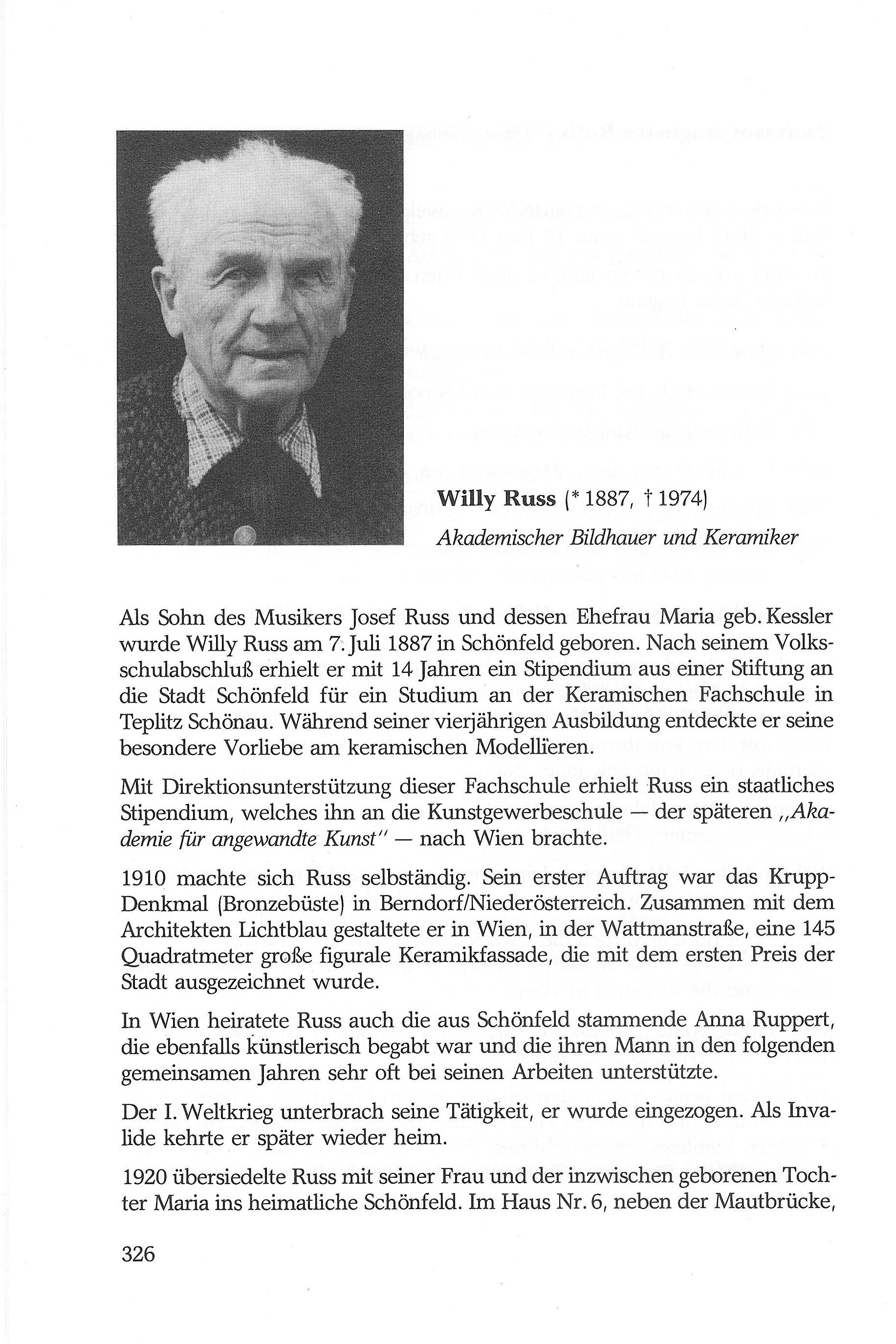 326
Willy Russ (* 1887, † 1974)
Academic Sculptor and Ceramicist
The son of the musician Josef Russ and his wife Maria, née Kessler,
Willy Russ was born on July 7, 1887, in Schönfeld. After completing
elementary school, at the age of 14, he received a scholarship from a
foundation established by the city of Schönfeld to study at the
Ceramics Technical School in Teplitz Schönau. During his four-year
training, he discovered his particular passion for ceramic modeling.
With the support of the director of this technical school, Russ
received a state scholarship, which took him to the School of Applied
Arts in Vienna—later the Academy of Applied Arts.
In 1910, Russ became self-employed. His first commission was the Krupp
Memorial (bronze bust) in Berndorf, Lower Austria. Together with the
architect Lichtblau, he designed a 145-square-meter figurative ceramic
façade on Wattmanstrasse in Vienna, which won the city's first
prize.
In Vienna, Russ married Anna Ruppert, a native of Schönfeld who was
also artistically gifted and who frequently assisted her husband in
his work during the following years.
World War I interrupted his career, and he was drafted into the
military. He later returned home as an invalid.
In 1920, Russ moved with his wife and their daughter Maria, who had
since been born, to his hometown of Schönfeld. At house number 6, next
to the toll bridge,
326
326
Willy Russ (* 1887, † 1974)
Academic Sculptor and Ceramicist
The son of the musician Josef Russ and his wife Maria, née Kessler,
Willy Russ was born on July 7, 1887, in Schönfeld. After completing
elementary school, at the age of 14, he received a scholarship from a
foundation established by the city of Schönfeld to study at the
Ceramics Technical School in Teplitz Schönau. During his four-year
training, he discovered his particular passion for ceramic modeling.
With the support of the director of this technical school, Russ
received a state scholarship, which took him to the School of Applied
Arts in Vienna—later the Academy of Applied Arts.
In 1910, Russ became self-employed. His first commission was the Krupp
Memorial (bronze bust) in Berndorf, Lower Austria. Together with the
architect Lichtblau, he designed a 145-square-meter figurative ceramic
façade on Wattmanstrasse in Vienna, which won the city's first
prize.
In Vienna, Russ married Anna Ruppert, a native of Schönfeld who was
also artistically gifted and who frequently assisted her husband in
his work during the following years.
World War I interrupted his career, and he was drafted into the
military. He later returned home as an invalid.
In 1920, Russ moved with his wife and their daughter Maria, who had
since been born, to his hometown of Schönfeld. At house number 6, next
to the toll bridge,
326
Page 0326
 327
he set up his studio, where he created ceramic works alongside
sculpture. Larger projects forced him to move to house number 135
(Lange Gasse) in 1931. In the garden, facing the main street, Russ had
a studio built to meet his larger requirements. Subsequently, this
artist created a number of works in stone, ceramics, and bronze,
including numerous outstanding pieces.
A brief overview:
In our hometown of Schönfeld, the following objects were located:
The cross on the so-called "Kühbühl" (Kühbühl).
A cross, a statue of the Virgin Mary with Child, and a statue of Jesus
with a group of angels on the so-called "Poschetzberg" (Poschetz
Mountain).
A Madonna relief (ceramic) on house number 392 (Poschetz). The war
memorial in the park.
Schönfeld town coat of arms (ceramic) on the town hall.
Also worth mentioning is his design for the Schönfeld Observation
Tower.
Russ's war memorials were located in Luditz, Mies, and
Lauterbach/Stadt. The artist created larger-than-life Goethe statues
for the towns of Marienbad and Elbogen.
He carried out one of his largest commissions for the Folklore Museum
in Cheb. It was a work of art of a special kind. In three years of
work (1941-1943), Willy Russ designed a tiled stove, 3 meters long,
1.5 meters wide, and 3 meters high. The "Egerländer Ofen," as it is
also called, consists of colored ceramic tiles. It depicts the
Egerland region, its customs, and its people in a unique way through
16 reliefs, 12 pairs of traditional costumes, 76 city coats of arms,
and 54 old sayings.
The reliefs represent: the Hutschenstuben (huts' rooms), Christmas,
the Old and New Years, Carnival, Raicha-Meuja (carrying out the dead),
Easter riding, Maypole dance, St. John's bonfire, the parents'
blessing, the chamber wagon, the child's baptism, the harvest wagon,
the harvest wreath, the Drischellüch (dry harvest), and the church
fair.
Like many of us, Russ had to leave his homeland. The Czechs installed
his last-mentioned major work of art in the Elbogen Castle Museum in
1952.
327
327
he set up his studio, where he created ceramic works alongside
sculpture. Larger projects forced him to move to house number 135
(Lange Gasse) in 1931. In the garden, facing the main street, Russ had
a studio built to meet his larger requirements. Subsequently, this
artist created a number of works in stone, ceramics, and bronze,
including numerous outstanding pieces.
A brief overview:
In our hometown of Schönfeld, the following objects were located:
The cross on the so-called "Kühbühl" (Kühbühl).
A cross, a statue of the Virgin Mary with Child, and a statue of Jesus
with a group of angels on the so-called "Poschetzberg" (Poschetz
Mountain).
A Madonna relief (ceramic) on house number 392 (Poschetz). The war
memorial in the park.
Schönfeld town coat of arms (ceramic) on the town hall.
Also worth mentioning is his design for the Schönfeld Observation
Tower.
Russ's war memorials were located in Luditz, Mies, and
Lauterbach/Stadt. The artist created larger-than-life Goethe statues
for the towns of Marienbad and Elbogen.
He carried out one of his largest commissions for the Folklore Museum
in Cheb. It was a work of art of a special kind. In three years of
work (1941-1943), Willy Russ designed a tiled stove, 3 meters long,
1.5 meters wide, and 3 meters high. The "Egerländer Ofen," as it is
also called, consists of colored ceramic tiles. It depicts the
Egerland region, its customs, and its people in a unique way through
16 reliefs, 12 pairs of traditional costumes, 76 city coats of arms,
and 54 old sayings.
The reliefs represent: the Hutschenstuben (huts' rooms), Christmas,
the Old and New Years, Carnival, Raicha-Meuja (carrying out the dead),
Easter riding, Maypole dance, St. John's bonfire, the parents'
blessing, the chamber wagon, the child's baptism, the harvest wagon,
the harvest wreath, the Drischellüch (dry harvest), and the church
fair.
Like many of us, Russ had to leave his homeland. The Czechs installed
his last-mentioned major work of art in the Elbogen Castle Museum in
1952.
327
Page 0327
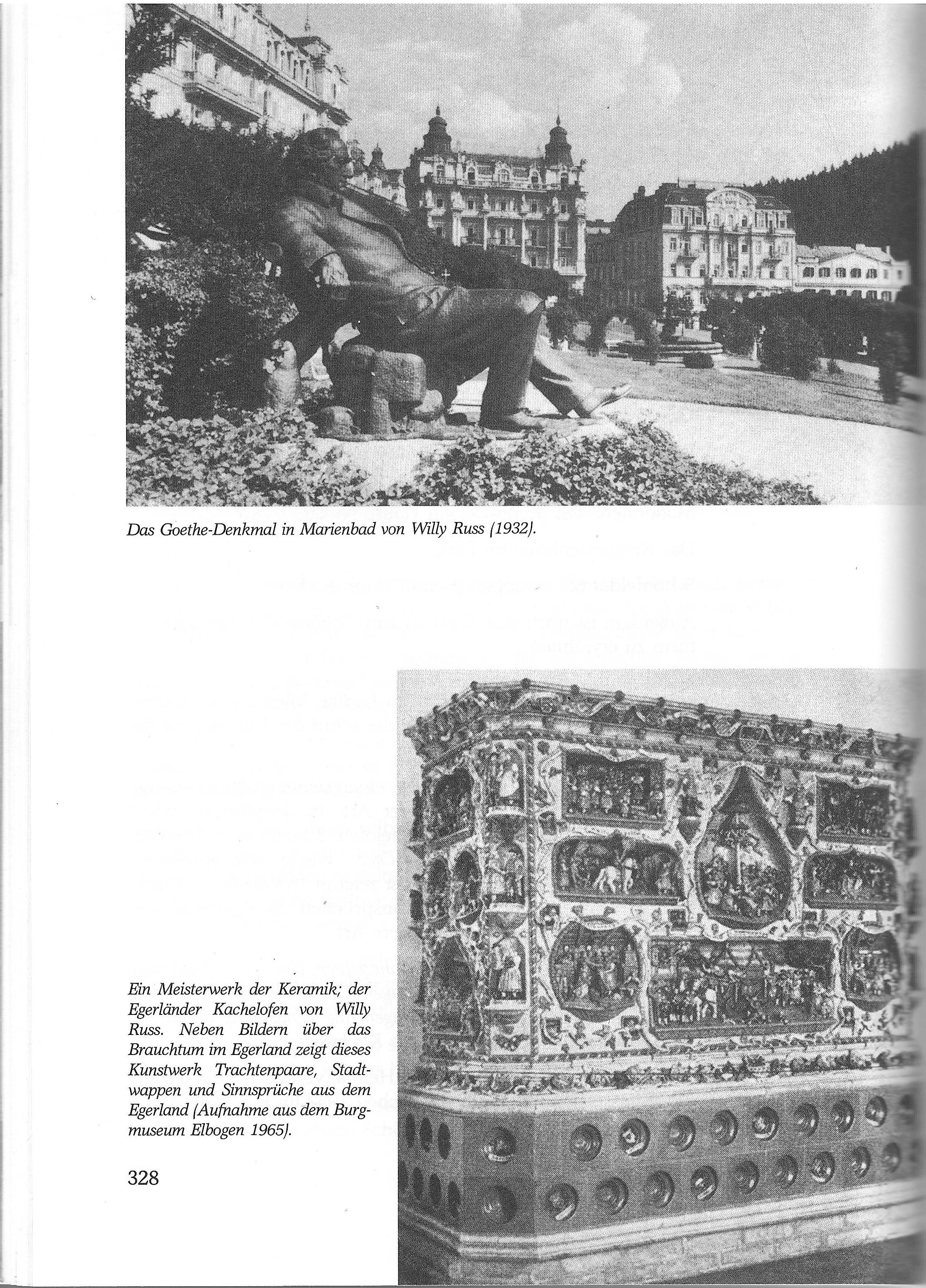 328
The Goethe Memorial in Marienbad by Willy Russ (1932).
A masterpiece of ceramics: the Egerland tiled stove by Willy Russ. In
addition to images of customs in the Egerland region, this work of art
features traditional costumes, city coats of arms, and sayings from
the Egerland region (photo from the Elbogen Castle Museum, 1965).
PEUTERS
328
328
The Goethe Memorial in Marienbad by Willy Russ (1932).
A masterpiece of ceramics: the Egerland tiled stove by Willy Russ. In
addition to images of customs in the Egerland region, this work of art
features traditional costumes, city coats of arms, and sayings from
the Egerland region (photo from the Elbogen Castle Museum, 1965).
PEUTERS
328
Page 0328
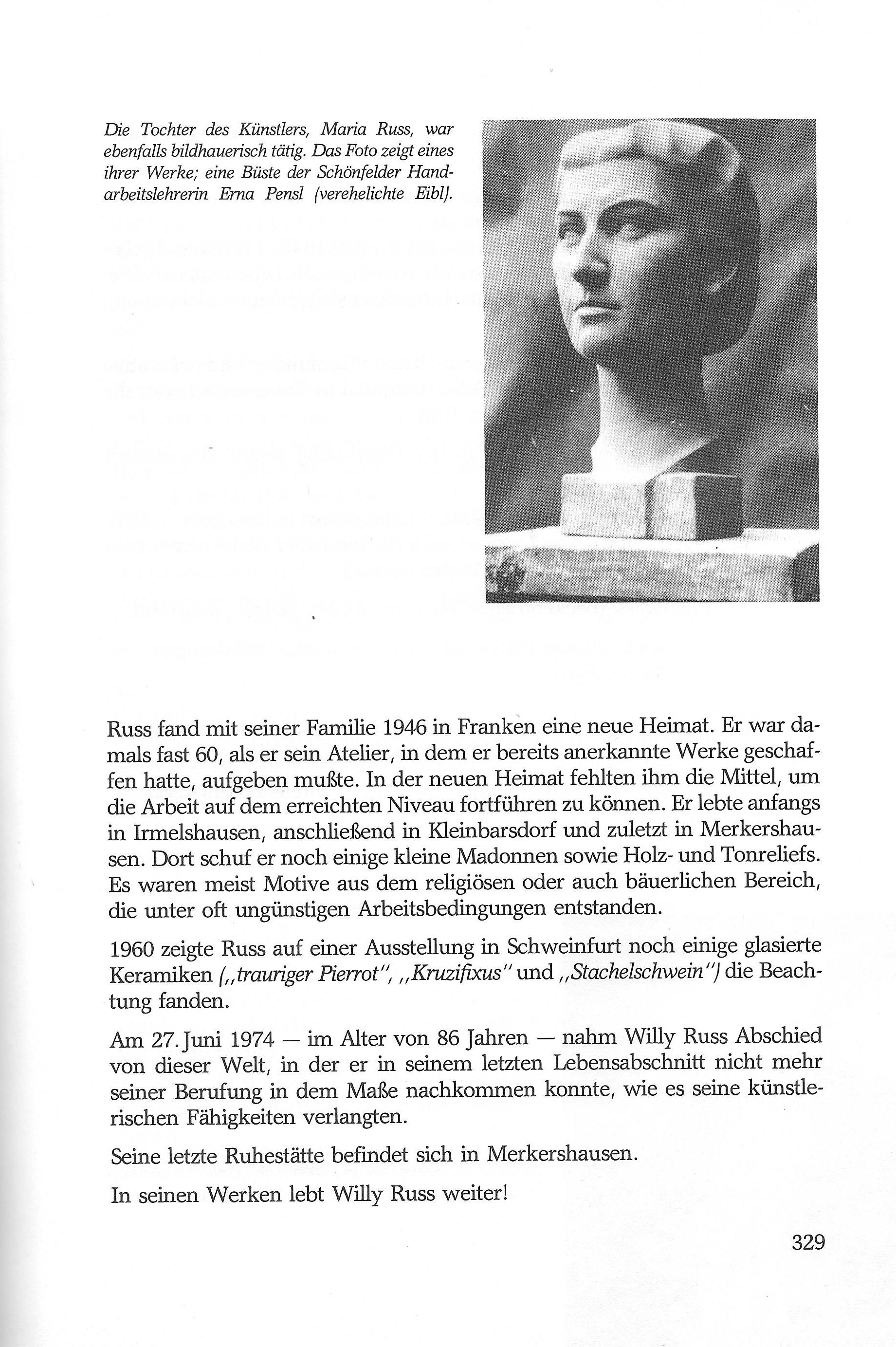 329
The artist's daughter, Maria Russ, was also a sculptor. The photo
shows one of her works: a bust of the Schönfeld needlework teacher
Erna Pensl (née Eibl).
Russ and his family found a new home in Franconia in 1946. He was
almost 60 at the time when he had to give up his studio, where he had
already created acclaimed works. In his new home, he lacked the means
to continue his work at the level he had achieved. He initially lived
in Irmelshausen, then in Kleinbarsdorf, and finally in
Merkershausen. There he created several small Madonnas as well as wood
and clay reliefs. These were mostly religious or rural motifs, often
created under unfavorable working conditions.
In 1960, Russ showed some glazed ceramics ("Sad Pierrot," "Crucifix,"
and "Porcupine") at an exhibition in Schweinfurt, which attracted
attention.
On June 27, 1974, at the age of 86, Willy Russ bid farewell to this
world, where, in the final phase of his life, he could no longer
fulfill his calling to the extent that his artistic abilities
demanded.
His final resting place is in Merkershausen.
Willy Russ lives on in his works!
329
329
The artist's daughter, Maria Russ, was also a sculptor. The photo
shows one of her works: a bust of the Schönfeld needlework teacher
Erna Pensl (née Eibl).
Russ and his family found a new home in Franconia in 1946. He was
almost 60 at the time when he had to give up his studio, where he had
already created acclaimed works. In his new home, he lacked the means
to continue his work at the level he had achieved. He initially lived
in Irmelshausen, then in Kleinbarsdorf, and finally in
Merkershausen. There he created several small Madonnas as well as wood
and clay reliefs. These were mostly religious or rural motifs, often
created under unfavorable working conditions.
In 1960, Russ showed some glazed ceramics ("Sad Pierrot," "Crucifix,"
and "Porcupine") at an exhibition in Schweinfurt, which attracted
attention.
On June 27, 1974, at the age of 86, Willy Russ bid farewell to this
world, where, in the final phase of his life, he could no longer
fulfill his calling to the extent that his artistic abilities
demanded.
His final resting place is in Merkershausen.
Willy Russ lives on in his works!
329
Page 0329
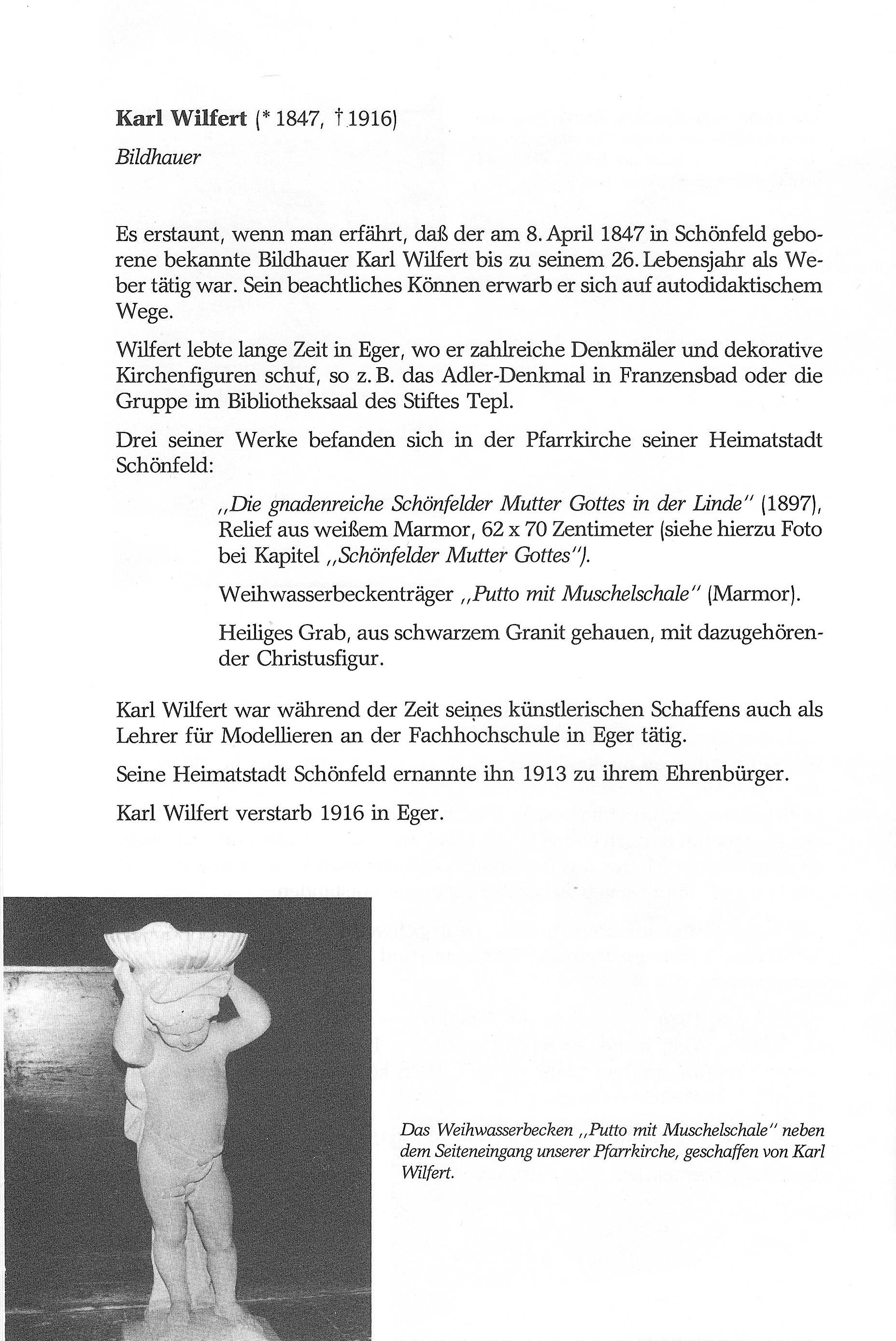 330
Karl Wilfert (* 1847, † 1916)
Sculptor
It is surprising to learn that the renowned sculptor Karl Wilfert,
born on April 8, 1847, in Schönfeld, worked as a weaver until he was
26. He acquired his considerable skills through self-taught work.
Wilfert lived for a long time in Cheb, where he created numerous
monuments and decorative church figures, such as the Eagle Monument in
Franzensbad and the group in the library hall of Teplá Abbey.
Three of his works were located in the parish church of his hometown
of Schönfeld:
"The Gracious Schönfeld Mother of God in the Linden Tree" (1897), a
relief in white marble, 62 x 70 centimeters (see photo in the chapter
"Schönfeld Mother of God").
Holy water stoup, "Putto with Shell" (marble).
Holy Sepulchre, carved from black granite, with the accompanying
figure of Christ.
During his artistic career, Karl Wilfert also taught modeling at the
University of Applied Sciences in Eger.
His hometown of Schönfeld made him an honorary citizen in 1913. Karl
Wilfert died in Eger in 1916.
The holy water stoup, "Putto with Shell," next to the side entrance of
our parish church, was created by Karl Wilfert.
330
330
Karl Wilfert (* 1847, † 1916)
Sculptor
It is surprising to learn that the renowned sculptor Karl Wilfert,
born on April 8, 1847, in Schönfeld, worked as a weaver until he was
26. He acquired his considerable skills through self-taught work.
Wilfert lived for a long time in Cheb, where he created numerous
monuments and decorative church figures, such as the Eagle Monument in
Franzensbad and the group in the library hall of Teplá Abbey.
Three of his works were located in the parish church of his hometown
of Schönfeld:
"The Gracious Schönfeld Mother of God in the Linden Tree" (1897), a
relief in white marble, 62 x 70 centimeters (see photo in the chapter
"Schönfeld Mother of God").
Holy water stoup, "Putto with Shell" (marble).
Holy Sepulchre, carved from black granite, with the accompanying
figure of Christ.
During his artistic career, Karl Wilfert also taught modeling at the
University of Applied Sciences in Eger.
His hometown of Schönfeld made him an honorary citizen in 1913. Karl
Wilfert died in Eger in 1916.
The holy water stoup, "Putto with Shell," next to the side entrance of
our parish church, was created by Karl Wilfert.
330
Page 0330
 331
Karl Schiener
This son of our hometown, whose father's house (No. 230) stood in the
New Town, has nothing in common with the Schönfeld artists already
mentioned in this chapter; at best, he was—and only in the broadest
sense—a bon vivant. If he is mentioned here, it is his
extraordinary life path at that time that gives rise to this.
It is said that after a school year full of daring feats, his father
took him to be apprenticed to a merchant in Teplitz. His stay there
was short-lived, however, as he soon returned on foot to his hometown,
where his father did not exactly welcome him with open
arms. Nevertheless, he learned the merchant's trade. After his
apprenticeship, he went to Vienna, where he met a merchant from Egypt,
whose service he entered. This activity took him to the land on the
Nile. When cholera broke out in Alexandria, Schiener tried to escape
the epidemic. He stowed away on a ship, which unwittingly and
unexpectedly took him to Shanghai – China's largest city. He worked
there as a dockworker for five years.
Around this time, Austria-Hungary had established a trading post in
Tsingtau (located on the coast of the Shanting Peninsula, which was a
German leased territory from 1898 to 1914) and stationed a small
police force for its protection. Schiener applied to join this unit
and was accepted.
A vacation finally brought him back to his hometown in 1912, after a
long absence. The visit of this well-traveled native son was a
sensation for Schönfeld. The reunions in the inns with his former
friends and colleagues – whose number grew daily – seemed almost
endless. -
Perhaps a small silk handkerchief with an embroidered monogram still
exists here and there, which the "China-Schiener," as he was commonly
called, brought home from that Far Eastern country as a gift for good
friends.
Similar to the reunions, the farewells were also necessary before
departure after a stay of almost a year.
Schiener returned to Tsingtau. During World War I, he was interned by
the British. After the war, he began his journey home, which would
take him via
331
331
Karl Schiener
This son of our hometown, whose father's house (No. 230) stood in the
New Town, has nothing in common with the Schönfeld artists already
mentioned in this chapter; at best, he was—and only in the broadest
sense—a bon vivant. If he is mentioned here, it is his
extraordinary life path at that time that gives rise to this.
It is said that after a school year full of daring feats, his father
took him to be apprenticed to a merchant in Teplitz. His stay there
was short-lived, however, as he soon returned on foot to his hometown,
where his father did not exactly welcome him with open
arms. Nevertheless, he learned the merchant's trade. After his
apprenticeship, he went to Vienna, where he met a merchant from Egypt,
whose service he entered. This activity took him to the land on the
Nile. When cholera broke out in Alexandria, Schiener tried to escape
the epidemic. He stowed away on a ship, which unwittingly and
unexpectedly took him to Shanghai – China's largest city. He worked
there as a dockworker for five years.
Around this time, Austria-Hungary had established a trading post in
Tsingtau (located on the coast of the Shanting Peninsula, which was a
German leased territory from 1898 to 1914) and stationed a small
police force for its protection. Schiener applied to join this unit
and was accepted.
A vacation finally brought him back to his hometown in 1912, after a
long absence. The visit of this well-traveled native son was a
sensation for Schönfeld. The reunions in the inns with his former
friends and colleagues – whose number grew daily – seemed almost
endless. -
Perhaps a small silk handkerchief with an embroidered monogram still
exists here and there, which the "China-Schiener," as he was commonly
called, brought home from that Far Eastern country as a gift for good
friends.
Similar to the reunions, the farewells were also necessary before
departure after a stay of almost a year.
Schiener returned to Tsingtau. During World War I, he was interned by
the British. After the war, he began his journey home, which would
take him via
331
Page 0331
 332
America. However, he only got as far as Vladivostok, where thousands
of German and Austrian prisoners of war from Siberia were awaiting
their return by ship. Here, Schiener settled for a while as an
interpreter before returning to his homeland via the Urals. When the
then Czech government established a trade mission in China, he was
sent to China to work as a translator. When the German government
wanted to establish a new university, Karl Schiener was remembered and
invited to Prague. As an expert on this country, he was to serve as an
advisor to the delegation. So he returned to the Far East for a third
time. However, since this position did not meet his expectations, he
returned home after just a year. His last major trip took him to North
America. There he worked for an American company. In the USA, Schiener
married a German-American woman from Thuringia. He spent his final
years in his house in Florida.
332
332
America. However, he only got as far as Vladivostok, where thousands
of German and Austrian prisoners of war from Siberia were awaiting
their return by ship. Here, Schiener settled for a while as an
interpreter before returning to his homeland via the Urals. When the
then Czech government established a trade mission in China, he was
sent to China to work as a translator. When the German government
wanted to establish a new university, Karl Schiener was remembered and
invited to Prague. As an expert on this country, he was to serve as an
advisor to the delegation. So he returned to the Far East for a third
time. However, since this position did not meet his expectations, he
returned home after just a year. His last major trip took him to North
America. There he worked for an American company. In the USA, Schiener
married a German-American woman from Thuringia. He spent his final
years in his house in Florida.
332
Page 0332
Cronik 001 Chronicle of the formerly royal free mining town of Schönfeld Part 1 1341-1880 Abridged version of the chronicle from 1934 by Pastor Karl Enzmann (partially verbatim). Part 2 1880-1946 Compiled from documents by Karl Haller and Josef Hubl (partially verbatim) including additions by Willi Bauer and the author. chronik Page-0001
Cronik 002 Sources Part 1 Municipal Archives in Schönfeld Parish archives and parish chronicle in Schönfeld. Vincenz Pröckl, "History of the Royal Mining Towns of Schlaggenwald and Schönfeld." Eger, 1887 (contains some errors). Dr. Anton Gnirs, "Karlsbad Historical Sources in the Oldest Council Documents of the City of Elbogen." Karlovy Vary 1929. Friedrich Tischer, "Bohemian Tin and Its Brands." Leipzig 1928. Mining Master Kleophas Fischer, "Schlaggenwald Mining, Subject, Mine, and Works Report." 1819. Provided by Dr. Anton Gnirs. Czech Royal Historical Historical Archives. By August Sedla?ek, page 865. Prague 1895; 1908. Ott?v Slovnik Nau?ný. Prague 1905, Volume 23, page 36. Dr. Wilhelm Weizsäcker, "Saxon Mining Law in Bohemia." Reichenberg 1929 (numerous other sources are cited there). Johann Thaddäus Peithner von Lichtenfels, "Essay on the Natural and Political History of the Bohemian and Moravian Mines." Vienna 1780, page 69. Count Kaspar von Sternberg, "Outlines of a History of the Bohemian Mines." Prague 1836. Volume 1, Section 1. Jaroslav Schaller, "Topography of the Kingdom of Bohemia." Part 2, Elbogen District. Prague 1785. Johann Gottfried Sommer, "The Kingdom of Bohemia." Volume 15, pages 265-268. Prague 1847. Dr. Ludwig Schlesinger, "History of Bohemia." Prague 1869. Dr. Anton Podlaha, "Libri erectionum archidioecesis Pragensis." Lib. VI, page 29. Prague 1927. Zemsky Archives of Prague. The richest source: Archives of the Ministry of the Interior in Prague. Excerpts and verbatim copies of the numerous documents, files, and writings contained in this archive, which are of the utmost importance for any local history, were prepared for Schönfeld in strenuous, tedious, and time-consuming work, entirely free of charge, by Mr. Karl Lochner of Schönfeld, a retired tax official in Prague. The municipality of Schönfeld owes this man its greatest gratitude for his selfless work. Part 2 Karl Haller, "Hometown Letter to all Schönfeld Residents," beginning 1952, 34 installments. "Elbogen Hometown Letter," 1961/62, 9 installments. Ch 2 chronik Page-0002
Cronik 003 Part 1 (1341-1880) 1341 The brothers Slawko and Borsso of Riesenburg granted their people in Schönfeld free inheritance rights on November 30, 1341. In 1248, William of Riesenburg was recorded as Burgrave of Elbogen. The young Borsso was succeeded in possession of the Petschau lordship with the mining towns by the brothers Slawko and Borsso of Riesenburg, who immediately upon their accession granted the following privilege to the town of Schönfeld, which, written in Latin, reads: "In God's name, Amen. We, Slawko and Borsso brothers and lords of Rysenburg, and all our heirs, publicly confess by this letter that, through God, we publicly grant our poor people in Schönfeld, and their grandchildren, eternally, such grace as they have been previously granted by our parents, so that their daughters shall have as much right as their sons." To all the inheritance and also to all the goods that they have or leave after their death, inside and out. We also grant them the grace that they may each give another an inheritance and also their goods. No one shall prevent them from having the power and authority of our special grace there in Schönfeld before our judge and also the Schöppen at whatever time and hour they wish, so that they may remain in the grace of us and also of our descendants, completely and unbroken, by imploring an eternal right. We give this letter with our two inner seals, which are attached to the present letter, as a true confession. With them were our man Kinat von Saran, Ahanna von Udritz, Lord Hildebrand von Luditz and other good people. The letter was given in Petschau one thousand three hundred years after the birth of Christ, then in the fortieth year on St. St. Andrew's Day." Although this document must be considered the oldest in the town of Schönfeld, it is by no means the first, but rather merely a confirmation of a much earlier privilege, according to the wording: "Give such grace as has previously been granted by our parents." This original Ch 3 chronik Page-0003
Cronik 004 1341 records also prove that Schönfeld was subject to the feudal nexus (reversion of an estate to the landlord). 1355 Letter of endowment and hand vestment from the brothers Slawko and Borsso von Riesenburg, granting the town of Schönfeld the court, the tin mining area, and the tin mines in Schönfeld and on the Petschau lands. However, the town is to pay the interest and taxes, along with other dues, as before. 1380 Borsso, Lord of Riesenburg, grants his men and women in the village of Schönfeld the Luditz right. 1404 Anna, widow of Borsso von Riesenburg, mistress of Petschau, donates an altarist (chaplain) for the Chapel of St. Catherine in Schönfeld on April 29th and endows the position with 5 shocks of groschen. 1414 On August 4, the priest Wenceslas of Prachatice was appointed chaplain in Schönfeld. In 1456, Henry, Burgrave of Meissen, Count of Hartenstein, the young Lord of Plauen, confirmed the village of Schönfeld's old vestments and privileges and granted it new rights. In 1472, Henry III, Burgrave of Meissen, Count of Hartenstein, Lord of Plauen, confirmed the privileges of his village of Schönfeld with a letter of endowment, given in Petschau on Friday, St. James's Eve. 1500 In this year, a dyeing factory is said to have already existed in house number 264 (Zickler House). A Zickler from this house wanted to make a pilgrimage to Jerusalem, but only got as far as Rome, where he fell ill. At Easter, he had been admitted to the Pope's footwashing ceremony with the oldest pilgrims. He brought relics, images, and several recipes, including the so-called "blue water" for healing wounds. 1508 Schönfeld borrows an executioner from the town of Eger. 1518 Hans Pflug von Rabenstein, lord of Petschau, swears a feudal oath to King Ladislaus on the Wednesday after St. Vitus' Day and takes the lordship of Petschau from him as a fief. This included the town of Schönfeld, where silver and tin are built, with all its smelters and mills; the mountains, including the mines and silver, as well as tin and all the ores. Ch 4 chronik Page-0004
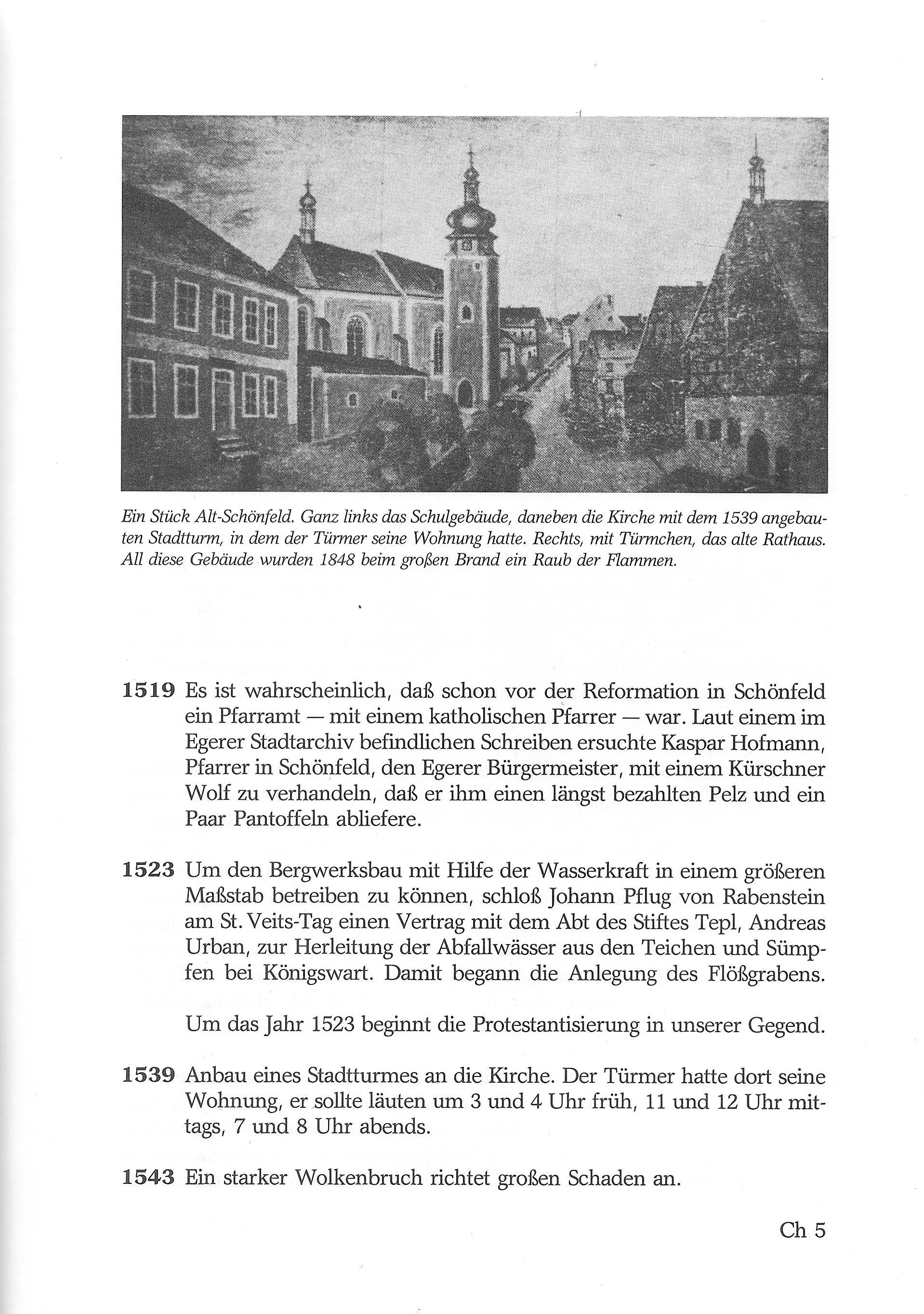
Cronik 005 A piece of Old Schönfeld. On the far left is the school building, next to it the church with the town tower, added in 1539, where the watchman had his residence. On the right, with its turret, is the old town hall. All of these buildings were destroyed in the great fire of 1848. 1519 It is likely that even before the Reformation, there was a rectory in Schönfeld – with a Catholic priest. According to a letter in the Eger city archives, Kaspar Hofmann, pastor in Schönfeld, asked the mayor of Eger to negotiate with a furrier named Wolf, asking him to return a fur coat and a pair of slippers that had long been paid for. 1523 In order to be able to operate the mine on a larger scale using hydropower, Johann Pflug von Rabenstein concluded a contract on St. Vitus's Day with Andreas Urban, the abbot of Teplá Abbey, to divert wastewater from the ponds and swamps near Königswart. This marked the beginning of the construction of the rafting ditch. Around 1523, Protestantization began in our area. 1539 A town tower was added to the church. The bell keeper had his residence there; he was to ring the bells at 3 and 4 a.m., 11 and 12 p.m., and 7 and 8 p.m. 1543 A heavy downpour caused extensive damage. Ch 5 chronik Page-0005
Cronik 006 1547 From this year on, timber was floated from Königswart to Schönfeld and Schlaggenwald. Kaspar Pflug von Rabenstein orders the Schlaggenwald and Schönfeld residents to provide troops. On April 1, he orders the council in Schlaggenwald and Schönfeld to march with 50 hackslingers to Königswart Castle and to pay the soldiers a levy. The council asks whether the young journeymen should also go along; in this case, the necessary spears should be sent. Pflug sets a review of the military forces for Simon and Juda, with all town and village residents to attend. On Judica Sunday, the Schlaggenwald and Schönfeld residents are to enlist in the flags due to the advancing enemy troops. The annual fair was canceled, and the quartermasters were instructed to check the water power and to go from house to house and order everyone to be ready. On July 11, Kaspar Pflug von Rabenstein summoned the miners' guild to the town hall in Schlaggenwald and issued instructions. This was his last official act as general and lord of the Petschau domain and the mines. On July 14, the imperial army was victorious in the Battle of Mühlberg. Kaspar Pflug sought asylum in Magdeburg to escape certain death or eternal imprisonment. He was declared forfeit of his honor, life, and property, and a price of 5,000 thalers was set for his surrender. On July 31, 1547, the imperial commissioners Ladislaus Popel von Lobkowitz and Melchior Hubecki appeared with a guard of 600 soldiers and seized all of Pflug's possessions, especially the mining towns of Schlaggenwald and Schönfeld, with all mines, stamp mills, smelters, supplies, forests, and hydraulic structures, for the king's benefit. Pflug's subjects and the miners were required to swear allegiance to King Ferdinand and swear to the instructions presented to them. An inventory was taken and the land register was drawn up. Supreme Chancellor Henry V received the Petschau domain, without the mines, as a pledge in exchange for a shilling. A massive and significant reform had taken place. In Schlaggenwald, an Imperial and Royal Mining Authority with extensive jurisdiction was established as the governing authority. In Schönfeld, an Imperial and Royal Mining Authority was established. A mining office was established. The towns of Schlaggenwald and Schönfeld were granted the status of Imperial and Royal Mining Towns and their rights and eligibility. chronik Page-0006
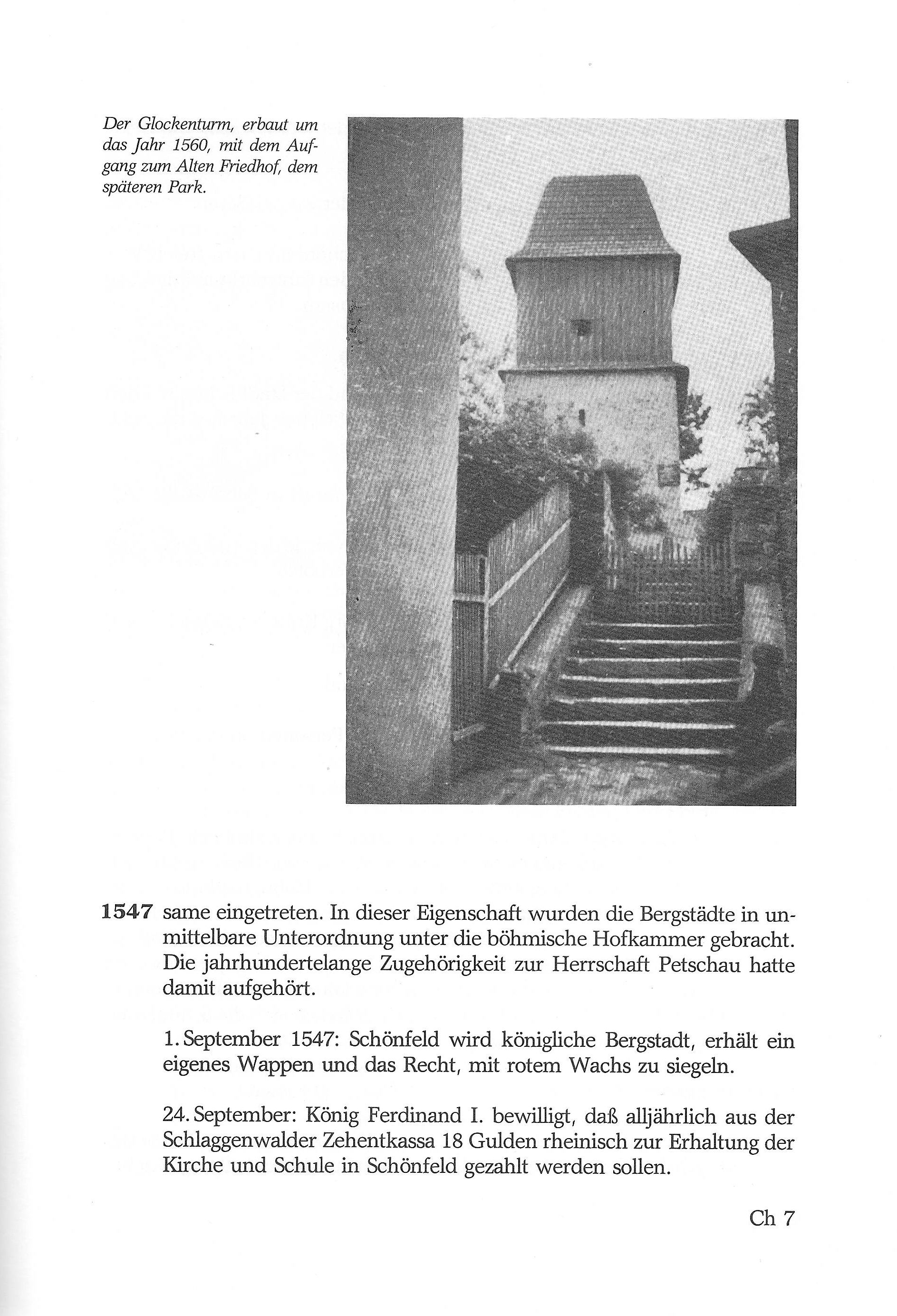
Cronik 007 The bell tower, built around 1560, with the entrance to the Old Cemetery, later the park. 1547. In this capacity, the mining towns were placed under direct subordination to the Bohemian Court Chamber. Their centuries-long affiliation with the Petschau domain thus ended. September 1, 1547: Schönfeld became a royal mining town, received its own coat of arms, and was granted the right to seal with red wax. September 24: King Ferdinand I authorized the annual payment of 18 Rhenish guilders from the Schlaggenwald tithe fund for the maintenance of the church and school in Schönfeld. Ch 7 chronik Page-0007
Cronik 008 In 1550, a separate parish is said to have been founded in Schönfeld. There is no evidence of this information. The tin foundry flourished between 1550 and 1750. In 1558, Archduke Ferdinand granted the town of Schönfeld a free weekly market on Thursdays, then a free annual market on St. Matthew the Apostle's Day, and its own salt mine. In 1560, the large bell was cast in Pilsen. On March 15, Archduke Ferdinand granted the town of Schönfeld permission to build a mill in Tiefenbach. In the same year, the town had the "Grundmühle" built. 1562 Founding of the Shoemakers' Guild (the oldest guild in Schönfeld). 1568 By imperial mandate of August 6, Jews were strictly forbidden to stay in all mining towns. 1579 On March 14, the shepherd killed by Georg Kraus was buried, but without students or a priest. During these years, there was a hospital in Schönfeld. 1585 In this year, 104 people died of the plague in Schönfeld. 1589 There was smallpox. 1590 An unemployed executioner named Hans Heinl, presumably from Kulmbach, Bavaria, was wandering around the area. In Carlsbad, he is said to have sold a piece of rope from a hanged man to a woman suspected of witchcraft—the wife of Hans Peterlein. He was imprisoned in Schönfeld for theft. captured and subjected to torture. Many people must have witnessed this "spectacle." In the same year, Hans Heinl was executed in Schönfeld. The people of Schönfeld had borrowed the executioner from the town of Eger. 1592 This year, the middle bell was cast. A wedding with obstacles - a cultural image from the end of the 16th century: Two lovers, the carter Georg Fischer Ch 8 chronik Page-0008
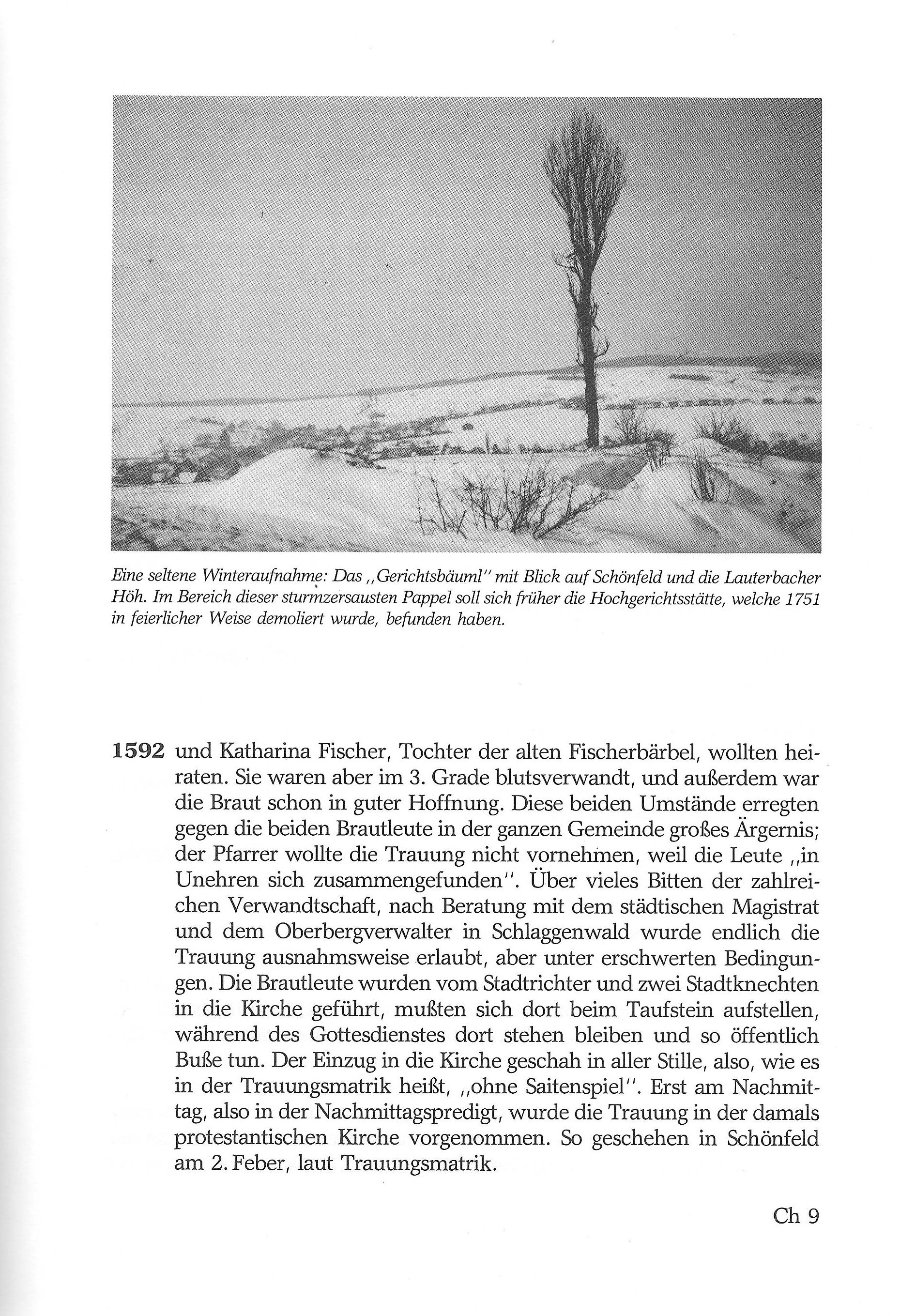
Cronik 009 A rare winter photograph: The "Gerichtsbäuml" (court tree) with a view of Schönfeld and the Lauterbacher Höh. The High Court, which was solemnly demolished in 1751, is said to have once been located in the vicinity of this storm-torn poplar. 1592 and Katharina Fischer, daughter of old Fischerbärbel, wanted to marry. However, they were related by blood in the third degree, and the bride was already expecting. These two circumstances aroused great resentment against the couple throughout the entire community; the priest did not want to perform the wedding because the people had "gathered together in dishonor." After much pleading by numerous relatives, and after consultation with the city magistrate and the chief mining administrator in Schlaggenwald, the wedding was finally permitted as an exception, but under difficult conditions. The bride and groom were led into the church by the city judge and two city servants, where they had to line up at the baptismal font and remain standing there during the service, thus publicly performing penance. The procession into the church took place in complete silence, i.e., as the marriage register states, "without stringed instruments." The wedding ceremony was not performed until the afternoon, during the afternoon sermon, in what was then a Protestant church. This happened in Schönfeld on February 2nd, according to the marriage register. Ch 9 chronik Page-0009
Cronik 010 1594 A bathhouse was established and opened at house no. 412 - "Damml" district. Bathroom became a public On June 29, Georg Stotler, a young man from Sangerberg, drowned in the bathhouse. April 16: Hans Stark, a journeyman miner, was buried without his students or pastor; he had been stabbed to death by Matthes Neidhart in a brawl on Easter Sunday. 1598 In November, plague and smallpox raged. 1599 The plague reappeared in the fall. 1601 About 1,000 soldiers marched through Schönfeld to Hungary. In the same year, the town hall was built by miners. The construction costs amounted to about 900 guilders. A worker received 5 kreutzers per day. 1604 On August 23, Anna Paulus was struck by lightning. 1608 September 3: Christof Walter, a butcher's son, fell into the water trough and drowned. 1609 August 20: Baltasar Egerer is struck by lightning. 1610 On September 3, Johann Schindler, a boy, fell into a shaft while herding cattle. On December 12, Marie Dick froze to death on her way out of Petschau. 1612 Smallpox raged again in the winter. 1614 By privilege of February 20, Emperor Matthias granted the town of Schönfeld the right to call itself an Imperial and Royal Free Mining Town in all its forms, i.e., free from contributions and military billeting. 1617 August 3: Purchase agreement between Schlaggenwald and Schönfeld. Schlaggenwald sells the jus pascendi, grazing rights on the Petschau lands, to Schönfeld for 2,000 guilders. This grazing right on Ch 10 chronik Page-0010
Cronik 011 In 1617, the extensive "Blumentrieb" complex was bordered by the Kropf, Berg, the road to Lauterbach, Mühlbachl, the Lauterbach deserted fields, and Thiergrubl. 1618 Beginning of the Thirty Years' War. 1621 Schönfeld is plundered by General Mannsfeld's troops. Imperial commissioners conduct investigations into whether and to what extent the mayor, council, and citizens participated in the revolt against the Emperor, what support they gave to General Mannsfeld, and how they behaved against the Winter King, Frederick of the Palatinate. Bavarian General Alexander Freiherr von Grotte enters Schönfeld with his troops. Schönfeld is forced to pay a 12-guilder contribution. 1623 Parts of the Lichtenstein Regiment arrived in Schönfeld; the town had to pay contributions and food costs. 1624 Schönfeld is exempt from military billeting and war contributions. August 24: By order The Protestant church in Schönfeld was closed by the imperial captain Vahel von Lilienau. The council was instructed to abolish the Protestant preachers within three days; they were no longer allowed to preach, hear confessions, or baptize, and were subject to forfeiture of their property and corporal punishment. No one was allowed to visit a foreign (Protestant) church under penalty of 10 guilders. Lilienau ordered the re-Catholicization of Schönfeld. 1629 For participating in the execution of five imperial soldiers, the councilors of Schönfeld had to pay a fine of 100 ducats. Schönfeld was then re-incorporated into the parish of Schlaggenwald. In a petition to the Bohemian Court Chamber dated January 4, the mayor, judges, and council in Schönfeld requested the appointment of their own pastor. The petition stated: "...for no one in the world can say otherwise than that this old mining town, which is older than Schlaggenwald, always had its own pastor, as the local parish was inhabited. 1632 Due to the threat of war, the mines were unoccupied. In June, Schönfeld was plundered by Wallenstein's troops. Ch 11 chronik Page-0011
Cronik 012 1634 In November, Schönfeld had to supply bread, beer, and money to the imperial troops. 1635 Due to the great insecurity and frequent looting and abuse, the residents often had to flee to the forests. 1638 By this year, 52 troop marches had severely damaged the Elbogen district, including Schönfeld. 1639 In this year, the Swedes were in Schönfeld and plundered the town. 1645 The mining towns of Schlaggenwald, Schönfeld, and Lauterbach, which were exempt from military billeting and contributions according to old privileges, were forced to pay large sums to Carlsbad for ensure the sustenance of the imperial armada. On May 8, at approximately 1:00 a.m., Klemens Lueger, a citizen and merchant in Schönfeld, was ambushed and killed with a wooden club. 1649 January 1: End of the Thirty Years' War. Many changes had taken place, and only gradually were the mining towns of Schlaggenwald and Schönfeld able to recover. The citizens' prosperity was gone, the city coffers emptied, and the towns burdened with an enormous debt. 1654 After the devastation of the Thirty Years' War, the imperial government in Vienna wanted to establish a secure basis for taxing its subjects. To this end, it ordered a census of real estate by districts and lordships. This survey for Bohemia was called the "Cadastre of 1654," or "Rolla" for short. In this, the inhabitants are listed by first and last name, their occupation, their Land ownership is measured in "Tagwerk" (daywork) in fields and meadows, which in turn are measured in "Strasse" (line), "Quarter" (quarter), and "Metzen" (meat). The livestock population is also recorded. In Schönfeld at that time, there were 358 Tagwerk (daywork) of fields and 190 Tagwerk (daywork) of meadows. There were: 45 horses, 474 cows, 324 sheep, 21 oxen, 252 head of young cattle, 57 pigs, and 14 goats. Ch 12 chronik Page-0012
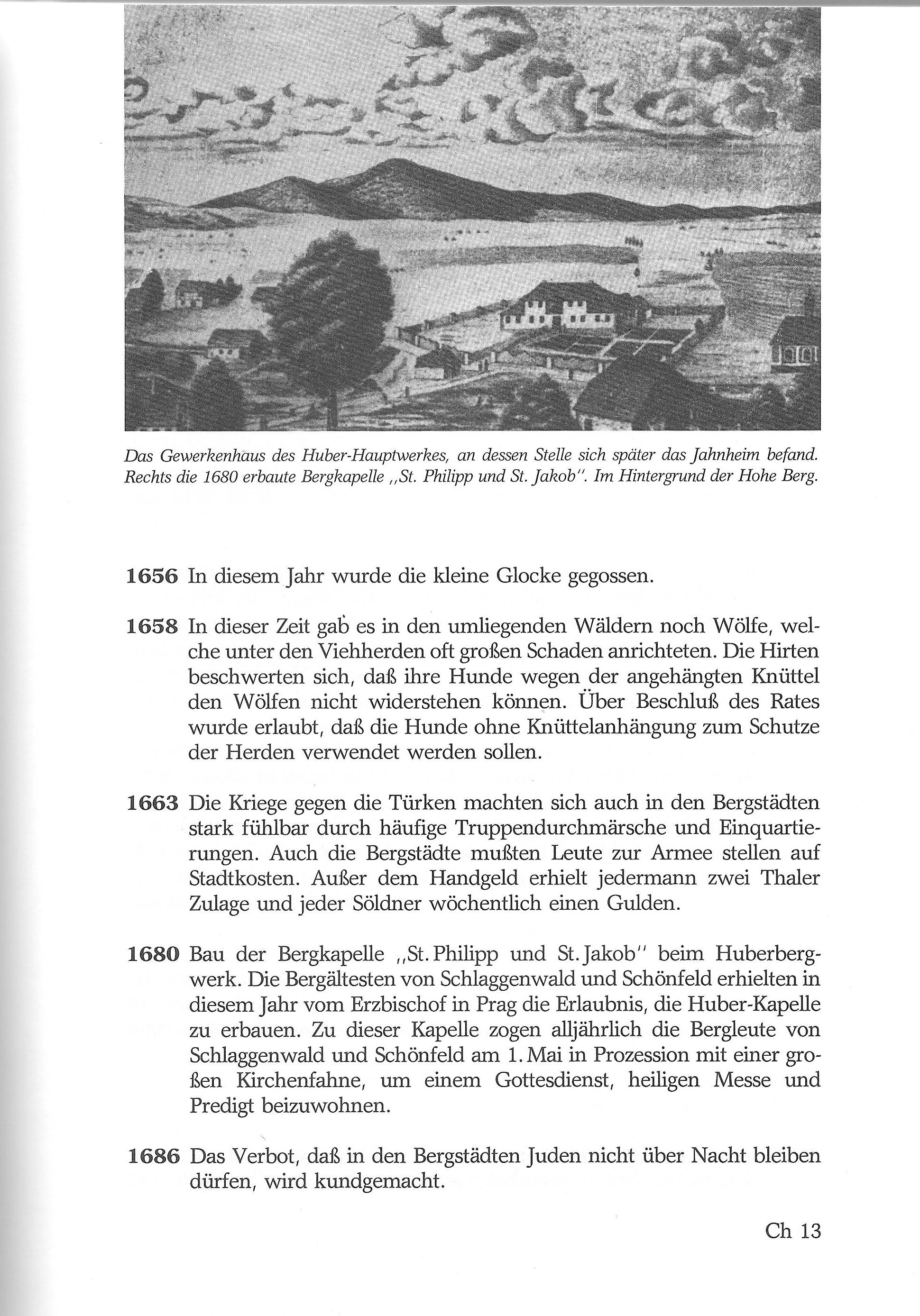
Cronik 013 The tradesmen's house of the Huber main factory, on whose site the Jahnheim (or Jahn Home) was later located. To the right is the mountain chapel, St. In the background is the Hohe Berg. 1656 This year the small bell was cast. 1658 At this time, wolves still existed in the surrounding forests, which often caused great damage to the herds. The shepherds complained that their dogs could not resist the wolves because of the clubs attached to them. By resolution of the council, it was permitted that the dogs could be used to protect the herds without the clubs. 1663 The wars against the Turks also had a strong impact on the mining towns due to frequent troop marches and billeting. The mining towns also had to contribute men to the army at the city's expense. In addition to the earnest money, everyone received a two-thaler allowance, and each mercenary received a weekly guilder. 1680 Construction of the mining chapel "St. Philip and St. Jacob" near the Huber mine. This year, the mining elders of Schlaggenwald and Schönfeld received permission from the Archbishop in Prague to build the Huber Chapel. Every year on May 1st, the miners of Schlaggenwald and Schönfeld marched to this chapel in procession, carrying a large church flag, to attend a church service, Holy Mass, and sermon. 1686 The ban on Jews staying overnight in mining towns is announced. Ch 13 chronik Page-0013
Cronik 014 1693 A large swarm of locusts swept through Lauterbach-Schönfeld-Petschau-Theusing and devastated the grain. Schönfeld suffered damage worth 150 guilders. 1701 The miners were instructed to appear in public only in mining attire. 1703 Major water ingress in the mine. 1706 This year, the death bell was purchased. In 1722, Schönfeld had 1,100 inhabitants around this year. At that time, the pastor received a weekly salary of three guilders from the town council, and each of the two teachers received one guilder. Due to the town's extreme poverty, this salary could sometimes not be paid. In those days, there were 109 brewing houses in Schönfeld, and 109 brews could have been produced, but due to the town's extreme poverty, many of them were often unable to brew. Several townspeople had to join forces, and brewing was carried out in eight sections. In 1721, there were 24 brews; 15 four-bucket barrels were brewed, totaling 360 barrels for the entire year. The fields were worked by two horses, i.e., two head of cattle. For every line of winter sowing, 4 almonds were grown in better soil, 22 in average soil, and 2 in poor soil; one almond yielded 3/4 of a line of grain. All the grain harvested here was consumed in the village. The fields, according to the old cadastre from 1722, lie partly on the plains, partly on mountains and hills; they are sandy and stony, often subject to winter rot, poor soil for grain, and the meadows are also poor. 1742 During the War of the Spanish Succession, Schönfeld suffered greatly at the hands of the French, who besieged Elbogen; livestock, grain, and valuables were confiscated. There were arson attacks, quartering, and troop marches. 1743 Erection of the Ecce Homo statue. 1750 Bohemia was divided into 18 districts, and a district office was established in Elbogen. From then on, direct traffic between all towns and Ch 14 chronik Page-0014
Cronik 015 1750 Offices with Prague ceased. All official submissions and reports had to go through the district office in Elbogen. There, a district captain was in office with a commissioner, a district treasurer, and an inspector, to whom the tax collectors in the district submitted the imperial and royal taxes, contribution money, and state levies every month. The high court, the punitive court, was transferred to the state. The high court buildings in Schönfeld and Schlaggenwald were ceremoniously demolished in 1751. 1756 Seven Years' War. The city was often required to deliver bread and grain. The city usually handed over the deliveries to a merchant for execution, but was often unable to pay the bill for a long time. The mining offices in Schönfeld and Lauterbach were abolished and placed under the management of the Schlaggenwald mining masters. 1757 On December 22nd, the Most Reverend Franz Adalbert Josef Caroli, Doctor of Theology, Vicar General, Provost of the Metropolitan Cathedral Chapter of St. Vitus in Prague, and first prelate of the Kingdom of Bohemia, was born in Schönfeld. He was a great benefactor by founding a hospital for the poor. The Hubertusstock mines were consolidated into one major mine this year. 1760 Construction of the large chapel "Assumption of Mary" (church). 1761 The workers of the Huber main mine had to cease operations due to heavy debts and low productivity. In 1766 and 1767, the weather was very unfavorable; persistent downpours severely affected the harvest, and a large amount of grain had to be delivered to the military. The following year also saw a very poor harvest. 1770 On November 1, there was a strong earthquake, which was repeated on November 4 and several subsequent days. The exemption of the miners from conscription was confirmed. 1771 A year of famine, the winter of 70/71 brought a great deal of snow. In March 1771, the frost was still so severe that birds were found dead in droves. The grain died over the winter; the little that remained Ch 15 chronik Page-0015
Cronik 016 The crop that stood in the fields in 1771 was washed away by heavy rains in the summer. 1772 This year was a year of famine, like the previous one. Many citizens were plunged into hardship and poverty. High prices and famine prevailed. People resorted to the worst foodstuffs. They boiled grass or beetroot, ground acorns into flour, dried chaff in the oven, and made bread from it; bark was scraped from trees and eaten. Emperor Joseph II came to Bohemia and traveled the country to see for himself the great hardship. He distributed large sums of money, had linen purchased and distributed. The export of grain was prohibited, and the import of grain from Hungary was ordered. The great hardship resulted in the planting of potatoes, which had previously been despised. Growing them had long been encouraged, but until the years of famine without success. Potatoes were also introduced in Schönfeld after these years, but this introduction probably proceeded slowly. The Josephinian land register, the original of which is available in the city archives and dates back to 1785, precisely lists the extent of individual holdings, the cultivation and harvest of grain, hay, and oats, as well as hop plantations, but no potatoes. A potato field was not mentioned in a document until 1796. 1774 In this year, there were 7 horses, 7 oxen, 178 cows, and 32 goats in Schönfeld. 1775 As in other communities, guilds existed in Schönfeld in earlier times, e.g., the shoemakers' guild, the tinsmiths' guild, and others. When a guild member died, the respective guild provided the pallbearers, the pall, the candlesticks, and the candles free of charge, and had a Requiem or Holy Mass. Now, in Schönfeld, there were craftsmen, such as tanners, dyers, glove makers, and others, who were represented only in small numbers and not affiliated with any guild. When one of these people died, the relatives had to beg a guild for the provision of pallbearers, candlesticks, and candles, for which the guild in question had to be paid fairly high fees, or, as the chronicle says, outrageous prices. For this reason, in order not to be dependent on the guilds, the so-called "Unzünftigen" (Unguilds) joined together in 1775 to form an association, the "Konfederieren" (Confederate). chronik Page-0016
Cronik 017 1775, called "the" together, with the obligation to bury each other free of charge. The entrance fee was 3 guilders in convention coins, and an annual contribution was also collected. 1783 In this year, a terrible hailstorm destroyed all crops, and the fields were covered in ice several feet deep. 1787 In this year, a certain Franz Haberdietzl and his associates from Schönfeld wanted to produce earthenware or porcelain in house number 27 (Gabriel-Hof/Hofgasse). However, because the chimney caught fire the first time it was lit, a fire roared, and the entrepreneurs were expelled. They moved to the Zech and bought the so-called sickle hammer there, which became the basis for the porcelain factory. In this year, the high altar in the parish church was completely rebuilt. The upper part was built at the expense of Father Pleyer. Ex-Jesuit, the lower part by the Eger pilgrims. The old high altar was moved to Elbogen in the Church of the Dead. 1790 On July 5, Schönfeld was struck by a terrible hailstorm. Numerous window panes were shattered, roofs were blown off and blown away in pieces. In the municipal forest, around 300 trees were uprooted. 1796 In this year, there were 139 sheep wool spinners, 38 cotton spinners, and 23 flax spinners in Schönfeld. The brewery in Schönfeld was initially the property of the brewing-right citizens. Gradually, the magistrate took over. The former four mayors and the council members brewed lager beer for themselves, served it, and benefited solely from it. In 1796, a dispute arose over the brewing business between the magistrate and the brewing-right citizens. A district commission appeared and investigated the mutual claims. On August 1, the provincial government in Prague made its decision. The magistrate's claims were rejected, and the brewing industry was recognized as the property of the citizens entitled to brew. In 1797, a small bell called the "tax bell" was located in the town hall tower; a signal from this bell reminded taxpayers to appear to pay taxes. Ch 17 chronik Page-0017
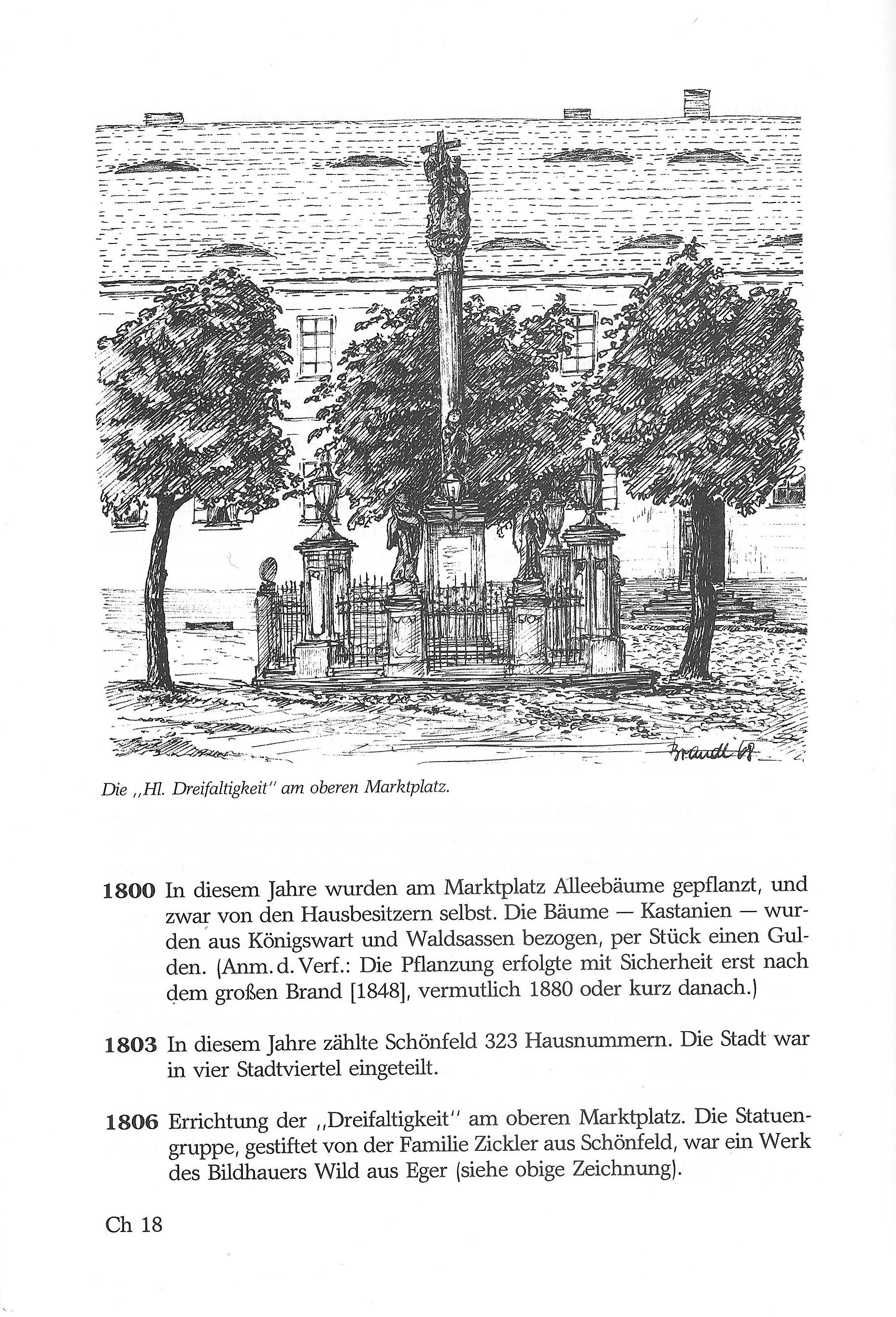
Cronik 018 Brandt The "St. Trinity" on the upper market square. 1800 In this year, avenue trees were planted on the market square by the house owners themselves. The trees Рchestnuts Рwere brought from K̦nigswart and Waldsassen, costing one guilder each. (Author's note: The planting certainly took place after the great fire [1848], probably in 1880 or shortly thereafter.) 1803 In this year, Sch̦nfeld had 323 house numbers. The town was divided into four districts. 1806 Erection of the "Trinity" on the upper market square. The statue group, donated by the Zickler family from Sch̦nfeld, was the work of the sculptor Wild from Eger (see drawing above). Ch 18 chronik Page-0018
Cronik 019 1810 All silver and jewelry had to be handed over to the state treasury. 1811 On March 8, the Financial Patent was issued, causing the value of money to drop dramatically (5:1). The wars with France were to blame. 1816 This year and the previous year were marked by very cold and wet weather. There was plenty of grass and straw, but very little grain; the ears were mostly grainless. Almost no potatoes grew. This resulted in severe inflation and famine. Grass mixed with bran and flour was used for food. In the fall of 1817, there was another good harvest. 1819 According to a resolution of the Pewter Founders' Guild of June 27, only master's sons were allowed to join the guild as apprentices. 1830 First Emperor's Birthday Celebration in Schönfeld. It was held with great solemnity, with great participation from the population. That year, there were still wooden chimneys in 22 houses in Schönfeld. On December 30th: In a joint petition to the Schönfeld magistrate, as the police and judicial authority, the merchants, cloth makers, and weavers in Schönfeld complained about the great harm caused to them in the town by peddlers of Jews, especially from the large Jewish community in Petschau. The petition referred to laws dating back to 1568, which prohibited Jews from entering all mining towns. The magistrate gave the police strict instructions to ensure that no Jewish peddlers were tolerated. Beer Serving 1825/1830: According to a resolution passed by the brewing-authorized citizenry on July 3, 1825, every citizen with a brewing license had the right to brew four times a year, to grind the beer allocated to their share, and to serve it themselves. Apart from the town hall tavern, no more than four beer taverns were to be tolerated. As a result of this resolution, the innkeepers suffered losses. The town hall tenant, Josef Anton Gareiß, therefore filed a complaint with the magistrate. Ch 19 chronik Page-0019
Cronik 020 In 1830, citizens with a brewing license were strictly forbidden from serving beer in their establishments. This right was granted only to innkeepers because they paid acquisition tax. 1831 On the night of October 6th to 7th, a violent break-in occurred at the town hall, and 172 guilders and 542 kreutzers were stolen from the court deposit box. The amount had to be reimbursed by order of the Imperial and Royal Elbogen District Office. On Epiphany Day, the northern lights were visible. 1834 The Theater Amateurs' Association was founded. Violent storms raged during the winter. Significant damage was caused to the forests, and the pewter top of the town tower was bent off. 1835 On October 11th, Halley's Comet was observed. The township had the following property that year: a town hall with a beer hall and bread bank, a brewery, a malt house, a land mill, a meat bank, a festival hall, a bell tower with bells, a town tower, a fire station, a community center with 3 bays of 1,386 fathoms of fields and 6 bays of 1,546 fathoms of meadows, and a community forest with 96 bays of 1,460 fathoms, all with an estimated value of approximately 10,151 guilders and 50 kreuzers. Annual income averaged 2,114 guilders and 28 kreuzers, and annual expenses amounted to approximately 2,028 guilders. At that time, the pastor received 38 fathoms of softwood and 2 fathoms of hardwood from the township annually as a ration. Furthermore, he received (as monetary compensation) an Easter lamb and 8 pounds of carp. The following annual salaries were paid to: Magistrate Councillor Magistrate's Clerk Bailiff Pastor First Teacher Second Teacher Third Teacher Town Watchman City Surgeon 400 guilders 180 guilders 60 guilders 168 guilders 13 kreuzers 36 guilders 24 kreuzers 29 guilders 7 kreuzers 13 guilders 59 kreuzers 34 guilders 14 kreuzers 20 guilders Ch 20 chronik Page-0020
Cronik 021 the two midwives, each police supervisor pipe driller and water attendant belt master postman night watchman chimney sweep 5 guilders 1 guilder 48 kreuzers 60 guilders 1 guilder 48 kreuzers 8 guilders 31 guilders 12 kreuzers 3 guilders Some of the aforementioned employees were still given a wood allowance of between 3 and 10 fathoms. At that time, 1 fathom of firewood, including felling and haulage costs, cost 4 guilders. Since around 1812, coal firing also became common and was fairly common by 1834. One fathom of coal cost 15 kreuzers on the spot; They were mostly obtained from green waste. Coal was a great boon for the poorer population, as wood was relatively expensive and often difficult to obtain due to deforestation. The formerly very dense forests were heavily depleted by the mines' demand for timber, and little attention was paid to cultivation. It was not until 1820 that significant attention was paid to forest management. 1836 A price list from that year. At that time, in Schönfeld, the following cost: 1 bar of wheat 6 guilders, 1 bar of grain 3 guilders 36 kreuzers, 1 bar of barley 3 guilders, 1 bar of oats 2 guilders 24 kreuzers, 1 bar of potatoes 2 guilders, 1 hundredweight of hay 1 guilders 45 kreuzers, 1 pound of beef 6 kreuzers, 1 pound of lamb 8 kreuzers, 1 pound of veal 5 kreuzers, 1 pound of pork 10 kreuzers, 1 chicken egg 2 kreuzers, 1 liter of beer 4 1/2 kreuzers, 1 pound of fresh butter 16 kreuzers, 1 pair of calfskin boots 4 guilders, 1,000 bricks 10 guilders. A bricklayer or carpenter received 18 kreuzers as wages daily. 1837 In this year, the Mount of Olives was erected in the porch of the parish church by Mr. Josef Zickler, a merchant in Schönfeld, and several other benefactors. The cost was 137 guilders. Ch 21 chronik Page-0021
Cronik 022 1839 Since this year, an improvement and lighting fund existed in Schönfeld. The purpose of these funds was to raise funds for building improvements and street lighting. During an audit of the municipal accounts by the Elbogen district office, the authorities discovered that these two funds had been established without state approval; therefore, their further activities were discontinued. The available funds were used for paving work. On June 1, a massive downpour swept over Schönfeld, causing extensive damage. The road to Lauterbach, which had been repaired only a year earlier, was severely damaged, and the adjacent meadows and fields were devastated. Water flooded many houses in the town. Almost all bridges were destroyed and had to be rebuilt. A week later, on a stormy night, thieves broke into the rectory. A stone water tank was erected in the market square. 1841 May 8th was a very hot day; in the afternoon there was a terrible thunderstorm and a massive hailstorm, which caused extensive damage to the fields and houses. 1842 A prison was built in Frohnfeste. That year, there was a severe drought, resulting in severe water and fodder shortages. All the mills in the town were idle. 1846 In February, the Schlaggenwald-Schönfeld-Petschau route of the new state road to be built was marked out. 1847 Sale of the "Grundmühle" to Josef Lugner from Tiefenbach. Since then, this mill has been removed from the Schönfeld land register. 1848 The great fire in Schönfeld on July 7. Within three hours, 230 residential and outbuildings were destroyed by flames. The damage was estimated at 600,000 guilders. In this and the following years, the state road from Wodnian to Graßlitz, leading through Schönfeld, was built; Schönfeld Ch 22 chronik Page-0022
Cronik 023 1848 had to make significant contributions to this. It is noted that near houses no. 58 and 59 – where the street runs – there was a hill, the so-called "Dammbecknberg." It was demolished during the construction of Kaiserstraße. 1849 According to a resolution of the city council, a new brick kiln with a capacity of 15,000 bricks was to be built near the municipal brickworks. In the winter, there were strong storm winds; the town tower, which had been provided with a temporary roof, was covered. 1850 This year, a significant change occurred in the administration of the municipality. By the Imperial and Royal Governorship Ordinance of December 29, 1849, the previously existing magistrate was abolished, effective February 18, 1850, depriving the municipality of its jurisdiction and a significant portion of its political activity. Schönfeld was assigned to the Falkenau District Administration. On May 20, the gendarmerie began its operations. It A worsted-spinning company was founded. In the first days of May, severe cold prevailed with heavy snowfall. Nervous fever raged in our area, presumably brought by the military quartered here, whose troops were mostly Italian. On July 15, at 3:30 a.m., a strong earthquake struck here. In 1850/52, reforestation took place at Brandhau. 1851 By state decree, all existing guilds were declared abolished. 1852 May 22: Laying of the foundation stone for the construction of the town hall. 1853 Construction of the road to Lauterbach, from the Stone Martyrdom to the border pillar, 681.5 fathoms long. Ch 23 chronik Page-0023
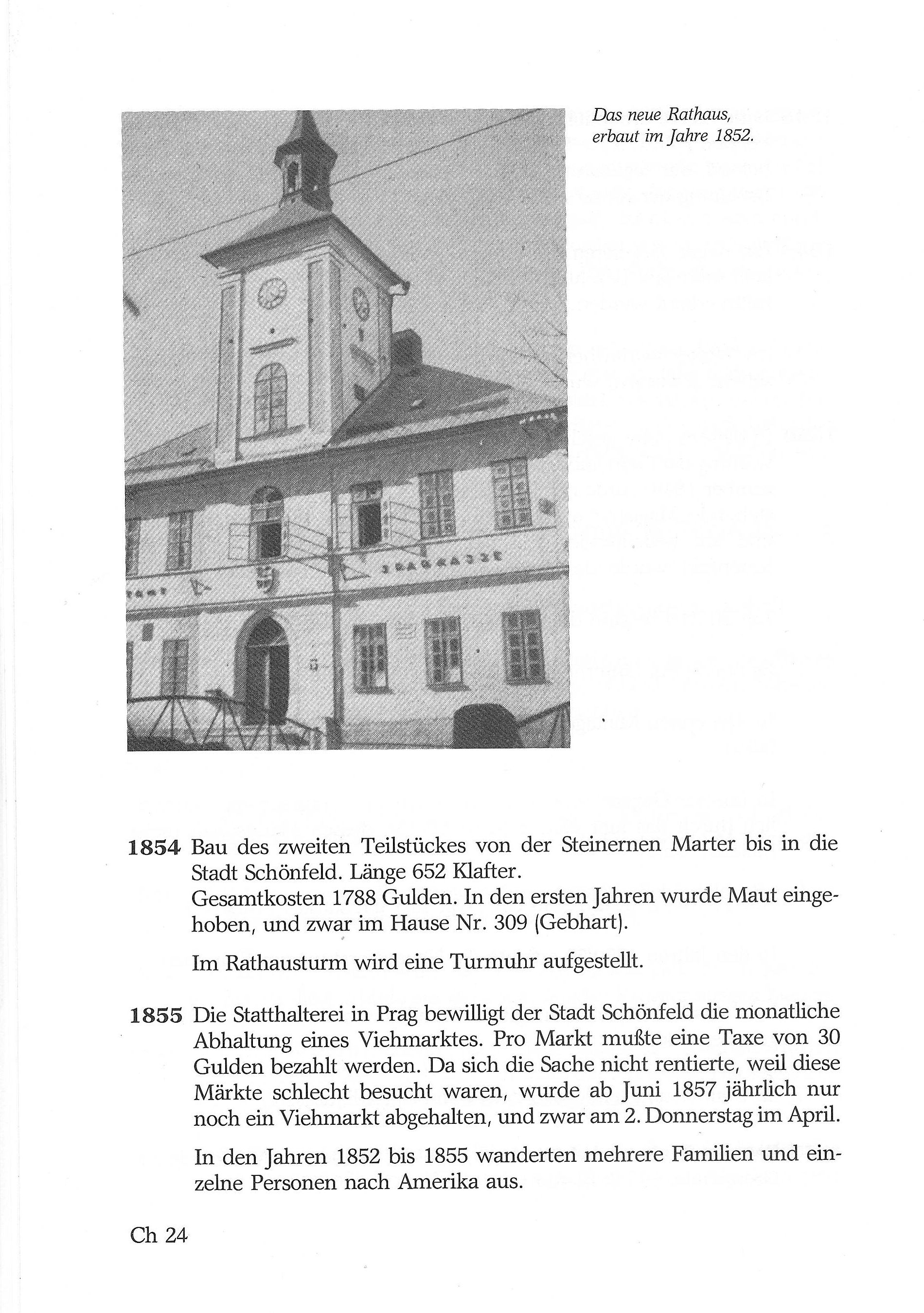
Cronik 024 The new town hall, built in 1852. 1854 Construction of the second Section from the Stone Martyrdom to the town of Schönfeld. Length: 652 fathoms. Total cost: 1,788 guilders. In the early years, tolls were collected at house number 309 (Gebhart). A clock was installed in the town hall tower. 1855 The Prague Governor's Office authorized the town of Schönfeld to hold a monthly cattle market. A fee of 30 guilders was charged per market. Since the project was not profitable due to poor attendance, only one cattle market was held annually from June 1857 onwards, on the second Thursday in April. Between 1852 and 1855, several families and individuals emigrated to America. Ch 24 chronik Page-0024
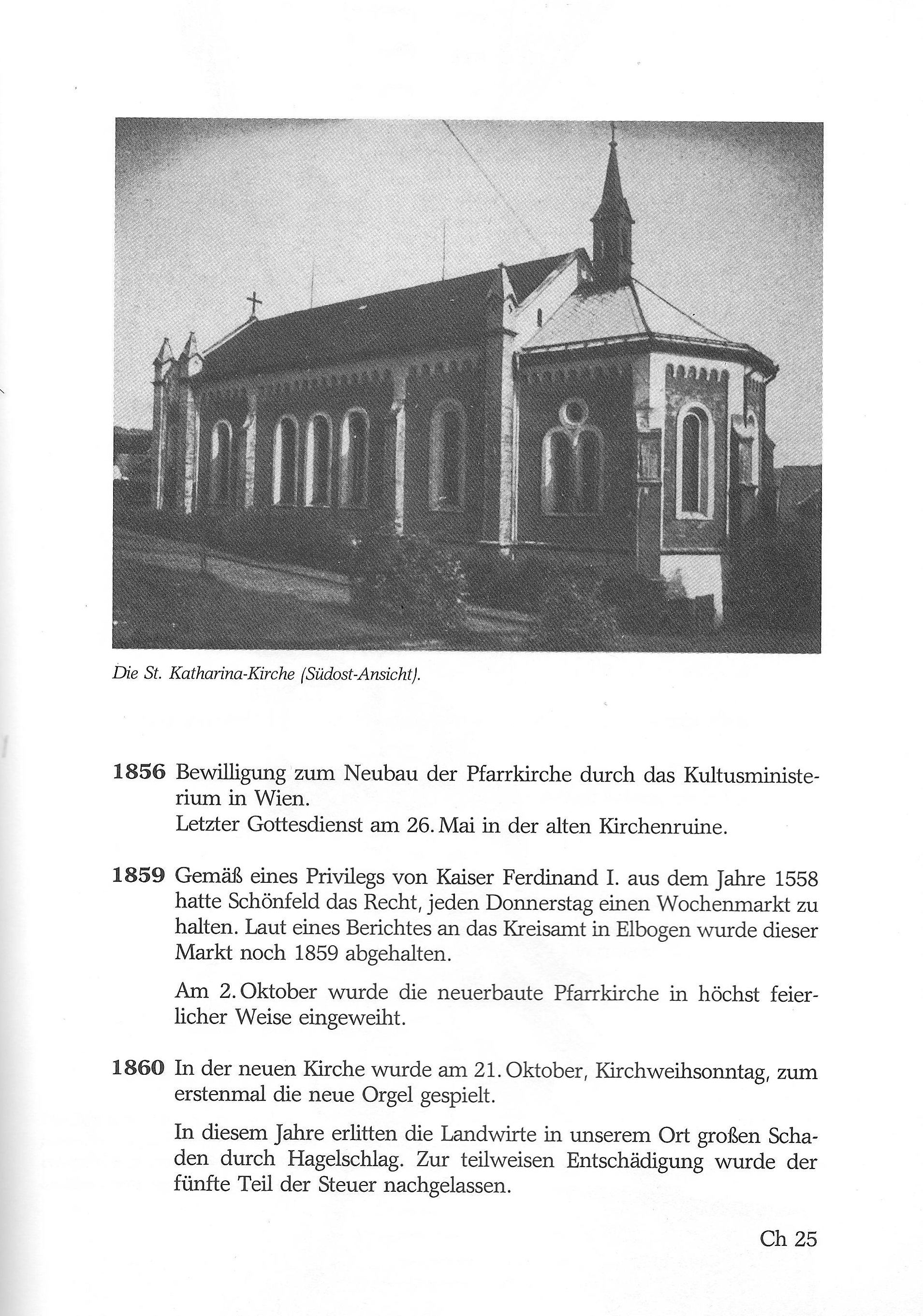
Cronik 025 St. Catherine's Church (southeast view). 1856 Approval for the construction of a new parish church by the Ministry of Culture in Vienna. Last service on May 26th in the old church ruins. 1859 According to a privilege granted by Emperor Ferdinand I in 1558, Schönfeld had the right to hold a weekly market every Thursday. According to a report to the district office in Elbogen, this market was still being held in 1859. On October 2nd, the newly built parish church was consecrated in a most solemn manner. 1860 The new organ was played for the first time in the new church on October 21st, Church Consecration Sunday. In this year, the farmers in our village suffered great damage from hailstorms. As partial compensation, a fifth of the tax was abated. Ch 25 chronik Page-0025
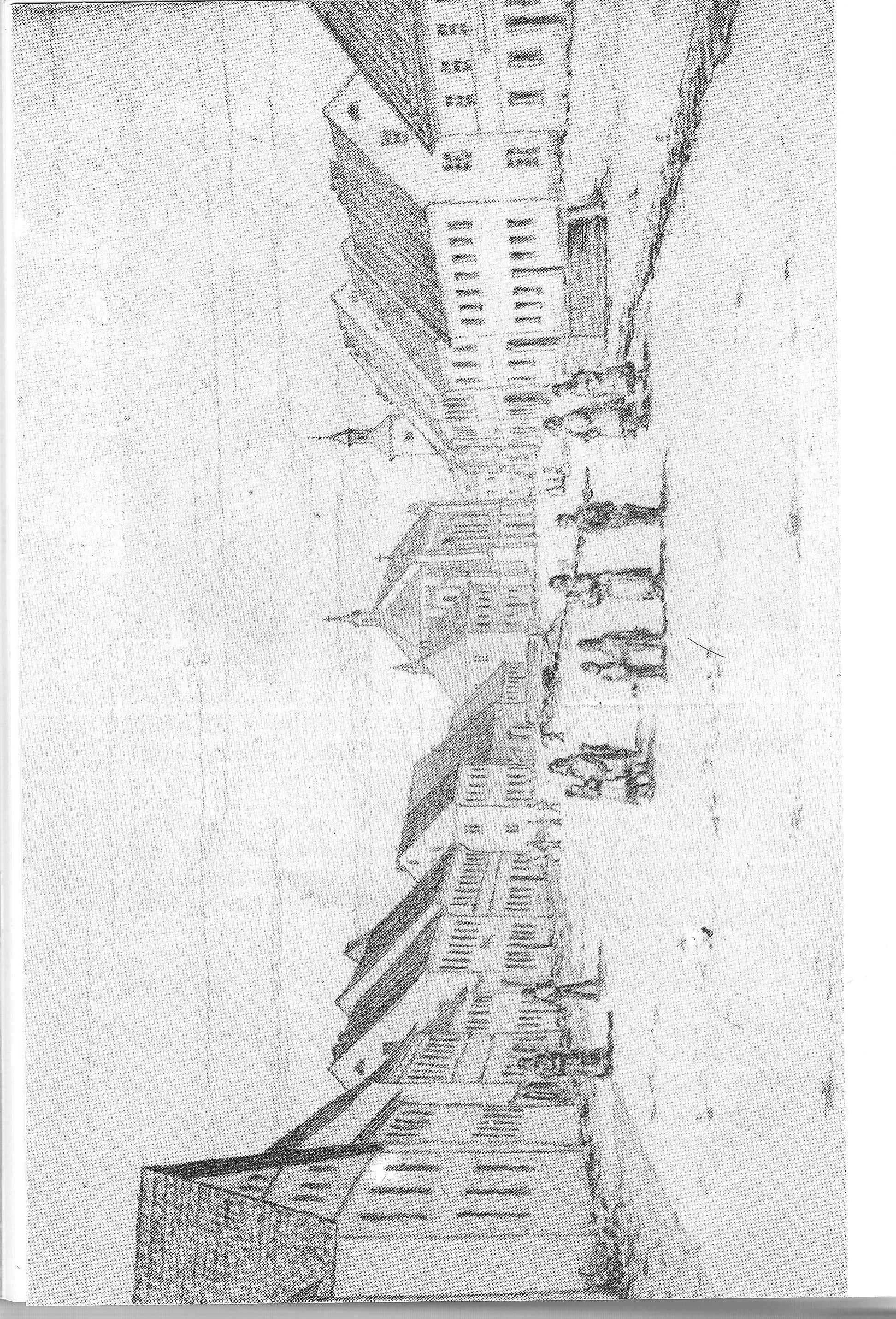
Cronik 026 --- chronik Page-0026
Cronik 027 1861 In the first weeks of this year, a terrible night storm uprooted the last of the old linden trees standing by the bell tower. This linden tree had saved the bell tower and the bells from destruction during the great fire of 1848. 1863 A very harsh winter. 1864 June was very cold. It snowed on July 2 and August 10. 1866 After the end of the war, Prussian troops of all branches of the military marched through Schönfeld. From August 23 to September 7, officers were quartered in the rectory. In this year, the Theater Amateurs' Association donated the 14 Stations of the Cross for the church. 1867 Porcelain painting began in Schönfeld. 1868 The construction of the new rectory was approved by the state patronage and awarded to the master builder Schmidt in Petschau. 1870 A butcher's shop was established at the municipal butcher's shop. 1874 This year, a general stagnation of all businesses occurred, leaving cloth makers and weavers without work; many people had to seek work outside. 1880 was the final year of the "Enzmann Chronicle." The only entry for this year: 14 marriages, 125 births, and 83 deaths. It should be added that information about marriages, births, and deaths was first recorded in the chronicle in 1584. The entry "a miner died in an accident" is frequently found. The first information about such a sad event dates back to 1577. The Schönfeld market square around 1870. The chestnut avenue, which later had a very positive impact on the appearance of this area, is still missing. Clearly visible to the right is a stone water tank erected in 1839 (later the Waaghäusl was located on this site). Behind it is the Geier House, which burned down in 1916 and was rebuilt in a different form. Ch 27 chronik Page-0027

Cronik 028 blank page chronik Page-0028
Cronik 029 Part 2 (1880-1946) 1880 Founding of the Shoemakers' Cooperative. This cooperative brought its members, among other benefits, military supplies during World War I, as well as those made to the Czech Army in the 1930s. 1883 In this year, the Spinner porcelain painting workshop, founded in 1867, was expanded into a porcelain factory. The factory employed around 60 people at the time. 1885 Founding of the Workers' Reading Club. In terms of his political and social stance, his activities marked the first revival of socialism in the town of Schönfeld. 1886 Founding of the "German Gymnastics Club Schönfeld." Since 1869, a gymnastics and fire brigade association had existed, with a gymnastics team within the fire brigade. In that year, the gymnasts separated from the fire brigade and founded their own association under nationalist principles. September 1: The post office also receives a telegraph office. 1893 Great heat and water shortages. It didn't rain all summer, the turf of the meadows burned out, and the crops withered. The result was a poor harvest and a fodder shortage on a scale never seen before. People had to sell their livestock at ridiculously low prices to avoid starving. 1896 On July 29, during a severe thunderstorm with a violent wind, the roof of the "Neues Grabenhäusl" (New Grave House) was lifted off and carried across the street into the field opposite. Ch 29 chronik Page-0029
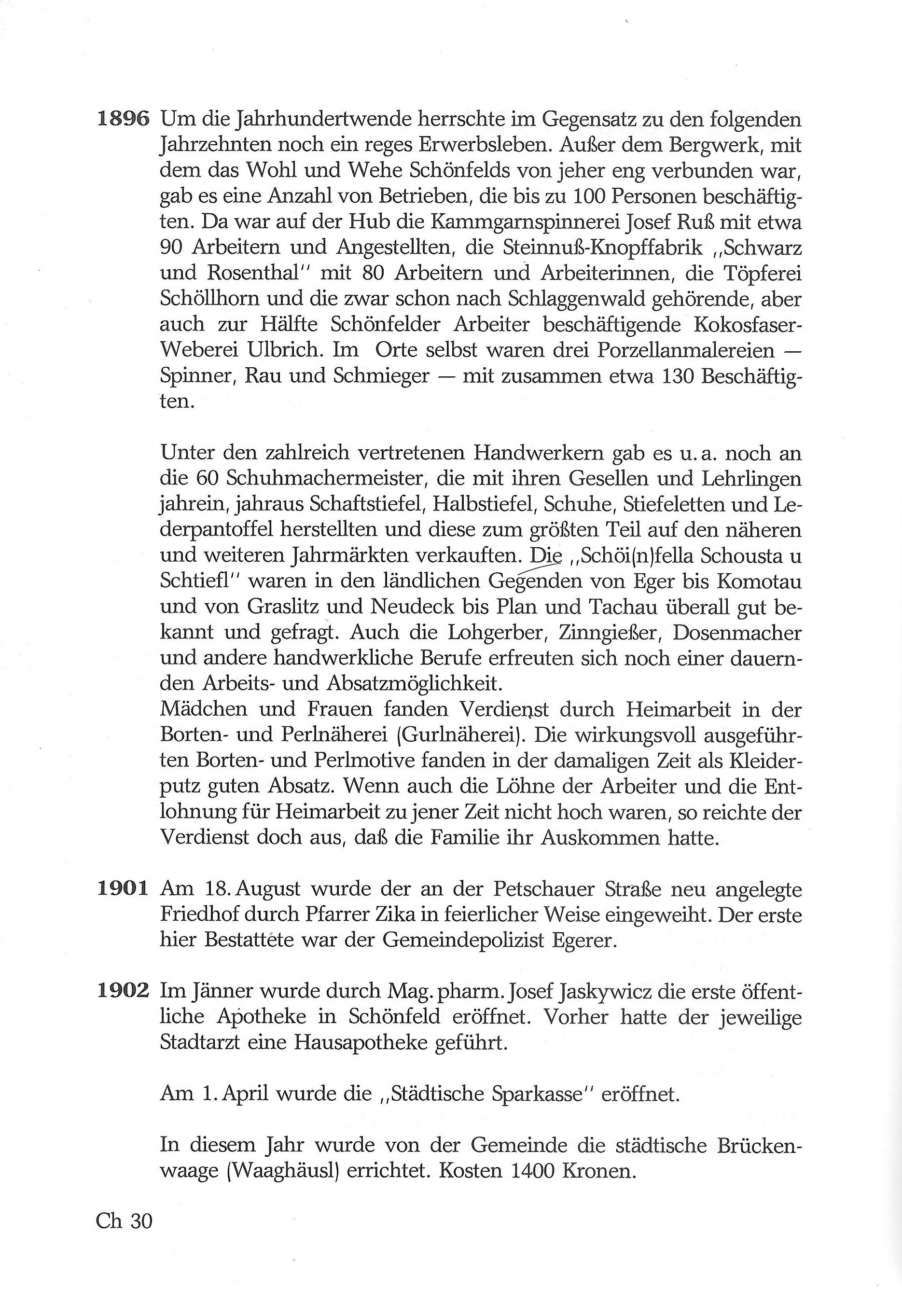
Cronik 030 1896 At the turn of the century, in contrast to the following decades, there was still a lively working life. In addition to the mine, with which Schönfeld's fortunes were always closely linked, there were a number of businesses employing up to 100 people. These included the Josef Ruß worsted spinning mill with approximately 90 male and female employees, the Schwarz and Rosenthal stone nut button factory with 80 male and female workers, the Schöllhorn pottery, and the Ulbrich coconut fiber weaving mill, which, although already part of Schlaggenwald, also employed half of its workforce from Schönfeld. In the village itself, there were three porcelain painting companies, Spinner, Rau, and Schmieger, with a total of approximately 130 employees. Among the numerous artisans represented were around 60 master shoemakers, who, with their journeymen and apprentices, produced high boots, half boots, shoes, ankle boots, and leather slippers year in, year out, and sold most of them at local and distant fairs. The "Schöi(n)fella Schousta u Schtiefl" (beautiful Schousta and Schtiefl) were well known and sought after throughout the rural areas from Eger to Komotau and from Graslitz and Neudeck to Plan and Tachau. Tanners, pewterers, can makers, and other skilled craftsmen also enjoyed a steady supply of work and sales. Girls and women earned money through homework in the braid and bead sewing (Gurlnäherei). The effectively executed braid and bead motifs sold well as clothing decorations at that time. Although the workers' wages and the remuneration for homework were not high at that time, the earnings were sufficient to support the family. 1901 On August 18, the newly established cemetery on Petschauer Straße was ceremoniously dedicated by Pastor Zika. The first person buried here was the local policeman Egerer. 1902 In January, Josef Jaskywicz, Pharm., opened the first public pharmacy in Schönfeld. Previously, the town doctor had managed a home pharmacy. On April 1st, the "Municipal Savings Bank" was opened. That year, the municipality built the municipal weighbridge (Waaghäusl). Cost: 1,400 crowns. Ch 30 chronik Page-0030
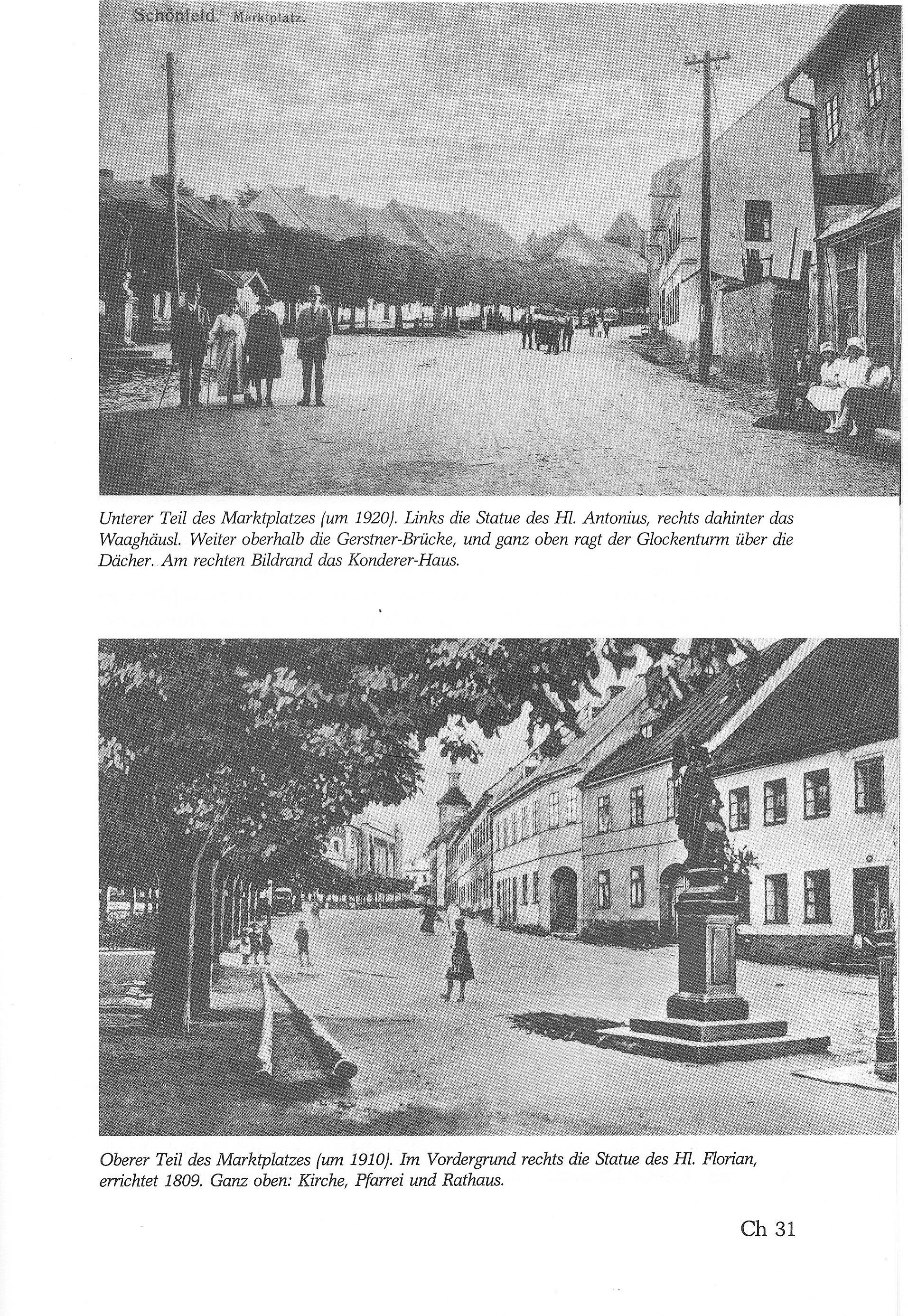
Cronik 031 Schönfeld. Market Square. Lower part of the market square (around 1920). On the left is the statue of St. Anthony, behind it to the right is the Waaghäusl. Further above is the Gerstner Bridge, and at the very top, the bell tower rises above the rooftops. On the right edge of the picture is the Konderer House. Upper part of the market square (around 1910). In the foreground on the right is the statue of St. Florian, erected in 1809. At the very top: the church, parish, and town hall. Ch 31 chronik Page-0031
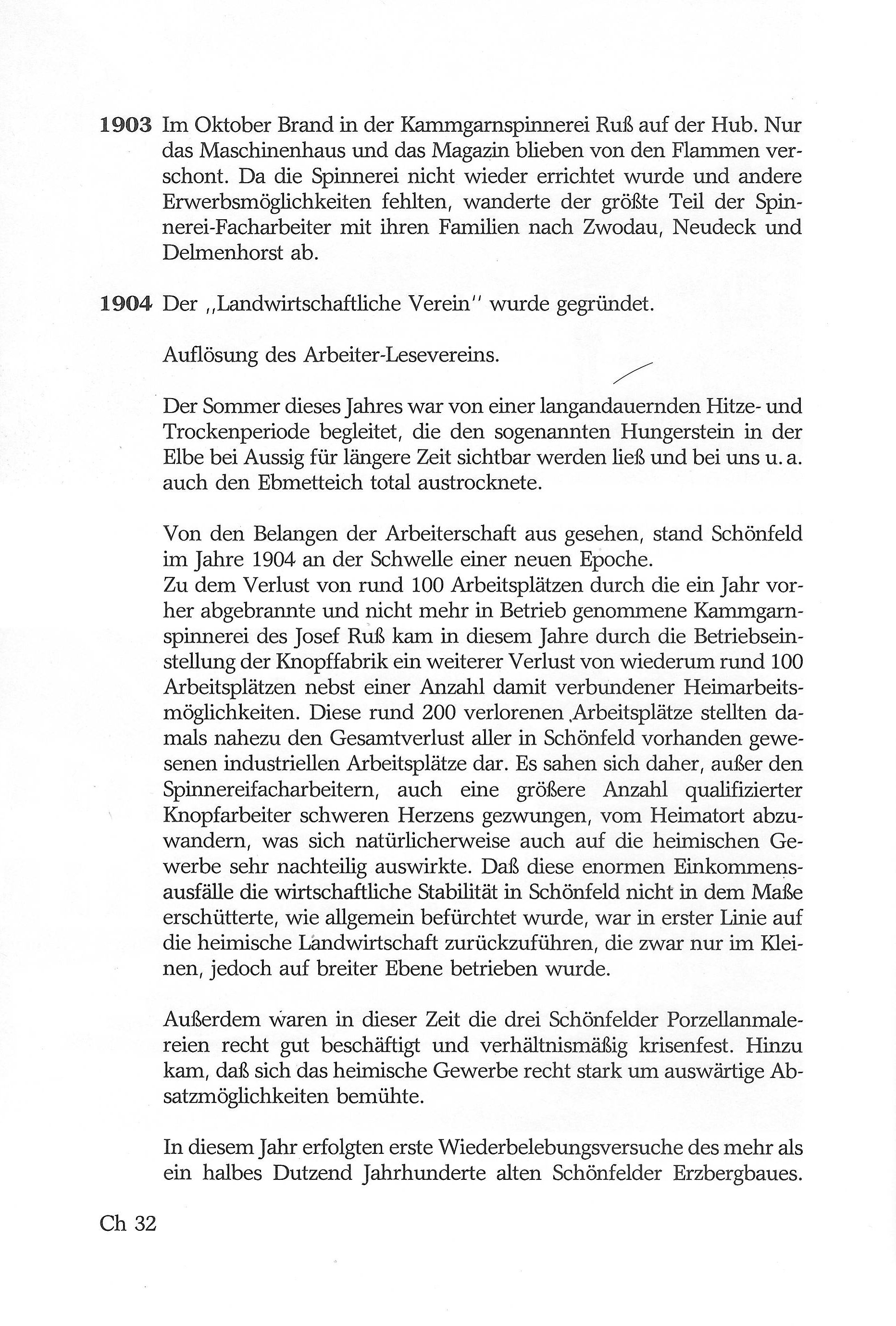
Cronik 032 1903 In October, a fire broke out at the Ruß worsted spinning mill on the Hub. Only the engine house and the warehouse were spared from the flames. Since the spinning mill was not rebuilt and other employment opportunities were lacking, most of the skilled spinning workers and their families emigrated to Zwodau, Neudeck, and Delmenhorst. 1904 The "Agricultural Association" was founded. Dissolution of the Workers' Reading Club. The summer of that year was accompanied by a prolonged period of heat and drought, which left the so-called Hungerstein in the Elbe near Aussig visible for a long time and, in our area, completely dried up the Ebmetteich, among other things. From the perspective of the workers, Schönfeld stood on the threshold of a new era in 1904. In addition to the loss of approximately 100 jobs due to Josef Ruß's worsted spinning mill, which had burned down a year earlier and was no longer in operation, the closure of the button factory that year resulted in a further loss of approximately 100 jobs, along with a number of associated home-based employment opportunities. These approximately 200 lost jobs represented almost the total loss of all industrial jobs that existed in Schönfeld at the time. Therefore, apart from the skilled spinning mill workers, A large number of skilled button workers were also forced, with a heavy heart, to emigrate from their hometown, which naturally had a very detrimental impact on local businesses. The fact that these enormous income losses did not shake the economic stability of Schönfeld to the extent generally feared was primarily due to local agriculture, which, although small-scale, was still practiced on a broad scale. Furthermore, the three Schönfeld porcelain painting workshops were quite busy during this period and relatively resilient to crises. In addition, local businesses were striving hard to find sales opportunities abroad. This year saw the first attempts to revive the more than half-dozen centuries-old Schönfeld ore mining industry. Ch 32 chronik Page-0032
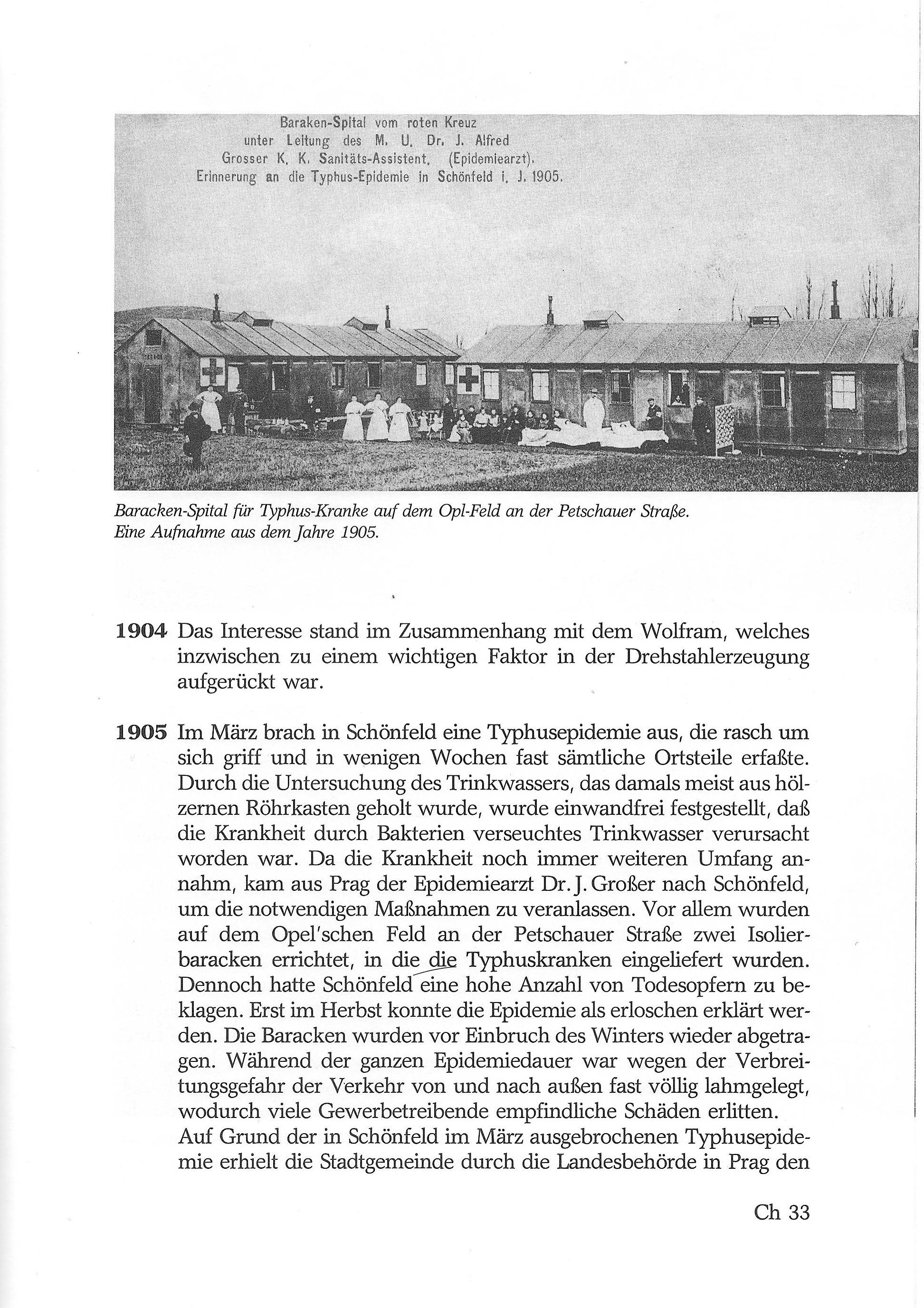
Cronik 033 Red Cross Barracks Hospital under the direction of M. U. Dr. J. Alfred Grosser, Royal Medical Assistant. (Epidemic doctor). Remembrance of the typhus epidemic in Schönfeld in 1905. Barracks hospital for typhus patients on the Opl field on Petschauer Straße. A photo from 1905. 1904 The interest was related to tungsten, which had since become an important factor in turning steel production. 1905 In March, a typhus epidemic broke out in Schönfeld, spreading rapidly and affecting almost all parts of the town within a few weeks. Examination of the drinking water, which at that time was mostly fetched from wooden tubing, clearly established that the disease was caused by bacteria-contaminated drinking water. As the disease continued to spread, the epidemic doctor Dr. J. Grosser came from Prague to Schönfeld to initiate the necessary measures. Most notably, two isolation barracks were built on the Opel field on Petschauer Straße, to which the typhus patients were admitted. Nevertheless, Schönfeld suffered a high number of fatalities. The epidemic was only declared extinct in the fall. The barracks were dismantled before the onset of winter. Throughout the entire epidemic, traffic to and from the outside was almost completely paralyzed due to the risk of spread, causing significant damage to many businesses. Due to the typhus epidemic that broke out in Schönfeld in March, the municipality received the Ch 33 from the state authorities in Prague. chronik Page-0033
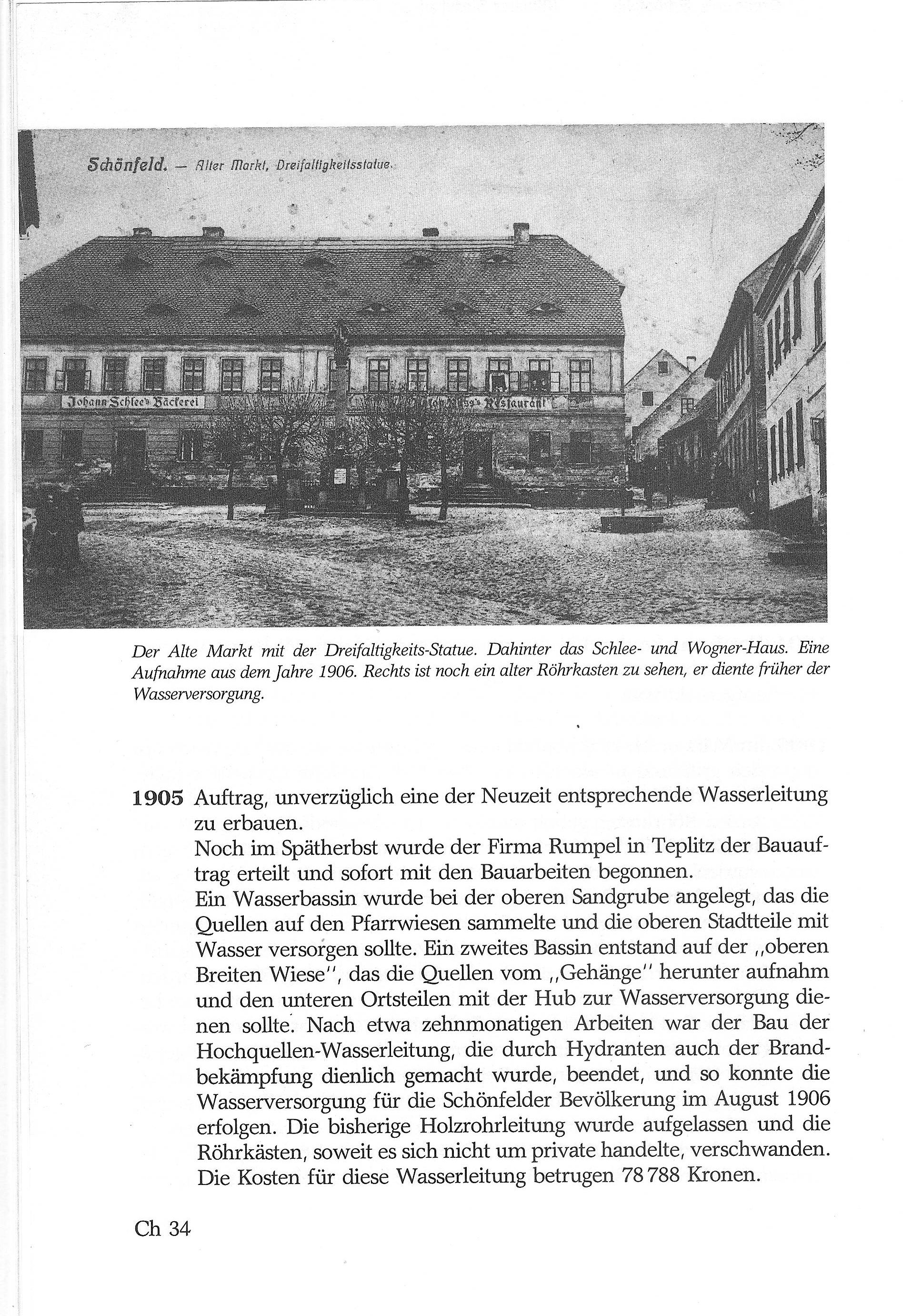
Cronik 034 Schönfeld. Old Market, Trinity Statue. Johann Schlee's Bacterel The Old Market with the Trinity Statue. Behind it, the Schlee and Wogner House. A photo from 1906. On the right, an old pipe box can still be seen; it formerly served as a water supply. 1905 Commission to immediately build a modern water pipeline. In late autumn, the Rumpel company in Teplitz was awarded the construction contract, and construction work began immediately. A water basin was built near the upper sand pit, which collected the springs on the parish meadows and was intended to supply water to the upper parts of the town. A second basin was built on the "upper Breite Wiese," which collected the springs from the "Gehänge" (hill) and was intended to supply water to the lower parts of the town via the Hub. After about ten months of work, the construction of the mountain spring water pipeline, which was also made useful for firefighting by means of hydrants, was completed, and water was supplied to the Schönfeld population in August 1906. The existing wooden pipeline was abandoned, and the pipe boxes, unless they were private, were removed. The cost of this water pipeline was 78,788 crowns. Ch 34 chronik Page-0034
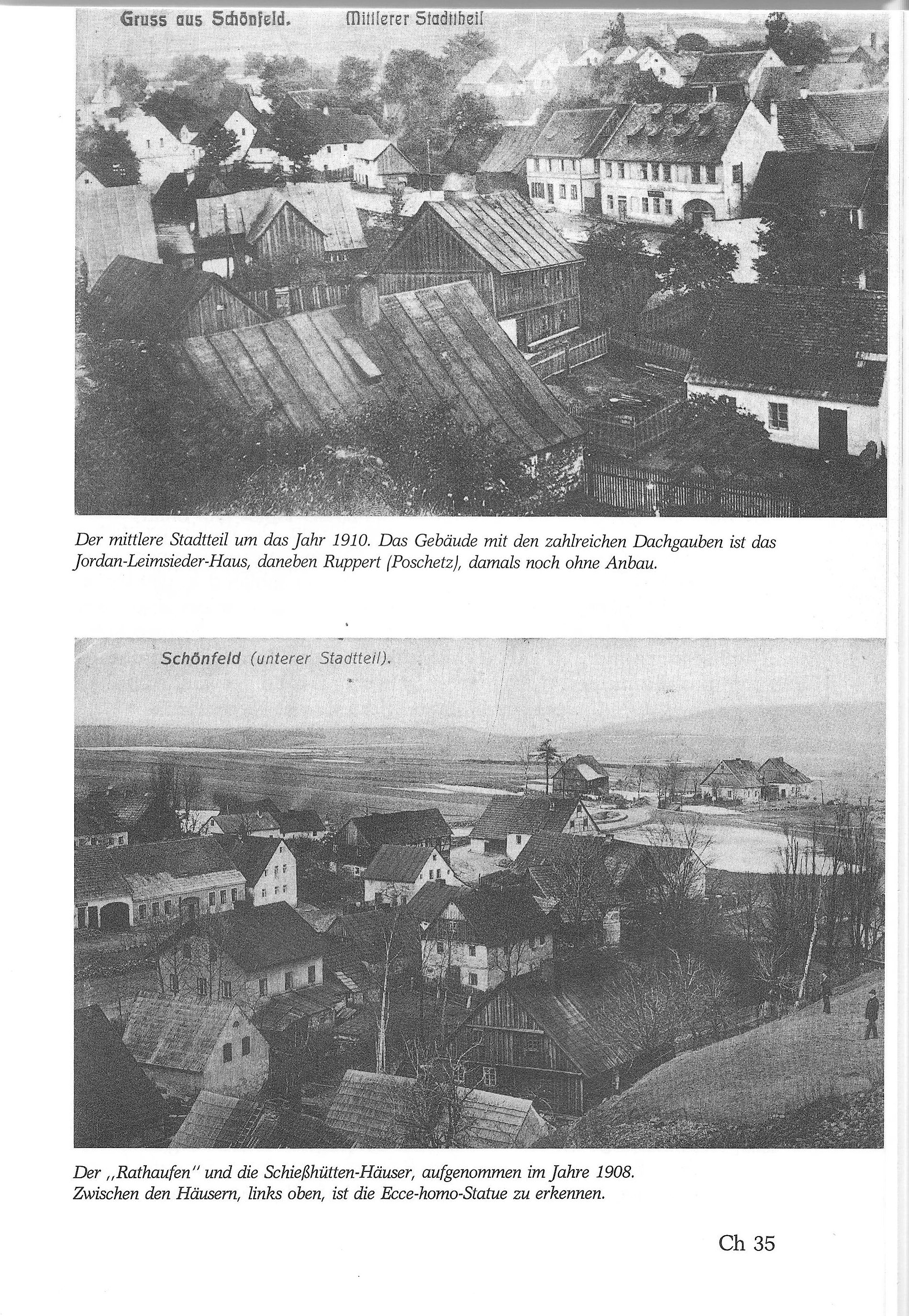
Cronik 035 Greetings from Schönfeld. Middle Town Center The middle part of the city around 1910. The building with the numerous dormer windows is the Jordan-Leimsieder-Haus, next to it Ruppert (Poschetz), which at that time was still without an extension. Schönfeld (lower part of the city). The "Rathaufen" (Council Pile) and the shooting lodge houses, photographed in 1908. The Ecce Homo statue can be seen between the houses, top left. Ch 35 chronik Page-0035
Cronik 036 1906 On September 15, the state-subsidized lace school opened in Schönfeld. The Innkeepers' and Butchers' Cooperative was also founded this year. A telephone exchange was connected to the Post and Telegraph Office on September 1. 1907 After years of struggle by the socialist parties against the more conservative circles in Austria, universal suffrage was introduced in Austria-Hungary this year by resolution of the Vienna Parliament. Previously, only those who paid at least five guilders in direct tax annually were eligible to vote; the less well-off sections of the population were excluded from the right to vote at that time. Eligible voters were divided into three groups, or three electoral bodies, depending on the amount of their tax payment. Those who paid more tax, i.e., those who voted in the first electoral body, had more weight than those who paid less. All of these disadvantages or privileges of individual sections of the population were abolished with the introduction of universal suffrage. However, this new electoral law did not yet provide for women's suffrage. 1909 In January, the Bolzschützen Association was founded. Its clubhouse was the Anna Jordan Inn, "bei der Oaltn." 1910 Raft ditch regulation. From the Glatzen Ponds to Schönfeld, the embankment and streambed were paved with stones. The work, which provided income for hundreds of workers, continued until 1912. 1911 The summer was very hot and dry. The crops produced a poor harvest due to premature ripening. The farmers were particularly concerned about the fodder shortage. 1912 The "Deutscher Jugendbund Glöisser" (German Youth League Glöisser) was founded. Furthermore, a local chapter of the "German School Association" was founded. At the suggestion and instigation of Karl Reinhold, the chairman of the Schönfeld Social Democratic Party, a branch of the Chodau Workers' Cooperative was opened in Schönfeld. Ch 36 chronik Page-0036
Cronik 037 1913 In midsummer, the second forest festival took place on the fairgrounds located next to the Schreiberlwiese and extending towards the Mühlberg. Effective December 2, the former judicial and tax district of Elbogen was separated from the political district of Falkenau and declared an independent district administration with its headquarters in Elbogen. 1914 On New Year's Day morning, a fairly strong and prolonged dawn appeared, which a large part of the population interpreted as a sure sign of war that would come that year. June 28: Assassination of Austrian heir to the throne, Franz Ferdinand, and his wife in Sarajevo. News of the event, initially kept secret by the government, spread like wildfire through the towns and villages of Austria-Hungary on the following holiday. From then on, all dances and other entertainment were suspended. Fears of an outbreak of war were the only topic of conversation among all sections of the population. July 25: Austria's ultimatum to Serbia, which was due to be delivered by 6 p.m., expired. Due to complete uncertainty about Serbia's response, extreme tension prevailed among the population, as peace hung by a thread. July 26: In the early morning hours, the mobilization of Austro-Hungarian troops against Serbia was announced. Reservists born up to 1878 (up to the age of 36) were called up. There was great excitement everywhere, as the long-feared war had broken out overnight. there. July 27: At 7 a.m., Mayor Rau bid farewell to the incoming reservists (about 100 men) in front of the town hall. Afterward, the procession, filled with the utmost patriotism, set off toward Schlaggenwald station to the sounds of the 73rd Regiment March and accompanied by most of the residents. August: The first war casualty in Schönfeld was the porcelain painter Josef Vogl, house number 331, who fell near Schabatz in Serbia. He was a platoon leader in the 102nd Infantry Regiment, which consisted predominantly of Czechs. Ch 37 chronik Page-0037
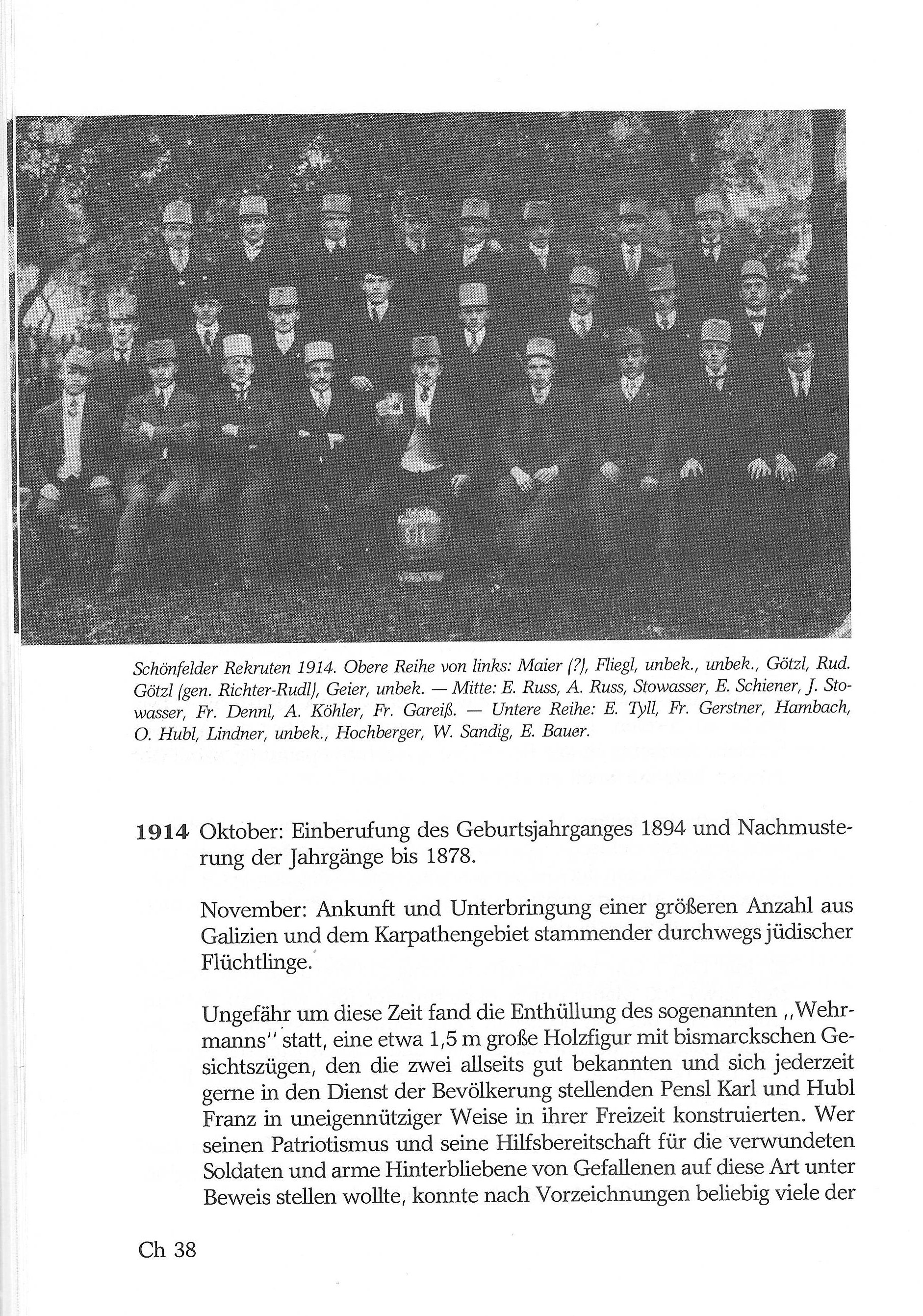
Cronik 038 Schönfeld recruits 1914. Top row from left: Maier (?), Fliegl, unknown, unknown, Götzl, Rud. Götzl (called Richter-Rudl), Geier, unknown. - Middle: E. Russ, A. Russ, Stowasser, E. Schiener, J. Stowasser, Mrs. Dennl, A. Köhler, Mrs. Gareiß. Bottom row: E. Tyll, Mrs. Gerstner, Hambach, O. Hubl, Lindner, unknown, Hochberger, W. Sandig, E. Bauer. 1914 October: Conscription of those born in 1894 and re-mustering of those born up to 1878. November: Arrival and accommodation of a large number of refugees, all Jewish, from Galicia and the Carpathian region. Around this time, the so-called "Wehrmann" (Wehrmann) was unveiled. This approximately 1.5 m tall wooden figure with Bismarckian features was selflessly constructed in their spare time by the two well-known and always happy to serve the public, Pensl Karl and Hubl Franz. Anyone who wanted to demonstrate their patriotism and willingness to help wounded soldiers and the poor relatives of fallen soldiers in this way could, based on preliminary drawings, insert as many of the nails as they wanted into the woodwork. Ch 38 chronik Page-0038
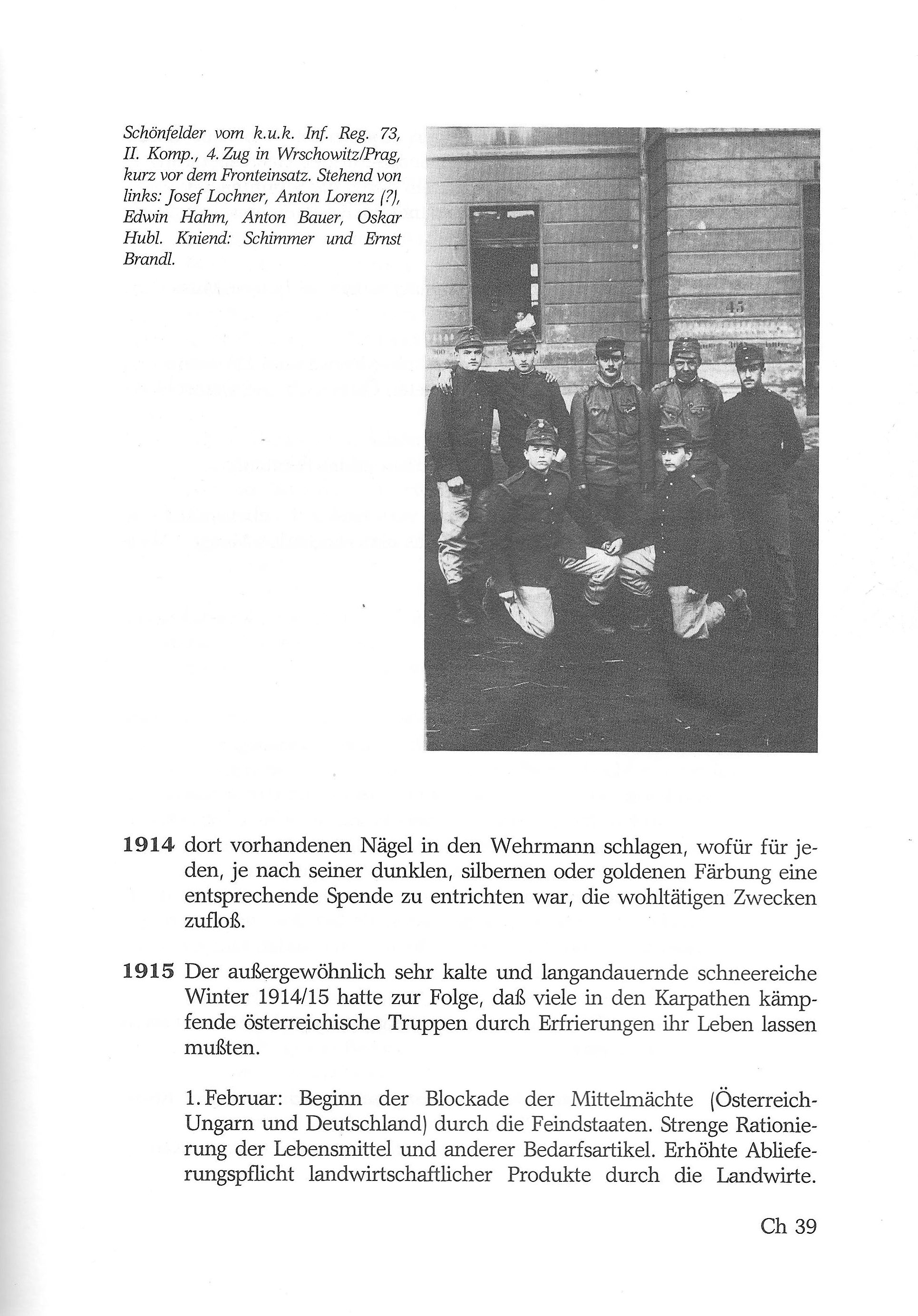
Cronik 039 Schönfelder from the Imperial and Royal Infantry Regiment 73, II Company, 4th Platoon in Wrschowitz/Prague, shortly before deployment to the front. Standing from left: Josef Lochner, Anton Lorenz (?), Edwin Hahm, Anton Bauer, Oskar Hubl. Kneeling: Schimmer and Ernst Brandl. 1914 The soldier was to be beaten, for which a corresponding donation had to be made for each, depending on its dark, silver, or gold color, which went to charity. 1915 The exceptionally cold and prolonged snowy winter of 1914/15 resulted in many Austrian troops fighting in the Carpathians losing their lives from frostbite. February 1: Beginning of the blockade of the Central Powers (Austria, Hungary, and Germany) by the enemy states. Strict rationing of food and other necessities. Increased delivery obligations for agricultural products by farmers. Ch 39 chronik Page-0039
Cronik 040 1915 House searches of late deliverers. Bread with added boiled potatoes and cornmeal. Beginning of army deliveries in the form of military shoes and boots by the Schönfeld shoemakers' cooperative, for which the Gerstner Hall was used as a communal workshop. March 15: Conscription of the 1895 birth cohort and physical examination of the 1896 cohort. May 23: Italy treacherously breaks away from the Triple Alliance and enters the war against its former allies Austria and Germany. Mining operations resume in the middle of the year. Autumn: After rationing of various foodstuffs was introduced, bread was baked predominantly from corn flour. 1916 After the construction of the overhead line from Unterreichenau to Schönfeld and the expansion of the local grid, which began in 1915, electricity and power were put into operation in 1916. In order to minimize the pressure and begging of bakers by their customers for unbranded bread and, at the same time, to minimize over-the-counter sales, and to remedy other grievances, the The community established a bread sales outlet in the lower part of the "Gasthaus zum Potherrn," which was called the "Bread Bank" after an old-fashioned name. Bakers were required to deliver all their bread products there, and consumers, as long as they had bread licenses, had to meet their needs there. War invalids Dunger Isidor and Russ Johann were employed as salespeople in the bread bank. June 13: Major water ingress in the mine, paralyzing the shaft for six weeks. On November 21, Emperor Franz Josef I died after 68 years of rule at the age of 87. His successor to the Austro-Hungarian imperial throne was Charles I, then 29 years old. Ch 40 chronik Page-0040
Cronik 041 1916 According to the Habsburg House Law, which was also the basic law of all Austrian states, upon the death of the emperor, the imperial title immediately passed to his successor. No special ceremonies were required, which is why the coronation could be postponed to any date. Shortly afterwards, all members of the army were sworn in to the new Emperor Karl. Naturally, the soldiers who had worked in the Schönfeld ore mine were not forgotten. Most of them took the oath before entering or leaving the mine, wearing their mining clothes and with lit miner's lamps. 1917 On March 1, Schönfeld received a gendarmerie station, which was relocated to Schönfeld from the neighboring town of Lauterbach. The station consisted of a sergeant major and two sergeants majors. Food shortages increased to the point of famine. Bread deteriorated to the point of inedibility due to the addition of coffee grounds, heather blossoms, and other indifferent additives. Linen, clothing, and footwear were no longer available for purchase; pipe tobacco consisted of cut beech leaves, and cigarettes were mostly made of pickled seaweed. 1918 The food situation was catastrophic; driven by hunger, many people bartered away their last supplies of bed linen, underwear, clothing, footwear, and other valuables in exchange for a few kilograms of flour, wheat, corn, potatoes, bran, and other foodstuffs that often only filled the stomach. In order to ensure that those without sufficient means of subsistence at least had a daily lunch, albeit one of highly questionable quality, a war kitchen was built in 1918 by the mayor's office in house number 224 in the Neustadt district on behalf of higher authorities. The food was prepared from dried vegetables called barbed wire, half-rotten potatoes, yellow beets, and cod, as well as other questionable animal feed. A portion of food, which was available against a ration card, cost 25 kreuzers. Apart from the civilians and soldiers employed in the mining industry, the population consisted only of women, the elderly, and children, as more than 600 men from Schönfeld had been drafted into military service. Most of the agricultural work had to be done by women and children. Ch 41 chronik Page-0041
Cronik 042 1918 October: Collapse of the Austrian fronts. The Czechs, South Slavs, and other non-German soldiers fighting in the Austrian troops refused to obey orders and abandoned their regiments and combat positions to return home or surrender to the enemy. The result was that within a few days the entire front was in disarray, marking the inevitable defeat of Austria-Hungary and Germany in the First World War. This sealed not only the military defeat, but also the disintegration of Austria-Hungary. 11 On October 28, the Czecho-Slovak Republic was proclaimed in Prague, followed by the occupation of the German territories in Bohemia, Moravia, and Silesia by Czech troops. With the end of the war, a time of great uncertainty began in many respects. The aristocracy and the entire big business community, along with the previously influential bourgeoisie, who were collectively referred to with the French word "bourgeoisie" in countless political assemblies and in opposing newspapers, feared being hanged from the nearest tree, as had happened in Russia a year earlier. But even the smallholder and worker had reason enough to fear, if not for their lives, then at least for their savings, often accumulated through decades of frugality. As elsewhere, the soldiers who had since returned home formed a "Soldiers' League" in Schönfeld, following the Russian model, which intended to take over the administration of the town. By possessing rifles and ammunition, the Soldiers' Council also intended to resist a Czech occupation of Schönfeld. However, this intention was recognized as hopeless and abandoned, as the Czechs had already threatened the population of our neighboring Petschau with artillery fire if the planned resistance was offered. On December 10, a group of Czech soldiers led by a sergeant arrived from Petschau and took over the administration of the town without resistance, after which the surrender of all weapons, including hunting rifles, was to follow. Deep dejection reigned among the population as they felt cheated of the right of self-determination enshrined in Wilson's 14 Points. Ch 42 chronik Page-0042
Cronik 043 1918 During the course of 1918, all Schönfelders who were in the European part of Russia returned home from Russian captivity. This year, the "Catholic Women's Relief Society" was founded. In October and November, a previously unknown disease appeared in Schönfeld, which developed into an epidemic and was dubbed the Spanish flu. This disease claimed a considerable number of lives among all age groups. 1919 Beginning of the year: All banknotes still originating from Austria-Hungary had to be presented for cancellation, with each banknote being provided with a postage stamp-like stamp to not only distinguish between the banknotes in circulation in Czechoslovakia and Austria, but also to determine how much each family owned outside of savings banks and banks. A certain percentage of the amounts, which increased with the amount, was retained, causing some to suffer a not insignificant loss. of the state. Naturally, the money deposited in cash registers and banks was also devalued according to its amount, and banknotes not presented for stamping lost their value completely. Naturally, those who had gradually replaced their paper money holdings with gold and silver coins in recent years enjoyed their cleverness, but even these, at least as far as the one-, two-, and five-krone silver coins were concerned, were taken out of circulation by a decree published on the third day of Easter. At the same time, all owners were called upon to exchange these coins for paper money at financial institutions at short notice. The government offices in the German territories were staffed by Czechs. In Schönfeld, the post office, the gendarmerie, and the street guards. Those still in government service Germans were encouraged to learn Czech as the state language. Fritz Garsch (411) and Franz Tyll (Themes No. 90), having only returned from captivity a few months earlier, returned to Russia, where they had been held as prisoners of war. Both have since been considered missing. Ch 43 chronik Page-0043
Cronik 044 1919 September 19: Lightning struck the Maria Schnee Chapel in the afternoon. Mrs. Reinhold from Zech, who had taken shelter there during the thunderstorm, suffered burns to her face and legs. During the summer, numerous cases of dysentery occurred, which also claimed a considerable number of lives. 1921 On February 12, the entire mining operation was shut down, which once again caused a large number of miners and employees to emigrate. On Shrove Tuesday, the first masked parade, organized by the German Youth League "Glöisser," took place. On the afternoon of August 9th, a peat fire broke out in the Filz. Although firefighters from Schönfeld, Schlaggenwald, Elbogen, Lauterbach, and Wasserhäuseln rushed to help, extinguishing efforts proved extremely difficult due to strong winds and dry conditions, so that the fire could not be prevented from spreading over a large area of ​​the Filz, destroying young forest vegetation and even spreading to the Hochwald forest. The plumes of smoke were visible as far as the Saaz region. The fire was only extinguished on the third day by persistent rain. In August, a municipal library was opened in the Schönfeld town hall by state decree. The lending fee per volume per week was 20 Heller. The first bookkeeper was the writer Josef Zachara. 1924 The great wave of layoffs began for German-born civil servants. Those who did not speak Czech received the so-called "Blue Bow," i.e., retirement. Thousands were thus retired at a relatively young age with low pensions. As a result of this measure, the following retired in Schönfeld: Chief Postmaster Willi Schmidt and postman Karl Pensl. 1925 Introduction of Mother's Day. Ch 44 On "Eger Sunday" July 12 Consecration of the church bell "St. Catherine." At the same time, the "Eleven O'Clock Bell," paid for by the youth association "Glöisser" from club funds, was also consecrated. ch 44 chronik Page-0044
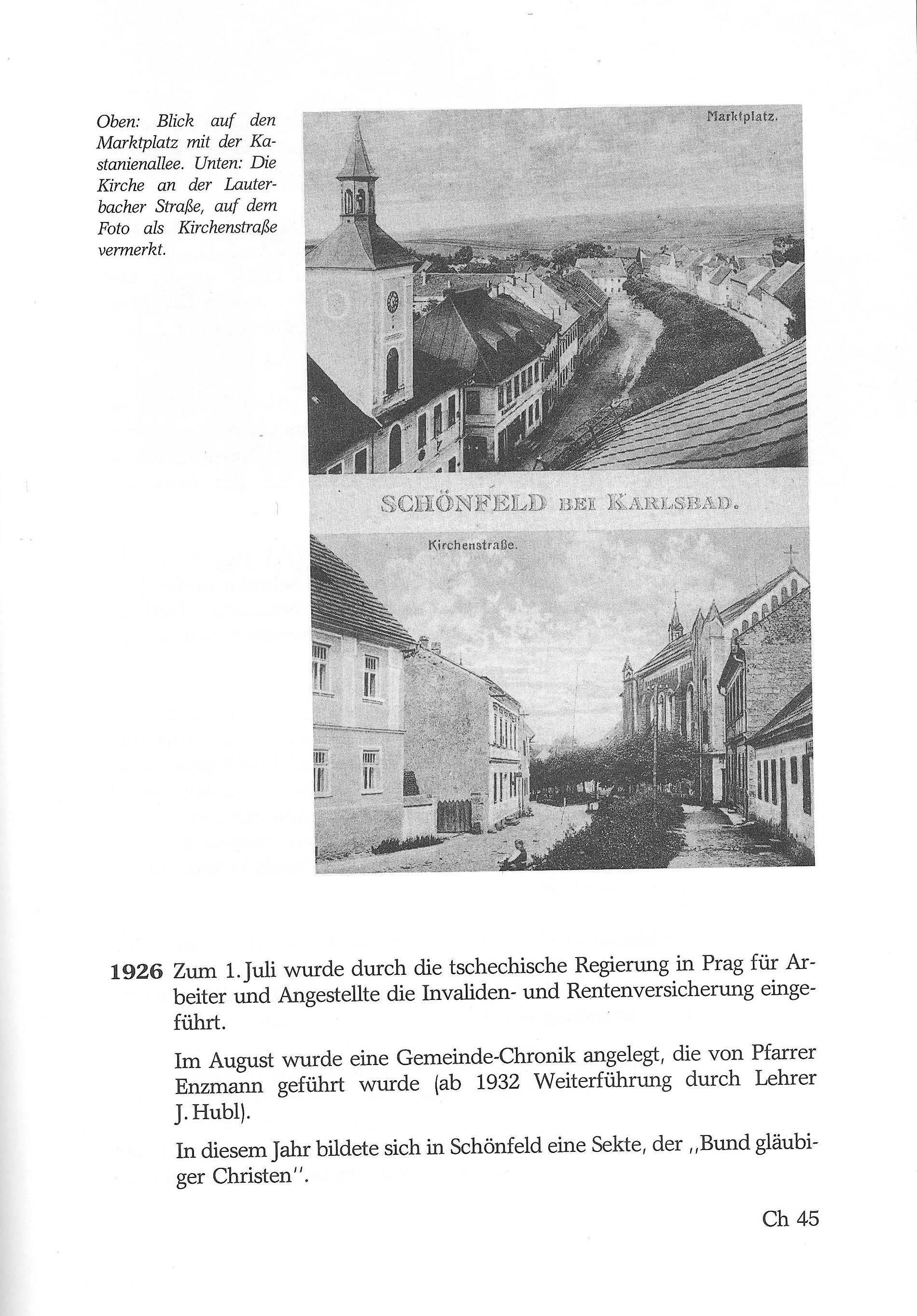
Cronik 045 Above: View of the market square with the chestnut avenue. Below: The church on Lauterbacher Strasse, marked Kirchenstrasse in the photo. Kirchenstrasse. SCHNFELD NEAR KARLSBAD. Kirchenstrasse. 1926 On July 1, the Czech government in Prague introduced disability and pension insurance for workers and employees. In August, a parish chronicle was established, kept by Pastor Enzmann (from 1932 onward by teacher J. Hubl). In this year, a sect was formed in Schönfeld, the "League of Believing Christians." Ch 45 chronik Page-0045
Cronik 046 1926 As one of the first radio listeners in Schönfeld, master tanner Anton Jordan applied to the post office for the first radio license in Schönfeld and received it with number 1 at the end of August 1926. 1927 The metal screw factory Winkler & Co., which had been operating on the Hub in the premises of the former stone nut button factory, relocated its entire operation to Komotau. Some of the employees there also went with them. After the closure of the ore mining operation, the closure of this operation was another severe blow to the working life in Schönfeld. On the occasion of the 125th anniversary of the birth of Josef Labitzky, the composer and founder of the Karlovy Vary spa band, born in Schönfeld on July 5, 1802, a marble memorial plaque bearing the inscription "Labitzky House" was unveiled at his birthplace, No. 232 in Rathausgasse. 1928: This year, the post, telegraph, and telephone office was relocated from No. 10, owned by Chief Postmaster Willi Schmidt, to the ground floor of the town hall. The former municipal inn in the town hall (last tenant: Johann Dennl, postman) was closed. Due to a lack of funds for a war memorial, two marble memorial plaques for the fallen of the World War were erected in the summer of 1928 by the Association of Veteran Soldiers. Unveiled in 1914/18 on the inner north side of the church, they contained the names of 84 fallen soldiers. In reality, however, there were 112 war victims. Inexplicably, the names of those who lived in Schönfeld but did not have the right of residence in Schönfeld were not recorded on the plaque. On September 1, Josef Romei l, No. 108 (Hotel zum Potherrn), opened the first scheduled bus service. This remedied the previously sorely felt lack of a rail connection in Schönfeld. On October 15, the Schönfeld Tourist Association was founded. 1929 The winter of 1928/29 was extraordinarily harsh, with prolonged extreme cold; In February, low temperatures of minus 28 Ch 46 chronik Page-0046
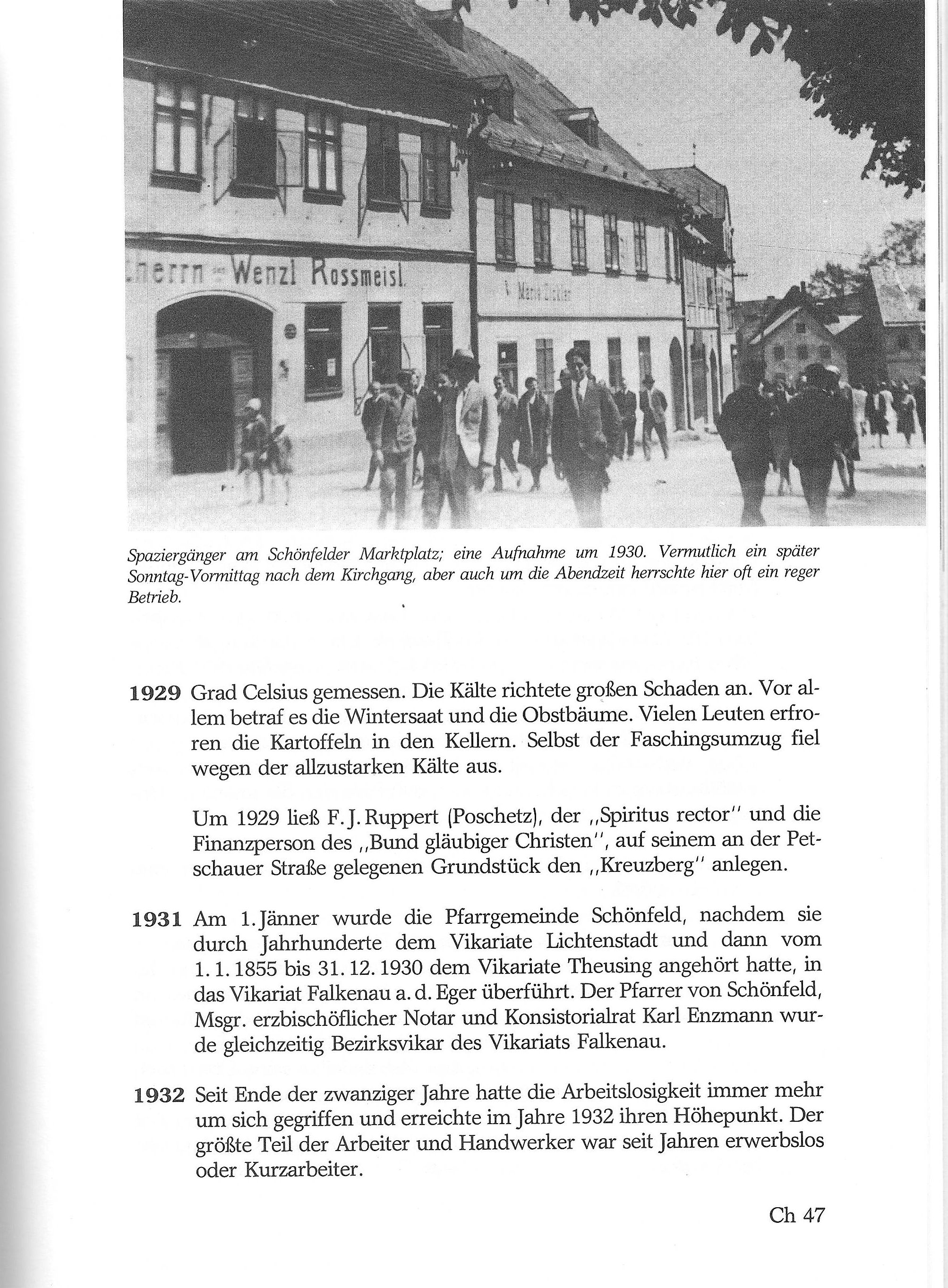
Cronik 047 Mr. Wenzl Rossmeisl Peddlers at the Schönfeld market square; a photo taken around 1930. Probably a late Sunday morning after church, but there was often a lot of activity here in the evening as well. 1929 degrees Celsius measured. The cold caused great damage. It particularly affected the winter crops and the fruit trees. Many people's potatoes froze in their cellars. Even the carnival parade was canceled due to the extreme cold. Around 1929, F. J. Ruppert (Poschetz), the "spiritus rector" and financial figure of the "Bund treuer Christen" (Association of Believing Christians), had the "Kreuzberg" built on his property on Petschauer Straße. 1931 On January 1, the Schönfeld parish, after having belonged to the Vicariate of Lichtenstadt for centuries and then, from January 1, 1855, to December 31, 1930, to the Vicariate of Theusing, was transferred to the Vicariate of Falkenau an der Eger. The pastor of Schönfeld, Archbishop Karl Enzmann, Archbishop Notary and Consistory Councilor, simultaneously became District Vicar of the Vicariate of Falkenau. 1932 Since the end of the 1920s, unemployment had become increasingly widespread, reaching its peak in 1932. The majority of workers and craftsmen had been unemployed for years. Unemployed or on short-time work. Ch 47 chronik Page-0047
Cronik 048 1932 The daily earnings of a worker still employed at that time ranged between 12 and 25 crowns. Every unemployed person received the Cech Card, named after the Minister of Labor Dr. Cech, as unemployment benefit from the Czech state. This amounted to 10 crowns per week. This small amount was barely enough to buy the bread needed for the family; a loaf of bread cost 3 crowns 50 heller at the time. Accordingly, the standard of living had sunk to a minimum. Families with several children, in particular, were severely lacking clothing and linen. For many years, welfare campaigns were carried out everywhere for the needy, for example by the Catholic Women's Relief Society, the local Caritas branch, the German Cultural Association, the local The "Democracy for Youth" group and the Sudeten German People's Aid (Sudetendeutsche Volkshilfe) were supported by the school. In winter, a soup and bread meal was always provided for poor schoolchildren at school. In addition, "free meals" were obtained for poor children in well-off families, so that they could have a sufficient lunch at least twice a week. During the winter months of 1932/33, a generous meal was provided for the unemployed in a "people's kitchen" set up in house no. 135 in Langen Gasse (Willi Russ). Approximately 500 people received work cards at that time. Unemployment only eased somewhat in 1936, when numerous Sudeten German workers found work in Germany as a result of the changed political situation there. Even in the winter months of 1935/36, 390 people in Schönfeld still received state benefits. In June, Otto Kuhn, Adolf Sammet, and Rauscher founded a screw factory. In September, the Dr. Kempf Lookout, a 14-meter-high observation tower, was inaugurated at Krudum. It was built by the Elbogen Tourist Association in honor of Dr. Andreas Kempf, a medical officer who died in Vienna in 1929. Andreas Kempf was born in 1865 on the Hub in Schönfeld. A year later, his parents moved to Dreihäuser. Kempf grew up there and went to school in Elbogen. He worked as a medical officer in Vienna for many years, but remained a loyal son of his forest homeland throughout his life and always spent his holidays there. Ch 48 chronik Page-0048
Cronik 049 1932 After the construction of the Dr. Kempf Lookout Tower on the Krudum, the firm decision was made in Schönfeld to also build an observation tower. 1933 In August, the Tourism Commission organized a large trade fair in the elementary school premises, in which all of Schönfeld's tradespeople exhibited their products. In one room, Pastor Enzmann displayed old documents, guild articles, and other items from Schönfeld's past. The exhibition, which lasted eight days, was intended to create the financial foundation for the construction of an observation tower on the Steingröll. Beginning of October: Construction work began on the Steingröll. Excavation of the ground for the observation tower. The structure progressed that fall to a height of six meters. This year, the "Sudeten German Homeland Front" was founded. After this national party was later banned, the "Sudeten German Party" was founded. It is worth mentioning that in the 1933 municipal elections in Schönfeld, a more nationalist slant than usual became apparent in the municipal council. While in the previous ten years the Trades Party had been considered dominant in Schönfeld and, with the help of the Farmers' League, had also occupied the mayor's seat, the outcome of the 1933 elections now saw the Sudeten German Homeland Front set the course and appointed Emil Vogl, then 32 years old, as mayor. Master tanner Franz Ruppert had served as mayor for the previous four years. However, the Czech district authorities in Elbogen, from a political perspective, found just as little favor with the entire city council as with the not exactly unfeeling Mayor Vogl, and, at the same time as banning the Sudeten German Homeland Front, which was considered subversive, dissolved the entire city council after a short period of existence. As a replacement, the district authorities appointed a three- or five-member administrative commission, headed by the impartial sawmill owner Emil Russ, who acted as a kind of mayor. On November 14, the Church Preservation Association was founded. Prior to this, the separation of church and state had taken place in Czechoslovakia. Ch 49 chronik Page-0049
Cronik 050 1933 While the state had previously paid the pastors' salaries, the parish now had to pay the pastor and maintain the church itself. The association began its activities on January 1, 1934. 1934 This year, the last of the carnival processions, which had already become a tradition in Schönfeld, was held. Probably under the impression of the serious times already looming on the political horizon, carnival processions were discontinued in the future. That year, Pastor Karl Enzmann published a chronicle dating back to 1880, entitled "Chronicle of the ancient, formerly royally free mining town of Schönfeld, Elbogen District." The chronicle of Schönfeld was published by the German Youth League, "Glöisser," after this association financed the printing costs. 1 Construction of the observation tower on Steingröll continued in the spring and was completed at the end of September. The ceremonial inauguration of the observation tower was scheduled for Sunday, October 6th. All preparations had been made, but the celebration had to be postponed due to pouring rain. In August, a postal workers' conference was held in the Geier Hall at the initiative of the Karlovy Vary post office cashier, Paul Lochner, a native of Schönfeld. Approximately 400 postal workers from all over the Egerland region attended. This month, the Schönfeld Theater Amateurs' Association celebrated its 100th anniversary. 1935 In the spring, work began on creating a city park in the old cemetery behind the church. On Sunday, June 23, the observation tower at Steingröll, completed the previous year, was ceremoniously inaugurated in glorious summer weather. On September 22 and 23, the Schönfeld Men's Choir celebrated its 50th anniversary. Ch 50 chronik Page-0050
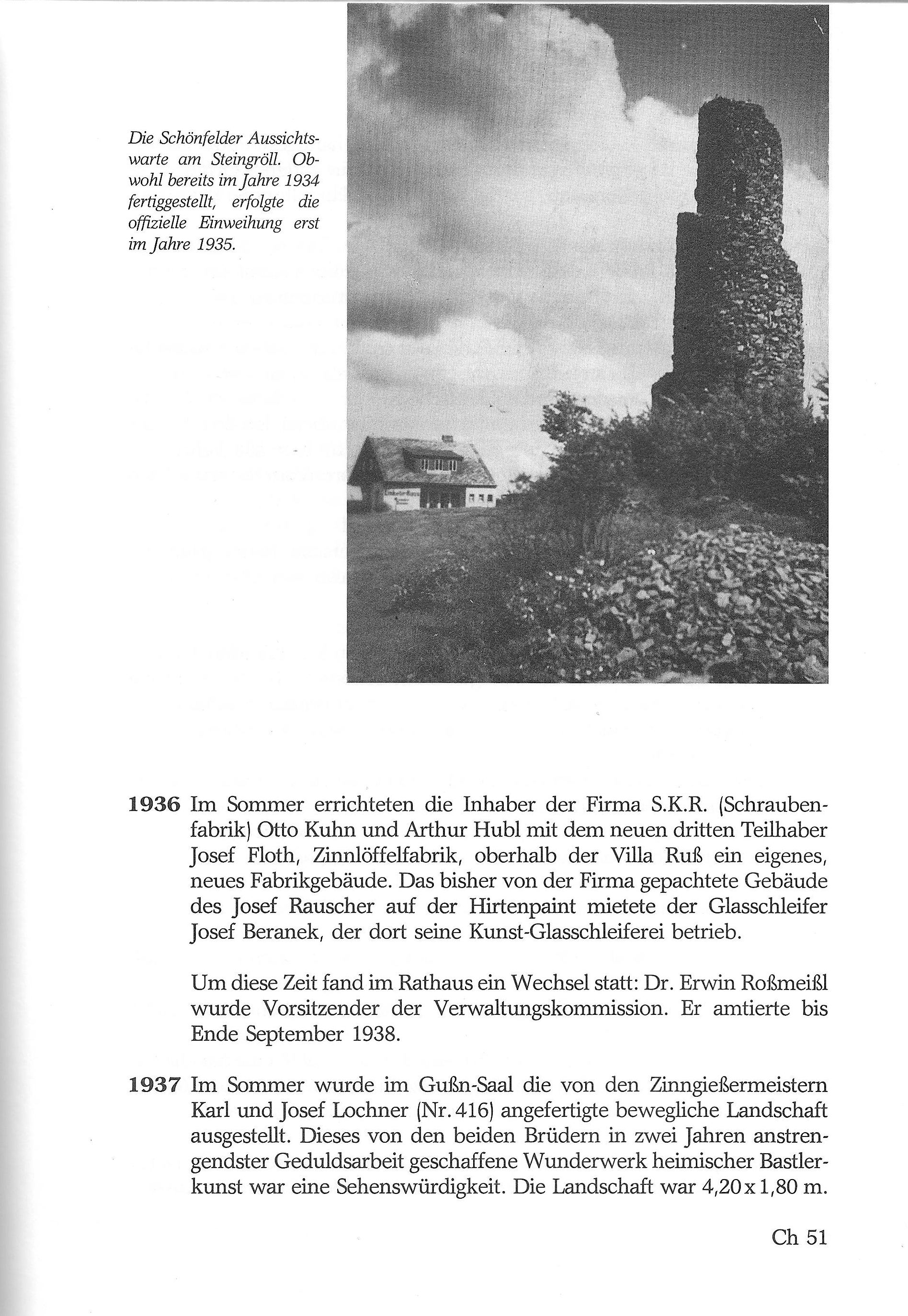
Cronik 051 The Schönfeld lookout tower at Steingröll. Although completed in 1934, the official inauguration did not take place until 1935. 1936 In the summer the owners of the SKR (screw factory) company, Otto Kuhn and Arthur Hubl, with the new third partner Josef Floth, tin spoon factory, built their own new factory building above Villa Ruß. The building previously leased by the company from Josef Rauscher on Hirtenpaint was rented by the glass cutter Josef Beranek, who ran his art glass cutting workshop there. Around this time, a change took place in the town hall: Dr. Erwin Roẞmeißl became chairman of the administrative commission. He served until the end of September 1938. 1937 In the summer, the moving landscape created by master pewterers Karl and Josef Lochner (No. 416) was exhibited in the Casting Hall. This marvel of local craftsmanship, created by the two brothers over two years of painstaking, patient work, was a sight to behold. The landscape measured 4.20 x 1.80 m. Ch 51 chronik Page-0051
Cronik 052 ----------------------------------------- c-052 1937 All figures, vehicles, and buildings were hand-carved. The moving landscape was also exhibited in other locations that autumn, such as Karlovy Vary and Komotau, and aroused great admiration everywhere. Ten percent of the proceeds (one crown for adults, 50 hellers for children) went to the poor fund of the respective exhibition venue and to the construction fund for the Schönfeld observation tower. On September 1st, a Czech school was opened in the Gusn Hall in Schönfeld. A total of 26 children attended this school at that time – only one Czech and 25 German children. The Czechs had persuaded less well-off families to send their children to the Czech school, as they received all teaching materials free of charge and enjoyed many other advantages. In September, the Sudeten German Party (Henlein Party) held a local festival in the Zona Garden, which was attended by locals as well as many outsiders. In the autumn, on the initiative of the then chairman of the administrative commission of the town of Schönfeld, Dr. Erwin Roßmeißl, a hand weaving workshop was set up in the large town hall. Dr. Rossmeisl by Atelier Mika in Prague. The five employees at the time were trained in the work methods by the owner of the aforementioned studio. Mainly scarves and ties were produced. Work ceased in September 1938. 1938 The eventful year. March 12: Adolf Hitler annexed Austria to the German Reich. This annexation also gave the Sudeten German Party (SDP) further impetus. This month, the SDP conducted a membership drive in Schönfeld; membership rose from 600 to 1,200 in about a month. April 20: SDP leader Konrad Henlein submitted a request to the Czech government for a list of the Sudeten Germans, as a demand for Ch 52 chronik Page-0052
Cronik 053 1938 agreement on the 10 Carlsbad Points (right to self-determination and autonomy) was presented. The Sudeten Germans' demands were rejected in their entirety. May 1: Large SDP rally for the southern part of the Elbogen district at the market square in Schlaggenwald. Speaker: MP Liebl, who primarily demanded autonomy for the Sudeten Germans. The numerous Czech gendarmerie forces present at this rally found no reason to intervene, as the rally passed without incident. May 29: Municipal elections in Schönfeld and other towns. In consideration of the extremely tense political situation, the Czech government spread the municipal elections over three Sundays in May, which in reality was intended to fragment the SDP's anticipated successes. The municipal elections yielded overwhelming victories for the SDP everywhere. In Schönfeld, however, the newly elected municipal council could not take action because the Social Democrats, led by Dr. Erwin Rossmeißl, had appealed the election in Schönfeld to the district authority. May 31: Mobilization of the Czech Army ordered by President Benesch. Reason: alleged Reich German troops on the Czech border. Czech intelligence department from Pilsen was stationed at the Schönfeld lookout tower as an observation post. German reservists were largely drafted into their units. After a few days of demobilization, Benesch declared that the mobilization had been based on erroneous information. August 19: Greetings to the SDP leader, Konrad Henlein, and MP Wollner on the occasion of their passage through Schönfeld in front of the town hall. A guard of honor of SDP members and other sections of the population formed along the street. Among other gifts, Henlein was also presented with a sewing lace tablecloth and an engraved pewter mug. August 28: At 10 a.m., the Municipal Museum in the town hall was opened by teacher Josef Hubl. Ch 53 chronik Page-0053
Cronik 054 1938 September 12: 8 p.m. Hitler's closing speech at the Reich Party Congress in Nuremberg. SDP members lined up in the market square to listen to the radio together. Radio owners had set up their radios in the open windows of the market houses. Czech gendarmerie on standby at their stations. Enthusiastic applause from the SDP for the individual sections of Hitler's speech, "One Reich," and a long-lasting chorus of "One people, one leader!" "Sieg Heil!" In the final phase of Hitler's speech, he urged the Prague government to grant the Sudeten German people the right of self-determination. After Hitler's speech, a demonstration march by the SDP and a large section of the population took place through Schönfeld. Gradl (a bus driver at Roßmeißl) gave a speech at Trinity Square. That night, several riots took place against the Social Democratic movement. Several windows were smashed at the Hotel Potherr and at the Wurzl on Lange Gasse. A swastika flag was raised on the town hall tower that night, but it was taken down again in the early hours of the next morning. September 13: Martial law is declared for 14 Sudeten German districts, including Elbogen, due to the events of the previous day. Towards evening, Czech tanks entered Schönfeld. Soldiers roamed the streets and alleys with fixed bayonets and rifles in hand, searching civilians' pockets for weapons and driving people into their houses, shouting insults. The youth were just taking their usual stroll in the market square. There were blows with rubber truncheons and prods with rifle butts. Curfew set from 8 p.m. to 6 a.m. No more than three people were allowed to stand or walk in a group. Constant Czech patrols. September 18: In the morning, a large group of Czech tanks, coming from Elbogen, drove through Schönfeld toward Petschau. chronik Page-0054
Cronik 055 1938 Ban of the Sudeten German Party, warrant issued for Konrad Henlein. He fled across the border to Germany. The imminent threat of war was averted by two talks between the British Prime Minister Chamberlain and Hitler at Obersalzberg and Bad Godesberg on the Rhine. On the night of September 23-24, Czechoslovak troops were mobilized, and a military observation post was again stationed on the Schönfeld observation tower. Thousands of German reservists were called up; they pretended to leave their homes with their suitcases, but not to their military units, but instead hid in the Krudum Forests. The same was true in all other towns. Large military camps were established in the Krudum Forests. Secret deliveries of food to relatives and courageous individuals were made. The first blackout of the Houses in the village were closed. To prevent the listening to foreign news, the surrender of all radio equipment belonging to the German population was ordered. Reich German broadcasts were broadcast for the Sudeten Germans. The Egerländer March always concluded the program. German schools were closed. Mass exodus of Ore Mountains residents across the Reich border. Formation of Sudeten German Freikorps in Saxony and Bavaria. Partial mobilization in France. September 29: Last attempt to save the peace. Conference in Munich between Hitler, Mussolini, Chamberlain, and Daladier. Result: The Sudeten German territories of Czechoslovakia are to be annexed to the German Reich on October 1. By the end of September, the Sudeten German territories are to be cleared of all military formations, including the gendarmerie and state police, and withdrawn behind the already clearly defined new Czech state border to avoid any contact with the German Wehrmacht, which advances into the Sudetenland on October 1, 1938. Furthermore, the Prague government was ordered to withdraw all civil servants and employees from all administrative areas in the Sudeten German territory. The occupation of the territory by German troops took place in five zones. September 30: News of the Anschluss to the Reich gradually leaks out. Pastor Karl Enzmann whispered it to some churchgoers after early mass. The then chronik Page-0055
Cronik 056 1938 Czech gendarme, Ripka, was of German nationality; he warned Pastor Enzmann that he was threatened with arrest. Enzmann could no longer return to the parish and fled the church, wearing only his chasuble and bareheaded, via Neudorf to Donawitz, where he remained hidden to avoid arrest by the Czechs at the last moment. But even Ripka, the gendarme, was forced to flee after the priest's disappearance, lest he himself be arrested as a result of the priest's warning. With his service rifle and all his pockets full of ammunition, Ripka rushed into the Krudum Forest, where the German reservists who had evaded Czech mobilization were hiding. They had greeted and welcomed Ripka with joy. Enzmann and Ripka's successful escape sparked great joy among the population, which, however, could not be expressed openly, as the Czechs were still there and no one could know what the rapidly unfolding events would bring. October 1: The population awaited the German Wehrmacht. A sleepless night for all. The Czechs, filled with impotent rage, made no preparations for their withdrawal. Threats that they would get the territory back. The residents sewed flags and prepared wreaths and banners for the impending invasion of the German troops. October 2: The Schönfeld residents waited impatiently for the arrival of the German Wehrmacht. Instead, towards evening, several convoys of cars and buses, manned by Czech gendarmes and border guards, arrived from Eger via Lauterbach to Schönfeld and settled into their overnight quarters. October 3: The convoy of Czech state police left Schönfeld in the morning hours, heading for Petschau-Pilsen. The same was true of the observation post on the lookout tower. The Czech gendarmerie in Schönfeld remained at its post. October 4: At 8 a.m., the Czech gendarmerie officers stationed in Schönfeld, the post office, and the road maintenance worker and his family finally departed by bus toward Petschau-Pilsen. The Czech teacher also left. Only now did they dare to place flag bearers, garlands, and banners on the walls of houses. chronik Page-0056
Cronik 057 1938 In the midst of this work, cheers and shouts of "Sieg Heil" were heard from the direction of Lauterbacher Straße. At 9 a.m., the first armored spearhead of the German Wehrmacht arrived in Schönfeld. Behind it, a kilometer-long column of motorized troops. Tremendous jubilation among the population. The column, showered with flowers, continued on to Petschau. After some time, the upper column was stopped, as more motorized units were approaching from Elbogen and Schlaggenwald, which were now given priority for Petschau for a while. Roaring cheers without end. Handshakes and conversations with the liberators. Motorized units marched through uninterruptedly, sometimes coming from Lauterbach, sometimes from Schlaggenwald, until 1 p.m. By midday, pouring rain had begun, but this could hardly dampen the jubilation. The soldiers were quartered in houses, with even less well-off quarterers sparing no expense or effort to ensure that the quartered soldiers lacked nothing in terms of comfort. The command post was located in the Hotel "Potherr." Artillery and field guards were deployed at the Weisser Hübel, at the Scheining, and on the Rabensgrüner Höhe. October 5: The Altenburg Infantry Regiment arrived on foot from Tachau and was stationed in Schönfeld. A pioneer regiment was also stationed there. The entire market square was full of vehicles and pontoons. The Eckl and Gerstner Paint was also crammed with tanks and cars right up to the street. Over the next few days, a military concert was held at the market square from 11 a.m. to 12 p.m. Boundless joy reigned among the population at the liberation from 20 years of Czech rule. All Czech signs disappeared. Since the mayor's position in Schönfeld was vacant at the time, the local commander of the German Wehrmacht temporarily appointed city secretary Heinrich Ruppert as mayor. Due to the enormous purchases made by the German soldiers, the grocery stores and especially the textile stores were almost completely sold out within a few days. sold out. The shopkeepers were pleased with this upscale business. After the warehouse manager of the local Konsum branch had also left Schönfeld a few days earlier, the remaining inventory was given priority to the members of the consumer cooperative, and the remaining inventory was distributed to the less well-off population. Ch 57 chronik Page-0057
Cronik 058 1938 The former local leader of the "SDP," Josef Tauber, returned to Schönfeld from his service with the Freikorps in mid-October. He was appointed mayor by the new German district administrator in Elbogen. A few days later, the population celebrated their liberation from 20 years of Czech oppression. One evening, they marched through the town with burning candles and lanterns. Mayor Tauber gave an impressive speech at the church. November: Establishment of the party (NSDAP), its formations and branches. New local leader Josef Zettl (master carpenter). All public offices were filled by Germans. Offices for all party branches were located in the party headquarters at Marktplatz No. 110 (Hubl). The bus lines established by Josef Roßmeißl were taken over by the Saxon KVG (Kraftverkehrsgesellschaft) in Dresden. In November, the Czech crowns were converted into Reichsmarks. While the previous exchange rate of 100 crowns = 12 Reichsmarks remained valid in the first days and weeks after the Anschluss, the value of the crown was reduced, and the official exchange rate of 100 crowns = 10 Reichsmarks was set. This fall, unemployment was almost completely eliminated by tackling various projects, including the road construction from Schönfeld to Rabensgrün, which had been planned for many years. To the extent that there were unemployed this winter due to the weather, they received far higher unemployment benefits than had previously been the case for the Czechs. December 3: Zeppelin visible north of Schönfeld, flying from Reichenberg, following the Eger Valley via Eger back to Bavaria. Ch 58 chronik Page-0058
Cronik 059 1938 December 4: Referendum in what was then the Sudetenland. Here is the text of the ballot: "Are you, fellow German, in agreement with the union with the Greater German Reich? Yes - No?" Result in Schönfeld: Over 98% Yes. 1939 In the spring, the previously existing local associations were dissolved and their assets confiscated by the Standstill Commission. At the beginning of spring, Schönfeld experienced a large influx of tourists. Saxons, in particular, enjoyed visiting our observation tower. in March 15: German troops marched through Schönfeld towards Petschau - due to Hitler's occupation of the remaining part of Czechoslovakia (creation of the so-called "Protectorate of Bohemia and Moravia"). On May 1, the registry office was established in Schönfeld. City Secretary Heinrich Ruppert was the first registrar. Rudi Weidl was the deputy and second in command of this office; After his conscription in 1941, farmer Willi took over this position. At the arts and crafts exhibition held in Nuremberg in May, a lace tablecloth made by the Schönfeld Lace School was purchased by Adolf Hitler. Hermann Göring acquired the famous lace tablecloth "The Four Seasons." In July, a project the Czechs had been dragging on for years was begun: covering the rafting ditch from the lower mill to the lower school building. August: Bloody incidents at the Polish border. On the 26th, individual reservists were drafted into the Wehrmacht. On Sunday, August 27, all food supplies in the relevant stores were unexpectedly taken into account. The following Monday, the first ration cards were issued for the week from August 28 to September 4, 1939. September 1: German troops cross the Polish border. Beginning of World War II! Ch 59 chronik Page-0059
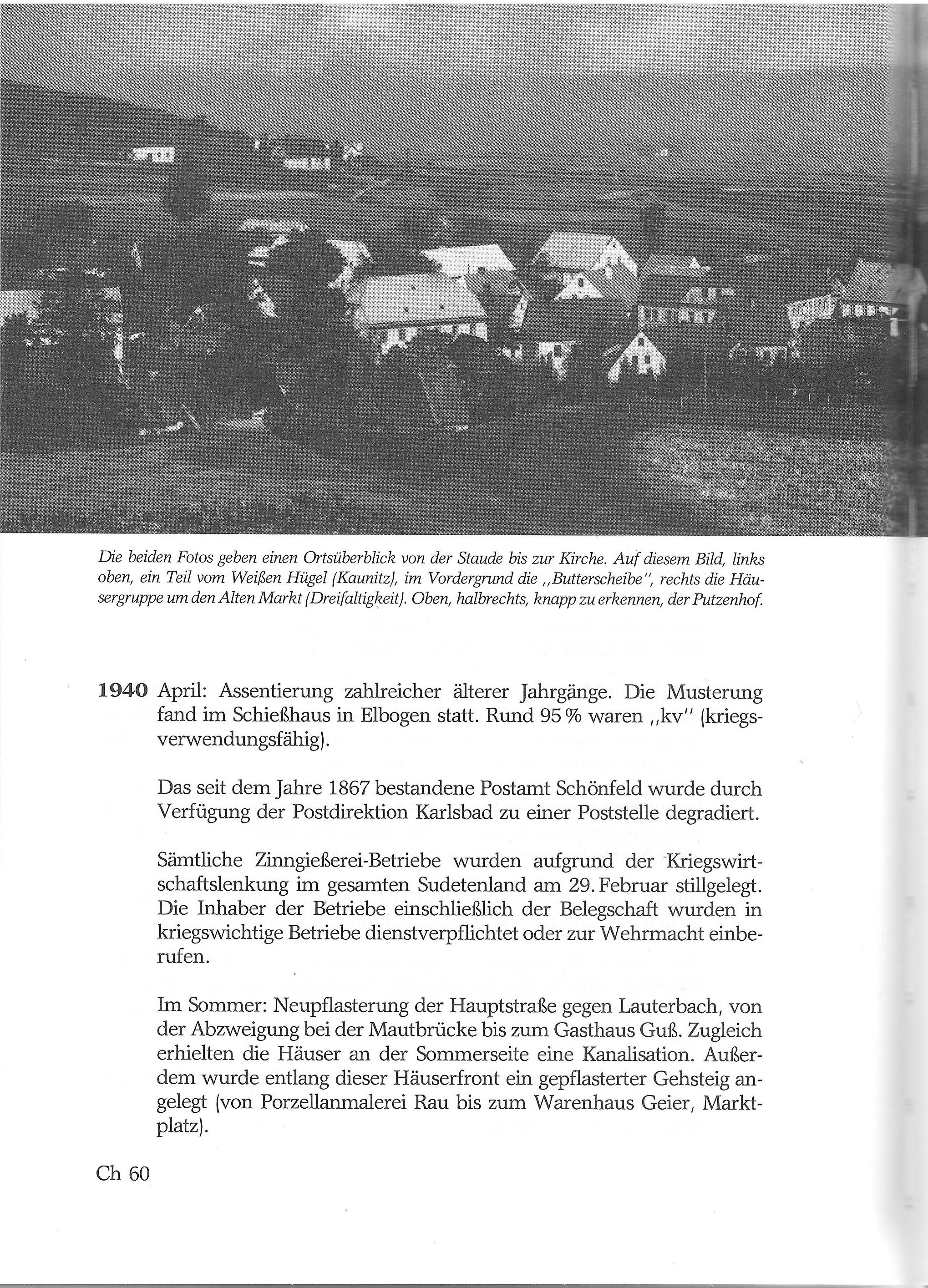
Cronik 060 The two photos provide an overview of the town from the Staude to the church. In this picture, top left, part of the White Hill (Kaunitz), in the foreground the "Butterscheibe," and on the right, the group of houses around The Old Market (Trinity Square). Above, half-right, just visible is the Putzenhof. 1940 April: Assent of numerous older classes. The muster took place at the shooting range in Elbogen. Around 95% were "kv" (suitable for war use). The Schönfeld post office, which had existed since 1867, was downgraded to a post office by order of the Karlsbad postal directorate. All tin foundries were closed down throughout the Sudetenland on February 29 due to the wartime economic control. The owners of the businesses, including their employees, were conscripted into war-critical factories or drafted into the Wehrmacht. In the summer: the main road toward Lauterbach was repaved, from the junction at the toll bridge to the Guß Inn. At the same time, the houses on the summer side received sewers. In addition, a paved sidewalk was laid along this frontage (from the Rau porcelain painting shop to the Geier department store, market square). chronik Page-0060
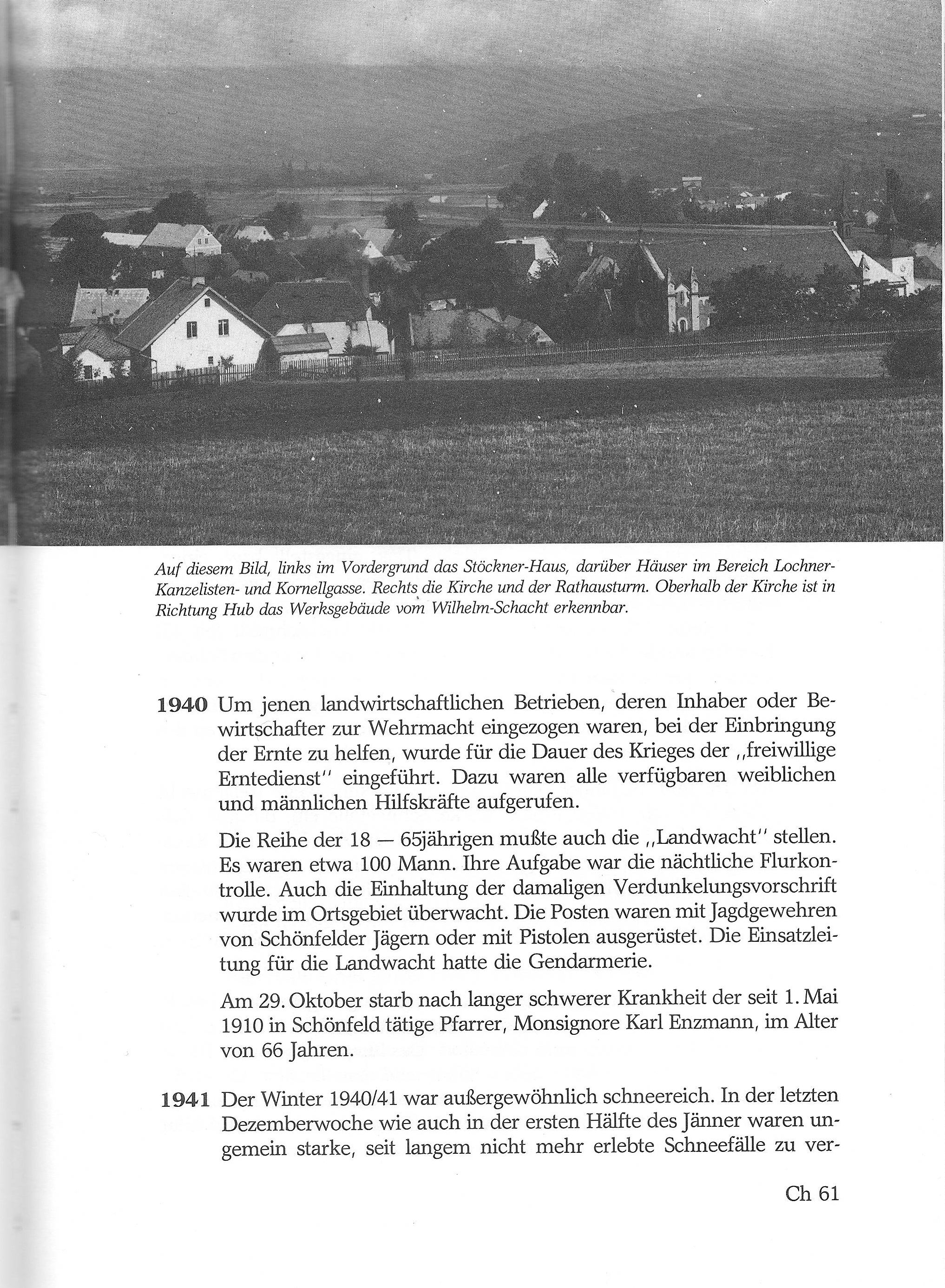
Cronik 061 In this picture, the Stöckner House is in the foreground on the left, with houses in the Lochner-Kanzelisten-, and Kornellgasse areas above it. The church and town hall tower are on the right. Above the church, in the direction of Hub, the Wilhelm-Schacht factory building can be seen. 1940 In order to assist those farms whose owners or managers had been drafted into the Wehrmacht with harvesting, the "voluntary harvest service" was introduced for the duration of the war. All available male and female helpers were called upon for this purpose. The "Landwacht" (country guard) also had to provide the number of those aged 18-65. There were about 100 men. Their task was to patrol the fields at night. Compliance with the blackout regulations at the time was also monitored in the local area. The sentries were equipped with hunting rifles from Schönfeld hunters or with pistols. The gendarmerie was in charge of the Landwacht operations. On October 29, Monsignor Karl Enzmann, a pastor in Schönfeld since May 1, 1910, died at the age of 66 after a long, serious illness. 1941 The winter of 1940/41 was exceptionally snowy. In the last week of December, as well as in the first half of January, exceptionally heavy snowfalls, unseen for a long time, were recorded. Ch 61 chronik Page-0061
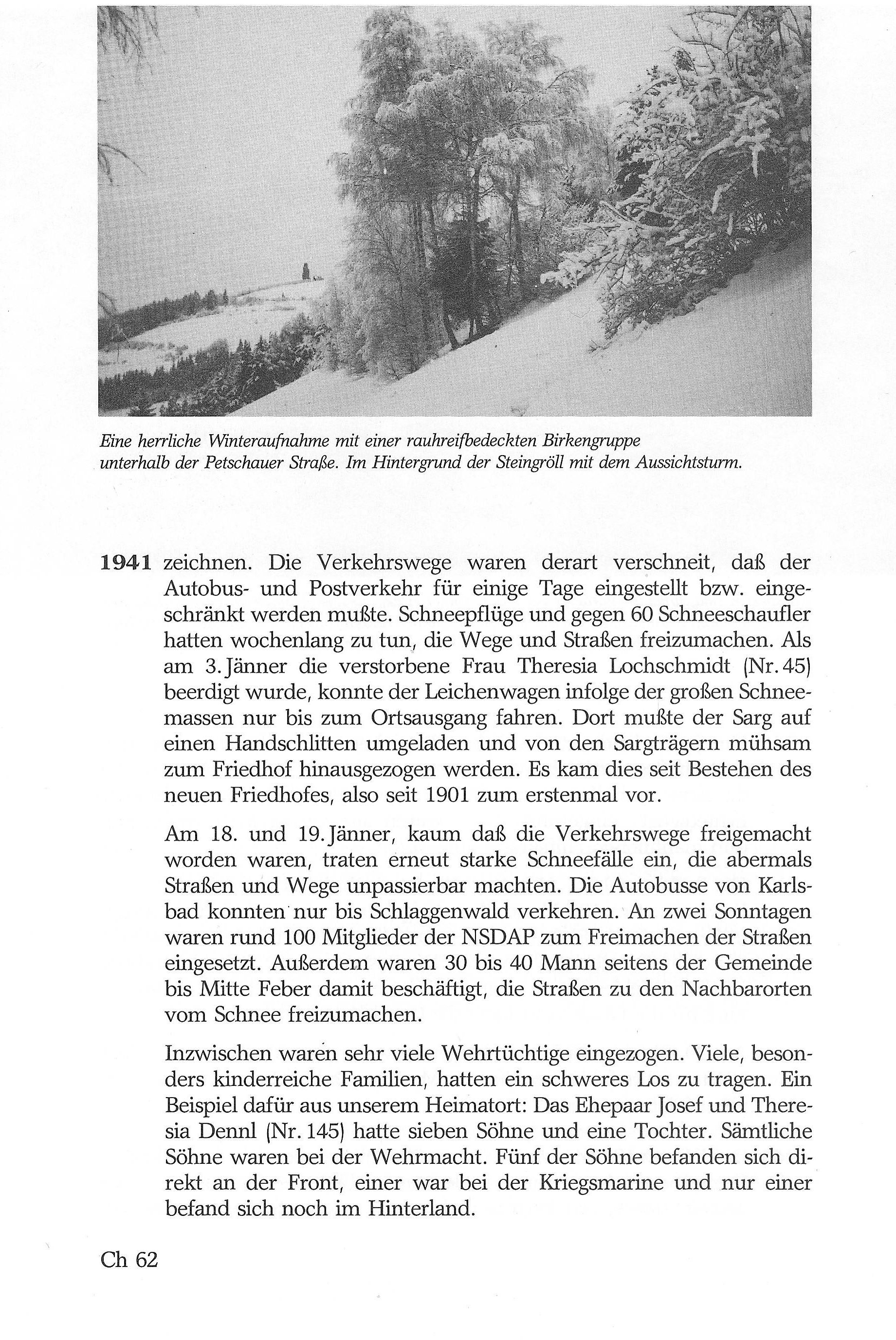
Cronik 062 A magnificent winter photograph with a group of birch trees covered in hoarfrost below Petschauer Straße. In the background, the Steingröll with the observation tower. 1941. The roads were so snow-covered that bus and postal services had to be suspended or restricted for several days. Snowplows and approximately 60 snow shovels were busy for weeks clearing the paths and streets. When the deceased Mrs. Theresia Lochschmidt (No. 45) was buried on January 3rd, the hearse could only reach the edge of town due to the heavy snowfall. There, the coffin had to be transferred to a hand sled and laboriously pulled out to the cemetery by the pallbearers. This was the first time this had happened since the new cemetery was established, i.e., since 1901. On January 18th and 19th, barely after the roads had been cleared, heavy snowfalls occurred again, once again rendering roads and paths impassable. The buses from Karlsbad could only travel as far as Schlaggenwald. On two Sundays, around 100 members of the Nazi Party were deployed to clear the roads. In addition, 30 to 40 men from the community were busy clearing the snow from the roads to neighboring towns until mid-February. In the meantime, many able-bodied soldiers had been drafted into the military. Many families, especially those with many children, had to bear a difficult fate. An example from our hometown: The couple Josef and Theresia Dennl (No. 145) had seven sons and one daughter. All of their sons were in the Wehrmacht. Five of the sons were directly at the front, one was in the Navy, and only one was still in the hinterland. chronik Page-0062
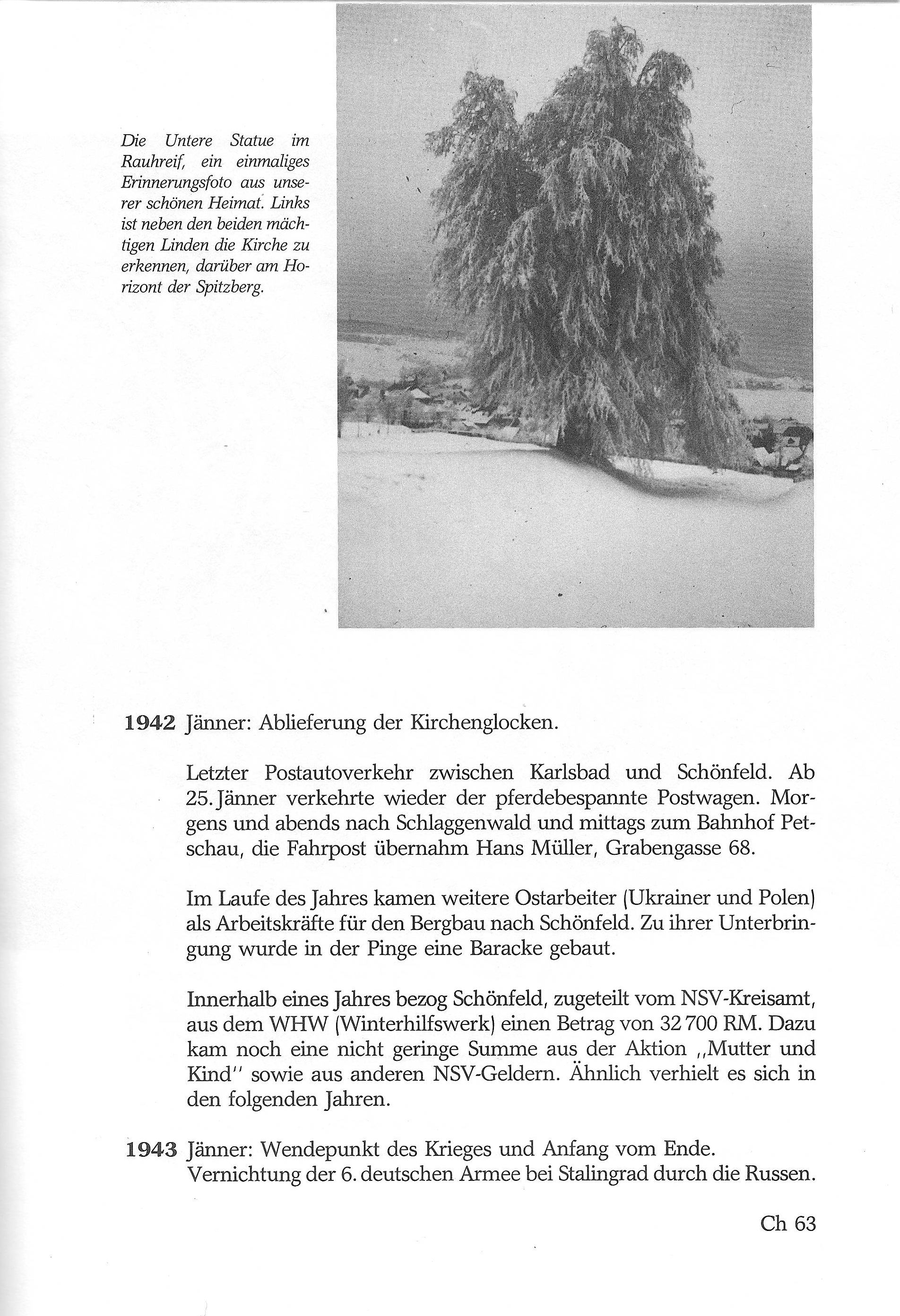
Cronik 063 Cronik The lower statue covered in hoarfrost, a unique souvenir photo from our beautiful homeland. On the left, next to the two mighty linden trees, you can see the church, with Spitzberg above it on the horizon. 1942 January: Delivery of the church bells. Last postal bus service between Karlovy Vary and Schönfeld. From January 25th, the horse-drawn mail coach began operating again. In the mornings and evenings, to Schlaggenwald, and at midday to Petschau station. Hans Müller, Grabengasse 68, handled the mail service. Over the course of the year, more Eastern workers (Ukrainians and Poles) came to Schönfeld as mining workers. A barracks was built in the pit to house them. Within a year, Schönfeld received 32,700 Reichsmarks from the WHW (Winter Relief Fund), allocated by the NSV district office. In addition, there was a substantial sum from the "Mother and Child" campaign and other NSV funds. The situation was similar in the following years. January 1943: Turning point of the war and the beginning of the end. Destruction of the German 6th Army at Stalingrad by the Russians. Ch 63 chronik Page-0063
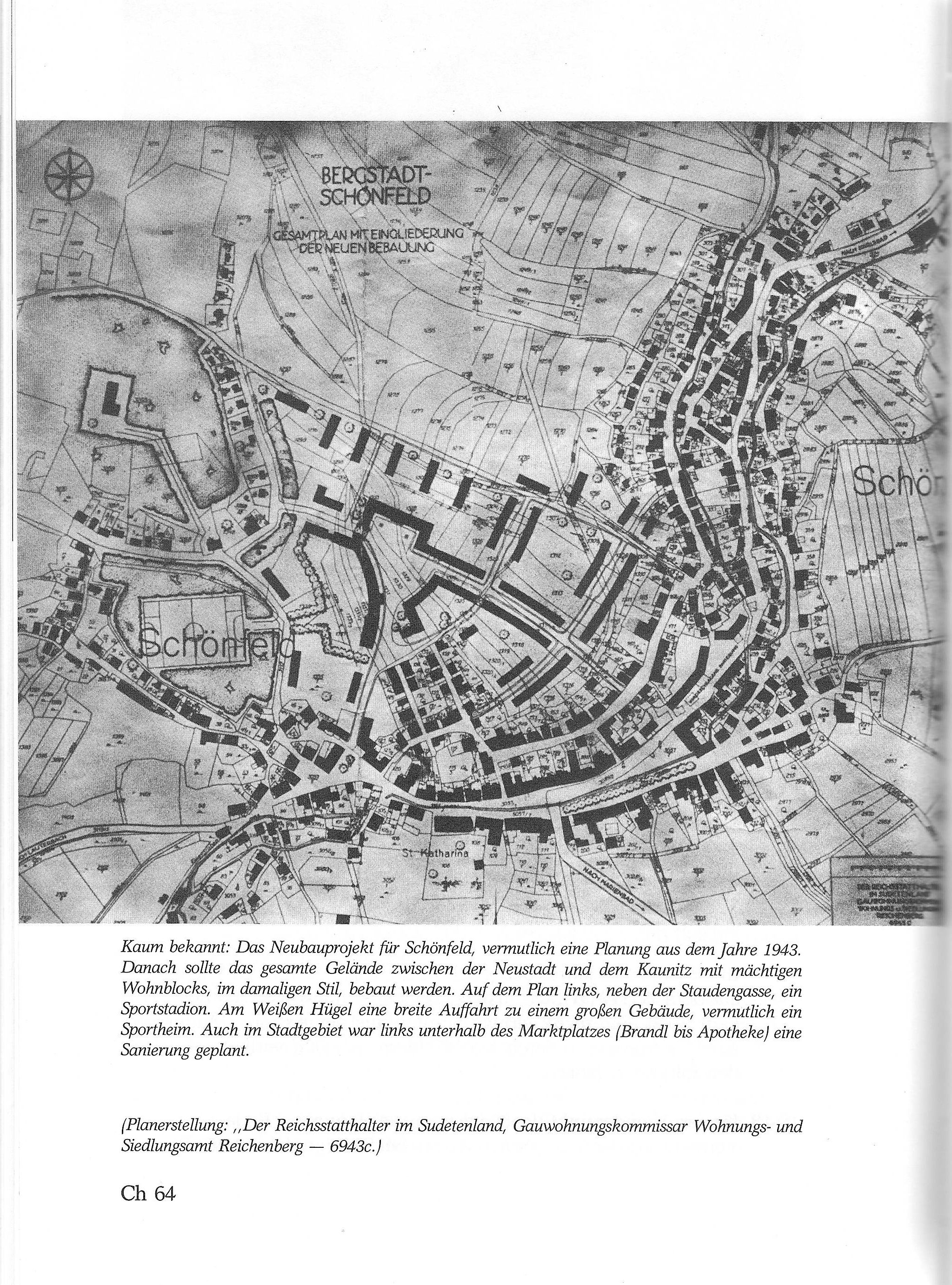
Cronik 064 HILL TOWN OF SCHONFELD OVERALL PLAN FOR THE INCORPORATION OF NEW DEVELOPMENT Schönfeld b 11 St. Katharina TO MARIENBAD Schönfeld Little known: The new construction project for Schönfeld, presumably a plan from 1943. According to this plan, the entire area between the Neustadt and the Kaunitz was to be built with massive apartment blocks in the style of the time. On the plan, on the left, next to Staudengasse, is a sports stadium. On the Weißer Hügel (White Hill), a wide driveway leading to a large building, presumably a sports center. Redevelopment was also planned in the urban area to the left below the market square (Brandl to the pharmacy). (Planning: "The Reich Governor in the Sudetenland, Gau Housing Commissioner, Housing and Settlement Office, Reichenberg - 6943c.) Ch 64 chronik Page-0064
Cronik 065 1943 On July 25, a provisional memorial for the soldiers who had fallen in the war so far was unveiled in the city park, in the middle of a large rock garden. It was designed in the shape of an Iron Cross by the local sculptor Willy Russ and executed in stone. In front of the memorial, the name plaques of those who had fallen so far were placed among flowers. The later victims were honored here in the same way. On August 31, a roll call of the men still at home took place at the gymnastics field for the purpose of enrolling and forming a "military team." This team was assigned various tasks related to securing the homeland. 168 men reported for the roll call. In the fall, after more than two years of construction, the new ore processing plant at the Hubhof was completed. In addition to tin, tungsten, and copper, molybdenum was now also being mined, a hard, tough heavy metal used in the light bulb industry and, when alloyed with iron, producing extremely hard tool steel. A 900-meter-long cable car had been built from the Wilhelm Shaft, with a concrete overpass near the Kreuzzeche mine, up to the processing plant at the Hubhof. According to reliable information, the construction of the ore processing plant cost 70 million Reichsmarks. 1944 In October, the "Volkssturm" (People's Militia) was formed. Its purpose was to actively contribute to the defense of the homeland in an emergency, alongside the Wehrmacht. Together with Lauterbach, a Volkssturm battalion of 300 men was formed. On a Sunday in October, their swearing-in took place during a roll call at the market square. Subsequently, the men received instruction, particularly in the use of the Panzerfaust, a then-new anti-tank weapon. Their other equipment consisted of a few hunting rifles and old military rifles. 1945 At the beginning of the year, the dire end of the war was already clearly apparent. In mid-January, the major Russian offensive began, targeting Berlin, Czechoslovakia, and Hungary. On January 24, approximately 40 Volkssturm men received their call-up notices. They had to be in Falkenau by 8 a.m. the next morning. Ch 65 chronik Page-0065
Cronik 066 1945 On January 30, the first refugees to arrive in Schönfeld were approximately 30 people, mostly farming families from East Prussia. They were housed in the vacant rooms of the old school building. On the very first night, a one-year-old child died as a result of the strain and, in particular, the extreme cold. At the same time, the municipality had to secure additional living space to accommodate the 600 refugees already announced. They arrived in Schönfeld in mid-February. It was no easy task to provide them with halfway decent accommodation. During this time, Ruppert (Poschetz) made his former prayer room available to set up a medical center for refugees. The newly arrived refugees came predominantly from the Görlitz and Hirschberg areas in Silesia. Some of them were also ethnic Germans from Bukovina and Poland, who had already fled for the second or third time. In mid-February, the so-called "People's Offering," a collection of linen and clothing, was carried out. Everyone was asked to make a real offering, meaning they could donate not only dispensable items, but also items for personal use. The collection yielded a surprisingly good result. The war was now taking place on all fronts on German soil. Air raids on German cities were a constant occurrence. Large American bomber squadrons, with their deadly cargo on board, flew over our homeland unchallenged. In March, the men of the Volkssturm (People's Militia) set up "anti-tank nests," the first in the Zona Garden, opposite the church, and the second on a plot of land behind the Kreuzzeche mine. In these pits, Volkssturm members were supposed to use a few rocket-propelled grenades to eliminate tanks advancing from Lauterbach or Schlaggenwald. In addition, holes had been drilled into the two approximately 4 m long, 4 m high, and almost 1 m thick concrete pillars that served as supports for the cable car road safety at the Kreuzzeche mine. In an emergency, the two concrete walls could be blown up and the debris used to block the road. Who could seriously believe that these measures could stop approaching enemy tanks? Around the same time, a "Wehrwolf" group was formed in our town. It consisted of around a dozen members of the then Hitler Youth. Reasonably, this group was active only once, and that before the end of the war, in a night operation that went unnoticed by the population. Ch 66 chronik Page-0066
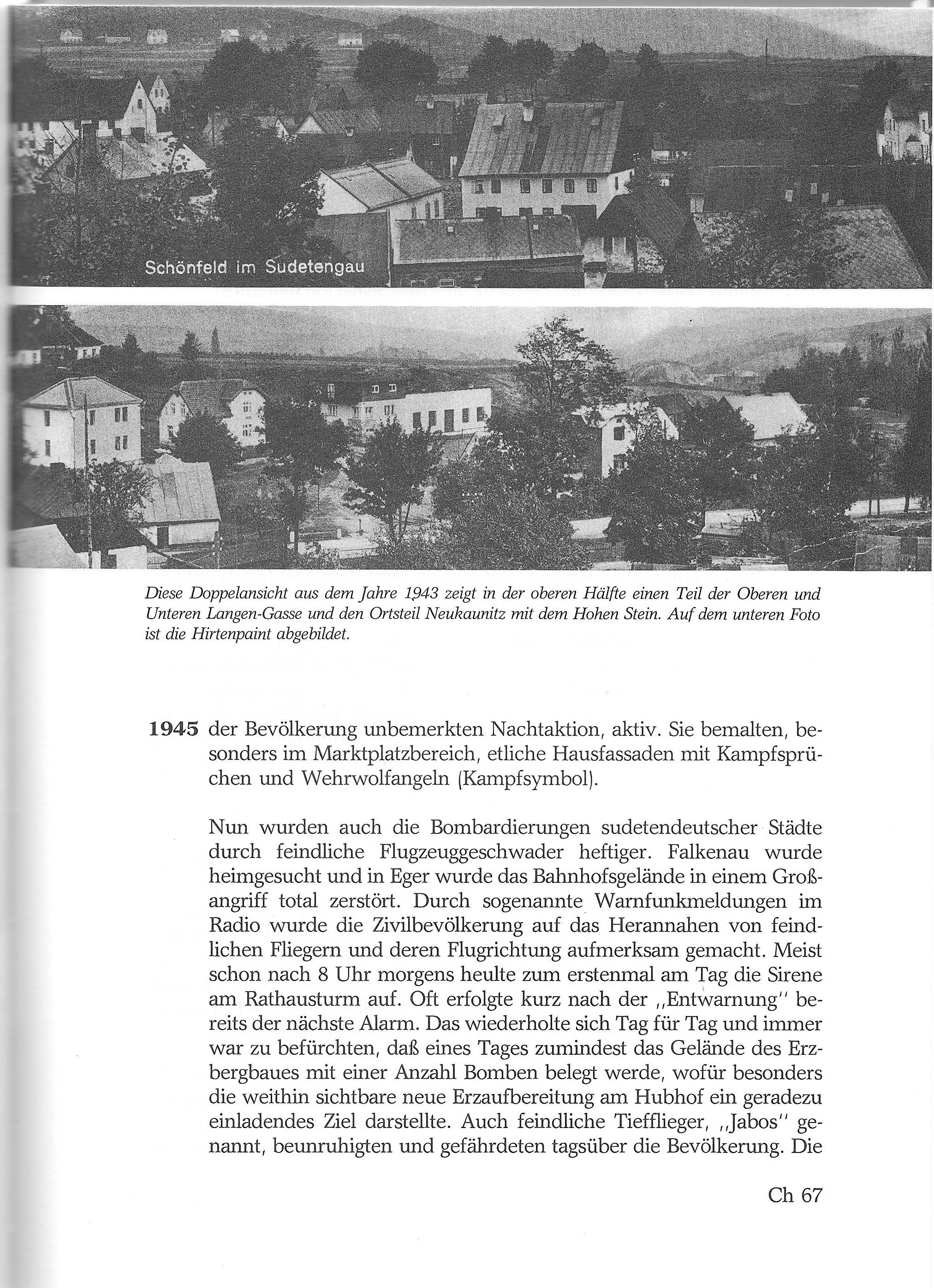
Cronik 067 Schönfeld in the Sudetenland This double view from 1943 shows, in the upper half, part of the Obere and Untere Langen-Gasse and the Neukaunitz district with the Hoher Stein. The lower photo shows the Hirtenpaint. 1945. They painted several house facades, especially in the market square area, with battle slogans and Wehrwolf fishing rods (battle symbol). Now the bombing of Sudeten German towns by enemy aircraft squadrons also became more intense. Falkenau was hit, and in Eger, the train station area was destroyed in a A major attack completely destroyed the city. Radio warnings alerted the civilian population to the approach of enemy aircraft and their direction of flight. Usually, the siren on the town hall tower would wail for the first time of the day as early as 8:00 a.m. Often, the next alarm would sound shortly after the all-clear. This was repeated day after day, and there was always a fear that one day at least the ore mining area would be bombed, for which the new ore processing plant at Hubhof, visible from afar, represented a particularly inviting target. Enemy low-flying aircraft, known as "fighter-bombers," also disturbed and endangered the population during the day. The Ch 67 chronik Page-0067
Cronik 068 1945 This spring, farmers could only cultivate their fields either early at dawn or in the evening after 7 p.m., because the first enemy aircraft were already circling over the countryside from 8 a.m. onwards. If the people working in the fields were surprised by low-flying aircraft, which happened very frequently, they had to abandon their draft animals and quickly seek hiding or lie down at a good distance from the team. On the afternoon of April 16, enemy low-flying aircraft appeared, circled over the town, whizzed just above the rooftops, and moved away again. Then a deafening crash of onboard weapons was heard. Soon after, black clouds of smoke were seen rising in the direction of the cemetery. The low-flying aircraft had attacked and set fire to the truck belonging to the merchant Spinner Fredl, which was on its way home with 5 tons of flour from the Stöhr mill in Petschau, near Kreuzberg. The driver of the truck, as well as two of his passengers, two French prisoners of war, had just managed to leave the truck and seek refuge in the nearby bushes. The truck along with the flour. By mid-April, American troops in the west had advanced close to the Sudeten German border. In view of the impending danger, the Volkssturm (Volkssturm) constructed "tank barriers" as a defensive measure against the advance of enemy tanks. On Lauterbacher Straße, between Josef Gebhart's house (309) and Johann Opl's garden wall opposite, on Petschauer Straße at the second bend, and at the Kreuzzeche mine, the existing anti-tank ditch was further expanded. Volkssturm men stood guard at the barriers day and night. But here, too, no sane person believed that these obstacles would have been capable of preventing any approaching enemy tanks from advancing further. Only, no one dared to express their doubts about it out loud. At the same time, homeowners were instructed to dig so-called "splinter trenches" for their households at some distance from their homes. These angular, often earth-covered shelters were intended to provide shelter for the residents during low-level attacks or artillery fire. On April 18, classes at the elementary school were suspended. Senior teacher Edwin Grünes was forced to take this measure when enemy bombing squadrons repeatedly approached the area, and a freshly announced all-clear was soon followed by another air raid warning. chronik Page-0068
Cronik 069 1945. Previously, the following official order had been issued for schools in response to air raid warnings: The children were divided into three groups from school, depending on their distance from their parents' home. The children closest to the school were allowed to return to their parents' home immediately upon the sound of the air raid siren. run. They were able to take children from the third group, those living furthest from the school (Rathaufen, Hub), into the basement of their house. The remaining middle group was housed in the air-raid shelter of the school building. Since the all-clear signal often took two to three hours to arrive, regular classes had naturally been impossible for a long time. End of April: The thunder of artillery from the direction of Eger had died down again. The Americans had withdrawn on the Bavarian side of the Bohemian Forest and entered Bohemia through the Bischofteinitz area. The first Sudeten German refugees were already arriving from the Saaz and Brünsdorf areas and also from the interior of Bohemia, seeking safety in time before the Russians advanced westward. On the night of May 1, the news arrived that Adolf Hitler had died in Berlin the day before. On May 2, Berlin was occupied by the Russians. Treks from East Prussians from Silesia, who endured unspeakable hardships on a journey lasting weeks, even months, and who carried only the bare essentials of clothing and linen in their wagons, arrived in Schönfeld. Shortly after their arrival, the wife of an East Prussian landowner gave birth to a boy. An Orthodox priest from Lithuania, who had joined one of the treks with his daughter, took up residence in the garden shed of the rectory garden because he could not find any other accommodation in all of Schönfeld. He lived here for an extended period. The owners of the treks drove their horses out into the meadows and fields and let them graze freely. This naturally aroused the anger of the affected landowners. One or the other dared to express his anger at the horse owners; he almost always received the understandable response: "You grieve over a bit of grass, but we have lost everything." Maybe you still feel the same way." Ch 69 chronik Page-0069
Cronik 070 1945 The war was drawing to a close. Our homeland lay between two fronts, inexorably approaching. At the beginning of May, approximately 1,000 Russian prisoners arrived in Schönfeld from various sources, spent the night in the bus garage and barns, and were led westward the next day. Squads of concentration camp prisoners were transferred from gendarmerie station to gendarmerie station. No community wanted to house them, fearing excesses. In Karlovy Vary, the war-disabled were released from the hospitals and left to their fate. Many were seen trudging through Schönfeld, trudging along with difficulty, leaning on crutches, with splinted limbs and armbands. In addition, in the first days of May, motorized Wehrmacht units arrived in Schönfeld from the Protectorate border, having previously endured tough, costly defensive battles with Czech partisans. In the early morning hours of May 4th, several German Wehrmacht trucks, coming from the Pilsen area, stopped at the first bend of Petschauer Straße behind the Grabenhäusl (Grab House). They were carrying four German soldiers who had fallen in combat with partisans. The drivers buried their dead comrades in a common grave along the road. They inscribed their names and units on pieces of a broken propeller and buried them in the ground with the fallen soldiers' steel helmets at their heads. A bouquet of colorful meadow flowers placed on the grave mound was the final salute to the dead. Then the trucks continued on toward Lauterbach. During the night of May 5th, a supply convoy arrived in Schönfeld with its trucks. An infantry company occupied the two school buildings. More and more Wehrmacht trucks arrived. The soldiers sought the last remaining shelters in barns, squares, and gardens under trees. Now, even in the final days of the war, Schönfeld was still involved in the war. The military now dominated the streets and alleys. Unrest and nervousness among the population had reached a peak. Furthermore, on Saturday, May 5, the order was given that the Volkssturm, together with the Wehrmacht, was to resist any incursion by enemy troops. Volkssturm men stood guard day and night. The next day, Monday, May 7, a sunny day, at 9:00 a.m., the thunder of two American tanks shook the houses on the main street in the lower part of the village. chronik Page-0070
Cronik 071 1945 They had come through the forest, along the lower Triftweg, and reached the main road at Hirtenpaint. At the market square, they stopped at the toll bridge. One tank aimed its gun at Petschauer Straße, the other at Lauterbacher Straße. A few American officers jumped off and went to the school, where part of the troops assembled in Schönfeld was quartered. The commander-in-chief of the German unit, a general, appeared at the front door of the upper school building. The American officers climbed the steps, exchanged a brief handshake, and spoke a few words. Then the general laid down his weapon. With him, the soldiers followed. Schönfeld was soon occupied by advancing American troops. The American command post was set up in the Hotel Potherr, and the commander himself lived in the Jahnheim. At 11 a.m. that same day, the mayor, along with all municipal employees, as well as the head of the municipal savings bank and all business owners of Schönfeld, including the then local Nazi Party leader, were ordered by the American commander to meet at the town hall for a meeting. Instructions were given regarding the implementation of ongoing tasks in the local area. Many German soldiers attempted to make their way home, while others wandered around helplessly until they were finally captured by the Americans. On the same day, the unconditional surrender was agreed upon with the Allied High Command in Reims, France, and ratified the following day, May 8, in Berlin. A total war had been followed by a total defeat, a defeat the likes of which had never been seen in German history. Shortly after the arrival of the American troops, the municipal trooper announced that all types of weapons, including SA bayonets and Hitler Youth daggers, were to be surrendered by the population and deposited in front of the town hall. At the same time, a curfew was announced for the German population between 8 p.m. and 6 a.m. Houses were confiscated for the American troops. The owners had to vacate them, in whole or in part, within two hours. Priority was given to the large buildings on the market square, such as Gerstner, Geier, and Longer, but smaller houses such as Horner and Ruppert (Poschetz) were also included. Ch 71 chronik Page-0071
Cronik 072 1945 Immediately after the arrival of the Americans, a rush of people began on the Wehrmacht vehicles, which were parked in squares and barns and contained a large amount of provisions. The crews of the convoys on Petschauer and Lauterbacher Streets had already abandoned their vehicles and fled, taking with them all manner of useful items. They had partially demolished the weapons, buried some or thrown them into the fields. In the ditches lay a vast number of empty cans, cartons, weapon parts, uniform fragments, canisters, and various military equipment. The image of a shattered army. This was the impression everyone had who saw this crewless convoy. Only later were the vehicles brought to the Opl field, where they remained completely stripped of supplies until 1946. The Eastern Workers and prisoners of war had made their way home in the first days after the collapse. The French had selected suitable cars from the abandoned vehicles and driven home. A Ukrainian had even appropriated one of the large buses of the former Saxon Motor Transport Company. On May 8, Mayor Josef Tauber was removed from his post by the American military administration. At the same time, the occupiers appointed Willi Bauer, then a municipal employee, as the new mayor. The municipality had set up a soup kitchen in the town hall courtyard to provide the many foreigners with a hot meal at least once a day. There were the German prisoners of war, who were neglected in the first few days, then the Eastern workers and the foreign prisoners of war. Added to this were the wounded released from the hospitals, as well as refugees who had come from the Karlsbad area; they all dominated the scene on the streets and squares. According to the city administration, Schönfeld had a food stand for over 5,000 people during these days. That was a little more than three times the population at the time. Locals said they had to be lucky to meet someone from Schönfeld. In the midst of this chaos, the collapse of the Wehrmacht and the collapse of a state, a message came from the Prague radio station, which had already been retaken by the Czechs, which, due to its enormity, was not taken very seriously by many Sudeten Germans. The message stated: chronik Page-0072
Cronik 073 1945 At its meeting on May 4, 1945, the Prague Council of Ministers decided to resettle all members of the German and Hungarian minorities in Czechoslovakia within a period of 18 months. After this period, no Sudeten Germans or Hungarians were to remain on Czechoslovak soil. Long before, during his stay in Moscow, former President Benes had obtained Stalin's consent to expel the Germans and Hungarians in Czechoslovakia. In this context, Stalin had declared that the USSR would be willing to accept 800,000 Germans as workers for Siberia. It was not considered possible that the Czechs, who now had firmly regained control of state power, could simply expel three and a half million Germans from their ancestral homeland. That this would happen without any compensation for the assets left behind was something no one had imagined at the time. So, people looked to the future with trepidation. After the horrors of the war, a new, serious concern now faced the people of our homeland. The American troops had occupied our territory only as far as the Teplá Valley. The Russians were moving into Petschau. Thus, between Petschau and Schönfeld, there was a demarcation line, so to speak, that could only be crossed with a permit. The Americans had erected a barrier about 200 meters from the town exit on Petschauer Straße and at the exit of Hofgasse towards Neudekera. Next to it stood a wooden guardhouse. The farmers who owned land in this direction, i.e., towards Friedhof, Länge, Neudekera, and Hubhof, could only access it with a pass, which they obtained from the town hall. This regulation remained in effect until the withdrawal of the American troops. So far, everything had gone well for the population. By the second day of the announcement, the Americans had already stopped observing the curfew for the German population. Otherwise, hardly a single German was harmed by the occupying forces. Things changed when, on May 16, Czechs suddenly marched into Schönfeld again. About 12 Red Guards with red armbands printed with RG (Revoluzni Garda) and four gendarmes formed the vanguard. The RG took up residence at the Gerstner Inn, while the gendarmes took up their previous position in the rectory, but after a few days, they moved to the Gasthaus zur Halle am Markt. Ch 73 chronik Page-0073
Cronik 074 1945 square. And now, as everywhere else, a time of terror began in Schönfeld as well. They first vented their hatred of everything German, which they brought to Schönfeld, on the war memorial in the town park. They toppled it from its pedestal, threw it over the wall behind the church, and defiled it in the most obscene and vile manner. They threw the nameplates of the fallen onto the compost heap behind the bell tower. They acted in the same way at the communal grave of the four German soldiers who had been buried on Petschauer Straße at the beginning of May. They burned the propeller parts bearing the names of the fallen, threw the wreaths and bouquets laid down onto the grounds, and destroyed the burial mound. The RG members took over the administration of the community as the Mistni narodni vybor (Local National Committee). Its Predseda (chairman) was a certain Zajic. The first official act of the new municipal government was the announcement that all savings deposits of Germans, Hungarians, and other enemies of the Republic were frozen, and no more withdrawals were permitted. At the same time, all other assets of the named individuals were confiscated for the benefit of the Czechoslovak state. Signs reading "Cesky majitek" (Czech property) were posted at the mine and the screw factory. Another immediate measure was the surrender of the radio sets. At that time, about 500 sets were registered in Schönfeld. Musical instruments also had to be surrendered. The Czechs opened a public library in the Zimmermann House. The German municipal library had, of course, been closed long ago. Ration cards were issued again. On the underprint of the cards, one could read hundreds of times: "For Germans." For Germans, however, there was no meat or fat, only bones and blood, no butter, only a little flour and bread, and only a little skim milk for small children. In the shops, Germans were limited to 10 a.m. to 12 p.m., and even then they had to wait until all Czech customers had been served. Germans were not allowed to visit restaurants or cinemas, nor were they allowed to use trains or buses, nor were they allowed to go into the forest. Furthermore, they were not allowed to travel more than 4 kilometers from their homes. If this was necessary, they had to apply to the Narodni Vybor for a travel permit. This cost 4 crowns. chronik Page-0074
Cronik 075 1945 To identify the Germans, they had to wear white armbands bearing the municipal stamp. The curfew also had to be strictly observed. Strict controls were in place. On the second day after the Czechs' arrival, all German men between 18 and 60 were summoned to the town hall to face a string of vicious insults and threats of punishment. Certain people from Schönfeld also continued to denounce the Czechs, revealing everything they knew about their homeland. The Czech gendarmes later declared more than once that they had easy work in Schönfeld; that everything was being handed to them, more than they would have liked. In addition, both the Americans and the Czechs, after entering Schönfeld, found the complete membership lists of the former SDP (Sudeten German Party) and the NSDAP. Inexplicably, they had neglected to destroy the lists beforehand. It is to be assumed that, even in light of the American troops in our town, the political leaders of the time still believed in the use of the much-cited miracle weapon, which was supposed to bring about a so-called final victory. This schizophrenic idea may have stood in the way of document destruction at the time. So, in this respect, too, everything was obvious to the Czechs. Let's return to the men summoned to the town hall. After a speech by Weigl (a Silesian discharged from military service, whose family had fled to Schönfeld and who, inexplicably, played a significant role in many Czech actions against the German population), the work order for the German men was issued. One group had to transport the pile of rubble in front of the old schoolhouse to the Hohen Stein with a heavy horse-drawn cart, of course without a horse. Others had to remove the obstacles that had been set up as tank traps. Still others were tasked with creating and planting flowerbeds in front of the church. The soil for this was brought from the Zohnergarten. After this work was completed, the asphalt road from the toll bridge to below the pinge was repaired. Finally, the alley from the Schleehaus to Josef Gareiß (Brosl) was channeled. Ch 75 chronik Page-0075
Cronik 076 1945 Simultaneously with the start of the aforementioned work, a wave of arrests began that lasted for many months. These primarily involved officials of the former Nazi Party. The Czechs had arrested around 120 people by the end of 1945, including youths from the former "Wehrwolf" group. But other people who were "framed" for something were not safe either. It was a nerve-wracking and anxious time, and hardly a day passed without an arrest followed by a house search. The victims, who were usually torn from their families in the morning or taken directly from their workplace, were taken to the town hall or the gendarmerie station. During the subsequent interrogation, they were beaten and slapped. After this harsh treatment, they were transported to Elbogen Castle. Often up to 400 prisoners were crammed into cells, constantly exposed to the arbitrary treatment and beatings of the guards. Here, they faced new interrogations, which almost always involved mistreatment. On several occasions, some of the prisoners were transferred to the Neurohlau barracks camp. One transport of approximately 250 men, including the author, traveled by rail to T?emošna near Pilsen. However, the space thus created in the castle was soon taken up by new arrivals. With meager food, the inmates of these so-called internment camps were assigned to various jobs—in Neurohlau, primarily track construction. Some were only able to maintain their health because they occasionally received food from relatives. Whole groups of food carriers often set out in the early hours toward Elbogen or Neurohlau. This journey, especially in winter, involved great hardship. The journey there and back was made on foot in all weather conditions. The provisions carried in a backpack or handbag and saved from the pittance usually consisted of bread, a bottle of coffee, and a wheat or coarse-grain porridge, which at that time was a staple on every "kitchen list." Most of the prisoners were not released until the course of 1946. On August 2, the Potsdam Agreement, concluded between the USA, Great Britain, and the USSR, was signed. The article concerning the resettlement of Germans read as follows: "The three governments, after considering this matter, recognize Ch 76 chronik Page-0076
Cronik 077 1945 in all its aspects, since the German populations in Poland, Czechoslovakia, and Hungary, or parts of them, are to be deported to Germany. They agree that any expansive deportation would be carried out in an orderly and humane manner." With the ratification of this agreement by the three victorious powers, the fate of the Sudeten Germans was finally sealed. Nevertheless, some still clung to straws like a drowning man, clinging to secret hopes, such as: The Americans would not abandon their occupied territory because of the Karlovy Vary-Marienbad-Franzensbad spa triangle, or: The western Sudetenland would be annexed to the state of Bavaria as New Bavaria. But all hopes proved false; fate took its course. On the morning of August 26, 60 men in Schönfeld received a summons from the Narodny Vybor to appear in front of the town hall the next day at 7 a.m. for deportation. They were to be provided with a blanket, cutlery, and provisions for two days. Understandably, there was great excitement among those affected and their families that day. However, the plan was stopped by the Americans that same day. The initiator was an American sergeant who was a regular customer at the Brandl barber shop (the author's father). From him, who was also supposed to be part of this transport, the sergeant learned of the Czechs' planned action. He immediately informed his commander at the Hotel Potherr, who reacted immediately and prohibited the transport on the grounds that he would not allow any Germans to be transported from the American to the Russian-occupied zone. Thus, the victims had once again gotten off lightly. Around this time, the previous RG members, most of whom were former university students and had prepared the ground for Czechization, were withdrawn from Schönfeld. They were replaced by the actual commissars, who now took over and built up the municipal administration. All were members of the Czech Communist Party. A certain Sladky, who had formerly worked at a coal mine in Kladno, became municipal commissar and also commissar for mining operations. Stejskal, an agricultural assistant, became housing commissar. The other municipal departments were also transferred. Ch 77 chronik Page-0077
Cronik 078 Assigned to loyal communists in 1945. Likewise, the businesses were placed under the control of commissars. Immediately after the commissars, the first settlers arrived in Schönfeld. Most of them came from the Kladno area. Often equipped with only a briefcase or a box under their arm, they moved into Schönfeld. Shortly thereafter, they could be seen wandering through the town, examining the houses until they finally found one they liked. Their next stop was the town hall, where they reported the number of the house they had chosen to the housing commissioner. Then the two went together into the house in question and informed the residents that they had to leave the house within two hours, in some cases within 20 minutes, and hand over the keys to the new "owner." They were only allowed to take the bare essentials of clothing and linen. Furniture and all other furnishings had to remain. The person displaced from his home was placed with his family in another house. Sometimes the affected people found shelter with relatives. Once the "new settler" had taken possession of a house, he would gather whatever he liked and what he might need from other houses throughout the village. In this way, he was equipped according to his wishes within a very short time. The Czechs who took over a business did the same. They, too, gathered the best from the closed-down German shops and businesses. Every week, new settlers arrived, among them many Slovaks, who had been promised a house, land, and a job in exchange for committing to two years of work in order to settle the Sudetenland. These people, of course, also demanded their own homes. So the Germans now lived in constant fear of being chased from their homes, perhaps within hours. Even at night, they had no peace. Every now and then, there was a drumming on the front door or window. Two or three gendarmes would be there, and if they were allowed in, they would drive all the residents out of bed and thoroughly search every room of the house. When the resident timidly asked what they were actually looking for in the middle of the night, they explained that they had to check whether a stranger was being hidden in the house. Through all sorts of other measures, they also sought to humiliate the German population and show them in whose hands the power now lay. Thus, Germans aged 14 and over were forced to go to Elbogen twice to see an exhibition with chronik Page-0078
Cronik 079 1945 to view images of Nazi atrocities. Everyone had to obtain confirmation of their visit, which they had to present when their ration card was next issued; otherwise, their food would have been withheld for the next food period. Another time, the Germans who were not employed had to go to our neighboring town of Lauterbach to attend the funeral of four deceased Jews. These had died on the march during the war as a result of the hardships they had endured. They had been buried at the edge of the forest on Sangerberger Straße. Now, girls and women from Lauterbach, who had formerly belonged to the BdM (Association of German Men's Movement) or the NS Women's League, had to dig up the dead Jews with their bare hands, meticulously clean the remains, and then properly coffin them. Germans from all over the surrounding area had to attend the subsequent burial at the Lauterbach cemetery. In mid-August, the former mark currency was also converted back to crowns. Germans had to surrender their mark contributions. In return, they were to receive 300 CZK per month per person to support their living expenses. But they only received this payment once or twice. At the beginning of the fruit-ripening season, it was announced that Germans were not allowed to pick fruit from their trees; it belonged to the Czech population. So the locals had to watch as strangers came into their gardens and harvested their fruit. At harvest time, German farmers could bring the grain home from their fields, thresh it, but then had to deliver all the produce to the Czechs. The grain was stored in two classrooms of the old school and in the granary of the lower mill. Most of the potatoes also had to be surrendered; they were stored in the town hall and other cellars. Of course, all these deliveries took place without any compensation to the farmers. The Germans had to watch with heartache as the letters of the inscription "Volksschule" were torn down from the two school buildings, and the two inscriptions "Stadtamt" and "Städtische Sparkasse" were torn down from the town hall. Schönfeld increasingly lost its purely German character, both in its outward appearance and in its language. On November 11, what had long been feared happened: On that day, the American occupation troops withdrew. Ch 79 chronik Page-0079
Cronik 080 The German population followed this withdrawal with fear and anxiety, because up to that point, it had been solely thanks to the presence of the American occupation troops that there had been no bloody riots and massacres against the Germans in our hometown, as had often been the case in the Russian-occupied territories in the immediate period after the surrender. At the beginning of November, the Germans were ordered to register all deposit books in their possession with savings banks, banks, and other financial institutions by November 15th. The first measures the Czechs took against the Germans after the American withdrawal were systematic house searches. For this purpose, Schönfeld had been divided into districts by the "Narodni vybor." Every Sunday, when no work was being done, three to four districts were assigned. Two to three men, usually accompanied by a gendarme, entered the house and searched it from the basement to the roof. A wagon following this group was used to transport the confiscated goods. Since all German property, including houses and land, had been forfeited to the state, from now on, even homeowners had to pay rent for their own houses. The rent depended on the size of the occupied house and was generally 50 CZK per month. In the first half of December, three transports of men were assembled with the destination of the Brüx coalfield. Around 100 men were conscripted in this way. The last of these transports departed on December 13th. Four men who had been called up for this transport had died in stormy weather. Winter weather forced people to flee across the Bavarian border overnight. The population, for most of whom the word "deprivation" had always been familiar, experienced perhaps the saddest Christmas imaginable this year. - Fallen, missing, captured, arrested, conscripted, dispossessed – all words that had a place in almost every family, at least to some extent. Moreover, expulsion from their ancestral homeland was imminent. chronik Page-0080
Cronik 081 1946 The first transport of resettlers from the western Sudetenland departed from Marienbad on January 30th. The first transport from the Elbogen district was assembled in mid-March, with its departure scheduled for March 19th. Approximately 320 people from Schönfeld were summoned to the Kreuzzeche mine at 7:00 a.m. that day for transport. Each person was permitted 50 kilograms of luggage. To prevent the resettlers from giving any of their belongings to acquaintances or neighbors, the Germans were not allowed to leave their homes the evening before from 6:00 p.m. to 6:00 a.m. under threat of severe punishment. On the sunny morning of the otherwise so celebrated St. Joseph's Day, wagon after wagon carrying the few belongings of the first displaced persons from our hometown drove down to the Kreuzzeche mine, where an inspection took place. For many, this departure from their hometown was a farewell forever. The inspection was primarily focused on luggage. Several items of the remaining belongings changed hands here. They were then transported by truck to Neusattl, where the departure camp had been set up in the former German elementary school. After a few days, they went to Neusattl station, where the transport train was waiting. Previously, each person had received 1,000 Reichsmarks as a departure allowance from the Czechs. Each transport consisted of 1,200 people. Thirty people and their luggage were loaded into each of the train's 40 freight cars. The journey then continued via Eger-Wiesau to Bavaria. The first transport was directed to the Königshofen district in Lower Franconia. Subsequently, an average of two transports departed from the Elbogen district each month. After three or four transports, the Czechs paid the departing Germans only 500 marks as a departure allowance. The checkpoint was also moved from the Kreuzzeche mine to the Geier Inn on the market square. The Germans who remained behind now lived among the Czechs and Slovaks already settled there, in a strange situation, a mixture of conflicting emotions. On the one hand, they envied those who had already been displaced, who had already survived the farewell to their homeland and found a new home somewhere else; on the other hand, they were happy to be able to live in their homeland, in their own house, for a few more weeks. Some volunteered for the next transport to escape the nerve-wracking situation. Ch 81 chronik Page-0081
Cronik 082 1946 After the first transports, it had become increasingly lonely for the Germans who had remained behind, increasingly deserted and thus more oppressive in the alleys and streets. Many houses stared accusingly at one through their broken or open windows, as if through hollow eyes. For the Germans, sermons were still allowed to be given in German in church. In May, the Czechs decided to build a sports field in the fields behind the New Town. Germans were enlisted for the work. However, work came to a halt in June due to haymaking. On a Sunday at the end of June, around 40 mowers went to work on the Breite Wiese. But only a small portion of the hay was taken home; most of it remained in swaths and rotted. The hay was for the livestock delivered by the expelled Germans and housed in the stables on the Hub and at the Hubhof. The cattle were allowed to graze unattended day and night on the dumps. Pastures were created for the young cattle on the Eckl-Paint and at the Wallisch-Garten. Of the approximately 370 cows that had been in Schönfeld, only about 40 remained in the spring of 1947. Most had died from hunger and lack of care. At the beginning of September, a Czech school opened in the former German school building. In addition to Czech and Slovak children, the children of Germans who were willing to remain in Schönfeld as workers were also accepted. While all previous transports of displaced persons had been directed to the American-occupied areas of West Germany, the two transports on August 26 and September 9 departed from Wiesau for the Russian-occupied zone, much to the horror of those affected. The next group of 112 people said goodbye to Schönfeld on September 28. This transport, the 14th from the Elbogen district, was headed to Hesse. The last transport included approximately 90 Schönfelders. They found their new home in the Groß-Gerau district. Ch 82 chronik Page-0082
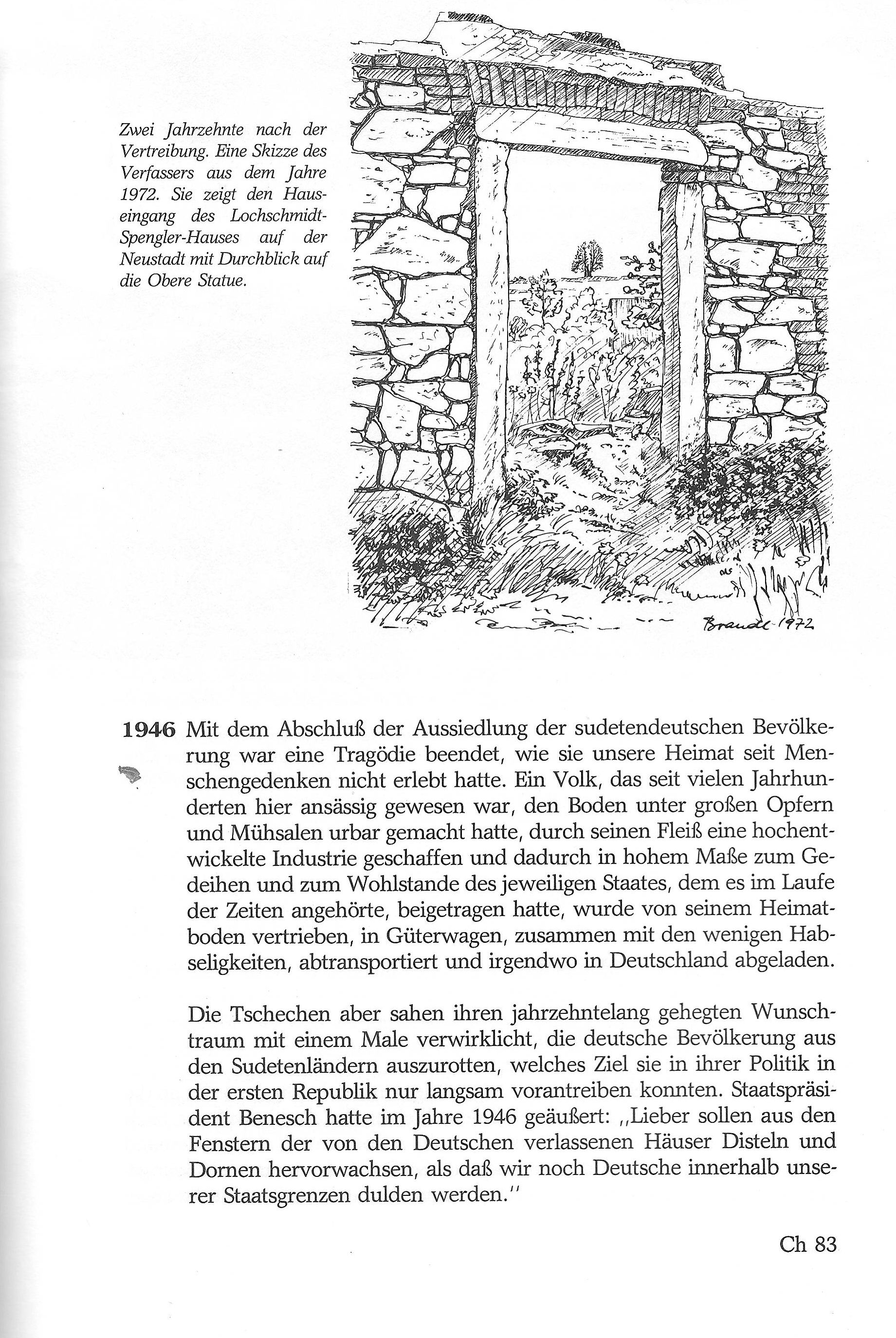
Cronik 083 Two decades after the expulsion. A sketch by the author from 1972. It shows the entrance of the Lochschmidt-Spengler House in the Neustadt district with a view of the Upper Statue. Brande 1972 1946 With the completion of the resettlement of the Sudeten German population, a tragedy was brought to an end, the likes of which our homeland had not experienced in living memory. A people that had lived here for many centuries, had cultivated the land at great sacrifice and hardship, had created a highly developed industry through their diligence, and had thus contributed significantly to the prosperity and wealth of the respective state to which they had belonged over time, was expelled from their homeland, transported in freight cars, along with their few belongings, and dumped somewhere in Germany. The Czechs, however, suddenly saw their dream, which they had cherished for decades, realized: to exterminate the German population from the Sudetenland, a goal which they had only been able to pursue slowly in their policies during the first republic. In 1946, President Benesch stated: "It would be better for thistles and thorns to grow from the windows of the houses abandoned by the Germans than for us to tolerate any more Germans within our national borders." Ch 83 chronik Page-0083
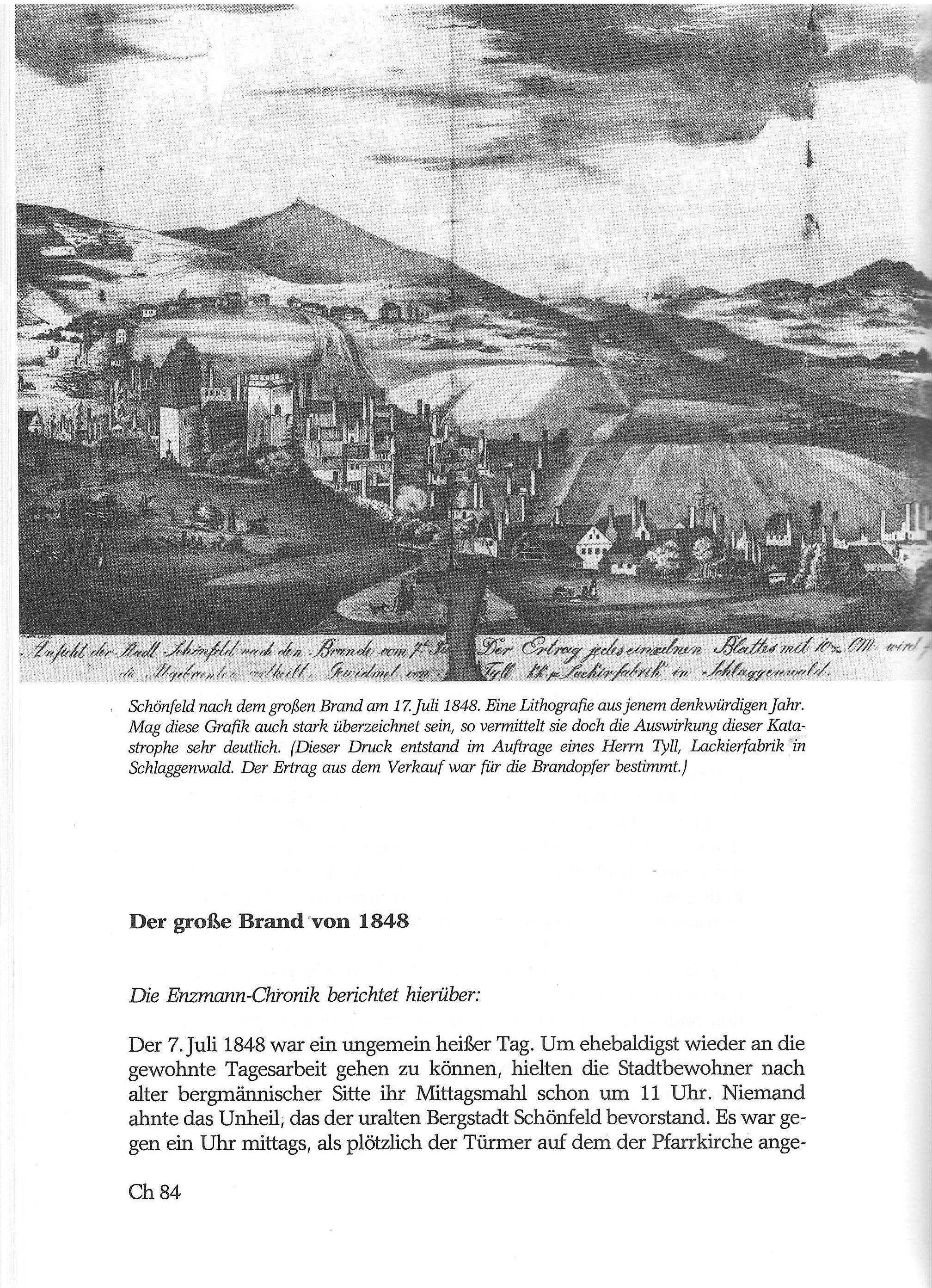
Cronik 084 Challenge of the town of Schönfeld after the fires. com 74 20, the recipients were given. Dedicated to The proceeds of each individual sheet are 10%. M. is; Tyll bh. p packing factory in Schlaggenwald. Schönfeld after the great fire on July 17, 1848. A lithograph from that memorable year. Although this graphic may be greatly exaggerated, it nevertheless conveys the impact of this catastrophe very clearly. (This print was commissioned by a Mr. Tyll, paint factory in Schlaggenwald. The proceeds from the sale were for the fire victims.) (determined.) The Great Fire of 1848 The Enzmann Chronicle reports: July 7, 1848, was an exceptionally hot day. In order to be able to return to their usual daily work as soon as possible, the townspeople, following an old mining custom, had their midday meal at 11:00 a.m. No one suspected the disaster that awaited the ancient mining town of Schönfeld. It was around 1:00 p.m. when the bell ringer suddenly appeared on the parish church tower. Ch 84 chronik Page-0084
Cronik 085 built town towers rang the alarm "Fire!" with the mountain bell. An old, long-dilapidated building opposite the rectory, house number 97, owned by the miner Kaspar Mayer, was ablaze. The number of people rushing to help was very small, as many townspeople were busy making hay and cutting peat. And so it happened that the flames quickly spread to the dried-out shingle roofs of the neighboring houses, first toward the upper part of the city, then to the rectory, the church, and the houses on the market square and in the adjacent streets. People rushed to help from neighboring towns. 17 fire engines were deployed, but not much could be saved. Within three hours, 230 residential and outbuildings were destroyed by the flames. 1,400 local residents, among them the elderly local pastor Adam Kanzler with the monstrance and the Ciborium, camped in the fields with their salvaged belongings. The damage caused was estimated at 600,000 guilders. The grief and dejection, as well as the misery of those affected, were indescribable. Those deprived of their homes had to huddle together in the houses of the lower part of the city or seek shelter in neighboring towns. The melancholy was indescribable when, two days after the fire, on the 4th Sunday after Pentecost, the Schönfeld residents attended Sunday mass, which, because the church had burned down, was held in the market square near the statue of Saint Anthony of Padua. Rivers of tears flowed as the old local priest spoke a few words of consolation. The neighboring towns, especially the cities of Karlsbad and Schlaggenwald, demonstrated great readiness to help. The fire at the town hall also destroyed many old, important documents, books, and writings. The service was held from the 4th Sunday after Pentecost until All Saints' Day in the market square near the statue. The service was held in the church vestibule of St. Anthony's Church, then, when the weather became unfavorable, in the church porch. Later, the mining authority erected a temporary roof over the remains of the church walls at a cost of 800 guilders, as well as two altars and a pulpit made of planks. To resume school classes, which had been interrupted for 16 weeks, two rooms were rented in a private house, in which four classes had to be taught. For many years after the fire, the Schönfeld residents made it a habit to go to church for Holy Mass on the day of the disaster, July 7th, during which a special hymn, the "Fire Song," was sung. Unfortunately, the lyrics of the hymn have not survived. To raise money for the fire-fighters, the certified Schönfeld magistrate Theodor Rislanek wrote a leaflet: Ch 85 chronik Page-0085
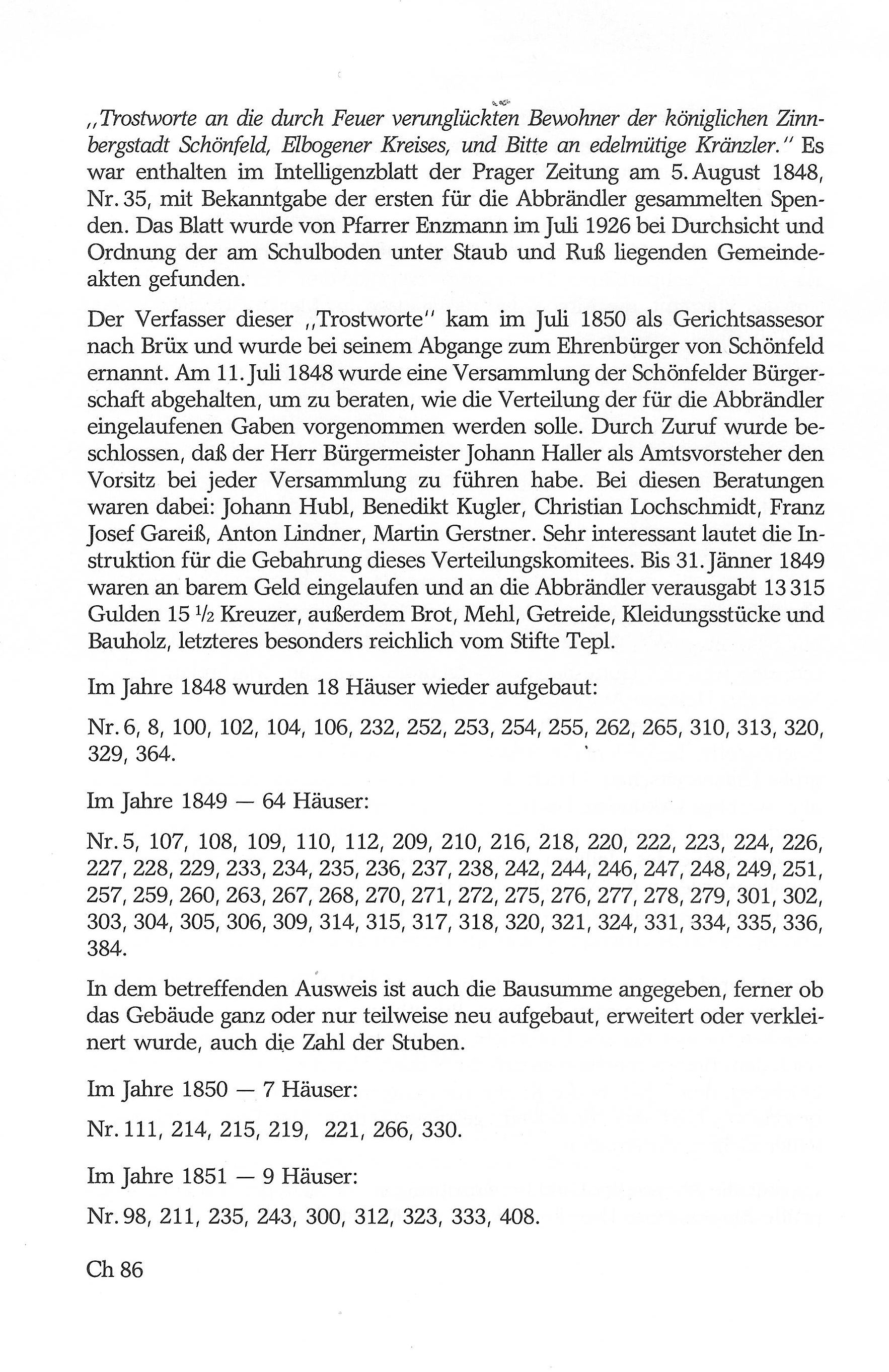
Cronik 086 "Words of comfort to the residents of the royal tin mining town of Schönfeld, Elbogen District, who were killed in a fire, and a plea to the generous Kränzler." It was included in the intelligence bulletin of the Prager Zeitung on August 5, 1848, No. 35, announcing the first donations collected for the firefighters. The bulletin was found by Pastor Enzmann in July 1926 while reviewing and organizing the parish records lying under dust and soot on the school floor. The author of these "words of comfort" came to Brüx in July 1850 as a court assessor and was made an honorary citizen of Schönfeld upon his departure. On July 11, 1848, a meeting of the Schönfeld citizens was held to discuss how to distribute the donations received for the firefighters. By acclamation, it was decided that Mayor Johann Haller, as head of the district office, would preside over every meeting. Present at these deliberations were: Johann Hubl, Benedikt Kugler, Christian Lochschmidt, Franz Josef Gareiß, Anton Lindner, and Martin Gerstner. The instructions for the conduct of this distribution committee are very interesting. By January 31, 1849, 13,315 guilders and 152 kreuzers in cash had been received and distributed to the fire-fighters, as well as bread, flour, grain, clothing, and lumber, the latter especially plentiful from the Tepl monastery. In 1848, 18 houses were rebuilt: Nos. 6, 8, 100, 102, 104, 106, 232, 252, 253, 254, 255, 262, 265, 310, 313, 320, 329, 364. In 1849 - 64 houses: Nos. 5, 107, 108, 109, 110, 112, 209, 210, 216, 218, 220, 222, 223, 224, 226, 227, 228, 229, 233, 234, 235, 236, 237, 238 242, 244, 246, 247, 248, 249, 251, 257, 259, 260, 263, 267, 268, 270, 271, 272, 275, 276, 277, 278, 279, 301, 302, 303, 304, 305, 306, 309, 314, 315, 317, 318, 320, 321, 324, 331, 334, 335, 336, 384. The relevant certificate also indicates the construction costs, whether the building was completely or partially rebuilt, expanded, or reduced in size, and the number of rooms. In 1850 - 7 houses: Nos. 111, 214, 215, 219, 221, 266, 330. In 1851 - 9 houses: Nos. 98, 211, 235, 243, 300, 312, 323, 333, 408. Ch 86 chronik Page-0086
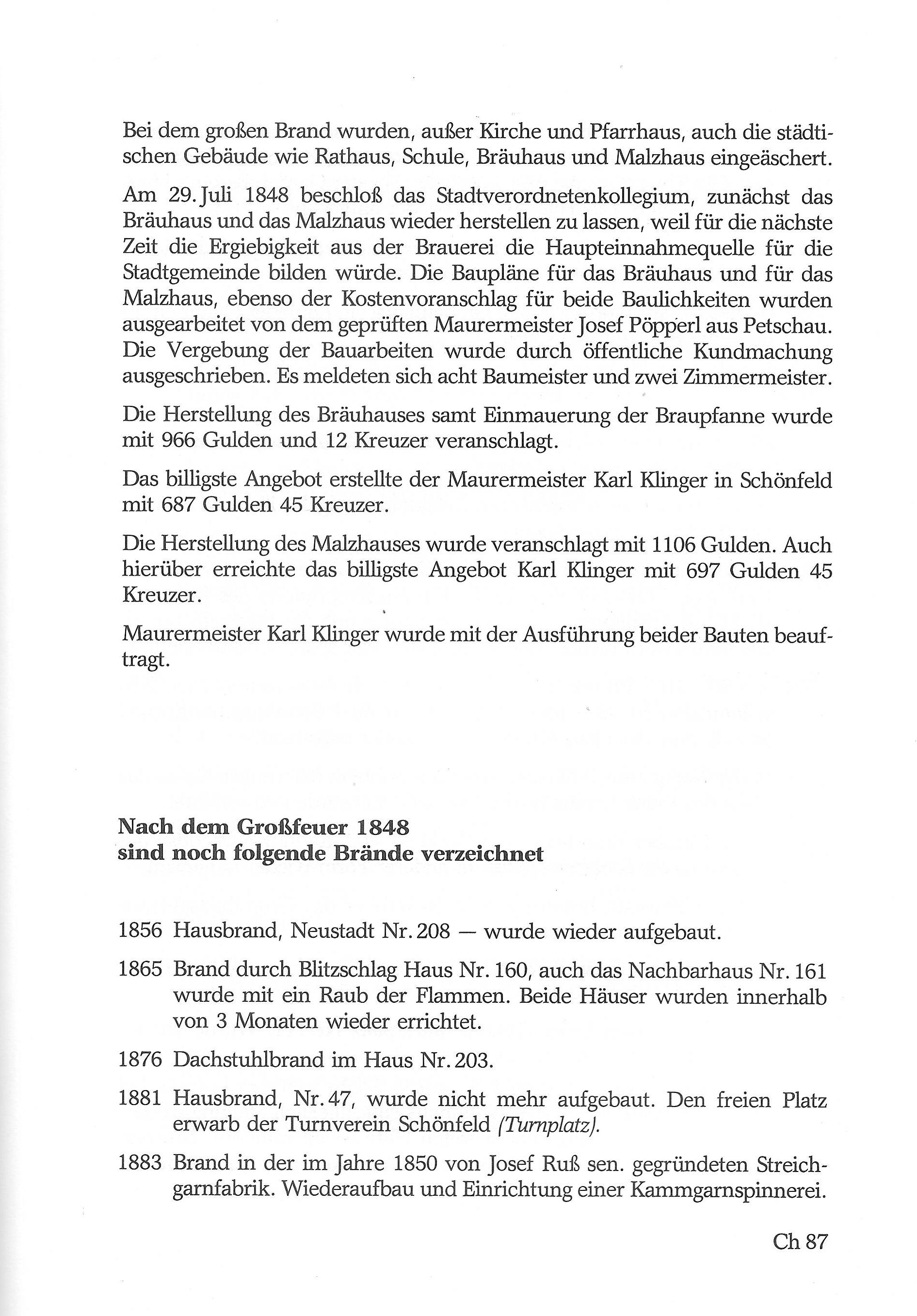
Cronik 087 In addition to the church and rectory, the municipal buildings such as the town hall, school, brewery, and malthouse were also incinerated in the great fire. On July 29, 1848, the city council decided to rebuild the brewery and malthouse first, as the brewery's profits would be the municipality's main source of income for the foreseeable future. The construction plans for the brewery and malthouse, as well as the cost estimate for both buildings, were drawn up by certified master mason Josef Pöpperl from Petschau. The construction work was awarded by public notice. Eight master builders and two master carpenters applied. The construction of the brewery, including the brickwork for the brewing kettle, was estimated at 966 guilders and 12 kreuzers. The lowest bid came from master mason Karl Klinger in Schönfeld, at 687 guilders and 45 kreuzers. The construction of the malt house was estimated at 1,106 guilders. The lowest bid for this, too, was received from Karl Klinger at 697 guilders and 45 kreuzers. Master mason Karl Klinger was commissioned to construct both buildings. After the major fire of 1848, the following fires were recorded: 1856: House fire; Neustadt No. 208 was rebuilt. 1865: Fire caused by lightning in house No. 160, and the neighboring house No. 161 was also destroyed by the flames. Both houses were rebuilt within three months. 1876: Roof fire in house No. 203. 1881: House fire in No. 47 was never rebuilt. The vacant site was acquired by the Schönfeld Gymnastics Club (gymnastics field). 1883: Fire in the woolen yarn factory founded in 1850 by Josef Ruß Sr. Reconstruction and establishment of a worsted spinning mill. Ch 87 chronik Page-0087
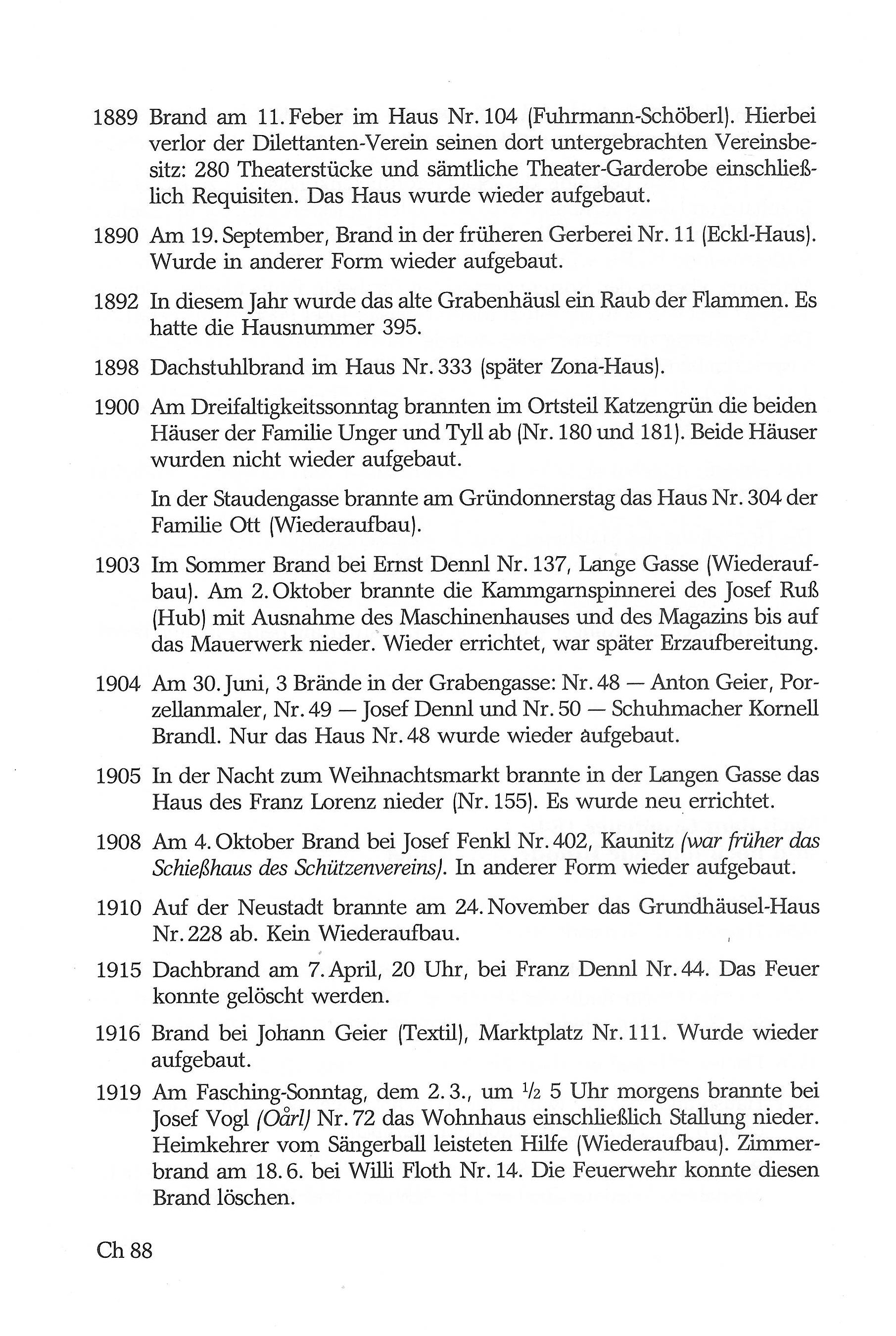
Cronik 088 1889 Fire on February 11th in house no. 104 (Fuhrmann-Schöberl). The amateur club lost its belongings housed there: 280 plays and all the theater's wardrobe, including props. The building was rebuilt. 1890 On September 19th, fire in the former tannery no. 11 (Eckl-Haus). It was rebuilt in a different form. 1892 This year, the old Grabenhäusl was destroyed by flames. It had the house number 395. 1898 Roof fire in house no. 333 (later Zona-Haus). 1900 On Trinity Sunday, the two houses belonging to the Unger and Tyll families (nos. 180 and 181) burned down in the Katzengrün district. Both houses were not rebuilt. On Maundy Thursday, the Ott family's house at No. 304 in Staudengasse burned down (rebuilt). 1903 In the summer, a fire broke out at Ernst Dennl's house at No. 137 in Lange Gasse (rebuilt). On October 2nd, Josef Ruß's worsted spinning mill (Hub) burned down to its masonry, with the exception of the engine house and the warehouse. Rebuilt, it later served as an ore processing plant. 1904 On June 30th, three fires broke out in Grabengasse: No. 48 - Anton Geier, porcelain painter, No. 49 - Josef Dennl, and No. 50 - shoemaker Kornell Brandl. Only house No. 48 was rebuilt. 1905 On the night of the Christmas market, Franz Lorenz's house (No. 155) in Lange Gasse burned down. It was rebuilt. 1908 On October 4, a fire broke out at Josef Fenkl No. 402, Kaunitz (formerly the shooting club's shooting range). Rebuilt in a different form. 1910 On November 24, Grundhäusel House No. 228 burned down in the Neustadt district. It was not rebuilt. 1915 On April 7, at 8 p.m., at Franz Dennl No. 44, a roof fire was extinguished. 1916 On March 2, at 4:30 a.m., a fire broke out at Johann Geier (Textiles), Marktplatz No. 111. The building was rebuilt. 1919 On Carnival Sunday, March 2, at 4:30 a.m., the house and stables at Josef Vogl (Oårl) No. 72 burned down. Those returning from the singers' ball provided assistance (reconstruction). A room fire broke out on June 18 at Willi Floth No. 14. The fire department was able to extinguish this fire. Ch88 chronik Page-0088
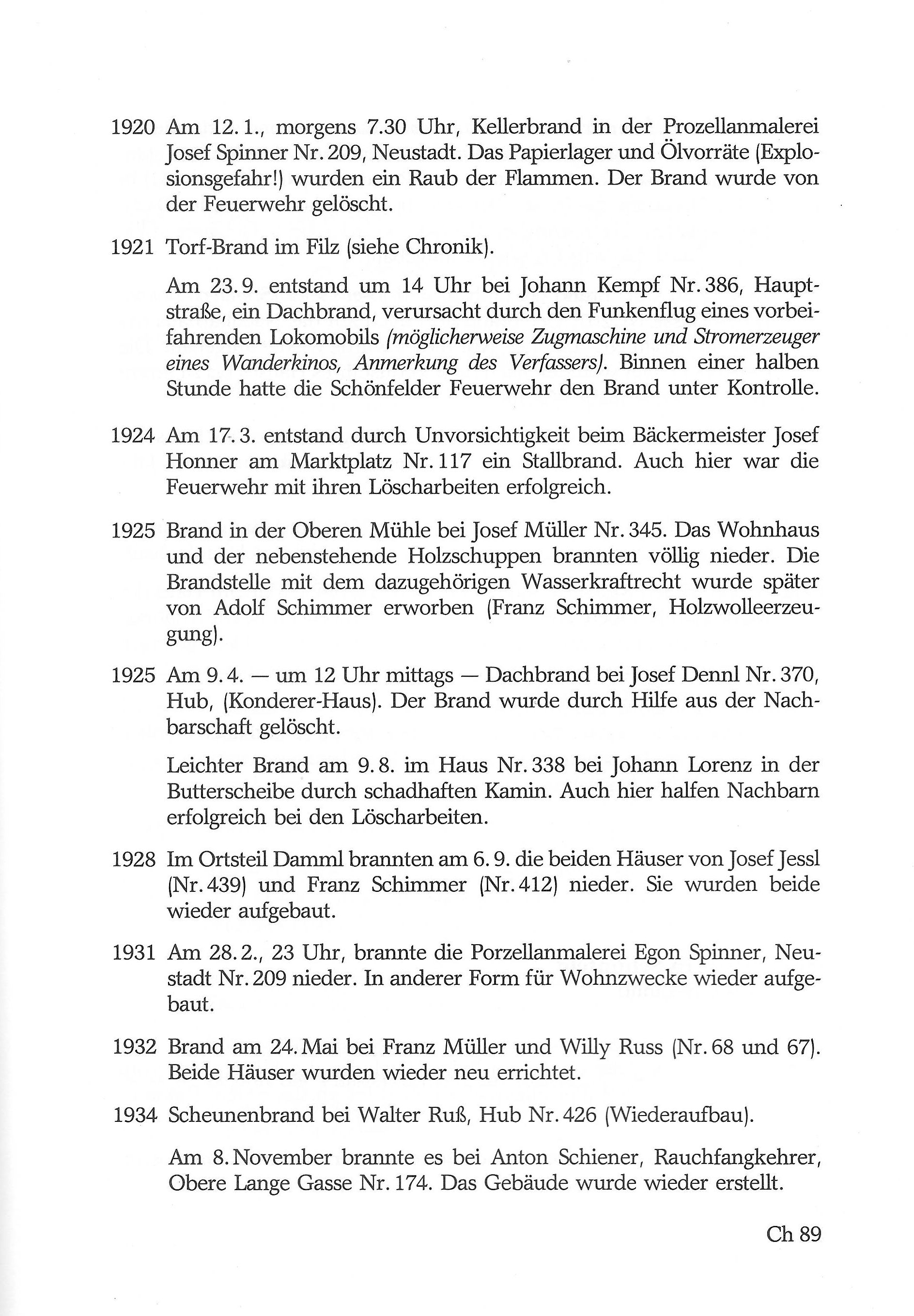
Cronik 089 1920 On January 12th, at 7:30 a.m., a cellar fire broke out at Josef Spinner's porcelain painting shop at No. 209 in Neustadt. The paper warehouse and oil supplies (danger of explosion!) were engulfed in flames. The fire was extinguished by the fire department. 1921 Peat fire in Filz (see Chronicle). On September 23rd, at 2 p.m., a roof fire broke out at Johann Kempf No. 386 on Hauptstraße, caused by sparks from a passing steam engine (possibly the tractor and power generator of a traveling cinema, author's note). Within half an hour, the Schönfeld fire department had the fire under control. 1924 On March 17th, a careless man in the barn at master baker Josef Honner's shop at Marktplatz No. 117 broke out. Here, too, the fire department was successful in extinguishing the fire. 1925 Fire in the Upper Mill at Josef Müller No. 345. The house and the adjacent woodshed burned down completely. The fire site, along with the associated hydropower rights, was later acquired by Adolf Schimmer (Franz Schimmer, wood wool production). 1925 On April 9th ??- at 12 noon - roof fire at Josef Dennl No. 370, Hub, (Konderer House). The fire was extinguished with help from the neighbors. A small fire on August 9th in house No. 338 at Johann Lorenz in the Butterscheibe caused by a damaged chimney. Here, too, neighbors successfully assisted in the firefighting efforts. 1928 In the Damml district, the two houses of Josef Jessl (No. 439) and Franz Schimmer (No. 412) burned down on September 6th. They were both rebuilt. 1931 On February 28, at 11 p.m., the Egon Spinner porcelain painting shop at Neustadt No. 209 burned down. It was rebuilt in a different form for residential use. 1932 Fire on May 24 at Franz Müller and Willy Russ's (Nos. 68 and 67). Both houses were rebuilt. 1934 Barn fire at Walter Russ's, Hub No. 426 (rebuilt). On November 8, a fire broke out at Anton Schiener's, chimney sweep, at Obere Lange Gasse No. 174. The building was rebuilt. Ch 89 chronik Page-0089
Cronik 090 1935 On February 23rd at 9:30 p.m., the fire brigade ball taking place that evening was abruptly interrupted by a call for a fire. On the Kaunitz River, the houses of Rudolf and Karl Paradeiser (Nos. 289 and 431) were ablaze. The bursting of the Eternit roof panels could be heard as far away as the village. Despite rapid response, both buildings were completely incinerated. They were rebuilt. April 10th, 2:30 a.m., fire at Ludwig and Josef Geier's (Schnappa-Boum) home, Lange Gasse No. 201. The fire also spread to the neighboring house of Oswald Jordan at No. 202. Only this house was rebuilt. After losing their home, the Geier brothers lived in the poorhouse (Kirchl) until their deaths. 1936 On November 6th, at 12 noon, the house of master baker Willi Hahn (No. 278) burned down in Staudengasse. It was rebuilt the same year. 1938 On Epiphany, the house of bricklayer Johann Weinhart, No. 283, burned down in Staudengasse. It was never rebuilt. 1942 In the early morning hours (3 a.m.) on March 1st, a fire broke out in the house of Marie Gareiß, Obere Lange Gasse No. 175. The 81-year-old resident had to be carried out of the burning house by neighbors. The fire department's rapid response prevented the fire from spreading to neighboring houses. Cause of fire: The elderly woman had presumably stored ashes in the barn that evening while still warm from the stove. The burnt-out ruins were removed and the area leveled. Road construction in Schönfeld (as far as still known) 1839 Paving of the street on the left bank of the Flößgraben stream from house no. 262 (Rau porcelain painting) to the lower corner of the town hall. 1841 Paving on the right bank of the ditch from the church to the upper corner of the brewery. Ch 90 chronik Page-0090
Cronik 091 1842 Street paving from house no. 260 (Nau(d)lå) to the pavement laid in 1839 near Rau, and also from the town hall to house no. 106 (Gräf). 1843 Paving from the Gräf House to the statue of Saint Florian. The funds for the paving work carried out from 1839 came from the treasury of the Improvement Fund, which had been dissolved by state order (see the "Chronicle" of 1839). 1843 By Court Chancellery decree of June 23, 1843, and December 17, 1844, the construction of the state road "Wodnian-Graslitz" from Elbogen via Schönfeld to Petschau to Pilsen was approved. The 1,710-fathom road segment allocated to Schönfeld, including the construction of bridges and canals, was commissioned to Georg Klement of Pirkenhammer for 12,165 guilders. 1846 That year, the Schlaggenwald-Schönfeld-Petschau route was marked out. Construction of the road began in 1847. Schönfeld made significant contributions. At the request of the municipality, construction was suspended until 1851 due to the Great Fire of 1848. 1852 The road was already in partial use at this time. 1853 Expansion of the Schönfeld-Lauterbach-Sangerberg-Marienbad district road from the border column to the Stone Martyrdom (length 681 1/2 fathoms = 1294 meters) at a cost of 754 guilders (subsidy from the state of 120 guilders). 1854: Expansion of the second section of this road from the Stone Martyrdom to the beginning of the town, a length of 652 fathoms = 1238 meters. The cost for this section amounted to 1034 guilders. At the request of the then mayor, Haller, the city received 300 guilders from the support fund established on the occasion of the wedding of Franz Joseph I. In the early years, a toll was levied for this road; the toll booth was then located in house no. 309 (Gebhart). 1857 Pavement repairs from the toll bridge to the poorhouse. 1899 Paving work began on the following sections: Stauden, Kornell, Kanzelisten, Manuel, Lochner, Hof, and Lange Gasse, as well as Butterscheibe and Neustadt. In addition, the paths to Breite Wiese and other parcels of land were also repaired. This work continued until 1908. Ch 91 chronik Page-0091
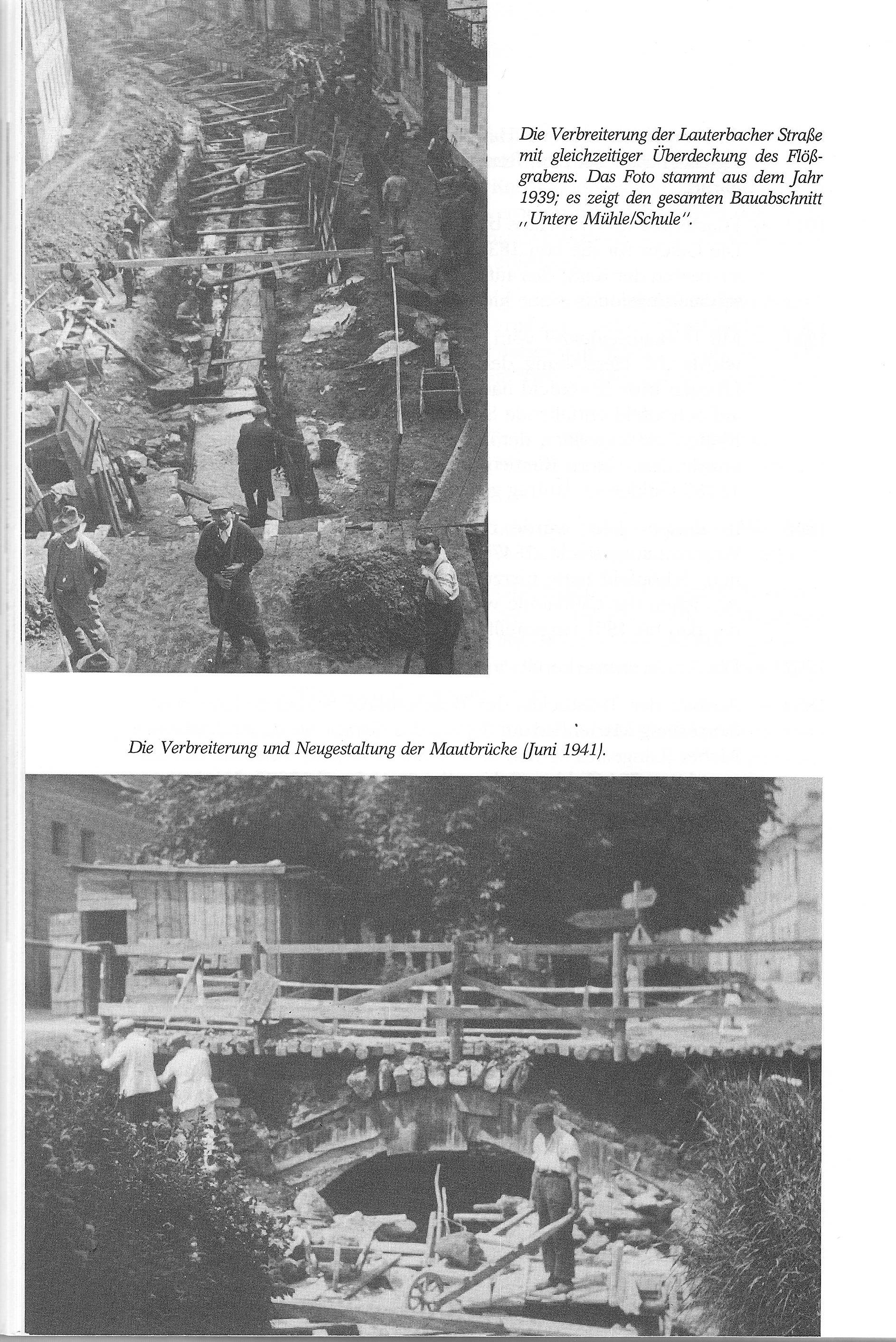
Cronik 092 The widening of Lauterbacher Straße and the simultaneous covering of the Flößgraben. The photo dates from 1939. It shows the entire construction section from Lower Mill to School. The widening and redesign of the toll bridge (June 1941). chronik Page-0092
Cronik 093 1939 Construction of a concrete sidewalk on the winter side of the market square from house no. 8 (Ruppert) to house no. 18 (Moi?l). In the same year, the section of road from the church to the Lower Mill, which had long since become too narrow for traffic, was widened. In this context, the Flößgraben stream bed was relocated and the watercourse on this stretch was covered. 1940 Repaving of the main road to Lauterbach from the toll bridge junction to house no. 315 (Guß). This eliminated the bumpy cobblestones that were still familiar to many. Construction of a paved sidewalk from house no. 262 (Rau) to the market square No. 111 (Geier Department Store). 1941 In the summer, Rathausgasse was channeled and paved from Hauptstraße to house No. 233 ("Neue Welt"). Weekly and Annual Markets in Schönfeld Schönfeld's market rights date back to the 16th century. At that time, the market offerings were primarily limited to grain and groceries. In the mid-19th century, the holding of a livestock market was permitted. Below are some dates on the market's history: 1558 According to a privilege granted by Emperor Ferdinand I in Prague on January 24, Schönfeld had the right to hold a weekly market every Thursday. According to a report to the district office in Elbogen, this market was still taking place in 1859. 1558 On April 5, Emperor Ferdinand I granted the town of Schönfeld the right to hold a free annual market on the day of the Apostles, in addition to the weekly market. Ch 93 chronik Page-0093
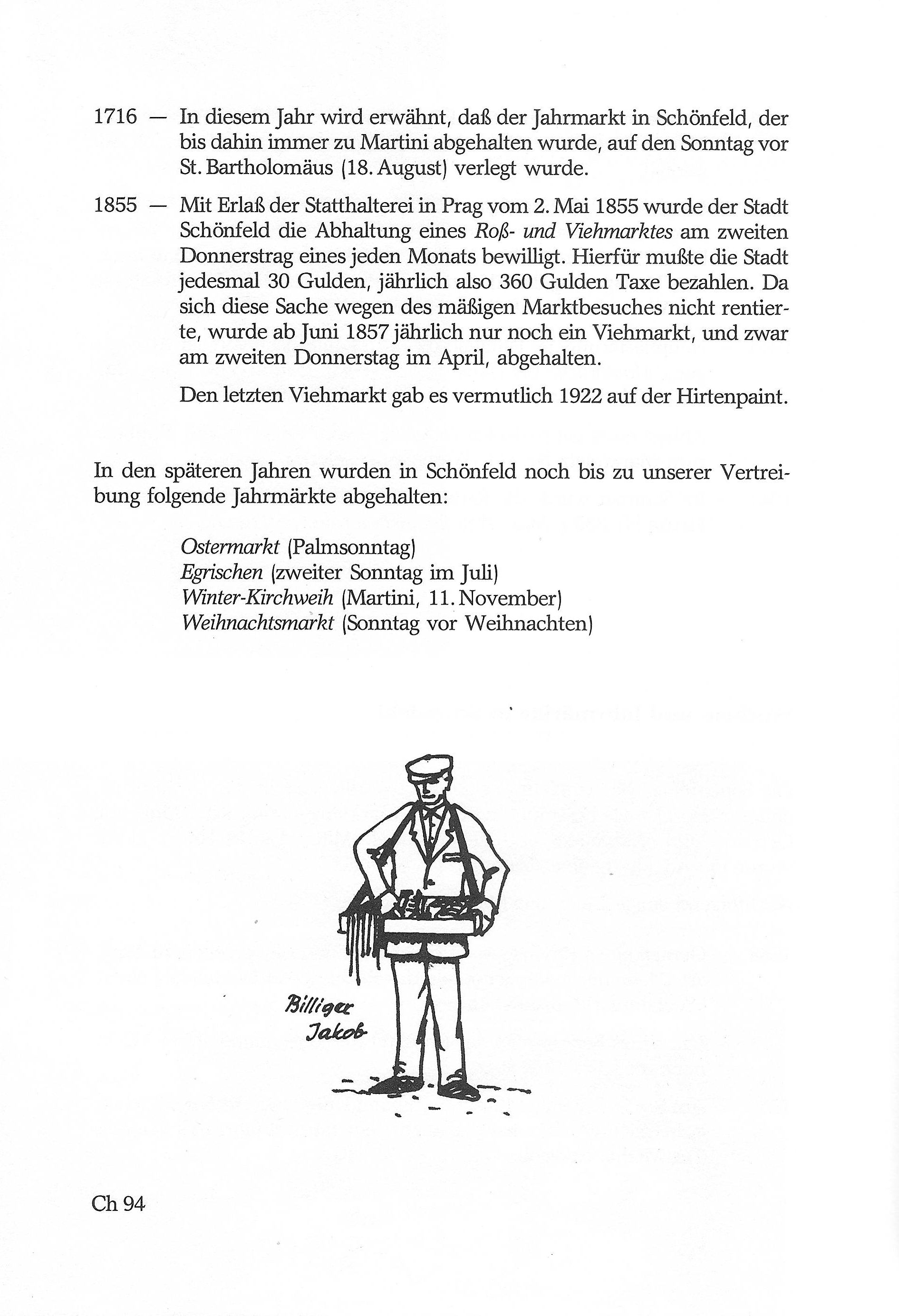
Cronik 094 1716 This year, it is mentioned that the annual fair in Schönfeld, which until then had always been held on St. Martin's Day, was moved to the Sunday before St. Bartholomew's Day (August 18). 1855 By decree of the Prague governor's office on May 2, 1855, the town of Schönfeld was authorized to hold a horse and cattle market on the second Thursday of each month. For this, the town had to pay a tax of 30 guilders each time, or 360 guilders annually. Since this was not profitable due to the low market attendance, only one cattle market was held annually from June 1857 onwards, namely on the second Thursday in April. The last cattle market was probably held in 1922 on the Hirtenpaint. In later years, the following fairs were held in Schönfeld until our expulsion: Easter Market (Palm Sunday) Egrischen (second Sunday in July) Winter Church Fair (Martini Day, November 11th) Christmas Market (Sunday before Christmas) Billiga Jakob Ch 94 chronik Page-0094
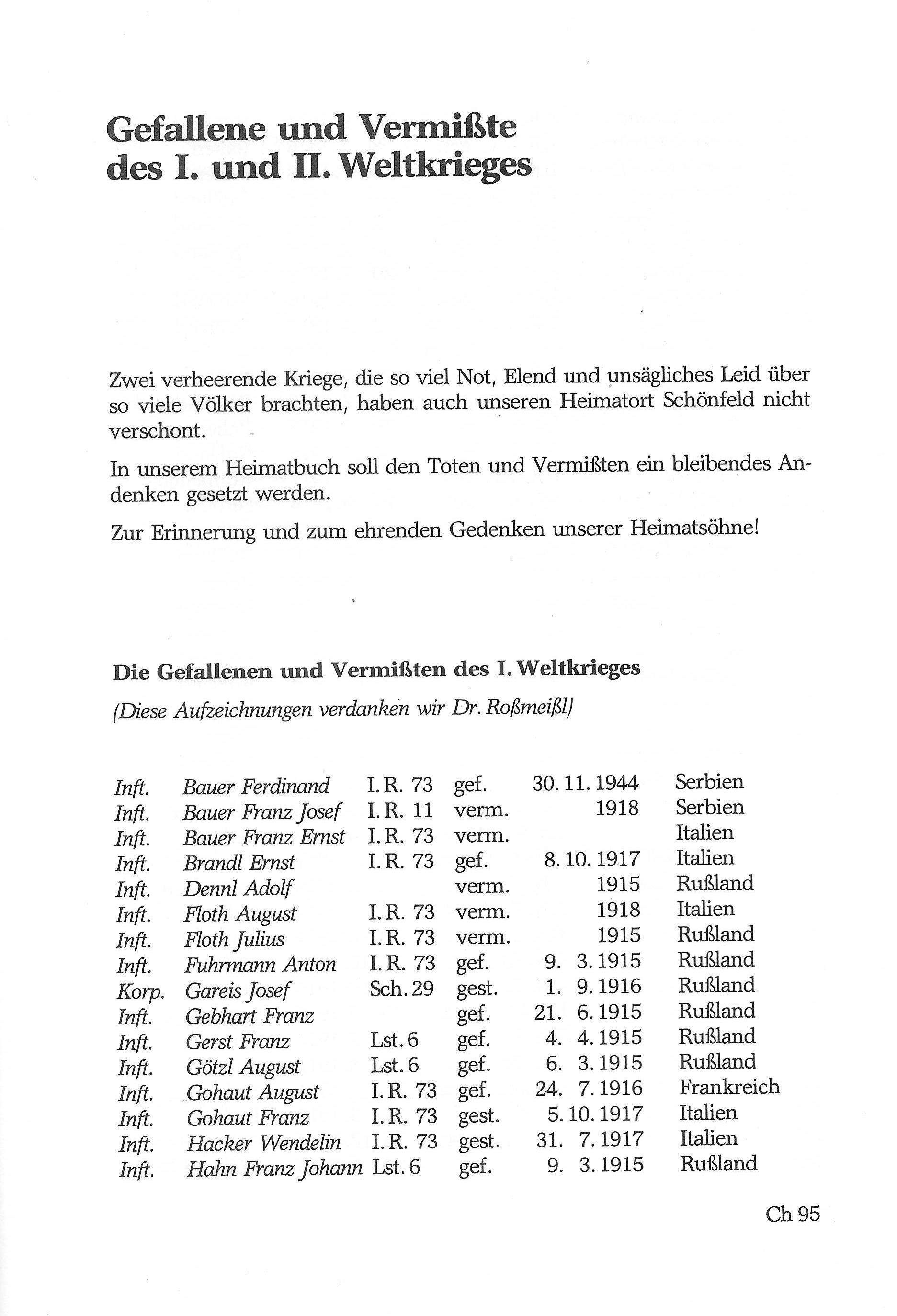
Cronik 095 Fallen and Missing of World Wars I and II Two devastating wars, which brought so much hardship, misery, and unspeakable suffering to so many peoples, did not spare our hometown of Schönfeld. In our hometown book, a lasting memorial to the dead and missing will be created. In memory and honorable remembrance of our homeland! The Fallen and Missing of World War I (We owe these records to Dr. Roßmeißl) Ch 95 chronik Page-0095
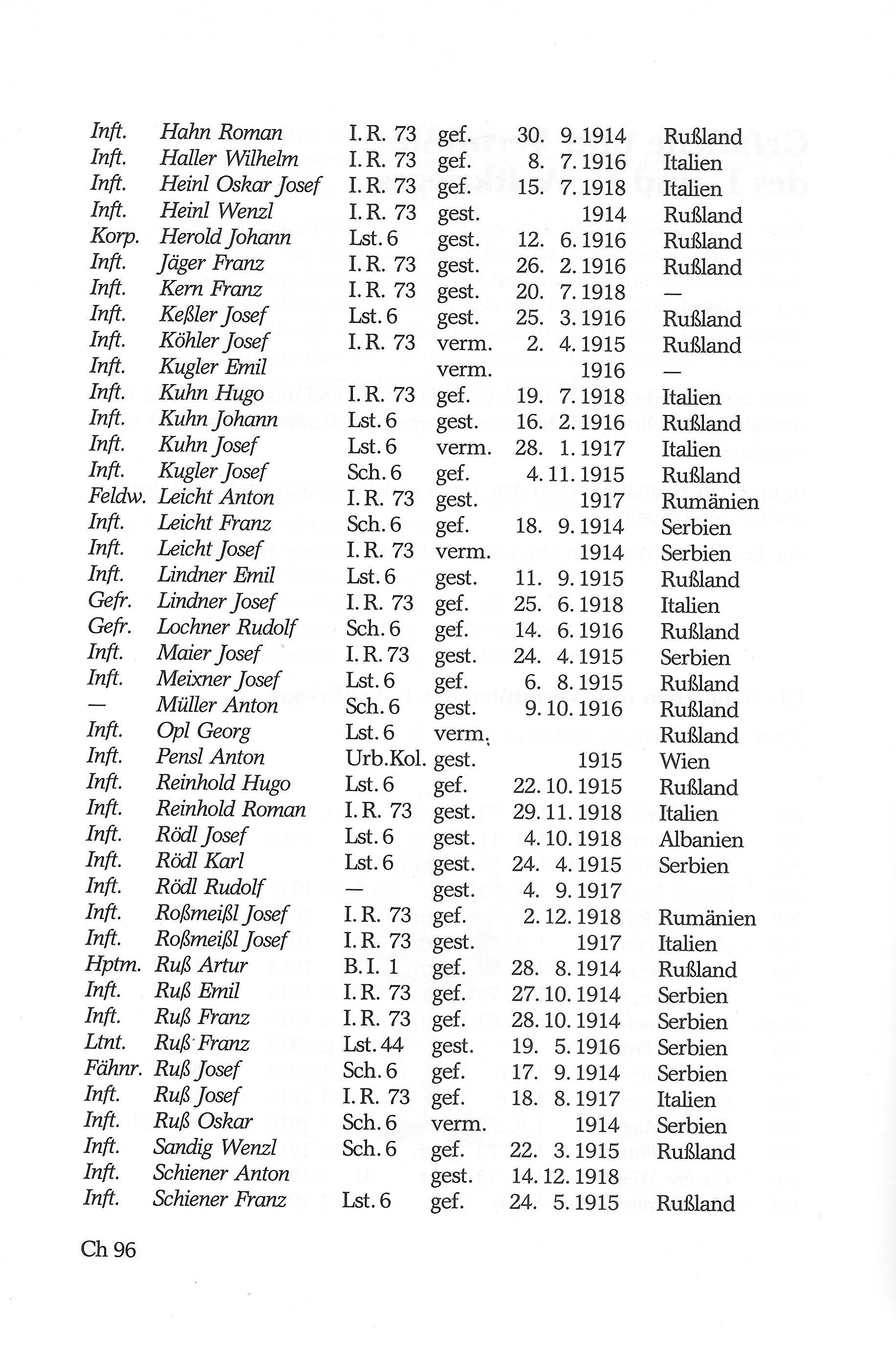
Cronik 096 Ch 96 chronik Page-0096
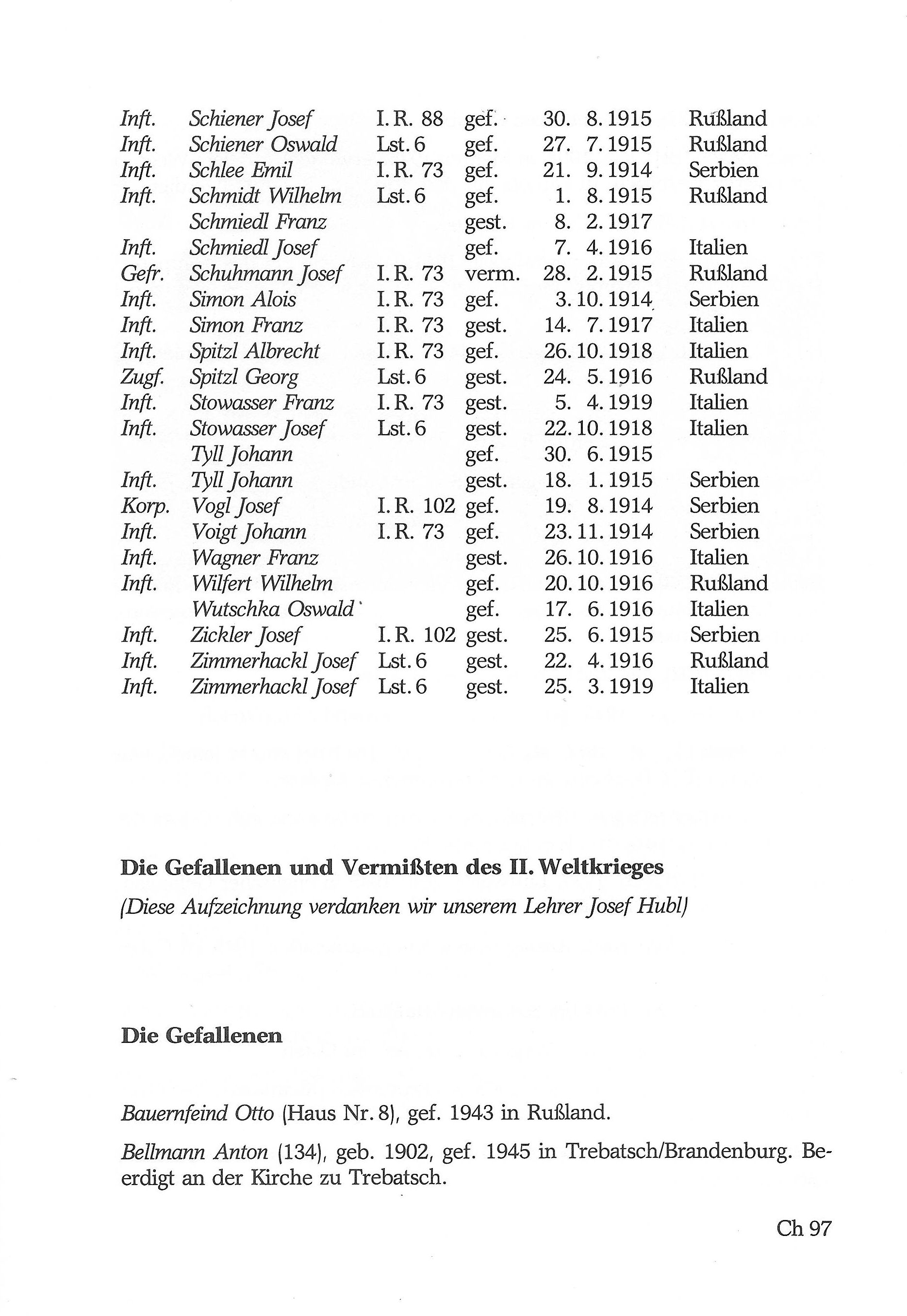
Cronik 097 ......... The Fallen and Missing of World War II (We owe this record to our teacher Josef Hubl) The Fallen Bauernfeind Otto (House No. 8), died 1943 in Russia. Bellmann Anton (134), born 1902, died 1945 in Trebatsch, Brandenburg. Buried at the church in Trebatsch. d Ch 97 chronik Page-0097
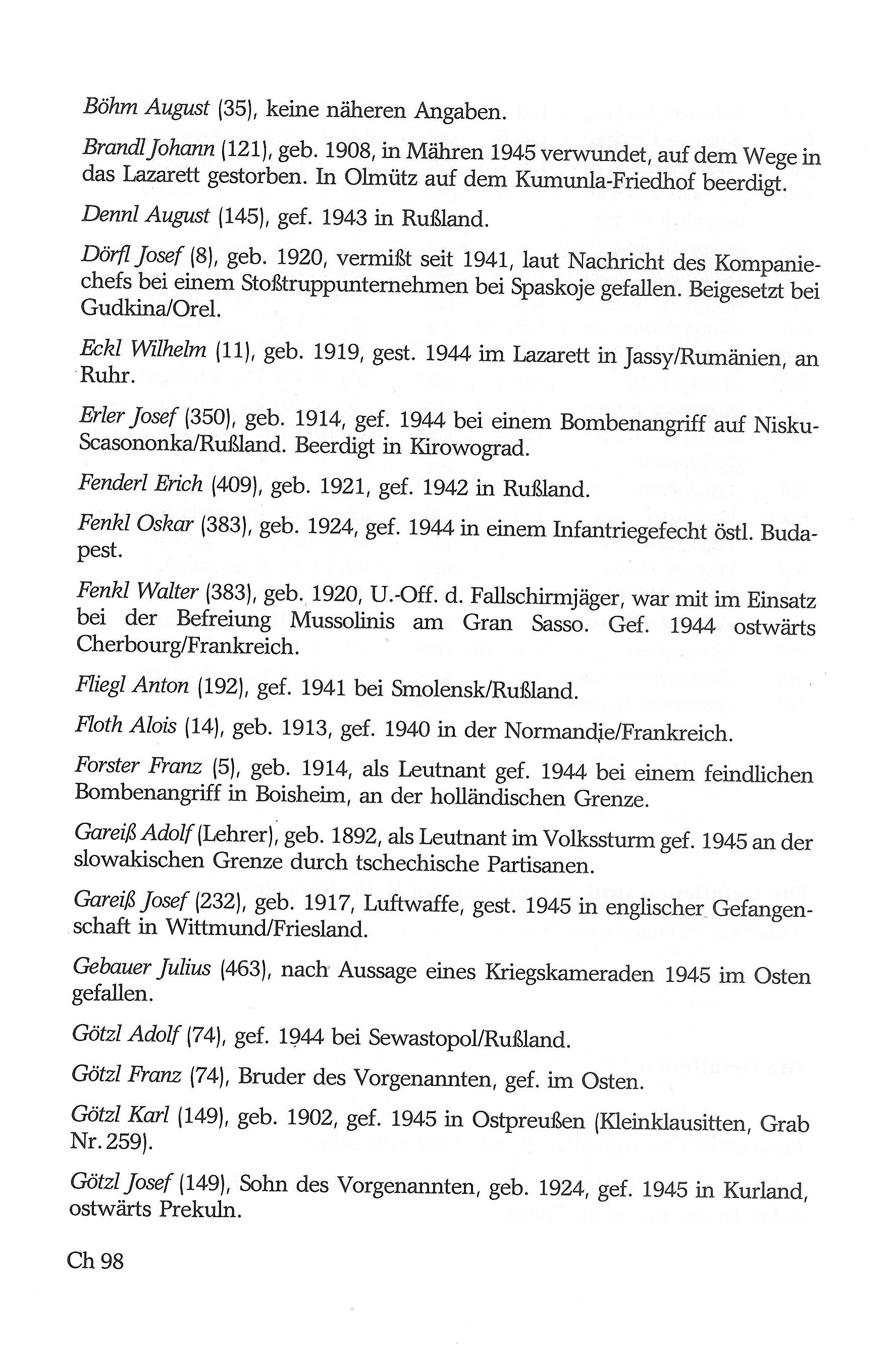
Cronik 098 Böhm August (35), no further details. Brandl Johann (121), born 1908, wounded in Moravia in 1945, died on the way to the hospital. Buried in Olomouc at the Kumunla Cemetery. Dennl August (145), died 1943 in Russia. Dörfl Josef (8), born 1920, missing since 1941, according to a report from the company commander, killed in action during a raid near Spaskoye. Buried near Gudkina/Orel. Eckl Wilhelm (11), born 1919, died 1944 in the hospital in Jassy/Romania, of dysentery. Erler Josef (350), born 1914, died 1944 during a bombing raid on Nisku-Scasononka, Russia. Buried in Kirovograd. Fenderl Erich (409), born 1921, died 1942 in Russia. Fenkl Oskar (383), born 1924, died 1944 in an infantry battle east of Budapest. Fenkl Walter (383), born 1920, paratrooper officer, participated in the liberation of Mussolini at Gran Sasso. Captured 1944 east of Cherbourg, France. Fliegl Anton (192), died 1941 near Smolensk, Russia. Floth Alois (14), born 1913, died 1940 in Normandy, France. Forster Franz (5), born in 1914, captured as a lieutenant in 1944 during an enemy bombing raid in Boisheim, on the Dutch border. Gareiß Adolf (teacher), born in 1892, captured as a lieutenant in the Volkssturm in 1945 on the Slovak border by Czech partisans. Gareiß Josef (232), born in 1917, Luftwaffe, died in 1945 in English captivity in Wittmund, Friesland. Gebauer Julius (463), according to a war comrade, killed in action in the East in 1945. Götzl Adolf (74), captured in 1944 near Sevastopol, Russia. Götzl Franz (74), brother of the aforementioned, captured in the East. Götzl Karl (149), born in 1902, captured 1945 in East Prussia (Kleinklausitten, grave no. 259). Götzl Josef (149), son of the aforementioned, born 1924, died 1945 in Courland, east of Prekuln. Ch 98 chronik Page-0098
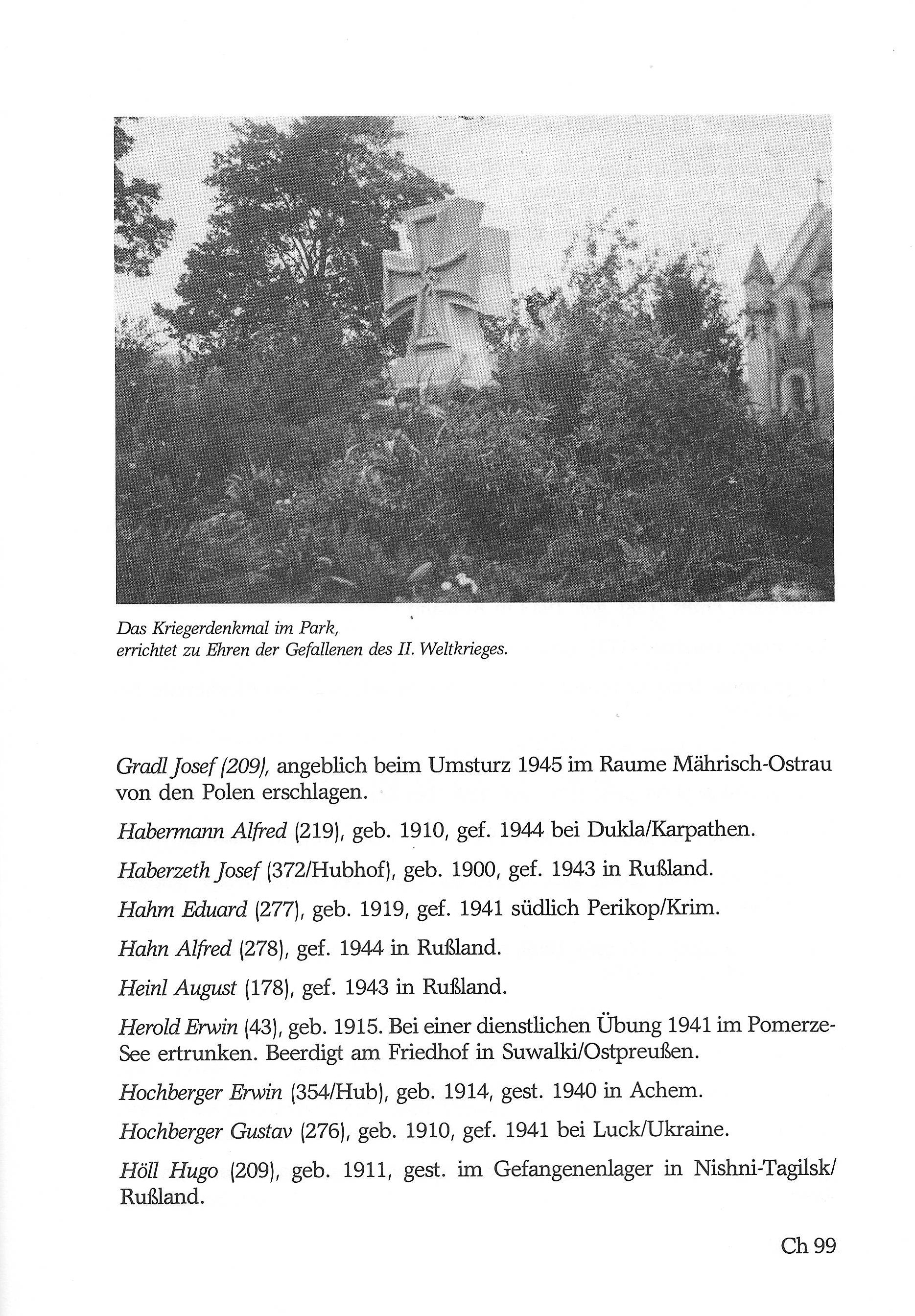
Cronik 099 The war memorial in the park, erected in honor of the fallen of World War II. Gradl Josef (209), allegedly killed by the Poles during the 1945 coup in the Moravian-Ostrau area. Habermann Alfred (219), born 1910, died 1944 near Dukla/Carpathians. Haberzeth Josef (372/Hubhof), born 1900, died 1943 in Russia. Hahm Eduard (277), born 1919, died 1941 south of Perikop/Crimea. Hahn Alfred (278), died 1944 in Russia. Heinl August (178), died 1943 in Russia. Herold Erwin (43), born 1915. Drowned in Lake Pomerze during a service exercise in 1941. Buried in the cemetery in Suwalki/East Prussia. Hochberger Erwin (354/Hub), born 1914, died 1940 in Achem. Hochberger Gustav (276), born 1910, died 1941 near Luck/Ukraine. Höll Hugo (209), born 1911, died in the prison camp in Nizhny Tagilsk/Russia. Ch 99 chronik Page-0099
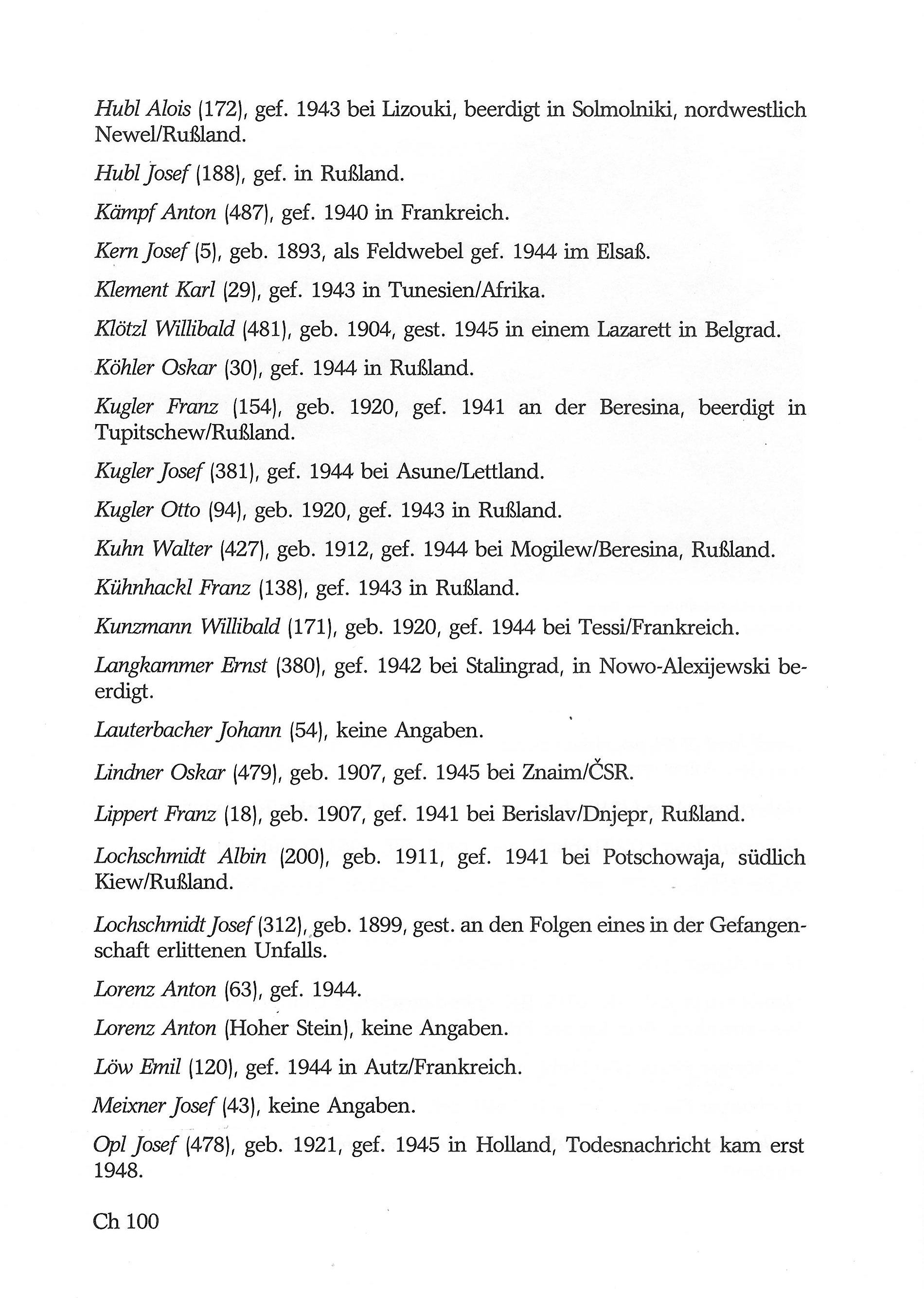
Cronik 100 Hubl Alois (172), died in 1943 near Lizouki, buried in Solmolniki, northwest of Newel, Russia. Hubl Josef (188), died in Russia. Kämpf Anton (487), died in 1940 in France. Kern Josef (5), born in 1893, died as a sergeant in 1944 in Alsace. Klement Karl (29), died in 1943 in Tunisia, Africa. Klötzl Willibald (481), born in 1904, died in 1945 in a military hospital in Belgrade. Köhler Oskar (30), died in 1944 in Russia. Kugler Franz (154), born in 1920, died 1941 on the Beresina River, buried in Tupitschew, Russia. Kugler Josef (381), died 1944 near Asune, Latvia. Kugler Otto (94), born 1920, died 1943 in Russia. Kuhn Walter (427), born 1912, died 1944 near Mogilev/Beresina, Russia. Kühnhackl Franz (138), died 1943 in Russia. Kunzmann Willibald (171), born 1920, died 1944 near Tessi, France. Langkammer Ernst (380), died 1942 near Stalingrad, buried in Novo-Alexijewski. Lauterbacher Johann (54), no information. Lindner Oskar (479), born 1907, died 1945 near Znaim/Czech Republic. Lippert Franz (18), born 1907, died 1941 near Berislav/Dnieper, Russia . Lochschmidt Albin (200), born 1911, died 1941 near Potschowaja, south of Kyiv/Russia. Lochschmidt Josef (312), born 1899, died as a result of an accident suffered while in captivity. Lorenz Anton (63), died 1944. Lorenz Anton (Hoher Stein), no information. Löw Emil (120), died 1944 in Autz/France. Meixner Josef (43), no information. Opl Josef (478), born 1921, died 1945 in Holland, news of his death only arrived in 1948. Ch 100 chronik Page-0100
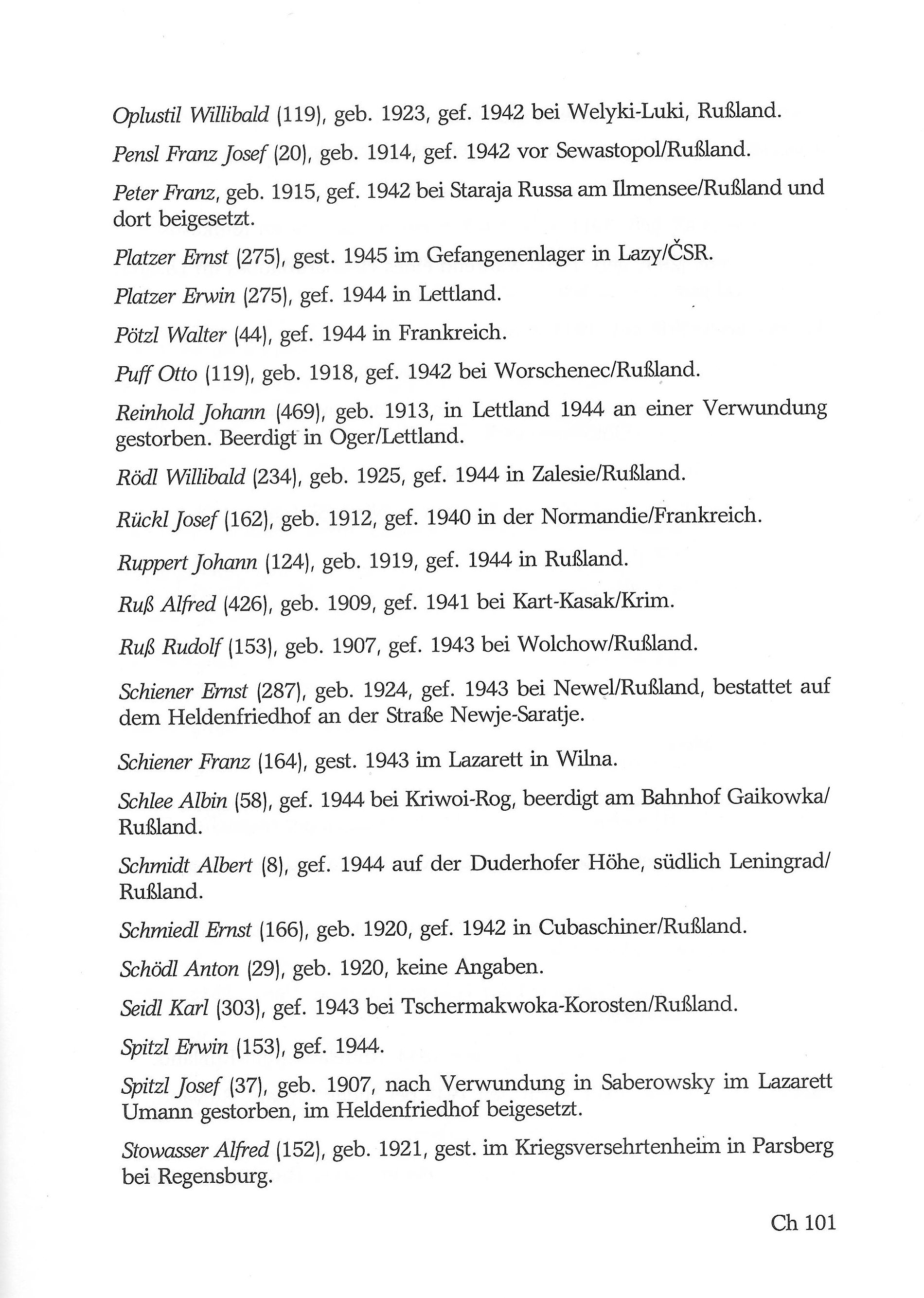
Cronik 101 Oplustil Willibald (119), born 1923, died 1942 near Welyki-Luki, Russia. Pensl Franz Josef (20), born 1914, died 1942 near Sevastopol, Russia. Peter Franz, born 1915, died 1942 near Staraya Russa on Lake Ilmen, Russia, and buried there. Platzer Ernst (275), died 1945 in the prison camp in Lazy, Czechoslovakia. Platzer Erwin (275), died 1944 in Latvia. Pötzl Walter (44), died in 1944 in France. Puff Otto (119), born in 1918, died in 1942 near Worschenec, Russia. Reinhold Johann (469), born in 1913, died of a wound in Latvia in 1944. Buried in Oger, Latvia. Rödl Willibald (234), born in 1925, died in 1944 in Zalesie, Russia. Rückl Josef (162), born in 1912, died in 1940 in Normandy, France. Ruppert Johann (124), born in 1919, died in 1944 in Russia. Ruß Alfred (426), born in 1909, died in 1941 near Kart-Kasak, Crimea. Ruß Rudolf (153), born 1907, died 1943 near Volkhov, Russia. Schiener Ernst (287), born 1924, died 1943 near Newel, Russia, buried in the Heroes' Cemetery on the Newje-Saratje road. Schiener Franz (164), died 1943 in the military hospital in Vilna. Schlee Albin (58), died 1944 near Krivoy Rog, buried at the Gaikowka train station, Russia. Schmidt Albert (8), died 1944 on the Duderhofer Höhe, south of Leningrad, Russia. Schmiedl Ernst (166), born 1920, died 1942 in Cubaschiner, Russia. Schödl Anton (29), born 1920, no information. Seidl Karl (303), died in 1943 near Chermakhovka-Korosten, Russia. Spitzl Erwin (153), died in 1944. Spitzl Josef (37), born in 1907, died in the Umann military hospital after being wounded in Saberowsky, and buried in the Heroes' Cemetery. Stowasser Alfred (152), born in 1921, died in the war invalids' home in Parsberg near Regensburg. Ch 101 chronik Page-0101
Cronik 102 Tischer Erich (353), gef., keine Angaben. Trötscher Alfred (333), als Feldwebel gef. 1941 am Balkan. Unterstab Hermann (370), gef. 1943 in Rußland. Vogl Franz (430), geb. 1911, gest. 1947 in einem Lazarett im Kaukasus. Wagner Anton (299), geb. 1902, während eines Heimaturlaubes im Lazarett in Karlsbad gest. und in Schönfeld beerdigt. Wagner Bruno (91), gef. 1943 in Rußland. Weinhart Josef (266), gef. vermutlich in Warschau. Wilfert Josef (237), geb. 1915, gef. 1941 bei Alexandrowka/Rußland. Beerdigt an der Straße Nowo-Golowanyewsk. Würl Rudolf (468), geb. 1910 (?), gef. 1942. Zettl Hermann (318), gest. 1944 im Lazarett in Nisch/Südslawien. Zimmerhackl Franz (154), gef. in Italien. Zimmerhackl Josef (290/Tischerhof), geb. 1920, gef. 1941, Dubno/Ukraine. Die Vermißten Albert Eduard (191), verm. seit 1941 im Mittelabschnitt der russischen Front. Bayer Josef (120), geb. 1908. Letzte Nachricht 1945 aus dem Raum Jägern- dorf-Schwarzwasser. Baumann Anton (285), geb. 1908, verm. seit 1945. Letzte Nachricht aus dem Raum Warka bei Radom/Polen. Bollmann Alfred (270), Feldwebel der Feldgendarmerie. Verm. 1943. Letzte Nachricht aus Stalingrad. Brandl Franz (118), geb. 1907, verm. seit 1944, Mittelabschnitt/Rußland. Dennl Josef (46), geb. 1913, verm. seit 1944 bei Sudak/Alusala, Rußland. Fenkl Franz (404), geb. 1898, keine Angaben. Gerst Alfred (340), geb. 1922, verm. seit 1944 im Raum Stalidrane/Lettland. chronik Page-0102
Cronik 103 Hahn Norbert (122), verm. bei Goldap/Ostpreußen. Hopf Albin (89), geb. 1919, verm. seit 1944. Letzte Nachricht aus dem Raume Kischinew am Dnjestr/Bessarabien. Hopf Oskar (174), geb. 1909, verm. seit 1943 bei Rabowitschi/Rußland. Kohler Ernst (29), geb. 1912, verm. seit 1945, letzte Nachricht aus Westpreu- Ben. Köhler Alois (209), geb. 1907 Hauptwachtm. der Gendarmerie, verm. seit 1944, Raum Radom/Polen. Köhler Willibald (36), verm. seit 1943 vor Stalingrad. Kugler Oswald (156), geb. 1908, verm. an der Ostfront. Kugler Rudolf (150), geb. 1906, verm. seit 1945. Kuhn Josef (122), geb. 1919. Ging nach dreimaliger Verwundung wieder an die Front. Seitdem verm. Einsatzort auch den Angehörigen unbekannt. Leistner Franz (46), geb. 1917, verm. seit 1943 im Raum Sihunitsche/Rußland. Lindner Anton (278), verm., keine Angaben. Lochner Josef (39), geb. 1917, verm. seit 1943, Kessel Stalingrad, letzte Nach- richt aus dem Raum zwischen Wolga und Don. Lorenz Franz (155), verm. in Rußland. Oplustil Josef (195), verm. seit 1945, war zuletzt in Lüneburg. Ott Franz (268), geb. 1920, verm. seit 1942. Letzte Nachricht aus dem Raume Irrsa am Wolchow/Rußland. Pensl Kurt (20), geb. 1913, Rev. Oberwachtmeister, verm. seit 1944 bei Vina/Rußland. Rödl Hans (342), geb. 1923, verm. seit 1943. Letzte Nachricht aus dem Raume Orel/Rußland. Ruß Karl (265), geb. 1922, verm. seit 1943 bei Stalingrad. Ruß Rudolf (58), verm. seit 1945 bei Berlin. Schiener Alois (174), verm. seit 1945 in Westpreußen. Schiener Alois (336), geb. 1909, verm. seit 1944. Schiener Josef (383), geb. 1913, verm. seit 1944. Letzte Nachricht aus dem Raume Horow-Lokasze/Rußland. chronik Page-0103
Cronik 104 Schmieger Alfred (208), presumed dead, no information. Schmieger Josef (208), presumed dead since the crossing from Crete. Spinner Arno, Dr. med. (418), presumed dead in Russia since 1945. Spitzl Alfred (216), presumed dead since 1945. Stöhr Hermann (194), born 1904, presumed dead in the Wilkomir/Russia area since 1944. Ströher Wilhelm (267), born 1912, presumed dead since 1943, wounded and taken prisoner by the Russians in the Caucasus-Crimea sector. Vogl Erwin (357), born 1908, presumed dead since 1945. Last message from a war comrade from the Kiev area. Wilfert Erhard (246), born 1911, presumably since 1944. Last news from the central sector of Russia. Zimmerhackl Johann (196), born 1918, deployed with a Stuka squadron in northern Norway. After his squadron's bombing raid on the port city of Murmansk (1941), his plane never returned. Missing ever since. This list concludes with Zimmerhackl; it is a sad testimony to the consequences of a mad war and genocide. It may be considered an irony of fate that the latter, from among the sons of our hometown who never returned, deserves special mention. Paula Zimmerhackl, the sister of the man missing since October 6, 1941, submitted a search request to the German Red Cross. In a message dated March 25, 1980, from Moscow, the "USSR Executive Committee of the Alliance of Red Cross and Red Crescent Societies, Holders of the Order of Lenin," confirmed that her brother, Johann Zimmerhackl, had died on December 14, 1942. The German Red Cross forwarded this message to the applicant. An extraordinary case: after almost 40 years of uncertainty, the fate of a missing person has been clarified. The message written in Moscow is reproduced here in a reduced version. chronik Page-0104
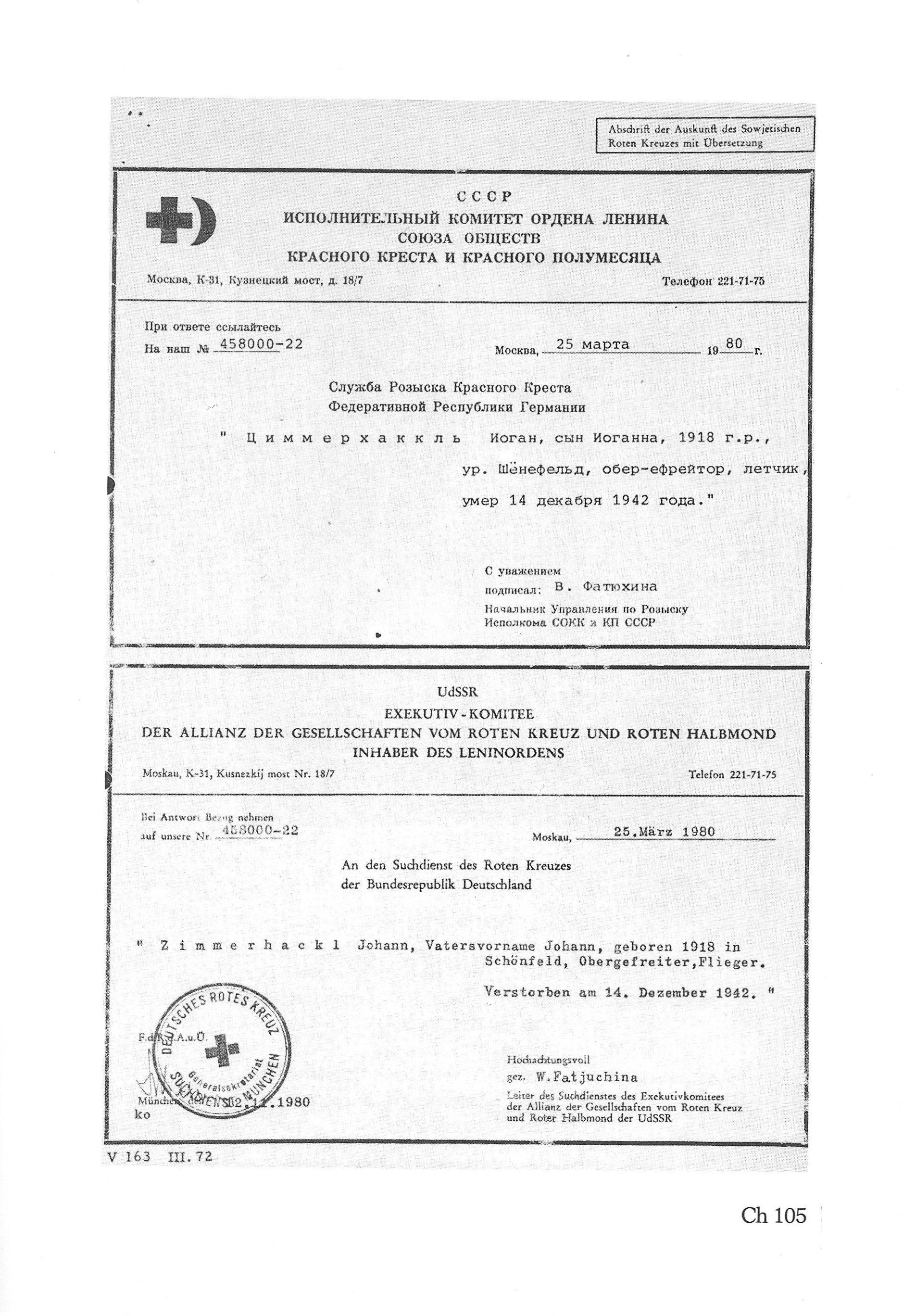
Cronik 105 Russian xxxxxxxxxxxxxxxxxx ------------------------------ USSR EXECUTIVE COMMITTEE THE ALLIANCE OF THE RED CROSS AND RED CREST SOCIETIES Moscow, K-31, Kuznetsky most No. 18/7 HOLDER OF THE ORDER OF LENIN Telephone 221-71-75 When answering, refer to ours No. 458000-22 March 25, 1980 Moscow, To the Tracing Service of the Red Cross of the Federal Republic of Germany # Zimmer hack l SCHES GER RED CROSS Retariat UNCHEN General's TRACKING SUEKBENS02 Munich ko V 163 III. 72 1980 Johann, father's first name Johann, born 1918 in Schönfeld, Corporal, Aviator. Died on December 14, 1942. Sincerely, signed V. Fatyukhina Head of the Tracing Service of the Executive Committee of the Alliance of Red Cross and Red Crescent Societies of the USSR Ch 105 chronik Page-0105

Cronik 106 blank page chronik Page-0106
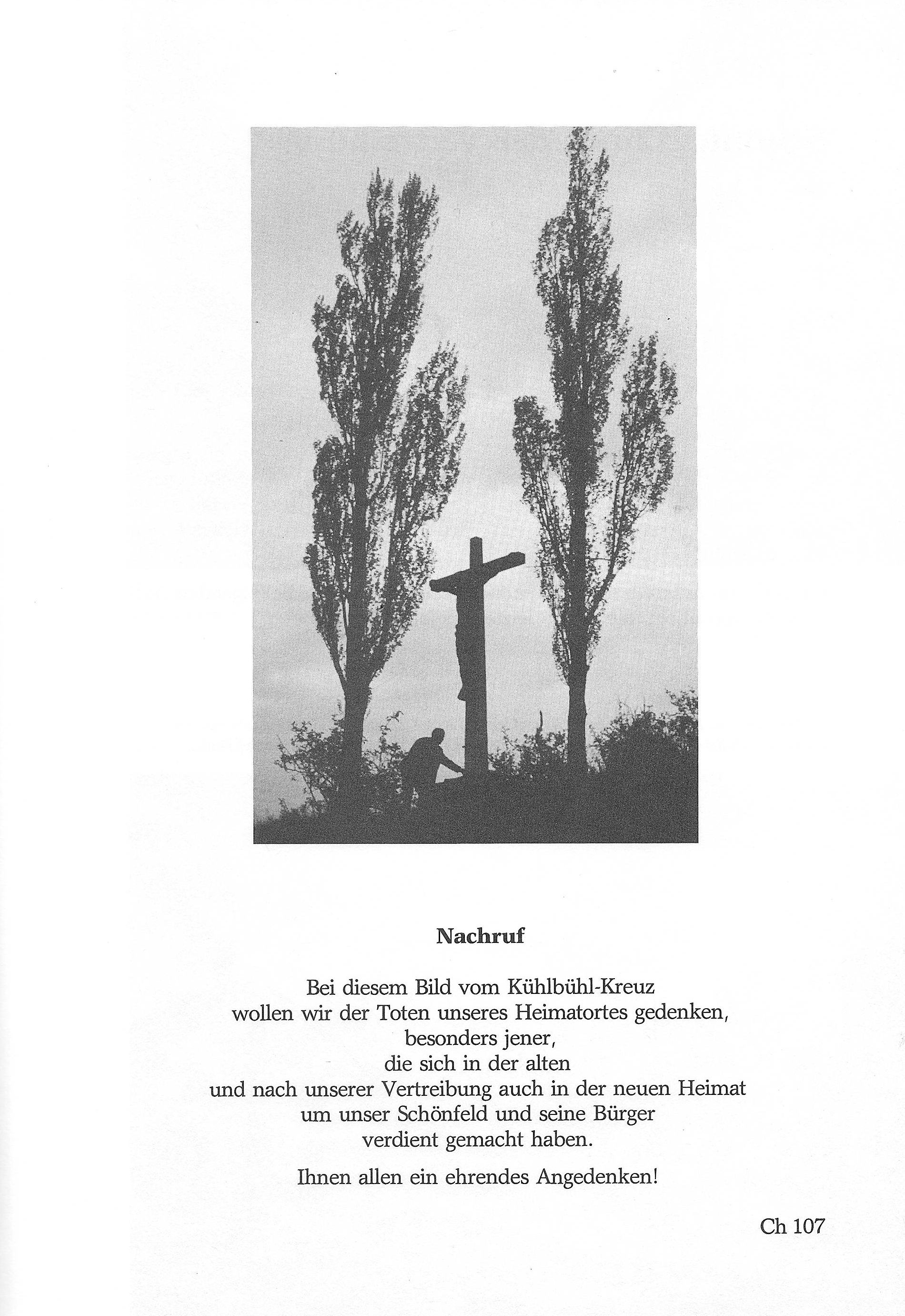
Cronik 107 Obituary With this image of the Kühlbühl Cross, we want to commemorate the dead of our hometown, especially those who rendered outstanding service to our Schönfeld and its citizens in their old homeland and, after our expulsion, also in their new homeland. A respectful memory to all of them! Ch 107 chronik Page-0107
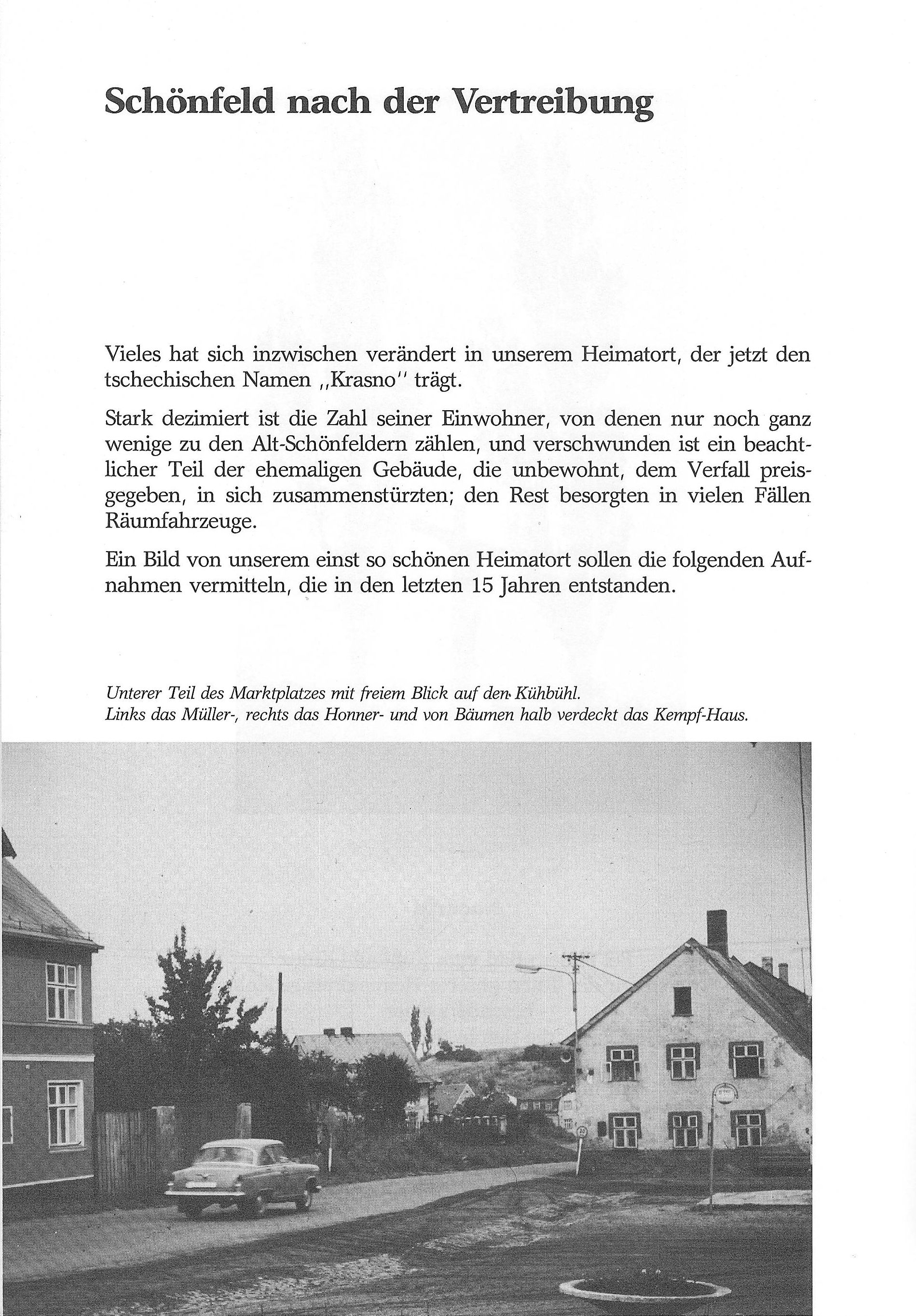
Cronik 108 Schönfeld after the Expulsion Much has changed in our hometown, which now bears the Czech name "Krasno." The number of its inhabitants has been greatly decimated, of whom only a very few are still considered to be the Old Schönfeld residents. A considerable portion of the former buildings have disappeared, left unoccupied and abandoned to decay, collapsing; the rest, in many cases, were taken care of by snowplows. The following photographs, taken over the last 15 years, are intended to convey a picture of our once beautiful hometown. Lower part of the market square with an unobstructed view of Kühbühl. On the left is the Müller House, on the right the Honner House, and the Kempf House, half-hidden by trees. chronik Page-0108
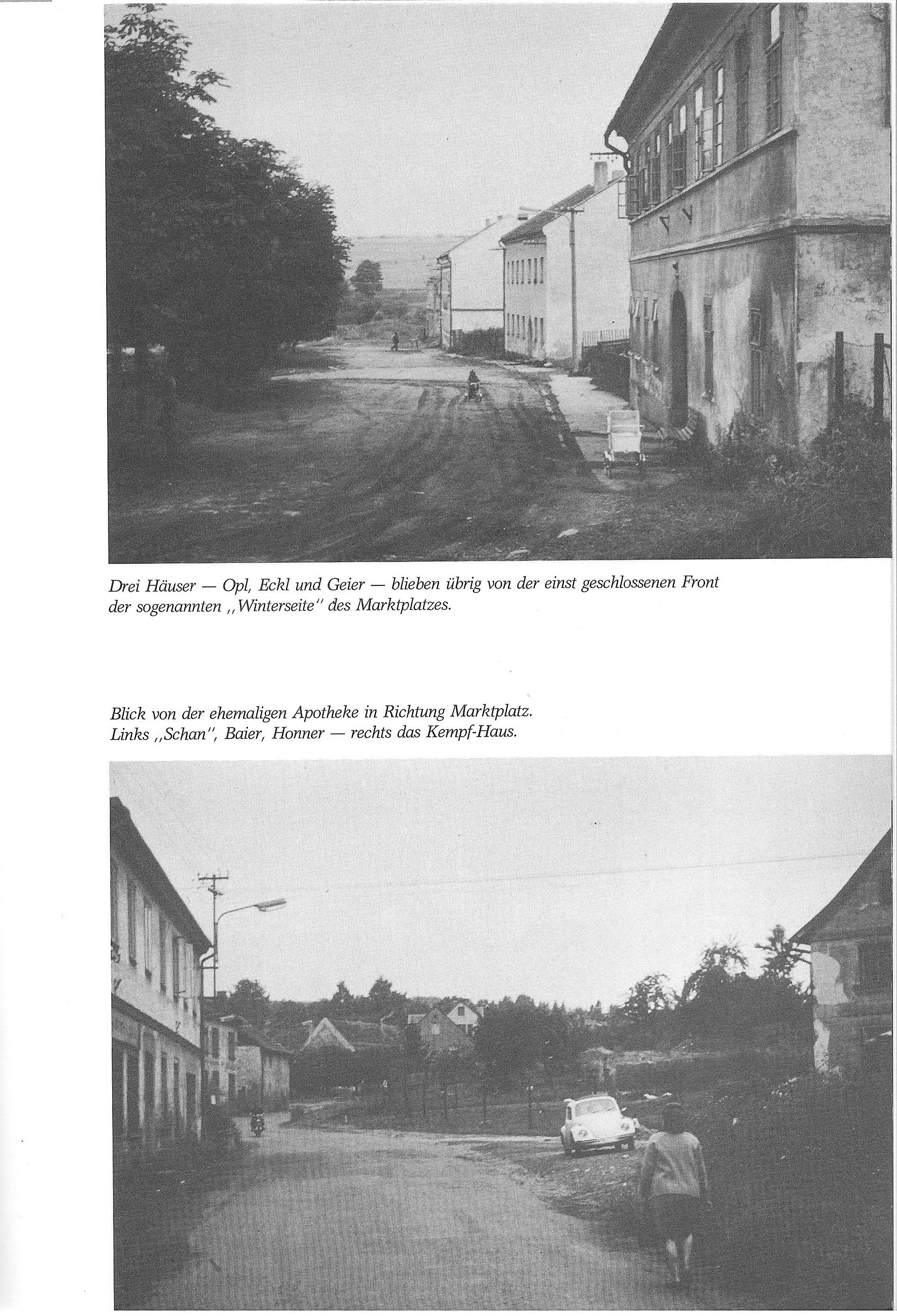
Cronik 109 Three houses: Opl, Eckl, and Geier, remain of the former Closed front of the so-called "winter side" of the market square. View from the former pharmacy towards the market square. On the left, "Schan," Baier, Honner - on the right, the Kempf House. chronik Page-0109
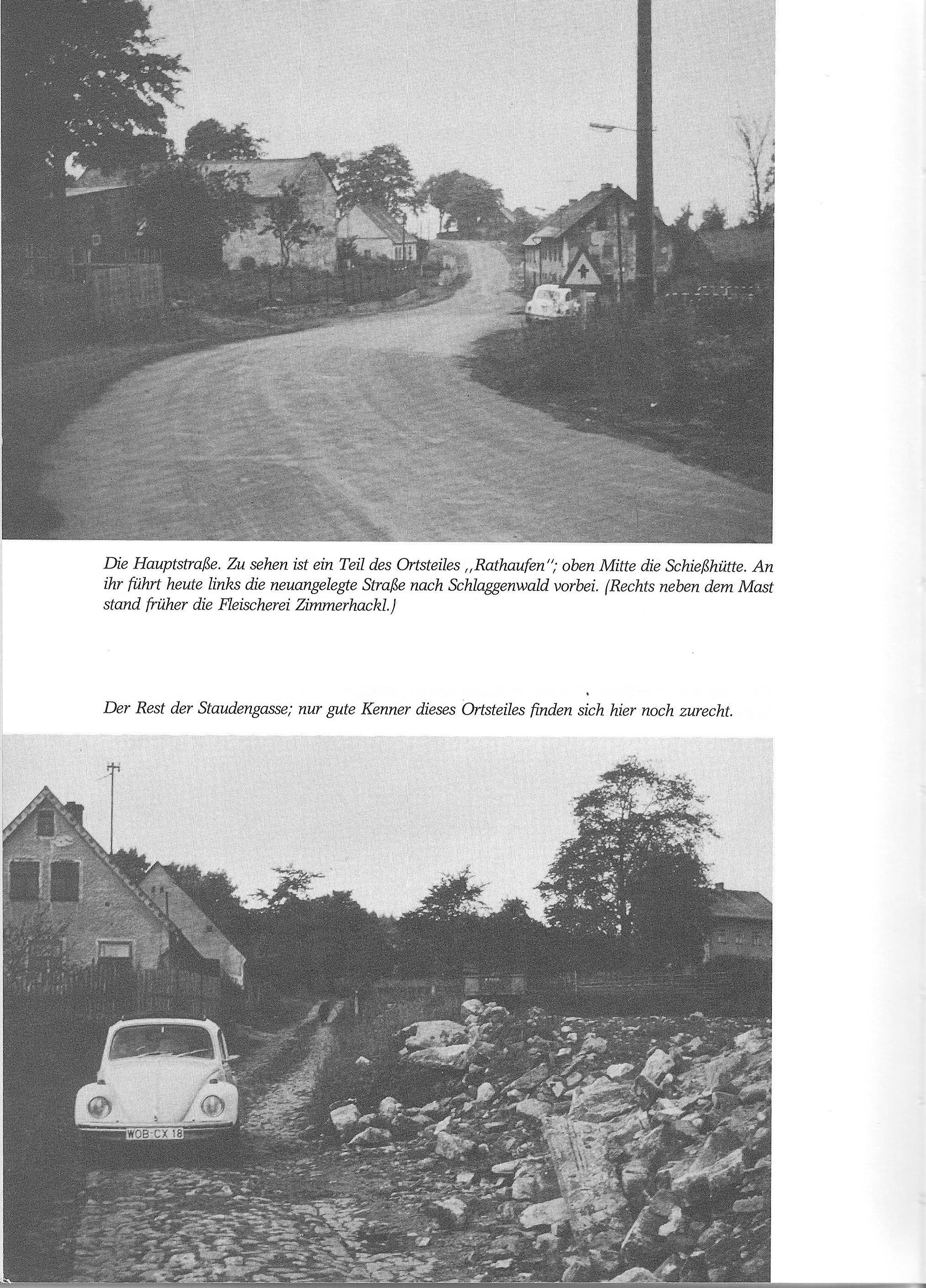
Cronik 110 The main street. Part of the "Rathaufen" district is visible; top center, the shooting lodge. The newly constructed road to Schlaggenwald now runs past it on the left. (To the right of the mast, the Zimmerhackl butcher shop used to stand.) The remainder of Staudengasse; only those who know this part of town can still find their way here. chronik Page-0110
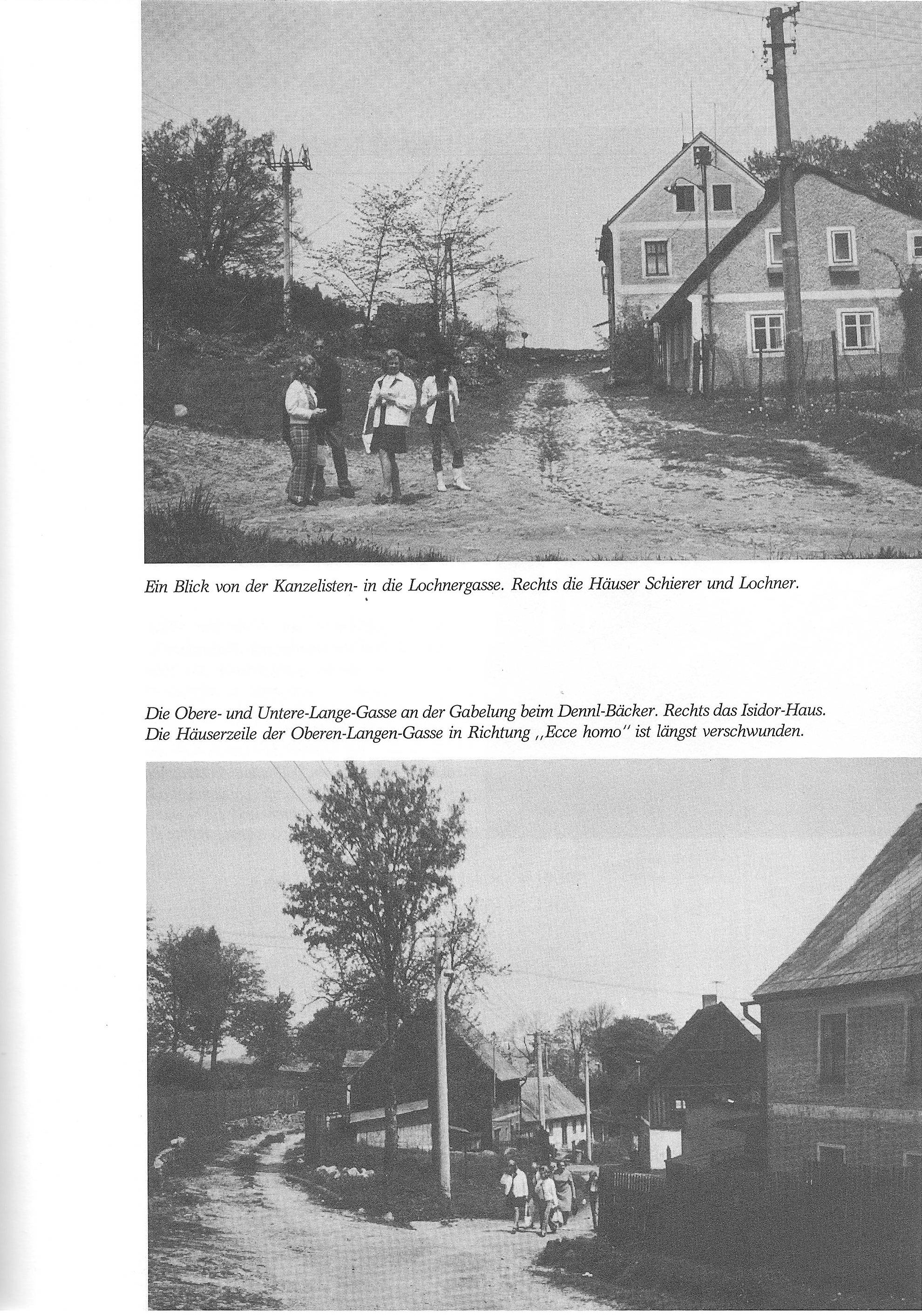
Cronik 111 A view from Kanzelistengasse into Lochnergasse. On the right, the Schierer and Lochner houses. The Obere- and Untere-Lange-Gasse at the fork near the Dennl bakery. On the right, the Isidor House. The row of houses on Oberen-Langen-Gasse in the direction of "Ecce homo" has long since disappeared. chronik Page-0111
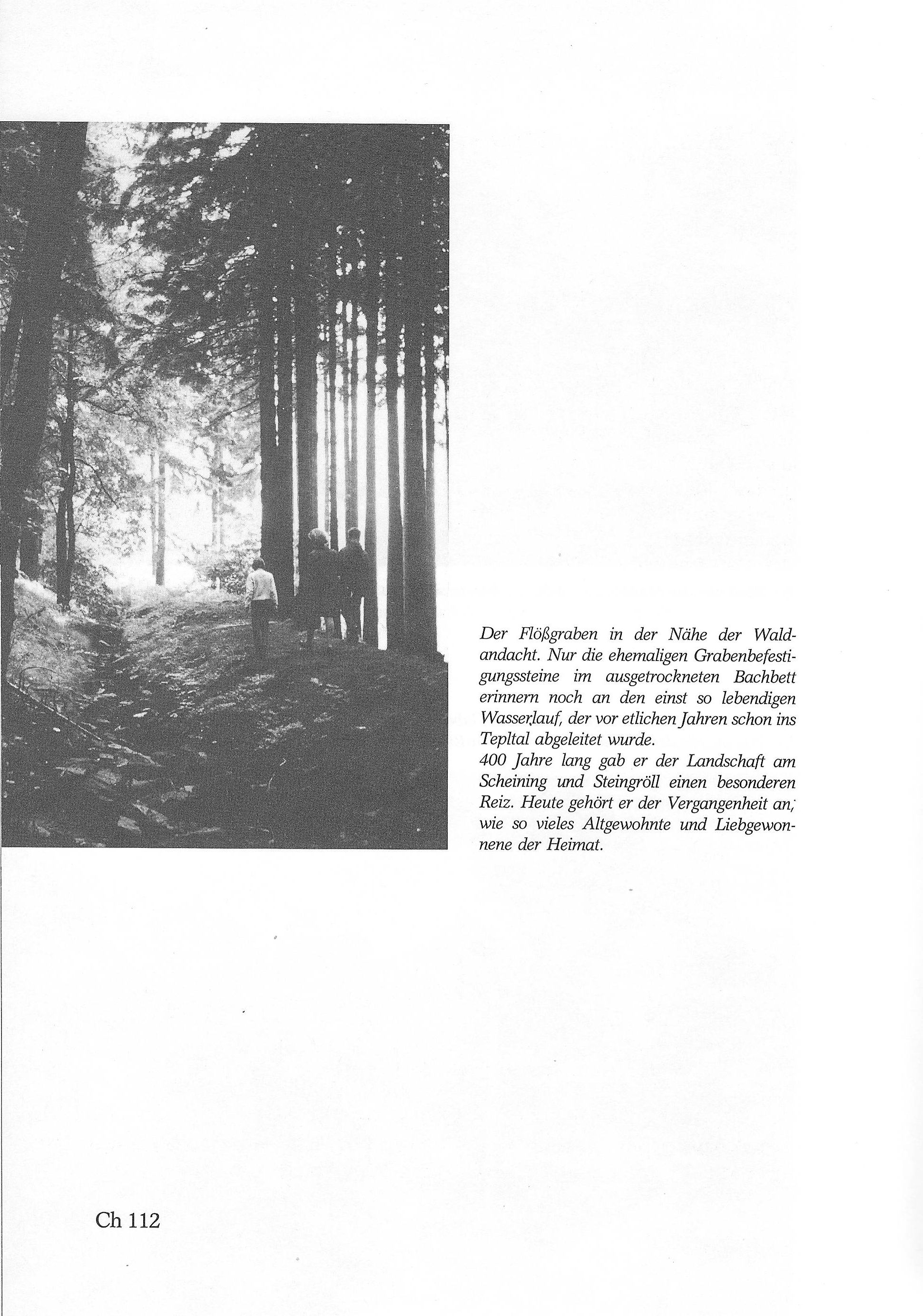
Cronik 112 The Flößgraben near the Waldandacht (forest prayer). Only the former ditch reinforcement stones in the dried-up streambed remain as a reminder of the once lively watercourse, which was diverted into the Tepl Valley several years ago. For 400 years, it gave the landscape along the Scheining and Steingröll streams a special charm. Today, it belongs to the past, like so many familiar and beloved features of their homeland. chronik Page-0112
Cronik 113 Schönfeld Local Heritage Officer The fact that many Schönfeld residents can celebrate a reunion with good old friends, former neighbors, and school friends every year at the local reunion in Darmstadt is primarily thanks to our fellow countrymen Kauer († 1980), Mießner, and Schimmer and their families, who, with great idealism, initiated this gathering a few years ago. Our fellow countryman Pensl Josef also deserves a special mention in this context. In addition, numerous other helpers should be mentioned who are continually actively involved in the preparation and implementation of this gathering. The fact that this Schönfelder reunion always takes place with relatively good attendance is also a credit to those who selflessly endeavored to ensure that the compatriots scattered in all directions by the expulsion could reunite. It was they too—and here the name of Karl Haller must be particularly emphasized—who, through their painstaking maintenance of information with the well-known local newspapers, repeatedly strengthened the invisible bond of solidarity with reports from the past and present. The following is a list of the names of the guardians of our local community: Karl Lochner 1948-1949 Karl Haller 1949 1960 Heinrich Ruppert (Arno Gerstner) 1960-1967 Josef Gareiß 1967-1972 Anna Egerer 1972 1980 Hilde Roth 1980-1982 Hans Hahm, guardian since 1983. All of these compatriots deserve our deepest and most sincere thanks, for they have selflessly dedicated themselves to this great task out of pure love for their homeland, for Schönfeld, and their former fellow citizens. Ch 113 chronik Page-0113